

- Industry Size (2026)
- USD 245 Mn
- Forecast (2036)
- USD 570 Mn
- CAGR (2026 to 2036)
- 8.8%
Thermoplastic Composite Exterior Clips and Brackets Market Size, Market Forecast and Outlook By FMI
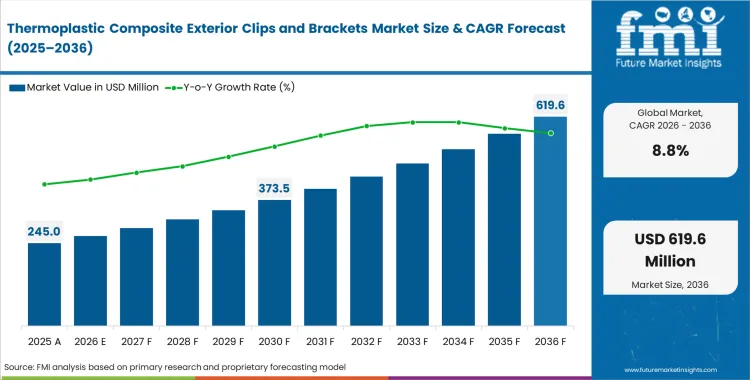
The thermoplastic composite exterior clips and brackets market was valued at USD 225 million in 2025. Valuation is estimated to surpass USD 245 million in 2026 at a CAGR of 8.8% during this forecast period. Industry is projected to reach USD 570 million by 2036, supported by wider OEM use of single-shot injection-molded attachment points in place of heavier multi-piece metallic assemblies, especially where vehicle weight control remains important.
Summary of Thermoplastic Composite Exterior Clips and Brackets Market
- The market is estimated at USD 225.0 million in 2025.
- The market is projected to reach USD 569.0 million by 2036.
- The market is expected to grow at a CAGR of 8.8% from 2026 to 2036.
- The forecast period represents an incremental opportunity of USD 324.2 million.
- Clips dominate the product segment with a 58.0% share.
- PA composites lead the resin segment with a 34.0% share.
- Glass fiber dominates the reinforcement segment with a 68.0% share.
- Passenger cars lead the vehicle type segment with a 71.0% share.
- Bumper systems are the leading application with a 31.0% share.
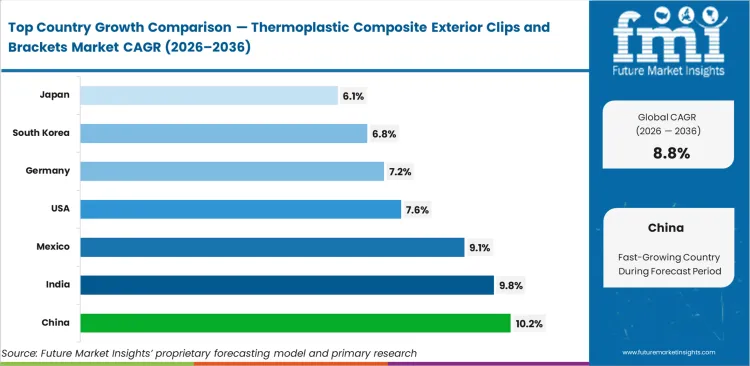
- China (10.2%), India (9.8%), and Mexico (9.1%) are among the fastest-growing markets.
Thermoplastic Composite Exterior Clips and Brackets Market Key Takeaways
| Metric | Details |
| Industry Size (2026) | USD 245 million |
| Industry Value (2036) | USD 570 million |
| CAGR (2026-2036) | 8.8% |
Source: Future Market Insights (FMI) analysis, based on proprietary forecasting model and primary research
Procurement directors at Tier-1 bumper fascia suppliers face mounting warranty claims from sensor misalignment caused by metallic bracket corrosion. Metallic components corrode when exposed to winter road salts, shifting radar and camera angles slightly out of calibration over three winters. Delaying conversion to polymeric brackets exposes automakers to expensive radar recalibration recalls. What generalist analysts miss is how automotive fasteners made from reinforced polyamides actually solve thermal expansion mismatches between plastic fascias and metal frames, preventing paint cracking at attachment points during extreme temperature fluctuations.
Once vehicle assembly plants transition from manual torque-gun fastening to automated push-to-lock robotic assembly, relying on heavy steel components becomes an assembly-line bottleneck. Automated insertion heads require high-tolerance polymeric retainers that snap into place consistently without damaging Class-A painted surfaces. Component weight reduction forces this transition, accelerating adoption across next-generation electric vehicle platforms where every gram dictates final homologation range ratings.
Regional variation remains closely tied to assembly capability, since plants equipped for robotic insertion can absorb composite integration faster than manual-labor production hubs. China is expected to post 10.2% CAGR through 2036 as domestic EV manufacturers push for fully non-metallic front-end modules. Localization pressure is also supporting India, where the market is projected to expand at 9.8% CAGR as automakers reduce reliance on imported steel hardware. Nearshoring of fascia molding capacity keeps Mexico on a 9.1% growth path, closely tied to assembly demand in North America. In the United States, lightweighting across light truck portfolios is supporting 7.6% CAGR during the forecast period. Germany is likely to grow at 7.2% as premium vehicle programs integrate radar mounts directly into grille architectures. Battery-electric platform standardization is sustaining South Korea at 6.8%, while Japan is estimated to record 6.1% CAGR through 2036 with greater use of miniaturized retainers in aerodynamic underbody panels.
Segmental Analysis
Thermoplastic Composite Exterior Clips and Brackets Market Analysis by Product Type
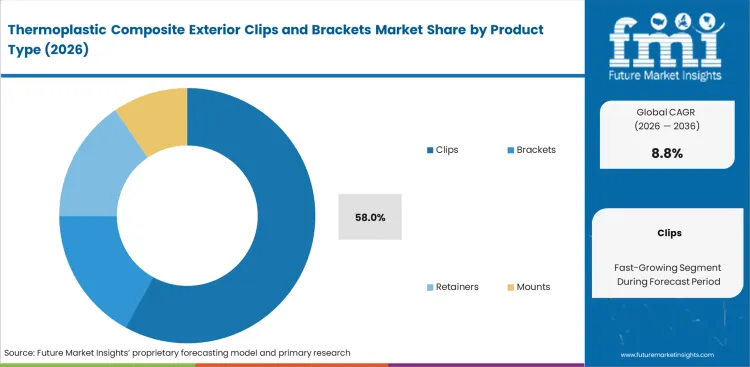
Legacy metallic fasteners fail consistently in modern aerodynamic designs because stiff steel clips scratch painted plastic panels during thermal expansion cycles. Clips dominate this category, securing an estimated 58.0% share in 2026, as it has been noted that polymeric alternatives flex harmoniously with bumper fascias. Assembly engineers at Tier-1 bumper suppliers specify these components specifically to eliminate galvanic corrosion risks. Finding precision push-pins that survive automated insertion forces without shattering remains difficult.
What piece-price comparisons miss is that utilizing composite clips entirely eliminates secondary rust-proofing treatments required for steel counterparts. Assembly line managers who ignore this transition face mounting warranty claims for paint bubbling and sensor misalignment. Natural automotive composites integration into vehicle design accelerates this product type's dominance across all platforms.
- Fascia integration: Push-to-lock polymeric pins allow robotic arms to secure massive front-end modules in seconds. Assembly engineers gain massive cycle-time reductions compared to threaded screw applications.
- Thermal matching: Polymeric formulations match the thermal expansion coefficient of exterior panels. Quality control directors avoid paint-cracking warranty claims previously caused by rigid metal hardware.
- Vibration dampening: Composite clips absorb road frequencies rather than transmitting them. NVH engineers must specify these fasteners to achieve strict acoustic targets in silent electric vehicle cabins.
Thermoplastic Composite Exterior Clips and Brackets Market Analysis by Resin System
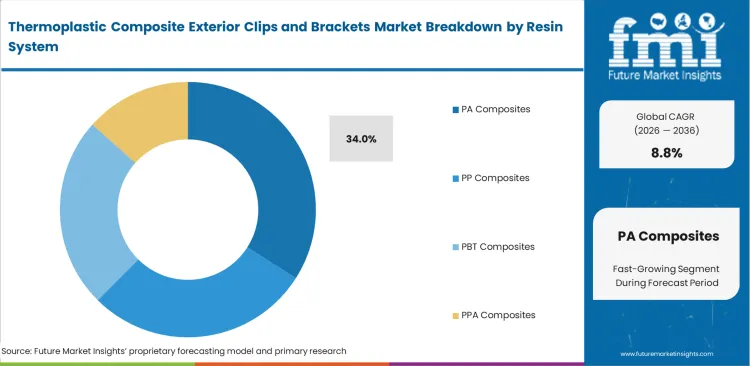
Chemical degradation destroys standard plastics exposed continuously to engine fluids, battery coolants, and winter road salts. PA Composites is set to dominate with a 34.0% share in 2026, driven by their exceptional chemical resistance profile in harsh underbody environments. The automotive material specifiers select polyamide matrices because they maintain tensile strength even when saturated with moisture. Balancing impact resistance with high rigidity requires complex compounding expertise. Polyamide brackets show a counter-intuitive behavior in humid environments, where they become tougher while many other polymers tend to turn brittle. Formulators who select cheaper PBT resins face catastrophic field failures when brackets shatter during minor parking impacts at sub-zero temperatures.
- Chemical resilience: Polyamide networks repel aggressive road salts and automotive fluids. Material engineers gain long-term durability guarantees essential for ten-year warranty requirements.
- Moisture conditioning: PA resins absorb ambient moisture, increasing impact toughness over time. Bracket designers avoid cold-weather shattering events that plague alternative resin choices.
- Thermal stability: High-heat polyamide variants survive proximity to cooling radiators and brake assemblies. Packaging engineers must route harnesses safely without risking bracket melt-deformation.
Thermoplastic Composite Exterior Clips and Brackets Market Analysis by Reinforcement
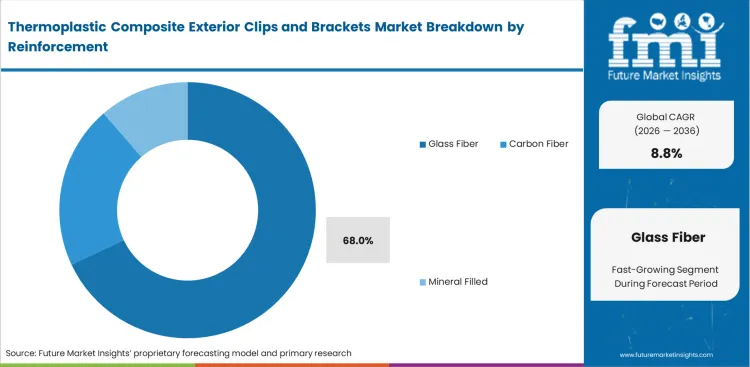
Procurement teams ruthlessly reject carbon fiber hardware for mainstream vehicles due to astronomical raw material costs. Glass Fiber is anticipated to capture around 68.0% share because it delivers the exact mechanical shear strength required for bumper mounting at one-tenth the cost of carbon alternatives. The Tier-1 molding directors favor short-glass-fiber compounds because they flow easily through complex multi-cavity injection molds. Achieving uniform fiber dispersion around sharp bracket corners dictates final component strength. Molders often hide fiber-orientation flaws behind thick bracket walls, creating hidden weak points that snap during crash testing. Suppliers failing to utilize advanced mold-flow analysis software produce visually perfect hardware that crumbles under operational stress.
- Cost-performance ratio: Glass fibers double base resin strength without destroying project budgets. Procurement directors achieve lightweighting targets without violating strict piece-price limits.
- Moldability limits: High glass loadings increase resin viscosity, complicating mold filling. Process engineers face elevated scrap rates until gate locations and injection pressures are perfectly optimized.
- Anisotropic shrinkage: Glass fibers align along flow paths, causing uneven cooling shrinkage. Tooling designers must anticipate this warpage to ensure final brackets meet tight dimensional tolerances.
Thermoplastic Composite Exterior Clips and Brackets Market Analysis by Vehicle Type
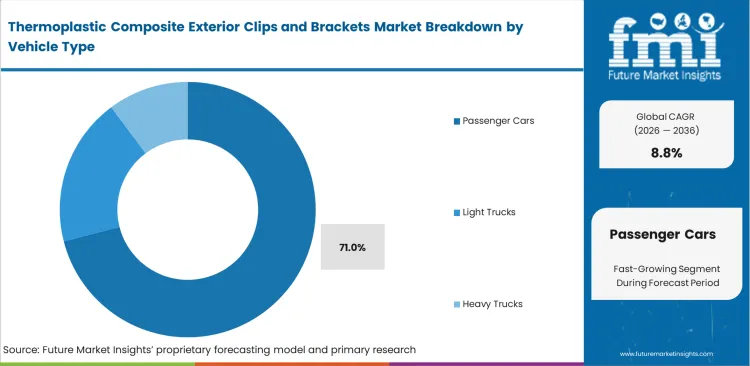
Aerodynamic styling demands smooth, seamless exterior panels with zero visible attachment hardware. Passenger Cars lead adoption with an expected 71.0% share in 2026, as designers rely on hidden polymeric retainers to snap complex body panels together blindly. The exterior trim engineers prefer this method because it enables dramatic styling curves impossible to secure with traditional manual tooling. Ensuring these hidden blind-fasteners release properly during collision repair presents a massive engineering challenge. Traditional mechanics often shatter these hidden composite mounts during routine bumper removals, forcing consumers to purchase entirely new fascia assemblies for minor repairs. Utilizing automotive plastic fasteners mandates entirely new service manuals and specialized removal tools across dealership networks.
- Styling enablement: Hidden blind-fasteners secure complex aerodynamic curves without surface blemishes. Exterior designers gain freedom to create aggressive vehicle styling cues.
- Assembly speed: Snap-fit retainers allow workers to attach heavy panels with a single push. Production managers avoid the ergonomic injuries associated with repetitive torque-gun usage.
- Serviceability conflict: High-retention clips resist removal during collision repair procedures. Dealership mechanics face increased labor times and accidental component breakage when replacing damaged fascias.
Thermoplastic Composite Exterior Clips and Brackets Market Analysis by Application
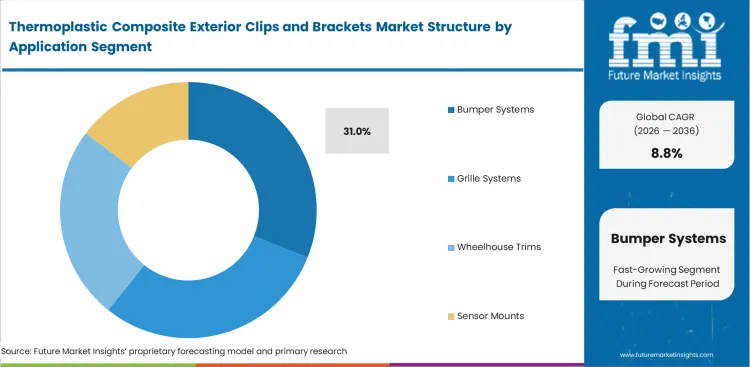
Crash energy management zones require hardware that yields predictably rather than transferring impact forces directly into the chassis. Bumper Systems is forecast to account for 31.0% in 2026 share because specific polymeric brackets are engineered to shear off at precise impact loads, protecting expensive radar sensors from destruction. As observed, the safety homologation directors mandate these calibrated failure points for pedestrian impact requirements.
Designing a bracket strong enough for high-speed aerodynamics but weak enough for low-speed pedestrian safety requires extreme precision. What crash-test data rarely reveals is that minor manufacturing variations in glass-fiber dispersion can drastically alter the sheer-point of a bumper bracket, turning a safe design into a dangerous rigid spear. Engineers selecting automotive bumper hardware must demand strict X-ray tomographic quality control from their molders.
- Calibrated shear: Bumper brackets yield precisely during low-speed impacts to absorb energy. Safety directors gain compliance with strict international pedestrian impact regulations.
- Sensor alignment: Rigid composite mounts prevent radar units from vibrating over rough terrain. ADAS calibration engineers avoid false-positive braking events caused by sensor oscillation.
- Thermal cycling: Bumper hardware endures extreme temperature swings between radiator heat and ambient winter air. Material scientists must specify low-warp formulations to prevent brackets from cracking.
Thermoplastic Composite Exterior Clips and Brackets Market Drivers, Restraints, and Opportunities
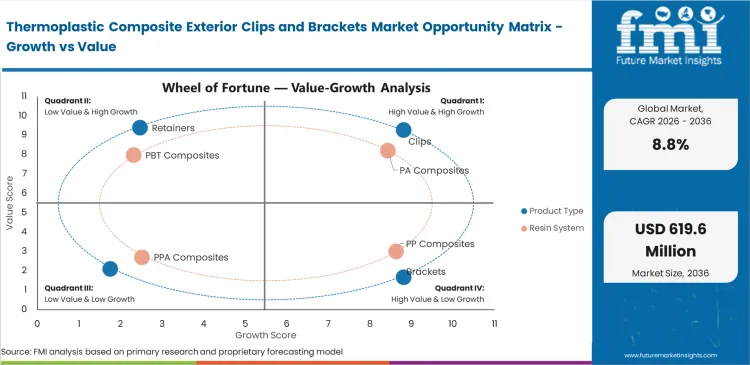
Warranty claims originating from galvanic corrosion compel quality assurance directors to eradicate metallic fasteners across vehicle exteriors. When dissimilar metals contact moisture and road salt, accelerated oxidation ruins painted finishes and shifts sensor alignments out of calibration. Delaying the transition to polymeric clips guarantees elevated recall costs for modern vehicles packed with sensitive ADAS hardware. Automakers demand single-shot injection-molded composite brackets that eliminate all metal-on-metal contact points entirely. Integration of these components reduces overall warranty reserves while simultaneously shedding crucial mass from heavy electric vehicle platforms.
Mold tooling validation cycles severely delay the launch of complex composite brackets even when automakers urgently request them. Unlike steel stamping dies which are easily adjusted, modifying a hardened steel injection mold to fix warpage issues requires weeks of expensive machining downtime. Tooling engineers struggle to predict exactly how glass-fiber reinforced resins will shrink as they cool inside complex cavity geometries. Until mold-flow simulation software achieves perfect accuracy, suppliers remain trapped in iterative trial-and-error tooling loops that delay production timelines and inflate initial capital expenditures.
Opportunities in the Thermoplastic Composite Exterior Clips and Brackets Market
- Radar-transparent formulations: Developing brackets that do not interfere with high-frequency electromagnetic waves. ADAS engineers gain freedom to mount sensors directly behind fascias without signal degradation.
- Recycled material qualification: Formulating high-performance clips using post-consumer recycled resins. Sustainability directors achieve circular-economy targets without sacrificing mechanical strength.
- Smart fastening technology: Embedding RFID tags directly into automotive exterior trim parts mounting hardware. Assembly line managers track component provenance instantly, improving traceability during quality control audits.
Regional Analysis
Based on regional analysis, Thermoplastic Composite Exterior Clips and Brackets is segmented into Asia Pacific, North America, and Europe across 40 plus countries.
.webp "Top Country Growth Comparison Thermoplastic Composite Exterior Clips And Brackets Market Cagr (2026 2036)")
| Country | CAGR (2026 to 2036) |
|---|---|
| China | 10.2% |
| India | 9.8% |
| Mexico | 9.1% |
| United States | 7.6% |
| Germany | 7.2% |
| South Korea | 6.8% |
| Japan | 6.1% |
Source: Future Market Insights (FMI) analysis, based on proprietary forecasting model and primary research
Asia Pacific Thermoplastic Composite Exterior Clips and Brackets Market Analysis
Asia Pacific remains the fastest-rising regional base for thermoplastic composite exterior clips and brackets because vehicle production is expanding, EV programs are widening, and local sourcing is becoming more important across exterior hardware categories. Automakers in the region are using lighter attachment parts to manage vehicle weight, simplify assembly, and reduce corrosion exposure in visible and semi-visible exterior applications. Regional molders are also improving their ability to supply fiber-reinforced components at higher volumes, which supports quicker program execution for bumper systems, grille assemblies, underbody panels, and sensor-adjacent mounts. Product development cycles are shortening across several vehicle platforms, so suppliers that can move from prototype tools to commercial production without long delays are in a stronger position.
- China: The market in China is forecast to expand at a 10.2% CAGR through 2036. Local EV production keeps part-development activity elevated, especially in front-end modules and exterior trim interfaces where lower-weight attachment hardware helps offset battery-related mass. Domestic suppliers are also benefiting from stronger in-country tooling and molding capability, which improves response time for design revisions and volume launches.
- India: Production localization remains a central factor in India, where OEMs and suppliers are raising the local content share of many vehicle components. Thermoplastic composite exterior clips and brackets in India are likely to advance at a 9.8% CAGR during the assessment period, supported by wider use of domestically molded polymer components in place of imported hardware. Resin conversion, tariff sensitivity, and the need for cost-efficient tooling continue to favor regional suppliers with scalable injection molding capacity.
- Japan: Precision remains the key purchasing criterion in Japan for retainers and brackets used in aerodynamic panels and tightly fitted exterior assemblies. The country is set to record a 6.1% CAGR in this market through 2036, as manufacturers focus on dimensional control, repeatability, and resin performance in smaller, technically demanding parts. That operating focus also supports export opportunities for suppliers with strong micro-molding and toolmaking capability.
- South Korea: Composite clips and brackets across South Korea are expected to rise at a 6.8% CAGR over the forecast period. Common-part usage helps reduce inventory complexity and improves sourcing efficiency for regional assembly operations. Standardized EV platform design is shaping product selection in South Korea, where OEMs prefer attachment hardware that can be used across multiple vehicle lines with limited redesign.
FMI’s report includes Taiwan, Thailand, and Indonesia. Industry expansion across these countries is linked to local clip production for vehicle assembly hubs and export-oriented component supply.
North America Thermoplastic Composite Exterior Clips and Brackets Market Analysis
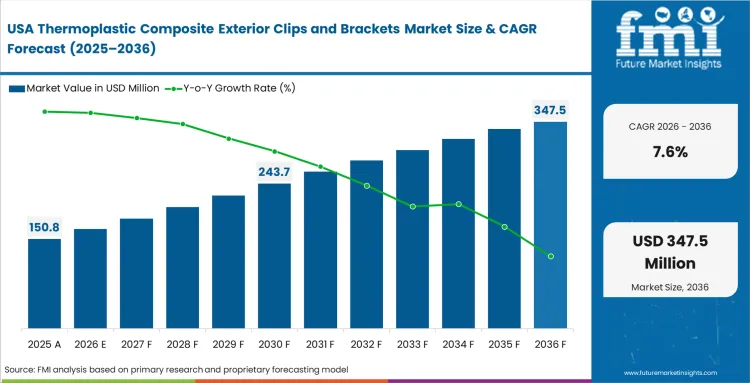
North America remains an important market for thermoplastic composite exterior clips and brackets because light trucks, SUVs, and larger bumper and grille assemblies create steady need for durable and lower-weight attachment components. OEMs in the region continue to review metallic mounting parts that add weight, require corrosion protection, or complicate multi-part assembly. Regional sourcing has also gained importance, which is pushing more investment toward molding operations that can supply larger composite brackets and clip systems closer to vehicle assembly plants. Material selection in this region also reflects cold-weather performance needs, particularly in applications where impact resistance and dimensional stability must be maintained across wide temperature ranges.
- Mexico: Mexico is anticipated to see this market expand at a 9.1% CAGR through 2036. Nearshoring continues to support local production of fascia-related and exterior attachment components for North American vehicle programs, and suppliers located near major manufacturing corridors are well placed to benefit from that shift. Facilities with experience in larger composite parts are gaining relevance as cross-border supply programs become more concentrated within the region.
- United States: Lightweighting remains an active theme across pickup trucks, utility vehicles, and hybrid platforms in the United States. The market is expected to grow at a 7.6% CAGR through 2036 as OEMs replace selected metallic mounting parts with advanced polymer alternatives in exterior applications where weight, corrosion resistance, and assembly efficiency matter. Investment requirements remain meaningful because larger brackets often require specialized high-tonnage molding capacity and careful material qualification.
FMI’s report includes Canada. Activity there remains centered on material validation and cold-weather performance testing for advanced polymer formulations used in exterior attachment parts.
Europe Thermoplastic Composite Exterior Clips and Brackets Market Analysis
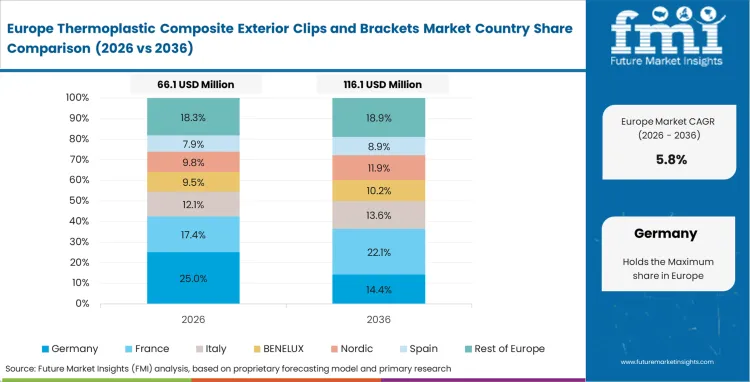
Europe shows a steady industry outlook for thermoplastic composite exterior clips and brackets, supported by premium vehicle programs, tighter exterior fit requirements, and wider integration of sensors into front-end and body-side assemblies. Exterior attachment hardware in the region must meet stricter expectations for dimensional consistency, appearance, and vibration control, especially in premium passenger vehicles. Material qualification is also moving toward recycled-content and lower-footprint composite formulations, which is influencing both part design and mold processing conditions. Suppliers that can deliver precise brackets and clips while meeting OEM material specifications remain better placed in European sourcing programs.
- Germany: Germany is likely to post a 7.2% CAGR in the thermoplastic composite exterior clips and brackets market by 2036. Premium vehicle manufacturers continue to integrate radar and lidar mounting points into more complex front-end layouts, which raises the need for rigid and dimensionally stable composite brackets. Suppliers that can meet tight tolerance requirements and maintain part performance under vibration are more likely to secure long-duration supply positions.
FMI’s report includes France, Italy, and the United Kingdom. Material selection across these countries is gradually inclining toward recycled-content automotive plastics, which is influencing future molding and qualification requirements.
Competitive Aligners for Market Players
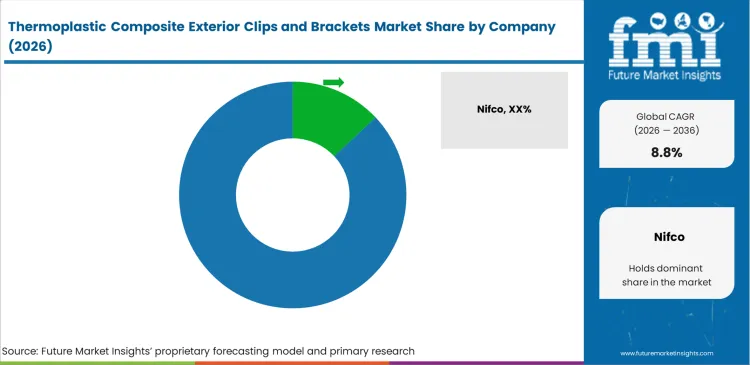
Legacy metal stampers attempting to enter this sector fail because they misunderstand injection molding physics, assuming they can simply substitute plastic for steel using identical geometry. Competition revolves around predictive mold-flow simulation capabilities, where suppliers like Nifco and ARaymond secure contracts by proving they can prevent glass-fiber warpage before cutting expensive steel tooling. Procurement directors award programs to molders who demonstrate exceptional dimensional stability across multi-cavity tools, not just those offering the lowest piece-price.
Incumbents hold massive advantages through proprietary libraries of validated resin formulations and thousands of hours of real-world cold-weather impact data. Challengers face immense difficulty convincing automotive engineers to risk a new, untested bracket material on a high-volume platform launch. Experienced suppliers leverage their deep understanding of automotive lightweight materials to design complex, multi-functional components that consolidate three metallic parts into a single composite injection, fundamentally altering the assembly cost equation.
Large automakers actively resist sole-source lock-in by demanding molders use standardized, open-market resin grades rather than proprietary blends. Quality control directors conduct rigorous audits to ensure secondary suppliers can replicate bracket performance perfectly if the primary supplier encounters production delays. Tooling ownership remains fiercely contested; OEMs insist on owning the injection molds to maintain leverage, while suppliers embed unique processing parameters into the tools that make transferring production to a competitor exceedingly difficult.
Key Players in Thermoplastic Composite Exterior Clips and Brackets Market
- Nifco
- ARaymond
- ITW Automotive
- Magna International
- Flex-N-Gate
- SMP Automotive
- Novares
Scope of the Report
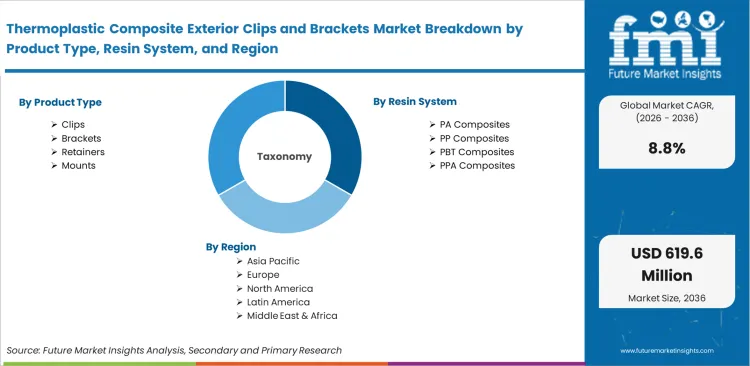
| Metric | Value |
|---|---|
| Quantitative Units | USD 245 million to USD 570 million, at a CAGR of 8.8% |
| Market Definition | Thermoplastic Composite Exterior Clips and Brackets encompass reinforced polymeric hardware designed to attach exterior automotive components. These high-strength fasteners and mounts replace legacy metal hardware, eliminating galvanic corrosion while reducing overall vehicle mass. |
| Segmentation | Product Type, Resin System, Reinforcement, Vehicle Type, Application, and Region |
| Regions Covered | North America, Latin America, Western Europe, Eastern Europe, Asia Pacific, Middle East and Africa |
| Countries Covered | United States, Canada, Brazil, Mexico, Germany, United Kingdom, France, Spain, Italy, Russia, Poland, China, India, Japan, Australia, New Zealand, South Korea, GCC Countries, South Africa |
| Key Companies Profiled | Nifco; ARaymond; ITW Automotive; Magna International; Flex-N-Gate; SMP Automotive; Novares |
| Forecast Period | 2026 to 2036 |
| Approach | Annual electric vehicle production volumes multiplied by average exterior fastener count per platform. |
Source: Future Market Insights (FMI) analysis, based on proprietary forecasting model and primary research
Thermoplastic Composite Exterior Clips and Brackets Market Analysis by Segments
By Product Type
- Clips
- Brackets
- Retainers
- Mounts
By Resin System
- PA Composites
- PP Composites
- PBT Composites
- PPA Composites
By Reinforcement
- Glass Fiber
- Carbon Fiber
- Mineral Filled
By Vehicle Type
- Passenger Cars
- Light Trucks
- Heavy Trucks
By Application
- Bumper Systems
- Grille Systems
- Wheelhouse Trims
- Sensor Mounts
Region
- North America
- United States
- Canada
- Latin America
- Brazil
- Mexico
- Western Europe
- Germany
- United Kingdom
- France
- Spain
- Italy
- Eastern Europe
- Russia
- Poland
- Asia Pacific
- China
- India
- Japan
- Australia
- New Zealand
- South Korea
- Middle East and Africa
- GCC Countries
- South Africa
Bibliography
- BASF. (2026, February 27). BASF report 2025.
- Candela, A., Caserta, M., Genovese, A., Maresca, F., Simeone, M., & Squillace, A. (2024, April 30). Lightweighting in the automotive industry as a measure for energy efficiency: Review of the main materials and methods 10(8), e29728.
- International Energy Agency. (2025, May 14). Global EV outlook 2025.
- Krueger, R. (2024, May). Advances in thermoplastic composites over three decades.
- Nifco Inc. (2025, December 26). Nifco report 2025 (covering FY2024 results).
This bibliography is provided for reader reference. The full FMI report contains the complete reference list with primary source documentation.
This Report Addresses
- Component weight reduction forces accelerating adoption across next-generation electric vehicle platforms.
- Warranty claims originating from galvanic corrosion compelling quality assurance directors to eradicate metallic fasteners.
- Mold tooling validation cycles severely delaying the launch of complex composite brackets.
- Assembly line automation pushing manufacturing engineers toward push-to-snap polymeric retainers over manual torque-driven metallic screws.
- Battery weight penalties compelling electric vehicle design heads to mandate extreme lightweighting for all non-structural attachment hardware.
- High-heat polyamide variants surviving proximity to cooling radiators and brake assemblies.
- Procurement teams ruthlessly rejecting carbon fiber hardware for mainstream vehicles due to astronomical raw material costs.
- Domestic production localization mandates pushing out imported steel hardware in favor of domestically molded polymeric components.
Frequently Asked Questions
What is the baseline valuation for exterior composite clips?
Thermoplastic Composite Exterior Clips and Brackets reached USD 225.0 million in 2025 before robotic assembly automation accelerated adoption.
Where is industry valuation heading by 2036?
Revenue expansion propels total valuation to USD 569.0 million by 2036 as automakers eliminate heavy metallic brackets entirely.
What compound annual growth rate defines this sector?
Demand advances at a 8.8% CAGR through 2036, signaling deep engineering commitment rather than temporary automotive styling trends.
Why do Clips hold the dominant share?
Clips secure 58.0% share because push-to-lock polymeric pins allow robotic arms to assemble front-end modules in seconds.
What operational consequence does choosing PA Composites deliver?
PA Composites command 34.0% share because polyamide networks repel aggressive road salts, granting engineers essential long-term durability guarantees.
Why do automotive buyers select Glass Fiber over alternatives?
Glass Fiber captures 68.0% share because procurement directors achieve lightweighting targets without violating strict piece-price limits.
What underlying reality does the Passenger Cars share obscure?
Passenger Cars hold 71.0% share, hiding massive serviceability conflicts as dealership mechanics frequently shatter hidden blind-fasteners during repairs.
How do pedestrian safety regulations shape Bumper Systems adoption?
Bumper brackets yield precisely during low-speed impacts, allowing safety directors to achieve compliance with strict international pedestrian regulations.
Why does China expand faster than India?
China advances at 10.2% on EV non-metallic mandates, while India tracks at 9.8% relying heavily on import substitution.
What non-obvious factor limits adoption in legacy assembly plants?
Assembly lines relying on manual labor transition slower because traditional torque-gun operations require threaded hardware, delaying polymeric adoption.
How do engineers prevent ADAS sensor misalignment?
Rigid composite mounts prevent radar units from vibrating, helping ADAS calibration engineers avoid dangerous false-positive braking events.
What hidden tooling issue delays product launches?
Glass fibers align along flow paths, causing uneven cooling shrinkage that forces tooling designers to recut expensive molds.
Why do PBT resins fail in this specific application?
Cheaper PBT resins shatter during minor parking impacts at sub-zero temperatures, whereas polyamide brackets actually toughen in humidity.
How do composite clips eliminate secondary processing costs?
Polymeric components inherently resist corrosion, allowing assembly line managers to bypass expensive secondary rust-proofing treatments required for steel.
What prevents carbon fiber from dominating this category?
Astronomical raw material costs force procurement teams to favor short-glass-fiber compounds exclusively for mainstream vehicle production.
Why are unreinforced plastics excluded from this scope?
Unreinforced commodity plastics cannot meet crash-safety shear requirements, failing instantly under aerodynamic loading on exterior automotive panels.
What role does thermal expansion play in material selection?
Composite formulations match exterior panel expansion rates, helping quality control directors prevent paint-cracking warranty claims caused by metal.
How do high-flow formulations reduce scrap rates?
Advanced high-flow resins fill complex mold cavities perfectly without creating weak weld lines at critical bracket corners.
What specific tension exists between styling and collision repair?
Designers rely on hidden blind-fasteners for sleek curves, but mechanics inevitably shatter these high-retention clips during routine maintenance.
Why are Mexican molding facilities expanding capacity rapidly?
Nearshoring initiatives accelerate investment as facilities mastering large-part composite molding secure lucrative cross-border export contracts for assembly lines.
How do European sustainability mandates impact resin selection?
Carbon reduction pressure forces procurement teams to adapt injection tooling for harder-to-process post-consumer recycled polymeric formulations.
What competitive advantage do incumbent molders hold over metal stampers?
Incumbents possess proprietary resin formulations and thousands of hours of cold-weather impact data that metal stampers completely lack.
Preview the report firsthand - request a free sample
Get SampleGet the brochure for pricing and purchase details.
Get PDFTable of Content
- Executive Summary
- Global Market Outlook
- Demand-side Trends
- Supply-side Trends
- Technology Roadmap Analysis
- Analysis and Recommendations
- Market Overview
- Market Coverage / Taxonomy
- Market Definition / Scope / Limitations
- Research Methodology
- Chapter Orientation
- Analytical Lens and Working Hypotheses
- Market Structure, Signals, and Trend Drivers
- Benchmarking and Cross-market Comparability
- Market Sizing, Forecasting, and Opportunity Mapping
- Research Design and Evidence Framework
- Desk Research Programme (Secondary Evidence)
- Company Annual and Sustainability Reports
- Peer-reviewed Journals and Academic Literature
- Corporate Websites, Product Literature, and Technical Notes
- Earnings Decks and Investor Briefings
- Statutory Filings and Regulatory Disclosures
- Technical White Papers and Standards Notes
- Trade Journals, Industry Magazines, and Analyst Briefs
- Conference Proceedings, Webinars, and Seminar Materials
- Government Statistics Portals and Public Data Releases
- Press Releases and Reputable Media Coverage
- Specialist Newsletters and Curated Briefings
- Sector Databases and Reference Repositories
- FMI Internal Proprietary Databases and Historical Market Datasets
- Subscription Datasets and Paid Sources
- Social Channels, Communities, and Digital Listening Inputs
- Additional Desk Sources
- Expert Input and Fieldwork (Primary Evidence)
- Primary Modes
- Qualitative Interviews and Expert Elicitation
- Quantitative Surveys and Structured Data Capture
- Blended Approach
- Why Primary Evidence is Used
- Field Techniques
- Interviews
- Surveys
- Focus Groups
- Observational and In-context Research
- Social and Community Interactions
- Stakeholder Universe Engaged
- C-suite Leaders
- Board Members
- Presidents and Vice Presidents
- R&D and Innovation Heads
- Technical Specialists
- Domain Subject-matter Experts
- Scientists
- Physicians and Other Healthcare Professionals
- Governance, Ethics, and Data Stewardship
- Research Ethics
- Data Integrity and Handling
- Primary Modes
- Tooling, Models, and Reference Databases
- Desk Research Programme (Secondary Evidence)
- Data Engineering and Model Build
- Data Acquisition and Ingestion
- Cleaning, Normalisation, and Verification
- Synthesis, Triangulation, and Analysis
- Quality Assurance and Audit Trail
- Market Background
- Market Dynamics
- Drivers
- Restraints
- Opportunity
- Trends
- Scenario Forecast
- Demand in Optimistic Scenario
- Demand in Likely Scenario
- Demand in Conservative Scenario
- Opportunity Map Analysis
- Product Life Cycle Analysis
- Supply Chain Analysis
- Investment Feasibility Matrix
- Value Chain Analysis
- PESTLE and Porter’s Analysis
- Regulatory Landscape
- Regional Parent Market Outlook
- Production and Consumption Statistics
- Import and Export Statistics
- Market Dynamics
- Global Market Analysis 2021 to 2025 and Forecast, 2026 to 2036
- Historical Market Size Value (USD Million) Analysis, 2021 to 2025
- Current and Future Market Size Value (USD Million) Projections, 2026 to 2036
- Y-o-Y Growth Trend Analysis
- Absolute $ Opportunity Analysis
- Global Market Pricing Analysis 2021 to 2025 and Forecast 2026 to 2036
- Global Market Analysis 2021 to 2025 and Forecast 2026 to 2036, By Product Type
- Introduction / Key Findings
- Historical Market Size Value (USD Million) Analysis By Product Type , 2021 to 2025
- Current and Future Market Size Value (USD Million) Analysis and Forecast By Product Type , 2026 to 2036
- Clips
- Brackets
- Retainers
- Mounts
- Clips
- Y-o-Y Growth Trend Analysis By Product Type , 2021 to 2025
- Absolute $ Opportunity Analysis By Product Type , 2026 to 2036
- Global Market Analysis 2021 to 2025 and Forecast 2026 to 2036, By Resin System
- Introduction / Key Findings
- Historical Market Size Value (USD Million) Analysis By Resin System, 2021 to 2025
- Current and Future Market Size Value (USD Million) Analysis and Forecast By Resin System, 2026 to 2036
- PA Composites
- PP Composites
- PBT Composites
- PPA Composites
- PA Composites
- Y-o-Y Growth Trend Analysis By Resin System, 2021 to 2025
- Absolute $ Opportunity Analysis By Resin System, 2026 to 2036
- Global Market Analysis 2021 to 2025 and Forecast 2026 to 2036, By Reinforcement
- Introduction / Key Findings
- Historical Market Size Value (USD Million) Analysis By Reinforcement, 2021 to 2025
- Current and Future Market Size Value (USD Million) Analysis and Forecast By Reinforcement, 2026 to 2036
- Glass Fiber
- Carbon Fiber
- Mineral Filled
- Glass Fiber
- Y-o-Y Growth Trend Analysis By Reinforcement, 2021 to 2025
- Absolute $ Opportunity Analysis By Reinforcement, 2026 to 2036
- Global Market Analysis 2021 to 2025 and Forecast 2026 to 2036, By Vehicle Type
- Introduction / Key Findings
- Historical Market Size Value (USD Million) Analysis By Vehicle Type, 2021 to 2025
- Current and Future Market Size Value (USD Million) Analysis and Forecast By Vehicle Type, 2026 to 2036
- Passenger Cars
- Light Trucks
- Heavy Trucks
- Passenger Cars
- Y-o-Y Growth Trend Analysis By Vehicle Type, 2021 to 2025
- Absolute $ Opportunity Analysis By Vehicle Type, 2026 to 2036
- Global Market Analysis 2021 to 2025 and Forecast 2026 to 2036, By Application
- Introduction / Key Findings
- Historical Market Size Value (USD Million) Analysis By Application, 2021 to 2025
- Current and Future Market Size Value (USD Million) Analysis and Forecast By Application, 2026 to 2036
- Bumper Systems
- Grille Systems
- Wheelhouse Trims
- Sensor Mounts
- Bumper Systems
- Y-o-Y Growth Trend Analysis By Application, 2021 to 2025
- Absolute $ Opportunity Analysis By Application, 2026 to 2036
- Global Market Analysis 2021 to 2025 and Forecast 2026 to 2036, By Region
- Introduction
- Historical Market Size Value (USD Million) Analysis By Region, 2021 to 2025
- Current Market Size Value (USD Million) Analysis and Forecast By Region, 2026 to 2036
- North America
- Latin America
- Western Europe
- Eastern Europe
- East Asia
- South Asia and Pacific
- Middle East & Africa
- Market Attractiveness Analysis By Region
- North America Market Analysis 2021 to 2025 and Forecast 2026 to 2036, By Country
- Historical Market Size Value (USD Million) Trend Analysis By Market Taxonomy, 2021 to 2025
- Market Size Value (USD Million) Forecast By Market Taxonomy, 2026 to 2036
- By Country
- USA
- Canada
- Mexico
- By Product Type
- By Resin System
- By Reinforcement
- By Vehicle Type
- By Application
- By Country
- Market Attractiveness Analysis
- By Country
- By Product Type
- By Resin System
- By Reinforcement
- By Vehicle Type
- By Application
- Key Takeaways
- Latin America Market Analysis 2021 to 2025 and Forecast 2026 to 2036, By Country
- Historical Market Size Value (USD Million) Trend Analysis By Market Taxonomy, 2021 to 2025
- Market Size Value (USD Million) Forecast By Market Taxonomy, 2026 to 2036
- By Country
- Brazil
- Chile
- Rest of Latin America
- By Product Type
- By Resin System
- By Reinforcement
- By Vehicle Type
- By Application
- By Country
- Market Attractiveness Analysis
- By Country
- By Product Type
- By Resin System
- By Reinforcement
- By Vehicle Type
- By Application
- Key Takeaways
- Western Europe Market Analysis 2021 to 2025 and Forecast 2026 to 2036, By Country
- Historical Market Size Value (USD Million) Trend Analysis By Market Taxonomy, 2021 to 2025
- Market Size Value (USD Million) Forecast By Market Taxonomy, 2026 to 2036
- By Country
- Germany
- UK
- Italy
- Spain
- France
- Nordic
- BENELUX
- Rest of Western Europe
- By Product Type
- By Resin System
- By Reinforcement
- By Vehicle Type
- By Application
- By Country
- Market Attractiveness Analysis
- By Country
- By Product Type
- By Resin System
- By Reinforcement
- By Vehicle Type
- By Application
- Key Takeaways
- Eastern Europe Market Analysis 2021 to 2025 and Forecast 2026 to 2036, By Country
- Historical Market Size Value (USD Million) Trend Analysis By Market Taxonomy, 2021 to 2025
- Market Size Value (USD Million) Forecast By Market Taxonomy, 2026 to 2036
- By Country
- Russia
- Poland
- Hungary
- Balkan & Baltic
- Rest of Eastern Europe
- By Product Type
- By Resin System
- By Reinforcement
- By Vehicle Type
- By Application
- By Country
- Market Attractiveness Analysis
- By Country
- By Product Type
- By Resin System
- By Reinforcement
- By Vehicle Type
- By Application
- Key Takeaways
- East Asia Market Analysis 2021 to 2025 and Forecast 2026 to 2036, By Country
- Historical Market Size Value (USD Million) Trend Analysis By Market Taxonomy, 2021 to 2025
- Market Size Value (USD Million) Forecast By Market Taxonomy, 2026 to 2036
- By Country
- China
- Japan
- South Korea
- By Product Type
- By Resin System
- By Reinforcement
- By Vehicle Type
- By Application
- By Country
- Market Attractiveness Analysis
- By Country
- By Product Type
- By Resin System
- By Reinforcement
- By Vehicle Type
- By Application
- Key Takeaways
- South Asia and Pacific Market Analysis 2021 to 2025 and Forecast 2026 to 2036, By Country
- Historical Market Size Value (USD Million) Trend Analysis By Market Taxonomy, 2021 to 2025
- Market Size Value (USD Million) Forecast By Market Taxonomy, 2026 to 2036
- By Country
- India
- ASEAN
- Australia & New Zealand
- Rest of South Asia and Pacific
- By Product Type
- By Resin System
- By Reinforcement
- By Vehicle Type
- By Application
- By Country
- Market Attractiveness Analysis
- By Country
- By Product Type
- By Resin System
- By Reinforcement
- By Vehicle Type
- By Application
- Key Takeaways
- Middle East & Africa Market Analysis 2021 to 2025 and Forecast 2026 to 2036, By Country
- Historical Market Size Value (USD Million) Trend Analysis By Market Taxonomy, 2021 to 2025
- Market Size Value (USD Million) Forecast By Market Taxonomy, 2026 to 2036
- By Country
- Kingdom of Saudi Arabia
- Other GCC Countries
- Turkiye
- South Africa
- Other African Union
- Rest of Middle East & Africa
- By Product Type
- By Resin System
- By Reinforcement
- By Vehicle Type
- By Application
- By Country
- Market Attractiveness Analysis
- By Country
- By Product Type
- By Resin System
- By Reinforcement
- By Vehicle Type
- By Application
- Key Takeaways
- Key Countries Market Analysis
- USA
- Pricing Analysis
- Market Share Analysis, 2025
- By Product Type
- By Resin System
- By Reinforcement
- By Vehicle Type
- By Application
- Canada
- Pricing Analysis
- Market Share Analysis, 2025
- By Product Type
- By Resin System
- By Reinforcement
- By Vehicle Type
- By Application
- Mexico
- Pricing Analysis
- Market Share Analysis, 2025
- By Product Type
- By Resin System
- By Reinforcement
- By Vehicle Type
- By Application
- Brazil
- Pricing Analysis
- Market Share Analysis, 2025
- By Product Type
- By Resin System
- By Reinforcement
- By Vehicle Type
- By Application
- Chile
- Pricing Analysis
- Market Share Analysis, 2025
- By Product Type
- By Resin System
- By Reinforcement
- By Vehicle Type
- By Application
- Germany
- Pricing Analysis
- Market Share Analysis, 2025
- By Product Type
- By Resin System
- By Reinforcement
- By Vehicle Type
- By Application
- UK
- Pricing Analysis
- Market Share Analysis, 2025
- By Product Type
- By Resin System
- By Reinforcement
- By Vehicle Type
- By Application
- Italy
- Pricing Analysis
- Market Share Analysis, 2025
- By Product Type
- By Resin System
- By Reinforcement
- By Vehicle Type
- By Application
- Spain
- Pricing Analysis
- Market Share Analysis, 2025
- By Product Type
- By Resin System
- By Reinforcement
- By Vehicle Type
- By Application
- France
- Pricing Analysis
- Market Share Analysis, 2025
- By Product Type
- By Resin System
- By Reinforcement
- By Vehicle Type
- By Application
- India
- Pricing Analysis
- Market Share Analysis, 2025
- By Product Type
- By Resin System
- By Reinforcement
- By Vehicle Type
- By Application
- ASEAN
- Pricing Analysis
- Market Share Analysis, 2025
- By Product Type
- By Resin System
- By Reinforcement
- By Vehicle Type
- By Application
- Australia & New Zealand
- Pricing Analysis
- Market Share Analysis, 2025
- By Product Type
- By Resin System
- By Reinforcement
- By Vehicle Type
- By Application
- China
- Pricing Analysis
- Market Share Analysis, 2025
- By Product Type
- By Resin System
- By Reinforcement
- By Vehicle Type
- By Application
- Japan
- Pricing Analysis
- Market Share Analysis, 2025
- By Product Type
- By Resin System
- By Reinforcement
- By Vehicle Type
- By Application
- South Korea
- Pricing Analysis
- Market Share Analysis, 2025
- By Product Type
- By Resin System
- By Reinforcement
- By Vehicle Type
- By Application
- Russia
- Pricing Analysis
- Market Share Analysis, 2025
- By Product Type
- By Resin System
- By Reinforcement
- By Vehicle Type
- By Application
- Poland
- Pricing Analysis
- Market Share Analysis, 2025
- By Product Type
- By Resin System
- By Reinforcement
- By Vehicle Type
- By Application
- Hungary
- Pricing Analysis
- Market Share Analysis, 2025
- By Product Type
- By Resin System
- By Reinforcement
- By Vehicle Type
- By Application
- Kingdom of Saudi Arabia
- Pricing Analysis
- Market Share Analysis, 2025
- By Product Type
- By Resin System
- By Reinforcement
- By Vehicle Type
- By Application
- Turkiye
- Pricing Analysis
- Market Share Analysis, 2025
- By Product Type
- By Resin System
- By Reinforcement
- By Vehicle Type
- By Application
- South Africa
- Pricing Analysis
- Market Share Analysis, 2025
- By Product Type
- By Resin System
- By Reinforcement
- By Vehicle Type
- By Application
- USA
- Market Structure Analysis
- Competition Dashboard
- Competition Benchmarking
- Market Share Analysis of Top Players
- By Regional
- By Product Type
- By Resin System
- By Reinforcement
- By Vehicle Type
- By Application
- Competition Analysis
- Competition Deep Dive
- Nifco
- Overview
- Product Portfolio
- Profitability by Market Segments (Product/Age /Sales Channel/Region)
- Sales Footprint
- Strategy Overview
- Marketing Strategy
- Product Strategy
- Channel Strategy
- ARaymond
- ITW Automotive
- Magna International
- Flex-N-Gate
- SMP Automotive
- Novares
- Nifco
- Competition Deep Dive
- Assumptions & Acronyms Used


