

- Industry Size (2025)
- USD 1.2 Bn
- Forecast (2035)
- USD 1.7 Bn
- CAGR (2025 to 2035)
- 3.5%
Demand for Automotive Brackets in Japan Forecast and Outlook 2025 to 2035
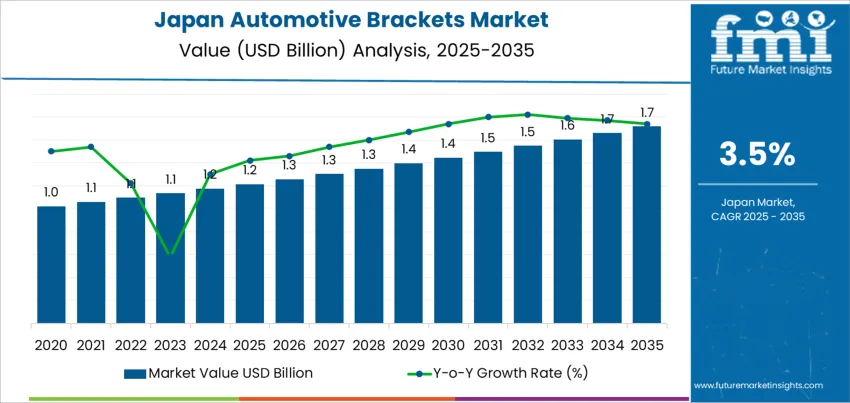
In 2025, the demand for automotive brackets in Japan is valued at USD 1.2 billion and is expected to reach USD 1.7 billion by 2035, with a CAGR of 3.5%. The initial growth phase from 2025 to 2030 will see steady increases in demand, driven by the continuous production of passenger vehicles and commercial vehicles, along with the increasing complexity of vehicle structures. Automotive brackets, which are critical components for mounting various systems such as exhaust systems, radiators, and suspension units, will see a rise in demand due to regulatory pressures for improved vehicle safety and performance. The growth of electric vehicles (EVs) and the need for lightweight materials further support the demand for high-strength, corrosion-resistant brackets.
From 2030 to 2035, demand for automotive brackets will continue to grow at a steady pace, reaching USD 1.7 billion by 2035. This period is marked by the increased adoption of advanced materials like aluminum and high-strength steel to reduce vehicle weight and enhance fuel efficiency. As the automotive industry shifts towards greater electrification, new design specifications will drive innovation in bracket manufacturing, particularly for battery systems and powertrain components in EVs. The key players in this sector, including local Japanese manufacturers and global automotive suppliers, will focus on providing precision-engineered solutions that meet the evolving demands of both traditional and electric vehicle platforms.
Quick Stats for Demand for Automotive Brackets in Japan
- Demand for Automotive Brackets in Japan Value (2025): USD 1.2 billion
- Demand for Automotive Brackets in Japan Forecast Value (2035): USD 1.7 billion
- Demand for Automotive Brackets in Japan Forecast CAGR (2025–2035): 3.5%
- Leading Product Type in Automotive Brackets in Japan: Passive Elastomeric Brackets (45%)
- Key Growth Regions for Automotive Brackets in Japan: Kyushu & Okinawa, Kanto, Kinki, Chubu, Tohoku, Rest of Japan
- Top Players in Automotive Brackets Industry in Japan: Allena Group, Toyo Tires, MISUMI Corporation, Cooper-Standard Holdings Inc., Hangzhou Ekko Auto Parts Co., Ltd.
What is the Growth Forecast for Automotive Brackets in Japan through 2035?
The demand for automotive brackets in Japan from 2020 to 2025 displays a stable and gradual growth pattern, with a steady increase from USD 1.0 billion in 2020 to USD 1.2 billion in 2025. Annual increases are modest, ranging between USD 0.1 and 0.2 billion each year. This indicates a relatively low volatility environment, with the market driven by steady automotive production and the need for brackets in various vehicle segments. The demand fluctuations are primarily tied to incremental increases in vehicle manufacturing output and minor shifts in design requirements, with no significant disruptions or market swings.
Between 2025 and 2035, the demand for automotive brackets is projected to rise from USD 1.2 billion to USD 1.7 billion, marking a moderate but steady increase over the decade. The Growth Volatility Index during this period remains low, with annual growth gradually widening from about USD 0.1 billion to USD 0.2 billion towards the end of the period. This steady rise reflects the continued development of automotive technologies, including increased demand for lightweight materials and advanced manufacturing techniques. The absence of sharp market fluctuations suggests stable growth, driven by long-term industry trends rather than short-term market volatility.
Automotive Brackets Industry in Japan Key Takeaways
| Metric | Value |
|---|---|
| Industry Value (2025) | USD 1.2 billion |
| Forecast Value (2035) | USD 1.7 billion |
| Forecast CAGR (2025–2035) | 3.5% |
What Is Driving the Demand for Automotive Brackets in Japan?
The demand for automotive brackets in Japan reflects underlying strength in the broader auto parts sector, which is growing as a response to evolving vehicle complexity, regulatory change, and replacement demand. The national auto parts market is expanding, supported by ongoing vehicle production and a robust aftermarket servicing base. Suppliers produce brackets for multiple applications engine mounts, chassis supports, suspension attachments, and body-to-frame connections with Japanese automakers maintaining strict quality and precision standards. Demand for durable, corrosion-resistant and lightweight bracket designs remains high, especially in traditional internal-combustion, hybrid, and commercial vehicles that dominate the domestic fleet.
Looking ahead, future demand for automotive brackets in Japan will be shaped by several emerging trends. Transition toward lighter, more fuel-efficient vehicles encourages use of high-strength steel, aluminum, and composite brackets that reduce weight while maintaining structural integrity. Growth in hybrid and electric vehicles adds bracket requirements for battery, motor mountings and structural reinforcements, even as traditional engine-mount brackets decline. Rising aftermarket activity tied to vehicle maintenance and replacement of worn brackets will sustain demand. Suppliers offering modular, multi-material brackets, and complying with stricter emissions and safety norms, are likely to capture a growing share of Japanese automotive bracket demand into the next decade.
What Factors Are Affecting the Demand for Automotive Brackets in Japan in Terms of Product Type and Application?
The demand for automotive brackets in Japan is influenced by both product type and application. The primary product types include passive elastomeric brackets, hydraulic brackets, and active engine brackets, with passive elastomeric brackets accounting for 45% of the total demand. In terms of application, automotive brackets are used in a variety of systems, including engines (30%), suspension, bumpers, wheels, headlights, footrests, and other parts. The choice of bracket type is determined by factors such as vibration damping, load-bearing requirements, and the specific role within the vehicle. Applications in critical areas like the engine and suspension systems account for a larger portion of the market, driven by the need for high durability and precision.
What Drives the Leading Demand for Passive Elastomeric Brackets in Japan?
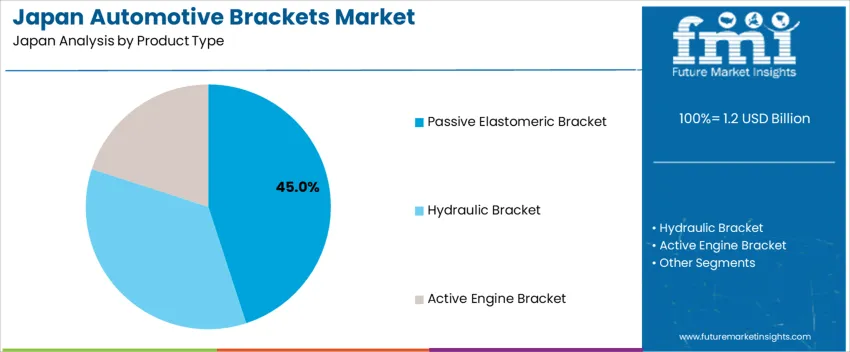
Passive elastomeric brackets lead the demand in Japan, accounting for 45% of the total market. These brackets are highly valued for their ability to absorb vibrations and reduce noise, which is essential in automotive applications. Passive elastomeric brackets are commonly used in engine and suspension systems, where vibration control is critical for performance and comfort. The material properties of elastomers, which provide flexibility and resilience, make these brackets ideal for applications that require durability under high stress, such as engine mounts and suspension components. Their effectiveness in damping vibrations and their ability to withstand harsh operating conditions further contribute to their widespread adoption in the Japanese automotive market.
The demand for passive elastomeric brackets is also driven by the increasing emphasis on comfort, safety, and performance in modern vehicles. As Japanese automakers continue to innovate with quieter, smoother-driving vehicles, passive elastomeric brackets play a key role in achieving these goals. Additionally, their cost-effectiveness and ease of integration into manufacturing processes make them a preferred choice in mass production. The automotive industry's growing focus on reducing vehicle noise and enhancing driving comfort ensures that passive elastomeric brackets will remain a dominant product type in the Japanese market.
What Is Driving the Demand for Automotive Brackets in Engine Applications in Japan?
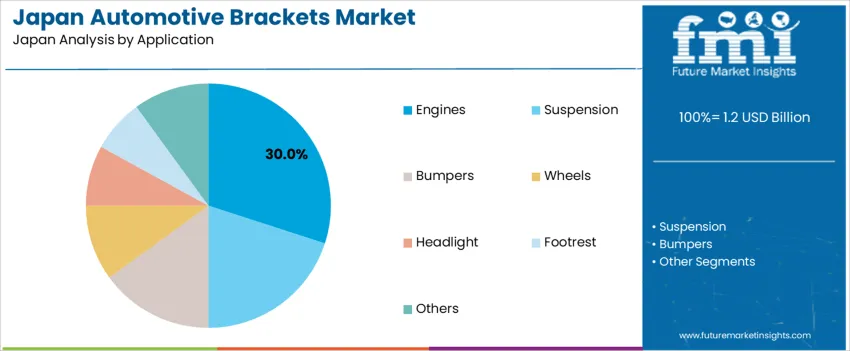
Engine applications account for 30% of the total demand for automotive brackets in Japan. This demand is primarily driven by the need for robust, durable components that can withstand high temperatures, vibrations, and mechanical stresses. Automotive brackets used in engines are critical for securing various engine components, such as the engine block, exhaust systems, and cooling systems. The high-performance requirements in engine applications necessitate the use of brackets that provide stability, precise alignment, and secure mounting, which is why products like passive elastomeric and hydraulic brackets are commonly used in these systems.
The demand for automotive brackets in engine applications is also influenced by the increasing performance and efficiency expectations in modern vehicles. As automakers in Japan focus on improving engine efficiency, reducing weight, and meeting strict emissions standards, the need for high-quality brackets to support engine components becomes even more crucial. Additionally, with the shift toward electric vehicles (EVs) and hybrid powertrains, the demand for specialized brackets to support new engine and powertrain technologies continues to rise. The consistent need for reliable and high-performance brackets in engine applications ensures that this segment remains a key driver in the automotive bracket market.
What Are the Key Drivers Shaping the Demand for Automotive Brackets in Japan?
In Japan, the demand for automotive brackets is primarily driven by the country’s continued leadership in automotive manufacturing, especially for domestic brands like Toyota, Honda, and Nissan. These manufacturers rely heavily on highly engineered brackets for the assembly of critical components such as powertrains, suspension systems, and interior fittings. Japan’s push towards fuel efficiency in its car designs, with a strong emphasis on lightweighting and enhanced vehicle safety, has led to increased use of aluminum and high-strength steel for brackets. Additionally, as hybrid and electric vehicles (EVs) gain traction, demand for specialized, lightweight brackets to support complex battery packs and electrical components has seen significant growth.
What Are the Key Restraints in the Automotive Bracket Market in Japan?
While the automotive sector in Japan is vast, the growth of the automotive bracket market is constrained by several factors. The first significant constraint is the high cost of raw materials like aluminum, magnesium, and high-strength steels used in manufacturing lightweight brackets. This can increase overall production costs for automakers. Moreover, with Japan’s aging population and lower birth rates, domestic car ownership is on the decline in urban areas, potentially leading to stagnation in the number of vehicles being manufactured. Finally, while the demand for EVs is increasing, the relatively slow shift to mass adoption of electric vehicles means that there’s still considerable reliance on traditional combustion engine designs, which limits some of the innovative bracket opportunities seen in EV manufacturing.
What Trends Are Shaping the Automotive Bracket Market in Japan?
A prominent trend in Japan’s automotive bracket market is the shift towards lightweighting. As automakers aim to meet stricter fuel efficiency regulations and reduce CO2 emissions, they are increasingly adopting lightweight materials for components like brackets. Aluminum and magnesium alloys are preferred due to their high strength-to-weight ratios. Additionally, with the advent of electric vehicles, there’s a push for more advanced bracket designs that integrate well with high-voltage components, battery management systems, and regenerative braking systems. Another key trend is the rise of additive manufacturing, which allows for more complex and efficient bracket designs while reducing material waste. Japanese manufacturers are also focusing on the integration of these brackets within the overall vehicle safety and performance system, further enhancing their role in crash safety, vibration reduction, and component durability.
What Role Does Japanese Automotive Innovation Play in the Demand for Brackets?
Japan’s automotive innovation, especially in hybrid and electric vehicle technologies, plays a crucial role in the evolving demand for automotive brackets. As automakers in Japan lead the charge in electric mobility, there’s an increased need for brackets that can support and secure complex battery packs, electric motors, and high-performance cooling systems. These systems require brackets with specialized designs that not only reduce weight but also ensure the structural integrity of EV components during intense driving conditions. Moreover, with Japan being a hub for automotive innovation, manufacturers are constantly seeking ways to integrate new materials like carbon fiber composites and high-strength steel into their bracket designs, further influencing market demand. The development of autonomous driving technologies and their associated components (such as sensor systems) also drives the demand for brackets that can securely hold these high-tech systems in place.
What is the Demand for Automotive Brackets in Japan by Region?
| Region | CAGR (%) |
|---|---|
| Kyushu & Okinawa | 4.4% |
| Kanto | 4.1% |
| Kinki | 3.6% |
| Chubu | 3.1% |
| Tohoku | 2.7% |
| Rest of Japan | 2.6% |
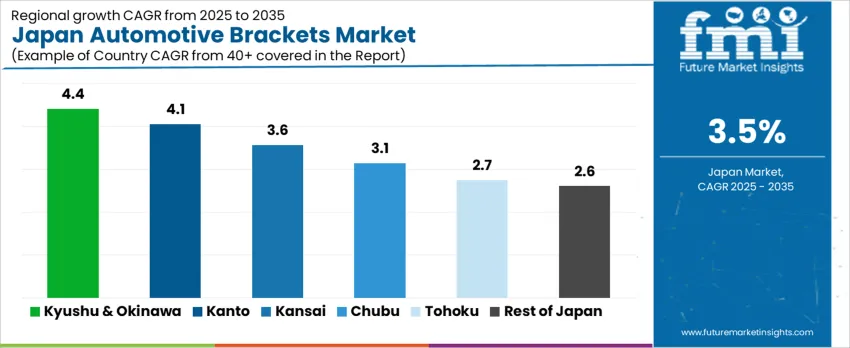
The demand for automotive brackets in Japan is expected to grow unevenly across regions. Kyushu & Okinawa lead with a CAGR of 4.4 %, supported by robust vehicle and component manufacturing facilities in that region and by supply chain strengths in auto parts production. The Kanto region follows at 4.1 %, where high concentration of assemblers and tier 1 suppliers sustains steady demand for brackets. The Kinki region’s 3.6 % growth reflects moderate manufacturing activity and parts sourcing. Chubu’s 3.1 % rate corresponds with regional automotive sub supplier presence. Tohoku and Rest of Japan show slower growth at 2.7 % and 2.6 %, reflecting lower assembly density, fewer auto parts suppliers, and more limited demand for structural components in these regions.
What is Driving the Demand for Automotive Brackets in Kyushu and Okinawa?
In Kyushu and Okinawa, the demand for automotive brackets is growing at a CAGR of 4.4% through 2035. The automotive sector in this region is primarily driven by the production of light commercial vehicles and passenger cars, with a steady increase in vehicle assembly. As local manufacturers focus on enhancing vehicle safety and performance, the need for strong, durable automotive brackets has risen. Additionally, Okinawa’s focus on eco-friendly transportation options and growing local manufacturing capabilities further fuels the demand for automotive brackets.
- Light commercial vehicle and passenger car production drive automotive bracket demand.
- Growing focus on vehicle safety and performance increases the need for durable components.
- Okinawa’s focus on eco-friendly vehicles supports the adoption of quality automotive brackets.
- Increasing local manufacturing capabilities fuel regional demand for automotive components.
How Does Kanto’s Automotive Industry Influence the Demand for Automotive Brackets?
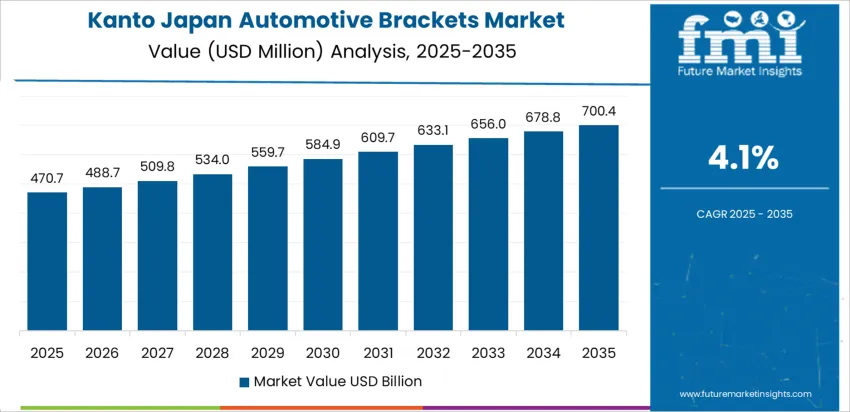
In Kanto, the demand for automotive brackets is projected to grow at a CAGR of 4.1% through 2035. As Japan’s largest automotive manufacturing region, Kanto is home to major global and domestic automotive manufacturers. The region’s focus on producing high-performance, fuel-efficient vehicles increases the demand for advanced automotive components, including brackets. Kanto’s robust automotive supply chain, which spans from production to aftermarket, also ensures steady demand for these components. With rising vehicle production and high export volumes, the need for automotive brackets continues to grow across various vehicle segments.
- Kanto’s large automotive manufacturing base drives steady demand for brackets.
- Focus on high-performance and fuel-efficient vehicles supports bracket adoption.
- Strong automotive supply chain infrastructure in Kanto ensures continuous demand.
- High production and export volumes fuel demand across multiple vehicle segments.
What Contributes to the Demand for Automotive Brackets in Kinki Region?
In Kinki, the demand for automotive brackets is expected to grow at a CAGR of 3.6% through 2035. The region’s automotive industry, particularly in Osaka and Kyoto, continues to grow, with an increasing number of both domestic and international manufacturers. As the focus shifts towards advanced vehicle technologies and lightweight materials, the demand for automotive brackets that support structural integrity and vehicle performance increases. Additionally, the growing emphasis on eco-friendly vehicle solutions further drives the need for durable, high-quality brackets to meet evolving automotive standards.
- Kinki’s automotive manufacturing and production increase bracket demand.
- The shift towards advanced vehicle technologies fuels the need for durable components.
- Focus on eco-friendly vehicles supports the demand for high-quality brackets.
- Lightweight materials in vehicle production increase the adoption of reliable automotive brackets.
How is Chubu Region’s Automotive Sector Impacting the Demand for Automotive Brackets?
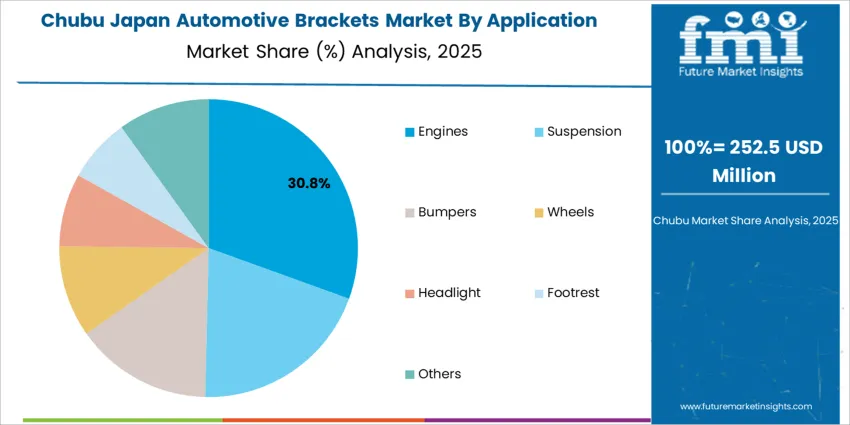
In Chubu, the demand for automotive brackets is projected to grow at a CAGR of 3.1% through 2035. The region, with a strong automotive presence in Aichi Prefecture, plays a crucial role in the production of commercial vehicles and parts. As commercial vehicle production rises and manufacturing standards become more stringent, there is an increasing need for robust and reliable automotive brackets. Additionally, the growing adoption of electric and hybrid vehicles in the region is driving demand for new, lightweight, and energy-efficient automotive components, including brackets.
- Chubu’s automotive sector in Aichi Prefecture drives consistent demand for brackets.
- The rise in commercial vehicle production increases the need for durable automotive components.
- The shift towards electric and hybrid vehicles fuels demand for lightweight automotive brackets.
- Strict manufacturing standards support the consistent adoption of high-quality brackets.
What Factors Drive the Demand for Automotive Brackets in Tohoku Region?
In Tohoku, the demand for automotive brackets is expected to grow at a CAGR of 2.7% through 2035. Although the automotive industry in Tohoku is smaller compared to other regions, steady demand persists due to vehicle servicing and replacement needs. Commercial vehicles and mid-range passenger vehicles remain essential to the region’s economy, contributing to the ongoing need for automotive brackets. As vehicle safety standards continue to evolve and the demand for reliable parts increases, the need for durable automotive brackets in the region grows steadily.
- Mid-range and commercial vehicle production support demand for automotive brackets.
- Steady aftermarket servicing demand contributes to consistent bracket usage.
- Increasing vehicle safety standards in Tohoku drive demand for high-quality components.
- Ongoing vehicle maintenance and replacement needs sustain demand in the region.
What Contributes to the Demand for Automotive Brackets in Rest of Japan?
In the rest of Japan, the demand for automotive brackets is projected to grow at a CAGR of 2.6% through 2035. While the automotive sector in these regions is not as large as in other major hubs, steady demand arises from vehicle maintenance, replacement cycles, and smaller-scale manufacturing. As vehicle fleets age and require more frequent servicing, the need for automotive components such as brackets grows. Additionally, the rest of Japan’s focus on improving fuel efficiency and vehicle safety continues to drive the adoption of advanced, durable automotive brackets for all vehicle types.
- Consistent demand from vehicle maintenance and replacement needs drives bracket adoption.
- Smaller-scale manufacturing in the rest of Japan supports steady demand.
- Aging vehicle fleets contribute to growing replacement and servicing needs.
- Focus on fuel efficiency and vehicle safety boosts demand for high-quality brackets.
What Is Driving the Demand for Automotive Brackets in Japan and Who Are the Key Players Shaping the Industry?
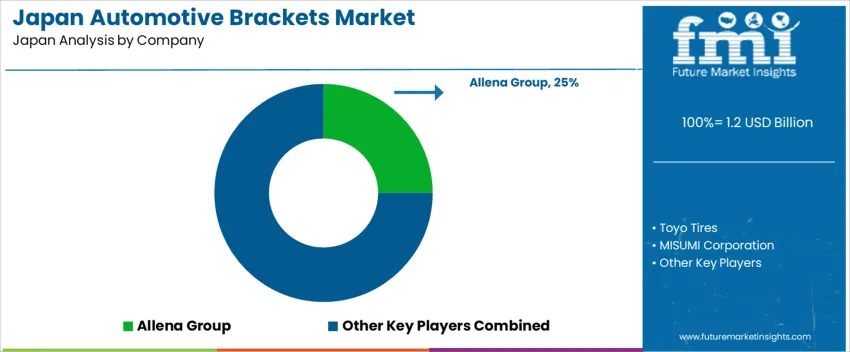
The demand for automotive brackets in Japan is driven by the country's ongoing innovation in vehicle design, with an increasing focus on lightweight materials and advanced structural components. Japanese automakers are incorporating more hybrid and electric vehicles into their fleets, which require specialized mounting systems and structural components, including high-quality brackets. These components are essential for securing various parts such as engines, suspension systems, and battery packs, particularly in the growing EV market. The automotive industry in Japan also places high demands on precision and durability, which further drives the need for high-performance brackets that can withstand heavy use and environmental factors.
Key players in the Japanese automotive bracket market include Allena Group, Toyo Tires, MISUMI Corporation, Cooper-Standard Holdings Inc., and Hangzhou Ekko Auto Parts Co., Ltd. Allena Group and MISUMI Corporation play significant roles in the domestic market by providing high-precision brackets and related components tailored to Japanese manufacturers' needs. Toyo Tires contributes by offering related parts that support automotive assemblies, including bracket applications for suspension systems. Cooper-Standard and Hangzhou Ekko also influence the market with their global supply networks, providing a variety of brackets for international OEMs and aftermarket needs. These companies are shaping the landscape by meeting the evolving demands of vehicle manufacturers for more sophisticated, lightweight, and durable bracket solutions.
Key Players in Automotive Brackets Industry in Japan
- Allena Group
- Toyo Tires
- MISUMI Corporation
- Cooper-Standard Holdings Inc.
- Hangzhou Ekko Auto Parts Co., Ltd.
Scope of the report
| Items | Values |
|---|---|
| Quantitative Units (2025) | USD billion |
| Product Type | Passive Elastomeric Bracket, Hydraulic Bracket, Active Engine Bracket |
| Application | Engines, Suspension, Bumpers, Wheels, Headlight, Footrest, Others |
| Vehicle Type | Passenger Car, Commercial Vehicle |
| Sales Channel | Original Equipment Manufacturers, Aftermarket |
| Region | Kyushu & Okinawa, Kanto, Kinki, Chubu, Tohoku, Rest of Japan |
| Countries Covered | Japan |
| Key Companies Profiled | Allena Group, Toyo Tires, MISUMI Corporation, Cooper-Standard Holdings Inc., Hangzhou Ekko Auto Parts Co., Ltd. |
| Additional Attributes | Dollar by sales by product type and application; regional growth breakdown; CAGR and volume growth projections; vehicle segment penetration and role of hybrid/EV platforms; material and weight trends (high-strength steel, aluminum, composites); focus on performance, safety, and environmental considerations; integration of advanced manufacturing techniques; supplier strategies on modular and multi-material brackets; aftermarket vs OEM demand; shift towards sustainable materials and lightweighting. |
Automotive Brackets Industry in Japan Segmentation
Product Type:
- Passive Elastomeric Bracket
- Hydraulic Bracket
- Active Engine Bracket
Application:
- Engines
- Suspension
- Bumpers
- Wheels
- Headlight
- Footrest
- Others
Vehicle Type:
- Passenger Car
- Commercial Vehicle
Sales Channel:
- Original Equipment Manufacturers
- Aftermarket
Region:
- Kyushu & Okinawa
- Kanto
- Kinki
- Chubu
- Tohoku
- Rest of Japan
Frequently Asked Questions
How big is the demand for automotive brackets in Japan in 2025?
The demand for automotive brackets in Japan is estimated to be valued at USD 1.2 billion in 2025.
What will be the size of automotive brackets in Japan in 2035?
The market size for the automotive brackets in Japan is projected to reach USD 1.7 billion by 2035.
How much will be the demand for automotive brackets in Japan growth between 2025 and 2035?
The demand for automotive brackets in Japan is expected to grow at a 3.5% CAGR between 2025 and 2035.
What are the key product types in the automotive brackets in Japan?
The key product types in automotive brackets in Japan are passive elastomeric bracket, hydraulic bracket and active engine bracket.
Which application segment is expected to contribute significant share in the automotive brackets in Japan in 2025?
In terms of application, engines segment is expected to command 30.0% share in the automotive brackets in Japan in 2025.
Preview the report firsthand - request a free sample
Get SampleGet the brochure for pricing and purchase details.
Get PDFTable of Content
- Executive Summary
- Japan Market Outlook
- Demand-side Trends
- Supply-side Trends
- Technology Roadmap Analysis
- Analysis and Recommendations
- Market Overview
- Market Coverage / Taxonomy
- Market Definition / Scope / Limitations
- Market Background
- Market Dynamics
- Drivers
- Restraints
- Opportunity
- Trends
- Scenario Forecast
- Demand in Optimistic Scenario
- Demand in Likely Scenario
- Demand in Conservative Scenario
- Opportunity Map Analysis
- Product Life Cycle Analysis
- Supply Chain Analysis
- Investment Feasibility Matrix
- Value Chain Analysis
- PESTLE and Porter’s Analysis
- Regulatory Landscape
- Regional Parent Market Outlook
- Production and Consumption Statistics
- Import and Export Statistics
- Market Dynamics
- Japan Market Analysis 2020 to 2024 and Forecast, 2025 to 2035
- Historical Market Size Value (USD Million) Analysis, 2020 to 2024
- Current and Future Market Size Value (USD Million) Projections, 2025 to 2035
- Y-o-Y Growth Trend Analysis
- Absolute $ Opportunity Analysis
- Japan Market Pricing Analysis 2020 to 2024 and Forecast 2025 to 2035
- Japan Market Analysis 2020 to 2024 and Forecast 2025 to 2035, By Product Type
- Introduction / Key Findings
- Historical Market Size Value (USD Million) Analysis By Product Type , 2020 to 2024
- Current and Future Market Size Value (USD Million) Analysis and Forecast By Product Type , 2025 to 2035
- Passive Elastomeric Bracket
- Hydraulic Bracket
- Active Engine Bracket
- Y-o-Y Growth Trend Analysis By Product Type , 2020 to 2024
- Absolute $ Opportunity Analysis By Product Type , 2025 to 2035
- Japan Market Analysis 2020 to 2024 and Forecast 2025 to 2035, By Application
- Introduction / Key Findings
- Historical Market Size Value (USD Million) Analysis By Application, 2020 to 2024
- Current and Future Market Size Value (USD Million) Analysis and Forecast By Application, 2025 to 2035
- Engines
- Suspension
- Bumpers
- Wheels
- Headlight
- Footrest
- Others
- Y-o-Y Growth Trend Analysis By Application, 2020 to 2024
- Absolute $ Opportunity Analysis By Application, 2025 to 2035
- Japan Market Analysis 2020 to 2024 and Forecast 2025 to 2035, By Vehicle Type
- Introduction / Key Findings
- Historical Market Size Value (USD Million) Analysis By Vehicle Type, 2020 to 2024
- Current and Future Market Size Value (USD Million) Analysis and Forecast By Vehicle Type, 2025 to 2035
- Passenger Car
- Commercial Vehicle
- Y-o-Y Growth Trend Analysis By Vehicle Type, 2020 to 2024
- Absolute $ Opportunity Analysis By Vehicle Type, 2025 to 2035
- Japan Market Analysis 2020 to 2024 and Forecast 2025 to 2035, By Sales Channel
- Introduction / Key Findings
- Historical Market Size Value (USD Million) Analysis By Sales Channel, 2020 to 2024
- Current and Future Market Size Value (USD Million) Analysis and Forecast By Sales Channel, 2025 to 2035
- Original Equipment Manufacturers
- Aftermarket
- Y-o-Y Growth Trend Analysis By Sales Channel, 2020 to 2024
- Absolute $ Opportunity Analysis By Sales Channel, 2025 to 2035
- Market Structure Analysis
- Competition Dashboard
- Competition Benchmarking
- Market Share Analysis of Top Players
- By Regional
- By Product Type
- By Application
- By Vehicle Type
- By Sales Channel
- Competition Analysis
- Competition Deep Dive
- Allena Group
- Overview
- Product Portfolio
- Profitability by Market Segments (Product/Age /Sales Channel/Region)
- Sales Footprint
- Strategy Overview
- Marketing Strategy
- Product Strategy
- Channel Strategy
- Toyo Tires
- MISUMI Corporation
- Cooper-Standard Holdings Inc.
- Hangzhou Ekko Auto Parts Co., Ltd
- Allena Group
- Competition Deep Dive
- Assumptions & Acronyms Used
- Research Methodology


