

- Industry Size (2025)
- USD 134.6 Mn
- Forecast (2035)
- USD 166.9 Mn
- CAGR (2025 to 2035)
- 2.2%
Demand for Automotive Grade Inductor in Japan 2025 to 2035
The Japan automotive grade inductor demand is valued at USD 134.6 million in 2025 and is forecasted to reach USD 166.9 million by 2035, recording a CAGR of 2.2%. Demand reflects the steady integration of inductive components in vehicle power electronics, including onboard chargers, DC-DC converters, engine control modules, and infotainment units. Increased utilization in electric and hybrid vehicles supports continued component upgrades that ensure thermal stability, vibration resistance, and high-current handling.
Products in the 1 to 10 microhenry inductance range hold the largest share due to their broad applicability across vehicle electronic architectures. These inductors provide stable current flow, reduced electromagnetic interference, and improved circuit efficiency. Performance improvements focus on miniaturization, high-temperature tolerance, and compliance with automotive quality standards.
Kyushu & Okinawa, Kanto, and Kansai account for the highest volumes due to the presence of automotive manufacturing clusters, Tier-1 suppliers, and electronics assembly operations. Component procurement in these regions reflects established EV production capabilities and investments in advanced automotive electronics. Key suppliers include TDK Corporation, Murata Manufacturing Co., Ltd., Vishay Intertechnology, Inc., Panasonic Corporation, and Taiyo Yuden Co., Ltd. Their product portfolios cover surface-mount and power inductors used in electrified powertrains, safety electronics, and vehicle communication systems.
Quick Stats for Japan Automotive Grade Inductor Demand
- Japan Automotive Grade Inductor Sales Value (2025): USD 134.6 million
- Japan Automotive Grade Inductor Forecast Value (2035): USD 166.9 million
- Japan Automotive Grade Inductor Forecast CAGR (2025–2035): 2.2%
- Leading Inductance Range in Japan Automotive Grade Inductor Demand: 1 to 10 micro henry
- Key Growth Regions in Japan Automotive Grade Inductor Demand: Kyushu & Okinawa, Kanto, Kansai
- Top Players in Japan Automotive Grade Inductor Demand: TDK Corporation, Murata Manufacturing Co., Ltd., Vishay Intertechnology, Inc., Panasonic Corporation, Taiyo Yuden Co., Ltd.
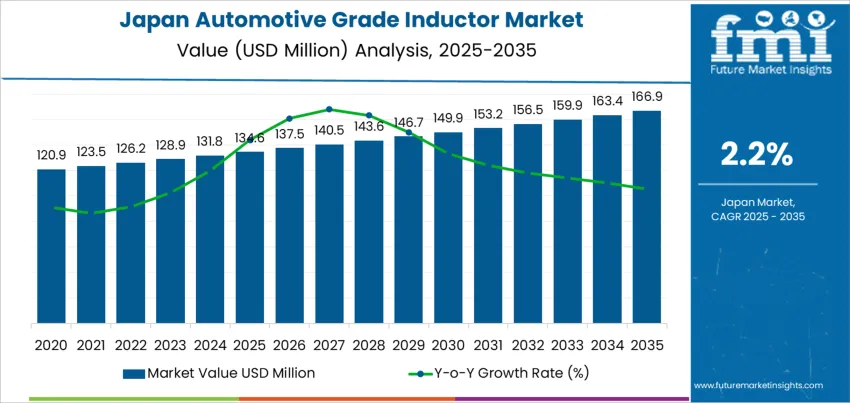
What is the Growth Forecast for Automotive Grade Inductor Industry in Japan through 2035?
Demand for automotive-grade inductors in Japan follows a phased growth curve shaped by electronics penetration in vehicle platforms. In the early period, growth is supported by advanced driver-assistance systems, infotainment upgrades, and incremental electrification. These features increase the number of inductive components per vehicle, though the scale remains linked to selective adoption in mid-to-high-end models. Early-stage growth is therefore steady but not rapid, grounded in gradual technology integration across domestic automakers.
Late-period dynamics show stronger contribution as electrified mobility becomes more widely embedded in the national fleet. EV power electronics, onboard chargers, DC-DC converters, and battery-management systems expand unit requirements, accelerating the curve. Component reliability standards drive replacement demand within supply chains, further supporting the later phase. Growth moderation may reappear once electrification penetration stabilizes and efficiency engineering reduces component counts. The comparison indicates that the larger share of cumulative expansion is expected in the second half of the decade. The growth curve transitions from electronics-feature adoption to powertrain-centric demand, reflecting a sector moving from incremental enhancement toward accelerated electrification maturity.
Japan Automotive Grade Inductor Key Takeaways
| Metric | Value |
|---|---|
| Japan Automotive Grade Inductor Sales Value (2025) | USD 134.6 million |
| Japan Automotive Grade Inductor Forecast Value (2035) | USD 166.9 million |
| Japan Automotive Grade Inductor Forecast CAGR (2025-2035) | 2.2% |
Why is the Demand for Automotive Grade Inductors in Japan Growing?
Demand for automotive grade inductors in Japan is increasing because vehicles rely on more electronic control systems that require stable power conversion and noise filtering. Hybrid and battery electric vehicles use inductors in onboard chargers, inverters and battery management units, which expands demand as electrification advances. Japanese automakers emphasise compact and efficient designs, so inductors that operate reliably under high heat and vibration conditions are essential for safety and performance.
Advanced driver assistance, infotainment and communication systems add further electronic modules, increasing the number of inductors installed per vehicle. Domestic automotive suppliers invest in next generation power electronics and higher voltage architectures that require inductors with better magnetic characteristics and smaller footprints. Efforts to enhance energy efficiency and reduce emissions reinforce the need for precise control of power electronics that inductors support. Constraints include high development and production costs for advanced materials, certification requirements that extend qualification timelines and competitive pressure to secure stable supply of components during manufacturing cycles. Smaller manufacturers may delay upgrades until platform changes justify new specifications.
Which Inductance Ranges, Applications, and Sales Channels Lead Demand for Automotive Grade Inductors in Japan?
Demand for automotive grade inductors in Japan is driven by electrification growth, advanced driver assistance system integration, and stable power regulation requirements in vehicle electronics. Japanese automakers prioritize inductors with high thermal tolerance, vibration resistance, and compact geometries for EV powertrains, onboard chargers, infotainment systems, and safety electronics. Supply chain reliability, compliance with AEC-Q200 standards, and long operational lifecycles remain core purchasing factors for manufacturers operating within Japan’s precision-focused automotive sector.
By Inductance Range, 1 to 10 Micro Henry Components Hold the Largest Share
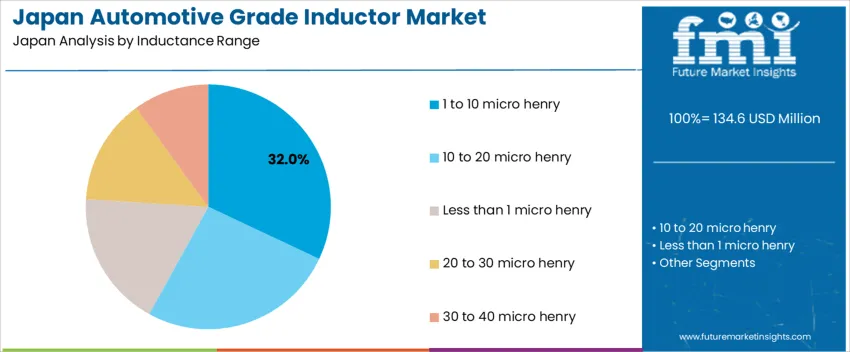
Inductors in the 1 to 10 µH range account for 32.0%, commonly used in DC-DC converters, battery management systems, and LED headlights across Japanese vehicles. They deliver efficient electromagnetic noise suppression while minimizing board space, meeting design constraints in hybrid and electric cars. The 10 to 20 µH segment holds 26.0%, serving infotainment hardware and low-frequency filtering circuits. Less than 1 µH inductors represent 18.0%, typically supporting high-switching power modules and fast response requirements. 20 to 30 µH units contribute 14.0%, while 30 to 40 µH components hold 10.0%, used in specialized drive and actuator controls. Range selection aligns with performance tuning, current capacity, and thermal load tolerance.
Key Points:
- 1–10 µH range widely used in EV power management and lighting electronics
- 10–20 µH supports audio and information systems
- Low-inductance units suit fast-switching efficiency-focused platforms
By Application, Passenger Vehicles Lead Demand
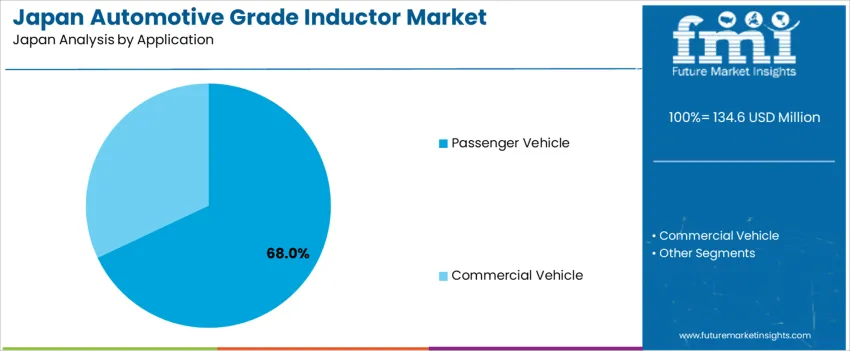
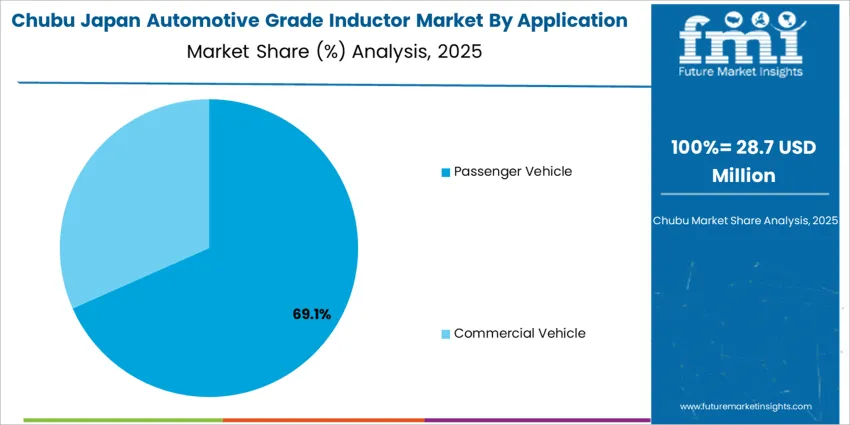
Passenger vehicles hold 68.0%, reflecting Japan’s strong hybrid and electric passenger car production where circuit reliability and compact integration define component use. Inductors enable stable voltage conversion in ADAS sensors, display modules, and active suspension controls. Commercial vehicles represent 32.0%, including buses and delivery fleets adopting electrified powertrains and telematics upgrades. Application trends follow increased electronic content per vehicle, strict emissions reduction goals, and safety-critical system expansion across major Japanese automakers.
Key Points:
- Passenger cars drive inductor usage through continuous EV advancement
- Commercial fleets adopt power electronics for efficiency and monitoring
- System integration consistency is essential for long-term reliability
By Sales Channel, OEM Procurement Dominates
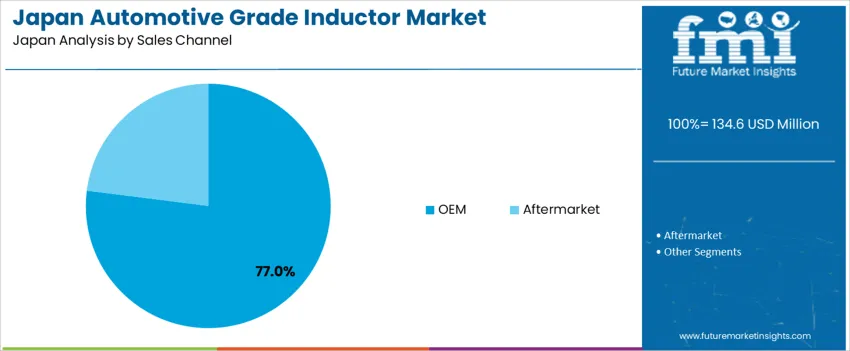
OEM channels account for 77.0%, driven by direct sourcing relationships with tier-1 suppliers to ensure component traceability and adherence to Japanese production specifications. Early design involvement supports precise electrical matching and lifecycle durability testing. The aftermarket holds 23.0%, serving repair and replacement needs for power electronics used in aging transport fleets. The predominant OEM focus reflects Japan’s centralized automotive manufacturing model, emphasizing quality assurance and standardized electronics architecture.
Key Points:
- Most volume fulfilled through established OEM supply chains
- Aftermarket supports servicing of electronics-dense vehicle fleets
- Approval traceability and efficiency standards influence sourcing decisions
What are the Drivers, Restraints, and Key Trends of the Demand for Automotive Grade Inductors in Japan?
Expansion of electrified vehicle production, increased electronics content in safety systems and strong domestic supply chains for passive components are driving demand.
In Japan, automotive grade inductors benefit from the national shift toward hybrid and battery electric vehicles, which require efficient power conversion in inverters, onboard chargers and DC-DC converters. Major automakers located in Aichi, Tochigi and Hiroshima increase use of inductors in ADAS modules, including cameras and radar systems that demand stable current filtering. Domestic electronics suppliers in regions such as Tochigi and Gunma maintain established manufacturing capacity for passive components used in vehicle body control, engine management and infotainment systems. Japan’s commitment to advanced automotive production supports continuous integration of inductors optimized for thermal stability and vibration resistance in long-life vehicle architectures.
High qualification requirements, long design cycles and sensitivity to import costs for magnetic materials restrain adoption.
Automotive grade inductors must comply with strict reliability and safety standards, which extend validation timelines for new designs across Japanese OEM platforms. Once approved, components remain locked in for several years, slowing rapid transitions to next-generation inductor technologies. Many magnetic materials and wire coatings used in premium inductors rely on imported inputs, exposing manufacturers to exchange-rate volatility that affects pricing. These operational and cost constraints reduce short-term flexibility in design changes and procurement strategies.
Shift toward high-temperature inductors for EV powertrains, increased collaboration with semiconductor suppliers and rising miniaturization for compact vehicle platforms define key trends.
EV platforms require inductors that maintain inductance stability under high heat loads created by fast-charging and high-power drive modules, driving demand for advanced ferrite and metal composite cores. Chip manufacturers and passive-component producers in Japan are collaborating to ensure electromagnetic compatibility between controllers and inductors used in ADAS and body network systems. Kei and mid-size vehicle segments encourage miniaturized components to support limited available space without compromising electrical performance. Pilot projects for autonomous fleet vehicles also prioritize inductors optimized for higher power density and continuous operation in commercial duty cycles. These trends indicate steady and technology-aligned demand for automotive grade inductors across Japan.
Analysis of the Demand for Automotive Grade Inductors in Japan by Region
Demand for automotive grade inductors in Japan reflects increasing electronic component density per vehicle, support for power conversion in hybrid architectures, and stable procurement cycles linked to tiered automotive suppliers. System reliability, vibration tolerance, and compact packaging influence sourcing decisions. Kyushu & Okinawa leads at 2.7%, followed by Kanto (2.5%), Kansai (2.2%), Chubu (1.9%), Tohoku (1.7%), and the Rest of Japan (1.6%).
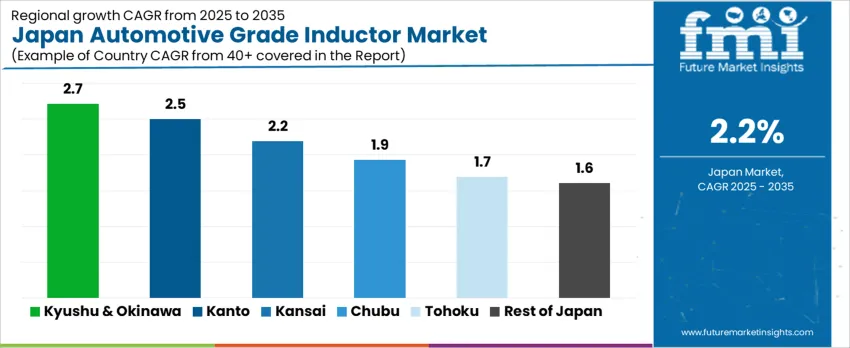
| Region | CAGR (2025-2035) |
|---|---|
| Kyushu & Okinawa | 2.7% |
| Kanto | 2.5% |
| Kansai | 2.2% |
| Chubu | 1.9% |
| Tohoku | 1.7% |
| Rest of Japan | 1.6% |
How is Kyushu & Okinawa driving demand for automotive grade inductors?
Kyushu & Okinawa posts 2.7% CAGR, driven by automotive parts production across hubs such as Fukuoka and Kumamoto where inductors are essential for DC-DC conversion, in-vehicle control modules, and noise-filtering in power electronics. Regional suppliers focus on components supporting stable current regulation in compact layouts used in electric sub-systems. Tier-2 manufacturing facilities adopt inductors designed to withstand mechanical vibration from suspension-area placement. Short lead-time procurement supports continuous assembly scheduling as localized production reduces dependence on cross-region shipments. Electrical testing labs validate temperature stability for under-hood placement. Packaging decisions emphasize traceability and solder-joint strength to align with automotive qualification standards. Logistical access to port facilities in Kyushu enables export support.
- Tier-2 assembly operations sustaining component demand
- Vibration-tolerant inductors supporting placement flexibility
- Local test facilities verifying temperature resilience
- Ports supporting outbound component logistics
How is Kanto shaping adoption of automotive grade inductors?
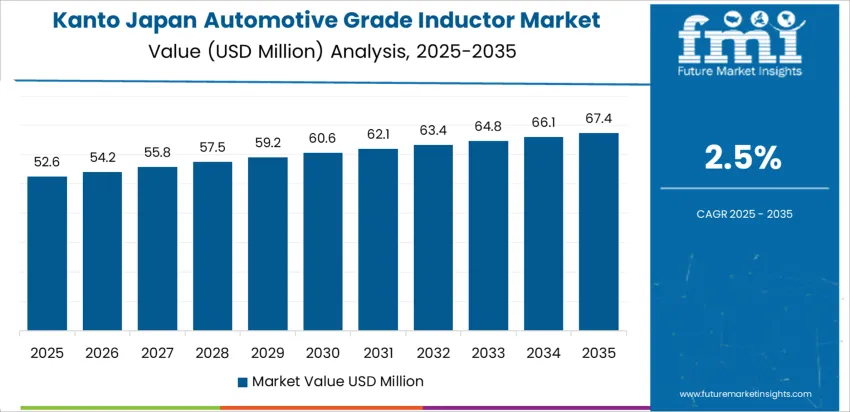
Kanto records 2.5% CAGR, supported by major electronics developers and automotive system integrators operating in Tokyo, Kanagawa, and Saitama. In-vehicle displays, safety controllers, and power steering modules require inductors for signal conditioning and energy conversion stability. Procurement teams prioritize high-reliability surface-mount components that maintain performance through extended duty cycles. Engineering evaluations focus on magnetic core materials that sustain consistent inductance measurements under thermal fluctuation. Production plants adopt packaging suited to automated pick-and-place lines used in high-output electronics manufacturing. E-commerce channels for B2B supply allow technical buyers to source variants meeting exact power ratings.
- Safety electronics expanding inductor relevance
- Automated assembly driving dimensional precision
- Thermal reliability supporting core material selection
- Centralized procurement simplifying technical sourcing
How is Kansai contributing to inductor procurement?
Kansai posts 2.2% CAGR, driven by automotive electronics manufacturing centered in Osaka and Kobe. Components support functions including body-electronics control, LED lighting drivers, and audio-system noise suppression. Procurement choices emphasize compact shielded inductors that minimize electromagnetic interference in multi-board layouts. Regional suppliers maintain moderate-volume production aligned to diversified automotive programs rather than single-platform dependency. Testing facilities monitor quality characteristics such as saturation current performance across continuous operational loads.
- Shielded designs addressing EMI mitigation
- Multi-board vehicles requiring compact component geometry
- Moderate manufacturing volumes sustaining steady adoption
- Quality verification reinforcing performance consistency
How is Chubu shaping sourcing patterns?
Chubu records 1.9% CAGR, centered on automotive component production clusters across Aichi, Gifu, and Shizuoka. Demand relates to electronic control modules used in powertrain systems, vehicle safety subsystems, and cabin-comfort components. Procurement teams rely on components that meet extended certification durations to maintain platform stability over multi-year production cycles. Engineering teams evaluate inductors based on vibration endurance and copper-loss performance under high-load conditions common in engine-adjacent placements. Contract manufacturers focus on integrating inductors with standardized pad layouts that ensure predictable placement accuracy. Thermal resilience testing supports stable usage in environments exposed to repeated temperature shifts from frequent vehicle operation. Logistics networks serving automotive OEM lines require accurate JIT supply schedules that support uninterrupted assembly flow. Procurement cost sensitivity reinforces reliance on established domestic suppliers familiar with design expectations across Chubu automotive facilities.
- Qualification longevity guiding part selection
- Automotive vibration standards shaping durability needs
- JIT deliveries supporting continuous assembly operations
- Layout standardization improving compatibility
How is Tohoku influencing demand for inductors?
Tohoku posts 1.7% CAGR, shaped by regional automotive electronics production in Miyagi, Iwate, and Fukushima, with component sourcing designed around stable supply contracts. Inductors support electronic modules in lighting control, seat-adjustment systems, and instrument-panel functions. Cold-weather driving across the region requires components that maintain magnetic stability and solder-joint integrity through low-temperature exposure. Smaller production facilities emphasize traceability for each component shipment to reinforce defect-response visibility and supplier accountability. Procurement teams favor compact shielded inductors that assist with noise control in products exposed to EMI-dense cabin environments. Batch-based scheduling supports procurement predictability for suppliers serving multiple low-to-moderate volume programs.
- Cold-climate resilience affecting performance expectations
- Shielded geometries aiding EMI management
- Traceable supply supporting quality assurance
- Batch-aligned ordering enabling consistent usage
How is the Rest of Japan adopting automotive inductors? (Revised)
The Rest of Japan posts 1.6% CAGR, influenced by demand for electronics in smaller-scale automotive manufacturing and localized tier-2 supplier operations. Inductors support functions in HVAC actuators, mirror-adjustment systems, and accessory power units that require stable current management. Procurement cycles match periodic component refresh periods instead of rapid design change. Buyers maintain inventories that minimize production stoppage risks due to supply delays. Compact standardized package formats help assembly teams maintain process stability without production-line reconfiguration. Reliability expectations reflect long-operating vehicles that dominate regional mobility patterns. Distribution routing spans wide geographic areas requiring accurate forecast alignment to avoid under-stocking or over-storage.
- Replacement-linked demand shaping purchasing cycles
- Standardized footprints maintaining assembly continuity
- Inventory security reducing downtime exposure
- Reliability requirements guiding long-term usage
What is the competitive landscape of demand for automotive-grade inductors in Japan?
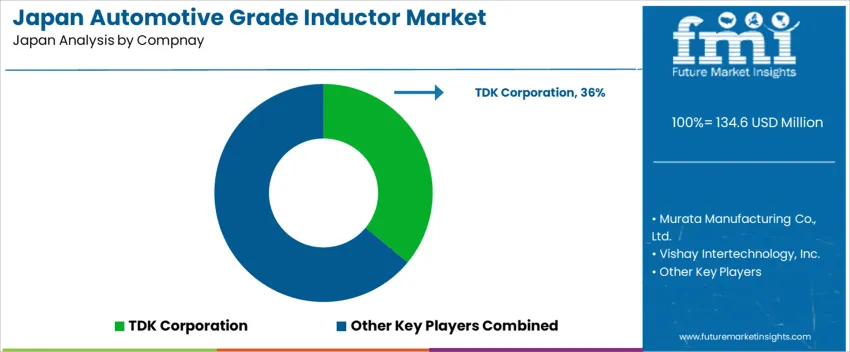
Demand for automotive-grade inductors in Japan is driven by suppliers supporting power-conversion, filtering, and signal-conditioning functions in electric-drive systems, ADAS electronics, and in-vehicle infotainment. TDK Corporation holds an estimated 36% share, supported by controlled inductance tolerance, vibration-resistant construction, and strong supply relationships with Japanese automotive OEMs and Tier-1 electronics integrators. Its components maintain stable magnetic characteristics under elevated temperatures and electrical-noise exposure common in mobility applications. Murata Manufacturing Co., Ltd. maintains strong participation with compact multilayer inductors that provide predictable impedance performance for high-frequency automotive electronics. Its devices offer secure solder-joint reliability and verified AEC-Q200 qualification for long-term system durability. Vishay Intertechnology, Inc. contributes presence through shielded inductors used in power electronics where precise current handling and minimal core losses support efficiency in hybrid and EV platforms.
Panasonic Corporation supports selective demand in noise-suppression and DC-DC converter assemblies, offering inductors with consistent thermal behaviour and stable saturation characteristics required in high-density electronics packaging. Taiyo Yuden Co., Ltd. adds capability in miniaturized automotive inductors designed for reliable EMC performance in sensor and control electronics. Competition in Japan focuses on temperature-stability performance, mechanical robustness, inductance accuracy, electromagnetic-noise control, and dependable delivery to automotive production schedules. Demand continues as Japanese mobility manufacturers adopt higher-efficiency power electronics and expand electrification across passenger-vehicle and commercial-fleet platforms.
Key Players in Japan Automotive Grade Inductor Demand
- TDK Corporation
- Murata Manufacturing Co., Ltd.
- Vishay Intertechnology, Inc.
- Panasonic Corporation
- Taiyo Yuden Co., Ltd.
Scope of the Report
| Items | Values |
|---|---|
| Quantitative Units | USD million |
| Inductance Range | Less than 1 micro henry, 1 to 10 micro henry, 10 to 20 micro henry, 20 to 30 micro henry, 30 to 40 micro henry |
| Application | Passenger Vehicle, Commercial Vehicle |
| Sales Channel | OEM, Aftermarket |
| Regions Covered | Kyushu & Okinawa, Kanto, Kansai, Chubu, Tohoku, Rest of Japan |
| Key Companies Profiled | TDK Corporation, Murata Manufacturing Co., Ltd., Vishay Intertechnology, Inc., Panasonic Corporation, Taiyo Yuden Co., Ltd. |
| Additional Attributes | Focus on high-reliability and AEC-Q200-certified inductors supporting ADAS, infotainment, powertrain control, and EV power electronics; demand driven by miniaturization, low core loss, high current tolerance, and electromagnetically efficient designs; integration with DC-DC converters and onboard chargers; adoption trends show higher usage in hybrid and battery electric vehicles across major Japanese automotive manufacturers. |
Japan Automotive Grade Inductor Demand by Segments
Inductance Range:
- 1 to 10 micro henry
- 10 to 20 micro henry
- Less than 1 micro henry
- 20 to 30 micro henry
- 30 to 40 micro henry
Application:
- Passenger Vehicle
- Commercial Vehicle
Sales Channel:
- OEM
- Aftermarket
Region:
- Kyushu & Okinawa
- Kanto
- Kansai
- Chubu
- Tohoku
- Rest of Japan
Frequently Asked Questions
How big is the demand for automotive grade inductor in Japan in 2025?
The demand for automotive grade inductor in Japan is estimated to be valued at USD 134.6 million in 2025.
What will be the size of automotive grade inductor in Japan in 2035?
The market size for the automotive grade inductor in Japan is projected to reach USD 166.9 million by 2035.
How much will be the demand for automotive grade inductor in Japan growth between 2025 and 2035?
The demand for automotive grade inductor in Japan is expected to grow at a 2.2% CAGR between 2025 and 2035.
What are the key product types in the automotive grade inductor in Japan?
The key product types in automotive grade inductor in Japan are 1 to 10 micro henry, 10 to 20 micro henry, less than 1 micro henry, 20 to 30 micro henry and 30 to 40 micro henry.
Which application segment is expected to contribute significant share in the automotive grade inductor in Japan in 2025?
In terms of application, passenger vehicle segment is expected to command 68.0% share in the automotive grade inductor in Japan in 2025.
Preview the report firsthand - request a free sample
Get SampleGet the brochure for pricing and purchase details.
Get PDFTable of Content
- Executive Summary
- Japan Market Outlook
- Demand-side Trends
- Supply-side Trends
- Technology Roadmap Analysis
- Analysis and Recommendations
- Market Overview
- Market Coverage / Taxonomy
- Market Definition / Scope / Limitations
- Market Background
- Market Dynamics
- Drivers
- Restraints
- Opportunity
- Trends
- Scenario Forecast
- Demand in Optimistic Scenario
- Demand in Likely Scenario
- Demand in Conservative Scenario
- Opportunity Map Analysis
- Product Life Cycle Analysis
- Supply Chain Analysis
- Investment Feasibility Matrix
- Value Chain Analysis
- PESTLE and Porter’s Analysis
- Regulatory Landscape
- Regional Parent Market Outlook
- Production and Consumption Statistics
- Import and Export Statistics
- Market Dynamics
- Japan Market Analysis 2020 to 2024 and Forecast, 2025 to 2035
- Historical Market Size Value (USD Million) Analysis, 2020 to 2024
- Current and Future Market Size Value (USD Million) Projections, 2025 to 2035
- Y-o-Y Growth Trend Analysis
- Absolute $ Opportunity Analysis
- Japan Market Pricing Analysis 2020 to 2024 and Forecast 2025 to 2035
- Japan Market Analysis 2020 to 2024 and Forecast 2025 to 2035, By Inductance Range
- Introduction / Key Findings
- Historical Market Size Value (USD Million) Analysis By Inductance Range , 2020 to 2024
- Current and Future Market Size Value (USD Million) Analysis and Forecast By Inductance Range , 2025 to 2035
- 1 to 10 micro henry
- 10 to 20 micro henry
- Less than 1 micro henry
- 20 to 30 micro henry
- 30 to 40 micro henry
- Y-o-Y Growth Trend Analysis By Inductance Range , 2020 to 2024
- Absolute $ Opportunity Analysis By Inductance Range , 2025 to 2035
- Japan Market Analysis 2020 to 2024 and Forecast 2025 to 2035, By Application
- Introduction / Key Findings
- Historical Market Size Value (USD Million) Analysis By Application, 2020 to 2024
- Current and Future Market Size Value (USD Million) Analysis and Forecast By Application, 2025 to 2035
- Passenger Vehicle
- Commercial Vehicle
- Y-o-Y Growth Trend Analysis By Application, 2020 to 2024
- Absolute $ Opportunity Analysis By Application, 2025 to 2035
- Japan Market Analysis 2020 to 2024 and Forecast 2025 to 2035, By Sales Channel
- Introduction / Key Findings
- Historical Market Size Value (USD Million) Analysis By Sales Channel, 2020 to 2024
- Current and Future Market Size Value (USD Million) Analysis and Forecast By Sales Channel, 2025 to 2035
- OEM
- Aftermarket
- Y-o-Y Growth Trend Analysis By Sales Channel, 2020 to 2024
- Absolute $ Opportunity Analysis By Sales Channel, 2025 to 2035
- Market Structure Analysis
- Competition Dashboard
- Competition Benchmarking
- Market Share Analysis of Top Players
- By Regional
- By Inductance Range
- By Application
- By Sales Channel
- Competition Analysis
- Competition Deep Dive
- TDK Corporation
- Overview
- Product Portfolio
- Profitability by Market Segments (Product/Age /Sales Channel/Region)
- Sales Footprint
- Strategy Overview
- Marketing Strategy
- Product Strategy
- Channel Strategy
- Murata Manufacturing Co., Ltd.
- Vishay Intertechnology, Inc.
- Panasonic Corporation
- Taiyo Yuden Co., Ltd.
- TDK Corporation
- Competition Deep Dive
- Assumptions & Acronyms Used
- Research Methodology


