

- Industry Size (2025)
- USD 198.5 Mn
- Forecast (2035)
- USD 890.8 Mn
- CAGR (2025 to 2035)
- 16.2%
Demand for Automotive AI Chipset in Japan 2025 to 2035
The Japan automotive AI chipset demand is valued at USD 198.5 million in 2025 and is forecasted to reach USD 890.8 million by 2035, reflecting a CAGR of 16.2%. Growth is supported by increased integration of artificial intelligence capabilities into advanced driver-assistance systems, in-vehicle control modules, and connected mobility platforms. Autonomous functions, real-time perception, and safety-related decision-making processes are strengthening chipset requirements in new vehicle programmes. GPUs lead the chipset landscape due to high parallel-processing efficiency, suitability for visual recognition workloads, and ability to support machine-learning inference. Their adoption aligns with rising deployment of camera-based sensing and predictive analytics in passenger and commercial models. Improvements in energy efficiency and thermal performance continue to influence manufacturer selection.
Kyushu & Okinawa, Kanto, and Kinki record highest implementation levels, driven by automotive production centers, semiconductor development hubs, and investment in electric and intelligent mobility programmes. Collaboration between automotive OEMs and semiconductor suppliers sustains ongoing innovation in onboard computing architecture. Key suppliers include Renesas Electronics Corporation; NVIDIA (Japan); Sony Semiconductor Solutions; Toshiba Electronic Devices & Storage Corporation; and NXP (Japan). Their portfolios support applications in perception processing, control-unit integration, and autonomous mobility functions used across future-generation automotive platforms.
Quick Stats for Japan Automotive AI Chipset Demand
- Japan Automotive AI Chipset Sales Value (2025): USD 198.5 million
- Japan Automotive AI Chipset Forecast Value (2035): USD 890.8 million
- Japan Automotive AI Chipset Forecast CAGR (2025–2035): 16.2%
- Leading Product Type in Japan Automotive AI Chipset Demand: GPUs
- Key Growth Regions in Japan Automotive AI Chipset Demand: Kyushu & Okinawa, Kanto, Kinki
- Top Players in Japan Automotive AI Chipset Demand: Renesas Electronics Corporation, NVIDIA (Japan), Sony Semiconductor Solutions, Toshiba Electronic Devices & Storage Corporation, NXP (Japan)
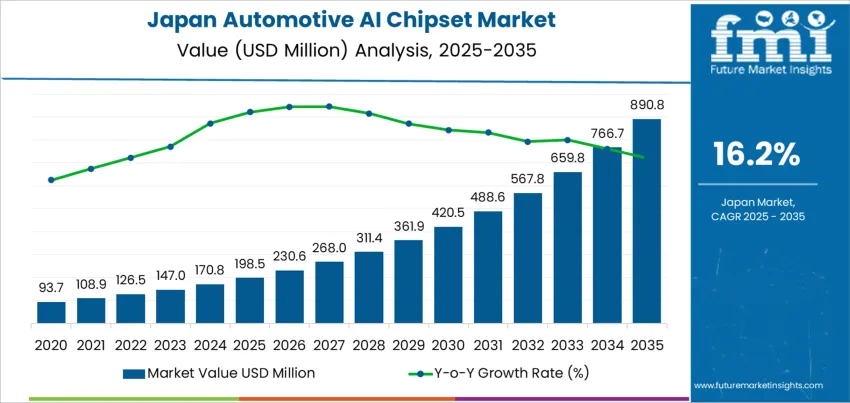
What is the Growth Forecast for Automotive AI Chipset Industry in Japan through 2035?
Demand for automotive AI chipsets in Japan demonstrates an advancing growth momentum tied to electrification, advanced driver-assistance systems, and connected-vehicle deployment. Early momentum is shaped by premium vehicle manufacturers integrating perception, decision, and safety-monitoring processors into flagship models. These applications form the core volume contribution as regulatory frameworks encourage collision-avoidance technologies and lane-support functions.
The next momentum layer is driven by autonomous-capable architectures in commercial and public-transport fleets. Field trials in urban corridors and controlled zones add incremental uptake, though volume scale is paced by validation requirements. Semiconductor innovation supports continued acceleration as local producers strengthen design for thermal reliability, cybersecurity, and low-latency processing. Momentum moderation may occur when upgrade cycles stabilize and non-AI electronics reach efficiency thresholds that limit unit proliferation.
Despite these shifts, trajectory remains clearly positive. Automotive electrification and intelligent-mobility programs expand the chipset addressable base, sustaining mid-term acceleration followed by a controlled maturity phase rooted in mandated safety and operational-efficiency needs.
Japan Automotive AI Chipset Key Takeaways
| Metric | Value |
|---|---|
| Japan Automotive AI Chipset Sales Value (2025) | USD 198.5 million |
| Japan Automotive AI Chipset Forecast Value (2035) | USD 890.8 million |
| Japan Automotive AI Chipset Forecast CAGR (2025-2035) | 16.2% |
Why is the Demand for Automotive AI Chipsets in Japan Growing?
Demand for automotive AI chipsets in Japan is increasing because vehicle manufacturers are integrating advanced driver assistance functions that require real time processing of data from cameras, radar and lidar sensors. Japan focuses on safety technologies that support automated braking, lane keeping and congestion assistance, which strengthens the need for high performance processors inside new vehicles. Electrification and the growth of hybrid and battery electric vehicles also contribute, since power management and predictive control systems depend on continuous data analysis.
Japanese suppliers invest in smart mobility platforms where connected vehicles exchange information with road infrastructure. This encourages adoption of chipsets capable of fast communication and traffic prediction. Robotics and factory automation expertise in Japan influences automotive production, expanding the role of semiconductor intelligence in quality and drive control systems. Government programmes promoting domestic semiconductor capability support investment in automotive grade chip development. Constraints include high development cost, long safety certification cycles and competition for secure supply of advanced process nodes. Some smaller automakers delay introducing full AI functionality until economic conditions and regulatory expectations make the investment more practical.
Which Product Types, Applications, and Processing Categories Lead Demand for Automotive AI Chipsets in Japan?
Demand for automotive AI chipsets in Japan is influenced by expanding electrification, government support for road-safety innovations, and integration of intelligent driver-assistance capabilities in locally manufactured vehicles. Automakers emphasize reduced power consumption, high-speed data handling, and functional safety compliance to support decision-making in dynamic driving environments. Domestic production benefits from semiconductor ecosystem maturity and collaborations between electronics firms and mobility OEMs. Adoption aligns with automated driving initiatives, continuous sensor data analysis, and infotainment personalization.
By Product, GPUs Hold the Largest Share
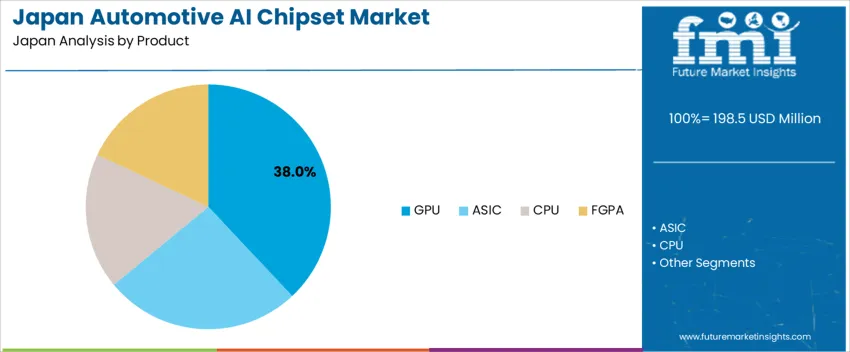
GPUs represent 38.0%, driven by strong demand for parallel computing required in perception tasks such as object detection and sensor fusion. These units support real-time processing for advanced navigation and on-road visibility systems. ASICs account for 26.0%, offering power-efficient execution in specialized safety applications. CPUs hold 18.0%, supporting system coordination and vehicle control logic. FPGAs represent 18.0%, valued for reconfigurable hardware adaptable to model updates during vehicle life cycles. Product selection emphasizes processing efficiency, thermal management, and compatibility with ADAS architectures deployed by Japanese automakers.
Key points:
- GPUs lead in visual-computing workloads.
- ASICs support faster inference in dedicated functions.
- CPUs and FPGAs maintain core system-control adaptability.
By Application, Autonomous Driving Holds the Largest Share
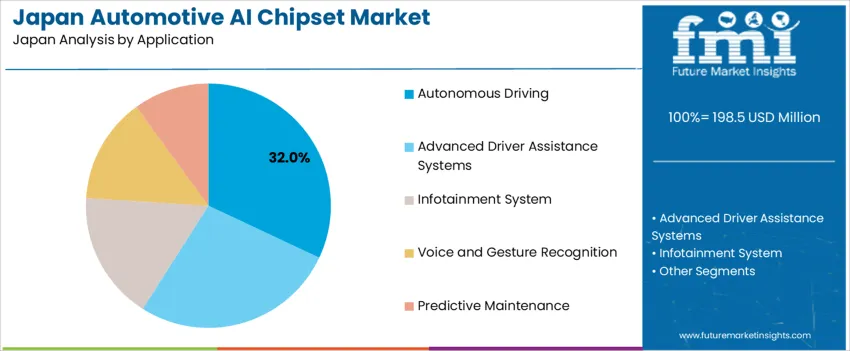
Autonomous driving accounts for 32.0%, supported by continuous testing of higher-level automation functions on Japanese roads. These chipsets enable navigation, obstacle classification, and decision-support logic across complex urban environments. ADAS represents 27.0%, reflecting installation of lane-keeping, adaptive cruise control, and collision-avoidance systems in mass-market vehicles. Infotainment systems hold 17.0%, enhancing personalized digital interfaces. Voice and gesture recognition represent 14.0%, supporting hands-free interaction. Predictive maintenance accounts for 10.0%, enabling efficient fault detection. Application distribution reflects regulatory focus on safety and differentiated driving-assistance features.
Key points:
- Autonomous functions guide long-term integration.
- ADAS supports broad consumer deployment.
- Cabin-experience enhancements contribute steady adoption.
By Processing Type, Machine Learning Leads
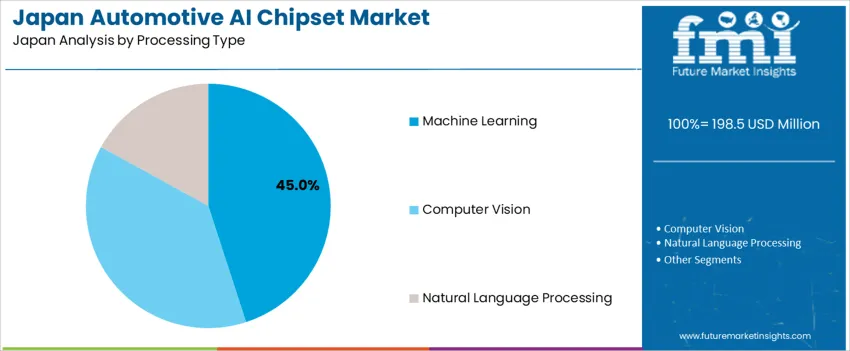
Machine learning accounts for 45.0%, enabling adaptive decision-making, behavior prediction, and response optimization across high-traffic scenarios. Computer vision holds 38.0%, driven by camera-dependent perception for lane marking detection and environmental awareness. Natural language processing represents 17.0%, supporting voice-command functions integrated into infotainment systems. Processing selection focuses on low-latency inference, neural-network acceleration, and compatibility with multimodal sensor input. System evolution emphasizes model-training efficiency, cyber-secure learning deployment, and scalable upgrades aligned with maturing automation capabilities in Japan’s passenger-vehicle fleet.
Key points:
- Machine learning drives vehicle intelligence improvements.
- Computer vision supports real-time situational analysis.
- NLP enables safe, interaction-based control features.
What are the Drivers, Restraints, and Key Trends of the Demand for Automotive AI Chipsets in Japan?
Expansion of advanced driver-assistance systems, increased EV and hybrid development and strong OEM presence in automated driving R&D are driving demand.
In Japan, automotive AI chipset usage increases as automakers enhance ADAS functions such as lane-keeping, blind-spot monitoring and parking assistance in models targeted for domestic roads. EV and hybrid platforms developed in Aichi, Hiroshima and Tochigi require onboard computing for safety monitoring, powertrain control and sensor fusion. OEMs and Tier-1 suppliers collaborate on automated driving pilots in Tokyo and highway corridors, supporting demand for chipsets that process camera, radar and lidar data in real time. Commercial fleet operators in logistics and public transport also explore AI-enabled safety features that reduce collision risk in congested urban environments. These applications strengthen procurement among Japanese vehicle manufacturers adapting to stricter safety expectations and mobility innovation policies.
High certification requirements, long vehicle development cycles and limited availability of advanced domestic semiconductor fabs restrain adoption.
Automotive chipsets must meet safety and reliability standards that lengthen validation processes, slowing rollout in vehicles designed for mass production. The multiyear development timelines of Japanese OEMs limit rapid platform upgrades once architecture decisions are set. Japan continues to expand advanced semiconductor capacity, yet reliance on overseas fabrication for leading-edge nodes increases supply chain exposure, especially for compute-intensive AI chips. Cost-sensitive vehicle segments may delay introduction of high-performance chipsets until integration benefits are clearly proven. These structural and economic constraints temper large-scale deployment outside premium and commercial models.
Shift toward centralized vehicle computing, increased collaboration with domestic sensor manufacturers and rising demand for over-the-air optimization define key trends.
Automakers are transitioning from multiple distributed ECUs to centralized compute units that require high-efficiency AI chipsets capable of managing multiple perception tasks. Suppliers integrate chipsets closely with Japanese-made cameras and radar modules to support compact vehicle designs common in kei and mid-size segments. Over-the-air software updates are gaining traction, requiring chipsets optimized for continuous learning and field performance improvements. Pilot deployments of automated logistics vehicles in ports and warehouse hubs increase demand for robust AI computing suitable for controlled-route autonomy. These trends indicate expanding adoption of automotive AI chipsets aligned with Japan’s mobility innovation priorities.
Analysis of the Demand for Automotive AI Chipsets in Japan by Region
Automotive AI chipsets support advanced driver-assistance systems, autonomous navigation features, predictive maintenance analytics, and electric vehicle power optimization. Demand aligns with automotive R&D clusters, semiconductor capabilities, and vehicle electrification pathways across Japan. Kyushu & Okinawa leads at 20.3% CAGR, driven by semiconductor foundry proximity, while Kanto (18.6%), Kinki (16.4%), Chubu (14.4%), Tohoku (12.6%), and Rest of Japan (12.0%) follow with differentiated adoption drivers.
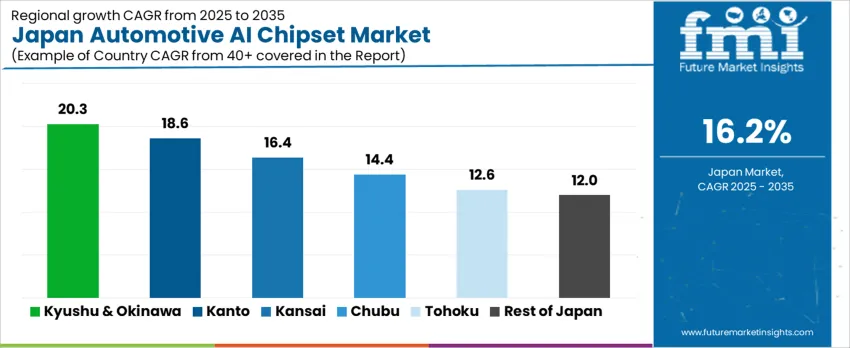
| Region | CAGR (2025-2035) |
|---|---|
| Kyushu & Okinawa | 20.3% |
| Kanto | 18.6% |
| Kinki | 16.4% |
| Chubu | 14.4% |
| Tohoku | 12.6% |
| Rest of Japan | 12.0% |
How is Kyushu & Okinawa driving demand for automotive AI chipsets?
Kyushu & Okinawa maintains 20.3% CAGR, influenced by semiconductor ecosystem concentration in Fukuoka and Kumamoto, along with expanding collaborations with Japanese automotive manufacturers integrating semi-autonomous platforms. Vehicle-chip production pilots focus on low-power neural processors applied to real-time driving decisions, pedestrian detection, and adaptive cruise control stabilization. Fleet electrification across logistics operations increases requirements for e-powertrain control chips embedded in battery modulation systems. Suppliers ensure radiation-resistant architectures for reliability under variable weather and road conditions. AI microcontrollers used in onboard diagnostics support predictive maintenance features distributed through service networks across Kyushu. Startup initiatives backed by regional funds contribute to high-performance edge computing chips packaged for compact automotive modules.
- Semiconductor cluster supporting chipset supply
- EV fleet digitalization lifting neural processor demand
- Predictive maintenance applications embedded into control units
- On-vehicle safety systems shaping AI architecture design
How is Kanto shaping demand for automotive AI chipsets?
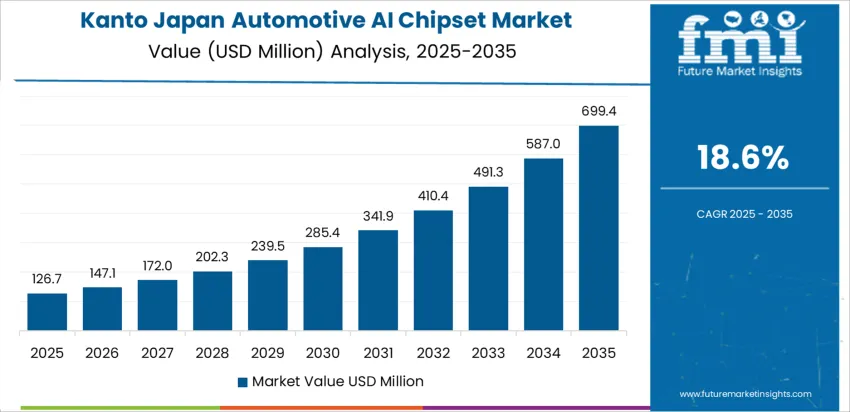
Kanto posts 18.6% CAGR, driven by Tokyo-Yokohama automotive innovation programs, fleet connectivity deployments, and continuous rollouts of high-precision safety automation. Manufacturers apply AI chips to fusion-sensor modules interpreting radar, LiDAR, and camera inputs for driver-assistance features. Connectivity infrastructure enables real-time decision computing integrated with maps updated through cloud services. Chipset characteristics prioritized in procurement include thermal stability, low-latency processing, and seamless compatibility with existing automotive control frameworks. Software-defined vehicle initiatives in R&D labs contribute to new chip adoption during platform refresh cycles.
- ADAS enhancements anchoring chipset upgrades
- Cloud-linked navigation driving computing integration
- R&D clusters supporting software-defined vehicle roadmaps
- Vehicle safety compliance shaping chipset selection
How is Kinki influencing adoption of automotive AI chipsets?
Kinki expands at 16.4% CAGR, supported by development in Osaka and Kobe automotive supply networks. Vehicle electronics manufacturers implement AI-enabled software to refine parking automation and lane monitoring. Suppliers prioritize chips designed for compact component enclosures, benefiting passenger and commercial vehicles with tight sensor arrangements. Local testing facilities validate chipset consistency under road vibration, prioritizing zero-latency braking responses. Procurement teams consider lifecycle security provisions to maintain protected data environments within vehicles.
- Sensor integration supporting compact chipset requirements
- Testing centers guiding hardware safety reliability
- Secure computing architectures influencing purchases
- Urban mobility applications sustaining chip utilization
How is Chubu contributing to automotive AI chipset demand?
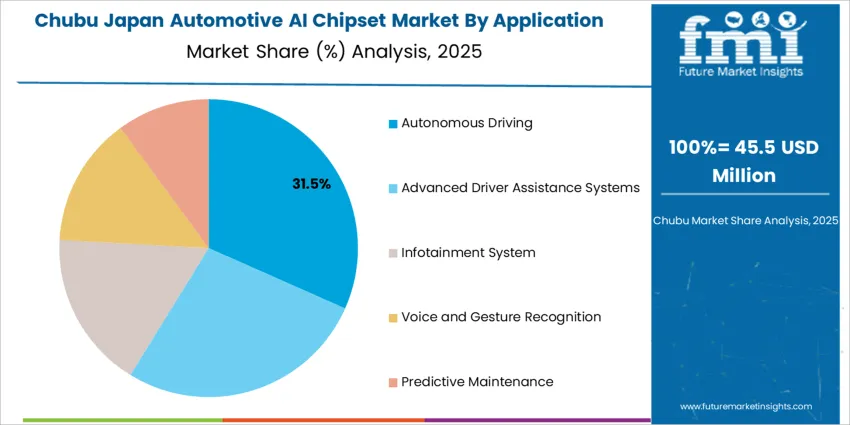
Chubu reaches 14.4% CAGR, driven by automotive production strength in Aichi Prefecture. AI chipsets support efficiency improvements in electric powertrains, regenerative braking optimization, and localized manufacturing automation. Component developers seek hardware that withstands sustained high temperatures common in engine-bay installations. Production lines adopt embedded diagnostic chips for assembly verification and calibration tasks, lowering error margins. Demand shows alignment with export vehicle platforms, requiring scalable chip variants adaptable to international navigation policies.
- Automotive production density sustaining chipset adoption
- Thermal-resistant chips meeting heat-exposure needs
- Diagnostics enhancing assembly accuracy
- Export vehicle calibration shaping component sourcing
How is Tohoku shaping automotive AI chipset demand?
Tohoku reaches 12.6% CAGR, driven by specialty automotive component production and material manufacturing supporting EV platforms. Regional plants contributing to national supply chains increasingly integrate AI chipsets that enhance system automation, including battery thermal management, charging optimization, and regenerative braking alignment. Winter driving conditions in Aomori, Akita, and Iwate require advanced collision-avoidance units that maintain stable computation and visual detection in low-visibility environments. Neural processors embedded within ADAS modules support lane-keeping and object recognition during adverse weather, improving operational continuity across commuter and logistics vehicles. Procurement teams prioritize robust thermal cycling endurance and vibration resistance, ensuring electronics remain reliable during snow-season fleet use. Regional workforce programs expand technician familiarity with automotive semiconductor systems, enabling smooth deployment across assembly lines. Connectivity projects under gradual rollout provide support for chipsets coordinating real-time mapping and hazard alerts.
- Battery and EV system integration lifting AI demand
- Winter road conditions accelerating ADAS upgrades
- Procurement favoring durability under climate stress
- Workforce programs supporting technical adoption
How is the Rest of Japan adopting automotive AI chipsets?
Rest of Japan grows at 12.0% CAGR, representing structured modernization among smaller manufacturing hubs and regional vehicle fleets. Demand is broadly linked to phased automation improvements that include blind-spot assistance, adaptive lighting, and driver-monitoring systems. Buyers emphasize chipset cost-efficiency and integration flexibility with vehicles already in service. Transport authorities encourage incremental adoption of enhanced safety controls without major drivetrain modifications, which supports ongoing deployment of compact neural processors. Regional automotive workshops benefit from standardized chip architecture, simplifying replacement and calibration workflows. Commercial fleets transitioning to EV operations add AI chipsets for charge-route planning and vehicle-health monitoring. Data security features embedded within chipsets gain relevance as digital connectivity expands across regional highways. Procurement maintains risk-managed investment pacing, aligning adoption with proven reliability outcomes observed in larger manufacturing clusters.
- Gradual automation features shaping chipset upgrades
- Cost-efficient components improving retrofit viability
- Fleet electrification contributing to digital control needs
- Standardized systems supporting practical deployment
What is the competitive landscape of demand for automotive AI chipsets in Japan?
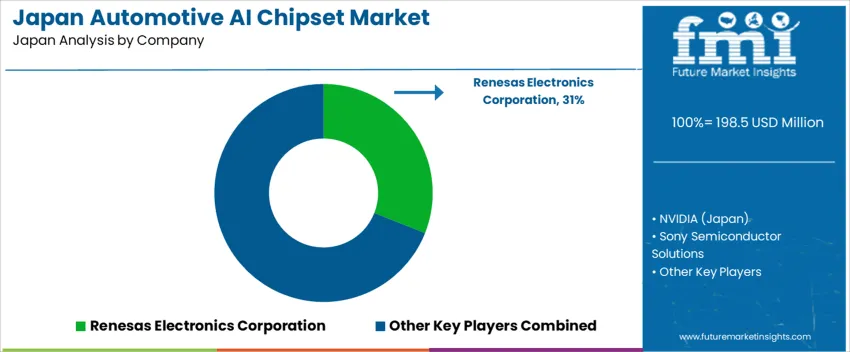
Demand for automotive AI chipsets in Japan is driven by electronic-control units supporting ADAS functions, automated-driving features, and perception systems across domestic vehicle platforms. Renesas Electronics Corporation holds an estimated 31.0% share, supported by controlled performance-efficiency ratios, functional-safety compliance, and deep integration within Japanese automotive-electronics architectures. Its AI-embedded processors deliver consistent real-time performance in constrained thermal environments. NVIDIA Japan maintains strong participation through GPU-accelerated SoCs used in higher-complexity autonomous-driving programs that require advanced sensor fusion and neural-network execution. Sony Semiconductor Solutions contributes presence in imaging-linked AI processing where stable edge inference and camera-system coordination support Japanese mobility applications.
Toshiba Electronic Devices & Storage Corporation supplies processors and accelerators designed for energy-efficient machine-vision workloads deployed in light-commercial and passenger vehicles. NXP Japan adds stable availability of safety-qualified processors enabling structured ADAS functionality with predictable verification paths. Competition in Japan centers on real-time perception accuracy, functional-safety certification, power-efficiency, silicon-node reliability, and supply-chain continuity. Demand expands where AI-enabled control units enhance driving-assistance capabilities and support progressive automation across vehicles produced for Japan’s regulated transportation environment.
Key Players in Japan Automotive AI Chipset Demand
- Renesas Electronics Corporation
- NVIDIA (Japan)
- Sony Semiconductor Solutions
- Toshiba Electronic Devices & Storage Corporation
- NXP (Japan)
Scope of the Report
| Items | Values |
|---|---|
| Quantitative Units | USD million |
| Product | GPU, ASIC, CPU, FPGA |
| Application | Autonomous Driving, Advanced Driver Assistance Systems, Infotainment System, Voice and Gesture Recognition, Predictive Maintenance |
| Processing Type | Machine Learning, Computer Vision, Natural Language Processing |
| Vehicle Type | Passenger Vehicle, Commercial Vehicle |
| Regions Covered | Kyushu & Okinawa, Kanto, Kinki, Chubu, Tohoku, Rest of Japan |
| Key Companies Profiled | Renesas Electronics Corporation, NVIDIA (Japan), Sony Semiconductor Solutions, Toshiba Electronic Devices & Storage Corporation, NXP (Japan) |
| Additional Attributes | Dollar demand across processing and application segments; growth driven by Level 2+ and Level 3 autonomy adoption; integration with sensor fusion modules, edge computing, and real-time decision systems; focus on power-efficient chipsets tailored for Japanese automotive OEMs; increasing semiconductor localization and collaboration with EV manufacturers across major industrial hubs in Chubu and Kanto. |
Japan Automotive AI Chipset Demand by Segments
Product:
- GPU
- ASIC
- CPU
- FGPA
Application:
- Autonomous Driving
- Advanced Driver Assistance Systems
- Infotainment System
- Voice and Gesture Recognition
- Predictive Maintenance
Processing Type:
- Machine Learning
- Computer Vision
- Natural Language Processing
Vehicle Type:
- Passenger Vehicle
- Commercial Vehicle
Region:
- Kyushu & Okinawa
- Kanto
- Kinki
- Chubu
- Tohoku
- Rest of Japan
Frequently Asked Questions
How big is the demand for automotive AI chipset in Japan in 2025?
The demand for automotive AI chipset in Japan is estimated to be valued at USD 198.5 million in 2025.
What will be the size of automotive AI chipset in Japan in 2035?
The market size for the automotive AI chipset in Japan is projected to reach USD 890.8 million by 2035.
How much will be the demand for automotive AI chipset in Japan growth between 2025 and 2035?
The demand for automotive AI chipset in Japan is expected to grow at a 16.2% CAGR between 2025 and 2035.
What are the key product types in the automotive AI chipset in Japan?
The key product types in automotive AI chipset in Japan are gpu, asic, CPU and fgpa.
Which application segment is expected to contribute significant share in the automotive AI chipset in Japan in 2025?
In terms of application, autonomous driving segment is expected to command 32.0% share in the automotive AI chipset in Japan in 2025.
Preview the report firsthand - request a free sample
Get SampleGet the brochure for pricing and purchase details.
Get PDFTable of Content
- Executive Summary
- Japan Market Outlook
- Demand-side Trends
- Supply-side Trends
- Technology Roadmap Analysis
- Analysis and Recommendations
- Market Overview
- Market Coverage / Taxonomy
- Market Definition / Scope / Limitations
- Market Background
- Market Dynamics
- Drivers
- Restraints
- Opportunity
- Trends
- Scenario Forecast
- Demand in Optimistic Scenario
- Demand in Likely Scenario
- Demand in Conservative Scenario
- Opportunity Map Analysis
- Product Life Cycle Analysis
- Supply Chain Analysis
- Investment Feasibility Matrix
- Value Chain Analysis
- PESTLE and Porter’s Analysis
- Regulatory Landscape
- Regional Parent Market Outlook
- Production and Consumption Statistics
- Import and Export Statistics
- Market Dynamics
- Japan Market Analysis 2020 to 2024 and Forecast, 2025 to 2035
- Historical Market Size Value (USD Million) Analysis, 2020 to 2024
- Current and Future Market Size Value (USD Million) Projections, 2025 to 2035
- Y-o-Y Growth Trend Analysis
- Absolute $ Opportunity Analysis
- Japan Market Pricing Analysis 2020 to 2024 and Forecast 2025 to 2035
- Japan Market Analysis 2020 to 2024 and Forecast 2025 to 2035, By Product
- Introduction / Key Findings
- Historical Market Size Value (USD Million) Analysis By Product , 2020 to 2024
- Current and Future Market Size Value (USD Million) Analysis and Forecast By Product , 2025 to 2035
- GPU
- ASIC
- CPU
- FGPA
- Y-o-Y Growth Trend Analysis By Product , 2020 to 2024
- Absolute $ Opportunity Analysis By Product , 2025 to 2035
- Japan Market Analysis 2020 to 2024 and Forecast 2025 to 2035, By Application
- Introduction / Key Findings
- Historical Market Size Value (USD Million) Analysis By Application, 2020 to 2024
- Current and Future Market Size Value (USD Million) Analysis and Forecast By Application, 2025 to 2035
- Autonomous Driving
- Advanced Driver Assistance Systems
- Infotainment System
- Voice and Gesture Recognition
- Predictive Maintenance
- Y-o-Y Growth Trend Analysis By Application, 2020 to 2024
- Absolute $ Opportunity Analysis By Application, 2025 to 2035
- Japan Market Analysis 2020 to 2024 and Forecast 2025 to 2035, By Processing Type
- Introduction / Key Findings
- Historical Market Size Value (USD Million) Analysis By Processing Type, 2020 to 2024
- Current and Future Market Size Value (USD Million) Analysis and Forecast By Processing Type, 2025 to 2035
- Machine Learning
- Computer Vision
- Natural Language Processing
- Y-o-Y Growth Trend Analysis By Processing Type, 2020 to 2024
- Absolute $ Opportunity Analysis By Processing Type, 2025 to 2035
- Japan Market Analysis 2020 to 2024 and Forecast 2025 to 2035, By Vehicle Type
- Introduction / Key Findings
- Historical Market Size Value (USD Million) Analysis By Vehicle Type, 2020 to 2024
- Current and Future Market Size Value (USD Million) Analysis and Forecast By Vehicle Type, 2025 to 2035
- Passenger Vehicle
- Commercial Vehicle
- Y-o-Y Growth Trend Analysis By Vehicle Type, 2020 to 2024
- Absolute $ Opportunity Analysis By Vehicle Type, 2025 to 2035
- Market Structure Analysis
- Competition Dashboard
- Competition Benchmarking
- Market Share Analysis of Top Players
- By Regional
- By Product
- By Application
- By Processing Type
- By Vehicle Type
- Competition Analysis
- Competition Deep Dive
- Renesas Electronics Corporation
- Overview
- Product Portfolio
- Profitability by Market Segments (Product/Age /Sales Channel/Region)
- Sales Footprint
- Strategy Overview
- Marketing Strategy
- Product Strategy
- Channel Strategy
- NVIDIA (Japan)
- Sony Semiconductor Solutions
- Toshiba Electronic Devices & Storage Corporation
- NXP (Japan)
- Renesas Electronics Corporation
- Competition Deep Dive
- Assumptions & Acronyms Used
- Research Methodology


