

- Industry Size (2025)
- USD 7.5 Bn
- Forecast (2035)
- USD 11.0 Bn
- CAGR (2025 to 2035)
- 4.0%
Demand for Automotive Wheel Spindle in Japan Forecast and Outlook 2025 to 2035
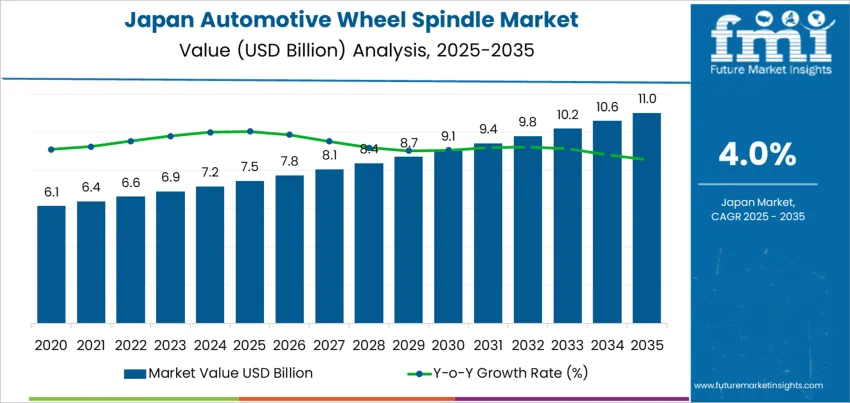
The demand for automotive wheel spindles in Japan is expected to grow from USD 7.5 billion in 2025 to USD 11.0 billion by 2035, reflecting a compound annual growth rate (CAGR) of 4.0%. Automotive wheel spindles, which play a critical role in supporting the wheel assembly and facilitating vehicle movement, are essential components in the automotive industry. As Japan’s automotive market continues to develop, driven by both the demand for new vehicles and the maintenance of existing ones, the market for automotive wheel spindles is expected to experience steady growth.
The market will experience consistent growth over the forecast period, starting at USD 7.5 billion in 2025 and increasing to USD 7.8 billion in 2026, and USD 8.1 billion in 2027. By 2028, demand will rise to USD 8.4 billion, continuing its steady growth trajectory. By 2035, the demand for automotive wheel spindles is forecasted to reach USD 11.0 billion, supported by ongoing demand in the automotive sector and advancements in vehicle technology, including electric and hybrid vehicle production.
Quick Stats of the Demand for Automotive Wheel Spindle in Japan
- Demand for Automotive Wheel Spindle in Japan Value (2025): USD 7.5 billion
- Demand for Automotive Wheel Spindle in Japan Forecast Value (2035): USD 11.0 billion
- Demand for Automotive Wheel Spindle in Japan Forecast CAGR (2025-2035): 4.0%
- Demand for Automotive Wheel Spindle in Japan Application: 63% Passenger Vehicle (SUV)
- Demand for Automotive Wheel Spindle in Japan Key Growth Regions: Kyushu & Okinawa, Kanto, Kansai, Chubu, Tohoku, Rest of Japan
- Demand for Automotive Wheel Spindle in Japan Key Players: GKN Automotive, NTN Corporation, Dana Incorporated, Nexteer Automotive, Hyundai-Wia Corporation
What is the Growth Forecast for the Automotive Wheel Spindle Industry in Japan through 2035?
The automotive wheel spindle market in Japan is expected to experience gradual and steady growth through 2035. Starting at USD 7.5 billion in 2025, the market will rise to USD 7.8 billion in 2026, USD 8.1 billion in 2027, and USD 8.4 billion by 2028. By 2030, the market is projected to reach USD 8.7 billion, continuing to expand at a steady pace. By 2035, the demand for automotive wheel spindles is expected to reach USD 11.0 billion, driven by consistent vehicle production and an ongoing focus on improving vehicle performance.
The early growth curve (2025–2029) for automotive wheel spindles is marked by gradual incremental increases each year, with steady demand driven by the steady pace of vehicle production and parts replacement. This early growth reflects a stable expansion as the automotive sector maintains its demand for essential components like wheel spindles.
In contrast, the late growth curve (2029–2035) is expected to experience more moderate, yet consistent, growth as the market matures. While the growth rate in the later years remains stable, the demand for automotive wheel spindles will be influenced by more advanced automotive technologies, such as electric and autonomous vehicles. The growth rate may begin to slow slightly after 2029 as the market stabilizes, reflecting a more mature and saturated automotive parts sector. However, demand will continue to increase at a steady pace through 2035, driven by ongoing vehicle production and after-market parts needs.
Key Takeaways of Automotive Wheel Spindle Industry in Japan
| Metric | Value |
|---|---|
| Industry Sales Value (2025) | USD 7.5 billion |
| Industry Forecast Value (2035) | USD 11 billion |
| Industry Forecast CAGR (2025-2035) | 4% |
Why is the Demand for Automotive Wheel Spindles in Japan Growing?
Demand for automotive wheel spindles in Japan is rising as new vehicle production and demand for advanced suspension and wheel systems increase. Wheel spindles form a core part of the suspension and wheel hub assembly, providing structural support for wheel rotation and connecting wheel hubs to suspension components. As automakers introduce more vehicles-including passenger cars, SUVs, hybrid vehicles, and electric vehicles-the need for reliable, well engineered spindles grows in parallel. Growth in vehicle manufacturing, periodic replacement needs, and upgrades in suspension and wheel assemblies all support rising spindle demand.
At the same time changing vehicle design trends push demand upward. Electric vehicles and hybrid cars impose different load, torque, and weight distribution requirements compared with traditional internal combustion vehicles. These changes call for spindles designed for durability, strength, and compatibility with modern wheel and suspension configurations. As manufacturers invest in lighter and more efficient wheel hub assemblies, demand grows for spindles built from advanced materials or precision engineered steel or alloys. The aftermarket also contributes: wear and tear, periodic maintenance needs, and consumer upgrades of wheel assemblies drive replacement demand for high quality spindles.
What Is the Current State of the Demand for Automotive Wheel Spindles in Japan in Terms of Product Type and Application?
The demand for automotive wheel spindles in Japan is primarily driven by product type and application. The leading product type is non-driven wheel, capturing 58% of the market share, while passenger vehicles (SUV) are the dominant application, accounting for 63% of the demand. Automotive wheel spindles are essential components that provide the pivot point for the vehicle's wheels and are crucial for the proper functioning of the suspension system. As demand for vehicles with enhanced performance and safety features grows, the demand for high-quality wheel spindles continues to rise in Japan.
How Are Non-Driven Wheels Leading the Demand for Automotive Wheel Spindles in Japan?
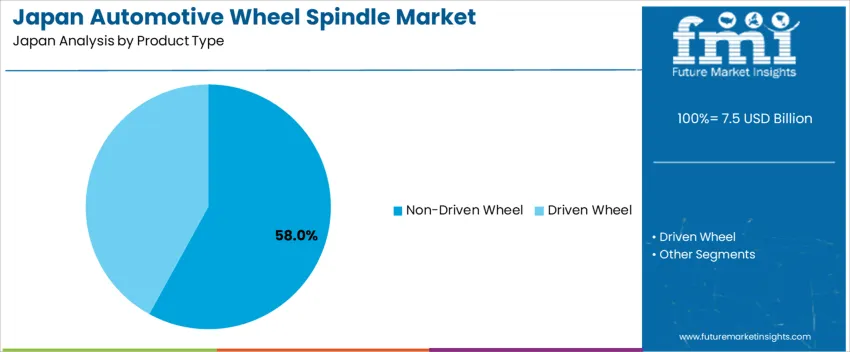
Non-driven wheel spindles lead the demand for automotive wheel spindles in Japan, holding 58% of the market share. Non-driven wheel spindles are commonly used in the front wheels of most vehicles that do not require power transmission from the wheel to the drivetrain, such as in standard passenger vehicles and some commercial vehicles. These spindles support the weight of the vehicle and allow the wheel to rotate freely while maintaining stability and smooth operation.
The demand for non-driven wheel spindles is driven by their widespread application in passenger vehicles, particularly those that prioritize performance and fuel efficiency. Non-driven spindles are typically found in the front axle of passenger cars, especially in front-wheel-drive and all-wheel-drive vehicles, where the rear wheels are not powered. As demand for passenger vehicles, particularly SUVs, continues to rise in Japan, non-driven wheel spindles are expected to remain the dominant choice, providing essential support and durability for a wide range of vehicle types.
How Is Passenger Vehicle (SUV) Leading the Application Demand for Automotive Wheel Spindles in Japan?
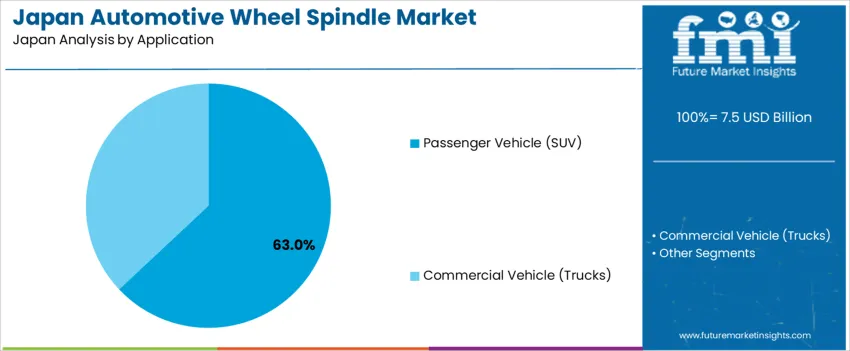
Passenger vehicles (SUVs) lead the application demand for automotive wheel spindles in Japan, accounting for 63% of the demand. SUVs, with their growing popularity in Japan, have driven the need for robust and high-performance wheel spindles that can handle the increased weight and off-road capabilities of these vehicles. Wheel spindles in SUVs are critical for maintaining vehicle stability, enhancing ride comfort, and ensuring safe handling, particularly in rugged or uneven terrain.
The demand for automotive wheel spindles in SUVs is driven by the growing consumer preference for larger, more versatile vehicles. As Japanese consumers increasingly choose SUVs for both urban and outdoor use, the need for durable and high-performance wheel spindles becomes more significant. Given the high demands placed on the suspension and wheel systems of SUVs, spindles must provide superior strength, stability, and longevity. As the SUV market continues to grow, the application of automotive wheel spindles in passenger vehicles is expected to remain the largest demand segment in Japan.
What is the Summary of Demand for Automotive Wheel Spindle in Japan?
Demand for automotive wheel spindles in Japan is rising gradually due to continuous vehicle production and replacement demand from the existing vehicle fleet. Wheel spindles are essential components in vehicle suspension and steering systems, offering support for wheels and enabling safe rotation. As vehicle ownership remains high and new vehicle production continues, the demand for wheel spindles grows. The demand is supported by the rise in light vehicles, hybrids, and electric vehicles, with the importance of safety, stability, and reliability contributing to the sustained need for wheel spindles in both the OEM and aftermarket sectors.
What are the Drivers of Demand for Automotive Wheel Spindle in Japan?
Several factors drive demand for wheel spindles in Japan. One key driver is the consistent production of passenger cars, light commercial vehicles, and other vehicle types, requiring the supply of suspension and wheel components, including spindles. Another driver is the aging vehicle fleet in Japan, which increases the demand for replacement parts, including spindles, as older vehicles undergo maintenance or overhaul. The growing emphasis on improved ride comfort, driving stability, and safety encourages the use of high-quality spindles, especially in modern vehicles. The shift toward hybrid and electric vehicles also supports the demand for specialized spindles designed for increased load and torque. Lastly, the expansion of the aftermarket segment, fueled by consumer preference for affordable replacement parts, contributes to steady demand for wheel spindles.
What are the Restraints on Demand for Automotive Wheel Spindle in Japan?
Despite the growth drivers, there are a few constraints limiting the demand for wheel spindles in Japan. One restraint is the overall slowdown or moderate growth in the broader auto parts market, which may limit the pace of demand for individual components such as spindles. The increasing complexity of vehicle suspension systems and the integration of advanced technologies may reduce the demand for standalone spindles, as alternative suspension systems or integrated modules become more common. Furthermore, the push for lighter, more efficient, and electric vehicles may result in design changes that reduce the need for traditional spindles. Cost sensitivity among consumers may also delay spindle replacements or encourage the use of cheaper repair alternatives, reducing demand in the aftermarket segment. Additionally, supply chain challenges and rising raw material costs for precision-machined spindles could increase prices and affect affordability.
What are the Key Trends Influencing Demand for Automotive Wheel Spindle in Japan?
Key trends influencing the demand for wheel spindles in Japan include a growing focus on vehicle safety, ride comfort, and stability. As consumers demand smoother rides and better handling, particularly in family cars and SUVs, there is an increased need for high-quality suspension components, including durable spindles. The rising adoption of electric and hybrid vehicles also plays a significant role in driving the demand for spindles designed to handle heavier battery loads and specialized suspension requirements. The expanding aftermarket segment, driven by the aging vehicle fleet, supports steady demand for replacement parts, including wheel spindles. Additionally, the growth of online distribution channels makes it easier for consumers and mechanics to access wheel spindles, contributing to increased replacement and upgrade cycles. Advances in manufacturing and materials technology also make spindles lighter, stronger, and more durable, boosting preference for upgraded components.
What is the Regional Demand Forecast for Automotive Wheel Spindles in Japan?
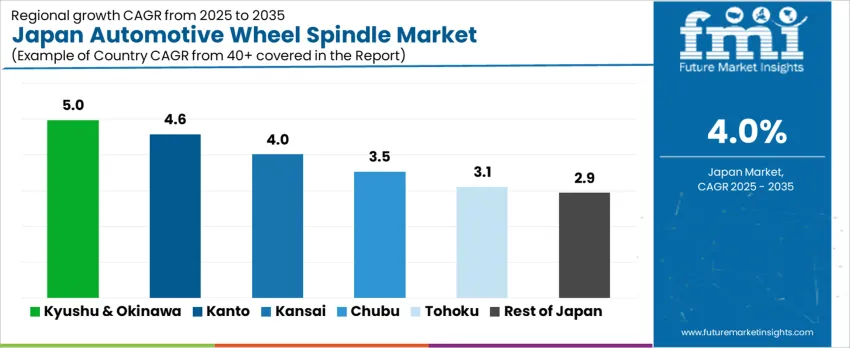
The demand for automotive wheel spindles in Japan is projected to increase steadily across all regions, reflecting both vehicle production and aftermarket replacement trends. The region with the highest growth outlook is Kyushu & Okinawa, at a CAGR of 5.0 %. Kanto follows with 4.6 %, supported by its dense automotive manufacturing and urban vehicle use. The Kansai region shows a CAGR of 4.0 %. Chubu, Tohoku, and the Rest of Japan report more modest growth at 3.5 %, 3.1 %, and 2.9 % respectively. These differences correspond to regional variations in automotive industry concentration, infrastructure renewal demand, and vehicle fleet turnover rates across Japan.
| Region | CAGR (%) |
|---|---|
| Kyushu & Okinawa | 5.0 |
| Kanto | 4.6 |
| Kansai | 4.0 |
| Chubu | 3.5 |
| Tohoku | 3.1 |
| Rest of Japan | 2.9 |
What factors drive the demand for wheel spindles in Kyushu & Okinawa?
In Kyushu & Okinawa, the projected 5.0 % annual growth in demand for automotive wheel spindles reflects a combination of industrial and after market dynamics. Kyushu hosts several automotive assembly plants and suppliers, which contributes to robust original equipment manufacturing (OEM) demand. As these manufacturing facilities continue operations, demand for spindles for new vehicles remains strong. Simultaneously, a considerable number of passenger vehicles and commercial trucks operate in the region’s coastal and mountainous terrain, leading to accelerated wear of suspension and wheel end components. Frequent use on varied road conditions, compounded by weather and road salt in some coastal areas, increases the need for replacement spindles. The aftermarket segment benefits from this wear rate, keeping demand steady. In addition, logistic and distribution hubs in the region serve both domestic and export markets, requiring maintenance fleets that lead to cyclical replacement of spindle assemblies. These combined factors support a relatively high growth rate, indicating sustained demand for wheel spindles in Kyushu & Okinawa over the forecast period.
Why is demand rising in Kanto?
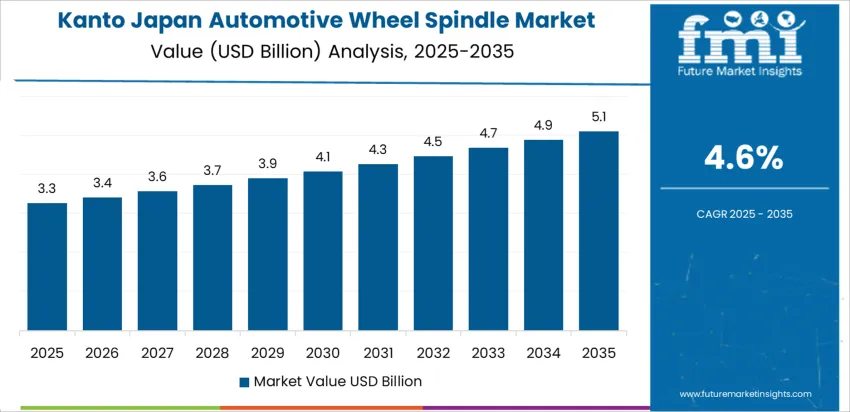
In Kanto, the expected 4.6 % CAGR for wheel spindles aligns with the region’s dense population, heavy traffic, and extensive vehicle ownership. The region encompasses major urban centers and extensive metropolitan infrastructure, with high usage of personal vehicles, taxis, rideshare cars, and light commercial fleets. Frequent stop and go traffic and urban road conditions place stress on suspension and wheel end components including spindles. As a result, periodic maintenance and replacement of wheel spindles become common. Furthermore, Kanto hosts numerous automotive suppliers and parts distributors, enabling ready availability of replacement components and promoting aftermarket turnover. OEM demand also remains significant as assembly plants supplying commuter and commercial vehicles often source spindles for new builds. Regulatory emphasis on vehicle safety and roadworthiness inspections adds impetus for replacement of worn or damaged spindles. Taken together, these factors drive consistent growth in demand for automotive wheel spindles in Kanto.
What supports growth in Kansai?
In the Kansai region, the 4.0 % projected demand growth for wheel spindles reflects a mix of OEM manufacturing, domestic vehicle use, and aftermarket replacement. Kansai—including major cities such as Osaka and Kobe—hosts several automotive component suppliers and intermediate goods manufacturers. While full vehicle assembly may be less concentrated than in other regions, component fabrication and subassembly, including spindles, remain active. This industrial base supports steady demand for spindles for both new vehicles and replacement markets. Additionally, urban and peri urban commuting as well as commercial vehicle operation contribute to wear on suspension systems. As older vehicles undergo inspection or refurbishment, replacement of wheel end components like spindles becomes necessary. The region’s logistics and transport networks, including port traffic and freight vehicles, generate demand from heavy duty usage. These factors combine to support moderate but stable growth in demand for automotive wheel spindles in Kansai.
How is demand evolving in Chubu?
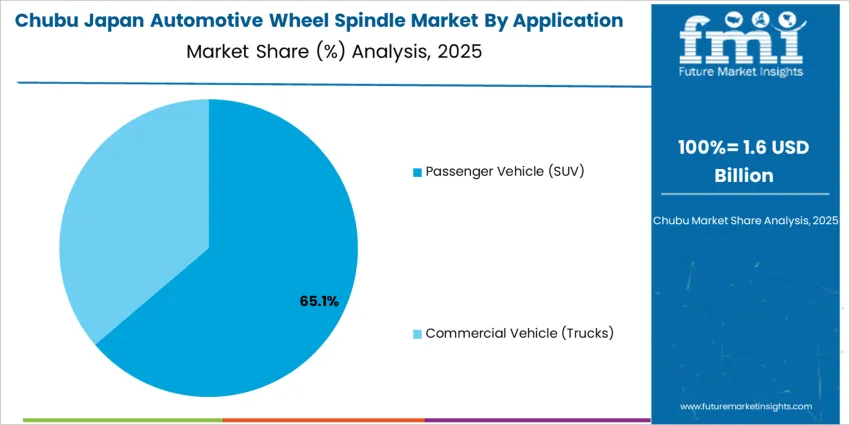
In Chubu, a projected 3.5 % CAGR for wheel spindles reflects a measured growth driven by mixed industrial and regional automotive use. The region includes industrial cities and manufacturing hubs where component suppliers and parts distributors operate. Demand from OEMs remains present, though at lower intensity compared with major automotive clusters. Replacement demand is driven by usage in commercial and private vehicles, particularly in rural and suburban zones. As older vehicles in Chubu age, owners increasingly opt for spindle and suspension replacements during maintenance or safety checks. The aftermarket network has gained traction, offering replacement parts for a variety of vehicle makes and models. While growth is slower than in coastal or metropolitan regions, rising vehicle age and fleet maintenance needs ensure ongoing demand. The moderate growth rate suggests steady but gradual adoption rather than rapid expansion.
What drives spindle demand in Tohoku?
In Tohoku, the projected 3.1 % CAGR indicates modest but persistent demand for automotive wheel spindles. The region has fewer major automotive manufacturing operations, and vehicle ownership rates tend to be lower compared with urban centers. Nonetheless, rural road conditions, longer travel distances, and seasonal weather variations can contribute to wear and tear on suspension and wheel components. Vehicles used for agriculture, forestry, and regional transport often demand more robust maintenance, which includes periodic replacement of spindles. As infrastructure improves and vehicle ownership rises among rural households, demand for replacement parts increases. Growing awareness of vehicle safety standards encourages timely replacement of worn wheel end components. Although not a major hub for OEM production, Tohoku’s maintenance-driven demand supports a stable increase in spindle consumption over time.
How is demand expected to grow in the Rest of Japan?
In the Rest of Japan—comprising smaller prefectures and rural areas outside major industrial or metropolitan zones—the demand for automotive wheel spindles is forecast to grow at a CAGR of 2.9 %. This modest growth reflects lower vehicle concentrations, less frequent replacement cycles, and limited automotive manufacturing activity. Nonetheless, maintenance needs among older vehicles continue to drive replacement spindle demand. Rural and semi-urban populations often rely on older cars and utility vehicles, which, over time, require parts replacement due to wear or corrosion. As aftermarket distribution networks expand, availability of replacement spindles improves even in remote areas. Gradual increases in vehicle ownership, combined with rising awareness of vehicle safety, contribute to incremental but stable demand growth. While overall volumes remain lower than major regions, a baseline market persists across the Rest of Japan, making it a long term segment for spindle replacement and parts supply.
How Are Companies Competing in the Automotive Wheel Spindle Market in Japan?
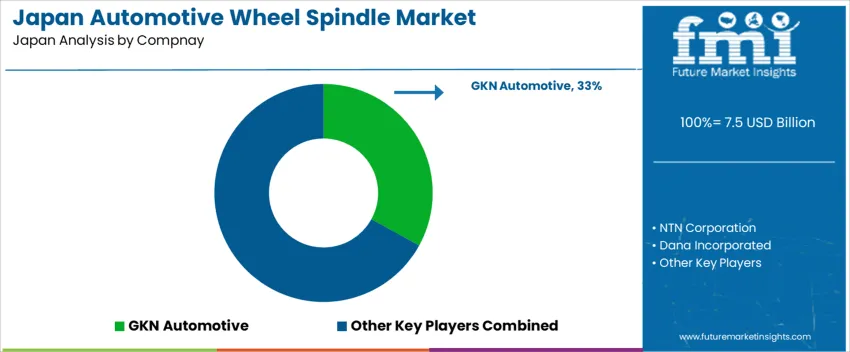
Demand for automotive wheel spindles in Japan is driven by steady vehicle production, regular maintenance cycles, and demand for durable components that ensure safe steering and suspension performance. Key suppliers in this market include GKN Automotive (with roughly 33 % share among the main providers), NTN Corporation, Dana Incorporated, Nexteer Automotive, and Hyundai Wia Corporation. These firms supply spindles for passenger cars, light trucks and SUVs-including both domestic Japanese models and imported vehicles.
Competition among suppliers centers on material strength, manufacturing precision, and reliability under load and varied driving conditions. Companies focus on producing spindles that meet strict tolerances in dimensions, bearing fit, and fatigue resistance. High-quality steel processing, heat treatment, and surface finishing are important to ensure long service life and safety. Another axis of competition is the ability to supply to original equipment manufacturers (OEMs) as well as aftermarket parts distributors-firms able to meet both specifications and delivery schedules tend to gain more traction. Spare parts availability and logistic support also influence supplier selection, especially in Japan where parts replacement and maintenance standards are rigorous. By delivering strong technical performance, compliance with automotive standards, and reliable supply chains, these companies aim to maintain or expand their share in Japan’s automotive wheel spindle market.
Key Players of the Automotive Wheel Spindle Industry in Japan
- GKN Automotive
- NTN Corporation
- Dana Incorporated
- Nexteer Automotive
- Hyundai-Wia Corporation
Scope of the Report
| Items | Details |
|---|---|
| Quantitative Units | USD Billion |
| Regions Covered | Japan |
| Product Type | Non-Driven Wheel, Driven Wheel |
| Application | Passenger Vehicle (SUV), Commercial Vehicle (Trucks) |
| Sales Channel | OEM, Aftermarket |
| Key Companies Profiled | GKN Automotive, NTN Corporation, Dana Incorporated, Nexteer Automotive, Hyundai-Wia Corporation |
| Additional Attributes | The demand for automotive wheel spindles in Japan is driven by the increasing production of both passenger vehicles and commercial vehicles, particularly SUVs and trucks. The market is segmented by product type, with non-driven wheel spindles used in the front of most vehicles, and driven wheel spindles being employed in the rear of vehicles with driven axles. Sales are split between OEMs and aftermarket, with OEM demand largely influenced by vehicle production volumes, while aftermarket demand is driven by replacement needs. Leading companies like GKN Automotive, NTN Corporation, and Dana Incorporated dominate the market, offering high-performance wheel spindles that meet the demand for vehicle durability, efficiency, and safety. The market is expected to grow as demand for SUVs and trucks continues to rise, particularly in commercial vehicle segments. |
Demand for Automotive Wheel Spindle in Japan
Product Type:
- Non-Driven Wheel
- Driven Wheel
Application:
- Passenger Vehicle (SUV)
- Commercial Vehicle (Trucks)
Sales Channel:
- OEM
- Aftermarket
Region:
- Kyushu & Okinawa
- Kanto
- Kansai
- Chubu
- Tohoku
- Rest of Japan
Frequently Asked Questions
How big is the demand for automotive wheel spindle in Japan in 2025?
The demand for automotive wheel spindle in Japan is estimated to be valued at USD 7.5 billion in 2025.
What will be the size of automotive wheel spindle in Japan in 2035?
The market size for the automotive wheel spindle in Japan is projected to reach USD 11.0 billion by 2035.
How much will be the demand for automotive wheel spindle in Japan growth between 2025 and 2035?
The demand for automotive wheel spindle in Japan is expected to grow at a 4.0% CAGR between 2025 and 2035.
What are the key product types in the automotive wheel spindle in Japan?
The key product types in automotive wheel spindle in Japan are non-driven wheel and driven wheel.
Which application segment is expected to contribute significant share in the automotive wheel spindle in Japan in 2025?
In terms of application, passenger vehicle (suv) segment is expected to command 63.0% share in the automotive wheel spindle in Japan in 2025.
Preview the report firsthand - request a free sample
Get SampleGet the brochure for pricing and purchase details.
Get PDFTable of Content
- Executive Summary
- Japan Market Outlook
- Demand-side Trends
- Supply-side Trends
- Technology Roadmap Analysis
- Analysis and Recommendations
- Market Overview
- Market Coverage / Taxonomy
- Market Definition / Scope / Limitations
- Market Background
- Market Dynamics
- Drivers
- Restraints
- Opportunity
- Trends
- Scenario Forecast
- Demand in Optimistic Scenario
- Demand in Likely Scenario
- Demand in Conservative Scenario
- Opportunity Map Analysis
- Product Life Cycle Analysis
- Supply Chain Analysis
- Investment Feasibility Matrix
- Value Chain Analysis
- PESTLE and Porter’s Analysis
- Regulatory Landscape
- Regional Parent Market Outlook
- Production and Consumption Statistics
- Import and Export Statistics
- Market Dynamics
- Japan Market Analysis 2020 to 2024 and Forecast, 2025 to 2035
- Historical Market Size Value (USD Million) Analysis, 2020 to 2024
- Current and Future Market Size Value (USD Million) Projections, 2025 to 2035
- Y-o-Y Growth Trend Analysis
- Absolute $ Opportunity Analysis
- Japan Market Pricing Analysis 2020 to 2024 and Forecast 2025 to 2035
- Japan Market Analysis 2020 to 2024 and Forecast 2025 to 2035, By Product Type
- Introduction / Key Findings
- Historical Market Size Value (USD Million) Analysis By Product Type , 2020 to 2024
- Current and Future Market Size Value (USD Million) Analysis and Forecast By Product Type , 2025 to 2035
- Non-Driven Wheel
- Driven Wheel
- Y-o-Y Growth Trend Analysis By Product Type , 2020 to 2024
- Absolute $ Opportunity Analysis By Product Type , 2025 to 2035
- Japan Market Analysis 2020 to 2024 and Forecast 2025 to 2035, By Application
- Introduction / Key Findings
- Historical Market Size Value (USD Million) Analysis By Application, 2020 to 2024
- Current and Future Market Size Value (USD Million) Analysis and Forecast By Application, 2025 to 2035
- Passenger Vehicle (SUV)
- Commercial Vehicle (Trucks)
- Y-o-Y Growth Trend Analysis By Application, 2020 to 2024
- Absolute $ Opportunity Analysis By Application, 2025 to 2035
- Japan Market Analysis 2020 to 2024 and Forecast 2025 to 2035, By Sales Channel
- Introduction / Key Findings
- Historical Market Size Value (USD Million) Analysis By Sales Channel, 2020 to 2024
- Current and Future Market Size Value (USD Million) Analysis and Forecast By Sales Channel, 2025 to 2035
- OEM
- Aftermarket
- Y-o-Y Growth Trend Analysis By Sales Channel, 2020 to 2024
- Absolute $ Opportunity Analysis By Sales Channel, 2025 to 2035
- Market Structure Analysis
- Competition Dashboard
- Competition Benchmarking
- Market Share Analysis of Top Players
- By Regional
- By Product Type
- By Application
- By Sales Channel
- Competition Analysis
- Competition Deep Dive
- GKN Automotive
- Overview
- Product Portfolio
- Profitability by Market Segments (Product/Age /Sales Channel/Region)
- Sales Footprint
- Strategy Overview
- Marketing Strategy
- Product Strategy
- Channel Strategy
- NTN Corporation
- Dana Incorporated
- Nexteer Automotive
- Hyundai-Wia Corporation
- GKN Automotive
- Competition Deep Dive
- Assumptions & Acronyms Used
- Research Methodology


