

- Industry Size (2025)
- USD 8.5 Bn
- Forecast (2035)
- USD 13.6 Bn
- CAGR (2025 to 2035)
- 5%
Demand for Automotive Brackets in USA Forecast and Outlook 2025 to 2035
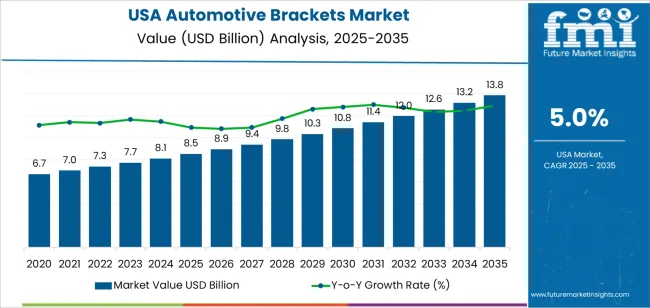
The demand for automotive brackets in USA is expected to grow from USD 8.5 billion in 2025 to USD 13.6 billion by 2035, reflecting a CAGR of 5%. The growth in the automotive brackets industry is driven by several factors, including the expanding automotive production capacity, the rising adoption of electric vehicles, and the growing complexity of modern vehicle architectures. With automakers focusing on weight reduction and performance optimization, automotive brackets provide essential structural support while enabling modular assembly processes that streamline manufacturing operations.
The growth is also driven by advancements in manufacturing technologies, increased vehicle complexity requiring specialized mounting solutions, and the broadening of bracket applications across engine, suspension, and body systems. The rising adoption of advanced driver assistance systems and the expansion of electric powertrain components will support the growth. The increasing focus on vehicle safety standards and crash-resistant designs among automotive manufacturers also adds to the demand for automotive brackets, which offer both structural integrity and assembly efficiency without the weight penalties of traditional welded solutions.
Quick Stats for the Automotive Brackets Industry in USA
- Automotive Brackets Industry in USA Value (2025): USD 8.5 billion
- Automotive Brackets Industry in USA Forecast Value (2035): USD 13.6 billion
- Automotive Brackets Industry in USA Forecast CAGR (2025-2035): 5%
- Automotive Brackets Industry in USA Leading Product Type: Passive Elastomeric Brackets (45%)
- Automotive Brackets Industry in USA Leading Application: Engines (30.0%)
- Automotive Brackets Industry in USA Leading Vehicle Type: Passenger Vehicles (65.0%)
- Automotive Brackets Industry in USA Leading Sales Channel: Original Equipment Manufacturers (75%)
- Automotive Brackets Industry in USA Key Growth Regions: West, South, Northeast, Midwest
- Automotive Brackets Industry in USA Top Players: Magna International, Gestamp Automoción, Tower International, Martinrea International, Aisin Corporation
What is the Growth Forecast for the Automotive Brackets Industry in USA through 2035?
The analysis for automotive brackets in USA reveals that the industry is expected to experience significant expansion over the forecast period from 2025 to 2035. The industry will grow from USD 8.5 billion in 2025 to USD 13.6 billion in 2035, reflecting an increase of USD 5.1 billion over the next decade. This growth indicates a strong expansion of the automotive brackets sector, with more automakers opting for advanced bracket solutions rather than traditional mounting methods.
From 2025 to 2030, the industry will grow from USD 8.5 billion to USD 10.7 billion, contributing USD 2.2 billion in growth. This phase will see an initial gain in adoption as more automakers embrace modular bracket systems, driven by an increasing interest in weight reduction and assembly efficiency. The demand for engine mounting brackets, particularly for hybrid and electric powertrains, will contribute significantly to this growth.
From 2030 to 2035, the industry will expand from USD 10.7 billion to USD 13.6 billion, contributing USD 2.9 billion in growth. This phase will see stronger expansion as bracket technology becomes more sophisticated, with more automakers choosing specialized bracket solutions for body systems, suspension components, and advanced electronic modules.
With more automotive suppliers and manufacturers embracing bracket-based assembly methods, the industry is expected to capture a larger share of the overall automotive components sector, particularly among manufacturers focused on production efficiency and vehicle performance optimization. The strong growth momentum in the latter half of the forecast period reflects the maturation of the industry, where bracket solutions become an integrated part of mainstream automotive assembly in USA.
USA Automotive Brackets Industry Key Takeaways
| Metric | Value |
|---|---|
| Industry Sales Value (2025) | USD 8.5 billion |
| Industry Forecast Value (2035) | USD 13.6 billion |
| Industry Forecast CAGR (2025-2035) | 5% |
What Is Driving the Demand for Automotive Brackets in USA?
Demand for automotive brackets in USA is rising as manufacturers increasingly embrace modular assembly over traditional welding methods, driven by production efficiency concerns and the desire for lighter vehicle architectures at reduced assembly cost. Many automakers, especially those producing high-volume models, prefer bracket-based mounting systems for engine components, suspension elements, and body panels instead of permanent welding that may be used only once or requires costly modifications.
Assembly plants offering standardized bracket systems, tier-one supplier partnerships, and pre-engineered mounting solutions support this shift by providing precision fitment, rapid installation, and manufacturing flexibility. Automotive manufacturers and suppliers are collaborating with bracket specialists to optimize component lifecycles and enhance production throughput, which drives adoption. Industry data show that the USA automotive brackets sector is valued at approximately USD 8.5 billion and is expected to grow steadily.
Another key factor is the convergence of vehicle electrification trends, regulatory compliance requirements, and the lightweighting mindset. Manufacturers increasingly seek to experiment with modular designs, follow OEM-driven specification changes, and minimize assembly complexity, which make bracket solutions attractive. Advances in materials science, precision manufacturing, and digital design platforms reduce friction in bracket integration processes and improve assembly reliability, which encourages broader acceptance.
Challenges remain: managing component tolerances across multiple suppliers, ensuring vibration dampening and structural integrity in a modular design, and maintaining operational profitability amid material and tooling costs. Despite these headwinds, as production methods shift toward modularity and efficiency, the demand for automotive brackets in USA is projected to continue its upward trajectory.
What Is the Current State of the Demand for Automotive Brackets in USA in Terms of Product Type and Application?
The demand for automotive brackets in USA is primarily driven by product type and application. The leading product type is passive elastomeric brackets, which holds 45% of the share, while engines is the dominant application segment, accounting for 30.0% of the demand. Automotive brackets have gained significant traction in both the OEM and aftermarket sectors due to their versatility, weight reduction benefits, and the growing trend of modular vehicle assembly. The bracket approach allows manufacturers and service providers to access high-performance, engineered mounting solutions without the need for complex welding operations, which appeals to various production environments.
How Are Passive Elastomeric Brackets Leading the Demand for Automotive Brackets in USA?
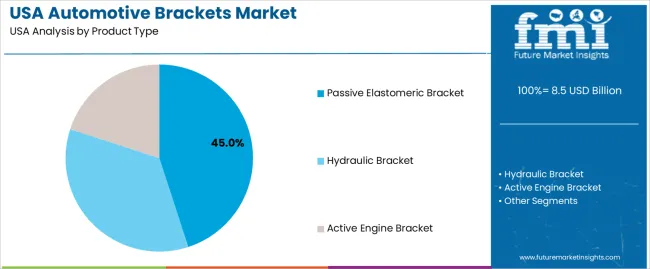
Passive elastomeric brackets are the leading product type in the automotive brackets sector, capturing 45% of the share. The increasing popularity of vibration dampening and noise reduction solutions for applications such as engine mounts, transmission supports, and chassis connections has driven demand for these components in the bracket space. Using passive elastomeric brackets allows manufacturers to access high-performance, engineered dampening properties for critical mounting applications without the significant cost of developing custom isolation systems.
In USA, where vehicle refinement standards are prominent, bracket solutions for passive elastomeric applications have become an attractive alternative for engineers seeking effective, standardized dampening solutions. Using passive elastomeric brackets for powertrains, suspension systems, and body mounting applications also supports the growing trend of modular assembly, as these components are often installed multiple times across different vehicle platforms. As manufacturers continue to prioritize vibration control and assembly standardization in vehicle design, the demand for passive elastomeric bracket solutions is expected to remain strong, positioning it as a dominant category in the automotive brackets sector.
How Are Engines Leading the Demand for Automotive Brackets in USA?
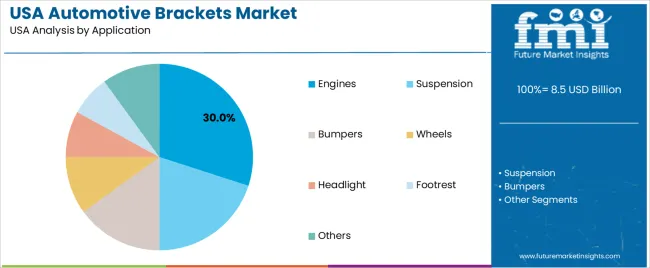
Engines are the leading application segment for automotive brackets in USA, capturing 30.0% of the share. In the engine application space, manufacturers, particularly those in the automotive production sector, are increasingly turning to bracket solutions for engine mounting systems, accessory brackets, and powertrain supports. Engine applications benefit from bracket solutions by ensuring precise positioning and vibration isolation for powertrains, without the need for large investments in custom welding fixtures or concerns about heat-affected zones.
Automotive bracket solutions also offer manufacturers the flexibility to adapt or modify their engine mounting configurations for different powertrains or for specific vehicle applications, which can enhance the versatility of their production lines without the complexity of managing multiple welded assemblies. The growing emphasis on powertrain modularity and reducing assembly complexity has driven many manufacturers to seek bracket solutions, which align with their production efficiency goals. As the automotive sector continues to embrace flexible, efficient, and standardized assembly practices, the demand for automotive bracket solutions is expected to grow, solidifying its position as the dominant segment in the industry.
What Are the Key Dynamics Influencing the Demand for Automotive Brackets in the United States?
Demand for automotive brackets in the USA is rising as manufacturers increasingly prioritize modular assembly over traditional welding, driven by production efficiency concerns, rapid model changeovers, and technology-enabled bracket platforms. Growth stems from standardized mounting systems, on-demand component access, and regulatory-driven assembly requirements. Operational challenges like material sourcing, component tolerances, and manufacturer reluctance to change established processes are restraining expansion. Key trends include interactive design software tools, supplier-direct bracket models, and the shift of bracket solutions into mainstream automotive assembly rather than just specialty or performance applications.
What Are the Primary Growth Drivers for Automotive Brackets Demand in the USA?
Several factors support growth in the USA automotive sector. First, younger engineering teams (millennials and Gen Z professionals) demonstrate strong interest in modular design, efficient assembly methods, and cost-effective access to engineered components, driving bracket adoption. Second, the proliferation of CAD software, e-commerce platforms, and supplier integration services simplifies automotive bracket sourcing and enhances production convenience.
Third, efficiency imperatives such as reducing assembly time, extending component lifecycles, and optimizing production workflows boost bracket adoption among cost-aware manufacturers. Fourth, applications and production requirements (new model launches, platform sharing, assembly line optimization) continue to fuel demand for higher-performance components on a modular basis rather than custom-welded alternatives.
What Are the Key Restraints Affecting Automotive Brackets Demand in the USA?
Despite momentum, several restraints inhibit growth. Customer concerns about component compatibility, structural integrity, and performance consistency of bracket systems may limit adoption among more conservative manufacturers. The cost structure of bracket solutions, including component acquisition, tooling, precision manufacturing, and quality control can reduce margins and raise total system costs, making the offering less compelling versus traditional welding for some applications. The bracket category remains specialized compared to total automotive fastening spend, and many manufacturers continue to prefer established welding methods. Operational complexity, including supplier management and reverse logistics, adds risk for production facilities.
What Are the Key Trends Shaping Automotive Brackets Demand in the USA?
Major trends include the move from performance-application brackets to broader assembly solutions covering standard powertrains, chassis systems, and everyday mounting requirements. There is increasing integration of technology such as virtual design validation, AI-driven component selection, and personalized bracket specifications, improving user experience and reducing compatibility-related issues.
Supplier-direct bracket platforms are emerging, enabling manufacturers to source components directly from bracket specialists and expanding the sector beyond traditional distributor channels only. Automotive manufacturers and bracket platforms are also consolidating with traditional component suppliers, offering hybrid standard-and-custom solutions, and promoting modular assembly credentials to appeal to efficiency-conscious production teams.
What Is Driving the Demand for Automotive Brackets in USA?
The demand for automotive brackets in USA is growing as manufacturers increasingly seek efficient, lightweight, and cost-effective options for vehicle assembly. Automotive bracket solutions allow production facilities to mount high-performance, engineered components for a fraction of the welding cost, reducing the need for complex fabrication and promoting more streamlined production. This approach is particularly attractive to manufacturers who want access to a wide variety of mounting solutions without the commitment of long-term tooling investments. Factors driving this demand include the rise in production efficiency focus, the popularity of modular-driven manufacturing, and the growing trend of platform-sharing assembly methods.
The increasing focus on traditional welding's time and cost impact is encouraging manufacturers to seek more efficient alternatives, like bracket systems. Regional demand varies depending on factors such as manufacturing concentration, automotive trends, and access to supplier networks. The West leads in demand, supported by higher technology adoption and innovation-focused production facilities, while the South, Northeast, and Midwest show steady adoption driven by shifting production behavior towards more efficient and cost-effective assembly choices. This analysis explores the factors shaping the demand for automotive brackets across the USA.
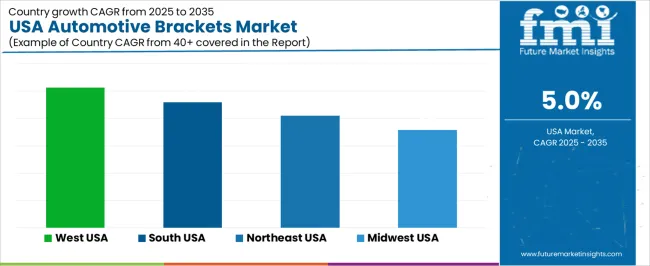
| Region | CAGR (2025-2035) |
|---|---|
| West USA | 5.1% |
| South USA | 4.6% |
| Northeast USA | 4.1% |
| Midwest USA | 3.6% |
Why Is the Demand for Automotive Brackets Highest in the West?
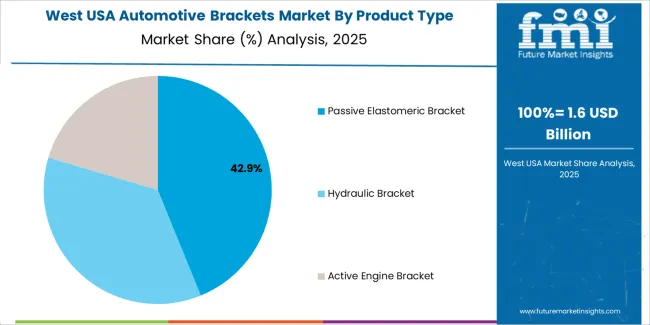
The West region leads the USA in the demand for automotive brackets with a CAGR of 5.1%. The region's large automotive presence, particularly in cities like Los Angeles, San Francisco, and Seattle, is highly attuned to production innovation and efficiency, both of which drive the demand for automotive bracket solutions. California, known for its technology-forward manufacturers, is a key geography where the demand for efficient and cost-effective assembly is growing.
The West also has a higher concentration of technology-oriented facilities who are comfortable with modular platforms and advanced assembly models. With the region's focus on production optimization, automotive brackets offer a viable alternative to traditional welding, enabling manufacturers to access high-performance mounting solutions for various applications without the operational cost of complex fabrication. As the demand for versatile and efficient assembly options continues to rise in the West, the region remains the leading geography for bracket solutions.
What Factors Are Supporting the Growth of Automotive Brackets Demand in the South?

The South shows strong demand for automotive brackets with a CAGR of 4.6%. The region's increasing focus on production efficiency, combined with a growing interest in assembly innovation, contributes to the rising adoption of bracket solutions. States like Texas, Florida, and Georgia have large automotive manufacturing populations and emerging production capabilities, making them key drivers of demand for efficient and streamlined assembly solutions.
The growing manufacturing base in the South, with its higher production volumes and increasing awareness of the operational impact of traditional welding, supports the demand for automotive brackets. The efficiency factor, coupled with the trend toward modular assembly instead of custom fabrication, is appealing to many manufacturers in the South. With the rise of platform sharing and shifting production preferences, the South is expected to continue to see strong demand for bracket solutions.
Why Is the Demand for Automotive Brackets Steady in the Northeast?
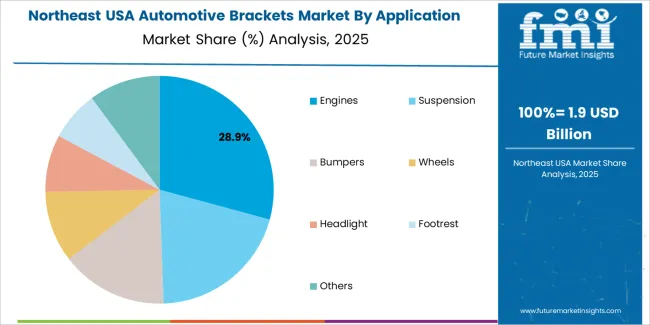
The Northeast demonstrates steady demand for automotive brackets with a CAGR of 4.1%. The region, home to major automotive centers like Detroit and Cleveland, has a high concentration of production-focused manufacturers who are increasingly turning to bracket solutions for high-performance, reliable mounting systems. The Northeast's emphasis on quality, combined with growing operational awareness, is driving the adoption of efficient assembly solutions.
The high cost of production in major manufacturing cities like Detroit makes automotive brackets an attractive option for facilities seeking variety in their assembly methods without the substantial cost of developing custom welding operations. While growth is steady compared to the West and South, the Northeast's production-focused population and strong manufacturing infrastructure ensure that the demand for automotive brackets remains a key part of the assembly landscape.
What Is Driving Automotive Brackets Demand in the Midwest?
The Midwest shows moderate growth in the demand for automotive brackets with a CAGR of 3.6%. While the region may not be as innovation-focused as the West or Northeast, there is a growing interest in more efficient and streamlined assembly choices. Cities like Chicago, Detroit, and Minneapolis are seeing an increasing number of manufacturers turning to automotive bracket solutions as they seek alternatives to traditional welding and want to reduce their assembly complexity.
The Midwest's steady adoption of bracket solutions is driven by the growing desire for production efficiency and the availability of more bracket platforms that cater to diverse manufacturing needs. As the awareness of the operational benefits of bracket solutions increases and manufacturers seek more efficient, streamlined assembly solutions, demand for these components will continue to grow in the Midwest, albeit at a slower pace compared to other regions.
How Are Companies Competing in the Automotive Brackets Industry in USA?
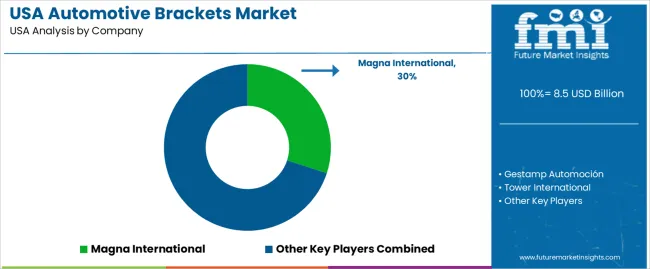
The automotive brackets industry in the United States is growing as manufacturers increasingly seek more efficient and cost-effective assembly options. Companies such as Magna International (holding approximately 30.0% share), Gestamp Automoción, Tower International, Martinrea International, and Aisin Corporation are key players in this industry, providing customers with access to high-performance, engineered mounting solutions for short-term and long-term use. The rise of modular assembly, growing operational awareness, and the desire for efficiency without the commitment of custom tooling are all driving factors behind the sector's expansion.
Competition in the automotive brackets industry is centered around product performance, customer service, and pricing flexibility. Companies focus on offering a wide selection of mounting solutions, from basic brackets to complex assemblies, and expanding their application ranges to cater to a broader customer base. Another competitive advantage is reliability, with many companies offering standardized systems, rapid delivery, and easy integration.
Some players are also emphasizing operational practices, such as the use of advanced materials and the promotion of modular assembly. Marketing materials typically highlight product performance, convenience of integration process, and the cost-effectiveness of access to high-end mounting solutions. By aligning their offerings with the growing demand for efficiency, convenience, and performance, these companies are positioning themselves to lead the USA automotive brackets industry.
Key Players in the Automotive Brackets in USA
- Magna International
- Gestamp Automoción
- Tower International
- Martinrea International
- Aisin Corporation
Scope of the Report
| Items | Details |
|---|---|
| Quantitative Units | USD Billion |
| Regions Covered | USA |
| Product Type | Passive Elastomeric Brackets, Hydraulic Brackets, Active Engine Brackets |
| Application | Engines, Suspension, Bumpers, Wheels, Headlight, Footrest, Others |
| Vehicle Type | Passenger Vehicles, Commercial Vehicles |
| Sales Channel | Original Equipment Manufacturers, Aftermarket |
| Key Companies Profiled | Magna International, Gestamp Automoción, Tower International, Martinrea International, Aisin Corporation |
| Additional Attributes | Dollar sales by product type and application define sector performance, with USA demand rising in OEM and aftermarket automotive brackets. Competition centers on product range, assembly efficiency, mounting flexibility, and advancing bracket platforms with improved integration capabilities. |
Key Segments of the Demand for Automotive Brackets in USA
Product Type
- Passive Elastomeric Brackets
- Hydraulic Brackets
- Active Engine Brackets
Application
- Engines
- Suspension
- Bumpers
- Wheels
- Headlight
- Footrest
- Others
Vehicle Type
- Passenger Vehicles
- Commercial Vehicles
Sales Channel
- Original Equipment Manufacturers
- Aftermarket
Region
- Northeast USA
- West USA
- Midwest USA
- South USA
Frequently Asked Questions
How big is the demand for automotive brackets in USA in 2025?
The demand for automotive brackets in USA is estimated to be valued at USD 8.5 billion in 2025.
What will be the size of automotive brackets in USA in 2035?
The market size for the automotive brackets in USA is projected to reach USD 13.8 billion by 2035.
How much will be the demand for automotive brackets in USA growth between 2025 and 2035?
The demand for automotive brackets in USA is expected to grow at a 5.0% CAGR between 2025 and 2035.
What are the key product types in the automotive brackets in USA?
The key product types in automotive brackets in USA are passive elastomeric bracket, hydraulic bracket and active engine bracket.
Which application segment is expected to contribute significant share in the automotive brackets in USA in 2025?
In terms of application, engines segment is expected to command 30.0% share in the automotive brackets in USA in 2025.
Preview the report firsthand - request a free sample
Get SampleGet the brochure for pricing and purchase details.
Get PDFTable of Content
- Executive Summary
- USA Market Outlook
- Demand-side Trends
- Supply-side Trends
- Technology Roadmap Analysis
- Analysis and Recommendations
- Market Overview
- Market Coverage / Taxonomy
- Market Definition / Scope / Limitations
- Market Background
- Market Dynamics
- Drivers
- Restraints
- Opportunity
- Trends
- Scenario Forecast
- Demand in Optimistic Scenario
- Demand in Likely Scenario
- Demand in Conservative Scenario
- Opportunity Map Analysis
- Product Life Cycle Analysis
- Supply Chain Analysis
- Investment Feasibility Matrix
- Value Chain Analysis
- PESTLE and Porter’s Analysis
- Regulatory Landscape
- Regional Parent Market Outlook
- Production and Consumption Statistics
- Import and Export Statistics
- Market Dynamics
- USA Market Analysis 2020 to 2024 and Forecast, 2025 to 2035
- Historical Market Size Value (USD Million) Analysis, 2020 to 2024
- Current and Future Market Size Value (USD Million) Projections, 2025 to 2035
- Y-o-Y Growth Trend Analysis
- Absolute $ Opportunity Analysis
- USA Market Pricing Analysis 2020 to 2024 and Forecast 2025 to 2035
- USA Market Analysis 2020 to 2024 and Forecast 2025 to 2035, By Product Type
- Introduction / Key Findings
- Historical Market Size Value (USD Million) Analysis By Product Type , 2020 to 2024
- Current and Future Market Size Value (USD Million) Analysis and Forecast By Product Type , 2025 to 2035
- Passive Elastomeric Bracket
- Hydraulic Bracket
- Active Engine Bracket
- Y-o-Y Growth Trend Analysis By Product Type , 2020 to 2024
- Absolute $ Opportunity Analysis By Product Type , 2025 to 2035
- USA Market Analysis 2020 to 2024 and Forecast 2025 to 2035, By Application
- Introduction / Key Findings
- Historical Market Size Value (USD Million) Analysis By Application, 2020 to 2024
- Current and Future Market Size Value (USD Million) Analysis and Forecast By Application, 2025 to 2035
- Engines
- Suspension
- Bumpers
- Wheels
- Headlight
- Footrest
- Others
- Y-o-Y Growth Trend Analysis By Application, 2020 to 2024
- Absolute $ Opportunity Analysis By Application, 2025 to 2035
- USA Market Analysis 2020 to 2024 and Forecast 2025 to 2035, By Vehicle Type
- Introduction / Key Findings
- Historical Market Size Value (USD Million) Analysis By Vehicle Type, 2020 to 2024
- Current and Future Market Size Value (USD Million) Analysis and Forecast By Vehicle Type, 2025 to 2035
- Passenger Car
- Commercial Vehicle
- Y-o-Y Growth Trend Analysis By Vehicle Type, 2020 to 2024
- Absolute $ Opportunity Analysis By Vehicle Type, 2025 to 2035
- USA Market Analysis 2020 to 2024 and Forecast 2025 to 2035, By Sales Channel
- Introduction / Key Findings
- Historical Market Size Value (USD Million) Analysis By Sales Channel, 2020 to 2024
- Current and Future Market Size Value (USD Million) Analysis and Forecast By Sales Channel, 2025 to 2035
- Original Equipment Manufacturers
- Aftermarket
- Y-o-Y Growth Trend Analysis By Sales Channel, 2020 to 2024
- Absolute $ Opportunity Analysis By Sales Channel, 2025 to 2035
- Market Structure Analysis
- Competition Dashboard
- Competition Benchmarking
- Market Share Analysis of Top Players
- By Regional
- By Product Type
- By Application
- By Vehicle Type
- By Sales Channel
- Competition Analysis
- Competition Deep Dive
- Magna International
- Overview
- Product Portfolio
- Profitability by Market Segments (Product/Age /Sales Channel/Region)
- Sales Footprint
- Strategy Overview
- Marketing Strategy
- Product Strategy
- Channel Strategy
- Gestamp Automoción
- Tower International
- Martinrea International
- Aisin Corporation
- Magna International
- Competition Deep Dive
- Assumptions & Acronyms Used
- Research Methodology


