

- Industry Size (2025)
- USD 52.2 Bn
- Forecast (2035)
- USD 85.3 Bn
- CAGR (2025 to 2035)
- 5.0%
Demand for Automotive Wheel Spindle in USA Forecast and Outlook (2025 to 2035)
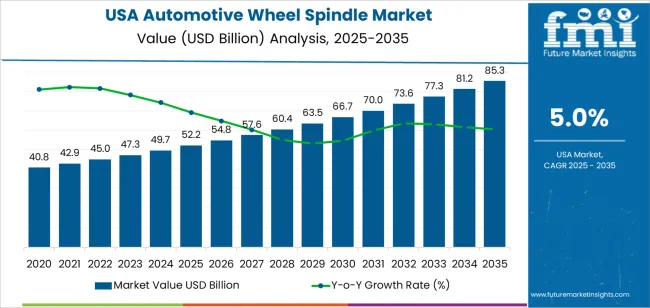
Automotive wheel spindle demand in the USA is valued at USD 52.2 billion in 2025 and is projected to reach USD 85.3 billion by 2035, reflecting a CAGR of 5.0%. Early growth is closely tied to high production volumes of pickup trucks and sport utility vehicles, which carry higher axle loads and require stronger spindle assemblies. The USA suspension and steering component market remains heavily weighted toward domestic assembly in the Midwest and Southern manufacturing corridors. Replacement demand supports a large share of volume, driven by collision repair, wear in high mileage vehicles, and fleet servicing. Forged steel spindles dominate passenger vehicles, while heavy duty cast and machined variants serve commercial trucks and vans operating in logistics, construction, and municipal sectors.
After 2030, spindle demand growth increasingly reflects structural changes in suspension design rather than pure vehicle volume expansion. Electric vehicles require revised spindle geometry to support higher curb weights and different load distribution from battery packs. Advanced driver assistance calibration accuracy raises dimensional and stiffness requirements in front axle assemblies. Light commercial fleets add steady demand through high duty cycle wear in delivery operations. Key suppliers include North America based forging specialists, Tier 1 suspension system manufacturers, and global groups with USA plants. Competitive strategy centers on tighter metallurgical control, fatigue life improvement, and alignment precision. Long term platform sourcing, shared tooling programs with OEMs, and just in time supply models shape procurement across major vehicle platforms through 2035.
Quick Stats for Demand for Automotive Wheel Spindles in USA:
- Demand for Automotive Wheel Spindles in USA Value (2025): USD 52.2 billion
- Demand for Automotive Wheel Spindles in USA Forecast Value (2035): USD 85.3 billion
- Demand for Automotive Wheel Spindles in USA Forecast CAGR (2025 to 2035): 5.0%
- Leading Product Type in Automotive Wheel Spindles in USA: Non-Driven Wheel (58%)
- Key Growth Regions for Automotive Wheel Spindles in USA: West, South, Northeast, Midwest
- Top Players in Automotive Wheel Spindles Industry in USA: GKN Automotive, NTN Corporation, Dana Incorporated, Nexteer Automotive, Hyundai-Wia Corporation
What is the Demand Forecast for Automotive Wheel Spindle in USA through 2035?
The overall demand for automotive wheel spindle in USA increases from USD 52.2 billion in 2025 to USD 54.8 billion by 2030, adding USD 2.6 billion in absolute value. This phase reflects steady production-linked growth supported by consistent vehicle output across passenger and light commercial segments. Demand is shaped by replacement cycles, stable suspension architecture, and gradual improvements in material strength and fatigue life rather than radical design changes. Growth remains structurally controlled, with wheel spindle content per vehicle largely unchanged. Expansion during this period is volume anchored, driven by fleet renewal, stable miles traveled, and routine chassis component upgrades across mass-market platforms.
From 2030 to 2035, the market expands more sharply from USD 54.8 billion to USD 85.3 billion, adding a substantially larger USD 30.5 billion within five years. This back weighted acceleration reflects a shift from pure production growth to value intensification per vehicle. Rising penetration of electric vehicles, higher curb weights due to battery packs, and increased load requirements for SUVs and pickup trucks raise spindle strength specifications and material complexity. As a result, unit pricing and engineering content per spindle increase alongside volume. This phase marks a transition toward higher mechanical performance requirements rather than simple unit-based demand growth.
Automotive Wheel Spindle Industry in USA Key Takeaways
| Metric | Value |
|---|---|
| Industry Value (2025) | USD 52.2 billion |
| Forecast Value (2035) | USD 85.3 billion |
| Forecast CAGR (2025 to 2035) | 5.0% |
What Is Driving the Demand for Automotive Wheel Spindle in the USA?
The demand for automotive wheel spindles in the USA has been supported by long term shifts in vehicle design, weight, and USAge patterns. Growth in light trucks, sport utility vehicles, and pickups increased stress on suspension and steering systems, which raised technical requirements for spindle strength and fatigue resistance. Early demand was closely tied to original equipment production, where forged steel spindles were specified for durability under high load and rough road conditions. Replacement demand expanded in parallel as corrosion, bearing failure, and collision damage created steady service needs. Commercial fleets operating under heavy mileage and harsh duty cycles adopted regular spindle replacement as part of preventive maintenance programs, which reinforced aftermarket consumption across regions.
Future demand for automotive wheel spindles in the USA will depend on changes in vehicle platforms, materials, and drivetrain layout. Lighter body structures and suspension systems may reduce dependence on traditional heavy steel designs, while the shift toward electric vehicles will introduce new load distribution patterns around hubs and axles. Increased battery mass and torque delivery can raise stress on front and rear spindle assemblies. Improved coatings and corrosion resistant alloys may extend service life and slow replacement cycles. Barriers to growth include longer warranty periods, improved road infrastructure, and consolidation among aftermarket suppliers. Market expansion will rely on how quickly new vehicle designs translate into revised spindle specifications.
How Are Product Type and Application Structuring the Demand for Automotive Wheel Spindle in USA?
The demand for automotive wheel spindles in the USA is structured by product type and application. Non-driven wheel spindles account for 58% of total demand, while driven wheel spindles serve a smaller but technically intensive segment. By application, passenger vehicles led by SUVs represent 63.0% of total consumption, followed by commercial vehicles such as trucks. Demand is shaped by vehicle production volumes, load distribution requirements, braking integration, and suspension design architecture. These segments reflect how drivetrain configuration and vehicle class dictate spindle design selection across original equipment manufacturing and aftermarket replacement activity in the USA.
Why Do Non-Driven Wheel Spindles Lead the Automotive Wheel Spindle Demand in USA?
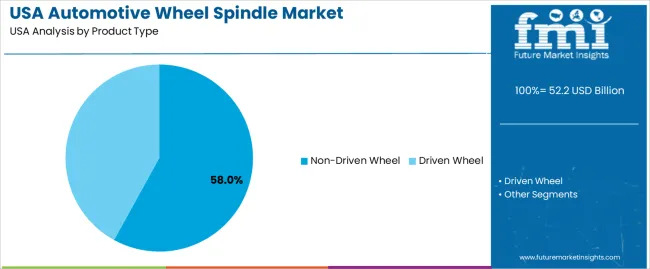
Non-driven wheel spindles account for 58% of total demand in the USA. This dominance reflects the high production volume of front and rear non-driven axle configurations across passenger vehicles and light trucks. Non-driven spindles primarily support steering articulation, braking load transfer, and vertical suspension movement without transmitting engine torque. Their simpler mechanical role allows broader standardization across multiple vehicle platforms, which supports high volume manufacturing efficiency.
Replacement demand also reinforces non-driven spindle volumes, particularly in regions with rough road conditions and high annual mileage. Wear from braking heat, road debris, and bearing fatigue contributes to steady service replacement cycles. Independent repair networks stock non-driven spindle assemblies due to predictable turnover rates. These production scale and service driven factors sustain non-driven spindles as the leading product type across the USA automotive spindle supply structure.
Why Does the Passenger Vehicle SUV Segment Dominate Automotive Wheel Spindle Demand in USA?
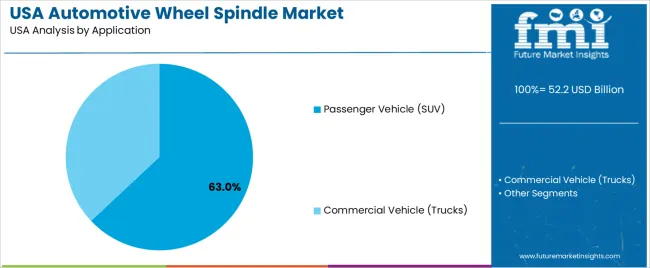
Passenger vehicles dominated by SUVs account for 63.0% of total automotive wheel spindle demand in the USA. This leadership reflects the sustained shift in consumer preference toward SUVs across urban, suburban, and fleet USAge. SUVs require robust spindle assemblies to support higher curb weight, elevated ride height, and increased braking loads compared with compact vehicles. These operating conditions raise per vehicle spindle value and material strength requirements.
SUV production volumes also exceed those of sedans and commercial trucks in domestic assembly programs. Fleet use of SUVs in law enforcement, service utilities, and shared mobility further broadens their spindle demand base. Aftermarket demand remains strong due to extended ownership cycles and varied terrain exposure. These volume concentration and load driven factors position passenger SUVs as the primary application segment for automotive wheel spindle demand across the USA.
What Forces Are Driving the Demand for Automotive Wheel Spindles in the USA?
Demand for automotive wheel spindles in the USA is driven by the dominance of large vehicles, high annual mileage, and sustained aftermarket replacement intensity. Pickup trucks, SUVs, and commercial vans impose higher radial and axial loads on wheel-end systems than compact passenger cars. Long-distance highway driving, towing, and off-road USAge accelerate bearing and spindle stress. Domestic vehicle production for trucks and fleet platforms sustains OEM demand, while the large installed base of aging vehicles anchors aftermarket volume. These USAge and fleet realities place wheel spindles among the most mechanically stressed suspension components in USA vehicles.
How Do Driving Conditions and Vehicle Segments Shape Spindle Demand in the USA?
The USA presents demanding operating conditions for wheel spindles. Northern states expose spindles to road salt, moisture, and freeze cycles that accelerate corrosion and bearing seat wear. Southern and desert regions apply thermal stress through prolonged high-temperature operation. Heavy pickup trucks used for towing impose continuous side-load on front spindles, while delivery vans accumulate rapid mileage that drives fatigue cycles. Off-road recreation and construction vehicle use further magnify impact loading. These environment- and USAge-driven forces directly shape spindle material selection, surface hardening requirements, and reinforcement geometry.
What Cost, Platform Design, and Electrification Factors Restrain Spindle Market Growth?
Wheel spindle growth in the USA is moderated by platform consolidation and design integration with sealed hub-bearing assemblies. Many newer vehicles reduce serviceable spindle replacement by integrating knuckle, bearing, and spindle as single units, which limits individual component sales. Rising alloy steel cost and heat-treatment energy expenses compress margins for domestic spindle manufacturers. Battery electric vehicles apply high torque loads but use fewer mechanical wear components across braking and drivetrain, which alters long-term replacement cycles. These design and cost pressures temper aggressive volume expansion despite high mechanical stress demand.
How Are Light weighting, Materials Engineering, and Safety Standards Reshaping Spindle Design in the USA?
Automotive wheel spindles in the USA are shifting toward high-strength alloy steels with localized induction hardening to improve fatigue resistance without adding mass. Lightweighting pressure drives tighter dimensional tolerance and hollow spindle architectures in some applications. Advanced corrosion-protective coatings are gaining importance in snowbelt regions. Integration with ADAS and electronic stability systems places higher load predictability and alignment accuracy demands on spindle geometry. These trends show the spindle evolving from a purely load-bearing shaft into a precision-aligned structural interface within modern USA suspension systems.
What is the Demand for Automotive Wheel Spindle in USA by Region?
| Region | CAGR (%) |
|---|---|
| West USA | 5.8% |
| South USA | 5.2% |
| Northeast USA | 4.6% |
| Midwest USA | 4.0% |
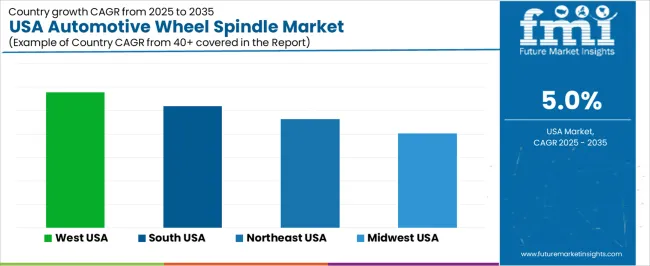
The demand for automotive wheel spindles in USA is forecast to grow across regions, with the West region leading at 5.8% CAGR. Growth in that region is supported by ongoing vehicle production and increasing sales of passenger vehicles and light trucks. The South shows 5.2% growth driven by robust manufacturing activity and rising demand for replacement parts in growing vehicle parc. In the Northeast, 4.6% growth reflects stable demand in a mature automotive market with frequent maintenance and part replacement. The Midwest registers the lowest growth at 4.0%, likely due to a more stable but slowly expanding vehicle population and lower volume of new vehicle sales compared with other regions.
What is Driving Automotive Wheel Spindle Demand in the West Region of USA?
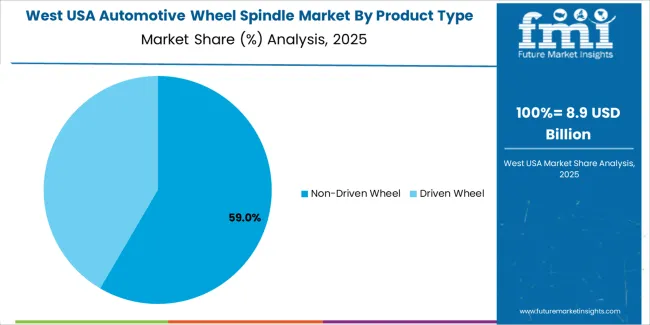
Expansion in the West reflects a CAGR of 59.0% through 2035 for automotive wheel spindle demand, supported by high vehicle utilization, electric vehicle penetration, and strong aftermarket servicing activity. Mountain driving, coastal highways, and dense urban congestion raise suspension and steering component stress. Performance oriented passenger vehicles and light commercial fleets increase spindle replacement frequency. Electric vehicles with higher curb weights further elevate structural load on wheel assemblies. Demand remains evenly split between OEM sourcing and aftermarket repair networks, with service driven consumption guiding purchasing patterns across western automotive maintenance corridors.
- Electric vehicle weight increases spindle load requirements
- Urban congestion accelerates suspension wear rates
- Performance vehicle USAge supports high aftermarket demand
- OEM and service networks drive balanced volume flow
How is the South Supporting Automotive Wheel Spindle Demand in USA?
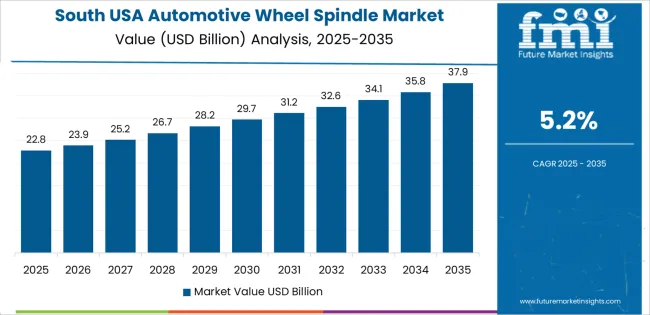
The South advances at a CAGR of 5.2% through 2035 for automotive wheel spindle demand, driven by high pickup truck USAge, rural driving conditions, and strong light commercial vehicle activity. Agricultural transport, construction fleets, and logistics operations create sustained spindle stress through uneven road exposure and heavy payloads. Assembly plants across southern states support baseline OEM demand for wheel end components. Replacement demand remains steady due to continuous fleet utilization. Purchasing decisions prioritize durability and fatigue resistance across both fleet and private vehicle maintenance operations.
- Pickup truck dominance anchors high spindle turnover
- Agricultural and construction fleets raise mechanical stress
- Regional assembly plants sustain OEM component demand
- Durability requirements guide material selection
Why is Automotive Wheel Spindle Demand Rising Steadily in the Northeast Region of USA?
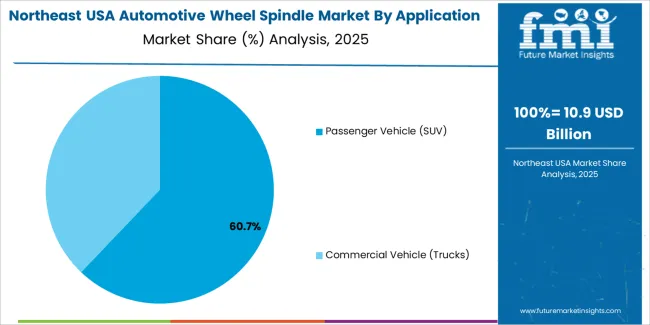
The Northeast records a CAGR of 4.6% through 2035 for automotive wheel spindle demand, shaped by harsh winter conditions, road salt corrosion, and dense urban traffic exposure. Freeze thaw cycles and moisture ingress accelerate bearing and spindle surface degradation. High urban vehicle density supports steady aftermarket service volumes. Municipal service fleets and public transport support vehicles add a layer of institutional demand. Demand remains replacement led rather than production driven, with service oriented purchasing patterns dominating across metropolitan automotive repair networks.
- Road salt exposure accelerates spindle corrosion rates
- Urban traffic density increases component fatigue
- Municipal fleets contribute steady institutional demand
- Aftermarket replacement dominates regional volume flow
What is Influencing Automotive Wheel Spindle Demand in the Midwest Region of USA?
The Midwest expands at a CAGR of 4.0% through 2035 for automotive wheel spindle demand, supported by freight hauling, agricultural equipment transport, and long distance rural driving conditions. Heavy trailers and payloads place sustained radial and axial loads on wheel assemblies. Seasonal weather changes increase mechanical stress across suspension systems. Fleet oriented vehicle USAge dominates purchasing behavior. Manufacturing centered component demand remains stable through steady truck and utility vehicle production. Growth stays maintenance driven, tied closely to structured fleet service schedules rather than consumer driven upgrades.
- Freight hauling raises continuous spindle load intensity
- Agricultural transport supports predictable replacement demand
- Seasonal weather variation increases mechanical fatigue
- Fleet service schedules guide stable procurement cycles
What Is Driving the Demand for Automotive Wheel Spindles in USA and Who Are the Key Players Shaping the Industry?
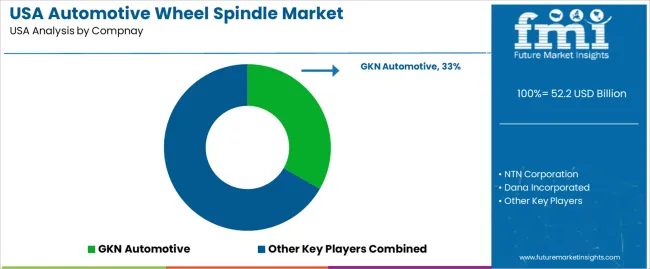
Demand for automotive wheel spindles in the USA is rising as automakers increase production of passenger vehicles, light trucks, and SUVs. Safety standards, ride comfort, and vehicle performance requirements push manufacturers to use precise, durable spindle assemblies. The growth of electric and hybrid vehicles also encourages demand for wheel spindles designed to support different suspension layouts and drivetrain loads. Aftermarket demand adds to volume because spindles wear over time and require replacement. Rising consumer expectation for smooth steering and stable handling supports ongoing demand for both OEM sourced and replacement wheel spindle components.
Key suppliers shaping the US wheel spindle market include GKN Automotive, NTN Corporation, Dana Incorporated, Nexteer Automotive, and Hyundai Wia Corporation. GKN Automotive provides driveline and suspension components on a global scale. NTN Corporation brings bearing and precision component expertise which can support spindle and hub assembly production. Dana Incorporated supplies comprehensive chassis and drivetrain parts, including spindle assemblies. Nexteer Automotive contributes steering and driveline systems which interface with wheel spindle and suspension modules. Hyundai Wia adds capability in precision metal components and aftermarket supply. These companies influence the market through their engineering capabilities, supply chain networks, and ability to meet evolving vehicle design and safety requirements.
Key Players in the Automotive Wheel Spindles Industry in USA
- GKN Automotive
- NTN Corporation
- Dana Incorporated
- Nexteer Automotive
- Hyundai-Wia Corporation
Scope of the Report
| Items | Values |
|---|---|
| Quantitative Units (2025) | USD billion |
| Product Type | Non-Driven Wheel, Driven Wheel |
| Application | Passenger Vehicle (SUV), Commercial Vehicle (Trucks) |
| Sales Channel | OEM, Aftermarket |
| Regions Covered | West USA, South USA, Northeast USA, Midwest USA |
| Countries Covered | USA |
| Key Companies Profiled | GKN Automotive, NTN Corporation, Dana Incorporated, Nexteer Automotive, Hyundai Wia Corporation |
| Additional Attributes | Dollar-value breakdown by product type, application, and sales channel; regional CAGR projections; demand shaped by SUV and pickup production, light commercial vehicle USAge, and fleet replacement cycles; non-driven spindles dominate due to high-volume standardization; replacement demand driven by wear, corrosion, and accident repair; driven wheel spindles serve specialized high-stress applications; post-2030 growth fueled by electric vehicle weight and suspension redesigns; key suppliers focus on fatigue life, metallurgical control, and alignment precision; procurement influenced by OEM platform sourcing, just-in-time supply, and aftermarket service networks. |
Automotive Wheel Spindles Industry in USA Segmentation
Product Type:
- Non-Driven Wheel
- Driven Wheel
Application:
- Passenger Vehicle (SUV)
- Commercial Vehicle (Trucks)
Sales Channel:
- OEM
- Aftermarket
Region:
- Northeast USA
- West USA
- Midwest USA
- South USA
Bibliography
- SAE International. (2023). Steering, axle, and suspension system engineering references for wheel end components including spindles. SAE Standards and Technical Papers.
- United States Department of Transportation. (2023). Motor vehicle safety compliance and component requirements relevant to wheel spindles. USDOT Safety and Regulatory Publications.
- American Axle and Manufacturing. (2023). Automotive wheel spindle design and performance documentation for driveline and suspension integration. AAM Technical Publications.
- USA Consumer Product Safety Commission. (2023). Safety guidelines and compliance for automotive replacement parts including wheel spindles. CPSC Regulatory and Guidance Publications.
Frequently Asked Questions
How big is the demand for automotive wheel spindle in USA in 2025?
The demand for automotive wheel spindle in USA is estimated to be valued at USD 52.2 billion in 2025.
What will be the size of automotive wheel spindle in USA in 2035?
The market size for the automotive wheel spindle in USA is projected to reach USD 85.3 billion by 2035.
How much will be the demand for automotive wheel spindle in USA growth between 2025 and 2035?
The demand for automotive wheel spindle in USA is expected to grow at a 5.0% CAGR between 2025 and 2035.
What are the key product types in the automotive wheel spindle in USA?
The key product types in automotive wheel spindle in USA are non-driven wheel and driven wheel.
Which application segment is expected to contribute significant share in the automotive wheel spindle in USA in 2025?
In terms of application, passenger vehicle (suv) segment is expected to command 63.0% share in the automotive wheel spindle in USA in 2025.
Preview the report firsthand - request a free sample
Get SampleGet the brochure for pricing and purchase details.
Get PDFTable of Content
- Executive Summary
- USA Market Outlook
- Demand-side Trends
- Supply-side Trends
- Technology Roadmap Analysis
- Analysis and Recommendations
- Market Overview
- Market Coverage / Taxonomy
- Market Definition / Scope / Limitations
- Market Background
- Market Dynamics
- Drivers
- Restraints
- Opportunity
- Trends
- Scenario Forecast
- Demand in Optimistic Scenario
- Demand in Likely Scenario
- Demand in Conservative Scenario
- Opportunity Map Analysis
- Product Life Cycle Analysis
- Supply Chain Analysis
- Investment Feasibility Matrix
- Value Chain Analysis
- PESTLE and Porter’s Analysis
- Regulatory Landscape
- Regional Parent Market Outlook
- Production and Consumption Statistics
- Import and Export Statistics
- Market Dynamics
- USA Market Analysis 2020 to 2024 and Forecast, 2025 to 2035
- Historical Market Size Value (USD Million) Analysis, 2020 to 2024
- Current and Future Market Size Value (USD Million) Projections, 2025 to 2035
- Y-o-Y Growth Trend Analysis
- Absolute $ Opportunity Analysis
- USA Market Pricing Analysis 2020 to 2024 and Forecast 2025 to 2035
- USA Market Analysis 2020 to 2024 and Forecast 2025 to 2035, By Product Type
- Introduction / Key Findings
- Historical Market Size Value (USD Million) Analysis By Product Type , 2020 to 2024
- Current and Future Market Size Value (USD Million) Analysis and Forecast By Product Type , 2025 to 2035
- Non-Driven Wheel
- Driven Wheel
- Y-o-Y Growth Trend Analysis By Product Type , 2020 to 2024
- Absolute $ Opportunity Analysis By Product Type , 2025 to 2035
- USA Market Analysis 2020 to 2024 and Forecast 2025 to 2035, By Application
- Introduction / Key Findings
- Historical Market Size Value (USD Million) Analysis By Application, 2020 to 2024
- Current and Future Market Size Value (USD Million) Analysis and Forecast By Application, 2025 to 2035
- Passenger Vehicle (SUV)
- Commercial Vehicle (Trucks)
- Y-o-Y Growth Trend Analysis By Application, 2020 to 2024
- Absolute $ Opportunity Analysis By Application, 2025 to 2035
- USA Market Analysis 2020 to 2024 and Forecast 2025 to 2035, By Sales Channel
- Introduction / Key Findings
- Historical Market Size Value (USD Million) Analysis By Sales Channel, 2020 to 2024
- Current and Future Market Size Value (USD Million) Analysis and Forecast By Sales Channel, 2025 to 2035
- OEM
- Aftermarket
- Y-o-Y Growth Trend Analysis By Sales Channel, 2020 to 2024
- Absolute $ Opportunity Analysis By Sales Channel, 2025 to 2035
- Market Structure Analysis
- Competition Dashboard
- Competition Benchmarking
- Market Share Analysis of Top Players
- By Regional
- By Product Type
- By Application
- By Sales Channel
- Competition Analysis
- Competition Deep Dive
- GKN Automotive
- Overview
- Product Portfolio
- Profitability by Market Segments (Product/Age /Sales Channel/Region)
- Sales Footprint
- Strategy Overview
- Marketing Strategy
- Product Strategy
- Channel Strategy
- NTN Corporation
- Dana Incorporated
- Nexteer Automotive
- Hyundai-Wia Corporation
- GKN Automotive
- Competition Deep Dive
- Assumptions & Acronyms Used
- Research Methodology


