

- Industry Size (2025)
- USD 1.4 Bn
- Forecast (2035)
- USD 2.5 Bn
- CAGR (2025 to 2035)
- 6.2%
Demand for Automotive UPS in USA Forecast and Outlook (2025 to 2035)
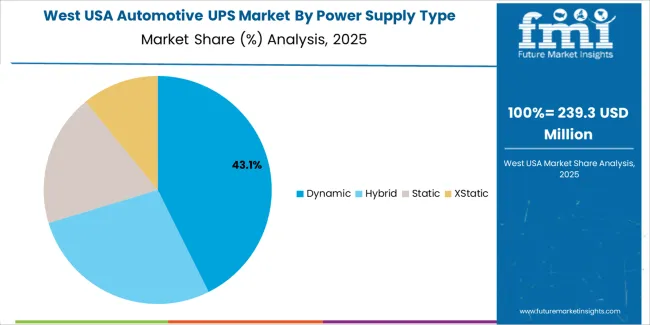
In 2025, demand for automotive in vehicle UPS systems in the USA is assessed at USD 1.4 billion and is projected to reach USD 2.5 billion by 2035 at a CAGR of 6.2%. Growth reflects rising electronic load inside passenger vehicles, fleet digitization, and increasing dependence on uninterrupted power for safety and control systems. Passenger cars account for 38% of installations, followed by electric vehicles at 27% and light commercial vehicles at 20%. Mid voltage input systems between 9V and 48V represent the largest share at 51%, aligned with conventional and hybrid architectures. Dynamic UPS designs lead with 42% share due to fast response under voltage fluctuation.
Beyond 2030, demand expansion in the USA is shaped by electrification depth and higher ampere requirements for power dense platforms. Systems rated above 40 Amp represent 61% of installations as vehicles integrate advanced driver assistance, infotainment clusters, and redundant safety electronics. Electric vehicles raise demand for high voltage UPS units above 48V, which already account for 31% share. Hybrid UPS designs hold 28% of the market, reflecting mixed electrical architectures across fleets. Key suppliers active in the USA include Siemens AG, Schneider Electric, Eaton Corporation, ABB Ltd, and Delta Electronics. Supplier strategy centers on thermal management performance, compact form factors, and integration with vehicle power management modules under long term OEM supply agreements.
Quick Stats for Demand for Automotive UPS in USA:
- Demand for Automotive UPS in USA Value (2025): USD 1.4 billion
- Demand for Automotive UPS in USA Forecast Value (2035): USD 2.5 billion
- Demand for Automotive UPS in USA Forecast CAGR (2025 to 2035): 6.2%
- Leading Power Supply Type in Automotive UPS in USA: Dynamic UPS (42%)
- Key Growth Regions for Automotive UPS in USA: West, South, Northeast, Midwest
- Top Players in Automotive UPS Industry in USA: Siemens AG, Schneider Electric, Eaton Corporation, ABB Ltd, Delta Electronics
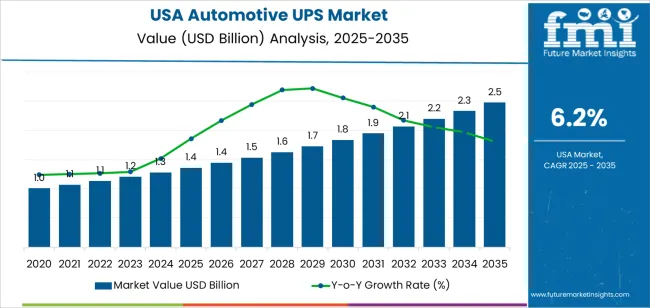
What is the Demand Forecast for Automotive UPS in USA through 2035?
The overall demand for automotive UPS in USA increases from USD 1.4 billion in 2025 to USD 1.8 billion by 2030, adding USD 0.4 billion in absolute value. This phase reflects the transition of in vehicle UPS from a fleet focused backup component into a broader electronic stability layer across passenger vehicles and light commercial platforms. Growth is driven by rising electronic load per vehicle, increasing dependence on continuous power for ADAS, telematics, and infotainment systems, and wider deployment of power buffering for connected vehicle platforms. The growth curve during this phase remains steady and controlled, indicating that UPS integration is becoming a planned design standard within vehicle electrical architectures.
From 2030 to 2035, the market expands from USD 1.8 billion to USD 2.5 billion, adding a larger USD 0.7 billion despite a similar five-year time span. This back weighted pattern reflects structural escalation in power resilience requirements rather than simple vehicle production expansion. Electric vehicles, software defined vehicle architectures, and autonomous ready platforms increase the need for uninterrupted auxiliary power for sensors, control units, braking redundancy, and vehicle communication systems. As a result, automotive UPS shifts from a protective subsystem to a core power management layer, raising value per vehicle and accelerating demand growth.
Automotive UPS (In Vehicle UPS) Industry in USA Key Takeaways
| Metric | Value |
|---|---|
| Industry Value (2025) | USD 1.4 billion |
| Forecast Value (2035) | USD 2.5 billion |
| Forecast CAGR (2025 to 2035) | 6.2% |
What Is Driving the Demand for Automotive UPS in Vehicle UPS in the USA?
Demand for in vehicle uninterruptible power supply systems in the USA emerged as automotive electronics shifted from support functions to core operating systems. Early need was limited to emergency fleets and specialized service vehicles where radios and control modules required stable backup power. As passenger vehicles added dense networks of sensors, cameras, infotainment processors, and driver assistance controls, voltage drops and transient power loss became operational risks rather than inconveniences. Start stop systems, idle shutdown, and growing accessory loads increased electrical instability in conventional platforms. OEM engineers began using compact UPS units to buffer sensitive controllers during cranking, battery aging, and load spikes. Replacement demand followed fleet operators once electronic failures were traced to unstable low voltage events in service.
Future demand for automotive UPS in the USA will hinge on how quickly vehicles transition into software defined platforms where uninterrupted power becomes central to safety and USAbility. Electric vehicles, hybrids, and 48 volt architectures create multiple power domains that must remain synchronized under fault conditions. UPS systems will increasingly be used to protect braking control, steering assist, over the air update cycles, cybersecurity firewalls, and autonomous sensing stacks. Growth will be strongest in commercial fleets, delivery vehicles, emergency services, and premium passenger cars where downtime carries direct operational cost. Barriers remain in unit cost, thermal management inside crowded dashboards, and integration complexity across mixed voltage systems. Adoption will depend on standardization and clear cost to reliability justification across platforms.
How Are Power Supply Types and Input Power Ranges Structuring the Demand for Automotive UPS in USA?
The demand for automotive UPS systems in the USA is structured by power supply type and input power range. Dynamic systems hold a 42% share, followed by hybrid, static, and xStatic configurations. By input power range, mid voltage systems operating between 9V and 48V account for 51.0% of total demand, followed by high voltage systems above 48V and low voltage systems up to 9V. Adoption patterns are shaped by vehicle electrification levels, backup power requirements for safety electronics, and compatibility with evolving electrical architectures. These segments reflect how reliability needs and power management strategies define UPS deployment across passenger and commercial vehicle platforms.
Why Does Dynamic Power Supply Lead the Automotive UPS Demand in USA?
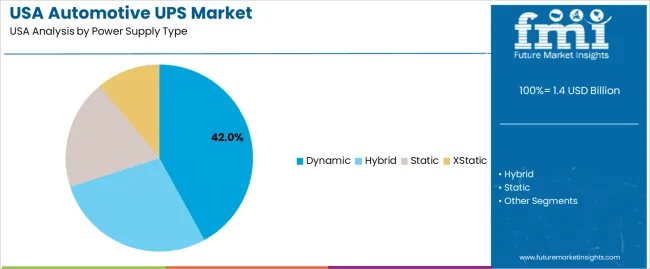
Dynamic automotive UPS systems account for 42% of total demand in the USA. Their leadership reflects the ability to deliver immediate power stabilization during voltage drops and transient load conditions. Modern vehicles rely on uninterrupted power supply to support advanced driver assistance systems, infotainment, braking electronics, and data processing units. Dynamic UPS designs respond rapidly to fluctuations, which makes them suitable for real time vehicle control environments where delays in backup activation are not acceptable.
Dynamic systems also align well with the electrical architectures used in passenger vehicles, sport utility vehicles, and light commercial fleets. These platforms experience frequent load variations from start stop systems, electric steering, and active safety modules. Integration with battery management systems remains relatively straightforward compared with hybrid alternatives. Replacement demand from fleet service operations also supports this segment, as dynamic systems show clear failure detection and predictable service intervals. These operational and integration advantages sustain dynamic UPS as the dominant power supply type in the USA automotive UPS landscape.
Why Does Mid Voltage Input Range Dominate Automotive UPS Demand in USA?
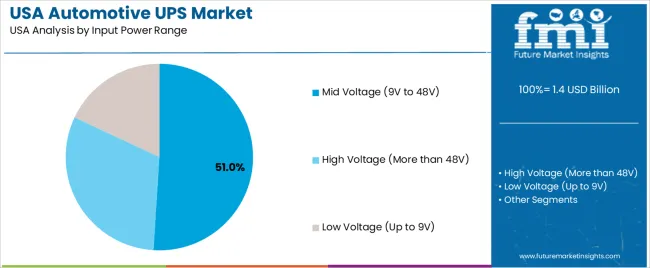
Mid voltage input systems operating between 9V and 48V represent 51.0% of total automotive UPS demand in the USA. This dominance reflects the transition of vehicle electrical architectures from conventional 12V systems toward mixed 12V and 48V platforms. Mid voltage ranges support power delivery for advanced infotainment, active safety, electric braking assist, and partial electrification components without requiring full high voltage system isolation.
Mid voltage UPS systems also serve a broad mix of internal combustion, hybrid, and mild hybrid vehicles. OEMs favor this range due to manageable insulation requirements, standardized connectors, and ease of integration into existing wiring harnesses. Aftermarket demand is also concentrated in this band because retrofit solutions for fleet vehicles and specialty applications predominantly operate within the 9V to 48V range. These manufacturing, deployment, and service advantages position mid voltage input systems as the core demand segment for in vehicle UPS installations across the USA.
What Is Driving the Growing Need for In-Vehicle UPS Systems Across the USA?
Demand for in-vehicle UPS systems in the USA is expanding as vehicles become rolling power-dependent platforms rather than purely transportation tools. Modern cars and trucks support continuous operation of telematics, navigation, cameras, ADAS sensors, and real-time data communication. Power interruptions during start-stop cycles, idle shutdowns, or voltage dips create risk for these systems. Public safety vehicles, mobile broadcast units, mobile repair vans, and refrigerated delivery fleets all require stable backup power during engine-off conditions. These USAge realities convert the automotive UPS from optional electronics into core electrical reliability infrastructure.
How Do Commercial Fleets and Emergency Applications Shape USA UPS Demand?
USA fleet operators depend heavily on power continuity for routing software, telematics, refrigeration units, mobile POS terminals, and diagnostic systems. UPS units maintain power during refueling, loading, driver changeovers, and emergency shutdowns. Ambulances, fire trucks, police vehicles, and disaster-response units require uninterrupted power for radios, medical devices, and data transmission even during engine loss. Utility service trucks and telecom maintenance fleets rely on in-vehicle UPS to stabilize delicate electronics at worksites. These mission-critical fleet and emergency use cases form the most structurally stable demand segment for automotive UPS in the USA.
What Economic and Engineering Barriers Limit Wider UPS Adoption in USA Vehicles?
In-vehicle UPS penetration in the USA is constrained by cost, space, battery lifecycle limitations, and system integration complexity. OEM-grade UPS requires advanced thermal management, wiring protection, and safety validation. Weight penalties discourage adoption in fuel-sensitive platforms. Aftermarket installations vary widely in quality and often raise warranty concerns. Battery degradation under high temperature and deep discharge cycles increases replacement cost. Passenger car buyers rarely perceive direct value from UPS systems, limiting mass-market pull. These financial and engineering barriers keep adoption concentrated in professional and performance-sensitive vehicle applications.
How Are Power Management, Electrification, and Smart Energy Control Reshaping UPS Design?
Automotive UPS systems in the USA are shifting toward lithium battery architectures with intelligent monitoring, fast charge recovery, and predictive fault detection. Software-managed switching enables seamless power transfer without disrupting vehicle electronics. In electric vehicles, UPS functions increasingly integrate within auxiliary battery subsystems rather than as standalone units. Cloud-connected UPS platforms allow fleet operators to monitor power health remotely. Compact modular UPS formats designed for under-seat and cargo-wall mounting support retrofit adoption. These developments signal in-vehicle UPS evolving into a software-defined reliability layer within USA vehicle electrical ecosystems.
What is the Demand for Automotive UPS (In-Vehicle UPS) in USA by Region?
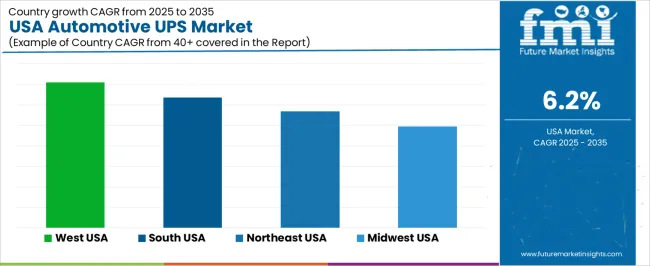
| Region | CAGR (%) |
|---|---|
| West | 7.1% |
| South | 6.4% |
| Northeast | 5.7% |
| Midwest | 4.9% |
The demand for in-vehicle UPS systems in the USA is rising across all regions, with the West region showing the highest growth at 7.1% CAGR. This growth is driven by increased adoption of electrified and hybrid vehicles, growing consumer demand for onboard power for electronics and infotainment, and expanded after-market upgrades for power backup in recreational and commercial vehicles. The South, at 6.4%, benefits from robust vehicle manufacturing and recreational vehicle (RV) USAge, which often require reliable onboard power sources. The Northeast, at 5.7%, sees growth due to dense urban vehicle populations and rising demand for power backup solutions in passenger and commercial cars. The Midwest, at 4.9%, exhibits slower growth, likely reflecting a more moderate rate of new vehicle purchases and lower proportion of premium or specialty vehicle use.
What is Driving Automotive UPS in Vehicle UPS Demand in the West Region of USA?
Growth in the West reflects a CAGR of 7.1% through 2035 for automotive UPS in vehicle UPS demand, supported by high electric vehicle USAge, advanced driver assistance adoption, and strong reliance on uninterrupted onboard power for telematics and safety systems. Technology intensive fleets depend on continuous power for navigation, data logging, and in vehicle computing. Ride sharing and delivery fleets strengthen demand for backup power reliability. Wildfire related grid outages also reinforce demand for onboard redundancy. Demand remains both OEM driven and aftermarket supported across passenger, fleet, and specialty mobility segments.
- Electric vehicle platforms increase backup power integration
- Fleet telematics rely on uninterrupted onboard power
- Delivery and ride share fleets drive consistent replacement demand
- Power outage resilience strengthens adoption rationale
How is the South Supporting Automotive UPS In Vehicle UPS Demand in USA?
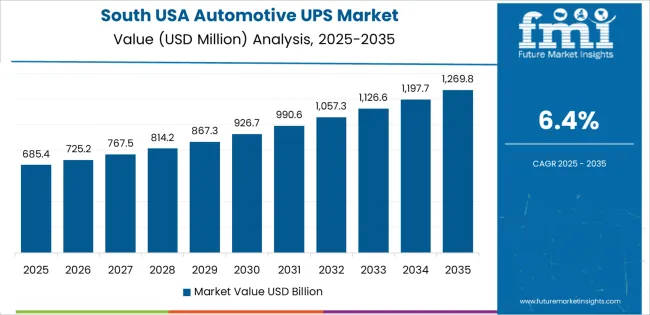
The South advances at a CAGR of 6.4% through 2035 for automotive UPS in vehicle UPS demand, driven by expanding logistics fleets, construction vehicle operations, and long distance freight movement. Fleet operators equip vehicles with backup power to support refrigeration units, tracking systems, and communication hardware. Disaster vulnerability from storms and hurricanes strengthens the need for continuous power during operations. Regional assembly output also contributes to OEM level integration. Demand remains utility focused, with reliability and durability guiding procurement across commercial and light industrial mobility platforms.
- Logistics fleets require uninterrupted power for tracking systems
- Storm resilience increases reliance on backup vehicle power
- Construction vehicles use UPS for auxiliary systems
- OEM integration supports baseline demand stability
Why is Automotive UPS in Vehicle UPS Demand Rising Steadily in the Northeast Region of USA?
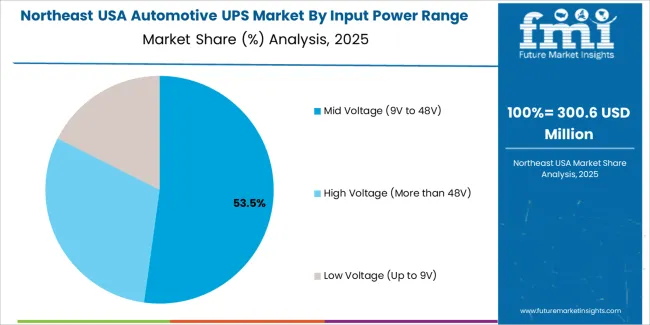
The Northeast records a CAGR of 5.7% through 2035 for automotive UPS in vehicle UPS demand, shaped by dense urban transport, winter reliability needs, and strong public service fleet Usage. Cold weather increases electrical load instability, raising the need for resilient power continuity. Emergency response fleets, transit maintenance vehicles, and municipal service units depend on backup power for communications and onboard equipment. Urban congestion also increases idle time power demand. Growth remains steady through public sector procurement and structured fleet upgrade programs.
- Winter operation exposes power stability risks
- Emergency fleets depend on uninterrupted onboard electricity
- Municipal service vehicles anchor steady replacement demand
- Urban congestion increases idle load on electrical systems
What is Influencing Automotive UPS in Vehicle UPS Demand in the Midwest Region of USA?
The Midwest expands at a CAGR of 4.9% through 2035 for automotive UPS in vehicle UPS demand, supported by agricultural transport, long haul trucking, and utility service vehicle operations. Extended driving distances and remote routing increase dependence on continuous onboard power for navigation, refrigeration, and communication systems. Power continuity supports safety monitoring in fleet vehicles operating outside urban coverage. Manufacturing centered demand also contributes steady OEM sourcing. Growth remains practical and service driven, with purchasing guided by endurance and failure tolerance rather than advanced infotainment requirements.
- Long haul trucking requires uninterrupted power supply
- Agricultural transport supports auxiliary system reliability
- Remote routing increases safety monitoring dependence
- Manufacturing output sustains baseline OEM demand
What Is Driving the Global Demand for Automotive UPS (In Vehicle UPS) Systems and Who Are the Key Players Shaping the Industry?
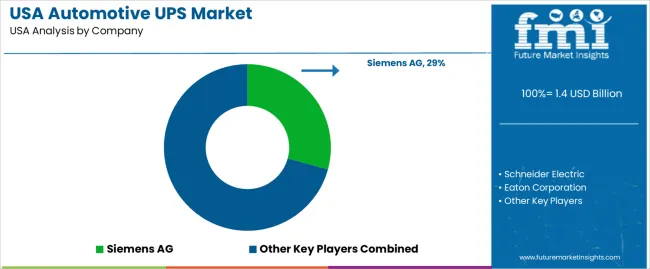
Demand for automotive UPS systems worldwide is rising as modern vehicles integrate more electronics, advanced driver assistance systems, infotainment, and safety features. The shift toward electric vehicles intensify the need for reliable backup power solutions. As vehicles evolve into mobile computing and connected platforms, uninterrupted power becomes essential to maintain critical functions during voltage fluctuations or battery transitions. Automotive UPS systems help ensure power continuity for control units, sensors, communications, and safety modules. Growing regulatory attention on vehicle safety and rising consumer demand for reliability support this trend across global markets.
Major multinational firms competing in this segment include Siemens AG, Schneider Electric, Eaton Corporation, ABB Ltd, and Delta Electronics. These companies supply in vehicle power solutions, backup modules, and integrated power management hardware tailored to automotive needs. Their global reach and engineering expertise allow them to support both OEMs and aftermarket suppliers. As automakers increasingly demand robust power management systems for electric and connected vehicles, these players influence supply-chain standards, system reliability expectations, and adoption rates globally.
Key Players in the Automotive UPS (In Vehicle UPS) Systems
- Siemens AG
- Schneider Electric
- Eaton Corporation
- ABB Ltd
- Delta Electronics
Scope of the Report
| Items | Values |
|---|---|
| Quantitative Units (2025) | USD billion |
| Power Supply Type | Dynamic, Hybrid, Static, XStatic |
| Input Power Range | Mid Voltage (9V to 48V), High Voltage (More than 48V), Low Voltage (Up to 9V) |
| Vehicle Type | Passenger Cars, Electric Vehicles, Light Commercial Vehicles, Heavy Commercial Vehicles |
| Ampere Rating | Above 40 Amp, Below 40 Amp |
| Regions Covered | West USA, South USA, Northeast USA, Midwest USA |
| Countries Covered | USA |
| Key Companies Profiled | Siemens AG, Schneider Electric, Eaton Corporation, ABB Ltd, Delta Electronics |
| Additional Attributes | Dollar-value breakdown by power supply type, input range, vehicle type, and ampere rating; regional CAGR projection; growing adoption across electric, hybrid, and conventional vehicles; demand driven by electrification, fleet digitization, and safety-critical electronics; OEM and aftermarket channels supported; emphasis on thermal management, compact design, and integration with vehicle power modules. |
Automotive UPS (In Vehicle UPS) Systems in USA Industry Segmentation
Power Supply Type:
- Dynamic
- Hybrid
- Static
- XStatic
Input Power Range:
- Mid Voltage (9V to 48V)
- High Voltage (More than 48V)
- Low Voltage (Up to 9V)
Vehicle Type:
- Passenger Cars
- Electric Vehicles
- Light Commercial Vehicles
- Heavy Commercial Vehicles
Ampere Rating:
- Above 40 Amp
- Below 40 Amp
Region:
- Northeast USA
- West USA
- Midwest USA
- South USA
Frequently Asked Questions
How big is the demand for automotive UPS in USA in 2025?
The demand for automotive UPS in USA is estimated to be valued at USD 1.4 billion in 2025.
What will be the size of automotive UPS in USA in 2035?
The market size for the automotive UPS in USA is projected to reach USD 2.5 billion by 2035.
How much will be the demand for automotive UPS in USA growth between 2025 and 2035?
The demand for automotive UPS in USA is expected to grow at a 6.2% CAGR between 2025 and 2035.
What are the key product types in the automotive UPS in USA?
The key product types in automotive UPS in USA are dynamic, hybrid, static and xstatic.
Which input power range segment is expected to contribute significant share in the automotive UPS in USA in 2025?
In terms of input power range, mid voltage (9v to 48v) segment is expected to command 51.0% share in the automotive UPS in USA in 2025.
Preview the report firsthand - request a free sample
Get SampleGet the brochure for pricing and purchase details.
Get PDFTable of Content
- Executive Summary
- USA Market Outlook
- Demand-side Trends
- Supply-side Trends
- Technology Roadmap Analysis
- Analysis and Recommendations
- Market Overview
- Market Coverage / Taxonomy
- Market Definition / Scope / Limitations
- Market Background
- Market Dynamics
- Drivers
- Restraints
- Opportunity
- Trends
- Scenario Forecast
- Demand in Optimistic Scenario
- Demand in Likely Scenario
- Demand in Conservative Scenario
- Opportunity Map Analysis
- Product Life Cycle Analysis
- Supply Chain Analysis
- Investment Feasibility Matrix
- Value Chain Analysis
- PESTLE and Porter’s Analysis
- Regulatory Landscape
- Regional Parent Market Outlook
- Production and Consumption Statistics
- Import and Export Statistics
- Market Dynamics
- USA Market Analysis 2020 to 2024 and Forecast, 2025 to 2035
- Historical Market Size Value (USD Million) Analysis, 2020 to 2024
- Current and Future Market Size Value (USD Million) Projections, 2025 to 2035
- Y-o-Y Growth Trend Analysis
- Absolute $ Opportunity Analysis
- USA Market Pricing Analysis 2020 to 2024 and Forecast 2025 to 2035
- USA Market Analysis 2020 to 2024 and Forecast 2025 to 2035, By Power Supply Type
- Introduction / Key Findings
- Historical Market Size Value (USD Million) Analysis By Power Supply Type , 2020 to 2024
- Current and Future Market Size Value (USD Million) Analysis and Forecast By Power Supply Type , 2025 to 2035
- Dynamic
- Hybrid
- Static
- XStatic
- Y-o-Y Growth Trend Analysis By Power Supply Type , 2020 to 2024
- Absolute $ Opportunity Analysis By Power Supply Type , 2025 to 2035
- USA Market Analysis 2020 to 2024 and Forecast 2025 to 2035, By Input Power Range
- Introduction / Key Findings
- Historical Market Size Value (USD Million) Analysis By Input Power Range, 2020 to 2024
- Current and Future Market Size Value (USD Million) Analysis and Forecast By Input Power Range, 2025 to 2035
- Mid Voltage (9V to 48V)
- High Voltage (More than 48V)
- Low Voltage (Up to 9V)
- Y-o-Y Growth Trend Analysis By Input Power Range, 2020 to 2024
- Absolute $ Opportunity Analysis By Input Power Range, 2025 to 2035
- USA Market Analysis 2020 to 2024 and Forecast 2025 to 2035, By Vehicle Type
- Introduction / Key Findings
- Historical Market Size Value (USD Million) Analysis By Vehicle Type, 2020 to 2024
- Current and Future Market Size Value (USD Million) Analysis and Forecast By Vehicle Type, 2025 to 2035
- Passenger Cars
- Electric Vehicles
- Light Commercial Vehicles
- Heavy Commercial Vehicles
- Y-o-Y Growth Trend Analysis By Vehicle Type, 2020 to 2024
- Absolute $ Opportunity Analysis By Vehicle Type, 2025 to 2035
- USA Market Analysis 2020 to 2024 and Forecast 2025 to 2035, By Ampere Rating
- Introduction / Key Findings
- Historical Market Size Value (USD Million) Analysis By Ampere Rating, 2020 to 2024
- Current and Future Market Size Value (USD Million) Analysis and Forecast By Ampere Rating, 2025 to 2035
- Above 40 Amp
- Below 40 Amp
- Y-o-Y Growth Trend Analysis By Ampere Rating, 2020 to 2024
- Absolute $ Opportunity Analysis By Ampere Rating, 2025 to 2035
- Market Structure Analysis
- Competition Dashboard
- Competition Benchmarking
- Market Share Analysis of Top Players
- By Regional
- By Power Supply Type
- By Input Power Range
- By Vehicle Type
- By Ampere Rating
- Competition Analysis
- Competition Deep Dive
- Siemens AG
- Overview
- Product Portfolio
- Profitability by Market Segments (Product/Age /Sales Channel/Region)
- Sales Footprint
- Strategy Overview
- Marketing Strategy
- Product Strategy
- Channel Strategy
- Schneider Electric
- Eaton Corporation
- ABB Ltd
- Delta Electronics
- Siemens AG
- Competition Deep Dive
- Assumptions & Acronyms Used
- Research Methodology


