

- Market Size (2026)
- USD 144.0 Mn
- Forecast (2036)
- USD 394.4 Mn
- CAGR (2026 to 2036)
- 10.6%
Moisture-Sensing Yarns for Sports Performance Apparel Market Size, Forecast, and Outlook By FMI
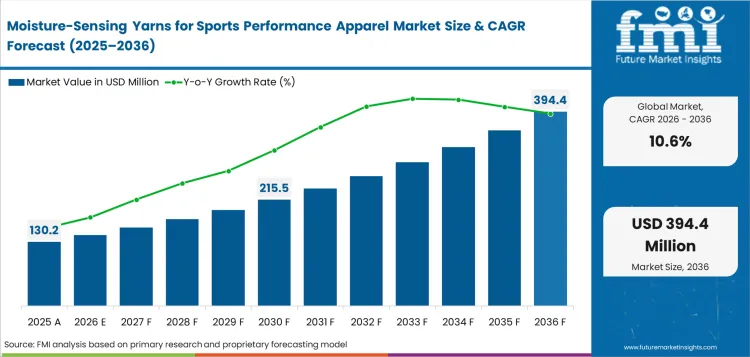
The moisture-sensing yarns for sports performance apparel market was valued at USD 130.2 million in 2025. The market is forecast to reach USD 144.0 million by the end of 2026 and expand at a CAGR of 10.6% between 2026 and 2036 to reach USD 394.4 million by 2036. Brand direct is expected to lead with a 46.0% sales channel share, and resistive-based yarns are estimated to lead the sensing mechanism segment with a 40.0% share.
Summary of the Moisture-Sensing Yarns for Sports Performance Apparel Market
- Demand and Growth Drivers
- Sports apparel brands are using moisture-sensing yarns to add measurable sweat response inside premium training garments.
- Wash durability requirements reinforce yarn qualification as sports garments face repeated sweat exposure and laundering.
- Fitness data use is increasing demand for fabric-level sensing across sports-inspired clothing and premium activewear.
- Product and Segment View
- Brand direct is expected to lead the sales channel segment with 46.0% share in 2026, reflecting direct fabric specification by sportswear brands.
- Resistive-based yarns are expected to lead sensing mechanism demand with 40.0% share in 2026, as electrical response can be integrated with simpler readout systems.
- Conductive composite yarns are expected to hold high-value yarn construction demand as signal continuity matters across stretch and wash cycles.
- Geography and Competitive Outlook
- India is expected to record a CAGR of 13.2% through 2036, backed by textile exports and rising fitness facility use.
- China is projected to expand at 12.4% CAGR by 2036, as sports industry output and outdoor participation create a larger use base.
- Companies combining yarn design skill with washable signal testing are strengthening their market position from 2026 to 2036.
- Analyst Opinion
- Nikhil Kaitwade, Principal Consultant for the Chemicals and Materials domain at FMI, says, “Moisture-sensing yarns are entering qualification in sports performance apparel. Sportswear brands need sweat detection without compromising comfort or wash life. Conductive material costs and garment testing raise pressure. Textile engineering depth and electronics interface skills can reduce trial failure.”
- Moisture-Sensing Yarns for Sports Performance Apparel Market Value Analysis
- The moisture-sensing yarns for sports performance apparel market is shifting from experimental smart textile work into structured fabric qualification programs.
- Premium sportswear brands are using these yarns to verify comfort performance across garment areas exposed to heavy sweat.
- The market is benefiting from broader use of conductive yarns for e-textile sensors across sports and fitness wearables.
- Washable signal evidence strengthens supplier selection as brands need lower return risk and credible performance claims after repeated use.
Key Takeaways, Market Size, and Forecast
- The moisture-sensing yarns for sports performance apparel market was valued at USD 130.2 million in 2025.
- By 2036, the moisture-sensing yarns for sports performance apparel market is expected to be worth USD 394.4 million.
- From 2026 to 2036, the market is projected to expand at a CAGR of 10.6%.
- The market is projected to create an incremental opportunity of USD 250.4 million between 2026 and 2036.
- In 2026, brand direct contracts are expected to account for 46.0% of sales channel demand.
- India at 13.2% and China at 12.4% are two of the faster-growing country markets.
Sports apparel brands face a practical design pressure: sweat sensing must feel like normal fabric and survive regular care. Myant X states that Skiin Osmotex dries in less than 20 minutes after activation. The technology makes active moisture control a measurable garment function instead of a passive wicking claim. Wash durability is the next approval gate. IEC 63203-204-1 defines household washing durability testing for e-textile products with conductive components and sensors. This pushes suppliers to document wash results before brand pilots enter seasonal ranges. Knit-level integration is becoming more exact. The 2024 US11983320B2 patent describes garment-integrated capacitive sensors using knitted conductive electrode layers and pressure coverage between 0.5 and 15 cm². Patent language points to yarn design serving both sensing accuracy and comfort, so suppliers with testing depth and knit engineering gain stronger buyer access.
Moisture-Sensing Yarns for Sports Performance Apparel Market Definition
The moisture-sensing yarns for sports performance apparel market includes yarn systems engineered to detect sweat or humidity changes inside sportswear fabrics. These yarns serve training tops, base layers, running apparel, and compression garments needing comfort feedback. Scope includes resistive yarns, capacitive yarns, conductive composite yarns, and coated yarns. Standard moisture-wicking fabrics without sensing function and electronic wrist wearables are outside the scope.
Moisture-Sensing Yarns for Sports Performance Apparel Market Inclusions
Market scope covers all commercially traded moisture-sensing yarns categorized by sensing mechanism, including resistive-based yarns and humidity-based yarns; yarn construction, including conductive composite yarns and coated yarns; fiber base, including polyester blends and nylon blends; apparel type, including training tops and base layers; and sales channel, including brand direct contracts and mill supply. Revenue scope covers 2026 to 2036. The key stakeholders include smart yarn manufacturers, conductive material suppliers, textile mills, sportswear brands, apparel OEMs, sensor interface providers, testing laboratories, distributors, and product design teams.
Moisture-Sensing Yarns for Sports Performance Apparel Market Exclusions
Scope does not include standard wicking fabrics, non-sensing sports apparel, wrist-based wearables, hospital-only monitoring garments, or electronic modules sold separately from yarn systems.
Moisture-Sensing Yarns for Sports Performance Apparel Market Research Methodology
- Primary Research: FMI analysts interviewed sportswear brands, smart textile developers, yarn manufacturers, and apparel mills in important markets.
- Desk Research: Used data from textile technology references, company product portfolios, physical activity sources, and sports apparel demand indicators.
- Market sizing and forecasting: Combined parent moisture-sensing yarn demand with sports apparel application share and yarn-level integration rates.
- Data validation: FMI cross-checked every three months against sportswear use patterns, conductive yarn demand, and company service coverage.
Why is the Moisture-Sensing Yarns for Sports Performance Apparel Market Growing?
- Sportswear brands are using sensing yarns earlier to prove sweat response before premium garment launches.
- Textile partners are becoming important as garments combine comfort fabric and electrical signal paths.
- Manufacturers are qualifying yarns with stronger wash records and stable signal output across repeated wear cycles.
Sports apparel firms need stronger proof for comfort claims as premium training garments add data-aware functions. Regular exercise participation creates a broad user base for garments offering sweat and comfort feedback. Yarn-level sensing captures moisture behavior closer to the body compared with external wearable devices during training use. Suppliers with repeatable wash records and stable signal output can reduce rejection during brand qualification.
Sports participation outside the United States reinforces the same demand pattern across fitness clothing. Sport England reported in April 2026 that 64.6% of adults in England, equal to 30.9 million people, met weekly activity guidelines from November 2024 to November 2025. Regular activity at this level raises the value of garments measuring sweat movement during training. Sportswear brands can use yarn-level sensing to build stronger performance claims. Larger apparel programs will favor suppliers proving comfort and durability together.
Market Segmentation Analysis
- Resistive-based yarns are estimated to capture 40.0% of the sensing mechanism segment in 2026 as brands prefer simpler moisture readout designs.
- Conductive composite yarns are expected to represent 37.5% of yarn construction share in 2026 through stronger signal stability in washable smart fabrics.
- Polyester blends are projected to hold 35.0% of fiber base share in 2026 with established use across performance apparel lines.
- Training tops are forecast to make up 32.0% of apparel type revenue in 2026 as upper-body sweat zones offer practical sensing points.
- Brand direct contracts are estimated at 46.0% of sales channel value in 2026 since apparel brands control qualification and placement decisions.
The market for moisture-sensing yarns for sports performance apparel is divided into five primary segment groups based on sensing mechanism, yarn construction, fiber base, apparel type, and sales channel. Sensing mechanisms include resistive-based, humidity-based, capacitive yarns, and hybrid mechanisms. Yarn construction includes conductive composite, coated yarns, core spun, and plated yarns. Fiber base includes polyester blends, nylon blends, cellulosic blends, and elastane blends. Apparel type includes training tops, base layers, running apparel, and compression wear. Sales channel includes brand direct, mill contracts, OEM supply, and research programs.
Insights into Moisture-Sensing Yarns for Sports Performance Apparel Market by Sensing Mechanism
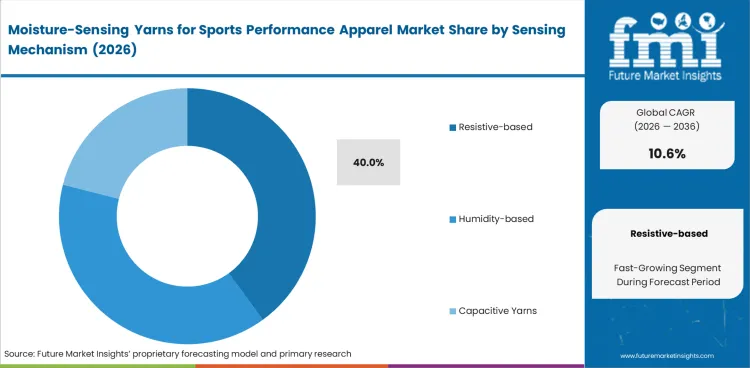
- In 2026, resistive-based yarns are estimated to make up 40.0% of the sensing mechanism segment.
- Simple electrical response lowers integration difficulty for apparel brands seeking washable sensing inside connected training garments.
Insights into Moisture-Sensing Yarns for Sports Performance Apparel Market by Yarn Construction
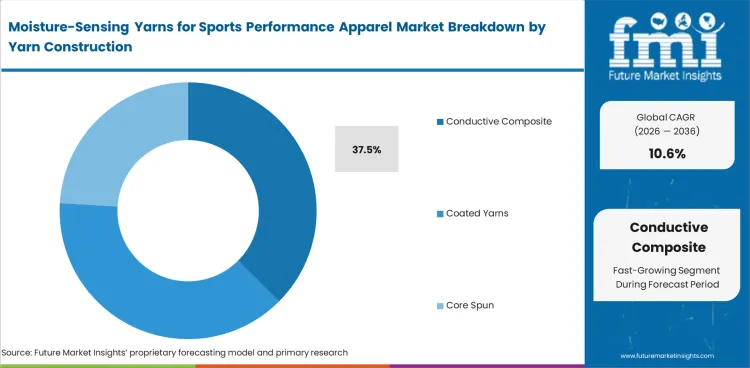
- Conductive composite yarns are expected to hold 37.5% of the yarn construction segment in 2026.
- Stretch-heavy sports apparel needs yarn structures to protect signal flow during movement and repeated washing cycles.
Insights into Moisture-Sensing Yarns for Sports Performance Apparel Market by Fiber Base
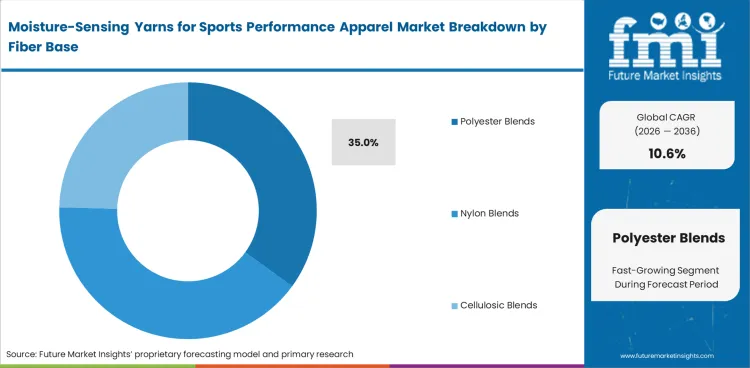
- In 2026, polyester blends are expected to account for 35.0% share of the fiber base segment.
- Performance apparel brands prefer polyester platforms for sweat handling and broad compatibility with existing garment lines.
Insights into Moisture-Sensing Yarns for Sports Performance Apparel Market by Apparel Type
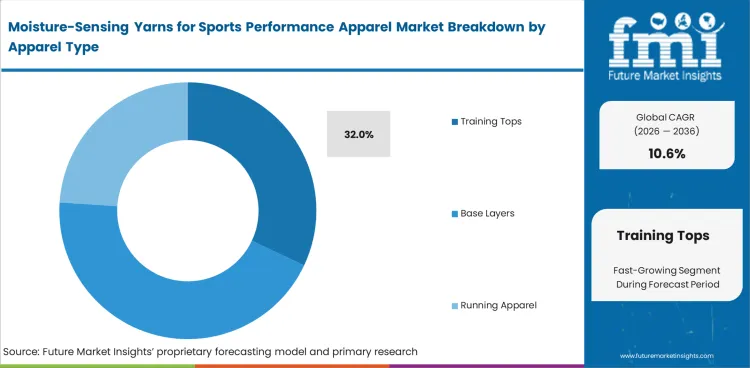
- Training tops are forecast to hold 32.0% of the apparel type segment in 2026.
- Upper-body garments provide better sweat mapping points across chest and back zones during intensive exercise.
Insights into Moisture-Sensing Yarns for Sports Performance Apparel Market by Sales Channel
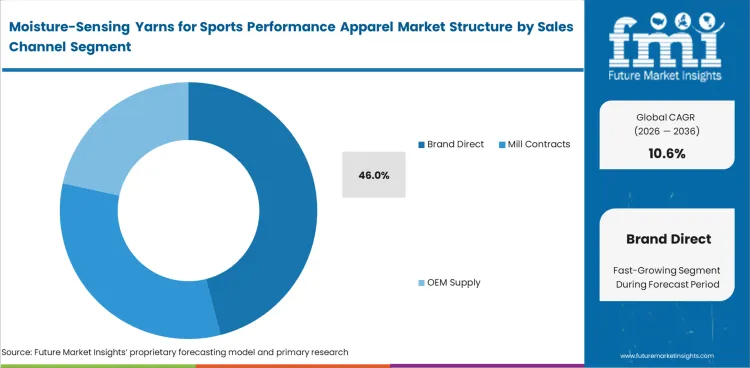
- Brand direct contracts are projected to account for 46.0% share of the sales channel segment in 2026.
- Large sportswear brands prefer direct sourcing for yarn placement control and performance documentation across apparel programs.
Moisture-Sensing Yarns for Sports Performance Apparel Market Drivers, Restraints, and Opportunities
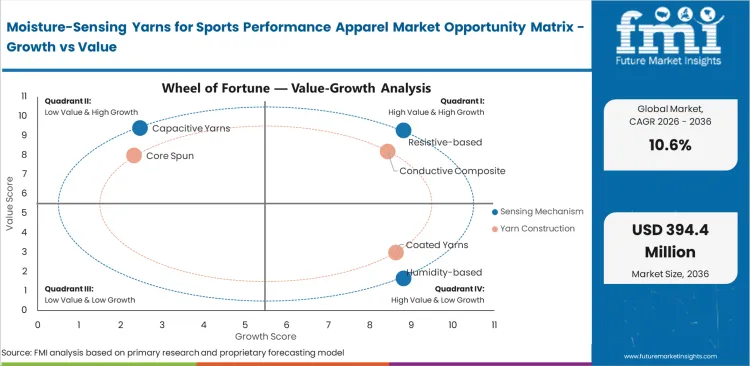
- Sweat-zone sensing is creating structured demand for yarns capable of converting moisture change into a reliable electrical response.
- Requirement for advanced conductive inputs and wash testing increases pricing pressure for smaller yarn suppliers.
- Connected apparel improves service opportunity through fabric testing and electronics interface work.
Moisture-sensing yarns for sports performance apparel demand continues to expand as training garments need washable sweat detection and stable comfort feedback. Conductive material cost and repeated wash testing can slow larger apparel programs. Growth continues through premium training tops, base layers, and connected sportswear applications.
Silver Conductive Inputs Lift Sensor Yarn Premiums
Silver-coated filaments and conductive finishes account for a major cost layer of moisture-sensing yarns because sensor accuracy depends on stable conductivity through sweat, stretch, and laundering. The estimated average silver price in 2025 was USD 38 per troy ounce, 34% higher than 2024, after starting the year at USD 29.35 and reaching USD 53.60 on November 13, according to the USA Geological Survey's February 2026 report. The report identified silver applications in clothing and electrical or electronics uses. These applications link the metal directly to wearable textile inputs. For sports apparel buyers, price negotiation should separate commodity yarn from conductive content. Premiums are more likely to hold on validated sensor yarns.
Cotton Yarn Discounts Change Blending Economics
Cotton is not the sensor layer. It affects the price architecture of moisture-sensing yarns used in sports apparel, as comfort-facing blends compete with synthetic performance bases. In April 2026, USA Department of Agriculture Foreign Agricultural Service reported that India’s MY 2025/26 cotton yarn export volume for August to December 2025 was 4% higher than a year earlier and 9% above the five-year average. The same source noted a 3% rupee depreciation and a 9% drop in yarn prices over the prior three months. This gives brands bargaining room on non-electronic yarn components. It does not automatically reduce the premium for calibrated sensing yarns, because validation and integration costs remain less flexible.
Analysis of Moisture-Sensing Yarns for Sports Performance Apparel Market By Key Countries
.webp "Top Country Growth Comparison Moisture Sensing Yarns For Sports Performance Apparel Market Cagr (2026 2036)")
| Country | CAGR |
|---|---|
| India | 13.2% |
| China | 12.4% |
| USA | 11.8% |
| Japan | 10.7% |
| UK | 9.8% |
Source: Future Market Insights, 2026.
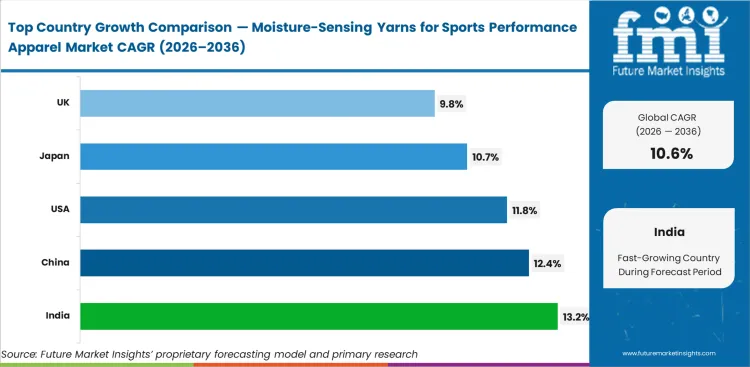
Moisture-Sensing Yarns for Sports Performance Apparel Market CAGR Analysis By Country
- India records the highest country outlook at 13.2% CAGR for 2026 to 2036, helped by textile export strength and rising fitness-center usage.
- China is projected at 12.4% CAGR across the forecast period, with sports industry scale and outdoor activity creating a larger apparel use base.
- United States demand is forecast to advance at 11.8% CAGR by 2036, due to fitness participation and brand-level smart apparel trials.
- Japan is expected to reach 10.7% CAGR during the assessment period as regular sports activity meets advanced textile engineering capacity.
- UK sales are projected to expand at 9.8% CAGR over the same period, supported by activewear maturity and selective smart apparel testing.
Demand for moisture-sensing yarns for sports performance apparel is forecast to rise at 10.6% CAGR from 2026 to 2036. Country-level analysis covers major markets contributing to this forecast, with the main markets listed below.
Demand Outlook for Moisture-Sensing Yarns for Sports Performance Apparel Market in India
Demand for moisture-sensing yarns in India's sports performance apparel industry is projected to record a CAGR of 13.2% through 2036. India’s textile and apparel exports remained at USD 37.54 billion in calendar year 2025, according to a January 2026 government release. This export base strengthens demand for moisture-sensing yarns in India as manufacturers move toward technical sports apparel. Local mills can gain from brands that require lower-cost fabric development and faster sampling.
- Textile export scale supports demand for conductive yarn testing and smart sportswear fabric development.
- Fitness facility memberships reached 12.3 million in 2024, creating a larger activewear user base.
- Domestic manufacturers need yarn partners to reduce rework across comfort testing and wash validation.
Sales Analysis of Moisture-Sensing Yarns for Sports Performance Apparel Market in China
The moisture-sensing yarns for sports performance apparel sector in China is expected to expand at a CAGR of 12.4% during the assessment period. China’s national sports industry reached 3.8421 trillion yuan in total output in 2024. This sports economy increases demand for moisture-sensing yarns in China across apparel and outdoor activity use. Testing providers benefit from local brands seeking stronger fabric performance records for domestic and export programs.
- Sports goods manufacturing and textile scale create a larger base for washable sensing yarn adoption.
- Outdoor sports participants exceeded 400 million in 2025, creating use cases for sweat-aware apparel.
- Local apparel firms need reliable yarn systems as smart garment claims face higher quality expectations.
Demand Outlook for Moisture-Sensing Yarns for Sports Performance Apparel Market in the United States
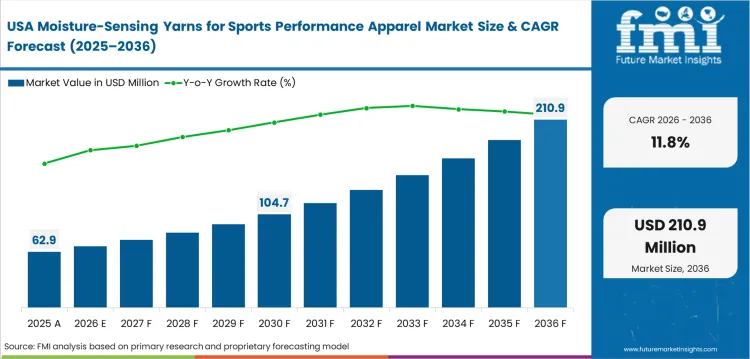
The USA moisture-sensing yarns for sports performance apparel industry is forecast to grow at a CAGR of 11.8% by 2036. USA sportswear brands value yarn partners with performance data and fabric testing capability. The Centers for Disease Control and Prevention reported in April 2026 that 47.2% of adults met aerobic activity guidelines in 2024. This active base supports demand for premium sports apparel with sweat sensing. Suppliers with brand trial experience can improve approval rates across training tops and base layers.
- Fitness participation raises demand for garments measuring sweat response during regular exercise.
- Sportswear brands need textile partners with conductive fiber knowledge and repeatable signal output.
- Smart apparel programs raise demand for moisture sensors inside washable fabric structures.
Opportunity Analysis of Moisture-Sensing Yarns for Sports Performance Apparel Market in Japan
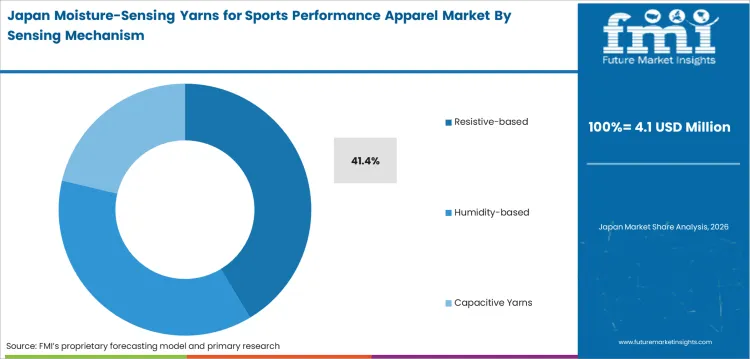
The moisture-sensing yarns for sports performance apparel segment in Japan is forecast to advance at 10.7% CAGR over the forecast years. Japan has a mature sportswear and fiber engineering base, which enhances demand for Japan moisture-sensing yarns. Regular sports participation forms a practical base for moisture-sensing yarns in the performance apparel industry in Japan. Premium garments need sweat-tracking capability that preserves comfort after repeated washing and regular use. Suppliers with strong fabric testing can serve brands developing higher-value sportswear programs.
- Premium sportswear demand favors the use of finer conductive yarns and softer next-to-skin fabric structures.
- Japanese textile suppliers can align sensing yarns with high-quality technical textiles production capability.
- Brand trials favor suppliers able to balance data capture with comfort and easy garment care.
Future Outlook for Moisture-Sensing Yarns for Sports Performance Apparel Market in the United Kingdom
The UK moisture-sensing yarns for sports performance apparel industry is expected to post 9.8% CAGR from 2026 to 2036. Regular sports participation in the UK creates a steady base for moisture-sensing yarns in performance apparel. Sports apparel users are choosing garments with comfort feedback during frequent training. Brands can use washable sensing yarns to improve premium activewear programs. Service providers with fabric testing and garment trial capability can help smaller brands. Mature retail competition keeps pricing pressure high across premium activewear.
- Strong adult activity levels support demand for sweat-aware training tops and base layers.
- Premium apparel brands need sweat resistant apparel features to pair comfort with measurable moisture response.
- Retail price pressure makes yarn qualification important before brands scale smart apparel collections.
Competitive Landscape and Strategic Positioning
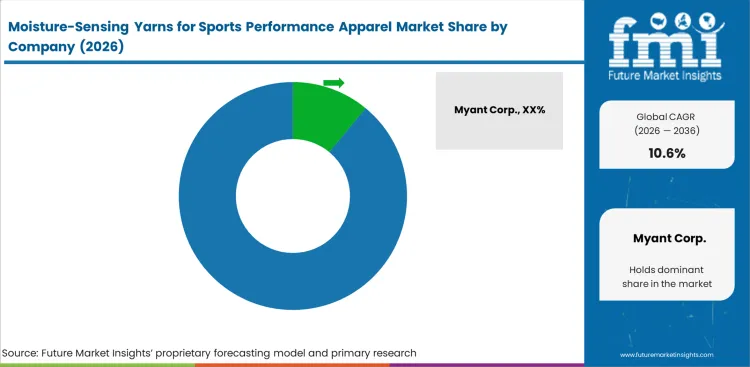
Moisture-Sensing Yarns for Sports Performance Apparel Market Analysis By Company
- Competition in this market centers on washable sensing performance and apparel-ready integration across premium sportswear product programs.
- Myant Corp. uses textile computing platforms designed to combine connected garments with moisture-related fabric functions.
- Hexoskin and Sensoria focus on smart apparel systems with body-data capture across connected sportswear applications.
- Specialist conductive textile providers compete on yarn conductivity and wash-tested fabric performance for premium apparel programs.
Myant Corp. holds a strong position through textile computing work across connected garments and moisture-related fabric functions. Hexoskin brings smart garment experience built around biometric textile monitoring and wearable data capture. Sensoria offers sports wearable apparel featuring sensor-integrated clothing designed to support training feedback. Teijin Frontier and Toray Industries add fiber engineering depth and sports textile manufacturing reach. Shieldex and Schoeller Textil address conductive material needs across premium textile programs.
High conductive input cost and strict wash-cycle validation create entry barriers for smaller suppliers. Supplier priorities center on yarn softness and signal stability across seasonal product cycles. Sportswear manufacturers prefer partners offering washable sensing performance with fabric integration knowledge. Companies with broader smart textile portfolios can reduce supplier coordination work for apparel brands.
Key Companies in the Moisture-Sensing Yarns for Sports Performance Apparel Market
Global companies active in the moisture-sensing yarns for sports performance apparel market include:
- Myant Corp., Hexoskin, and Sensoria have strong smart garment capability for sensing integration and data capture.
- Teijin Frontier, Toray Industries, and Coats Group serve manufacturers through yarn development and textile production coverage.
- Shieldex, Bekaert, Schoeller Textil, and Heathcoat Fabrics hold specialist positions across conductive yarns and premium fabric systems.
Competitive Benchmarking: Moisture-Sensing Yarns for Sports Performance Apparel Market
| Company | Wash-Cycle Evidence | Yarn Integration Depth | Sports Apparel Access | Geographic Footprint |
|---|---|---|---|---|
| Myant Corp. | High | High | Strong | North America |
| Hexoskin | High | Medium | Strong | North America |
| Sensoria | Medium | Medium | Strong | North America and Europe |
| Teijin Frontier | High | High | Strong | Asia Pacific and Global |
| Toray Industries | High | High | Strong | Asia Pacific and Global |
| Coats Group | Medium | High | Strong | Global |
| Shieldex | Medium | High | Moderate | Europe and North America |
| Bekaert | Medium | Medium | Moderate | Europe and Global |
| Schoeller Textil | High | Medium | Strong | Europe |
| Heathcoat Fabrics | Medium | High | Moderate | Europe |
Source: Future Market Insights, 2026.
Key Developments in Moisture-Sensing Yarns for Sports Performance Apparel Market
- In January 2025, Myant presented its partnership with Osmotex at CES 2025. The work centered on Skiin technologies and textile computing for active fabric functions.
- In November 2025, Hexoskin received FDA 510(k) clearance for a smart garment system recording ECG, respiratory, and activity signals.
- In December 2025, Asahi Kasei and Teijin agreed to integrate Asahi Kasei Advance with Teijin Frontier effective October 1, 2026.
Key Players in the Moisture-Sensing Yarns for Sports Performance Apparel Market
Major Global Players:
- Myant Corp.
- Hexoskin
- Teijin Frontier
- Toray Industries
- Coats Group
- Bekaert
Specialist Players:
- Sensoria
- Shieldex
- Schoeller Textil
- Heathcoat Fabrics
Report Scope and Coverage
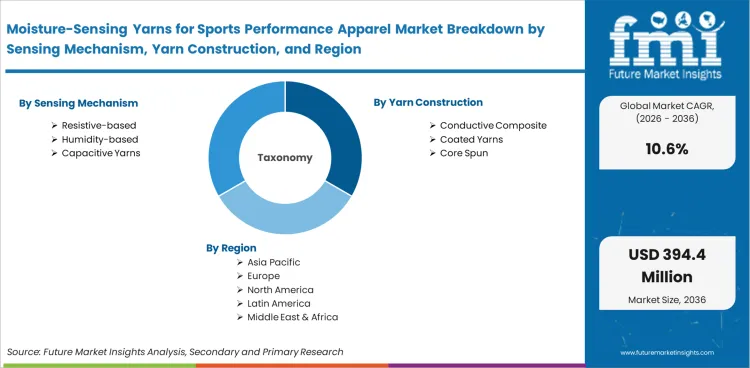
Moisture-Sensing Yarns for Sports Performance Apparel Market Breakdown By Sensing Mechanism, Yarn Construction, Fiber Base, Apparel Type, Sales Channel, And Region
| Parameter | Details |
|---|---|
| Quantitative Units | USD 144.0 million to USD 394.4 million, at a CAGR of 10.6% |
| Market Definition | The moisture-sensing yarns for sports performance apparel market covers yarn systems detecting sweat or humidity inside sportswear fabrics. |
| Regions Covered | North America, Latin America, Europe, East Asia, South Asia and Pacific, Middle East and Africa |
| Countries Covered | USA, UK, Germany, China, India, Japan, South Korea, and 30 plus countries |
| Key Companies Profiled | Myant Corp., Hexoskin, Sensoria, Teijin Frontier, Toray Industries, Coats Group, Shieldex, Bekaert, Schoeller Textil, Heathcoat Fabrics |
| Forecast Period | 2026 to 2036 |
| Approach | Hybrid bottom-up and top-down methodology starting with parent yarn demand and verified sports apparel use patterns. |
Moisture-Sensing Yarns for Sports Performance Apparel Market by Segments<
Moisture-Sensing Yarns for Sports Performance Apparel Market Segmented by Sensing Mechanism:
- Resistive-based
- Humidity-based
- Capacitive Yarns
- Hybrid Mechanisms
Moisture-Sensing Yarns for Sports Performance Apparel Market Segmented by Yarn Construction:
- Conductive Composite
- Coated Yarns
- Core Spun
- Plated Yarns
Moisture-Sensing Yarns for Sports Performance Apparel Market Segmented by Fiber Base:
- Polyester Blends
- Nylon Blends
- Cellulosic Blends
- Elastane Blends
Moisture-Sensing Yarns for Sports Performance Apparel Market Segmented by Apparel Type:
- Training Tops
- Base Layers
- Running Apparel
- Compression Wear
Moisture-Sensing Yarns for Sports Performance Apparel Market Segmented by Sales Channel:
- Brand Direct
- Mill Contracts
- OEM Supply
- Research Programs
Moisture-Sensing Yarns for Sports Performance Apparel Market by Region:
- North America
- USA
- Canada
- Mexico
- Latin America
- Brazil
- Chile
- Rest of Latin America
- Europe
- Germany
- UK
- Italy
- Spain
- France
- Rest of Europe
- East Asia
- China
- Japan
- South Korea
- South Asia and Pacific
- India
- ASEAN
- Australia & New Zealand
- Rest of South Asia and Pacific
- Middle East and Africa
- Saudi Arabia
- Other GCC Countries
- South Africa
- Rest of Middle East and Africa
Research Sources and Bibliography
- Centers for Disease Control and Prevention. (2026, April 7). Aerobic physical activity among adults age 18 and older: United States, 2024. CDC National Center for Health Statistics.
- Sport England. (2026, April 23). Active Lives Adult Survey: November 2024 to November 2025 report. Sport England.
- National Bureau of Statistics of China. (2026, January 1). Announcement on total scale and value-added data of national sports industry in 2024. National Bureau of Statistics of China.
- Government of China. (2025, October 29). China’s outdoor sports participants exceed 400 million. The State Council of the People’s Republic of China.
- Press Information Bureau. (2026, January 16). India’s textile and apparel exports maintain growth momentum. Government of India.
- Health & Fitness Association. (2025, September 9). India’s fitness market set to double by 2030. Health & Fitness Association.
- Sasakawa Sports Foundation. (2024, December). The 2024 SSF National Sports-Life Survey. Sasakawa Sports Foundation.
- Federal Reserve Bank of St. Louis. (2026, April 14). Producer Price Index by Industry: Fiber, Yarn, and Thread Mills. FRED.
- Federal Reserve Bank of St. Louis. (2026, April 14). Producer Price Index by Commodity: Textile Products and Apparel: Synthetic Fibers. FRED.
- Islam, M. T., et al. (2025). Advancements in functional smart and wearable textiles for sports and fitness applications. PMC.
This Report Answers
- What is the current and future size of the moisture-sensing yarns for sports performance apparel market?
- How fast is the moisture-sensing yarns for sports performance apparel market expected to expand between 2026 and 2036?
- Which sensing mechanism is expected to lead the market by 2026?
- Which sales channel is expected to account for the highest demand by 2026?
- What factors are driving demand for moisture-sensing yarns across sports apparel globally?
- How are wash-cycle requirements influencing adoption of smart yarn systems?
- Why are Brand Direct contracts the main demand base for moisture-sensing yarn suppliers?
- How are conductive yarn designs creating demand for specialized fabric validation?
- Which countries are projected to record faster expansion through 2036?
- What is driving market expansion in India and China?
- Who are the key companies active in the moisture-sensing yarns for sports performance apparel market?
- How does FMI estimate and validate the market forecast?
Frequently Asked Questions
What is the global market demand for Moisture-Sensing Yarns for Sports Performance Apparel in 2026?
In 2026, the global market for moisture-sensing yarns for sports performance apparel is expected to be worth USD 144.0 million.
How big will the market for Moisture-Sensing Yarns for Sports Performance Apparel be in 2036?
By 2036, the market for moisture-sensing yarns for sports performance apparel is expected to be worth USD 394.4 million.
How much is demand for Moisture-Sensing Yarns for Sports Performance Apparel expected to expand between 2026 and 2036?
Between 2026 and 2036, demand for moisture-sensing yarns for sports performance apparel is expected to expand at a CAGR of 10.6%.
Which sensing mechanism segment is likely to be the leading seller globally by 2026?
Resistive-based yarns will make up 40.0% of the sensing mechanism segment in 2026.
What is causing demand to rise in India?
The India moisture-sensing yarns for sports performance apparel market is projected to record 13.2% CAGR through 2036, backed by textile exports and fitness use.
What is causing demand to rise in China?
The China moisture-sensing yarns for sports performance apparel market is projected to expand at 12.4% CAGR through 2036, backed by sports industry scale and outdoor activity.
What does this report mean by Moisture-Sensing Yarns for Sports Performance Apparel Market definition?
The market includes yarn systems detecting sweat or humidity changes inside sports performance apparel before data is used for comfort or training feedback.
How does FMI make the Moisture-Sensing Yarns for Sports Performance Apparel forecast and check it?
Forecasting models use a hybrid bottom-up and top-down approach, starting with parent yarn demand and checking it against sports apparel use patterns.
Preview the report firsthand - request a free sample
Get SampleGet the brochure for pricing and purchase details.
Get PDFTable of Content
- Key Takeaways
- Market Size and CAGR
- Top Growth Driver
- Fastest Growing Segment
- Leading Region
- Key Companies
- Emerging Opportunities
- Executive Summary
- Global Market Outlook
- Demand-side Trends
- Supply-side Trends
- Technology Roadmap Analysis
- Analysis and Recommendations
- Analyst Perspective (What is happening? Why now? What should investors know?)
- Key Questions Answered
- How large is the market?
- What is the CAGR?
- What are key trends?
- Which region dominates?
- Who are the leaders?
- Market Overview
- Market Coverage / Taxonomy
- Market Definition / Scope / Limitations
- Research Methodology
- Chapter Orientation
- Analytical Lens and Working Hypotheses
- Market Structure, Signals, and Trend Drivers
- Benchmarking and Cross-market Comparability
- Market Sizing, Forecasting, and Opportunity Mapping
- Research Design and Evidence Framework
- Desk Research Programme (Secondary Evidence)
- Expert Input and Fieldwork (Primary Evidence)
- Tooling, Models, and Reference Databases
- Data Engineering and Model Build
- Quality Assurance and Audit Trail
- Market Background
- Market Dynamics (Drivers, Restraints, Opportunity, Trends)
- Scenario Forecast (Optimistic, Likely, Conservative)
- Impact Analysis
- AI Impact
- Sustainability Impact
- Regulatory Impact
- Technology Impact
- Consumer / Buyer Analysis
- Purchase Drivers
- Adoption Barriers
- Buyer Journey
- Opportunity Map Analysis
- Product Life Cycle Analysis
- Supply Chain Analysis
- Investment Feasibility Matrix
- Value Chain Analysis
- PESTLE and Porter's Analysis
- Regulatory Landscape
- Regional Parent Market Outlook
- Production and Consumption Statistics
- Import and Export Statistics
- Global Market Analysis and Forecast, 2021 to 2036
- Historical Market Size Value (USD Million) & Volume (Unit) Analysis, 2021 to 2025
- Current and Future Market Size Value (USD Million) & Volume (Unit) Projections, 2026 to 2036
- Y-o-Y Growth Trend Analysis
- Absolute $ Opportunity Analysis
- Global Market Pricing Analysis, 2021 to 2036
- Global Market Analysis and Forecast, By Sensing Mechanism, 2021 to 2036
- Introduction / Key Findings
- Historical Market Size Value (USD Million) & Volume (Unit) Analysis By Sensing Mechanism, 2021 to 2025
- Current and Future Market Size Value (USD Million) & Volume (Unit) Analysis and Forecast By Sensing Mechanism, 2026 to 2036
- Resistive-based
- Humidity-based
- Capacitive Yarns
- Hybrid Mechanisms
- Resistive-based
- Y-o-Y Growth Trend Analysis By Sensing Mechanism, 2021 to 2025
- Absolute $ Opportunity Analysis By Sensing Mechanism, 2026 to 2036
- Global Market Analysis and Forecast, By Yarn Construction, 2021 to 2036
- Introduction / Key Findings
- Historical Market Size Value (USD Million) & Volume (Unit) Analysis By Yarn Construction, 2021 to 2025
- Current and Future Market Size Value (USD Million) & Volume (Unit) Analysis and Forecast By Yarn Construction, 2026 to 2036
- Conductive Composite
- Coated Yarns
- Core Spun
- Plated Yarns
- Conductive Composite
- Y-o-Y Growth Trend Analysis By Yarn Construction, 2021 to 2025
- Absolute $ Opportunity Analysis By Yarn Construction, 2026 to 2036
- Global Market Analysis and Forecast, By Fiber Base, 2021 to 2036
- Introduction / Key Findings
- Historical Market Size Value (USD Million) & Volume (Unit) Analysis By Fiber Base, 2021 to 2025
- Current and Future Market Size Value (USD Million) & Volume (Unit) Analysis and Forecast By Fiber Base, 2026 to 2036
- Polyester Blends
- Nylon Blends
- Cellulosic Blends
- Elastane Blends
- Polyester Blends
- Y-o-Y Growth Trend Analysis By Fiber Base, 2021 to 2025
- Absolute $ Opportunity Analysis By Fiber Base, 2026 to 2036
- Global Market Analysis and Forecast, By Apparel Type, 2021 to 2036
- Introduction / Key Findings
- Historical Market Size Value (USD Million) & Volume (Unit) Analysis By Apparel Type, 2021 to 2025
- Current and Future Market Size Value (USD Million) & Volume (Unit) Analysis and Forecast By Apparel Type, 2026 to 2036
- Training Tops
- Base Layers
- Running Apparel
- Compression Wear
- Training Tops
- Y-o-Y Growth Trend Analysis By Apparel Type, 2021 to 2025
- Absolute $ Opportunity Analysis By Apparel Type, 2026 to 2036
- Global Market Analysis and Forecast, By Apparel Type, 2021 to 2036
- Introduction / Key Findings
- Historical Market Size Value (USD Million) & Volume (Unit) Analysis By Apparel Type, 2021 to 2025
- Current and Future Market Size Value (USD Million) & Volume (Unit) Analysis and Forecast By Apparel Type, 2026 to 2036
- Training Tops
- Base Layers
- Running Apparel
- Compression Wear
- Training Tops
- Y-o-Y Growth Trend Analysis By Apparel Type, 2021 to 2025
- Absolute $ Opportunity Analysis By Apparel Type, 2026 to 2036
- Global Market Analysis and Forecast, By Sales Channel
- Introduction / Key Findings
- Historical Market Size Value (USD Million) & Volume (Unit) Analysis By Sales Channel, 2021 to 2025
- Current and Future Market Size Value (USD Million) & Volume (Unit) Analysis and Forecast By Sales Channel, 2026 to 2036
- Brand Direct
- Mill Contracts
- OEM Supply
- Research Programs
- Brand Direct
- Y-o-Y Growth Trend Analysis By Sales Channel, 2021 to 2025
- Absolute $ Opportunity Analysis By Sales Channel, 2026 to 2036
- Global Market Analysis and Forecast, By Region, 2021 to 2036
- Introduction
- Historical Market Size Value (USD Million) & Volume (Unit) Analysis By Region, 2021 to 2025
- Current Market Size Value (USD Million) & Volume (Unit) Analysis and Forecast By Region, 2026 to 2036
- North America
- Latin America
- Western Europe
- Eastern Europe
- East Asia
- South Asia and Pacific
- Middle East & Africa
- Market Attractiveness Analysis By Region
- North America Market Analysis and Forecast, By Country, 2021 to 2036
- Historical Market Size Value (USD Million) & Volume (Unit) Trend Analysis By Market Taxonomy, 2021 to 2025
- Market Size Value (USD Million) & Volume (Unit) Forecast By Market Taxonomy, 2026 to 2036
- By Country
- USA
- Canada
- Mexico
- By Sensing Mechanism
- By Yarn Construction
- By Fiber Base
- By Apparel Type
- By Apparel Type
- By Sales Channel
- By Country
- Market Attractiveness Analysis
- By Country
- By Sensing Mechanism
- By Yarn Construction
- By Fiber Base
- By Apparel Type
- By Apparel Type
- By Sales Channel
- Key Takeaways
- Latin America Market Analysis and Forecast, By Country
- Historical Market Size Value (USD Million) & Volume (Unit) Trend Analysis By Market Taxonomy, 2021 to 2025
- Market Size Value (USD Million) & Volume (Unit) Forecast By Market Taxonomy, 2026 to 2036
- By Country
- Brazil
- Chile
- Rest of Latin America
- By Sensing Mechanism
- By Yarn Construction
- By Fiber Base
- By Apparel Type
- By Apparel Type
- By Sales Channel
- By Country
- Market Attractiveness Analysis
- By Country
- By Sensing Mechanism
- By Yarn Construction
- By Fiber Base
- By Apparel Type
- By Apparel Type
- By Sales Channel
- Key Takeaways
- Western Europe Market Analysis and Forecast, By Country
- Historical Market Size Value (USD Million) & Volume (Unit) Trend Analysis By Market Taxonomy, 2021 to 2025
- Market Size Value (USD Million) & Volume (Unit) Forecast By Market Taxonomy, 2026 to 2036
- By Country
- Germany
- UK
- Italy
- Spain
- France
- Nordic
- BENELUX
- Rest of Western Europe
- By Sensing Mechanism
- By Yarn Construction
- By Fiber Base
- By Apparel Type
- By Apparel Type
- By Sales Channel
- By Country
- Market Attractiveness Analysis
- By Country
- By Sensing Mechanism
- By Yarn Construction
- By Fiber Base
- By Apparel Type
- By Apparel Type
- By Sales Channel
- Key Takeaways
- Eastern Europe Market Analysis and Forecast, By Country
- Historical Market Size Value (USD Million) & Volume (Unit) Trend Analysis By Market Taxonomy, 2021 to 2025
- Market Size Value (USD Million) & Volume (Unit) Forecast By Market Taxonomy, 2026 to 2036
- By Country
- Russia
- Poland
- Hungary
- Balkan & Baltic
- Rest of Eastern Europe
- By Sensing Mechanism
- By Yarn Construction
- By Fiber Base
- By Apparel Type
- By Apparel Type
- By Sales Channel
- By Country
- Market Attractiveness Analysis
- By Country
- By Sensing Mechanism
- By Yarn Construction
- By Fiber Base
- By Apparel Type
- By Apparel Type
- By Sales Channel
- Key Takeaways
- East Asia Market Analysis and Forecast, By Country
- Historical Market Size Value (USD Million) & Volume (Unit) Trend Analysis By Market Taxonomy, 2021 to 2025
- Market Size Value (USD Million) & Volume (Unit) Forecast By Market Taxonomy, 2026 to 2036
- By Country
- China
- Japan
- South Korea
- By Sensing Mechanism
- By Yarn Construction
- By Fiber Base
- By Apparel Type
- By Apparel Type
- By Sales Channel
- By Country
- Market Attractiveness Analysis
- By Country
- By Sensing Mechanism
- By Yarn Construction
- By Fiber Base
- By Apparel Type
- By Apparel Type
- By Sales Channel
- Key Takeaways
- South Asia and Pacific Market Analysis and Forecast, By Country
- Historical Market Size Value (USD Million) & Volume (Unit) Trend Analysis By Market Taxonomy, 2021 to 2025
- Market Size Value (USD Million) & Volume (Unit) Forecast By Market Taxonomy, 2026 to 2036
- By Country
- India
- ASEAN
- Australia & New Zealand
- Rest of South Asia and Pacific
- By Sensing Mechanism
- By Yarn Construction
- By Fiber Base
- By Apparel Type
- By Apparel Type
- By Sales Channel
- By Country
- Market Attractiveness Analysis
- By Country
- By Sensing Mechanism
- By Yarn Construction
- By Fiber Base
- By Apparel Type
- By Apparel Type
- By Sales Channel
- Key Takeaways
- Middle East & Africa Market Analysis and Forecast, By Country
- Historical Market Size Value (USD Million) & Volume (Unit) Trend Analysis By Market Taxonomy, 2021 to 2025
- Market Size Value (USD Million) & Volume (Unit) Forecast By Market Taxonomy, 2026 to 2036
- By Country
- Kingdom of Saudi Arabia
- Other GCC Countries
- Türkiye
- South Africa
- Other African Union
- Rest of Middle East & Africa
- By Sensing Mechanism
- By Yarn Construction
- By Fiber Base
- By Apparel Type
- By Apparel Type
- By Sales Channel
- By Country
- Market Attractiveness Analysis
- By Country
- By Sensing Mechanism
- By Yarn Construction
- By Fiber Base
- By Apparel Type
- By Apparel Type
- By Sales Channel
- Key Takeaways
- Key Countries Market Analysis
- USA
- Pricing Analysis
- Market Share Analysis, 2025
- By Sensing Mechanism
- By Yarn Construction
- By Fiber Base
- By Apparel Type
- By Apparel Type
- By Sales Channel
- Canada
- Pricing Analysis
- Market Share Analysis, 2025
- By Sensing Mechanism
- By Yarn Construction
- By Fiber Base
- By Apparel Type
- By Apparel Type
- By Sales Channel
- Mexico
- Pricing Analysis
- Market Share Analysis, 2025
- By Sensing Mechanism
- By Yarn Construction
- By Fiber Base
- By Apparel Type
- By Apparel Type
- By Sales Channel
- Brazil
- Pricing Analysis
- Market Share Analysis, 2025
- By Sensing Mechanism
- By Yarn Construction
- By Fiber Base
- By Apparel Type
- By Apparel Type
- By Sales Channel
- Chile
- Pricing Analysis
- Market Share Analysis, 2025
- By Sensing Mechanism
- By Yarn Construction
- By Fiber Base
- By Apparel Type
- By Apparel Type
- By Sales Channel
- Germany
- Pricing Analysis
- Market Share Analysis, 2025
- By Sensing Mechanism
- By Yarn Construction
- By Fiber Base
- By Apparel Type
- By Apparel Type
- By Sales Channel
- UK
- Pricing Analysis
- Market Share Analysis, 2025
- By Sensing Mechanism
- By Yarn Construction
- By Fiber Base
- By Apparel Type
- By Apparel Type
- By Sales Channel
- Italy
- Pricing Analysis
- Market Share Analysis, 2025
- By Sensing Mechanism
- By Yarn Construction
- By Fiber Base
- By Apparel Type
- By Apparel Type
- By Sales Channel
- Spain
- Pricing Analysis
- Market Share Analysis, 2025
- By Sensing Mechanism
- By Yarn Construction
- By Fiber Base
- By Apparel Type
- By Apparel Type
- By Sales Channel
- France
- Pricing Analysis
- Market Share Analysis, 2025
- By Sensing Mechanism
- By Yarn Construction
- By Fiber Base
- By Apparel Type
- By Apparel Type
- By Sales Channel
- India
- Pricing Analysis
- Market Share Analysis, 2025
- By Sensing Mechanism
- By Yarn Construction
- By Fiber Base
- By Apparel Type
- By Apparel Type
- By Sales Channel
- ASEAN
- Pricing Analysis
- Market Share Analysis, 2025
- By Sensing Mechanism
- By Yarn Construction
- By Fiber Base
- By Apparel Type
- By Apparel Type
- By Sales Channel
- Australia & New Zealand
- Pricing Analysis
- Market Share Analysis, 2025
- By Sensing Mechanism
- By Yarn Construction
- By Fiber Base
- By Apparel Type
- By Apparel Type
- By Sales Channel
- China
- Pricing Analysis
- Market Share Analysis, 2025
- By Sensing Mechanism
- By Yarn Construction
- By Fiber Base
- By Apparel Type
- By Apparel Type
- By Sales Channel
- Japan
- Pricing Analysis
- Market Share Analysis, 2025
- By Sensing Mechanism
- By Yarn Construction
- By Fiber Base
- By Apparel Type
- By Apparel Type
- By Sales Channel
- South Korea
- Pricing Analysis
- Market Share Analysis, 2025
- By Sensing Mechanism
- By Yarn Construction
- By Fiber Base
- By Apparel Type
- By Apparel Type
- By Sales Channel
- Russia
- Pricing Analysis
- Market Share Analysis, 2025
- By Sensing Mechanism
- By Yarn Construction
- By Fiber Base
- By Apparel Type
- By Apparel Type
- By Sales Channel
- Poland
- Pricing Analysis
- Market Share Analysis, 2025
- By Sensing Mechanism
- By Yarn Construction
- By Fiber Base
- By Apparel Type
- By Apparel Type
- By Sales Channel
- Hungary
- Pricing Analysis
- Market Share Analysis, 2025
- By Sensing Mechanism
- By Yarn Construction
- By Fiber Base
- By Apparel Type
- By Apparel Type
- By Sales Channel
- Kingdom of Saudi Arabia
- Pricing Analysis
- Market Share Analysis, 2025
- By Sensing Mechanism
- By Yarn Construction
- By Fiber Base
- By Apparel Type
- By Apparel Type
- By Sales Channel
- Türkiye
- Pricing Analysis
- Market Share Analysis, 2025
- By Sensing Mechanism
- By Yarn Construction
- By Fiber Base
- By Apparel Type
- By Apparel Type
- By Sales Channel
- South Africa
- Pricing Analysis
- Market Share Analysis, 2025
- By Sensing Mechanism
- By Yarn Construction
- By Fiber Base
- By Apparel Type
- By Apparel Type
- By Sales Channel
- USA
- Market Structure Analysis
- Competition Dashboard
- Competition Benchmarking
- Market Share Analysis of Top Players
- By Regional
- By Sensing Mechanism
- By Yarn Construction
- By Fiber Base
- By Apparel Type
- By Apparel Type
- By Sales Channel
- Emerging Startups
- Innovation Benchmarking
- Competition Analysis
- Competition Deep Dive
- Myant Corp.
- Overview
- Product Portfolio
- Profitability by Market Segments (Product/Region/Sales Channel)
- Sales Footprint
- Strategy Overview
- Marketing Strategy
- Product Strategy
- Channel Strategy
- Hexoskin
- Teijin Frontier
- Toray Industries
- Coats Group
- Bekaert
- Sensoria
- Shieldex
- Schoeller Textil
- Heathcoat Fabrics
- Myant Corp.
- Case Studies
- Success Stories
- Recent Developments
- Competition Deep Dive
- Assumptions & Acronyms Used


