

- Market Size (2026)
- USD 186.7 Mn
- Forecast (2036)
- USD 493.1 Mn
- CAGR (2026 to 2036)
- 10.2%
How big is Spray Retention Additives Market in 2026?
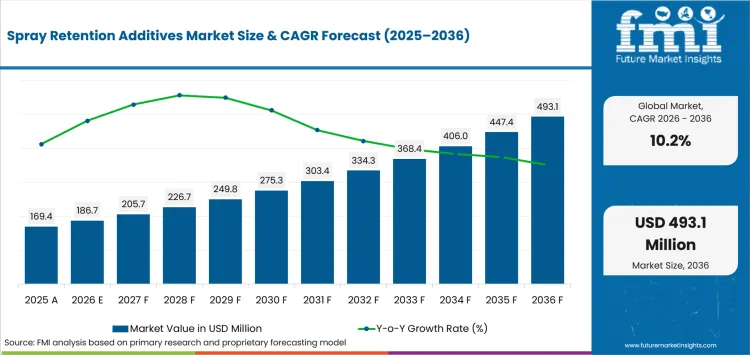
USD 186.7 million in 2026 and USD 493.1 million by 2036 at a 10.2% CAGR.
Demand for spray retention additives is projected to expand at 10.2% CAGR between 2026 and 2036, increasing valuation from USD 186.7 million in 2026 to USD 493.1 million by 2036. Commercial demand is tied to keeping more of an applied spray on the intended plant or soil surface while preserving pesticide performance across changing nozzle, water and weather conditions.
Spray quality has become a more explicit part of pesticide stewardship because droplet size influences both deposition and off-target movement. The USA Environmental Protection Agency includes drift-reducing adjuvants among mitigation measures and notes that these products can increase droplet size and reduce the share of fine droplets that are more prone to drift.
Key Takeaways of Spray Retention Additives Market
- Spray retention additives gain commercial relevance where applicators need dependable deposition, adhesion and coverage without moving the spray away from the intended target.
- Surfactant-Based is projected at 38.0% share in 2026 because surface-active chemistries can improve wetting and spreading across difficult leaf surfaces.
- Efficacy Enhancement is estimated at 44.3% of function demand in 2026 as retention and coverage are purchased primarily to support the performance of the spray program.
- Cereals & Grains are forecast at 38.2% by crop type in 2026, reflecting broad-acre use where repeatable spray deposition matters across large treated areas.
- Performance can weaken when adjuvant chemistry, pesticide formulation, water quality, nozzle choice or weather conditions are poorly matched to the application.
- Evonik Industries AG, Syensqo SA/NV, Wilbur-Ellis Company LLC, Helena Agri-Enterprises, LLC, Precision Laboratories, LLC, Winfield Solutions, LLC d/b/a WinField United, BRANDT, Inc. and Loveland Products, Inc. (Nutrien) serve formulation, tank-mix, drift-control or crop-application needs relevant to spray retention.
Analyst Perspective
"A retention additive earns repeat use when it improves how the spray behaves at the nozzle, in flight and after contact with the target. Buyers will increasingly ask for evidence that the same product can hold deposition quality across pesticide chemistry, water conditions and application equipment rather than relying on a generic adjuvant claim."
- Nikhil Kaitwade, Principal Consultant, Future Market Insights
How is the Spray Retention Additives Market segmented?
The spray retention additives market is segmented by product type, function, crop type, application method, sales channel and region.
Product Type covers Surfactant-Based, Oil-Based, Polymer-Based, Mineral / Carrier-Based and Others. Function includes Efficacy Enhancement, Loss & Drift Reduction, Handling & Compatibility and Others. Crop Type includes Cereals & Grains, Fruits & Vegetables, Oilseeds & Pulses, Turf & Ornamentals and Others. Application Method covers Foliar Tank-Mix, Granule / Dry Blend, Fertigation and Others. Sales Channel includes Agri-Input Distributors, Cooperatives, Agri-Retail Chains, Online / Direct-to-Farm and Others.
Why does surfactant-based lead the product type category?
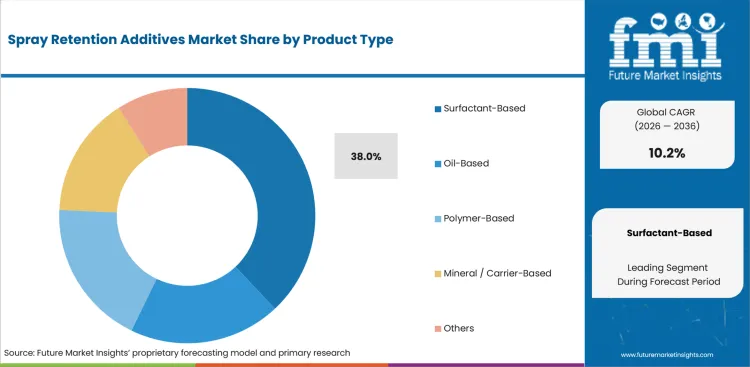
Surfactant-based products address a basic spray-delivery problem by changing the interaction between water droplets and the target surface. Extension guidance from Purdue University and Penn State describes surfactants as tools that alter wetting, spreading and spray behavior, which can help a pesticide cover and remain on waxy or otherwise difficult plant surfaces.
- Based on product type, Surfactant-Based is projected to account for 38.0% in 2026 as wetting and spreading functions are relevant across herbicide, fungicide and insecticide tank mixes.
- Silicone and nonionic surfactant systems can be selected for different coverage and retention requirements, giving formulators and applicators a flexible route to modify droplet behavior without changing the pesticide active ingredient.
Why does efficacy enhancement lead the function category?
Retention has commercial value when it converts more of the applied spray into useful target coverage. USDA Forest Service guidance notes that adjuvants can improve droplet retention and deposition, while extension literature links spreading and adhesion to more consistent contact between spray solution and plant surfaces.
- In 2026, Efficacy Enhancement is expected to lead the function category with 44.3% share because the principal purchasing case is better use of an existing crop-protection spray rather than a separate field operation.
- The performance claim still depends on the active ingredient and label directions, so suppliers compete through formulation fit, compatibility guidance and evidence generated under relevant spray conditions.
Why do cereals & grains lead the crop type category?
Cereals and grains expose spray programs to broad treated areas where small losses in deposition can be repeated across many passes. Herbicide, fungicide and insecticide applications therefore place practical value on consistent droplet formation, canopy contact and retention during field-scale operations.
- The Cereals & Grains segment is likely to capture 38.2% share in 2026 due to the recurring need to maintain application quality across large field-crop programs.
- The value proposition is strongest when additives improve spray placement without creating antagonism, excessive runoff or a droplet spectrum that conflicts with the pesticide label and application equipment.
Why does foliar tank-mix lead the application method category?
Foliar tank-mix use allows the applicator to add an adjuvant at the point where pesticide chemistry, carrier water and equipment settings are known. This creates a direct route to adjust wetting, deposition, drift or compatibility for a defined field application rather than relying only on formulation-stage modification.
- Foliar Tank-Mix is forecast to account for 42.1% of application method demand in 2026 because retention and spray-quality functions are commonly needed during foliar crop-protection applications.
- Tank-mix selection requires label compliance and careful sequence control because compatibility problems can offset the intended gain in spray quality or field performance.
Why do agri-input distributors lead the sales channel category?
Spray retention additives are rarely selected by chemistry name alone. The practical choice depends on the pesticide program, crop, nozzle, carrier water and local application conditions, which gives agronomy-led distribution an important role in matching products to a field use case.
- Agri-Input Distributors are expected to lead sales channel demand with 41.3% share in 2026 because they combine product availability with application guidance close to the point of use.
- Digital and direct channels can expand for repeat purchases, but first-use decisions remain more dependent on technical fit and local support when multiple adjuvant functions are available for the same spray program.
What are the drivers, restraints and opportunities in the Spray Retention Additives Market?
Pressure for on-target spray deposition supports retention additives, while application-specific performance limits broad substitution as precision and aerial spraying create new formulation requirements.
- Driver: Drift-mitigation and pesticide-stewardship requirements increase attention to droplet size, deposition and retention during crop-protection applications.
- Restraint: Performance varies with pesticide chemistry, water quality, nozzle setup, crop surface and weather, so an additive that works in one spray program may not transfer cleanly to another.
- Opportunity: Drone, low-volume and precision spraying create demand for additives that manage droplet behavior under tighter carrier volumes and more demanding application windows.
Regulators and extension agencies increasingly treat spray behavior as part of responsible pesticide use. EPA guidance recognizes drift-reducing adjuvants as one mitigation option, while UK and German application frameworks emphasize drift-reduction practices and validated application technology. These requirements make measurable deposition and drift performance more relevant to product selection.
The technical constraint is that retention is a system outcome rather than a single ingredient property. Purdue Extension and other agronomy guidance stress that adjuvant choice interacts with pesticide formulation, target surface and application conditions. Poor matching can reduce efficacy, increase runoff or create crop-safety problems, which raises the value of clear technical instructions and field validation.
Aerial and drone applications create a defined development route. Agriculture agencies in Japan and South Korea continue to formalize and expand drone-based pesticide application, where low carrier volumes and rotor airflow change droplet transport. Suppliers that can maintain deposition and retention while respecting drift and label requirements can address a more specialized application environment.
Which country CAGRs are profiled in the Spray Retention Additives Market?
| Country | CAGR |
|---|---|
| South Korea | 9.9% |
| Germany | 9.6% |
| USA | 9.3% |
| UK | 8.7% |
| Japan | 8.1% |
How do country-level CAGRs compare in the Spray Retention Additives Market?
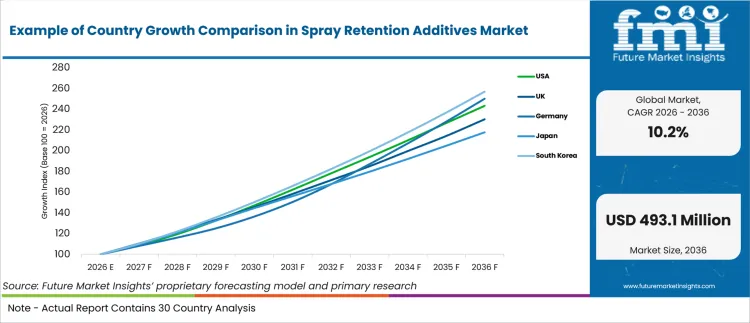
The profiled CAGRs span 1.8 percentage points across markets with different pesticide stewardship rules, crop structures and adoption paths for precision application. The spacing measures expected expansion rather than current market value or current additive consumption in each country.
- South Korea is set to grow at 9.9% CAGR, supported by the continued operationalization of agricultural drone spraying and the need to manage deposition under aerial application conditions.
- Germany is likely to grow at 9.6% as approved adjuvant listings and drift-reduction requirements keep technical validation visible in crop-protection application decisions.
- The USA is set to expand at 9.3%, with EPA mitigation frameworks giving drift-reducing adjuvants a defined role within pesticide-risk reduction measures.
- The UK spray retention additives market is anticipated to grow at 8.7% CAGR as pesticide-use policy and spray-drift controls encourage more deliberate selection of application technology and supporting adjuvants.
- Japan is forecast to grow at 8.1%, where drone-compatible pesticide use and low-volume aerial application create specialized requirements for spray delivery and drift control.
Comparable CAGRs can produce different commercial entry conditions. The full report provides country-level CAGR analysis across North America, Latin America, Europe, East Asia, South Asia and Pacific, and the Middle East and Africa.
Country-wise Analysis
- South Korea is building practical experience with agricultural drones for pesticide spraying, and Rural Development Administration materials describe the role of rotor downwash in moving spray into crop canopies. The South Korean spray retention additives sector is projected to record 9.9% CAGR during the assessment period as aerial application increases the need to control droplet movement and target contact under low-volume operating conditions.
- Germany maintains a formal regulatory route for crop-protection adjuvants, with the Federal Office of Consumer Protection and Food Safety publishing an updated list of approved additives and the Julius Kühn-Institut testing drift-reducing application technology. Germany is forecast to post 9.6% CAGR through 2036 as buyers place more value on validated spray behavior that fits pesticide and equipment requirements.
- The USA Environmental Protection Agency includes drift-reducing adjuvants in its pesticide mitigation menu and describes droplet-size management as one route to reduce off-target movement, giving retention and deposition technologies a clearer role within stewardship-oriented application programs. The USA spray retention additives market is set to expand at 9.3% CAGR through 2036 as stewardship requirements increase attention to droplet size and on-target deposition.
- The UK Pesticides National Action Plan and Health and Safety Executive guidance emphasize sustainable pesticide use, drift reduction and appropriate application practice, which supports demand for adjuvant selection based on measurable spray quality rather than generic tank-mix use. The UK spray retention additives market is anticipated to grow at 8.7% CAGR through 2036 as pesticide-use policy and spray-drift controls encourage more deliberate selection of application technology and supporting adjuvants.
- Ministry of Agriculture, Forestry and Fisheries guidance in Japan requires operators to follow registered use patterns and drift-prevention practices, creating a technical opening for additives that support deposition under concentrated, low-volume aerial sprays. Japan is forecast to grow at 8.1% CAGR through 2036 as drone-compatible pesticide use and low-volume aerial application create specialized requirements for spray delivery and drift control.
Who are the notable companies in the Spray Retention Additives Market?
Evonik Industries AG, Syensqo SA/NV, Wilbur-Ellis Company LLC, Helena Agri-Enterprises, LLC, Precision Laboratories, LLC, Winfield Solutions, LLC d/b/a WinField United, BRANDT, Inc. and Loveland Products, Inc. (Nutrien) are notable companies serving the spray retention additives market.
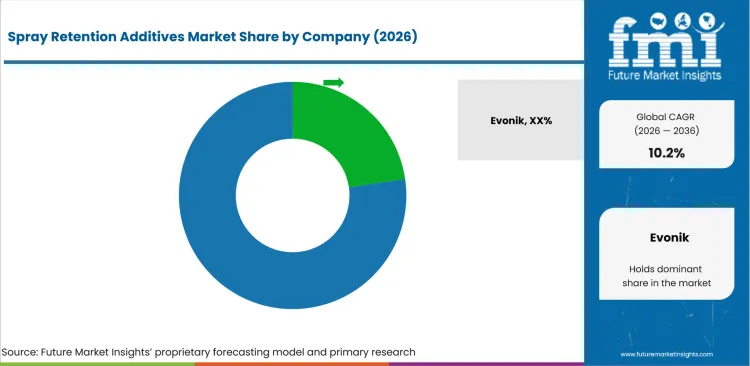
Competition spans specialty-chemical suppliers, agriculture-focused formulators and crop-input businesses that connect adjuvants with field application support. Portfolio breadth matters less than whether a supplier can demonstrate a useful retention, deposition, wetting, drift or compatibility function within a specific pesticide and application system.
- Evonik Industries AG and Syensqo SA/NV supply specialty surfactant and tank-mix technologies used to modify wetting, spreading, deposition or drift behavior.
- Wilbur-Ellis Company LLC, Helena Agri-Enterprises, LLC, Winfield Solutions, LLC d/b/a WinField United, and Loveland Products, Inc. within Nutrien connect adjuvant products with crop-input distribution and agronomic support.
- Precision Laboratories, LLC and BRANDT, Inc. maintain dedicated application-aid and adjuvant portfolios covering deposition, surfactancy, drift control or multi-function tank-mix use.
Competitive Benchmarking: Spray Retention Additives Market
| Company | Retention / deposition portfolio | Drift-control capability | Crop-spray integration | Geographic Reach |
|---|---|---|---|---|
| Evonik Industries AG | High | High | High | Global crop-protection markets |
| Syensqo SA/NV | High | High | High | Global agriculture markets |
| Wilbur-Ellis Company LLC | High | High | High | United States and selected agriculture markets |
| Helena Agri-Enterprises, LLC | High | High | High | United States |
| Precision Laboratories, LLC | High | High | High | Global agriculture markets |
| Winfield Solutions, LLC d/b/a WinField United | High | High | High | United States and Canada |
| BRANDT, Inc. | High | High | High | North America and international agriculture markets |
| Loveland Products, Inc. (Nutrien) | High | Medium | High | Nutrien Ag Solutions markets |
Key Developments in the Spray Retention Additives Market
- In August 2025, WinField United launched SuperLock adjuvant, a new premium product combining a high surfactant crop oil concentrate with proprietary drift reduction technology, backed by more than 3,600 wind-tunnel measurements at its Innovation Center.
- In April 2025, BRANDT announced a new proprietary adjuvant portfolio to be produced at its Advanced Ag Formulations plant in Aurora, Nebraska.
Key Players in the Spray Retention Additives Market
Specialty Chemistry and Formulation Platforms
- Evonik Industries AG
- Syensqo SA/NV
Crop Input and Agronomy Platforms
- Wilbur-Ellis Company LLC
- Helena Agri-Enterprises, LLC
- Winfield Solutions, LLC d/b/a WinField United
- Loveland Products, Inc. (Nutrien)
Specialist Adjuvant and Application-Aid Suppliers
- Precision Laboratories, LLC
- BRANDT, Inc.
Spray Retention Additives Market - Report Scope
| Coverage field | Report scope |
|---|---|
| Market breakdown | By product type, function, crop type, application method, sales channel and region. |
| Quantitative Units | USD million. |
| Market Definition | Agricultural spray additives used to improve retention, deposition, wetting, coverage, adhesion, drift control or handling within crop-protection and related spray applications. |
| Regions Covered | North America, Latin America, Europe, East Asia, South Asia and Pacific, and Middle East and Africa. |
| Countries Covered | South Korea, Germany, USA, UK, Japan, and 20+ countries included in the full report. |
| Key Companies Profiled | Evonik Industries AG, Syensqo SA/NV, Wilbur-Ellis Company LLC, Helena Agri-Enterprises, LLC, Precision Laboratories, LLC, Winfield Solutions, LLC d/b/a WinField United, BRANDT, Inc. and Loveland Products, Inc. (Nutrien). |
| Forecast Period | 2026 to 2036. |
| Approach | Primary and secondary research with market triangulation. |
Spray Retention Additives Market - Research Methodology
| Method | Approach |
|---|---|
| Primary Research | FMI analysts gathered input from adjuvant formulators, crop-input suppliers, distributors, agronomists, applicators, growers, procurement teams and subject-matter experts. Interviews examined product selection, tank-mix practice, label constraints, spray quality, technical support and the evidence required before an additive becomes part of a recurring crop-protection program. |
| Desk Research | Desk research covered government pesticide guidance, regulatory publications, agricultural extension literature, application-technology research, technical literature, company filings, product information and official corporate announcements. Sources were reviewed for relevance, publication date, geographic coverage and consistency with the defined market scope. |
| Market Sizing and Forecasting | The market model combined the baseline value with historical performance, segment structure, pricing and volume indicators, crop-protection activity, application practices, company participation and country-level demand conditions. Forecast assumptions considered regulatory developments, precision spraying, drone adoption, crop cycles, product substitution and barriers to wider use. |
| Data Validation | Estimates were checked against multiple independent indicators, including public pesticide-use guidance, company activity, application technology, regulatory developments and findings from primary interviews. Validation also tested whether products and revenues fell within the defined spray-retention market boundary to reduce double counting with broader pesticide formulation aids. |
Spray Retention Additives Market by Segments
Spray Retention Additives Market segmented by Product Type:
- Surfactant-Based
- Oil-Based
- Polymer-Based
- Mineral / Carrier-Based
- Others
Spray Retention Additives Market segmented by Function:
- Efficacy Enhancement
- Loss & Drift Reduction
- Handling & Compatibility
- Others
Spray Retention Additives Market segmented by Crop Type:
- Cereals & Grains
- Fruits & Vegetables
- Oilseeds & Pulses
- Turf & Ornamentals
- Others
Spray Retention Additives Market segmented by Application Method:
- Foliar Tank-Mix
- Granule / Dry Blend
- Fertigation
- Others
Spray Retention Additives Market segmented by Sales Channel:
- Agri-Input Distributors
- Cooperatives
- Agri-Retail Chains
- Online / Direct-to-Farm
- Others
Spray Retention Additives Market by Region:
- North America
- United States
- Canada
- Latin America
- Brazil
- Chile
- Mexico
- Rest of Latin America
- Western Europe
- Germany
- United Kingdom
- Italy
- Spain
- France
- Nordics
- Benelux
- Rest of Western Europe
- Eastern Europe
- Russia
- Poland
- Hungary
- Balkan and Baltic States
- Rest of Eastern Europe
- East Asia
- China
- Japan
- South Korea
- South Asia and Pacific
- India
- ASEAN
- Australia and New Zealand
- Rest of South Asia and Pacific
- Middle East and Africa
- Kingdom of Saudi Arabia
- Other GCC Countries
- Türkiye
- South Africa
- Other African Union Countries
- Rest of Middle East and Africa
Research Sources and Bibliography
- USA Environmental Protection Agency. (2025, April 30). Mitigation Menu.
- USA Environmental Protection Agency. (2025, September 16). Introduction to Pesticide Drift.
- USA Environmental Protection Agency. (2025). Mitigation Menu Measure Descriptions.
- Purdue University Extension. (2025, June 24). Adjuvants And The Power Of The Spray Droplet.
- Penn State Extension. (2022, June 30). Spray Adjuvants.
- USDA Forest Service. (2024). Spray Adjuvants & Water Quality.
- Oregon State University Extension. (2023). Pesticide Redistribution and Persistence on Plant Surfaces.
- Department for Environment, Food & Rural Affairs and devolved administrations. (2025, March 21). UK Pesticides National Action Plan 2025.
- UK Health and Safety Executive. (2025). Reducing Spray Drift and LERAP Guidance.
- Bundesamt für Verbraucherschutz und Lebensmittelsicherheit. (2026, August 5). Liste der Zusatzstoffe.
- Julius Kühn-Institut. (2026). Drift Reduction and Plant Protection Application Technology Guidance.
- Ministry of Agriculture, Forestry and Fisheries, Japan. (2024; updated 2026). Pesticides Usable with Drones.
- Rural Development Administration, Republic of Korea. (2025). Agricultural Drone Application Guidance and Field Research.
- Evonik Industries AG. (2026). BREAK-THRU Agricultural Additives and Crop Protection Product Information.
- Syensqo SA/NV. (2026). Solutions for Agricultural Tank Mix and AgRHO Product Information.
- Wilbur-Ellis Company LLC. (2026). Adjuvant and Drift Reduction Product Information.
- Helena Agri-Enterprises, LLC. (2026). Adjuvant Product Information and FieldLink Guidance.
- Precision Laboratories, LLC. (2026). Tank Mix Adjuvants and Spray Application Resources.
- Winfield Solutions, LLC d/b/a WinField United. (2025-2026). Adjuvant Research and Product Guidance.
- BRANDT, Inc. (2025-2026). Adjuvants and Application Aids Product Information.
- Nutrien Ag Solutions / Loveland Products, Inc. (2024-2026). Crop Protection and Adjuvant Product Information.
This bibliography is provided for reader reference and is not exhaustive. The full report contains the complete reference list and detailed citations.
This Report Answers
- How large is the Spray Retention Additives Market in 2026 and 2036?
- Which spray-delivery conditions support recurring demand for retention additives?
- Which product type segment accounts for the approved 2026 share?
- How does function shape commercial spray retention additive demand?
- Which crop type supports recurring use across broad application programs?
- Which application method places retention additives closest to the spray decision?
- How do sales channels shape product selection and technical support?
- How do profiled country growth rates affect commercial entry conditions?
- Which companies serve agricultural spray retention applications?
Frequently Asked Questions
How big is the Spray Retention Additives Market in 2026?
USD 186.7 million represents the spray retention additives market value in 2026 across agricultural spray applications. Demand is supported by the need to keep applied crop-protection products on target as the market advances toward USD 493.1 million by 2036.
What is the CAGR of the Spray Retention Additives Market from 2026 to 2036?
A 10.2% CAGR is projected for the spray retention additives market between 2026 and 2036. Growth is tied to pesticide stewardship, precision application and the need for more consistent deposition across changing spray systems and crop conditions.
Which product type segment is projected to account for 38.0% of the Spray Retention Additives Market?
Surfactant-Based is projected to account for 38.0% of product type demand within the spray retention additives market in 2026. Wetting and spreading functions give surfactant systems relevance across multiple foliar crop-protection programs.
How much will the Spray Retention Additives Market add between 2026 and 2036?
USD 306.4 million is expected to be added to the spray retention additives market between 2026 and 2036. The increase depends on broader use of retention, deposition and drift-management technologies within conventional and precision spray programs.
Which companies are active in the Spray Retention Additives Market?
Eight companies active in the spray retention additives market include Evonik Industries AG, Syensqo SA/NV, Wilbur-Ellis Company LLC, Helena Agri-Enterprises, LLC, Precision Laboratories, LLC, Winfield Solutions, LLC d/b/a WinField United, BRANDT, Inc. and Loveland Products, Inc. (Nutrien). The group covers specialty surfactants, tank-mix adjuvants, deposition aids and retail-linked crop application support.
Preview the report firsthand - request a free sample
Get SampleGet the brochure for pricing and purchase details.
Get PDFTable of Content
- Key Takeaways
- Market Size and CAGR
- Top Growth Driver
- Fastest Growing Segment
- Leading Region
- Key Companies
- Emerging Opportunities
- Executive Summary
- Global Market Outlook
- Demand-side Trends
- Supply-side Trends
- Technology Roadmap Analysis
- Analysis and Recommendations
- Analyst Perspective (What is happening? Why now? What should investors know?)
- Key Questions Answered
- How large is the market?
- What is the CAGR?
- What are key trends?
- Which region dominates?
- Who are the leaders?
- Market Overview
- Market Coverage / Taxonomy
- Market Definition / Scope / Limitations
- Research Methodology
- Chapter Orientation
- Analytical Lens and Working Hypotheses
- Market Structure, Signals, and Trend Drivers
- Benchmarking and Cross-market Comparability
- Market Sizing, Forecasting, and Opportunity Mapping
- Research Design and Evidence Framework
- Desk Research Programme (Secondary Evidence)
- Expert Input and Fieldwork (Primary Evidence)
- Tooling, Models, and Reference Databases
- Data Engineering and Model Build
- Quality Assurance and Audit Trail
- Market Background
- Market Dynamics (Drivers, Restraints, Opportunity, Trends)
- Scenario Forecast (Optimistic, Likely, Conservative)
- Impact Analysis
- AI Impact
- Sustainability Impact
- Regulatory Impact
- Technology Impact
- Consumer / Buyer Analysis
- Purchase Drivers
- Adoption Barriers
- Buyer Journey
- Opportunity Map Analysis
- Product Life Cycle Analysis
- Supply Chain Analysis
- Investment Feasibility Matrix
- Value Chain Analysis
- PESTLE and Porter's Analysis
- Regulatory Landscape
- Regional Parent Market Outlook
- Production and Consumption Statistics
- Import and Export Statistics
- Global Market Analysis and Forecast, 2021 to 2036
- Historical Market Size Value (USD Million) Analysis, 2021 to 2025
- Current and Future Market Size Value (USD Million) Projections, 2026 to 2036
- Y-o-Y Growth Trend Analysis
- Absolute $ Opportunity Analysis
- Global Market Pricing Analysis, 2021 to 2036
- Global Market Analysis and Forecast, By Product Type, 2021 to 2036
- Introduction / Key Findings
- Historical Market Size Value (USD Million) Analysis By Product Type, 2021 to 2025
- Current and Future Market Size Value (USD Million) Analysis and Forecast By Product Type, 2026 to 2036
- Surfactant-Based
- Oil-Based
- Polymer-Based
- Mineral / Carrier-Based
- Others
- Surfactant-Based
- Y-o-Y Growth Trend Analysis By Product Type, 2021 to 2025
- Absolute $ Opportunity Analysis By Product Type, 2026 to 2036
- Global Market Analysis and Forecast, By Function, 2021 to 2036
- Introduction / Key Findings
- Historical Market Size Value (USD Million) Analysis By Function, 2021 to 2025
- Current and Future Market Size Value (USD Million) Analysis and Forecast By Function, 2026 to 2036
- Efficacy Enhancement
- Loss & Drift Reduction
- Handling & Compatibility
- Others
- Efficacy Enhancement
- Y-o-Y Growth Trend Analysis By Function, 2021 to 2025
- Absolute $ Opportunity Analysis By Function, 2026 to 2036
- Global Market Analysis and Forecast, By Crop Type, 2021 to 2036
- Introduction / Key Findings
- Historical Market Size Value (USD Million) Analysis By Crop Type, 2021 to 2025
- Current and Future Market Size Value (USD Million) Analysis and Forecast By Crop Type, 2026 to 2036
- Cereals & Grains
- Fruits & Vegetables
- Oilseeds & Pulses
- Turf & Ornamentals
- Others
- Cereals & Grains
- Y-o-Y Growth Trend Analysis By Crop Type, 2021 to 2025
- Absolute $ Opportunity Analysis By Crop Type, 2026 to 2036
- Global Market Analysis and Forecast, By Application Method, 2021 to 2036
- Introduction / Key Findings
- Historical Market Size Value (USD Million) Analysis By Application Method, 2021 to 2025
- Current and Future Market Size Value (USD Million) Analysis and Forecast By Application Method, 2026 to 2036
- Foliar Tank-Mix
- Granule / Dry Blend
- Fertigation
- Others
- Foliar Tank-Mix
- Y-o-Y Growth Trend Analysis By Application Method, 2021 to 2025
- Absolute $ Opportunity Analysis By Application Method, 2026 to 2036
- Global Market Analysis and Forecast, By Sales Channel, 2021 to 2036
- Introduction / Key Findings
- Historical Market Size Value (USD Million) Analysis By Sales Channel, 2021 to 2025
- Current and Future Market Size Value (USD Million) Analysis and Forecast By Sales Channel, 2026 to 2036
- Agri-Input Distributors
- Cooperatives
- Agri-Retail Chains
- Online / Direct-to-Farm
- Others
- Agri-Input Distributors
- Y-o-Y Growth Trend Analysis By Sales Channel, 2021 to 2025
- Absolute $ Opportunity Analysis By Sales Channel, 2026 to 2036
- Global Market Analysis and Forecast, By Region, 2021 to 2036
- Introduction
- Historical Market Size Value (USD Million) Analysis By Region, 2021 to 2025
- Current Market Size Value (USD Million) Analysis and Forecast By Region, 2026 to 2036
- North America
- Latin America
- Western Europe
- Eastern Europe
- East Asia
- South Asia and Pacific
- Middle East & Africa
- Market Attractiveness Analysis By Region
- North America Market Analysis and Forecast, By Country, 2021 to 2036
- Historical Market Size Value (USD Million) Trend Analysis By Market Taxonomy, 2021 to 2025
- Market Size Value (USD Million) Forecast By Market Taxonomy, 2026 to 2036
- By Country
- USA
- Canada
- By Product Type
- By Function
- By Crop Type
- By Application Method
- By Sales Channel
- By Country
- Market Attractiveness Analysis
- By Country
- By Product Type
- By Function
- By Crop Type
- By Application Method
- By Sales Channel
- Key Takeaways
- Latin America Market Analysis and Forecast, By Country
- Historical Market Size Value (USD Million) Trend Analysis By Market Taxonomy, 2021 to 2025
- Market Size Value (USD Million) Forecast By Market Taxonomy, 2026 to 2036
- By Country
- Brazil
- Mexico
- Chile
- Rest of Latin America
- By Product Type
- By Function
- By Crop Type
- By Application Method
- By Sales Channel
- By Country
- Market Attractiveness Analysis
- By Country
- By Product Type
- By Function
- By Crop Type
- By Application Method
- By Sales Channel
- Key Takeaways
- Western Europe Market Analysis and Forecast, By Country
- Historical Market Size Value (USD Million) Trend Analysis By Market Taxonomy, 2021 to 2025
- Market Size Value (USD Million) Forecast By Market Taxonomy, 2026 to 2036
- By Country
- Germany
- UK
- Italy
- Spain
- France
- Nordic
- BENELUX
- Rest of Western Europe
- By Product Type
- By Function
- By Crop Type
- By Application Method
- By Sales Channel
- By Country
- Market Attractiveness Analysis
- By Country
- By Product Type
- By Function
- By Crop Type
- By Application Method
- By Sales Channel
- Key Takeaways
- Eastern Europe Market Analysis and Forecast, By Country
- Historical Market Size Value (USD Million) Trend Analysis By Market Taxonomy, 2021 to 2025
- Market Size Value (USD Million) Forecast By Market Taxonomy, 2026 to 2036
- By Country
- Russia
- Poland
- Hungary
- Balkan & Baltic
- Rest of Eastern Europe
- By Product Type
- By Function
- By Crop Type
- By Application Method
- By Sales Channel
- By Country
- Market Attractiveness Analysis
- By Country
- By Product Type
- By Function
- By Crop Type
- By Application Method
- By Sales Channel
- Key Takeaways
- East Asia Market Analysis and Forecast, By Country
- Historical Market Size Value (USD Million) Trend Analysis By Market Taxonomy, 2021 to 2025
- Market Size Value (USD Million) Forecast By Market Taxonomy, 2026 to 2036
- By Country
- China
- Japan
- South Korea
- By Product Type
- By Function
- By Crop Type
- By Application Method
- By Sales Channel
- By Country
- Market Attractiveness Analysis
- By Country
- By Product Type
- By Function
- By Crop Type
- By Application Method
- By Sales Channel
- Key Takeaways
- South Asia and Pacific Market Analysis and Forecast, By Country
- Historical Market Size Value (USD Million) Trend Analysis By Market Taxonomy, 2021 to 2025
- Market Size Value (USD Million) Forecast By Market Taxonomy, 2026 to 2036
- By Country
- India
- ASEAN
- Australia & New Zealand
- Rest of South Asia and Pacific
- By Product Type
- By Function
- By Crop Type
- By Application Method
- By Sales Channel
- By Country
- Market Attractiveness Analysis
- By Country
- By Product Type
- By Function
- By Crop Type
- By Application Method
- By Sales Channel
- Key Takeaways
- Middle East & Africa Market Analysis and Forecast, By Country
- Historical Market Size Value (USD Million) Trend Analysis By Market Taxonomy, 2021 to 2025
- Market Size Value (USD Million) Forecast By Market Taxonomy, 2026 to 2036
- By Country
- Kingdom of Saudi Arabia
- Other GCC Countries
- Türkiye
- South Africa
- Other African Union
- Rest of Middle East & Africa
- By Product Type
- By Function
- By Crop Type
- By Application Method
- By Sales Channel
- By Country
- Market Attractiveness Analysis
- By Country
- By Product Type
- By Function
- By Crop Type
- By Application Method
- By Sales Channel
- Key Takeaways
- Key Countries Market Analysis
- USA
- Pricing Analysis
- Market Share Analysis, 2025
- By Product Type
- By Function
- By Crop Type
- By Application Method
- By Sales Channel
- Canada
- Pricing Analysis
- Market Share Analysis, 2025
- By Product Type
- By Function
- By Crop Type
- By Application Method
- By Sales Channel
- Mexico
- Pricing Analysis
- Market Share Analysis, 2025
- By Product Type
- By Function
- By Crop Type
- By Application Method
- By Sales Channel
- Brazil
- Pricing Analysis
- Market Share Analysis, 2025
- By Product Type
- By Function
- By Crop Type
- By Application Method
- By Sales Channel
- Chile
- Pricing Analysis
- Market Share Analysis, 2025
- By Product Type
- By Function
- By Crop Type
- By Application Method
- By Sales Channel
- Germany
- Pricing Analysis
- Market Share Analysis, 2025
- By Product Type
- By Function
- By Crop Type
- By Application Method
- By Sales Channel
- UK
- Pricing Analysis
- Market Share Analysis, 2025
- By Product Type
- By Function
- By Crop Type
- By Application Method
- By Sales Channel
- Italy
- Pricing Analysis
- Market Share Analysis, 2025
- By Product Type
- By Function
- By Crop Type
- By Application Method
- By Sales Channel
- Spain
- Pricing Analysis
- Market Share Analysis, 2025
- By Product Type
- By Function
- By Crop Type
- By Application Method
- By Sales Channel
- France
- Pricing Analysis
- Market Share Analysis, 2025
- By Product Type
- By Function
- By Crop Type
- By Application Method
- By Sales Channel
- India
- Pricing Analysis
- Market Share Analysis, 2025
- By Product Type
- By Function
- By Crop Type
- By Application Method
- By Sales Channel
- ASEAN
- Pricing Analysis
- Market Share Analysis, 2025
- By Product Type
- By Function
- By Crop Type
- By Application Method
- By Sales Channel
- Australia & New Zealand
- Pricing Analysis
- Market Share Analysis, 2025
- By Product Type
- By Function
- By Crop Type
- By Application Method
- By Sales Channel
- China
- Pricing Analysis
- Market Share Analysis, 2025
- By Product Type
- By Function
- By Crop Type
- By Application Method
- By Sales Channel
- Japan
- Pricing Analysis
- Market Share Analysis, 2025
- By Product Type
- By Function
- By Crop Type
- By Application Method
- By Sales Channel
- South Korea
- Pricing Analysis
- Market Share Analysis, 2025
- By Product Type
- By Function
- By Crop Type
- By Application Method
- By Sales Channel
- Russia
- Pricing Analysis
- Market Share Analysis, 2025
- By Product Type
- By Function
- By Crop Type
- By Application Method
- By Sales Channel
- Poland
- Pricing Analysis
- Market Share Analysis, 2025
- By Product Type
- By Function
- By Crop Type
- By Application Method
- By Sales Channel
- Hungary
- Pricing Analysis
- Market Share Analysis, 2025
- By Product Type
- By Function
- By Crop Type
- By Application Method
- By Sales Channel
- Kingdom of Saudi Arabia
- Pricing Analysis
- Market Share Analysis, 2025
- By Product Type
- By Function
- By Crop Type
- By Application Method
- By Sales Channel
- Türkiye
- Pricing Analysis
- Market Share Analysis, 2025
- By Product Type
- By Function
- By Crop Type
- By Application Method
- By Sales Channel
- South Africa
- Pricing Analysis
- Market Share Analysis, 2025
- By Product Type
- By Function
- By Crop Type
- By Application Method
- By Sales Channel
- USA
- Market Structure Analysis
- Competition Dashboard
- Competition Benchmarking
- Market Share Analysis of Top Players
- By Regional
- By Product Type
- By Function
- By Crop Type
- By Application Method
- By Sales Channel
- Emerging Startups
- Innovation Benchmarking
- Competition Analysis
- Competition Deep Dive
- Evonik
- Overview
- Product Portfolio
- Profitability by Market Segments
- Sales Footprint
- Strategy Overview
- Marketing Strategy
- Product Strategy
- Channel Strategy
- Solvay (Syensqo)
- Wilbur-Ellis
- Helena Agri-Enterprises
- Precision Laboratories
- WinField United (Land O'Lakes)
- Brandt
- Loveland Products (Nutrien)
- Evonik
- Case Studies
- Success Stories
- Recent Developments
- Competition Deep Dive
- Assumptions & Acronyms Used


