

- Market Size (2026)
- USD 318.2 Mn
- Forecast (2036)
- USD 825.4 Mn
- CAGR (2026 to 2036)
- 10.0%
How big is Spray Deposition Additives Market in 2026?
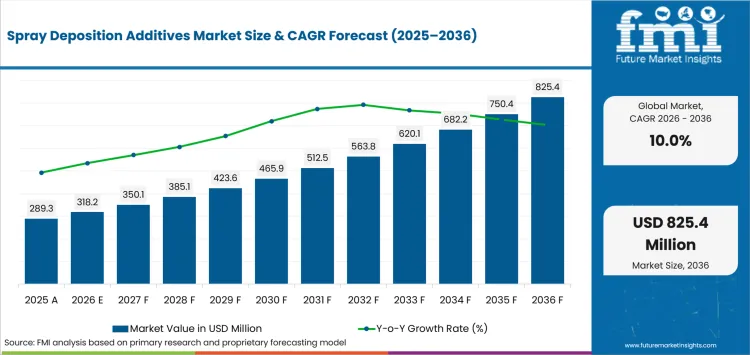
USD 318.2 million in 2026 and USD 825.4 million by 2036 at a 10.0% CAGR.
Demand for spray deposition additives are projected to expand at 10.0% CAGR between 2026 and 2036 as pesticide users place more value on measurable droplet control. EPA released PALM in August 2025 to translate pesticide mitigation requirements into field-specific planning steps. The planning route raises the value of documented agricultural adjuvants because applicators need repeatable off-target control without weakening treatment performance.
Country adoption diverges as low-volume application changes the cost of poor deposition. Japan’s agriculture ministry reported in October 2025 that drone pesticide spraying reduced operating hours by 61% in demonstration results. The labor reduction strengthens the case for smart agriculture solutions that work at lower carrier volumes. Formulation compatibility still determines whether a deposition additive earns repeat use.
Key Takeaways
- Demand rises as regulators and applicators place greater weight on droplet behavior, target retention and repeatable spray performance.
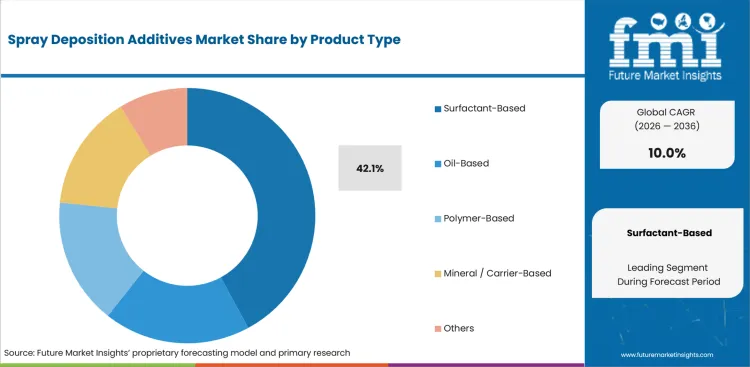
- By product type, surfactant-based additives are estimated to hold 42.1% in 2026 owing to wetting and spreading requirements across routine foliar programs.
- In 2026, efficacy enhancement is expected to lead function demand with 47.2% share because retention and active delivery directly affect treatment performance.
- Cereals & grains are set to lead crop type with 49.5% share in 2026 due to repeated broadacre applications that reward dependable deposition per hectare.
- Formulation interactions and nozzle dependence slow switching because a useful additive must perform consistently with the pesticide, water volume and intended application equipment.
- Some of the key players in this market include Innvictis, WinField United, Rovensa Next, Helena Agri-Enterprises, Precision Laboratories, Nouryon, Clariant, and Croda.
Analyst Perspective
"A spray deposition additive earns repeat use when field data show the recommended rate controls droplets without weakening coverage or crop safety. Agronomy teams should compare nozzle-specific evidence and mixing support before accepting a lower unit price that shifts qualification work back to the applicator."
- Nikhil Kaitwade, Principal Consultant, Future Market Insights
How is the spray deposition additives market segmented?
The spray deposition additives market is segmented by product type, function, crop type, application method, sales channel and region.
Product type includes surfactant-based, oil-based, polymer-based, mineral / carrier-based and other additives. Function covers efficacy enhancement, loss & drift reduction, handling & compatibility and other functions. Crop type includes cereals & grains, fruits & vegetables, oilseeds & pulses, turf & ornamentals and others. Application methods cover foliar tank-mix, granule / dry blend, fertigation and others. Sales channels include agri-input distributors, cooperatives, agri-retail chains, online / direct-to-farm and other routes.
Why do surfactant-based products lead demand within the product type category?
Surfactant systems alter wetting and spreading at the leaf interface where changes affect usable coverage. USDA Agricultural Research Service work published in June 2025 tested nonionic adjuvants with pesticide formulations in ground and aerial spraying. The study shows why surfactant chemistry must be evaluated within the complete spray mixture.
- By product type, surfactant-based additives are estimated to hold 42.1% in 2026 owing to their broad fit across routine foliar spray programs.
- Application teams retain these products when lower surface tension improves contact without creating formulation or crop-safety problems under the intended commercial field rate.
Why does efficacy enhancement lead demand within the function category?
Efficacy enhancement becomes commercially relevant after an additive improves retention or active uptake without forcing a different spray workflow. Helena Agri-Enterprises reported in March 2025 that Cohort reduces drift and runoff while improving absorption and herbicide activity. Its approval with Liberty Ultra shows why herbicide programs require formulation-specific adjuvant fit.
- Efficacy enhancement is projected to hold 47.2% share in 2026 due to its direct link with crop-protection performance.
- Field adoption strengthens when deposition gains survive rain and operating variability while the additive retains compatibility with the biological or chemical active ingredient during routine use.
Why do cereals & grains lead demand within the crop type category?
Broadacre spraying exposes operators to long passes and changing wind conditions where fine droplets can produce off-target loss. EPA’s April 2025 ecological spray-drift worksheet assigns mitigation credit to qualifying adjuvant use in eligible herbicide applications. That structure raises the operating value of low-drift herbicide adjuvants across crop programs.
- By crop type, cereals & grains are forecast to represent 49.5% in 2026 driven by repeated foliar programs that reward reliable deposition per treated hectare.
- High-acreage use magnifies poor mixing or crop-safety outcomes, so repeat purchasing depends on clear rates across common commercial nozzles and pesticide formulations.
Why does foliar tank-mix lead demand within the application method category?
Foliar tank-mix use keeps additive selection beside the pesticide decision and permits adjustments for changing spray conditions. USDA ARS reported in April 2025 that two renewable-source adjuvants failed drift-reduction tests in piloted aerial spraying. The finding makes application-specific proof necessary before commercial operators substitute one tank-side additive for another.
- In 2026, foliar tank-mix is expected to lead application method with 46.6% share because operators can match additives to the active ingredient and spray setup.
- Spray retention additives retain demand when mixing-order guidance and clear use rates reduce incompatibility risk while preserving flexibility between crops and application windows.
What are the drivers, restraints and opportunities in the spray deposition additives market?
Closer control of off-target spray supports demand, formulation-specific qualification restricts switching and low-volume automated spraying expands the performance window for deposition aids.
- Driver: Drift mitigation is becoming an application-planning requirement that gives measurable droplet control more weight during additive selection.
- Restraint: Additive performance changes with formulation and equipment, so one successful tank mix does not automatically transfer to another program.
- Opportunity: Drone and automated field spraying raise the value of formulations that stabilize droplets and retention under lower carrier volumes.
Regulatory guidance is increasingly linking application decisions with measurable spray-performance outcomes. EPA's October 2025 mitigation menu assigns spray-drift buffer reductions to specific application practices and qualifying drift-reduction adjuvants. The framework allows applicators to select approved additives as part of a documented drift-mitigation strategy rather than relying solely on operational adjustments. Biofilm fungicide adjuvants and related application aids become more attractive when they address a defined delivery challenge and help satisfy established application requirements.
Qualification costs rise because the same adjuvant can change droplet behavior across pesticide formulations and nozzle setups. The UK Pesticides National Action Plan set a 2030 target to reduce each of twenty Pesticide Load Indicator metrics by at least 10%. European adjuvant demand therefore depends on evidence that a formulation fits risk-reduction programs without weakening treatment effectiveness or complicating routine field qualification.
Smart-farming systems are increasing the importance of application accuracy across crop-protection programs. South Korea's February 2025 smart-farming plan targets deployment of smart technologies across 20% of major field-crop production areas while advancing the use of drones and robotic equipment in open-field agriculture. Automated spraying systems typically operate with lower carrier volumes and more precise application parameters, leaving less tolerance for poor droplet formation or inconsistent coverage
Which country CAGRs are profiled in the Spray Deposition Additives Market?
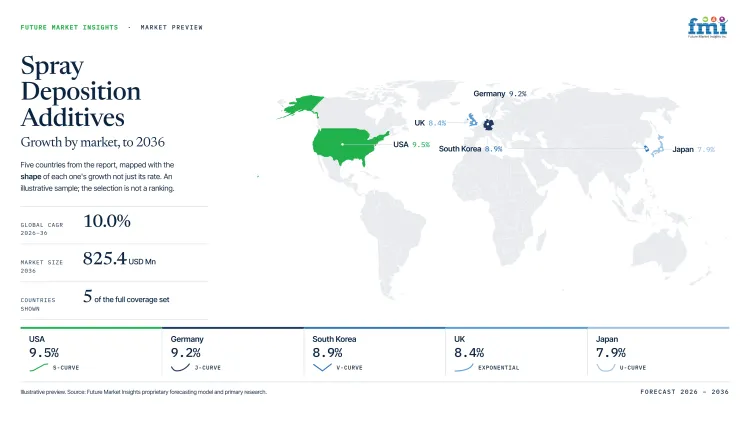
| Country | CAGR |
|---|---|
| USA | 9.5% |
| Germany | 9.2% |
| South Korea | 8.9% |
| UK | 8.4% |
| Japan | 7.9% |
How do country-level CAGRs compare in the Spray Deposition Additives Market?
The 1.6 percentage-point range separates an upper cluster from slower adoption in the UK and Japan. The USA and Germany form the upper group as drift rules and equipment testing make deposition performance visible. South Korea follows as smart-farming programs bring low-volume spraying into field operations. The UK and Japan progress more slowly under different constraints.
- USA: EPA mitigation tools tie drift evidence to field-level herbicide planning.
- Germany: JKI equipment testing places additive claims beside recognized nozzle performance.
- South Korea: smart-farming programs move drone spraying toward contracted field services.
- UK: pesticide-risk targets reward precise placement while integrated pest management restrains volume-led demand.
- Japan: labor-saving drone evidence favors contractor-led spraying where equipment ownership is costly.
Similar CAGRs describe different order-conversion conditions and not equivalent revenue bases. The full report provides country-level CAGR analysis across North America, Latin America, Europe, East Asia, South Asia, Oceania and the Middle East and Africa.
Country-wise Analysis
- In the USA, commercial applicators increasingly work from label-specific mitigation choices that connect spray setup with field conditions and regional herbicide programs across state jurisdictions with different registration practices. Spray deposition additive demand is forecast to rise at 9.5% CAGR through 2036, driven by mitigation tools that give deposition evidence a clearer place in application planning and retailer advice. EPA’s August 2025 mitigation webinar explained final Insecticide Strategy measures and spray-drift calculators, creating a practical planning route for crop advisers; state-level differences, meanwhile, continue to favor companies that combine defensible droplet data with regional distribution and application training nationwide.
- Germany’s professional spray programs already depend on tested equipment and recognized nozzle performance before crop-protection applications move into routine field use across commercial farms and specialist contracting businesses. The Julius Kühn-Institut’s April 2025 notice records tested plant-protection equipment under section 52 of Germany’s Plant Protection Act, reinforcing an equipment-led route for documenting drift performance in commercial spraying. The market is projected to record 9.2% CAGR through 2036, attributable to additive suppliers that can document behavior with locally used nozzles and fit established workflows, whereas broad performance claims face a higher local qualification burden.
- In South Korea, open-field modernization is linking drone equipment with contractor services and operator training across seasonal crop-protection programs in major field-producing areas and rural service networks. MAFRA’s February 2025 work plan funded technology verification for agricultural drones, robots and autonomous vehicles, giving local programs a formal testing route even though specialist operating capacity remains uneven outside established service areas. Demand is forecast to expand at 8.9% CAGR through 2036, supported by contractor-led spraying that reaches more farms and favors distributors pairing additive rates with local application protocols and seasonal technical support during campaigns.
- British arable programs increasingly assess spray inputs through pesticide-risk reduction and integrated pest management rather than higher chemical volume as the commercial objective in routine crop-protection planning. The UK market is forecast to rise at 8.4% CAGR through 2036, underpinned by formulations that improve targeting within existing spray programs while volume-dependent products require stronger justification. The Environmental Improvement Plan annual progress report published in July 2025 recorded continued pesticide-risk and integrated pest management actions, thereby reinforcing precise placement as an operating priority and rewarding companies that document performance without relying on greater treatment intensity.
- Japan’s commercial drone spraying increasingly relies on service providers that align application equipment with crop-specific operating instructions across dispersed production areas and smaller farms that cannot justify dedicated aircraft. MAFF’s 2025 white paper reported 22 certified production-method innovation plans and eight certified development-supply plans in fiscal 2024, giving smart-agriculture providers a wider formal route for testing and commercial deployment. Demand is forecast to expand at 7.9% CAGR through 2036, reflecting wider access through approved smart-agriculture routes, while equipment cost and uneven operator availability make simple low-volume rate guidance and local contractor validation especially important during regional campaigns.
Who are the notable companies in the Spray Deposition Additives Market?
Innvictis, WinField United, Rovensa Next, Helena Agri-Enterprises, Precision Laboratories, Nouryon, Clariant, and Croda are the notable companies profiled in this market.
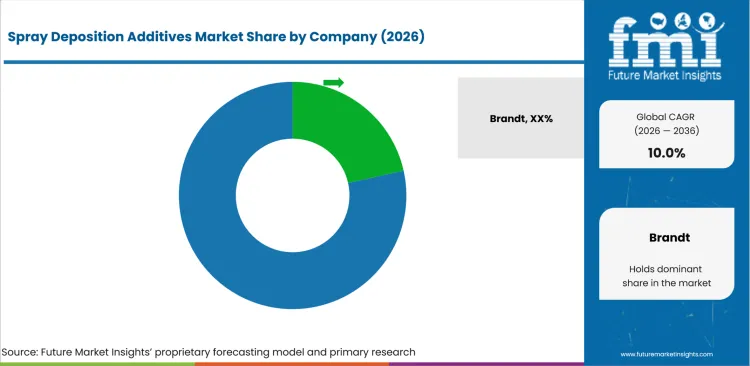
Competition divides between farm-facing adjuvant brands and specialty-chemical groups that develop formulation technology for crop protection. Innvictis and WinField United work close to application decisions alongside Rovensa Next and Helena Agri-Enterprises. Precision Laboratories also competes near the spray decision through mixing guidance and application support. Nouryon and Clariant supply dedicated tank-mix chemistry while Croda extends formulation expertise into spray delivery. Low-dose spray programs retain demand for silicone surfactants where spreading must hold across changing spray volumes.
- Grower-channel adjuvant platforms - Innvictis and WinField United compete alongside Rovensa Next plus Helena Agri-Enterprises and Precision Laboratories around tank-mix guidance and field access.
- Specialty formulation chemistry - Nouryon and Clariant compete with Croda around surfactant design and formulation testing for crop-protection spray performance.
Competitive Benchmarking: Spray Deposition Additives Market
| Company | Drift & Deposition Control | Foliar Activation & Retention | Application Qualification Depth | Geographic Reach |
|---|---|---|---|---|
| Innvictis | Medium | High | Medium | United States through Simplot Grower Solutions |
| WinField United | High | High | High | United States and Canada |
| Rovensa Next | High | High | High | Global across North America, Europe, Asia and Latin America |
| Helena Agri-Enterprises | Medium | High | High | United States |
| Precision Laboratories | High | High | High | North America |
| Nouryon | High | High | High | Global |
| Clariant | Medium | High | High | Global |
| Croda | Medium | High | High | Global |
Scoring basis: High drift and deposition control requires current evidence of quantified or multi-condition spray performance. Medium requires one documented spray-delivery route. High foliar activation and retention requires multiple documented functions across wetting and spreading as well as penetration or rainfastness. Medium requires one documented function. High application qualification depth requires current field trials or certification plus formal application research or documented low-volume programs. Medium requires current application guidance or narrower technical support. Low is reserved for an explicit documented limitation. Geographic reach reflects verified operating coverage instead of corporate size.
Key Developments in the Spray Deposition Additives Market
- In June 2026, Rovensa Next launched ORO-5 in North America as a multifunctional adjuvant designed to condition hard water and improve target deposition without lowering spray-tank pH across ground and aerial applications.
- In April 2025, Nouryon launched Adsee® Flex 960 at the ISAA Symposium 2025 in Rio de Janeiro, Brazil, as a patented tank-mix adjuvant based on an optimized blend of surfactants and colloidal silica to enhance deposition and rainfastness of active ingredients.
- In March 2025, Clariant showcased Synergen™ Guard 100 at CAC 2025 as a nano-emulsion-based tank-mix adjuvant and rainfastness agent for biological crop-protection products, designed to improve coverage and rain protection while maintaining compatibility with a broad range of microorganisms.
Key Players in the Spray Deposition Additives Market
Grower-Channel Adjuvant Platforms
- Innvictis
- WinField United
- Rovensa Next
- Helena Agri-Enterprises
- Precision Laboratories
Specialty Formulation Chemistry Companies
- Nouryon
- Clariant
- Croda
Spray Deposition Additives Market - Report Scope
| Coverage field | Report scope |
|---|---|
| Market breakdown | By product type, function, crop type, application method, sales channel and region. |
| Quantitative Units | USD million. |
| Market Definition | Revenue from spray deposition additives used to change wetting, spreading, retention, droplet behavior or related spray-delivery performance within the defined segmentation. |
| Regions Covered | North America, Latin America, Europe, East Asia, South Asia and Pacific, and Middle East and Africa. |
| Countries Covered | USA, Germany, South Korea, UK, Japan, and 20+ countries included in the full report. |
| Key Companies Profiled | Innvictis, WinField United, Rovensa Next, Helena Agri-Enterprises, Precision Laboratories, Nouryon, Clariant, and Croda. |
| Forecast Period | 2026 to 2036. |
| Approach | Primary and secondary research with market triangulation. |
Spray Deposition Additives Market - Research Methodology
| Method | Approach |
|---|---|
| Primary Research | FMI analysts gathered input from manufacturers, service providers, technology developers, distributors, end users, procurement teams, and subject-matter experts. Interviews examined purchasing decisions, product or service evaluation, adoption barriers, approval requirements, pricing considerations, and expectations for technical or commercial support. Respondents were also asked what evidence is required before a trial, pilot, or initial order develops into regular purchasing. |
| Desk Research | Desk research covered government statistics, regulatory publications, trade data, industry associations, technical literature, standards, company filings, product information, and official corporate announcements. Sources were reviewed for relevance, publication date, geographic coverage, and consistency with the defined market scope. Claims relating to performance, applications, approvals, capacity, investment, and commercial activity were retained only when supported by credible public evidence. |
| Market Sizing and Forecasting | The market model combined the baseline value with historical performance, segment structure, pricing and volume indicators, adoption levels, company participation, and country-level demand conditions. Forecast assumptions considered economic activity, investment trends, regulatory developments, technology adoption, purchasing cycles, supply availability, and barriers to wider market use. Segment and regional estimates were reconciled before the final market total was calculated. |
| Data Validation | Estimates were checked against multiple independent indicators, including public data, company activity, trade patterns, industry developments, and findings from primary interviews. Validation also tested whether products, services, applications, and company revenues fell within the defined market boundaries. Adjacent categories, unsupported claims, overlapping revenues, and activities without direct market relevance were excluded to reduce double counting and maintain consistency across segments and countries. |
Spray Deposition Additives Market by Segments
Spray Deposition Additives Market segmented by Product Type:
- Surfactant-Based
- Oil-Based
- Polymer-Based
- Mineral / Carrier-Based
- Others
Spray Deposition Additives Market segmented by Function:
- Efficacy Enhancement
- Loss & Drift Reduction
- Handling & Compatibility
- Others
Spray Deposition Additives Market segmented by Crop Type:
- Cereals & Grains
- Fruits & Vegetables
- Oilseeds & Pulses
- Turf & Ornamentals
- Others
Spray Deposition Additives Market segmented by Application Method:
- Foliar Tank-Mix
- Granule / Dry Blend
- Fertigation
- Others
Spray Deposition Additives Market segmented by Sales Channel:
- Agri-Input Distributors
- Cooperatives
- Agri-Retail Chains
- Online / Direct-to-Farm
- Others
Spray Deposition Additives Market by Region:
- North America
- United States
- Canada
- Latin America
- Brazil
- Mexico
- Argentina
- Chile
- Western Europe
- Germany
- France
- United Kingdom
- Italy
- Spain
- Benelux
- Nordics
- Eastern Europe
- Poland
- Czech Republic
- Romania
- Hungary
- East Asia
- China
- Japan
- South Korea
- South Asia and Pacific
- India
- ASEAN
- Australia and New Zealand
- Middle East and Africa
- GCC Countries
- South Africa
- Türkiye
- Israel
Research Sources and Bibliography
- USA Environmental Protection Agency. (2025, August 14). EPA releases new mobile tool to help farmers implement recommended ecological pesticide mitigation measures.
- Ministry of Agriculture, Forestry and Fisheries of Japan. (2025, October). Promotion of Smart Agriculture.
- USA Department of Agriculture, Agricultural Research Service. (2025, June 1). Adjuvant and pesticide formulation interactions: Impacts on spray quality in ground and aerial applications.
- Helena Agri-Enterprises. (2025, March 17). Navigating New Herbicide Strategy Under the Endangered Species Act.
- USA Environmental Protection Agency. (2025, April). Pesticide Ecological Spray Drift Buffer Calculation Worksheet, Version 1.
- USA Department of Agriculture, Agricultural Research Service. (2025, April 29). Testing the drift reduction potential of some adjuvants from renewable sources for aerial pesticide applications.
- USA Environmental Protection Agency. (2025, October 2). Mitigation Menu.
- Department for Environment, Food & Rural Affairs. (2025, October 24). UK Pesticides National Action Plan 2025: Working for a more sustainable future.
- Ministry of Agriculture, Food and Rural Affairs of the Republic of Korea. (2025, February 27). S. Korea’s First Master Plan for Promotion of the Growth of the Smart-Farming Industry for the Years 2025-2029.
- USA Environmental Protection Agency. (2025, August 20). Register for EPA’s Webinar on Mitigation Measures to Protect Endangered Species from Pesticides.
- Julius Kühn-Institut. (2025, April 23). Vierzehnte Bekanntmachung über die Eintragung der geprüften Gerätetypen in die beschreibende Liste nach § 52 Absatz 2 des Pflanzenschutzgesetzes.
- Ministry of Agriculture, Food and Rural Affairs of the Republic of Korea. (2025, February 14). The 2025 Work Plan for the Ministry of Agriculture, Food and Rural Affairs, South Korea.
- Department for Environment, Food & Rural Affairs. (2025, July 14). Environmental Improvement Plan annual progress report: April 2024 to March 2025.
- Ministry of Agriculture, Forestry and Fisheries of Japan. (2025). Special Feature 3: Utilization and Future Prospects of Smart Agriculture Technologies.
- Innvictis. (2025, May 28). Inntero Technology: A Multifunctional Solution for Growers.
- WinField United. (2026, January 20). 2025 Agronomic Insights from the Innovation Center.
- Rovensa Next. (2026, June 17). Rovensa Next Introduces ORO-5: Advanced Multi-Functional Adjuvant for Superior Spray Performance.
- Nouryon. (2025, April 7). Nouryon launches Adsee® Flex 960, an advanced tank mix adjuvant for enhanced crop performance.
- Clariant. (2025, March 13). Clariant’s novel solutions for enhancing crop health and biological formulations at CAC 2025: Synergen™ Soil and Synergen Guard 100.
- Precision Laboratories. (2025, December 17). Choosing the Right Adjuvant for ESA Compliance.
- Croda International Plc. (2026, February 24). Life Sciences and Industrial Specialties business review.
- Momentive Performance Materials. (2025, November 10). 2025 CDP Corporate Questionnaire 2025.
- Rovensa Next. (2026, January 27). FAUVE Project: Rovensa Next and UTC collaborate on innovative drone spraying for water savings and agricultural efficiency.
- Croda International Plc. (2025, February 25). Results for the year ended 31 December 2024.
- BRB International B.V. (2025, November 7). Relaunching BRB Silicone Spray Adjuvants for Agrochemicals Market.
- BRANDT. (2025, April 15). BRANDT Grows Product Management Team.
- Precision Laboratories. (2025, January 20). The Mix Tank App Expands Functionality To Streamline Spraying Practices.
- ADAMA Agricultural Solutions UK Ltd. (2025, February 19). Three new fungicide co-formulations approved and launched in the UK.
- Prellberg, M. (2025, August 18). Engineering the perfect mix. Evonik.
This bibliography is provided for reader reference and is not exhaustive. The full report contains the complete reference list and detailed citations
This Report Answers
- How large is the spray deposition additives market in 2026 and what value is forecast for 2036?
- Which application and regulatory conditions support recurring demand for spray deposition additives?
- Why do surfactant-based products hold the largest product type share in 2026?
- Why does efficacy enhancement represent the largest function share in 2026?
- Why do cereals & grains account for the largest crop type share in 2026?
- How do country growth rates compare across the USA, Germany, South Korea, UK and Japan?
- Which companies compete across grower-channel adjuvants and specialty formulation chemistry?
- What formulation and equipment conditions can slow adoption of a new spray deposition additive?
Frequently Asked Questions
How big is the Spray Deposition Additives Market in 2026?
The spray deposition additives market is valued at USD 318.2 million in 2026 and is projected to reach USD 825.4 million by 2036. Growth is supported by tighter drift control and wider use of precision spraying.
What is the CAGR of the Spray Deposition Additives Market from 2026 to 2036?
The spray deposition additives market is projected to grow at a CAGR of 10.0% between 2026 and 2036. Expansion is supported by measurable deposition requirements and low-volume application systems.
Which product type leads the Spray Deposition Additives Market?
The surfactant-based segment is expected to hold 42.1% of the spray deposition additives market in 2026, supported by broad wetting and spreading use across foliar programs. Compatibility with multiple pesticide classes supports repeat purchasing.
Which function leads the Spray Deposition Additives Market?
The efficacy enhancement segment is expected to hold 47.2% of the spray deposition additives market in 2026, supported by its direct link to coverage and active delivery. Repeat use depends on formulation compatibility and dependable retention.
Which companies are active in the Spray Deposition Additives Market?
Key companies active in the spray deposition additives market include Innvictis, WinField United, Rovensa Next, Helena Agri-Enterprises, Precision Laboratories, Nouryon, Clariant, and Croda. Their positions differ across field distribution and tank-mix formulation as well as specialty surfactants and low-volume application support.
Preview the report firsthand - request a free sample
Get SampleGet the brochure for pricing and purchase details.
Get PDFTable of Content
- Key Takeaways
- Market Size and CAGR
- Top Growth Driver
- Fastest Growing Segment
- Leading Region
- Key Companies
- Emerging Opportunities
- Executive Summary
- Global Market Outlook
- Demand-side Trends
- Supply-side Trends
- Technology Roadmap Analysis
- Analysis and Recommendations
- Analyst Perspective (What is happening? Why now? What should investors know?)
- Key Questions Answered
- How large is the market?
- What is the CAGR?
- What are key trends?
- Which region dominates?
- Who are the leaders?
- Market Overview
- Market Coverage / Taxonomy
- Market Definition / Scope / Limitations
- Research Methodology
- Chapter Orientation
- Analytical Lens and Working Hypotheses
- Market Structure, Signals, and Trend Drivers
- Benchmarking and Cross-market Comparability
- Market Sizing, Forecasting, and Opportunity Mapping
- Research Design and Evidence Framework
- Desk Research Programme (Secondary Evidence)
- Expert Input and Fieldwork (Primary Evidence)
- Tooling, Models, and Reference Databases
- Data Engineering and Model Build
- Quality Assurance and Audit Trail
- Market Background
- Market Dynamics (Drivers, Restraints, Opportunity, Trends)
- Scenario Forecast (Optimistic, Likely, Conservative)
- Impact Analysis
- AI Impact
- Sustainability Impact
- Regulatory Impact
- Technology Impact
- Consumer / Buyer Analysis
- Purchase Drivers
- Adoption Barriers
- Buyer Journey
- Opportunity Map Analysis
- Product Life Cycle Analysis
- Supply Chain Analysis
- Investment Feasibility Matrix
- Value Chain Analysis
- PESTLE and Porter's Analysis
- Regulatory Landscape
- Regional Parent Market Outlook
- Production and Consumption Statistics
- Import and Export Statistics
- Global Market Analysis and Forecast, 2021 to 2036
- Historical Market Size Value (USD Million) Analysis, 2021 to 2025
- Current and Future Market Size Value (USD Million) Projections, 2026 to 2036
- Y-o-Y Growth Trend Analysis
- Absolute $ Opportunity Analysis
- Global Market Pricing Analysis, 2021 to 2036
- Global Market Analysis and Forecast, By Product Type, 2021 to 2036
- Introduction / Key Findings
- Historical Market Size Value (USD Million) Analysis By Product Type, 2021 to 2025
- Current and Future Market Size Value (USD Million) Analysis and Forecast By Product Type, 2026 to 2036
- Surfactant-Based
- Oil-Based
- Polymer-Based
- Mineral / Carrier-Based
- Others
- Surfactant-Based
- Y-o-Y Growth Trend Analysis By Product Type, 2021 to 2025
- Absolute $ Opportunity Analysis By Product Type, 2026 to 2036
- Global Market Analysis and Forecast, By Function, 2021 to 2036
- Introduction / Key Findings
- Historical Market Size Value (USD Million) Analysis By Function, 2021 to 2025
- Current and Future Market Size Value (USD Million) Analysis and Forecast By Function, 2026 to 2036
- Efficacy Enhancement
- Loss & Drift Reduction
- Handling & Compatibility
- Others
- Efficacy Enhancement
- Y-o-Y Growth Trend Analysis By Function, 2021 to 2025
- Absolute $ Opportunity Analysis By Function, 2026 to 2036
- Global Market Analysis and Forecast, By Crop Type, 2021 to 2036
- Introduction / Key Findings
- Historical Market Size Value (USD Million) Analysis By Crop Type, 2021 to 2025
- Current and Future Market Size Value (USD Million) Analysis and Forecast By Crop Type, 2026 to 2036
- Cereals & Grains
- Fruits & Vegetables
- Oilseeds & Pulses
- Turf & Ornamentals
- Others
- Cereals & Grains
- Y-o-Y Growth Trend Analysis By Crop Type, 2021 to 2025
- Absolute $ Opportunity Analysis By Crop Type, 2026 to 2036
- Global Market Analysis and Forecast, By Application Method, 2021 to 2036
- Introduction / Key Findings
- Historical Market Size Value (USD Million) Analysis By Application Method, 2021 to 2025
- Current and Future Market Size Value (USD Million) Analysis and Forecast By Application Method, 2026 to 2036
- Foliar Tank-Mix
- Granule / Dry Blend
- Fertigation
- Others
- Foliar Tank-Mix
- Y-o-Y Growth Trend Analysis By Application Method, 2021 to 2025
- Absolute $ Opportunity Analysis By Application Method, 2026 to 2036
- Global Market Analysis and Forecast, By Sales Channel, 2021 to 2036
- Introduction / Key Findings
- Historical Market Size Value (USD Million) Analysis By Sales Channel, 2021 to 2025
- Current and Future Market Size Value (USD Million) Analysis and Forecast By Sales Channel, 2026 to 2036
- Agri-Input Distributors
- Cooperatives
- Agri-Retail Chains
- Online / Direct-to-Farm
- Others
- Agri-Input Distributors
- Y-o-Y Growth Trend Analysis By Sales Channel, 2021 to 2025
- Absolute $ Opportunity Analysis By Sales Channel, 2026 to 2036
- Global Market Analysis and Forecast, By Region, 2021 to 2036
- Introduction
- Historical Market Size Value (USD Million) Analysis By Region, 2021 to 2025
- Current Market Size Value (USD Million) Analysis and Forecast By Region, 2026 to 2036
- North America
- Latin America
- Western Europe
- Eastern Europe
- East Asia
- South Asia and Pacific
- Middle East & Africa
- Market Attractiveness Analysis By Region
- North America Market Analysis and Forecast, By Country, 2021 to 2036
- Historical Market Size Value (USD Million) Trend Analysis By Market Taxonomy, 2021 to 2025
- Market Size Value (USD Million) Forecast By Market Taxonomy, 2026 to 2036
- By Country
- USA
- Canada
- By Product Type
- By Function
- By Crop Type
- By Application Method
- By Sales Channel
- By Country
- Market Attractiveness Analysis
- By Country
- By Product Type
- By Function
- By Crop Type
- By Application Method
- By Sales Channel
- Key Takeaways
- Latin America Market Analysis and Forecast, By Country
- Historical Market Size Value (USD Million) Trend Analysis By Market Taxonomy, 2021 to 2025
- Market Size Value (USD Million) Forecast By Market Taxonomy, 2026 to 2036
- By Country
- Brazil
- Mexico
- Chile
- Rest of Latin America
- By Product Type
- By Function
- By Crop Type
- By Application Method
- By Sales Channel
- By Country
- Market Attractiveness Analysis
- By Country
- By Product Type
- By Function
- By Crop Type
- By Application Method
- By Sales Channel
- Key Takeaways
- Western Europe Market Analysis and Forecast, By Country
- Historical Market Size Value (USD Million) Trend Analysis By Market Taxonomy, 2021 to 2025
- Market Size Value (USD Million) Forecast By Market Taxonomy, 2026 to 2036
- By Country
- Germany
- UK
- Italy
- Spain
- France
- Nordic
- BENELUX
- Rest of Western Europe
- By Product Type
- By Function
- By Crop Type
- By Application Method
- By Sales Channel
- By Country
- Market Attractiveness Analysis
- By Country
- By Product Type
- By Function
- By Crop Type
- By Application Method
- By Sales Channel
- Key Takeaways
- Eastern Europe Market Analysis and Forecast, By Country
- Historical Market Size Value (USD Million) Trend Analysis By Market Taxonomy, 2021 to 2025
- Market Size Value (USD Million) Forecast By Market Taxonomy, 2026 to 2036
- By Country
- Russia
- Poland
- Hungary
- Balkan & Baltic
- Rest of Eastern Europe
- By Product Type
- By Function
- By Crop Type
- By Application Method
- By Sales Channel
- By Country
- Market Attractiveness Analysis
- By Country
- By Product Type
- By Function
- By Crop Type
- By Application Method
- By Sales Channel
- Key Takeaways
- East Asia Market Analysis and Forecast, By Country
- Historical Market Size Value (USD Million) Trend Analysis By Market Taxonomy, 2021 to 2025
- Market Size Value (USD Million) Forecast By Market Taxonomy, 2026 to 2036
- By Country
- China
- Japan
- South Korea
- By Product Type
- By Function
- By Crop Type
- By Application Method
- By Sales Channel
- By Country
- Market Attractiveness Analysis
- By Country
- By Product Type
- By Function
- By Crop Type
- By Application Method
- By Sales Channel
- Key Takeaways
- South Asia and Pacific Market Analysis and Forecast, By Country
- Historical Market Size Value (USD Million) Trend Analysis By Market Taxonomy, 2021 to 2025
- Market Size Value (USD Million) Forecast By Market Taxonomy, 2026 to 2036
- By Country
- India
- ASEAN
- Australia & New Zealand
- Rest of South Asia and Pacific
- By Product Type
- By Function
- By Crop Type
- By Application Method
- By Sales Channel
- By Country
- Market Attractiveness Analysis
- By Country
- By Product Type
- By Function
- By Crop Type
- By Application Method
- By Sales Channel
- Key Takeaways
- Middle East & Africa Market Analysis and Forecast, By Country
- Historical Market Size Value (USD Million) Trend Analysis By Market Taxonomy, 2021 to 2025
- Market Size Value (USD Million) Forecast By Market Taxonomy, 2026 to 2036
- By Country
- Kingdom of Saudi Arabia
- Other GCC Countries
- Türkiye
- South Africa
- Other African Union
- Rest of Middle East & Africa
- By Product Type
- By Function
- By Crop Type
- By Application Method
- By Sales Channel
- By Country
- Market Attractiveness Analysis
- By Country
- By Product Type
- By Function
- By Crop Type
- By Application Method
- By Sales Channel
- Key Takeaways
- Key Countries Market Analysis
- USA
- Pricing Analysis
- Market Share Analysis, 2025
- By Product Type
- By Function
- By Crop Type
- By Application Method
- By Sales Channel
- Canada
- Pricing Analysis
- Market Share Analysis, 2025
- By Product Type
- By Function
- By Crop Type
- By Application Method
- By Sales Channel
- Mexico
- Pricing Analysis
- Market Share Analysis, 2025
- By Product Type
- By Function
- By Crop Type
- By Application Method
- By Sales Channel
- Brazil
- Pricing Analysis
- Market Share Analysis, 2025
- By Product Type
- By Function
- By Crop Type
- By Application Method
- By Sales Channel
- Chile
- Pricing Analysis
- Market Share Analysis, 2025
- By Product Type
- By Function
- By Crop Type
- By Application Method
- By Sales Channel
- Germany
- Pricing Analysis
- Market Share Analysis, 2025
- By Product Type
- By Function
- By Crop Type
- By Application Method
- By Sales Channel
- UK
- Pricing Analysis
- Market Share Analysis, 2025
- By Product Type
- By Function
- By Crop Type
- By Application Method
- By Sales Channel
- Italy
- Pricing Analysis
- Market Share Analysis, 2025
- By Product Type
- By Function
- By Crop Type
- By Application Method
- By Sales Channel
- Spain
- Pricing Analysis
- Market Share Analysis, 2025
- By Product Type
- By Function
- By Crop Type
- By Application Method
- By Sales Channel
- France
- Pricing Analysis
- Market Share Analysis, 2025
- By Product Type
- By Function
- By Crop Type
- By Application Method
- By Sales Channel
- India
- Pricing Analysis
- Market Share Analysis, 2025
- By Product Type
- By Function
- By Crop Type
- By Application Method
- By Sales Channel
- ASEAN
- Pricing Analysis
- Market Share Analysis, 2025
- By Product Type
- By Function
- By Crop Type
- By Application Method
- By Sales Channel
- Australia & New Zealand
- Pricing Analysis
- Market Share Analysis, 2025
- By Product Type
- By Function
- By Crop Type
- By Application Method
- By Sales Channel
- China
- Pricing Analysis
- Market Share Analysis, 2025
- By Product Type
- By Function
- By Crop Type
- By Application Method
- By Sales Channel
- Japan
- Pricing Analysis
- Market Share Analysis, 2025
- By Product Type
- By Function
- By Crop Type
- By Application Method
- By Sales Channel
- South Korea
- Pricing Analysis
- Market Share Analysis, 2025
- By Product Type
- By Function
- By Crop Type
- By Application Method
- By Sales Channel
- Russia
- Pricing Analysis
- Market Share Analysis, 2025
- By Product Type
- By Function
- By Crop Type
- By Application Method
- By Sales Channel
- Poland
- Pricing Analysis
- Market Share Analysis, 2025
- By Product Type
- By Function
- By Crop Type
- By Application Method
- By Sales Channel
- Hungary
- Pricing Analysis
- Market Share Analysis, 2025
- By Product Type
- By Function
- By Crop Type
- By Application Method
- By Sales Channel
- Kingdom of Saudi Arabia
- Pricing Analysis
- Market Share Analysis, 2025
- By Product Type
- By Function
- By Crop Type
- By Application Method
- By Sales Channel
- Türkiye
- Pricing Analysis
- Market Share Analysis, 2025
- By Product Type
- By Function
- By Crop Type
- By Application Method
- By Sales Channel
- South Africa
- Pricing Analysis
- Market Share Analysis, 2025
- By Product Type
- By Function
- By Crop Type
- By Application Method
- By Sales Channel
- USA
- Market Structure Analysis
- Competition Dashboard
- Competition Benchmarking
- Market Share Analysis of Top Players
- By Regional
- By Product Type
- By Function
- By Crop Type
- By Application Method
- By Sales Channel
- Emerging Startups
- Innovation Benchmarking
- Competition Analysis
- Competition Deep Dive
- Brandt
- Overview
- Product Portfolio
- Profitability by Market Segments
- Sales Footprint
- Strategy Overview
- Marketing Strategy
- Product Strategy
- Channel Strategy
- Loveland Products (Nutrien)
- Oro Agri (Rovensa)
- Croda
- Clariant
- Stepan Company
- Evonik
- Solvay (Syensqo)
- Brandt
- Case Studies
- Success Stories
- Recent Developments
- Competition Deep Dive
- Assumptions & Acronyms Used


