

- Industry Size (2026)
- USD 382 Mn
- Forecast (2036)
- USD 1274 Mn
- CAGR (2026 to 2036)
- 12.8%
Biofilm Breaking Fungicide Adjuvant Market Forecast and Outlook 2026 to 2036
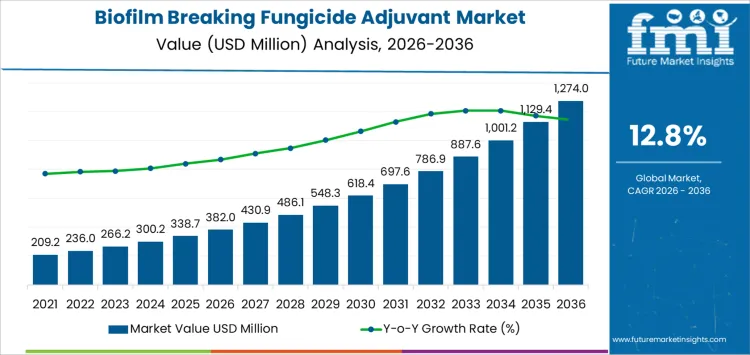
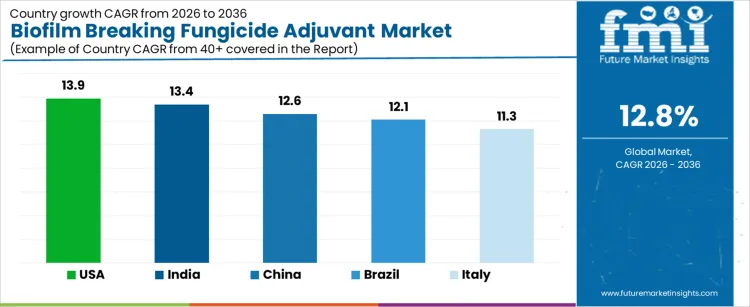
The global Biofilm Breaking Fungicide Adjuvant Market, valued at USD 382 million in 2026 and forecasted to reach USD 1,274 million by 2036, is growing at a CAGR of 12.8%. The USA leads the market with a strong 13.9% CAGR, driven by its focus on green farming and increased adoption of biofilm-breaking adjuvants. China follows with a 12.6% CAGR, where its vast agricultural base is fueling demand for more effective, eco-friendly disease control methods. Brazil, growing at 12.1%, is increasingly adopting these adjuvants to tackle fungal disease pressures in its extensive crop base, including soybeans and coffee. India, with a 13.4% CAGR, also shows significant adoption, driven by its agricultural expansion and the need for better pest and disease management solutions.
Quick Stats for Biofilm Breaking Fungicide Adjuvant Market
- Biofilm Breaking Fungicide Adjuvant Market Value (2026): USD 382 million
- Biofilm Breaking Fungicide Adjuvant Market Forecast Value (2036): USD 1,274 million
- Biofilm Breaking Fungicide Adjuvant Market Forecast CAGR: 12.8%
- Leading Adjuvant Function Type in Biofilm Breaking Fungicide Adjuvant Market: Biofilm Disruptors & Penetration Enhancers (36%)
- Key Growth Regions in Biofilm Breaking Fungicide Adjuvant Market: North America, Asia Pacific, Europe
- Key Players in Biofilm Breaking Fungicide Adjuvant Market: BASF SE, Bayer CropScience, Syngenta Group, Corteva Agriscience, Clariant AG
Italy, growing at 11.3%, is experiencing steady demand for biofilm-breaking adjuvants, particularly in its vineyards and orchards. The country’s focus on reducing chemical pesticide use and promoting green agriculture supports this growth. The strong adoption of biofilm-breaking solutions in these regions is supported by their ability to improve fungicide efficacy and reduce environmental impact, aligning with both regulatory frameworks and consumer demand for residue-free produce. As growers in these key markets seek to enhance crop protection while addressing environmental and resistance concerns, biofilm-breaking fungicide adjuvants are set to play a crucial role in the future of crop disease management across these regions.
Biofilm‑Breaking Fungicide Adjuvant Market Key Takeaways
| Metric | Value |
|---|---|
| Industry Value (2026) | USD 382 million |
| Forecast Value (2036) | USD 1,274 million |
| Forecast CAGR (2026 to 2036) | 12.8% |
How is the Global Biofilm‑Breaking Fungicide Adjuvant Sector Advancing?
The global biofilm‑breaking fungicide adjuvant market is expanding rapidly as growers seek advanced tools to improve the effectiveness of fungicide applications. Biofilms are protective layers formed by fungal pathogens that can shield them from conventional fungicides, reducing treatment efficacy and leading to persistent infections. Biofilm‑breaking adjuvants are specialized chemicals that disrupt these structures, allowing fungicides to penetrate more effectively and control disease. As crop diseases become more difficult to manage due to resistance and environmental pressures, the use of biofilm‑breaking adjuvants is gaining traction across a wide range of crops including cereals, fruits, vegetables, and specialty crops.
Demand for these adjuvants is being driven by the need to enhance disease control while lowering overall chemical loads. Growers are increasingly focused on solutions that boost fungicide performance without increasing application frequency or dosage, which can raise costs and environmental impact. Biofilm‑breaking adjuvants help achieve this by improving spray coverage, uptake, and penetration into the pathogen’s defensive structures. This makes them an attractive component of integrated disease management programs that prioritize efficiency and durability.
Looking ahead, the market is expected to grow as research continues to refine adjuvant formulations for broader compatibility and improved performance under diverse field conditions. Adoption may be influenced by factors such as cost considerations, the need for grower education on optimized use, and regional regulatory environments. Despite these challenges, the strong emphasis on effective disease control and reduced fungicide resistance will sustain demand for biofilm‑breaking fungicide adjuvants across global agriculture.
What is the Segment-Wise Analysis for the Global Biofilm Breaking Fungicide Adjuvant Market?
The global Biofilm Breaking Fungicide Adjuvant Market is segmented by adjuvant function type and fungicide compatibility. Biofilm disruptors and penetration enhancers lead the market with a 36% share, as they are essential for breaking down biofilms and enhancing the efficacy of fungicides. Other key adjuvant function types include surfactant-chelator blends, enzyme-activated biofilm degraders, and polymer-based wetting & spreading agents. In terms of fungicide compatibility, systemic fungicides hold the largest share at 41%, followed by contact fungicides, biological fungicides, and copper & sulfur-based products.
How Do Biofilm Disruptors & Penetration Enhancers Lead the Global Biofilm Breaking Fungicide Adjuvant Market?
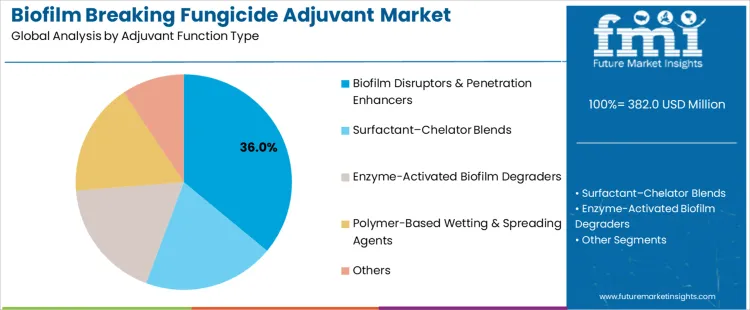
Biofilm disruptors and penetration enhancers hold a 36% share in the global Biofilm Breaking Fungicide Adjuvant Market due to their ability to address the challenge of biofilm formation, which can significantly reduce the efficacy of fungicides. Biofilms act as protective barriers that shield pathogens from the action of fungicides, rendering treatments less effective. Biofilm disruptors break down these barriers, enabling fungicides to penetrate plant tissues more effectively and target the pathogens directly. These adjuvants are widely used in crops affected by biofilm-forming microbes, improving fungicide performance and contributing to more efficient plant protection. As agricultural practices increasingly focus on green pest management solutions, the demand for biofilm disruptors and penetration enhancers is rising, reinforcing their leadership in this market.
Why Do Systemic Fungicides Hold the Largest Market Share in the Global Biofilm Breaking Fungicide Adjuvant Market?
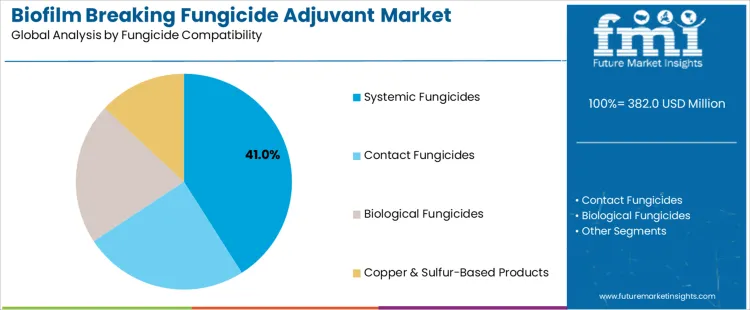
Systemic fungicides hold the largest share of 41% in the global Biofilm Breaking Fungicide Adjuvant Market due to their ability to be absorbed and transported throughout the plant, providing comprehensive protection against fungal diseases. These fungicides are effective in controlling a broad range of plant pathogens, as they move through the plant, offering long-lasting protection. When used with biofilm-breaking adjuvants, such as disruptors and penetration enhancers, systemic fungicides’ effectiveness is further amplified, especially in crops where biofilms hinder fungicide absorption. This combination ensures targeted treatment, improving disease control and supporting green agricultural practices. The widespread use of systemic fungicides in large-scale agricultural operations continues to drive their dominant market share, making them the preferred choice for growers seeking efficient and long-lasting disease management solutions.
What Is Shaping the Biofilm‑Breaking Fungicide Adjuvant Market?
The biofilm‑breaking fungicide adjuvant market is shaped by the increasing need to improve crop protection efficacy and overcome barriers created by microbial biofilms. Fungal pathogens often produce biofilms on plant surfaces that shield spores and hyphae from traditional fungicides, leading to reduced effectiveness and resistance. Biofilm‑breaking adjuvants enhance the penetration and activity of fungicidal actives by disrupting these protective layers, boosting performance. As growers face rising disease pressure and seek green, effective solutions, demand for specialized adjuvants that optimize fungicide outcomes is increasing.
What Challenges Are Limiting Adoption of Biofilm‑Breaking Fungicide Adjuvants?
Adoption is constrained by variability in field performance across crops, disease types, and environmental conditions. Not all biofilm structures or pathogen species respond uniformly to existing adjuvant technologies, leading to uncertain outcomes for growers. Some producers may hesitate to invest in additional inputs without clear, localized efficacy data or cost‑benefit evidence. Compatibility with different fungicide chemistries and application equipment also requires careful consideration, and inadequate agronomic guidance can slow adoption. Regulatory variations in adjuvant approvals across regions can further complicate market entry and use.
What Key Trends Are Shaping the Biofilm‑Breaking Fungicide Adjuvant Market?
Key trends include development of multi‑functional adjuvant systems that combine biofilm disruption with improved spray spread, retention, and active uptake. There is rising interest in bio‑based and low‑toxicity adjuvants that align with green agriculture and regulatory preferences. Digital agriculture tools including disease pressure forecasting and precision application guidance are helping growers time applications for optimal performance. Partnerships between adjuvant developers, crop protection companies, and agronomic advisors are accelerating tailored solution deployment. Increased integration of biofilm‑breaking adjuvants into IPM and regenerative agriculture strategies is expanding market adoption globally.
What is the Growth Outlook for the Biofilm Breaking Fungicide Adjuvant Market by Country?
| Country | CAGR (%) |
|---|---|
| USA | 13.9% |
| China | 12.6% |
| Brazil | 12.1% |
| India | 13.4% |
| Italy | 11.3% |
The Biofilm Breaking Fungicide Adjuvant Market is growing steadily, with the USA leading at a 13.9% CAGR, driven by the increasing demand for efficient and green crop protection solutions. China follows with 12.6%, supported by its vast agricultural base and rising adoption of bio-based crop protectants. Brazil’s market grows at 12.1%, fueled by its large agricultural industry and the need for effective fungal disease control. India’s market is growing at 13.4%, as farmers increasingly adopt biofilm-breaking adjuvants for better pest and disease management in crops. Italy’s market grows at 11.3%, driven by demand for eco-friendly and effective crop protection solutions in European agriculture.
Why is the USA Leading in the Biofilm Breaking Fungicide Adjuvant Market?
The USA’s Biofilm Breaking Fungicide Adjuvant Market is growing at 13.9%, driven by the increasing need for green and effective crop protection solutions in agriculture. Biofilm-breaking adjuvants help fungicides penetrate the protective biofilm layers formed by fungal pathogens, improving their efficacy and reducing the need for excessive chemical treatments. As concerns over pesticide resistance and environmental impacts grow, American farmers are increasingly turning to bio-based solutions that are both effective and environmentally friendly. With a strong focus on precision agriculture and integrated pest management, the demand for biofilm-breaking adjuvants is rising. Government incentives for green farming practices are contributing to market growth. As farmers seek to improve crop yields and reduce environmental harm, the market for these innovative adjuvants is expected to continue expanding in the USA.
What is Driving the Growth of the Biofilm Breaking Fungicide Adjuvant Market in China?
China’s Biofilm Breaking Fungicide Adjuvant Market is growing at 12.6%, driven by the country’s vast agricultural industry and the increasing need for effective disease control. Fungicides are critical for managing fungal infections in crops, particularly in high-value products like fruits and vegetables. Biofilm-breaking adjuvants improve fungicide efficiency by overcoming the protective biofilm layers formed by fungal pathogens. As China faces the challenges of pest resistance and the overuse of chemical fungicides, there is a growing demand for more green and targeted solutions. The government’s support for greener agricultural practices and integrated pest management is also driving the adoption of biofilm-breaking adjuvants. With China’s push for green agricultural practices, the demand for these innovative products is expected to grow steadily.
How is the Biofilm Breaking Fungicide Adjuvant Market Expanding in Brazil?
Brazil’s Biofilm Breaking Fungicide Adjuvant Market is growing at 12.1%, driven by the country’s large-scale agricultural industry and increasing need for effective pest and disease management. As one of the world’s largest producers of crops like soybeans, sugarcane, and coffee, Brazil is particularly vulnerable to fungal diseases, making fungicide efficiency crucial. Biofilm-breaking adjuvants enhance fungicide performance by enabling deeper penetration into the biofilm layer that protects pathogens. With the increasing adoption of green farming practices and the growing demand for eco-friendly solutions, Brazilian farmers are increasingly turning to these adjuvants. As Brazil continues to focus on improving crop yields and reducing reliance on chemical treatments, the demand for biofilm-breaking fungicide adjuvants is expected to continue to grow.
What is Contributing to the Growth of the Biofilm Breaking Fungicide Adjuvant Market in India?
India’s Biofilm Breaking Fungicide Adjuvant Market is growing at 13.4%, driven by the country’s expanding agricultural sector and the rising need for efficient disease control methods. India’s diverse agricultural landscape, including high-value crops such as fruits, vegetables, and spices, is highly susceptible to fungal diseases. Biofilm-breaking adjuvants improve the penetration of fungicides into the biofilm layers that shield pathogens, improving fungicide effectiveness and reducing the need for higher chemical doses. As India focuses on increasing agricultural productivity while minimizing chemical pesticide use, bio-based and eco-friendly solutions like biofilm-breaking adjuvants are gaining popularity. With government initiatives to promote green farming practices, the market for these adjuvants is expected to grow steadily.
What is Driving the Growth of the Biofilm Breaking Fungicide Adjuvant Market in Italy?
Italy’s Biofilm Breaking Fungicide Adjuvant Market is growing at 11.3%, driven by the country’s strong agricultural sector and increasing demand for green crop protection solutions. Italy’s vineyards, orchards, and vegetable farms are particularly vulnerable to fungal diseases, and there is growing interest in products that offer targeted, environmentally friendly control. Biofilm-breaking adjuvants help improve fungicide efficiency by breaking down the protective biofilm layers that fungi form, enhancing disease management. Italy’s regulatory framework, which emphasizes reducing chemical pesticide use and promoting green farming practices, is contributing to the rise of biofilm-breaking solutions. With growing awareness of environmental impact and the demand for high-quality produce, Italy’s market for these adjuvants is expected to continue expanding.
How Are Companies Competing in the Biofilm‑Breaking Fungicide Adjuvant Market?
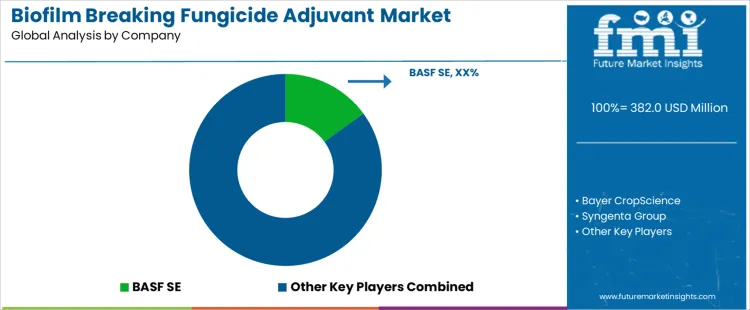
In the biofilm‑breaking fungicide adjuvant market BASF SE, Bayer CropScience, Syngenta Group, Corteva Agriscience, and Clariant AG are positioned with distinct product brochures that emphasize formulation performance and enhanced disease control. Brochures from BASF SE describe adjuvant systems engineered to disrupt biofilm matrices and improve fungicide penetration, with performance data shown for key crops. Application guidance and tank‑mix compatibility charts are included to support technical decisions. Bayer CropScience materials focus on adjuvants that support foliar uptake and biofilm breakdown, with trial results highlighted to illustrate improved pathogen suppression and crop response. Clear instructions are provided for growers and advisors evaluating spray programs.
Syngenta Group brochures present biofilm‑breaking adjuvant solutions alongside broader plant health tools, with visuals and summaries that explain how improved spray coverage enhances fungicide efficacy. Crop‑specific recommendations and mode‑of‑action notes are featured to aid selection. Corteva Agriscience collateral positions its adjuvant formulations as part of integrated protection strategies, with short technical briefs that highlight formulation benefits and resistance management considerations. Performance comparisons under varying environmental conditions are provided. Clariant AG literature emphasizes specialty surfactants and adjuvant chemistries designed for efficient biofilm penetration and reduced surface tension. Product sheets include dosing guidance and safety profiles.
Key Players in Biofilm Breaking Fungicide Adjuvant Market
- BASF SE
- Bayer CropScience
- Syngenta Group
- Corteva Agriscience
- Clariant AG
Scope of Report
| Items | Values |
|---|---|
| Quantitative Units (2026) | USD 382 million |
| Adjuvant Function Type | Biofilm Disruptors & Penetration Enhancers, Surfactant-Chelator Blends, Enzyme-Activated Biofilm Degraders, Polymer-Based Wetting & Spreading Agents, Others |
| Fungicide Compatibility | Systemic Fungicides, Contact Fungicides, Biological Fungicides, Copper & Sulfur-Based Products |
| Regions Covered | Asia Pacific, Europe, North America, Latin America, Middle East & Africa |
| Countries Covered | USA, China, Japan, South Korea, India, Australia & New Zealand, ASEAN, Germany, UK, France, Italy, Spain, Nordic, BENELUX, Brazil, Chile, Mexico, Saudi Arabia, Other GCC Countries, Turkey, South Africa, Other African Union |
| Key Companies Profiled | BASF SE, Bayer CropScience, Syngenta Group, Corteva Agriscience, Clariant AG |
| Additional Attributes | Dollar sales by adjuvant function type, fungicide compatibility, and region; regional CAGR and growth outlook; distribution channels including agricultural suppliers, fungicide manufacturers, and service providers; innovation trends in biofilm-breaking fungicide adjuvants; competitive positioning of global vs regional suppliers. |
Biofilm Breaking Fungicide Adjuvant Market by Segments
Adjuvant Function Type
- Biofilm Disruptors & Penetration Enhancers
- Surfactant-Chelator Blends
- Enzyme-Activated Biofilm Degraders
- Polymer-Based Wetting & Spreading Agents
- Others
Fungicide Compatibility
- Systemic Fungicides
- Contact Fungicides
- Biological Fungicides
- Copper & Sulfur-Based Products
Region:
- Asia Pacific
- China
- Japan
- South Korea
- India
- Australia & New Zealand
- ASEAN
- Rest of Asia Pacific
- Europe
- Germany
- United Kingdom
- France
- Italy
- Spain
- Nordic
- BENELUX
- Rest of Europe
- North America
- United States
- Canada
- Mexico
- Latin America
- Brazil
- Chile
- Rest of Latin America
- Middle East & Africa
- Kingdom of Saudi Arabia
- Other GCC Countries
- Turkey
- South Africa
- Other African Union
- Rest of Middle East & Africa
Frequently Asked Questions
How big is the biofilm breaking fungicide adjuvant market in 2026?
The global biofilm breaking fungicide adjuvant market is estimated to be valued at USD 382.0 million in 2026.
What will be the size of biofilm breaking fungicide adjuvant market in 2036?
The market size for the biofilm breaking fungicide adjuvant market is projected to reach USD 1,274.0 million by 2036.
How much will be the biofilm breaking fungicide adjuvant market growth between 2026 and 2036?
The biofilm breaking fungicide adjuvant market is expected to grow at a 12.8% CAGR between 2026 and 2036.
What are the key product types in the biofilm breaking fungicide adjuvant market?
The key product types in biofilm breaking fungicide adjuvant market are biofilm disruptors & penetration enhancers, surfactant–chelator blends, enzyme-activated biofilm degraders, polymer-based wetting & spreading agents and others.
Which fungicide compatibility segment to contribute significant share in the biofilm breaking fungicide adjuvant market in 2026?
In terms of fungicide compatibility, systemic fungicides segment to command 41.0% share in the biofilm breaking fungicide adjuvant market in 2026.
Preview the report firsthand - request a free sample
Get SampleGet the brochure for pricing and purchase details.
Get PDFTable of Content
- Executive Summary
- Global Market Outlook
- Demand-side Trends
- Supply-side Trends
- Technology Roadmap Analysis
- Analysis and Recommendations
- Market Overview
- Market Coverage / Taxonomy
- Market Definition / Scope / Limitations
- Market Background
- Market Dynamics
- Drivers
- Restraints
- Opportunity
- Trends
- Scenario Forecast
- Demand in Optimistic Scenario
- Demand in Likely Scenario
- Demand in Conservative Scenario
- Opportunity Map Analysis
- Product Life Cycle Analysis
- Supply Chain Analysis
- Investment Feasibility Matrix
- Value Chain Analysis
- PESTLE and Porter’s Analysis
- Regulatory Landscape
- Regional Parent Market Outlook
- Production and Consumption Statistics
- Import and Export Statistics
- Market Dynamics
- Global Market Analysis 2021 to 2025 and Forecast, 2026 to 2036
- Historical Market Size Value (USD Million) Analysis, 2021 to 2025
- Current and Future Market Size Value (USD Million) Projections, 2026 to 2036
- Y-o-Y Growth Trend Analysis
- Absolute $ Opportunity Analysis
- Global Market Pricing Analysis 2021 to 2025 and Forecast 2026 to 2036
- Global Market Analysis 2021 to 2025 and Forecast 2026 to 2036, By Adjuvant Function Type
- Introduction / Key Findings
- Historical Market Size Value (USD Million) Analysis By Adjuvant Function Type , 2021 to 2025
- Current and Future Market Size Value (USD Million) Analysis and Forecast By Adjuvant Function Type , 2026 to 2036
- Biofilm Disruptors & Penetration Enhancers
- Surfactant-Chelator Blends
- Enzyme-Activated Biofilm Degraders
- Polymer-Based Wetting & Spreading Agents
- Others
- Y-o-Y Growth Trend Analysis By Adjuvant Function Type , 2021 to 2025
- Absolute $ Opportunity Analysis By Adjuvant Function Type , 2026 to 2036
- Global Market Analysis 2021 to 2025 and Forecast 2026 to 2036, By Fungicide Compatibility
- Introduction / Key Findings
- Historical Market Size Value (USD Million) Analysis By Fungicide Compatibility, 2021 to 2025
- Current and Future Market Size Value (USD Million) Analysis and Forecast By Fungicide Compatibility, 2026 to 2036
- Systemic Fungicides
- Contact Fungicides
- Biological Fungicides
- Copper & Sulfur-Based Products
- Y-o-Y Growth Trend Analysis By Fungicide Compatibility, 2021 to 2025
- Absolute $ Opportunity Analysis By Fungicide Compatibility, 2026 to 2036
- Global Market Analysis 2021 to 2025 and Forecast 2026 to 2036, By Region
- Introduction
- Historical Market Size Value (USD Million) Analysis By Region, 2021 to 2025
- Current Market Size Value (USD Million) Analysis and Forecast By Region, 2026 to 2036
- North America
- Latin America
- Western Europe
- Eastern Europe
- East Asia
- South Asia and Pacific
- Middle East & Africa
- Market Attractiveness Analysis By Region
- North America Market Analysis 2021 to 2025 and Forecast 2026 to 2036, By Country
- Historical Market Size Value (USD Million) Trend Analysis By Market Taxonomy, 2021 to 2025
- Market Size Value (USD Million) Forecast By Market Taxonomy, 2026 to 2036
- By Country
- USA
- Canada
- Mexico
- By Adjuvant Function Type
- By Fungicide Compatibility
- By Country
- Market Attractiveness Analysis
- By Country
- By Adjuvant Function Type
- By Fungicide Compatibility
- Key Takeaways
- Latin America Market Analysis 2021 to 2025 and Forecast 2026 to 2036, By Country
- Historical Market Size Value (USD Million) Trend Analysis By Market Taxonomy, 2021 to 2025
- Market Size Value (USD Million) Forecast By Market Taxonomy, 2026 to 2036
- By Country
- Brazil
- Chile
- Rest of Latin America
- By Adjuvant Function Type
- By Fungicide Compatibility
- By Country
- Market Attractiveness Analysis
- By Country
- By Adjuvant Function Type
- By Fungicide Compatibility
- Key Takeaways
- Western Europe Market Analysis 2021 to 2025 and Forecast 2026 to 2036, By Country
- Historical Market Size Value (USD Million) Trend Analysis By Market Taxonomy, 2021 to 2025
- Market Size Value (USD Million) Forecast By Market Taxonomy, 2026 to 2036
- By Country
- Germany
- UK
- Italy
- Spain
- France
- Nordic
- BENELUX
- Rest of Western Europe
- By Adjuvant Function Type
- By Fungicide Compatibility
- By Country
- Market Attractiveness Analysis
- By Country
- By Adjuvant Function Type
- By Fungicide Compatibility
- Key Takeaways
- Eastern Europe Market Analysis 2021 to 2025 and Forecast 2026 to 2036, By Country
- Historical Market Size Value (USD Million) Trend Analysis By Market Taxonomy, 2021 to 2025
- Market Size Value (USD Million) Forecast By Market Taxonomy, 2026 to 2036
- By Country
- Russia
- Poland
- Hungary
- Balkan & Baltic
- Rest of Eastern Europe
- By Adjuvant Function Type
- By Fungicide Compatibility
- By Country
- Market Attractiveness Analysis
- By Country
- By Adjuvant Function Type
- By Fungicide Compatibility
- Key Takeaways
- East Asia Market Analysis 2021 to 2025 and Forecast 2026 to 2036, By Country
- Historical Market Size Value (USD Million) Trend Analysis By Market Taxonomy, 2021 to 2025
- Market Size Value (USD Million) Forecast By Market Taxonomy, 2026 to 2036
- By Country
- China
- Japan
- South Korea
- By Adjuvant Function Type
- By Fungicide Compatibility
- By Country
- Market Attractiveness Analysis
- By Country
- By Adjuvant Function Type
- By Fungicide Compatibility
- Key Takeaways
- South Asia and Pacific Market Analysis 2021 to 2025 and Forecast 2026 to 2036, By Country
- Historical Market Size Value (USD Million) Trend Analysis By Market Taxonomy, 2021 to 2025
- Market Size Value (USD Million) Forecast By Market Taxonomy, 2026 to 2036
- By Country
- India
- ASEAN
- Australia & New Zealand
- Rest of South Asia and Pacific
- By Adjuvant Function Type
- By Fungicide Compatibility
- By Country
- Market Attractiveness Analysis
- By Country
- By Adjuvant Function Type
- By Fungicide Compatibility
- Key Takeaways
- Middle East & Africa Market Analysis 2021 to 2025 and Forecast 2026 to 2036, By Country
- Historical Market Size Value (USD Million) Trend Analysis By Market Taxonomy, 2021 to 2025
- Market Size Value (USD Million) Forecast By Market Taxonomy, 2026 to 2036
- By Country
- Kingdom of Saudi Arabia
- Other GCC Countries
- Turkiye
- South Africa
- Other African Union
- Rest of Middle East & Africa
- By Adjuvant Function Type
- By Fungicide Compatibility
- By Country
- Market Attractiveness Analysis
- By Country
- By Adjuvant Function Type
- By Fungicide Compatibility
- Key Takeaways
- Key Countries Market Analysis
- USA
- Pricing Analysis
- Market Share Analysis, 2025
- By Adjuvant Function Type
- By Fungicide Compatibility
- Canada
- Pricing Analysis
- Market Share Analysis, 2025
- By Adjuvant Function Type
- By Fungicide Compatibility
- Mexico
- Pricing Analysis
- Market Share Analysis, 2025
- By Adjuvant Function Type
- By Fungicide Compatibility
- Brazil
- Pricing Analysis
- Market Share Analysis, 2025
- By Adjuvant Function Type
- By Fungicide Compatibility
- Chile
- Pricing Analysis
- Market Share Analysis, 2025
- By Adjuvant Function Type
- By Fungicide Compatibility
- Germany
- Pricing Analysis
- Market Share Analysis, 2025
- By Adjuvant Function Type
- By Fungicide Compatibility
- UK
- Pricing Analysis
- Market Share Analysis, 2025
- By Adjuvant Function Type
- By Fungicide Compatibility
- Italy
- Pricing Analysis
- Market Share Analysis, 2025
- By Adjuvant Function Type
- By Fungicide Compatibility
- Spain
- Pricing Analysis
- Market Share Analysis, 2025
- By Adjuvant Function Type
- By Fungicide Compatibility
- France
- Pricing Analysis
- Market Share Analysis, 2025
- By Adjuvant Function Type
- By Fungicide Compatibility
- India
- Pricing Analysis
- Market Share Analysis, 2025
- By Adjuvant Function Type
- By Fungicide Compatibility
- ASEAN
- Pricing Analysis
- Market Share Analysis, 2025
- By Adjuvant Function Type
- By Fungicide Compatibility
- Australia & New Zealand
- Pricing Analysis
- Market Share Analysis, 2025
- By Adjuvant Function Type
- By Fungicide Compatibility
- China
- Pricing Analysis
- Market Share Analysis, 2025
- By Adjuvant Function Type
- By Fungicide Compatibility
- Japan
- Pricing Analysis
- Market Share Analysis, 2025
- By Adjuvant Function Type
- By Fungicide Compatibility
- South Korea
- Pricing Analysis
- Market Share Analysis, 2025
- By Adjuvant Function Type
- By Fungicide Compatibility
- Russia
- Pricing Analysis
- Market Share Analysis, 2025
- By Adjuvant Function Type
- By Fungicide Compatibility
- Poland
- Pricing Analysis
- Market Share Analysis, 2025
- By Adjuvant Function Type
- By Fungicide Compatibility
- Hungary
- Pricing Analysis
- Market Share Analysis, 2025
- By Adjuvant Function Type
- By Fungicide Compatibility
- Kingdom of Saudi Arabia
- Pricing Analysis
- Market Share Analysis, 2025
- By Adjuvant Function Type
- By Fungicide Compatibility
- Turkiye
- Pricing Analysis
- Market Share Analysis, 2025
- By Adjuvant Function Type
- By Fungicide Compatibility
- South Africa
- Pricing Analysis
- Market Share Analysis, 2025
- By Adjuvant Function Type
- By Fungicide Compatibility
- USA
- Market Structure Analysis
- Competition Dashboard
- Competition Benchmarking
- Market Share Analysis of Top Players
- By Regional
- By Adjuvant Function Type
- By Fungicide Compatibility
- Competition Analysis
- Competition Deep Dive
- BASF SE
- Overview
- Product Portfolio
- Profitability by Market Segments (Product/Age /Sales Channel/Region)
- Sales Footprint
- Strategy Overview
- Marketing Strategy
- Product Strategy
- Channel Strategy
- Bayer CropScience
- Syngenta Group
- Corteva Agriscience
- Clariant AG
- BASF SE
- Competition Deep Dive
- Assumptions & Acronyms Used
- Research Methodology


