

- Market Size (2026)
- USD 17.7 Bn
- Forecast (2036)
- USD 34.5 Bn
- CAGR (2026 to 2036)
- 6.9%
Smart Agriculture Solution Market Size, Market Forecast and Outlook By FMI
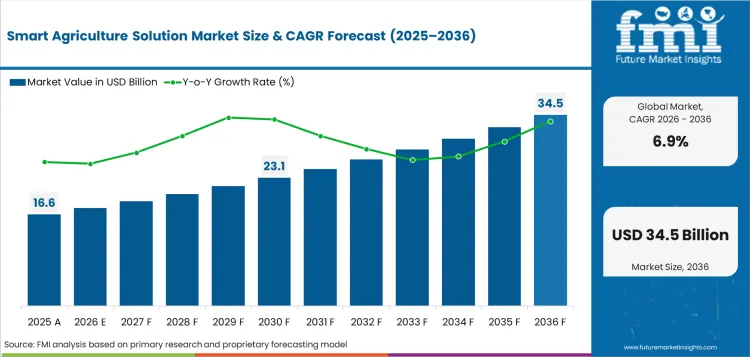
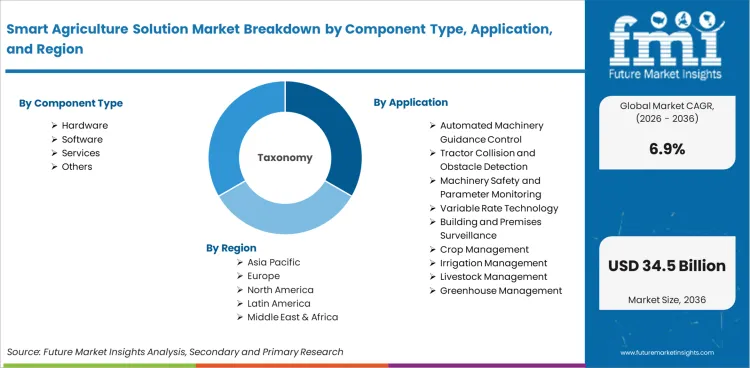
The smart agriculture solution market was valued at USD 16.6 billion in 2025. The market is set to reach USD 17.7 billion by 2026-end and grow at a CAGR of 6.9% between 2026-2036 to reach USD 34.5 billion by 2036.
Summary of the Smart Agriculture Solution Market
- Demand and Growth Drivers
- Farm labor scarcity in developed markets is accelerating automation investment, with GPS-guided machinery, autonomous tractors, and robotic harvesting systems reducing labor dependency per hectare of cultivated land.
- Input cost optimization through variable rate technology enables field-zone-specific application of seed, fertilizer, and crop protection, reducing input waste by 10 to 25% while maintaining or improving yield output.
- Government digital agriculture programs in South Korea, the EU, and Japan are providing subsidies and infrastructure support for precision farming technology adoption among small and medium-scale farm operators.
- Product and Segment View
- Hardware holds 52.3% of the component segment in 2026, with GPS receivers, field sensors, automated steering controllers, and drone platforms as the primary hardware categories deployed.
- Automated machinery guidance and control accounts for 28.1% of the application segment, with GPS auto-steer and section control reducing overlap and improving field pass efficiency.
- IoT technology leads the technology segment, with sensor networks, connectivity platforms, and cloud-based data aggregation enabling real-time field monitoring across crop operations.
- Geography and Competitive Outlook
- South Korea leads at 11.7% CAGR, driven by government smart farm programs, protected cultivation technology, and precision rice farming adoption in labor-constrained agricultural regions.
- The USA at 11.5% reflects the largest precision farming installed base, with corn belt adoption of auto-steer, variable rate, and yield monitoring technologies at over 70% penetration.
- John Deere holds the leading position with 23.0% market share through integrated precision agriculture platforms spanning guidance, sensing, data management, and autonomous operation.
- Analyst Opinion
- The smart agriculture solution market is transitioning from individual precision farming tools to integrated farm management platforms where hardware, software, and data analytics combine to optimize input application, yield prediction, and operational planning at field and enterprise levels.
- Growth reflects the convergence of labor scarcity, input cost pressure, and environmental compliance that together create economic justification for technology investment across farm sizes and crop types.
- John Deere maintains the leading position through integrated technology from guidance receivers through Operations Center software, with equipment sales providing the distribution channel for precision technology upsell.
- Companies offering interoperable platforms that work across equipment brands and integrate third-party agronomic data capture a wider addressable market than proprietary-only systems.
- Capital allocation toward autonomous operation, AI-powered crop analytics, and farmer-facing subscription platforms is expected to shape competitive positioning through 2036.
Key Takeaways, Market Size, and Forecast
- The smart agriculture solution market was valued at USD 16.6 billion in 2025.
- By 2036, the Smart Agriculture Solution Market is expected to be worth USD 34.48 billion.
- From 2026 to 2036, the market is projected to expand at a CAGR of 6.9%.
- The market is projected to create an incremental opportunity of USD 16.79 billion between 2026 and 2036.
- In 2026, hardware components are expected to account for 52.3% of the component type segment, driven by sensor deployment, GPS receivers, and automated machinery control units installed across precision farming operations.
- South Korea (11.7%) and the USA (11.5%) are two of the fastest growing markets in the world.
Smart Agriculture Solution Market Definition
The smart agriculture solution market includes hardware, software, and service solutions that enable precision farming, irrigation management, livestock monitoring, greenhouse management, and farm management. Products incorporate IoT sensors, GPS guidance, AI analytics, remote sensing, and automation technologies for agricultural operations.
Smart Agriculture Solution Market Inclusions
Market scope includes precision farming solutions, irrigation management, livestock monitoring, greenhouse management, and farm management software. Revenue is tracked by component type (hardware, software, services), application, technology, product, and end use from 2026 to 2036.
Smart Agriculture Solution Market Exclusions
The scope does not include conventional agricultural machinery without smart technology integration, basic irrigation equipment without sensor-based control, or commodity agricultural inputs (seed, fertilizer, crop protection chemicals).
Smart Agriculture Solution Market Research Methodology
- Primary Research: FMI analysts conducted interviews with precision agriculture OEMs, farm technology providers, agribusiness companies, and farm operators across key markets.
- Desk Research: Combined data from agricultural machinery market statistics, farm technology adoption surveys, government smart agriculture program documentation, and manufacturer financial disclosures.
- Market Sizing and Forecasting: Bottom-up aggregation from farm count by size and crop type, technology adoption penetration rates, and average system pricing, triangulated with manufacturer revenue data.
- Data Validation: Cross-checked quarterly against agricultural equipment sales data, farm technology survey results, and precision agriculture manufacturer revenue disclosures.
Why is the Smart Agriculture Solution Market Growing?
- Farm labor costs are rising 5 to 8% per year in the USA, EU and Japan, creating an economic rationale for the investment in automation that reduces labor hours per hectare by 30 to 50% through GPS guidance and autonomous operation.
- South Korea is the market leader with an 11.7% CAGR as government smart farm programs invest in protected cultivation technology, precision rice farming systems and agricultural robotics to address aging farmer populations.
- Satellite and drone crop sensing is driving down the cost of collecting field level data, enabling mid-size farm operations to afford to generate prescription maps for variable rate application.
The smart agriculture solution market is driven by economic incentives for technology adoption due to labor shortages, cost pressures and environmental regulations. Precision farming technologies, including GPS auto-steer, variable rate application, yield monitoring, and crop sensing, deliver quantifiable benefits in terms of reduced input waste, enhanced operational efficiency, and optimized yields. GPS guidance has been adopted in over 70% of large scale row crop operations in the USA and Brazil. Mid-size operations and specialty crops are the next frontier for adoption.
In addition to row crop precision farming, protected cultivation and livestock monitoring are increasing segments. Smart greenhouse systems for climate, irrigation and nutrient delivery optimize production of high value crops. Wearable sensors for livestock monitoring monitor animal health, activity and reproduction status. The market is projected to grow at a CAGR of 6.9% between 2026 and 2036.
Market Segmentation Analysis
- Hardware is 52.3% of the component segment. The major categories are GPS receivers, RTK base stations, field sensors, automated steering controllers, and drone platforms.
- Automated machinery guidance and control accounts for 28.1% of applications, with auto-steer penetration rates of over 70% on large US and Brazilian row crop operations.
- Precision farming solutions with guidance, variable rate and yield monitoring are the core technology stack leading the product segment.
Smart Agriculture Solution Market Segmentation By component type, By application, By technology, By product And By end use. Each dimension has different technology maturity, economics of adoption and farm operation requirements.
Insights into the Hardware Component Segment
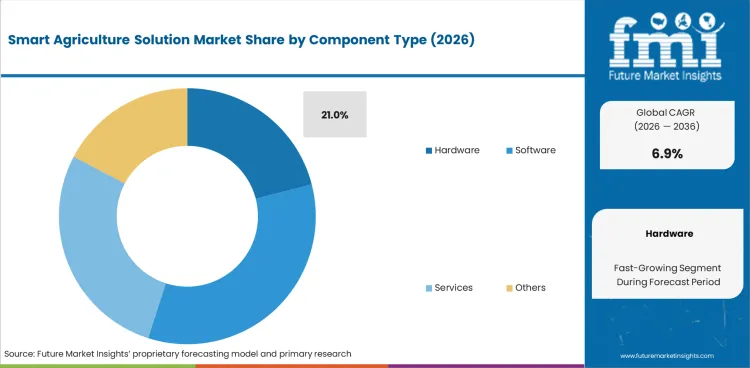
Hardware is expected to account for 21.0% of the component segment by 2026. GPS/GNSS receivers with RTK correction offer centimeter-level positioning for auto-steer and section control. Field sensors (soil moisture, nutrient, weather) for real-time monitoring data. The machine interface hardware consists of automated steering controllers and rate controllers.
The rest is made up of software and services. Farm management software platforms collect field data for planning, analysis, and reporting. Recurring revenue models include software subscription, data analytics, and so on. Services include installation, calibration and agronomic consulting.
Insights into the Automated Machinery Guidance Application
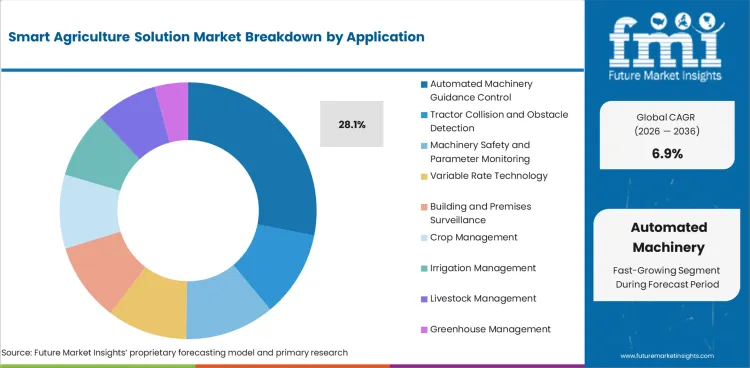
In 2026, automated machinery guidance and control accounts for 28.1% of applications. GPS auto-steer reduces overlap during planting, spraying and harvesting passes reducing input waste by 5 to 10% and operator fatigue on long field operations. Section control automatically switches spray nozzles and planter units on and off at field boundaries and previously covered areas.
The remaining share of applications serves variable rate technology, collision detection, crop management and premises surveillance. Variable Rate Adjusts seed, fertilizer and chemical application rates according to prescriptions for each field zone. Collision detection and safety monitoring for operator and bystander protection.
Smart Agriculture Solution Market Drivers, Restraints, and Opportunities
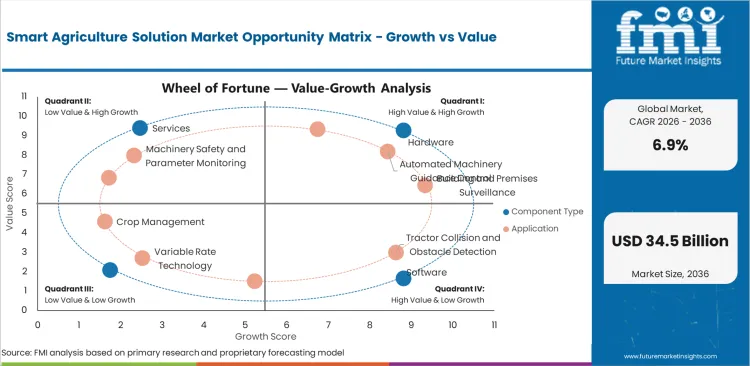
- Structural economic justification for investment in automation. - Labor scarcity and rising farm wage costs in all developed agricultural markets.
- Technology interoperability fragmentation constrains adoption, with proprietary data formats and equipment lock-in creating friction for multi-brand farm operations.
- Satellite broadband connectivity expansion (Starlink, OneWeb) is removing the rural coverage gap that previously limited cloud-based farm management adoption in remote agricultural regions.
Labor economics, input optimization, and technology availability impact the smart agriculture solution market. Increasing adoption across different farm sizes and crop types is indicative of growth at 6.9% CAGR between 2026 and 2036.
Farm Labor Economics
Demand reflects structural labor scarcity in agricultural markets. Farm wage inflation at 5 to 8% annually in the USA, Germany, Japan, and Australia creates ROI justification for GPS guidance, autonomous operation, and robotic systems that reduce labor hours per hectare.
Interoperability Constraints
Proprietary data and proprietary equipment ecosystems limit adoption. Fleet farmers who utilize mixed brands are challenged by data incompatibility among the platforms of John Deere Operations Center, CNH PLM Connect and AGCO Fuse. Open standards (ISOBUS, AgGateway) are a partial answer
Connectivity Infrastructure
This is being helped by the growing availability of rural broadband through LEO satellite networks (Starlink, OneWeb) and rolling out of 4G/5G coverage, which will enable cloud-based farm management software, real-time transmission of sensor data and remote equipment monitoring.
Environmental Compliance Incentives
EU Common Agricultural Policy (CAP) conditionality requirements and US Conservation Stewardship Program payments incentivize precision application technology that reduces input waste and documents environmental compliance.
Analysis of Smart Agriculture Solution Market By Key Countries
.webp "Top Country Growth Comparison Smart Agriculture Solution Market Cagr (2026 2036)")
| Country | CAGR |
|---|---|
| South Korea | 11.7% |
| USA | 11.5% |
| European Union | 11.4% |
| UK | 11.2% |
| Japan | 11.1% |
Source: FMI analysis based on primary research and proprietary forecasting model
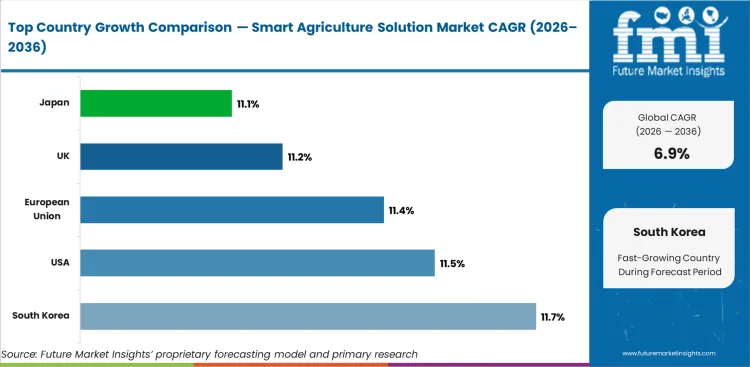
- South Korea is at 11.7% CAGR with government smart farm programs on protected cultivation, precision rice farming, and agricultural robotics.
- US 11.5% driven by the largest precision farming installed base, with corn belt auto-steer and VRT at over 70% adoption.
- The European Union at 11.4% is a reflection of CAP reform conditionality, farm labor shortages, and precision farming investment across member states.
- Supported by agricultural labor shortage, government smart agriculture strategy and robotic farming research investment, Japan at 11.1%.
The global smart agriculture solution market is estimated at USD 17.69 billion in 2026 and is projected to expand at 6.9% CAGR from 2026 to 2036. The analysis covers key markets.
Demand Outlook for Smart Agriculture Solution Market in South Korea
South Korea is projected to expand at a CAGR of 11.7% through 2036. The Ministry of Agriculture, Food and Rural Affairs’ smart farm programs support protected cultivation technology, precision rice farming systems and agricultural robotics. The aging farmer population (average over 65) creates a structural demand for labor-replacing automation.
- Ministry of Agriculture smart farm programs subsidize greenhouse automation, precision irrigation and sensor-based crop monitoring systems to small and medium Korean farms.
- Pilot work is underway on precision rice farming technology including drone based sensing, variable rate fertilization and automated water level control across Korean rice production regions.
- Korean agricultural robotics research at KAIST and commercial companies focuses on strawberry harvesting, greenhouse transportation and crop monitoring for labor-constrained operations.
Future Outlook for Smart Agriculture Solution Market in the USA
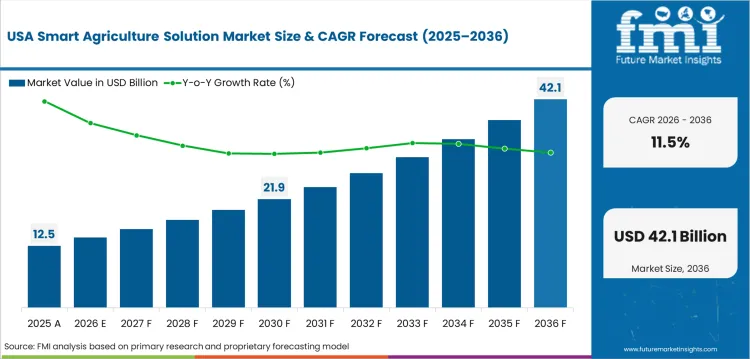
The USA is expected to grow at a CAGR of 11.5% till 2036. World’s largest precision farming market with >70% adoption of auto-steer in farms >1,000 acres in corn belt. John Deere, Trimble and AGCO precision agriculture platforms serve the installed base. Autonomous operation and AI crop analytics are the next technology frontier.
- John Deere Operations Center and See and Spray technology bring together guidance, sensing and selective application, with autonomous tractor development on track for commercial availability.
- Trimble Agriculture and Raven Industries (CNH) precision farming platforms are available to independent equipment dealers and mixed-brand farm operations across USA crop regions.
- USDA Conservation Stewardship Program and Environmental Quality Incentives Program Program payments help fund adoption of precision application technology for documentation of environmental compliance.
Opportunity Analysis of Smart Agriculture Solution Market in the European Union
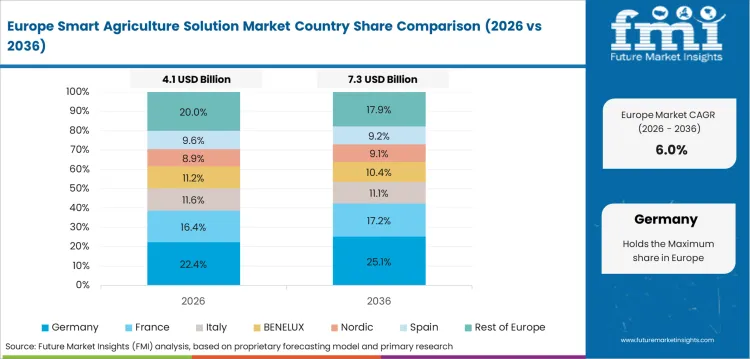
The European Union is anticipated to witness growth at a CAGR of 11.4% till 2036. CAP reform (2023-2027) conditionality requirements that link farm payments to environmental practices provide incentives for precision application technology. A shortage of farm labour in Germany, France and Spain is driving investment in automation.
- Conditionality requirements of the EU CAP reform link direct payments to crop rotation, nutrient management and environmental compliance practices that precision farming technology makes possible.
- CLAAS, Fendt (AGCO) and John Deere Mannheim European operations supply precision farming technology through established agricultural machinery dealer networks.
- Wageningen University, INRAE and other agricultural research institutes receive EU Horizon Europe research funding for smart agriculture technology development.
In-depth Analysis of Smart Agriculture Solution Market in the UK
The UK is projected to grow at 11.2% CAGR through 2036. Post-Brexit Environmental Land Management (ELM) scheme payments reward environmental outcomes, creating incentives for precision application technology. Farm labor availability reduced by Brexit immigration policy changes is accelerating automation investment.
- Environmental Land Management scheme payments reward precision farming practices including variable rate application, soil health monitoring, and nutrient management planning.
- Brexit-related agricultural labor reduction has increased urgency for automation in fruit picking, vegetable harvesting, and livestock management operations.
- Precision Decisions, SOYL (Frontier Agriculture), and Hutchinsons Omnia agronomic platforms provide UK farm management and precision application services.
Sales Analysis of Smart Agriculture Solution Market in Japan
Japan is projected to grow at 11.1% CAGR through 2036. The government Smart Agriculture Strategy targets technology adoption to address farmer aging (average age 68), farm consolidation, and food security objectives. Kubota, Yanmar, and ISEKI agricultural equipment manufacturers integrate smart technology into Japanese-market compact machinery.
- Government Smart Agriculture Strategy provides subsidies for GPS guidance, automated cultivation, and drone-based crop management targeting rice, vegetable, and fruit production.
- Kubota and Yanmar autonomous tractor and rice transplanter development targets Japanese farming conditions with compact machinery optimized for small field sizes.
- NTT East and SoftBank agricultural IoT platforms provide sensor networks and data management for greenhouse and open-field crop monitoring across Japanese prefectures.
Competitive Landscape and Strategic Positioning
- John Deere has a strong position with 23.0% market share using integrated precision agriculture from guidance to data management. Distribution channel: Equipment sales
- Trimble, AGCO (Fendt/Fuse), and CNH Industrial (Raven) compete via precision farming technology platforms and dealer network distribution.
- Competitive landscape includes agricultural equipment OEMs, niche precision farming players, and data analytics platforms.
John Deere is still leading the way with vertically integrated precision ag that includes StarFire receivers, AutoTrac guidance, ExactApply sprayer technology and Operations Center data management. Distribution channel to upsell precision technology attachments and subscriptions is provided by selling equipment through a worldwide network of more than 4,000 dealers.
Brand-agnostic precision farming technology that serves mixed-fleet farm operations competes against Trimble Agriculture. AGCO (Fuse platform, Fendt Guide) provides integrated precision to owners of AGCO equipment. CNH Industrial acquired Raven Industries for its precision agriculture business.
Barriers to entry : Dealer network development, GPS correction infrastructure and farmer trust relationships. Strategic priorities include autonomous operation, AI crop analytics and interoperable data platforms.
Key Companies in the Smart Agriculture Solution Market
Key global companies leading the smart agriculture solution market include:
- John Deere (USA), CNH Industrial/Raven (USA/UK), and AGCO Corporation (USA) hold leading positions through integrated precision farming technology and global agricultural equipment dealer networks.
- Trimble Inc. (USA), Topcon Positioning (Japan), and The Climate Corporation/Bayer (USA/Germany) maintain strong positions through brand-agnostic precision farming and digital agronomy platforms.
- BASF Digital Farming (Germany), Yara International (Norway), and Sentera (USA) serve specialized segments including crop analytics, nutrient management, and aerial sensing.
Competitive Benchmarking: Smart Agriculture Solution Market
| Company | Equipment Integration | Software Platform | Autonomous R&D | Geographic Reach |
|---|---|---|---|---|
| John Deere | Full (Proprietary) | Operations Center | Advanced | Global |
| Trimble Inc. | Brand-Agnostic | Farmer Pro | Moderate | Global |
| AGCO Corporation | Full (Fuse) | Fuse/JCA | Moderate | Global |
| CNH/Raven | Full (PLM Connect) | PLM/Raven | Advanced | Global |
| Topcon Positioning | Brand-Agnostic | TAP | Limited | Global |
| Climate Corp/Bayer | None (Software) | Climate FieldView | Limited | Americas, Europe |
| BASF Digital Farming | None (Software) | xarvio | Limited | Europe, Americas |
| Yara International | Partial (Sensors) | Atfarm | Limited | Global |
| Kubota | Full (Japanese) | KSAS | Advanced (Japan) | Asia |
Source: Future Market Insights competitive analysis, 2026.
Key Developments in Smart Agriculture Solution Market
- In 2025, John Deere launched commercial autonomous tractor operation capability for tillage applications, expanding from initial pilot programs to broader availability through participating dealer locations in North America.
- In 2025, Trimble Agriculture expanded its Farmer Pro platform with AI-powered yield prediction and variable rate prescription generation using satellite imagery and field data integration.
- In 2026, AGCO Corporation announced Fuse Smart Farming integration with third-party drone sensing platforms, enabling automated prescription map generation from aerial crop imagery.
Key Development in the Smart Agriculture Solutions Market
- In 2025, John Deere expanded its autonomous farming portfolio by launching next-generation self-driving tractors and AI-enabled agricultural equipment at CES 2025, featuring advanced computer vision, LiDAR, and precision spraying technologies to address labor shortages and improve farm productivity.
- In 2025, AGCO Corporation strengthened its smart agriculture business through the expansion of its PTx Trimble precision farming platform, introducing new AI-driven retrofit technologies, cloud-based farm management solutions, and autonomous grain cart systems to support mixed-fleet digital farming operations.
Key Players in the Smart Agriculture Solution Market
Major Global Players
- John Deere
- Trimble Inc.
- AGCO Corporation
- Raven Industries
- Topcon Positioning Systems
- CNH Industrial
Emerging Players/Startups
- Arable Inc.
- FarmWise (acquired by Deere)
- Augmenta
- Taranis (acquired by Corteva)
- CropX Technologies
Report Scope and Coverage
| Parameter | Details |
|---|---|
| Quantitative Units | USD 17.69 billion to USD 34.48 billion, at a CAGR of 6.9% |
| Market Definition | The smart agriculture solution market includes hardware, software, and services for precision farming, irrigation, livestock monitoring, and farm management using IoT, AI, and automation. |
| Regions Covered | North America, Latin America, Europe, East Asia, South Asia and Pacific, Middle East and Africa |
| Countries Covered | South Korea, USA, European Union, UK, Japan, 30 plus countries |
| Key Companies Profiled | John Deere, Trimble Inc., AGCO Corporation, Raven Industries, Topcon Positioning Systems, CNH Industrial, BASF Digital Farming, The Climate Corporation (Bayer AG), Yara International, Sentera |
| Forecast Period | 2026 to 2036 |
| Approach | Hybrid bottom-up methodology using farm counts, technology adoption rates, and average system pricing, triangulated with manufacturer revenue and farm technology survey data. |
Segmentation
Smart Agriculture Solution Market Segmented by Component Type:
- Hardware
- Sensor Monitoring Systems
- Soil Sensors
- Weather Sensors
- Smart Detection Systems
- GPS-Enabled Ranging Systems
- Drones
- Sensor Monitoring Systems
- Software
- Data Analytics Platforms
- Farm Management Systems
- Services
- Consulting Services
- Integration Services
- Maintenance and Support
- Climate Information Services
- Supply Chain Management Services
- Others
Smart Agriculture Solution Market Segmented by Application:
- Automated Machinery Guidance Control
- Tractor Collision and Obstacle Detection
- Machinery Safety and Parameter Monitoring
- Variable Rate Technology
- Building and Premises Surveillance
- Crop Management
- Yield Optimization
- Soil Management
- Irrigation Management
- Water Efficiency
- Precision Irrigation
- Livestock Management
- Health Tracking
- Breeding Management
- Greenhouse Management
- Controlled Environment Agriculture
Smart Agriculture Solution Market Segmented by Technology:
- Internet of Things
- Connected Farm Devices
- Real Time Monitoring
- Artificial Intelligence
- Predictive Analytics
- Crop Disease Detection
- Remote Sensing Technology
- Satellite Imaging
- Drone Imaging
- Automation Technology
- Autonomous Farming Equipment
- Robotic Systems
Smart Agriculture Solution Market Segmented by Product:
- Precision Farming Solutions
- Soil Monitoring Systems
- Crop Health Monitoring Systems
- Irrigation Management Solutions
- Smart Irrigation Systems
- Automated Water Control Systems
- Livestock Monitoring Solutions
- Animal Tracking Systems
- Health Monitoring Systems
- Greenhouse Management Solutions
- Climate Control Systems
- Lighting Automation Systems
- Farm Management Software
- Farm Planning Software
- Yield Monitoring Software
Smart Agriculture Solution Market Segmented by End Use:
- Farmers
- Agribusiness Companies
- Greenhouse Operators
- Research Institutions
Smart Agriculture Solution Market by Region:
- North America
- USA
- Canada
- Mexico
- Latin America
- Brazil
- Chile
- Rest of Latin America
- Western Europe
- Germany
- UK
- Italy
- Spain
- France
- Nordic
- BENELUX
- Rest of Western Europe
- Eastern Europe
- Russia
- Poland
- Hungary
- Balkan & Baltic
- Rest of Eastern Europe
- East Asia
- China
- Japan
- South Korea
- South Asia and Pacific
- India
- ASEAN
- Australia & New Zealand
- Rest of South Asia and Pacific
- Middle East & Africa
- Kingdom of Saudi Arabia
- Other GCC Countries
- Turkiye
- South Africa
- Other African Union
- Rest of Middle East & Africa
Research Sources and Bibliography
- 1. Food and Agriculture Organization. (2025). FAO Digital Agriculture Strategy and Statistics. FAO.
- 2. USA Department of Agriculture. (2025). USDA Precision Agriculture Adoption Survey. USDA.
- 3. European Commission. (2025). EC Common Agricultural Policy Digital Technology Reports. EC.
- 4. International Federation of Robotics. (2025). IFR Agricultural Robotics Data. IFR.
- 5. World Bank. (2025). World Bank Agricultural Technology Investment Data. World Bank.
This bibliography is provided for reader reference. The full Future Market Insights report contains the complete reference list with publication dates, URLs, and supporting data for all cited works.
This Report Answers
- Estimating the size of the smart agriculture solution market and revenue projections from 2026 to 2036.
- Segmentation by component type, application, technology, product, and end use.
- Insights across key regional markets.
- Analysis of precision farming versus livestock and greenhouse management dynamics.
- Assessment of the competitive landscape across equipment OEMs and technology providers.
- Identification of investment opportunities in autonomous operation, AI analytics, and emerging market adoption.
- Farm technology adoption tracking and ROI analysis.
- Delivery of data in PDF and Excel formats.
Frequently Asked Questions
What is the global market demand for Smart Agriculture Solutions in 2026?
In 2026, the global smart agriculture solution market is estimated at USD 17.69 billion.
How big will the Smart Agriculture Solution Market be in 2036?
By 2036, the market is projected to reach USD 34.48 billion.
How much is demand for the Smart Agriculture Solution Market expected to grow between 2026 and 2036?
Between 2026 and 2036, the market is projected to expand at a CAGR of 6.9%.
Which component type is expected to lead in the Smart Agriculture Solution Market in 2026?
Hardware is expected to hold 52.3% in 2026, with GPS receivers, field sensors, and automated steering controllers as primary categories.
What is causing demand to rise in South Korea?
South Korea is expected to grow at 11.7% CAGR through 2036, driven by government smart farm programs and aging farmer demographics creating automation demand.
What is causing demand to rise in the USA?
The USA is expected to grow at 11.5% CAGR through 2036, supported by the largest precision farming installed base and advancing autonomous operation technology.
What does this report mean by Smart Agriculture Solution Market definition?
The market includes hardware, software, and services for precision farming, irrigation, livestock monitoring, and farm management using IoT, AI, and automation.
How does FMI make the Smart Agriculture Solution Market forecast and validate it?
Forecasting uses hybrid methodology with farm counts and adoption rates, validated against manufacturer revenue and farm technology surveys.
Preview the report firsthand - request a free sample
Get SampleGet the brochure for pricing and purchase details.
Get PDFTable of Content
- Executive Summary
- Global Market Outlook
- Demand-side Trends
- Supply-side Trends
- Technology Roadmap Analysis
- Analysis and Recommendations
- Market Overview
- Market Coverage / Taxonomy
- Market Definition / Scope / Limitations
- Research Methodology
- Chapter Orientation
- Analytical Lens and Working Hypotheses
- Market Structure, Signals, and Trend Drivers
- Benchmarking and Cross-market Comparability
- Market Sizing, Forecasting, and Opportunity Mapping
- Research Design and Evidence Framework
- Desk Research Programme (Secondary Evidence)
- Company Annual and Sustainability Reports
- Peer-reviewed Journals and Academic Literature
- Corporate Websites, Product Literature, and Technical Notes
- Earnings Decks and Investor Briefings
- Statutory Filings and Regulatory Disclosures
- Technical White Papers and Standards Notes
- Trade Journals, Industry Magazines, and Analyst Briefs
- Conference Proceedings, Webinars, and Seminar Materials
- Government Statistics Portals and Public Data Releases
- Press Releases and Reputable Media Coverage
- Specialist Newsletters and Curated Briefings
- Sector Databases and Reference Repositories
- FMI Internal Proprietary Databases and Historical Market Datasets
- Subscription Datasets and Paid Sources
- Social Channels, Communities, and Digital Listening Inputs
- Additional Desk Sources
- Expert Input and Fieldwork (Primary Evidence)
- Primary Modes
- Qualitative Interviews and Expert Elicitation
- Quantitative Surveys and Structured Data Capture
- Blended Approach
- Why Primary Evidence is Used
- Field Techniques
- Interviews
- Surveys
- Focus Groups
- Observational and In-context Research
- Social and Community Interactions
- Stakeholder Universe Engaged
- C-suite Leaders
- Board Members
- Presidents and Vice Presidents
- R&D and Innovation Heads
- Technical Specialists
- Domain Subject-matter Experts
- Scientists
- Physicians and Other Healthcare Professionals
- Governance, Ethics, and Data Stewardship
- Research Ethics
- Data Integrity and Handling
- Primary Modes
- Tooling, Models, and Reference Databases
- Desk Research Programme (Secondary Evidence)
- Data Engineering and Model Build
- Data Acquisition and Ingestion
- Cleaning, Normalisation, and Verification
- Synthesis, Triangulation, and Analysis
- Quality Assurance and Audit Trail
- Market Background
- Market Dynamics
- Drivers
- Restraints
- Opportunity
- Trends
- Scenario Forecast
- Demand in Optimistic Scenario
- Demand in Likely Scenario
- Demand in Conservative Scenario
- Opportunity Map Analysis
- Product Life Cycle Analysis
- Supply Chain Analysis
- Investment Feasibility Matrix
- Value Chain Analysis
- PESTLE and Porter’s Analysis
- Regulatory Landscape
- Regional Parent Market Outlook
- Production and Consumption Statistics
- Import and Export Statistics
- Market Dynamics
- Global Market Analysis 2021 to 2025 and Forecast, 2026 to 2036
- Historical Market Size Value (USD Million) Analysis, 2021 to 2025
- Current and Future Market Size Value (USD Million) Projections, 2026 to 2036
- Y-o-Y Growth Trend Analysis
- Absolute $ Opportunity Analysis
- Global Market Pricing Analysis 2021 to 2025 and Forecast 2026 to 2036
- Global Market Analysis 2021 to 2025 and Forecast 2026 to 2036, By Component Type
- Introduction / Key Findings
- Historical Market Size Value (USD Million) Analysis By Component Type , 2021 to 2025
- Current and Future Market Size Value (USD Million) Analysis and Forecast By Component Type , 2026 to 2036
- Hardware
- Sensor Monitoring Systems
- Soil Sensors
- Weather Sensors
- Smart Detection Systems
- GPS-Enabled Ranging Systems
- Drones
- Software
- Data Analytics Platforms
- Farm Management Systems
- Services
- Consulting Services
- Integration Services
- Maintenance and Support
- Climate Information Services
- Supply Chain Management Services
- Others
- Hardware
- Y-o-Y Growth Trend Analysis By Component Type , 2021 to 2025
- Absolute $ Opportunity Analysis By Component Type , 2026 to 2036
- Global Market Analysis 2021 to 2025 and Forecast 2026 to 2036, By Application
- Introduction / Key Findings
- Historical Market Size Value (USD Million) Analysis By Application, 2021 to 2025
- Current and Future Market Size Value (USD Million) Analysis and Forecast By Application, 2026 to 2036
- Automated Machinery Guidance Control
- Tractor Collision and Obstacle Detection
- Machinery Safety and Parameter Monitoring
- Variable Rate Technology
- Building and Premises Surveillance
- Crop Management
- Yield Optimization
- Soil Management
- Irrigation Management
- Water Efficiency
- Precision Irrigation
- Livestock Management
- Health Tracking
- Breeding Management
- Greenhouse Management
- Controlled Environment Agriculture
- Automated Machinery Guidance Control
- Y-o-Y Growth Trend Analysis By Application, 2021 to 2025
- Absolute $ Opportunity Analysis By Application, 2026 to 2036
- Global Market Analysis 2021 to 2025 and Forecast 2026 to 2036, By Technology
- Introduction / Key Findings
- Historical Market Size Value (USD Million) Analysis By Technology, 2021 to 2025
- Current and Future Market Size Value (USD Million) Analysis and Forecast By Technology, 2026 to 2036
- Internet of Things
- Connected Farm Devices
- Real Time Monitoring
- Artificial Intelligence
- Predictive Analytics
- Crop Disease Detection
- Remote Sensing Technology
- Satellite Imaging
- Drone Imaging
- Automation Technology
- Autonomous Farming Equipment
- Robotic Systems
- Internet of Things
- Y-o-Y Growth Trend Analysis By Technology, 2021 to 2025
- Absolute $ Opportunity Analysis By Technology, 2026 to 2036
- Global Market Analysis 2021 to 2025 and Forecast 2026 to 2036, By Product
- Introduction / Key Findings
- Historical Market Size Value (USD Million) Analysis By Product, 2021 to 2025
- Current and Future Market Size Value (USD Million) Analysis and Forecast By Product, 2026 to 2036
- Precision Farming Solutions
- Soil Monitoring Systems
- Crop Health Monitoring Systems
- Irrigation Management Solutions
- Smart Irrigation Systems
- Automated Water Control Systems
- Livestock Monitoring Solutions
- Animal Tracking Systems
- Health Monitoring Systems
- Greenhouse Management Solutions
- Climate Control Systems
- Lighting Automation Systems
- Farm Management Software
- Farm Planning Software
- Yield Monitoring Software
- Precision Farming Solutions
- Y-o-Y Growth Trend Analysis By Product, 2021 to 2025
- Absolute $ Opportunity Analysis By Product, 2026 to 2036
- Global Market Analysis 2021 to 2025 and Forecast 2026 to 2036, By End Use
- Introduction / Key Findings
- Historical Market Size Value (USD Million) Analysis By End Use, 2021 to 2025
- Current and Future Market Size Value (USD Million) Analysis and Forecast By End Use, 2026 to 2036
- Farmers
- Agribusiness Companies
- Greenhouse Operators
- Research Institutions
- Farmers
- Y-o-Y Growth Trend Analysis By End Use, 2021 to 2025
- Absolute $ Opportunity Analysis By End Use, 2026 to 2036
- Global Market Analysis 2021 to 2025 and Forecast 2026 to 2036, By Region
- Introduction
- Historical Market Size Value (USD Million) Analysis By Region, 2021 to 2025
- Current Market Size Value (USD Million) Analysis and Forecast By Region, 2026 to 2036
- North America
- Latin America
- Western Europe
- Eastern Europe
- East Asia
- South Asia and Pacific
- Middle East & Africa
- Market Attractiveness Analysis By Region
- North America Market Analysis 2021 to 2025 and Forecast 2026 to 2036, By Country
- Historical Market Size Value (USD Million) Trend Analysis By Market Taxonomy, 2021 to 2025
- Market Size Value (USD Million) Forecast By Market Taxonomy, 2026 to 2036
- By Country
- USA
- Canada
- Mexico
- By Component Type
- By Application
- By Technology
- By Product
- By End Use
- By Country
- Market Attractiveness Analysis
- By Country
- By Component Type
- By Application
- By Technology
- By Product
- By End Use
- Key Takeaways
- Latin America Market Analysis 2021 to 2025 and Forecast 2026 to 2036, By Country
- Historical Market Size Value (USD Million) Trend Analysis By Market Taxonomy, 2021 to 2025
- Market Size Value (USD Million) Forecast By Market Taxonomy, 2026 to 2036
- By Country
- Brazil
- Chile
- Rest of Latin America
- By Component Type
- By Application
- By Technology
- By Product
- By End Use
- By Country
- Market Attractiveness Analysis
- By Country
- By Component Type
- By Application
- By Technology
- By Product
- By End Use
- Key Takeaways
- Western Europe Market Analysis 2021 to 2025 and Forecast 2026 to 2036, By Country
- Historical Market Size Value (USD Million) Trend Analysis By Market Taxonomy, 2021 to 2025
- Market Size Value (USD Million) Forecast By Market Taxonomy, 2026 to 2036
- By Country
- Germany
- UK
- Italy
- Spain
- France
- Nordic
- BENELUX
- Rest of Western Europe
- By Component Type
- By Application
- By Technology
- By Product
- By End Use
- By Country
- Market Attractiveness Analysis
- By Country
- By Component Type
- By Application
- By Technology
- By Product
- By End Use
- Key Takeaways
- Eastern Europe Market Analysis 2021 to 2025 and Forecast 2026 to 2036, By Country
- Historical Market Size Value (USD Million) Trend Analysis By Market Taxonomy, 2021 to 2025
- Market Size Value (USD Million) Forecast By Market Taxonomy, 2026 to 2036
- By Country
- Russia
- Poland
- Hungary
- Balkan & Baltic
- Rest of Eastern Europe
- By Component Type
- By Application
- By Technology
- By Product
- By End Use
- By Country
- Market Attractiveness Analysis
- By Country
- By Component Type
- By Application
- By Technology
- By Product
- By End Use
- Key Takeaways
- East Asia Market Analysis 2021 to 2025 and Forecast 2026 to 2036, By Country
- Historical Market Size Value (USD Million) Trend Analysis By Market Taxonomy, 2021 to 2025
- Market Size Value (USD Million) Forecast By Market Taxonomy, 2026 to 2036
- By Country
- China
- Japan
- South Korea
- By Component Type
- By Application
- By Technology
- By Product
- By End Use
- By Country
- Market Attractiveness Analysis
- By Country
- By Component Type
- By Application
- By Technology
- By Product
- By End Use
- Key Takeaways
- South Asia and Pacific Market Analysis 2021 to 2025 and Forecast 2026 to 2036, By Country
- Historical Market Size Value (USD Million) Trend Analysis By Market Taxonomy, 2021 to 2025
- Market Size Value (USD Million) Forecast By Market Taxonomy, 2026 to 2036
- By Country
- India
- ASEAN
- Australia & New Zealand
- Rest of South Asia and Pacific
- By Component Type
- By Application
- By Technology
- By Product
- By End Use
- By Country
- Market Attractiveness Analysis
- By Country
- By Component Type
- By Application
- By Technology
- By Product
- By End Use
- Key Takeaways
- Middle East & Africa Market Analysis 2021 to 2025 and Forecast 2026 to 2036, By Country
- Historical Market Size Value (USD Million) Trend Analysis By Market Taxonomy, 2021 to 2025
- Market Size Value (USD Million) Forecast By Market Taxonomy, 2026 to 2036
- By Country
- Kingdom of Saudi Arabia
- Other GCC Countries
- Turkiye
- South Africa
- Other African Union
- Rest of Middle East & Africa
- By Component Type
- By Application
- By Technology
- By Product
- By End Use
- By Country
- Market Attractiveness Analysis
- By Country
- By Component Type
- By Application
- By Technology
- By Product
- By End Use
- Key Takeaways
- Key Countries Market Analysis
- USA
- Pricing Analysis
- Market Share Analysis, 2025
- By Component Type
- By Application
- By Technology
- By Product
- By End Use
- Canada
- Pricing Analysis
- Market Share Analysis, 2025
- By Component Type
- By Application
- By Technology
- By Product
- By End Use
- Mexico
- Pricing Analysis
- Market Share Analysis, 2025
- By Component Type
- By Application
- By Technology
- By Product
- By End Use
- Brazil
- Pricing Analysis
- Market Share Analysis, 2025
- By Component Type
- By Application
- By Technology
- By Product
- By End Use
- Chile
- Pricing Analysis
- Market Share Analysis, 2025
- By Component Type
- By Application
- By Technology
- By Product
- By End Use
- Germany
- Pricing Analysis
- Market Share Analysis, 2025
- By Component Type
- By Application
- By Technology
- By Product
- By End Use
- UK
- Pricing Analysis
- Market Share Analysis, 2025
- By Component Type
- By Application
- By Technology
- By Product
- By End Use
- Italy
- Pricing Analysis
- Market Share Analysis, 2025
- By Component Type
- By Application
- By Technology
- By Product
- By End Use
- Spain
- Pricing Analysis
- Market Share Analysis, 2025
- By Component Type
- By Application
- By Technology
- By Product
- By End Use
- France
- Pricing Analysis
- Market Share Analysis, 2025
- By Component Type
- By Application
- By Technology
- By Product
- By End Use
- India
- Pricing Analysis
- Market Share Analysis, 2025
- By Component Type
- By Application
- By Technology
- By Product
- By End Use
- ASEAN
- Pricing Analysis
- Market Share Analysis, 2025
- By Component Type
- By Application
- By Technology
- By Product
- By End Use
- Australia & New Zealand
- Pricing Analysis
- Market Share Analysis, 2025
- By Component Type
- By Application
- By Technology
- By Product
- By End Use
- China
- Pricing Analysis
- Market Share Analysis, 2025
- By Component Type
- By Application
- By Technology
- By Product
- By End Use
- Japan
- Pricing Analysis
- Market Share Analysis, 2025
- By Component Type
- By Application
- By Technology
- By Product
- By End Use
- South Korea
- Pricing Analysis
- Market Share Analysis, 2025
- By Component Type
- By Application
- By Technology
- By Product
- By End Use
- Russia
- Pricing Analysis
- Market Share Analysis, 2025
- By Component Type
- By Application
- By Technology
- By Product
- By End Use
- Poland
- Pricing Analysis
- Market Share Analysis, 2025
- By Component Type
- By Application
- By Technology
- By Product
- By End Use
- Hungary
- Pricing Analysis
- Market Share Analysis, 2025
- By Component Type
- By Application
- By Technology
- By Product
- By End Use
- Kingdom of Saudi Arabia
- Pricing Analysis
- Market Share Analysis, 2025
- By Component Type
- By Application
- By Technology
- By Product
- By End Use
- Turkiye
- Pricing Analysis
- Market Share Analysis, 2025
- By Component Type
- By Application
- By Technology
- By Product
- By End Use
- South Africa
- Pricing Analysis
- Market Share Analysis, 2025
- By Component Type
- By Application
- By Technology
- By Product
- By End Use
- USA
- Market Structure Analysis
- Competition Dashboard
- Competition Benchmarking
- Market Share Analysis of Top Players
- By Regional
- By Component Type
- By Application
- By Technology
- By Product
- By End Use
- Competition Analysis
- Competition Deep Dive
- John Deere
- Overview
- Product Portfolio
- Profitability by Market Segments (Product/Age /Sales Channel/Region)
- Sales Footprint
- Strategy Overview
- Marketing Strategy
- Product Strategy
- Channel Strategy
- Trimble Inc.
- AGCO Corporation
- Raven Industries
- Topcon Positioning Systems
- CNH Industrial
- BASF Digital Farming
- The Climate Corporation (Bayer AG)
- Yara International
- Sentera
- John Deere
- Competition Deep Dive
- Assumptions & Acronyms Used


