

- Market Size (2026)
- USD 234.6 Mn
- Forecast (2036)
- USD 555.3 Mn
- CAGR (2026 to 2036)
- 9.0%
How big is Foliar Penetration Additives Market in 2026?
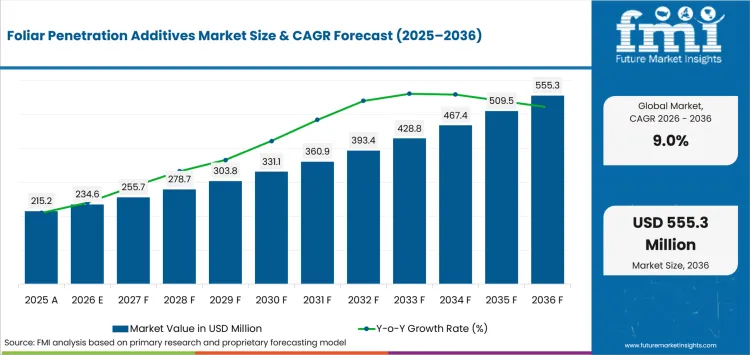
USD 234.6 million in 2026 and USD 555.3 million by 2036 at a 9.0% CAGR.
Demand for foliar penetration additives is projected to expand at 9.0% CAGR between 2026 and 2036. Valuation is expected to rise from USD 234.6 million in 2026 to USD 555.3 million by 2036. Application performance remains a key consideration when growers and crop-input suppliers evaluate tank-mix programs. EPA's February 2026 registration manual identifies penetrants and wetting agents as recognized agricultural adjuvant functions used alongside pesticide applications. The guidance reinforces their role in improving spray delivery and deposition under field conditions.
Country demand diverges around low-volume application and market-access rules rather than one agronomic need. Japan’s drone pesticide spraying route reduces labor while UK commercialization requires formal adjuvant listing. Japan’s Ministry of Agriculture reported in October 2025 that drone pesticide spraying reduced operating hours by 61% on average in demonstration sites. Lower carrier volumes make controlled coverage more valuable while national authorization changes how quickly a product can reach local channels.
Key Takeaways of Foliar Penetration Additives Market
- Demand is rising as crop-protection programs put greater economic weight on wetting and deposition that protect the value of each spray pass.
- Based on product type, surfactant-based products are projected to account for 39.7% in 2026 due to broad wetting requirements across foliar spray programs.
- The efficacy enhancement segment is likely to capture 50.2% share in 2026 attributable to direct demand for better coverage and uptake performance.
- Cereals & grains are set to lead the crop type category with 40.7% share in 2026 due to repeat adjuvant use across broad-acre treatment windows.
- Compatibility risk and country-specific listing requirements can lengthen qualification when an additive lacks evidence for the intended active ingredient and spray setup.
- Some of the key players in this market include Precision Laboratories, WinField United (Land O'Lakes), BRANDT, Loveland Products (Nutrien), Rovensa Next (Oro Agri), Croda, Clariant, and Nouryon.
Analyst Perspective
"The strongest foliar penetration additive is not necessarily the most aggressive penetrant because crop safety changes with the active ingredient and leaf surface. Commercial programs should compare wetting plus uptake evidence against nozzle setup and local authorization before they compare price per litre."
- Nikhil Kaitwade, Principal Consultant, Future Market Insights
How is the Foliar Penetration Additives Market segmented?
The foliar penetration additives market is segmented by product type, function, crop type, application method, sales channel and region.
Product types include surfactant-based, oil-based, polymer-based, mineral or carrier-based and other formulations. Functions cover efficacy enhancement, loss and drift reduction, handling and compatibility and other uses. Crop types include cereals & grains, fruits & vegetables, oilseeds & pulses, turf & ornamentals and others. Application methods cover foliar tank-mix, granule or dry blend, fertigation and others. Sales channels include agri-input distributors, cooperatives, agri-retail chains, online or direct-to-farm routes and others.
What supports foliar tank-mix use within the application method category?
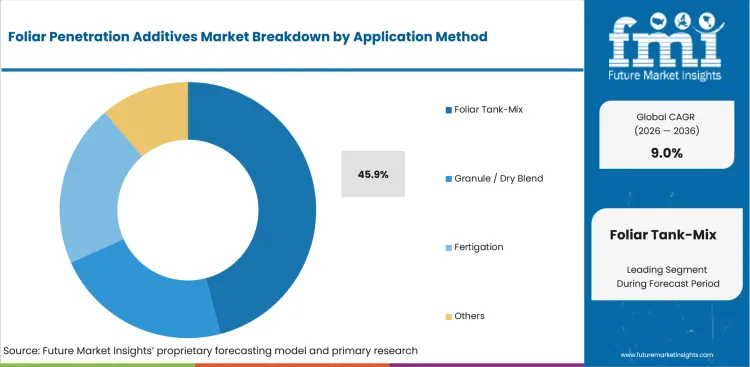
Foliar tank-mix use lets applicators select an additive at preparation based on the pesticide and nozzle setup. That flexibility becomes more valuable in low-drift herbicide adjuvant programs where mitigation rules require a defined concentration or droplet profile.
- Foliar tank-mix is projected to hold 45.9% share in 2026 owing to application flexibility across changing pesticide programs and spray conditions.
- The regulatory basis for this use is reflected in EPA’s April 2025 herbicide drift options, which specify an oil-emulsion adjuvant at 2.5% of finished spray volume for qualifying mitigation routes.
What makes surfactant-based products central to the product type category?
Surfactant-based additives improve initial leaf contact by lowering surface tension across waxy crop surfaces. Formulators still test wetting against pesticide compatibility because agricultural surfactants cannot deliver identical performance across herbicide and fungicide mixtures under changing water conditions.
- By product type, surfactant-based products are estimated to hold 39.7% in 2026 owing to broad wetting requirements across foliar tank mixes.
- The need for penetrant support is reinforced by an EPA label approved in November 2025, which requires a penetrating spray adjuvant to achieve optimum foliar coverage on listed vegetable crops.
Why does efficacy enhancement lead the function category?
Efficacy-enhancement products are evaluated against field performance rather than the chemistry label alone. Applicators compare activator adjuvants after spray contact because gains in deposition or retention disappear if the mixture loses compatibility. Rainfastness becomes decisive on high-value crops when treatment timing leaves little room for an early repeat pass.
- By function, efficacy enhancement is forecast to represent 50.2% in 2026 driven by its direct tie to coverage and uptake performance.
- This performance focus is supported by a January 2025 EPA-approved OXYFLUORFEN 2EC label, which specifies a nonionic surfactant to enhance herbicidal effectiveness against emerged weeds.
How do cereals & grains anchor the crop type category?
Cereal programs spread adjuvant cost across large treated areas and create several spray windows during the growing season. Later fungicide adjuvant programs raise the value of canopy coverage as crop density makes deposition harder across broad-acre fields nationwide.
- In 2026, cereals & grains are expected to lead crop type with 40.7% share because broad-acre systems support repeat herbicide and fungicide applications.
- The scale of cereal and grain treatment is reflected in USDA NASS data from June 2025, which recorded 95.2 million planted USA corn acres for the 2025 season.
What are the drivers, restraints and opportunities in the Foliar Penetration Additives Market?
Demand rises with pressure for dependable spray delivery while compatibility and listing requirements restrain substitution and low-volume application expands the value of multifunctional adjuvants.
- Driver: Higher-value pesticide programs raise the economic cost of poor deposition and strengthen demand for additives that improve on-target spray delivery.
- Restraint: Product performance changes with active ingredients and crop surfaces so qualification must address compatibility and crop-safety risk before repeat use.
- Opportunity: Formulators that document drift reduction against EPA mitigation conditions can win placement in herbicide programs that require qualifying spray-control options.
Spray efficiency becomes commercially important once poor deposition threatens a higher-value pesticide pass. EPA’s April 2025 ecological mitigation support document found oil-emulsion adjuvants could support 25% to 44% buffer reductions under tested medium or coarse spray conditions. The bounded test conditions make field evidence valuable in no-till weed control programs because one drift result cannot transfer across every pesticide formulation.
Qualification costs rise as an adjuvant approaches regular channel use because formulation data can require separate local support. HSE guidance updated in March 2025 states that adjuvant applications may need letters of access to protected formulation data for inclusion on the UK Official List. Companies with local dossiers can reduce review friction while weaker documentation delays distributor commitment during seasonal product planning.
Regulatory tools give documented drift-control adjuvants a clearer route into programs that already calculate mitigation at field level. EPA released the Pesticide App for Label Mitigations in August 2025 so applicators can calculate ecological spray-drift and runoff mitigation against field parameters. Formulators with compatible evidence can compete for programs that already treat mitigation planning as part of seasonal application setup.
Which country CAGRs are profiled in the Foliar Penetration Additives Market?
| Country | CAGR |
|---|---|
| USA | 8.6% |
| South Korea | 8.3% |
| Germany | 8.0% |
| UK | 7.7% |
| Japan | 6.8% |
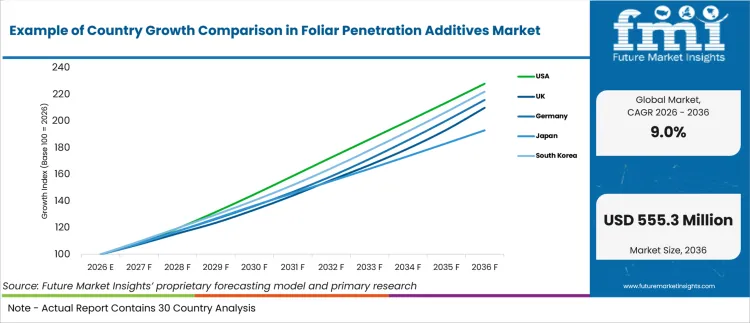
How do country-level CAGRs compare in the Foliar Penetration Additives Market?
The 1.8-point spread separates two faster-growth markets from a close middle pair and a slower Japanese profile. USA and South Korea form the upper group as drift controls and aerial use alter spray decisions. Germany and the UK cluster around formal approval routes while Japan remains lower despite strong labor-saving drone adoption.
- EPA drift rules make mitigation evidence part of USA herbicide planning.
- New aerial registrations extend concentrated spraying into South Korean fruit production programs.
- BVL authorization makes regulatory maintenance a recurring German channel cost for distributors.
- HSE listing ties UK distributor recommendations to active product authorization and use conditions.
- Drone labor savings favor Japanese low-volume use despite local compatibility testing demands.
Similar CAGRs can therefore hide different qualification costs and channel economics locally. The full report provides country-level CAGR analysis across North America, Latin America, Europe, East Asia, South Asia, Oceania and the Middle East and Africa.
Country-wise Analysis
- USA applicators plan adjuvant choice around herbicide mitigation requirements and nozzles already fitted across commercial spray rigs. The USA foliar penetration additives sector is projected to record 8.6% CAGR during the assessment period as retailer agronomy teams translate qualifying drift controls into seasonal product guidance. EPA’s October 2025 measure descriptions explain how oil and polymer chemistries reduce driftable fine droplets under defined application conditions. Product-specific compatibility remains the main local friction because one droplet result does not transfer across every active ingredient. Companies with nozzle data and dealer training can convert regulatory fit into repeat orders without relying on a generic penetration claim.
- South Korean fruit growers increasingly use drones on steep orchard blocks where labor shortages make ground spraying difficult during narrow treatment windows. RDA reported in May 2025 that the first fruit-crop unmanned-aerial pesticide for sweet persimmon achieved 82% of conventional control at 32-times dilution without phytotoxicity. Crop-specific registration remains the main friction because concentrated mixes need approved use directions before retailers can recommend them. Foliar penetration additive demand in South Korea is forecast to rise at 8.3% CAGR over the forecast period as registered aerial uses expand. Formulations validated for concentrated deposition have the clearest route into seasonal local orchard spray programs.
- German distributors serving EU agricultural adjuvants work within BVL authorization before placing products into professional pesticide programs. The agency’s June 2025 Section 42 manual defines the application route for adjuvants and gives established companies a clear regulatory path. Foliar penetration additive sales in Germany are forecast to expand at 8.0% CAGR by 2036 as authorized products move through established crop-protection channels. Cross-crop claims remain a material friction because wetting performance must match the intended pesticide and spray conditions. Companies that maintain German regulatory files and application-specific data can reach distributors faster during seasonal stocking than entrants carrying broad chemistry claims without local qualification.
- UK distributors check adjuvant authorization before recommending a product or taking a new formulation into seasonal stock. HSE’s September 2025 database overview provides direct access to the Official List of Adjuvants for current product checks. The searchable route lowers due-diligence time for established entries but exposes missing authorization across intended pesticide combinations. The UK foliar penetration additives outlook is anticipated to advance at 7.7% CAGR over the assessment period as current listings support distributor confidence. Companies with precise use directions gain easier local channel support while incomplete authorization raises the cost of extending one formulation across additional agronomy programs.
- Japanese orchard operators need spray systems that can work on steep ground and cover citrus canopies during labor-constrained treatment windows. Foliar penetration additive demand in Japan is estimated to expand at 6.8% CAGR through 2036 as domestic drone platforms broaden aerial treatment options. MAFF’s agricultural-drone council recorded in September 2025 that third-party liability insurance became mandatory from October for unmanned aircraft weighing 25 kilograms or more. The rule adds a fleet-cost friction while low-volume spray compatibility remains essential for concentrated applications. Companies that validate wetting under Japanese drone settings have a stronger route into orchard programs than portfolios designed around conventional high-volume spraying.
Who are the notable companies in the Foliar Penetration Additives Market?
Precision Laboratories, WinField United (Land O'Lakes), BRANDT, Loveland Products (Nutrien), Rovensa Next (Oro Agri), Croda, Clariant, and Nouryon are the notable companies profiled in this market.
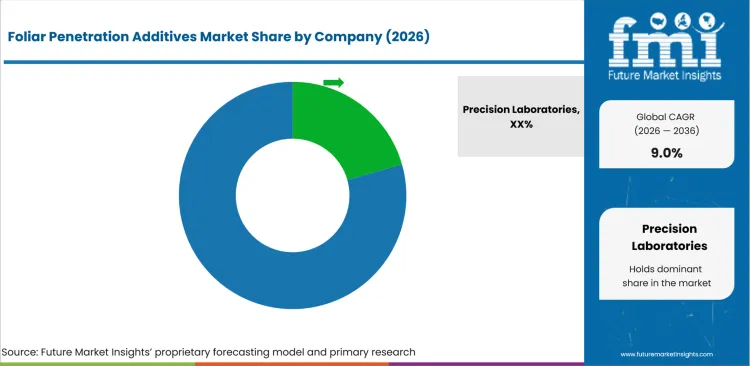
Competition separates farm-facing adjuvant brands from formulation specialists with different routes to application decisions. Adjacent agricultural biostimulants compete for distributor attention inside crowded crop-input programs each season. Emulsifiable concentrate formulations also shape upstream selection before the final tank mix reaches applicators.
- WinField United, BRANDT and Loveland Products (Nutrien) pair adjuvant brands with farm-facing agronomy channels.
- Precision Laboratories and Rovensa Next (Oro Agri) emphasize spray quality plus tank-mix performance for field applications.
- Croda, Clariant and Nouryon supply crop-formulation chemistry across several international crop-protection markets and formulation routes.
Competitive Benchmarking: Foliar Penetration Additives Market
| Company | Foliar Wetting & Penetration | Drift & Deposition Control | Tank-Mix Integration | Geographic Reach |
|---|---|---|---|---|
| Precision Laboratories | High | High | High | North America |
| WinField United (Land O'Lakes) | High | High | High | North America |
| BRANDT | High | Medium | High | North America and selected international markets |
| Loveland Products (Nutrien) | High | High | High | North America and international Nutrien retail markets |
| Rovensa Next (Oro Agri) | High | High | High | More than 90 countries |
| Croda | High | High | High | Global crop-care operations |
| Clariant | High | Medium | High | Global agriculture formulation markets |
| Nouryon | High | High | High | Global agriculture and crop-protection markets |
Key Developments in the Foliar Penetration Additives Market
- In June 2026, Rovensa Next (Oro Agri) announced a USA distribution agreement with Novonesis that places selected biosolutions alongside its adjuvant technologies for the 2027 growing season.
- In March 2026, Clariant launched two crop-formulation technologies at CAC 2026 and positioned them beside its agriculture-additives portfolio for complex pesticide formulations.
- In January 2025, Precision Laboratories expanded the Mix Tank App with new mixing-sequence functionality intended to reduce incompatibility risk during complex agricultural spray programs.
Key Players in the Foliar Penetration Additives Market
Field-Channel Adjuvant Platforms
- WinField United (Land O'Lakes)
- BRANDT
- Loveland Products (Nutrien)
Specialist Application Chemistries
- Precision Laboratories
- Rovensa Next (Oro Agri)
Formulation and Crop-Care Chemistry Suppliers
- Croda
- Clariant
- Nouryon
Foliar Penetration Additives Market - Report Scope
| Coverage field | Report scope |
|---|---|
| Market breakdown | By product type, function, crop type, application method, sales channel and region. |
| Quantitative Units | Revenue in USD million and CAGR in %l |
| Market Definition | Commercial foliar additives used to improve wetting, spreading, deposition, retention or penetration of crop-protection and foliar treatment sprays. |
| Regions Covered | North America, Latin America, Europe, East Asia, South Asia and Pacific and Middle East and Africa. |
| Countries Covered | USA, South Korea, Germany, UK, Japan, and 20+ countries included in the full report. |
| Key Companies Profiled | Precision Laboratories, WinField United (Land O'Lakes), BRANDT, Loveland Products (Nutrien), Rovensa Next (Oro Agri), Croda, Clariant, Nouryon. |
| Forecast Period | 2026 to 2036. |
| Approach | Primary and secondary research with market triangulation. |
Foliar Penetration Additives Market - Research Methodology
| Method | Approach |
|---|---|
| Primary Research | FMI analysts gathered input from manufacturers, service providers, technology developers, distributors, end users, procurement teams, and subject-matter experts. Interviews examined purchasing decisions, product or service evaluation, adoption barriers, approval requirements, pricing considerations, and expectations for technical or commercial support. Respondents were also asked what evidence is required before a trial, pilot, or initial order develops into regular purchasing. |
| Desk Research | Desk research covered government statistics, regulatory publications, trade data, industry associations, technical literature, standards, company filings, product information, and official corporate announcements. Sources were reviewed for relevance, publication date, geographic coverage, and consistency with the defined market scope. Claims relating to performance, applications, approvals, capacity, investment, and commercial activity were retained only when supported by credible public evidence. |
| Market Sizing and Forecasting | The market model combined the baseline value with historical performance, segment structure, pricing and volume indicators, adoption levels, company participation, and country-level demand conditions. Forecast assumptions considered economic activity, investment trends, regulatory developments, technology adoption, purchasing cycles, supply availability, and barriers to wider market use. Segment and regional estimates were reconciled before the final market total was calculated. |
| Data Validation | Estimates were checked against multiple independent indicators, including public data, company activity, trade patterns, industry developments, and findings from primary interviews. Validation also tested whether products, services, applications, and company revenues fell within the defined market boundaries. Adjacent categories, unsupported claims, overlapping revenues, and activities without direct market relevance were excluded to reduce double counting and maintain consistency across segments and countries. |
Foliar Penetration Additives Market by Segments
Foliar Penetration Additives Market segmented by Product Type:
- Surfactant-Based
- Oil-Based
- Polymer-Based
- Mineral / Carrier-Based
- Others
Foliar Penetration Additives Market segmented by Function:
- Efficacy Enhancement
- Loss & Drift Reduction
- Handling & Compatibility
- Others
Foliar Penetration Additives Market segmented by Crop Type:
- Cereals & Grains
- Fruits & Vegetables
- Oilseeds & Pulses
- Turf & Ornamentals
- Others
Foliar Penetration Additives Market segmented by Application Method:
- Foliar Tank-Mix
- Granule / Dry Blend
- Fertigation
- Others
Foliar Penetration Additives Market segmented by Sales Channel:
- Agri-Input Distributors
- Cooperatives
- Agri-Retail Chains
- Online / Direct-to-Farm
- Others
Foliar Penetration Additives Market by Region:
- North America
- United States
- Canada
- Latin America
- Brazil
- Mexico
- Argentina
- Chile
- Western Europe
- Germany
- France
- United Kingdom
- Italy
- Spain
- Benelux
- Nordics
- Eastern Europe
- Poland
- Czech Republic
- Romania
- Hungary
- East Asia
- China
- Japan
- South Korea
- South Asia and Pacific
- India
- ASEAN
- Australia and New Zealand
- Middle East and Africa
- GCC Countries
- South Africa
- Türkiye
- Israel
Research Sources and Bibliography
- USA Environmental Protection Agency. (2026, February 26). Pesticide Registration Manual: Chapter 1 - Overview of Requirements for Pesticide Registration and Registrant Obligations.
- Ministry of Agriculture, Forestry and Fisheries of Japan. (2025, October 1). Promotion of Smart Agriculture.
- USA Environmental Protection Agency. (2025, November 26). US EPA, Pesticide Product Label, A151.01, 11/26/2025.
- USA Environmental Protection Agency. (2025, January 23). US EPA, Pesticide Product Label, OXYFLUORFEN 2EC, 01/23/2025.
- USA Department of Agriculture, National Agricultural Statistics Service. (2025, June 30). Corn planted acreage up 5% from 2024, soybean acreage down 4% from last year.
- USA Environmental Protection Agency. (2025, October 2). Mitigation Menu.
- USA Environmental Protection Agency. (2025, April). Ecological Mitigation Support Document to Support Endangered Species Strategies, Version 2.1.
- Health and Safety Executive. (2025, March 6). Letters of access: pesticide product and adjuvant applications.
- USA Environmental Protection Agency. (2025, August 14). EPA Releases New Mobile Tool to Help Farmers Implement Recommended Ecological Pesticide Mitigation Measures.
- USA Environmental Protection Agency. (2025, October 30). Mitigation Menu Measure Descriptions.
- Rural Development Administration, Republic of Korea. (2025, May 28). 단감, 과수 드론 방제의 새 시대를 열다.
- Federal Office of Consumer Protection and Food Safety. (2025, June 20). Application for authorisation of an adjuvant according to Section 42 of the Plant Protection Act: Instructions for completing the application form.
- Health and Safety Executive. (2025, September 26). Pesticides databases - overview.
- Ministry of Agriculture, Forestry and Fisheries of Japan. (2025, September 10). 農業用ドローンの普及拡大に向けた官民協議会.
- Clariant. (2026, March 17). Clariant advances formulation stability and biological compatibility for improved agriculture at CAC 2026.
- Rovensa Next. (2026, June 11). Rovensa Next to Distribute Novonesis’ Biosolutions for Plant Health in the United States.
- Precision Laboratories. (2025, January 20). The Mix Tank App Expands Functionality To Streamline Spraying Practices.
- Croda International Plc. (2025, February 25). Results for the year ended 31 December 2024.
- BRB International. (2025, November 7). Relaunching BRB Silicone Spray Adjuvants for Agrochemicals Market.
- Rovensa Next. (2026, January 27). FAUVE Project: Rovensa Next and UTC collaborate on innovative drone spraying for water savings and agricultural efficiency.
- Nouryon. (2025, April 7). Nouryon launches Adsee® Flex 960, an advanced tank mix adjuvant for enhanced crop performance.
- BRANDT. (2025, April 15). BRANDT Grows Product Management Team.
- Clariant. (2025, March 13). Clariant’s novel solutions for enhancing crop health and biological formulations at CAC 2025: Synergen™ Soil and Synergen Guard 100.
- Rizobacter. (2025, April 29). Rizobacter lanza RIZOSPRAY PRO MANÍ: el primer adyuvante funcional del mercado.
- Momentive Performance Materials. (2025, November 10). 2025 CDP Corporate Questionnaire 2025.
- Stepan Company. (2025, June 10). See What Stepan Agricultural Solutions Showcased at ICSCE 2025.
- WinField United. (2025). Introducing a Simplified Way to Help Boost Herbicide Performance.
This bibliography is provided for reader reference and is not exhaustive. The full report contains the complete reference list and detailed citations
This Report Answers
- How large is the foliar penetration additives market in 2026 and 2036?
- Which spray-delivery conditions support recurring demand for penetration additives?
- Why do surfactant-based products hold 39.7% of product type demand in 2026?
- Why does efficacy enhancement account for 50.2% of function demand in 2026?
- How does low-volume tank-mix application change additive qualification requirements?
- How do country growth rates differ across the five profiled markets?
- Which companies compete through field-channel and formulation-science positions?
- What compatibility and regulatory issues slow repeat adoption?
- Which recent company actions are changing competition in the category?
Frequently Asked Questions
How big is the Foliar Penetration Additives Market in 2026?
The foliar penetration additives market is valued at USD 234.6 million in 2026 and is projected to reach USD 555.3 million by 2036. Growth is driven by increasing demand for improved spray deposition, wetting, and uptake across crop-protection programs.
What is the CAGR of the Foliar Penetration Additives Market from 2026 to 2036?
The foliar penetration additives market is projected to grow at a CAGR of 9.0% between 2026 and 2036. Expansion is supported by rising adoption of adjuvant technologies that enhance spray efficiency and reduce application losses.
Which product type leads the Foliar Penetration Additives Market?
Surfactant-based products are projected to account for 39.7% of the market in 2026. Their leading share is supported by broad use in foliar spray applications requiring improved wetting, spreading, and coverage performance.
Which function dominates the Foliar Penetration Additives Market?
Efficacy enhancement is projected to account for 50.2% of the market in 2026. Its dominance is driven by the need to improve spray coverage, retention, and active-ingredient uptake across diverse crop programs.
Which crop type leads the Foliar Penetration Additives Market?
Cereals & grains are projected to account for 40.7% of the market in 2026. Their leading share reflects extensive cultivation areas and recurring herbicide and fungicide applications throughout the growing season.
Which application method leads the Foliar Penetration Additives Market?
Foliar tank-mix application is projected to account for 45.9% of the market in 2026. Its dominance is supported by flexibility in adjuvant selection and compatibility with a wide range of crop-protection programs.
Which companies are active in the Foliar Penetration Additives Market?
Key companies operating in the market include Precision Laboratories, WinField United (Land O'Lakes), BRANDT, Loveland Products (Nutrien), Rovensa Next (Oro Agri), Croda, Clariant, and Nouryon. These companies compete through formulation expertise, field-performance validation, distributor networks, and crop-protection technologies.
Preview the report firsthand - request a free sample
Get SampleGet the brochure for pricing and purchase details.
Get PDFTable of Content
- Key Takeaways
- Market Size and CAGR
- Top Growth Driver
- Fastest Growing Segment
- Leading Region
- Key Companies
- Emerging Opportunities
- Executive Summary
- Global Market Outlook
- Demand-side Trends
- Supply-side Trends
- Technology Roadmap Analysis
- Analysis and Recommendations
- Analyst Perspective (What is happening? Why now? What should investors know?)
- Key Questions Answered
- How large is the market?
- What is the CAGR?
- What are key trends?
- Which region dominates?
- Who are the leaders?
- Market Overview
- Market Coverage / Taxonomy
- Market Definition / Scope / Limitations
- Research Methodology
- Chapter Orientation
- Analytical Lens and Working Hypotheses
- Market Structure, Signals, and Trend Drivers
- Benchmarking and Cross-market Comparability
- Market Sizing, Forecasting, and Opportunity Mapping
- Research Design and Evidence Framework
- Desk Research Programme (Secondary Evidence)
- Expert Input and Fieldwork (Primary Evidence)
- Tooling, Models, and Reference Databases
- Data Engineering and Model Build
- Quality Assurance and Audit Trail
- Market Background
- Market Dynamics (Drivers, Restraints, Opportunity, Trends)
- Scenario Forecast (Optimistic, Likely, Conservative)
- Impact Analysis
- AI Impact
- Sustainability Impact
- Regulatory Impact
- Technology Impact
- Consumer / Buyer Analysis
- Purchase Drivers
- Adoption Barriers
- Buyer Journey
- Opportunity Map Analysis
- Product Life Cycle Analysis
- Supply Chain Analysis
- Investment Feasibility Matrix
- Value Chain Analysis
- PESTLE and Porter's Analysis
- Regulatory Landscape
- Regional Parent Market Outlook
- Production and Consumption Statistics
- Import and Export Statistics
- Global Market Analysis and Forecast, 2021 to 2036
- Historical Market Size Value (USD Million) Analysis, 2021 to 2025
- Current and Future Market Size Value (USD Million) Projections, 2026 to 2036
- Y-o-Y Growth Trend Analysis
- Absolute $ Opportunity Analysis
- Global Market Pricing Analysis, 2021 to 2036
- Global Market Analysis and Forecast, By Product Type, 2021 to 2036
- Introduction / Key Findings
- Historical Market Size Value (USD Million) Analysis By Product Type, 2021 to 2025
- Current and Future Market Size Value (USD Million) Analysis and Forecast By Product Type, 2026 to 2036
- Surfactant-Based
- Oil-Based
- Polymer-Based
- Mineral / Carrier-Based
- Others
- Surfactant-Based
- Y-o-Y Growth Trend Analysis By Product Type, 2021 to 2025
- Absolute $ Opportunity Analysis By Product Type, 2026 to 2036
- Global Market Analysis and Forecast, By Function, 2021 to 2036
- Introduction / Key Findings
- Historical Market Size Value (USD Million) Analysis By Function, 2021 to 2025
- Current and Future Market Size Value (USD Million) Analysis and Forecast By Function, 2026 to 2036
- Efficacy Enhancement
- Loss & Drift Reduction
- Handling & Compatibility
- Others
- Efficacy Enhancement
- Y-o-Y Growth Trend Analysis By Function, 2021 to 2025
- Absolute $ Opportunity Analysis By Function, 2026 to 2036
- Global Market Analysis and Forecast, By Crop Type, 2021 to 2036
- Introduction / Key Findings
- Historical Market Size Value (USD Million) Analysis By Crop Type, 2021 to 2025
- Current and Future Market Size Value (USD Million) Analysis and Forecast By Crop Type, 2026 to 2036
- Cereals & Grains
- Fruits & Vegetables
- Oilseeds & Pulses
- Turf & Ornamentals
- Others
- Cereals & Grains
- Y-o-Y Growth Trend Analysis By Crop Type, 2021 to 2025
- Absolute $ Opportunity Analysis By Crop Type, 2026 to 2036
- Global Market Analysis and Forecast, By Application Method, 2021 to 2036
- Introduction / Key Findings
- Historical Market Size Value (USD Million) Analysis By Application Method, 2021 to 2025
- Current and Future Market Size Value (USD Million) Analysis and Forecast By Application Method, 2026 to 2036
- Foliar Tank-Mix
- Granule / Dry Blend
- Fertigation
- Others
- Foliar Tank-Mix
- Y-o-Y Growth Trend Analysis By Application Method, 2021 to 2025
- Absolute $ Opportunity Analysis By Application Method, 2026 to 2036
- Global Market Analysis and Forecast, By Sales Channel, 2021 to 2036
- Introduction / Key Findings
- Historical Market Size Value (USD Million) Analysis By Sales Channel, 2021 to 2025
- Current and Future Market Size Value (USD Million) Analysis and Forecast By Sales Channel, 2026 to 2036
- Agri-Input Distributors
- Cooperatives
- Agri-Retail Chains
- Online / Direct-to-Farm
- Others
- Agri-Input Distributors
- Y-o-Y Growth Trend Analysis By Sales Channel, 2021 to 2025
- Absolute $ Opportunity Analysis By Sales Channel, 2026 to 2036
- Global Market Analysis and Forecast, By Region, 2021 to 2036
- Introduction
- Historical Market Size Value (USD Million) Analysis By Region, 2021 to 2025
- Current Market Size Value (USD Million) Analysis and Forecast By Region, 2026 to 2036
- North America
- Latin America
- Western Europe
- Eastern Europe
- East Asia
- South Asia and Pacific
- Middle East & Africa
- Market Attractiveness Analysis By Region
- North America Market Analysis and Forecast, By Country, 2021 to 2036
- Historical Market Size Value (USD Million) Trend Analysis By Market Taxonomy, 2021 to 2025
- Market Size Value (USD Million) Forecast By Market Taxonomy, 2026 to 2036
- By Country
- USA
- Canada
- By Product Type
- By Function
- By Crop Type
- By Application Method
- By Sales Channel
- By Country
- Market Attractiveness Analysis
- By Country
- By Product Type
- By Function
- By Crop Type
- By Application Method
- By Sales Channel
- Key Takeaways
- Latin America Market Analysis and Forecast, By Country
- Historical Market Size Value (USD Million) Trend Analysis By Market Taxonomy, 2021 to 2025
- Market Size Value (USD Million) Forecast By Market Taxonomy, 2026 to 2036
- By Country
- Brazil
- Mexico
- Chile
- Rest of Latin America
- By Product Type
- By Function
- By Crop Type
- By Application Method
- By Sales Channel
- By Country
- Market Attractiveness Analysis
- By Country
- By Product Type
- By Function
- By Crop Type
- By Application Method
- By Sales Channel
- Key Takeaways
- Western Europe Market Analysis and Forecast, By Country
- Historical Market Size Value (USD Million) Trend Analysis By Market Taxonomy, 2021 to 2025
- Market Size Value (USD Million) Forecast By Market Taxonomy, 2026 to 2036
- By Country
- Germany
- UK
- Italy
- Spain
- France
- Nordic
- BENELUX
- Rest of Western Europe
- By Product Type
- By Function
- By Crop Type
- By Application Method
- By Sales Channel
- By Country
- Market Attractiveness Analysis
- By Country
- By Product Type
- By Function
- By Crop Type
- By Application Method
- By Sales Channel
- Key Takeaways
- Eastern Europe Market Analysis and Forecast, By Country
- Historical Market Size Value (USD Million) Trend Analysis By Market Taxonomy, 2021 to 2025
- Market Size Value (USD Million) Forecast By Market Taxonomy, 2026 to 2036
- By Country
- Russia
- Poland
- Hungary
- Balkan & Baltic
- Rest of Eastern Europe
- By Product Type
- By Function
- By Crop Type
- By Application Method
- By Sales Channel
- By Country
- Market Attractiveness Analysis
- By Country
- By Product Type
- By Function
- By Crop Type
- By Application Method
- By Sales Channel
- Key Takeaways
- East Asia Market Analysis and Forecast, By Country
- Historical Market Size Value (USD Million) Trend Analysis By Market Taxonomy, 2021 to 2025
- Market Size Value (USD Million) Forecast By Market Taxonomy, 2026 to 2036
- By Country
- China
- Japan
- South Korea
- By Product Type
- By Function
- By Crop Type
- By Application Method
- By Sales Channel
- By Country
- Market Attractiveness Analysis
- By Country
- By Product Type
- By Function
- By Crop Type
- By Application Method
- By Sales Channel
- Key Takeaways
- South Asia and Pacific Market Analysis and Forecast, By Country
- Historical Market Size Value (USD Million) Trend Analysis By Market Taxonomy, 2021 to 2025
- Market Size Value (USD Million) Forecast By Market Taxonomy, 2026 to 2036
- By Country
- India
- ASEAN
- Australia & New Zealand
- Rest of South Asia and Pacific
- By Product Type
- By Function
- By Crop Type
- By Application Method
- By Sales Channel
- By Country
- Market Attractiveness Analysis
- By Country
- By Product Type
- By Function
- By Crop Type
- By Application Method
- By Sales Channel
- Key Takeaways
- Middle East & Africa Market Analysis and Forecast, By Country
- Historical Market Size Value (USD Million) Trend Analysis By Market Taxonomy, 2021 to 2025
- Market Size Value (USD Million) Forecast By Market Taxonomy, 2026 to 2036
- By Country
- Kingdom of Saudi Arabia
- Other GCC Countries
- Türkiye
- South Africa
- Other African Union
- Rest of Middle East & Africa
- By Product Type
- By Function
- By Crop Type
- By Application Method
- By Sales Channel
- By Country
- Market Attractiveness Analysis
- By Country
- By Product Type
- By Function
- By Crop Type
- By Application Method
- By Sales Channel
- Key Takeaways
- Key Countries Market Analysis
- USA
- Pricing Analysis
- Market Share Analysis, 2025
- By Product Type
- By Function
- By Crop Type
- By Application Method
- By Sales Channel
- Canada
- Pricing Analysis
- Market Share Analysis, 2025
- By Product Type
- By Function
- By Crop Type
- By Application Method
- By Sales Channel
- Mexico
- Pricing Analysis
- Market Share Analysis, 2025
- By Product Type
- By Function
- By Crop Type
- By Application Method
- By Sales Channel
- Brazil
- Pricing Analysis
- Market Share Analysis, 2025
- By Product Type
- By Function
- By Crop Type
- By Application Method
- By Sales Channel
- Chile
- Pricing Analysis
- Market Share Analysis, 2025
- By Product Type
- By Function
- By Crop Type
- By Application Method
- By Sales Channel
- Germany
- Pricing Analysis
- Market Share Analysis, 2025
- By Product Type
- By Function
- By Crop Type
- By Application Method
- By Sales Channel
- UK
- Pricing Analysis
- Market Share Analysis, 2025
- By Product Type
- By Function
- By Crop Type
- By Application Method
- By Sales Channel
- Italy
- Pricing Analysis
- Market Share Analysis, 2025
- By Product Type
- By Function
- By Crop Type
- By Application Method
- By Sales Channel
- Spain
- Pricing Analysis
- Market Share Analysis, 2025
- By Product Type
- By Function
- By Crop Type
- By Application Method
- By Sales Channel
- France
- Pricing Analysis
- Market Share Analysis, 2025
- By Product Type
- By Function
- By Crop Type
- By Application Method
- By Sales Channel
- India
- Pricing Analysis
- Market Share Analysis, 2025
- By Product Type
- By Function
- By Crop Type
- By Application Method
- By Sales Channel
- ASEAN
- Pricing Analysis
- Market Share Analysis, 2025
- By Product Type
- By Function
- By Crop Type
- By Application Method
- By Sales Channel
- Australia & New Zealand
- Pricing Analysis
- Market Share Analysis, 2025
- By Product Type
- By Function
- By Crop Type
- By Application Method
- By Sales Channel
- China
- Pricing Analysis
- Market Share Analysis, 2025
- By Product Type
- By Function
- By Crop Type
- By Application Method
- By Sales Channel
- Japan
- Pricing Analysis
- Market Share Analysis, 2025
- By Product Type
- By Function
- By Crop Type
- By Application Method
- By Sales Channel
- South Korea
- Pricing Analysis
- Market Share Analysis, 2025
- By Product Type
- By Function
- By Crop Type
- By Application Method
- By Sales Channel
- Russia
- Pricing Analysis
- Market Share Analysis, 2025
- By Product Type
- By Function
- By Crop Type
- By Application Method
- By Sales Channel
- Poland
- Pricing Analysis
- Market Share Analysis, 2025
- By Product Type
- By Function
- By Crop Type
- By Application Method
- By Sales Channel
- Hungary
- Pricing Analysis
- Market Share Analysis, 2025
- By Product Type
- By Function
- By Crop Type
- By Application Method
- By Sales Channel
- Kingdom of Saudi Arabia
- Pricing Analysis
- Market Share Analysis, 2025
- By Product Type
- By Function
- By Crop Type
- By Application Method
- By Sales Channel
- Türkiye
- Pricing Analysis
- Market Share Analysis, 2025
- By Product Type
- By Function
- By Crop Type
- By Application Method
- By Sales Channel
- South Africa
- Pricing Analysis
- Market Share Analysis, 2025
- By Product Type
- By Function
- By Crop Type
- By Application Method
- By Sales Channel
- USA
- Market Structure Analysis
- Competition Dashboard
- Competition Benchmarking
- Market Share Analysis of Top Players
- By Regional
- By Product Type
- By Function
- By Crop Type
- By Application Method
- By Sales Channel
- Emerging Startups
- Innovation Benchmarking
- Competition Analysis
- Competition Deep Dive
- Precision Laboratories
- Overview
- Product Portfolio
- Profitability by Market Segments
- Sales Footprint
- Strategy Overview
- Marketing Strategy
- Product Strategy
- Channel Strategy
- WinField United (Land O'Lakes)
- Brandt
- Loveland Products (Nutrien)
- Oro Agri (Rovensa)
- Croda
- Clariant
- Stepan Company
- Precision Laboratories
- Case Studies
- Success Stories
- Recent Developments
- Competition Deep Dive
- Assumptions & Acronyms Used


