

- Market Size (2026)
- USD 636.8 Mn
- Forecast (2036)
- USD 1760.0 Mn
- CAGR (2026 to 2036)
- 10.7%
How big is Vehicle Cybersecurity Penetration Testing Services Market in 2026?
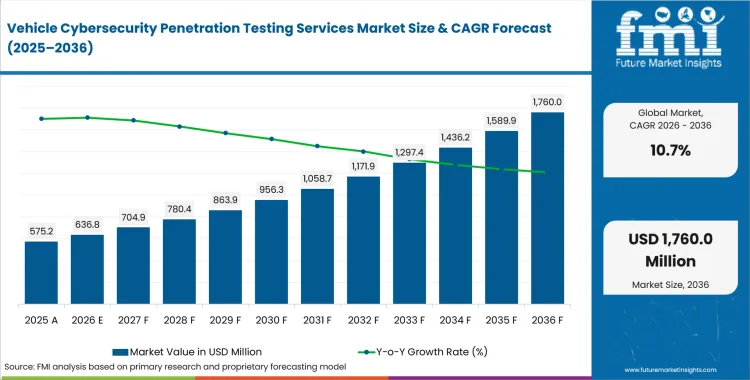
USD 636.8 million in 2026 and USD 1760.0 million by 2036 at a 10.7% CAGR.
Demand for vehicle cybersecurity penetration testing services is projected to expand at 10.7% CAGR between 2026 and 2036, increasing valuation from USD 636.8 million in 2026 to USD 1760.0 million by 2036. Growing vehicle connectivity and the transition toward software-defined architectures are increasing the need for rigorous cybersecurity validation throughout the product lifecycle. NHTSA stated in September 2025 that software permeates modern vehicles and expanding connectivity creates abundant attack surfaces. Expanding attack surfaces give automotive cybersecurity testing a defined role in release approval and corrective-action planning. Software-defined vehicles require renewed attack simulation after code revisions alter interfaces or third-party dependencies across a platform. Independent laboratories gain recurring assignments through reproducible findings and documented retesting that confirms corrective actions across later vehicle and component releases.
United States vehicle programs can draw on independent laboratories with complete-vehicle access and mature proving-ground networks. European programs place greater weight on formal type-approval evidence across several regulated vehicle categories and national procedures. In October 2025, the European Union published Regulation 2025/1455 for the cybersecurity protection of L-category vehicles. The regulation applies UN Regulation 155 cybersecurity requirements to specified two-wheel and three-wheel vehicles and quadricycles from scheduled dates. The change widens the regulated test base beyond passenger vehicles and links connected car systems with documented approval evidence. Vehicle cybersecurity management programs help manufacturers assign findings across engineering teams and technical services during formal review. Providers need regional regulatory knowledge and practical hardware access to prevent evidence rework during compressed launch schedules.
Key Takeaways of Vehicle Cybersecurity Penetration Testing Services Market
- Demand for vehicle cybersecurity penetration testing services is driven by increasing vehicle connectivity and regulatory requirements that require documented cybersecurity validation before deployment.
- OEMs lead by end use with 51.0% share, reflecting their responsibility for vehicle integration and approval submissions across connected vehicle platforms.
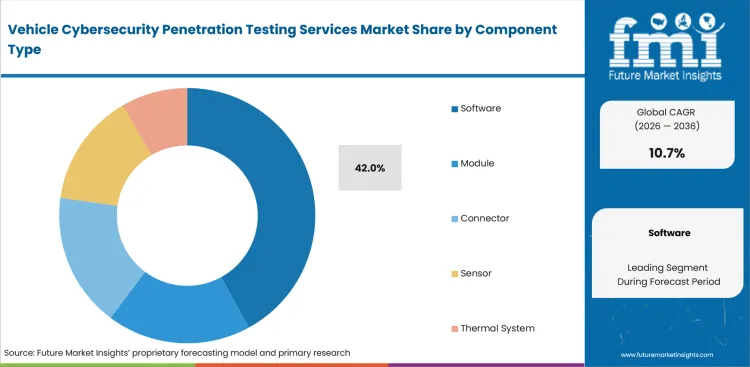
- Software accounts for the largest component share at 42.0%, supported by continuous code revisions, over-the-air updates and the need for recurring security assessments.
- Battery electric vehicles hold 27.0% share by propulsion type, as charging infrastructure and digital interfaces expand the cybersecurity testing scope.
- Regulatory complexity, limited access to production-representative systems, evolving attack surfaces and the need for specialized cybersecurity expertise remain the primary barriers to broader market adoption.
- Competition centers on UL Solutions, DEKRA, TÜV SÜD, SGS, NCC Group, PlaxidityX, AVL, and HORIBA MIRA, with providers differentiating through automotive cybersecurity expertise, regulatory support, and testing depth across vehicle systems.
Analyst Perspective
"Commercial demand ultimately depends on a testing provider's ability to uncover real-world vulnerabilities across vehicle software, ECUs, wireless interfaces, and connected services without disrupting development timelines. Automotive manufacturers increasingly favor partners that combine deep technical testing expertise with regulatory evidence support, the objective is to strengthen cybersecurity resilience while maintaining compliance and accelerating vehicle program approvals."
- Nikhil Kaitwade, Principal Analyst, Future Market Insights
How is the Vehicle Cybersecurity Penetration Testing Services Market segmented?
The vehicle cybersecurity penetration testing services industry is segmented by component type, vehicle type, propulsion, sales channel, and region.
Component type identifies the tested layer across sensors, modules, connectors, software, and thermal systems used during security assessment. Vehicle type separates passenger cars, commercial vehicles, heavy trucks, two-wheelers, and buses with different interface density and approval exposure. Propulsion distinguishes battery-electric, plug-in hybrid, fuel-cell, hybrid, and ICE retrofit architectures with different external interfaces and control paths. Sales channel separates OEM-led programs, aftermarket assignments, fleet engagements, distributor routes, and direct service contracts. Region captures differences in regulation, vehicle access, specialist availability, and evidence review across national approval programs. The automotive software market provides context for frequent code releases, but this report measures paid penetration testing services rather than software revenue. The segmentation framework separates technical scope from purchasing route and national approval responsibility throughout the report.
How does software shape demand within the component type category?
Software changes vehicle behavior without a hardware redesign, so each release can alter previously tested interfaces across related platforms. PlaxidityX reported in June 2025 that GlobalLogic integrated automated security tools into a software-defined vehicle cloud framework. The partnership adds code analysis and vulnerability scanning together with automated security testing inside continuous development workflows ahead of production releases. Similar vehicle software operations create recurring work for laboratories that reproduce findings and verify corrective actions across scheduled production releases.
- The component type category is forecast to be led by software at 42.0% share in 2026 due to frequent code changes across connected vehicle functions. Penetration testers must assess application logic and communication paths across third-party libraries during each planned release. A revised software package can reopen an attack route even though the underlying hardware remains unchanged.
- Vehicle engineering teams place software testing inside release gates that assign every finding to a responsible code owner. Reusable scripts support regression testing across related models and software branches during scheduled validation across several releases. Laboratories reduce repeat effort by preserving proven attack scenarios and evidence formats for later software releases without rebuilding the complete assessment.
What makes passenger car central to the vehicle type category?
Passenger cars combine high production volumes with cellular links and Bluetooth connections across mobile applications and driver-assistance functions. The USA Bureau of Industry and Security finalized connected-vehicle restrictions in January 2025 for passenger vehicles under 10,001 pounds. The final rule identifies telematics control units and wireless modules as regulated connectivity systems inside connected passenger vehicles. Growing passenger vehicle telematics expands the interfaces that testing teams must assess across related model families.
- By vehicle type, passenger car is estimated to hold 12.0% share in 2026 owing to shared connected interfaces across high-volume model families. A missed vulnerability can affect several trims and national configurations through shared infotainment or telematics modules. Manufacturers need evidence that each corrective action remains effective across regional software packages and radio interfaces.
- Laboratories can extend one validated attack library across related passenger-car architectures instead of treating every derivative as a separate assignment. Shared electronic modules improve test reuse through consistent attack methods and evidence formats across related vehicle models. National approval differences remain material as software packages and communication settings can change across the same global model family.
Where does battery electric create propulsion testing demand?
Battery-electric vehicles connect with chargers and cloud operators through payment services and electricity networks during connected charging sessions. The USA Department of Energy published its Vehicle Grid Integration Assessment Report in January 2025. Its ten-year roadmap includes codes and standards together with cybersecurity across vehicle-grid integration for future deployment planning. The wider telematics control units environment creates remote paths that require coordinated testing across vehicles and backend services.
- Based on propulsion, battery electric is projected to account for 27.0% share in 2026 due to the wider security boundary created by charging and energy services. Vulnerabilities can cross organizational lines through shared identity and communication services during connected charging operations. Independent testing helps vehicle manufacturers and charging operators assign corrective work ahead of deployment schedule changes.
- Vehicle manufacturers and fleet operators use scenarios that combine charging sessions with mobile accounts and backend communication. Assessments limited to the vehicle can miss failures that begin inside external identity or payment services. Joint exercises provide stronger assurance by tracing one attack path across every connected service owner and technical interface.
How do manufacturers evaluate OEM-led sales channel programs?
OEMs control final vehicle architecture and remain responsible for evidence submitted during type approval across global launch programs. PlaxidityX reported in May 2025 that a Japanese autonomous bus project needed UN Regulation 155 and ISO/SAE 21434 evidence ahead of an airport trial. The engagement delivered threat analysis and validation records for one complete vehicle program and supporting approval documents. Similar automotive TIC assignments require laboratories to align component findings with the final vehicle security case.
- By sales channel, OEM is forecast to represent 51.0% share in 2026 driven by vehicle manufacturer control of integration and final approval submissions. Component manufacturers provide test results for individual modules across shared interfaces and planned vehicle configurations. The vehicle manufacturer must reconcile those results and show that unresolved weaknesses do not compromise complete vehicle functions during launch approval.
- Vehicle manufacturers favor one coordinated testing program that covers internal engineering teams and external component partners. Shared planning reduces duplicate attacks across common interfaces and assigns corrective work to the correct engineering group. Inconsistent component evidence can delay final review and force the vehicle manufacturer to rebuild traceability for technical services.
What are the drivers, restraints, and opportunities in the Vehicle Cybersecurity Penetration Testing Services Market?
Formal cybersecurity controls create repeat testing demand, but restricted vehicle access delays assessments and digital-key certification opens specialized wireless testing work.
- Driver: Vehicle approval controls and software revisions require repeatable attack testing across development and later production updates.
- Restraint: Protected interfaces and fragmented evidence routes extend testing schedules across regional vehicle variants and repair environments.
- Opportunity: Accredited laboratories can combine penetration testing with digital-key security and interoperability assessments across connected vehicle programs.
Vehicle approval under UN Regulation 155 requires a cybersecurity management system and documented evidence for the vehicle type. The European Union published the updated regulation in January 2025 with Supplement 3 in force for vehicle approvals. Penetration testing services support this process by finding exploitable paths and recording corrective actions in a form technical services can review. Software updates create additional assignments whenever revised code changes a validated interface or communication path across an approved platform.
Protected diagnostic interfaces limit how deeply an independent laboratory can test a production-representative vehicle during a scheduled assessment. Japan's transport ministry reported in June 2025 that certain faults remained accessible through manufacturer systems rather than common independent repair tools. Laboratories without approved credentials can lose valuable time during access arrangements or issue reproduction inside launch programs. Service agreements therefore need clear data rights and escalation contacts at the start of attack simulation across each vehicle program.
Digital-key certification is a notable opportunity for laboratories that can test NFC and Bluetooth Low Energy together with ultra-wideband communication. DEKRA's Michigan and Virginia facilities operate as authorized Car Connectivity Consortium Digital Key laboratories, supporting conformance and interoperability testing across NFC, Bluetooth Low Energy, and ultra-wideband communication. The authorization combines security and interoperability testing within regional vehicle programs and recognized certification workflows. A laboratory can extend the same engagement into relay-resistance and key-provisioning tests, which reduces coordination across separate facilities.
Which country CAGRs are profiled in the Vehicle Cybersecurity Penetration Testing Services Market?
| Country | CAGR |
|---|---|
| China | 14.4% |
| South Korea | 13.4% |
| India | 12.3% |
| United States | 11.2% |
| Japan | 10.2% |
| Germany | 9.1% |
How do country-level CAGRs compare in the Vehicle Cybersecurity Penetration Testing Services Market?
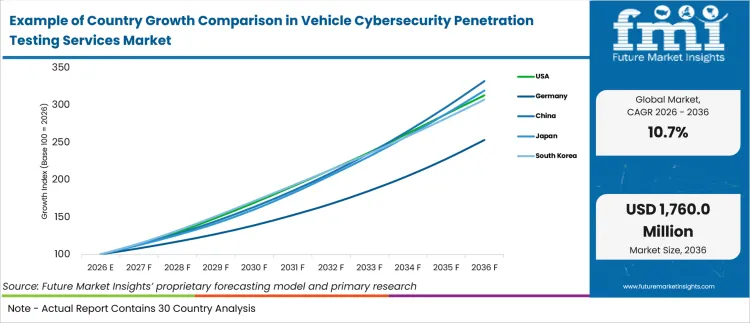
The country comparison spans 5.3 percentage points and reflects different stages of regulatory implementation across national vehicle programs. China and South Korea form the higher-growth cluster as formal cybersecurity requirements enter routine approval work. India follows through expanding specialist training and validation capacity across major automotive engineering centers and national laboratories. The United States and Japan show steadier growth through mature engineering networks and defined connected-vehicle controls. Germany remains at the mature end as established technical services already handle regulated cybersecurity evidence.
- A 1.0-point gap separates China and South Korea as both markets convert national cybersecurity rules into routine approval work.
- India remains 1.1 points below South Korea as specialist training expands faster than access to production-representative vehicles.
- Another 1.1-point gap separates India and the United States as mature laboratories encounter stricter proprietary-access controls.
- Japan sits 1.0 point below the United States through precise evidence reviews and manufacturer-controlled diagnostic environments.
- Germany remains 1.1 points below Japan as established technical services absorb demand within a mature approval system.
Comparable growth rates create different engagement models through variations in laboratory access and approval responsibility across national vehicle programs. Providers need local regulatory knowledge and practical hardware access to convert each forecast into repeat project activity. The full report covers North America and Latin America together with Europe, East Asia and South Asia and Pacific alongside the Middle East and Africa.
Country-wise Analysis
- China applies GB 44495-2024 across connected vehicle development and formal approval documentation for domestic model programs. China's national standards platform published Amendment No. 1 for GB 44495-2024 in January 2026 through its official database. China's market for vehicle cybersecurity penetration testing services is estimated to post 14.4% CAGR over the forecast period, supported by domestic engineering scale and mandatory national standards. The amendment gives laboratories a current reference for complete-vehicle and component security assessments across regulated domestic model programs. Large vehicle manufacturers create repeat assignments through established engineering teams and domestic laboratories serving related vehicle platforms. Chinese-language evidence requirements and protected interfaces can restrict foreign delivery without dependable local engineering and testing partners.
- South Korea requires cybersecurity evidence to follow current vehicle-management procedures and official notices across domestic approval programs. South Korea's vehicle cybersecurity penetration testing services outlook is anticipated to advance at 13.4% CAGR over the assessment period, reinforced by concentrated vehicle engineering and current national procedures. The transport ministry revised the procedures in January 2026 following their initial publication in November 2025. The revised notice gives laboratories a clearer basis for scope planning and evidence review across domestic approval programs. Concentrated technology clusters improve access to development teams and test vehicles near major automotive sites. Foreign providers face Korean-language documentation and restricted production data during compressed launch schedules and final evidence reviews.
- India combines fast vehicle software development with growing demand for local interpretation of AIS 189 and AIS 190. The Automotive Research Association of India offered a dedicated automotive cybersecurity certificate program in September 2025. The program covered threat analysis and both national standards for engineers responsible for vehicle development and validation. Vehicle cybersecurity penetration testing services revenue in India is forecast to expand at 12.3% CAGR by 2036, aided by standards training and expanding automotive validation skills. Local training improves scope discussions between laboratories and vehicle manufacturers during initial planning and final evidence review. Price sensitivity and uneven access to production-representative vehicles remain material barriers outside major automotive engineering clusters.
- United States vehicle programs use mature proving grounds within a complex connected-vehicle supply chain governed by federal controls. Adoption of vehicle cybersecurity penetration testing services in the United States is estimated to expand at 11.2% CAGR through 2036, driven by connected-system risk and established specialist laboratory capacity. CISA disclosed an authentication-bypass vulnerability affecting ZF RSSPlus in January 2025 through its industrial control advisory program. The advisory gives laboratories a practical attack case for comparable diagnostic interfaces across commercial vehicle platforms. Nationwide engineering capacity supports specialist testing across passenger and commercial vehicle classes during several development stages. Confidentiality restrictions and delayed proprietary ECU access can impede complete-vehicle assessments near scheduled launches and final approval reviews.
- Japan applies precise approval controls to connected software functions across domestic vehicle programs and national launch procedures. The transport ministry announced in January 2025 that cybersecurity requirements would extend to motorcycles and three-wheelers from July 2029 for new types. Vehicle cybersecurity penetration testing services demand in Japan is forecast to rise at 10.2% CAGR over the forecast period, influenced by precise approval documentation and established domestic engineering. The expansion gives laboratories a wider regulated vehicle base for testing across several mobility categories. Strong domestic manufacturing supports repeat assignments through reliable vehicle access and established manufacturer relationships across model programs. Foreign teams face Japanese-language evidence reviews and restricted access to manufacturer diagnostic environments during compressed project schedules.
- Germany relies on formal European type-approval procedures and dense technical-service networks for connected vehicles and national launch programs. TÜV SÜD reported in September 2025 that it was ready to perform homologation of autonomous vehicles, combining independent testing with cybersecurity expertise. The project demonstrates direct local capability across real-vehicle validation and approval evidence inside German vehicle programs. Germany's vehicle cybersecurity penetration testing services sector is projected to record 9.1% CAGR during the assessment period, underpinned by mature technical services and sustained software validation requirements. Established automotive clusters support component assessments near vehicle manufacturers through technical-service networks and regional test facilities. High documentation expectations and limited test-vehicle availability can lengthen corrective-action cycles for providers without local laboratory partnerships.
Who are the notable companies in the Vehicle Cybersecurity Penetration Testing Services Market?
UL Solutions, DEKRA, TÜV SÜD, NCC Group, PlaxidityX, SGS, AVL, and HORIBA MIRA are the notable companies profiled in this market.
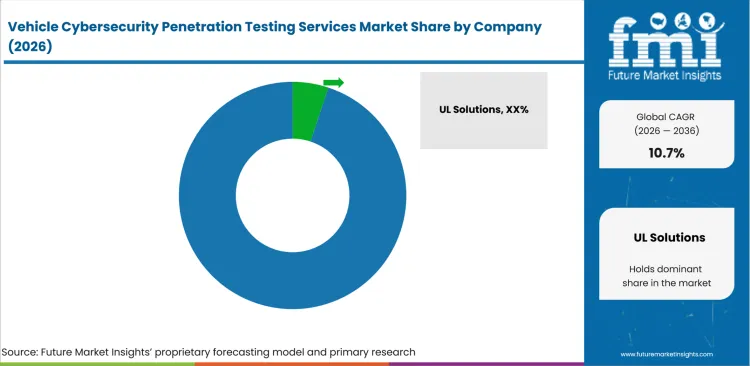
Competition separates dedicated attack teams from testing groups that combine penetration work with certification and vehicle engineering. NCC Group reported in February 2026 that its 2025 research covered automotive exploitation and cyber-physical risk across transport systems. The report supports a clear distinction between general cyber consulting and testing that reproduces vehicle-level consequences. Cybersecurity homologation increases the value of evidence that technical services can review during approval and later update reviews. Providers therefore compete through vehicle access and attack depth together with retesting speed across launch regions.
- UL Solutions and DEKRA combine automotive cybersecurity assessment with broader testing and certification networks across several launch regions. TÜV SÜD and SGS add structured regulatory evidence services that support vehicle programs across international approval routes. Vehicle program directors need proof that a proposed laboratory can access representative hardware and apply named attack methods inside each launch region.
- NCC Group and PlaxidityX provide specialist attack research across software and embedded systems within complete vehicle programs. Their value increases during investigations that require custom attack chains and direct communication with responsible engineers. Automotive security teams should confirm that assigned specialists can reproduce findings and complete scheduled retesting without transferring protected hardware between countries.
- AVL and HORIBA MIRA connect cybersecurity work with broader vehicle engineering and validation programs across several development stages. Their approach suits development teams that need security findings linked with system behavior and integration results. Commercial evaluation should separate direct penetration-testing depth from adjacent engineering services inside each proposed work package.
Competitive Benchmarking: Vehicle Cybersecurity Penetration Testing Services Market
| Company | Penetration Testing Depth | Regulatory Evidence Support | Vehicle and Component Coverage | Geographic Reach |
|---|---|---|---|---|
| UL Solutions | High | High | Medium | Global |
| DEKRA | High | High | High | Global |
| TÜV SÜD | Medium | High | Medium | Global |
| NCC Group | High | Medium | Medium | Global |
| PlaxidityX | High | Medium | High | Global |
| SGS | Medium | High | Medium | Global |
| AVL | Medium | Medium | High | Global |
| HORIBA MIRA | Medium | Medium | High | United Kingdom |
Key Developments in the Vehicle Cybersecurity Penetration Testing Services Market
- In May 2025, DEKRA opened its USA Automotive Test Center of Excellence in Michigan with vehicle cybersecurity testing and certification capabilities. The facility supports penetration testing and evidence work under ISO/SAE 21434 and UN Regulations 155 and 156. North American vehicle programs gain local access to complete-vehicle assessment and regulatory support during regional launch programs. The site reduces dependence on overseas laboratories during compressed development schedules for vehicle and component programs.
- In August 2025, UL Solutions became the first company from the testing and certification sector to join the Eclipse Foundation Software Defined Vehicle Working Group. The membership places independent assurance experience inside an open-source community developing shared vehicle architectures and related tools. UL Solutions can observe emerging software frameworks earlier and adapt relevant test methods for automotive software programs. Vehicle manufacturers gain assurance input during platform design rather than near final release and related validation planning.
- In March 2025, PlaxidityX partnered with Deloitte Spain to deliver managed automotive cybersecurity services across vehicle lifecycles. The arrangement combines cyber operations with regulatory guidance for vehicle manufacturers and mobility companies across lifecycle programs. Clients can connect ongoing threat management with penetration testing and compliance work through one engagement. The partnership strengthens local delivery for European programs that require coordinated technical evidence across development and field operation.
- In February 2025, TÜV Italia received accreditation for cybersecurity certification under IEC 62443 and ISO/SAE 21434 for industrial automation and vehicle development processes. The accreditation gives TÜV SÜD another recognized route for assessing cybersecurity processes across vehicle development lifecycles. Manufacturers can combine technical testing with structured assessment support inside one laboratory network across several launch regions. The added capability improves evidence consistency for vehicle programs entering several regulated markets and development cycles.
Key Players in the Vehicle Cybersecurity Penetration Testing Services Market
Testing and Certification Providers
- UL Solutions
- DEKRA
- TÜV SÜD
- SGS
Cybersecurity Specialists
- NCC Group
- PlaxidityX
Engineering and Validation Providers
- AVL
- HORIBA MIRA
Vehicle Cybersecurity Penetration Testing Services Market - Report Scope
| Coverage field | Report scope |
|---|---|
| Market breakdown | Component type, vehicle type, propulsion, sales channel, and region. |
| Quantitative Units | USD Million, CAGR in %. |
| Market Definition | Revenue from independent and contracted penetration testing for vehicle software, components, connected interfaces, and complete vehicle systems. |
| Regions Covered | North America, Latin America, Western Europe, Eastern Europe, East Asia, South Asia and Pacific, and Middle East and Africa. |
| Countries Covered | United States, Germany, China, Japan, South Korea, India, and 30+ countries. |
| Key Companies Profiled | UL Solutions, DEKRA, TÜV SÜD, NCC Group, PlaxidityX, SGS, AVL, and HORIBA MIRA. |
| Forecast Period | 2026 to 2036. |
| Approach | Hybrid bottom-up and top-down market sizing supported by primary interviews and official desk research. |
Vehicle Cybersecurity Penetration Testing Services Market - Research Methodology
| Method | Approach |
|---|---|
| Primary Research | FMI analysts gathered input from manufacturers, service providers, technology developers, distributors, end users, procurement teams, and subject-matter experts. Interviews examined purchasing decisions, product or service evaluation, adoption barriers, approval requirements, pricing considerations, and expectations for technical or commercial support. Respondents were also asked what evidence is required before a trial, pilot, or initial order develops into regular purchasing. |
| Desk Research | Desk research covered government statistics, regulatory publications, trade data, industry associations, technical literature, standards, company filings, product information, and official corporate announcements. Sources were reviewed for relevance, publication date, geographic coverage, and consistency with the defined market scope. Claims relating to performance, applications, approvals, capacity, investment, and commercial activity were retained only when supported by credible public evidence. |
| Market Sizing and Forecasting | The market model combined the baseline value with historical performance, segment structure, pricing and volume indicators, adoption levels, company participation, and country-level demand conditions. Forecast assumptions considered economic activity, investment trends, regulatory developments, technology adoption, purchasing cycles, supply availability, and barriers to wider market use. Segment and regional estimates were reconciled before the final market total was calculated. |
| Data Validation | Estimates were checked against multiple independent indicators, including public data, company activity, trade patterns, industry developments, and findings from primary interviews. Validation also tested whether products, services, applications, and company revenues fell within the defined market boundaries. Adjacent categories, unsupported claims, overlapping revenues, and activities without direct market relevance were excluded to reduce double counting and maintain consistency across segments and countries. |
Vehicle Cybersecurity Penetration Testing Services Market by Segments
Vehicle Cybersecurity Penetration Testing Services Market segmented by Component Type:
- Sensor
- Module
- Connector
- Software
- Thermal System
Vehicle Cybersecurity Penetration Testing Services Market segmented by Vehicle Type:
- Passenger Car
- Light Commercial Vehicle
- Heavy Truck
- Two Wheeler
- Bus
Vehicle Cybersecurity Penetration Testing Services Market segmented by Propulsion:
- Battery Electric
- Plug-in Hybrid
- Fuel Cell
- Hybrid
- ICE Retrofit
Vehicle Cybersecurity Penetration Testing Services Market segmented by Sales Channel:
- OEM
- Aftermarket
- Fleet Operators
- Distributors
- Direct Sales
Vehicle Cybersecurity Penetration Testing Services Market by Region:
- North America
- United States
- Canada
- Mexico
- Latin America
- Brazil
- Chile
- Rest of Latin America
- Western Europe
- Germany
- UK
- Italy
- Spain
- France
- Nordic
- BENELUX
- Rest of Western Europe
- Eastern Europe
- Russia
- Poland
- Hungary
- Balkan and Baltic
- Rest of Eastern Europe
- East Asia
- China
- Japan
- South Korea
- South Asia and Pacific
- India
- ASEAN
- Australia and New Zealand
- Rest of South Asia and Pacific
- Middle East and Africa
- Kingdom of Saudi Arabia
- Other GCC Countries
- Turkiye
- South Africa
- Other African Union
- Rest of Middle East and Africa
Research Sources and Bibliography
- National Highway Traffic Safety Administration. (2025, September 23). Auto-ISAC Cybersecurity Summit Keynote.
- European Commission. (2025, October 29). Commission Delegated Regulation (EU) 2025/1455 of 23 July 2025 amending Delegated Regulation (EU) No 44/2014 as regards laying down technical requirements and testing procedures regarding the protection of L-category vehicles against cyberattacks.
- PlaxidityX. (2025, June 26). GlobalLogic and PlaxidityX Partner to Secure and Streamline the Development Cycle for Software-Defined Vehicles (SDVs).
- Bureau of Industry and Security. (2025, January 14). Commerce Finalizes Rule to Secure Connected Vehicle Supply Chains from Foreign Adversary Threats.
- USA Department of Energy. (2025, January 13). Vehicle Grid Integration Assessment Report.
- PlaxidityX. (2025, May 21). TIER IV Selects PlaxidityX to Provide Cyber Security Expertise for The Japanese Airport Autonomous Bus Project.
- European Union. (2025, January 10). UN Regulation No. 155 - Uniform provisions concerning the approval of vehicles with regards to cyber security and cyber security management system [2025/5].
- Ministry of Land, Infrastructure, Transport and Tourism. (2025, June 12).
- DEKRA. (2025, December 4). DEKRA Expands USA Testing Capabilities for CCC Digital Key™ Certification.
- Standardization Administration of China. (2026, January 28).
- Ministry of Land, Infrastructure and Transport. (2026, January 16).
- Automotive Research Association of India. (2025, September 12). 1-DAY CERTIFICATE PROGRAMME ON AUTOMOTIVE CYBERSECURITY - OVERVIEW.
- Cybersecurity and Infrastructure Security Agency. (2025, January 21). ZF Roll Stability Support Plus (RSSPlus).
- Ministry of Land, Infrastructure, Transport and Tourism. (2025, January 10).
- TÜV SÜD. (2025, September 2). We are ready to perform homologation of autonomous vehicles.
- NCC Group. (2026, February 26). NCC Group publishes its Annual Cyber Security Research Report 2025 highlighting breakthroughs across AI security, cryptography and cyber-physical risk.
- DEKRA. (2025, May 23). DEKRA Opens USA Automotive Test Center of Excellence in Michigan to Advance Future Mobility.
- UL Solutions. (2025, August 7). UL Solutions Becomes First Testing, Inspection and Certification Company to Join Eclipse Foundation’s Software Defined Vehicle Working Group.
- PlaxidityX. (2025, March 18). Deloitte Spain and PlaxidityX Join Forces to Deliver Transformative Automotive Cyber Security Solutions.
- TÜV SÜD. (2025, February 17). TÜV Italia receives accreditation for cybersecurity according to IEC 62443 and ISO/SAE 21434.
- UL Solutions. (2020, October 27). UL Introduces New Automotive Cybersecurity Safety Services in Japan.
- SGS. (2024, August 19). Unveiling the Value and Impact of Penetration Testing in Strengthening Business Security.
- SGS. (2025, October 16). Steering Clear of Automotive Industry Cyber Threats.
- AVL. (2023, March). AVL and AIT Cooperate: Highly Automated Automotive Cyber Security Software for Threat Analysis and Risk Assessment.
- HORIBA MIRA. (2026, February 25). 25th February 2026 - Finding a Career that Makes a Difference: Ross Booth's Second Career Journey at MIRA Tech Park.
- HORIBA MIRA. (2015, September 7). Hackers after your car? Tackling automotive cyber security.
This bibliography is provided for reader reference and is not exhaustive. The full report contains the complete reference list and detailed citations.
This Report Answers
- How large is the vehicle cybersecurity penetration testing services market in 2026 and 2036?
- Which regulatory and software pressures support recurring penetration testing demand?
- Why does software account for 42.0% of component type demand in 2026?
- How do passenger-car and battery-electric programs shape security testing requirements?
- Why does OEM account for 51.0% of sales channel demand in 2026?
- How do country growth rates differ across China, South Korea, India, the United States, Japan, and Germany?
- Which companies provide automotive penetration testing and integrated vehicle assurance?
- What limits testing speed across protected interfaces and national approval routes?
- How should manufacturers compare testing depth and regulatory evidence support?
Frequently Asked Questions
What is driving growth in the vehicle cybersecurity penetration testing services market?
Connected functions expose new attack paths across software and external services during every scheduled release. Formal approval evidence turns vulnerability assessment into recurring work for launches and later production vehicle updates and reviews.
Who are the key players in the vehicle cybersecurity penetration testing services market?
UL Solutions and DEKRA combine vehicle testing with certification across international laboratory networks serving several launch regions. NCC Group and PlaxidityX provide specialist attack methods, whereas TÜV SÜD and SGS support structured regulatory evidence across vehicle programs.
What is a notable restraint in the vehicle cybersecurity penetration testing services market?
Protected interfaces can prevent independent laboratories from reaching production-representative diagnostic functions during scheduled vehicle assessments. Fragmented evidence routes then extend test planning and corrective-action review across regional vehicle configurations and approval programs.
Why should executives track the vehicle cybersecurity penetration testing services market?
A missed vulnerability can delay vehicle approval and raise corrective-action costs across related models and software versions. Independent testing gives executives documented evidence for release decisions and formal acceptance of remaining operational risk.
What business problem does the vehicle cybersecurity penetration testing services market address?
Connected vehicle programs need proof that exposed interfaces resist realistic attacks across software and electronic components. Penetration testing identifies exploitable paths and confirms corrective actions ahead of deployment or a production software release.
What should automotive engineering teams evaluate in the vehicle cybersecurity penetration testing services market?
Engineering teams should compare attack depth and hardware access across every intended vehicle launch country. They should confirm assigned specialists and retesting capacity during approval of the final testing scope and delivery schedule.
What limits return on investment in the vehicle cybersecurity penetration testing services market?
Incomplete scopes can miss backend services or shared interfaces across the complete vehicle architecture during validation. Unclear corrective-action ownership then extends testing cycles without improving approval confidence or reducing later software risk.
What supports long-term confidence in the vehicle cybersecurity penetration testing services market?
Repeatable methods and traceable findings support confidence across software releases and related vehicle variants worldwide. Recognized regulatory expertise helps manufacturers reuse evidence during approval reviews and later vehicle update assessments.
Preview the report firsthand - request a free sample
Get SampleGet the brochure for pricing and purchase details.
Get PDFTable of Content
- Key Takeaways
- Market Size and CAGR
- Top Growth Driver
- Fastest Growing Segment
- Leading Region
- Key Companies
- Emerging Opportunities
- Executive Summary
- Global Market Outlook
- Demand-side Trends
- Supply-side Trends
- Technology Roadmap Analysis
- Analysis and Recommendations
- Analyst Perspective (What is happening? Why now? What should investors know?)
- Key Questions Answered
- How large is the market?
- What is the CAGR?
- What are key trends?
- Which region dominates?
- Who are the leaders?
- Market Overview
- Market Coverage / Taxonomy
- Market Definition / Scope / Limitations
- Research Methodology
- Chapter Orientation
- Analytical Lens and Working Hypotheses
- Market Structure, Signals, and Trend Drivers
- Benchmarking and Cross-market Comparability
- Market Sizing, Forecasting, and Opportunity Mapping
- Research Design and Evidence Framework
- Desk Research Programme (Secondary Evidence)
- Expert Input and Fieldwork (Primary Evidence)
- Tooling, Models, and Reference Databases
- Data Engineering and Model Build
- Quality Assurance and Audit Trail
- Market Background
- Market Dynamics (Drivers, Restraints, Opportunity, Trends)
- Scenario Forecast (Optimistic, Likely, Conservative)
- Impact Analysis
- AI Impact
- Sustainability Impact
- Regulatory Impact
- Technology Impact
- Consumer / Buyer Analysis
- Purchase Drivers
- Adoption Barriers
- Buyer Journey
- Opportunity Map Analysis
- Product Life Cycle Analysis
- Supply Chain Analysis
- Investment Feasibility Matrix
- Value Chain Analysis
- PESTLE and Porter's Analysis
- Regulatory Landscape
- Regional Parent Market Outlook
- Production and Consumption Statistics
- Import and Export Statistics
- Global Market Analysis and Forecast, 2021 to 2036
- Historical Market Size Value (USD Million) Analysis, 2021 to 2025
- Current and Future Market Size Value (USD Million) Projections, 2026 to 2036
- Y-o-Y Growth Trend Analysis
- Absolute $ Opportunity Analysis
- Global Market Pricing Analysis, 2021 to 2036
- Global Market Analysis and Forecast, By Component Type, 2021 to 2036
- Introduction / Key Findings
- Historical Market Size Value (USD Million) Analysis By Component Type, 2021 to 2025
- Current and Future Market Size Value (USD Million) Analysis and Forecast By Component Type, 2026 to 2036
- Software
- Module
- Connector
- Sensor
- Thermal System
- Software
- Y-o-Y Growth Trend Analysis By Component Type, 2021 to 2025
- Absolute $ Opportunity Analysis By Component Type, 2026 to 2036
- Global Market Analysis and Forecast, By Vehicle Type, 2021 to 2036
- Introduction / Key Findings
- Historical Market Size Value (USD Million) Analysis By Vehicle Type, 2021 to 2025
- Current and Future Market Size Value (USD Million) Analysis and Forecast By Vehicle Type, 2026 to 2036
- Passenger Car
- Light Commercial Vehicle
- Heavy Truck
- Two Wheeler
- Bus
- Passenger Car
- Y-o-Y Growth Trend Analysis By Vehicle Type, 2021 to 2025
- Absolute $ Opportunity Analysis By Vehicle Type, 2026 to 2036
- Global Market Analysis and Forecast, By Propulsion, 2021 to 2036
- Introduction / Key Findings
- Historical Market Size Value (USD Million) Analysis By Propulsion, 2021 to 2025
- Current and Future Market Size Value (USD Million) Analysis and Forecast By Propulsion, 2026 to 2036
- Battery Electric
- Plug-In Hybrid
- Fuel Cell
- Hybrid
- Ice Retrofit
- Battery Electric
- Y-o-Y Growth Trend Analysis By Propulsion, 2021 to 2025
- Absolute $ Opportunity Analysis By Propulsion, 2026 to 2036
- Global Market Analysis and Forecast, By Sales Channel, 2021 to 2036
- Introduction / Key Findings
- Historical Market Size Value (USD Million) Analysis By Sales Channel, 2021 to 2025
- Current and Future Market Size Value (USD Million) Analysis and Forecast By Sales Channel, 2026 to 2036
- Oem
- Tier 1
- Aftermarket
- Fleet Retrofit
- Charging Network
- Oem
- Y-o-Y Growth Trend Analysis By Sales Channel, 2021 to 2025
- Absolute $ Opportunity Analysis By Sales Channel, 2026 to 2036
- Global Market Analysis and Forecast, By Region, 2021 to 2036
- Introduction
- Historical Market Size Value (USD Million) Analysis By Region, 2021 to 2025
- Current Market Size Value (USD Million) Analysis and Forecast By Region, 2026 to 2036
- North America
- Latin America
- Western Europe
- Eastern Europe
- East Asia
- South Asia and Pacific
- Middle East & Africa
- Market Attractiveness Analysis By Region
- North America Market Analysis and Forecast, By Country, 2021 to 2036
- Historical Market Size Value (USD Million) Trend Analysis By Market Taxonomy, 2021 to 2025
- Market Size Value (USD Million) Forecast By Market Taxonomy, 2026 to 2036
- By Country
- USA
- Canada
- By Component Type
- By Vehicle Type
- By Propulsion
- By Sales Channel
- By Country
- Market Attractiveness Analysis
- By Country
- By Component Type
- By Vehicle Type
- By Propulsion
- By Sales Channel
- Key Takeaways
- Latin America Market Analysis and Forecast, By Country
- Historical Market Size Value (USD Million) Trend Analysis By Market Taxonomy, 2021 to 2025
- Market Size Value (USD Million) Forecast By Market Taxonomy, 2026 to 2036
- By Country
- Brazil
- Mexico
- Chile
- Rest of Latin America
- By Component Type
- By Vehicle Type
- By Propulsion
- By Sales Channel
- By Country
- Market Attractiveness Analysis
- By Country
- By Component Type
- By Vehicle Type
- By Propulsion
- By Sales Channel
- Key Takeaways
- Western Europe Market Analysis and Forecast, By Country
- Historical Market Size Value (USD Million) Trend Analysis By Market Taxonomy, 2021 to 2025
- Market Size Value (USD Million) Forecast By Market Taxonomy, 2026 to 2036
- By Country
- Germany
- UK
- Italy
- Spain
- France
- Nordic
- BENELUX
- Rest of Western Europe
- By Component Type
- By Vehicle Type
- By Propulsion
- By Sales Channel
- By Country
- Market Attractiveness Analysis
- By Country
- By Component Type
- By Vehicle Type
- By Propulsion
- By Sales Channel
- Key Takeaways
- Eastern Europe Market Analysis and Forecast, By Country
- Historical Market Size Value (USD Million) Trend Analysis By Market Taxonomy, 2021 to 2025
- Market Size Value (USD Million) Forecast By Market Taxonomy, 2026 to 2036
- By Country
- Russia
- Poland
- Hungary
- Balkan & Baltic
- Rest of Eastern Europe
- By Component Type
- By Vehicle Type
- By Propulsion
- By Sales Channel
- By Country
- Market Attractiveness Analysis
- By Country
- By Component Type
- By Vehicle Type
- By Propulsion
- By Sales Channel
- Key Takeaways
- East Asia Market Analysis and Forecast, By Country
- Historical Market Size Value (USD Million) Trend Analysis By Market Taxonomy, 2021 to 2025
- Market Size Value (USD Million) Forecast By Market Taxonomy, 2026 to 2036
- By Country
- China
- Japan
- South Korea
- By Component Type
- By Vehicle Type
- By Propulsion
- By Sales Channel
- By Country
- Market Attractiveness Analysis
- By Country
- By Component Type
- By Vehicle Type
- By Propulsion
- By Sales Channel
- Key Takeaways
- South Asia and Pacific Market Analysis and Forecast, By Country
- Historical Market Size Value (USD Million) Trend Analysis By Market Taxonomy, 2021 to 2025
- Market Size Value (USD Million) Forecast By Market Taxonomy, 2026 to 2036
- By Country
- India
- ASEAN
- Australia & New Zealand
- Rest of South Asia and Pacific
- By Component Type
- By Vehicle Type
- By Propulsion
- By Sales Channel
- By Country
- Market Attractiveness Analysis
- By Country
- By Component Type
- By Vehicle Type
- By Propulsion
- By Sales Channel
- Key Takeaways
- Middle East & Africa Market Analysis and Forecast, By Country
- Historical Market Size Value (USD Million) Trend Analysis By Market Taxonomy, 2021 to 2025
- Market Size Value (USD Million) Forecast By Market Taxonomy, 2026 to 2036
- By Country
- Kingdom of Saudi Arabia
- Other GCC Countries
- Türkiye
- South Africa
- Other African Union
- Rest of Middle East & Africa
- By Component Type
- By Vehicle Type
- By Propulsion
- By Sales Channel
- By Country
- Market Attractiveness Analysis
- By Country
- By Component Type
- By Vehicle Type
- By Propulsion
- By Sales Channel
- Key Takeaways
- Key Countries Market Analysis
- USA
- Pricing Analysis
- Market Share Analysis, 2025
- By Component Type
- By Vehicle Type
- By Propulsion
- By Sales Channel
- Canada
- Pricing Analysis
- Market Share Analysis, 2025
- By Component Type
- By Vehicle Type
- By Propulsion
- By Sales Channel
- Mexico
- Pricing Analysis
- Market Share Analysis, 2025
- By Component Type
- By Vehicle Type
- By Propulsion
- By Sales Channel
- Brazil
- Pricing Analysis
- Market Share Analysis, 2025
- By Component Type
- By Vehicle Type
- By Propulsion
- By Sales Channel
- Chile
- Pricing Analysis
- Market Share Analysis, 2025
- By Component Type
- By Vehicle Type
- By Propulsion
- By Sales Channel
- Germany
- Pricing Analysis
- Market Share Analysis, 2025
- By Component Type
- By Vehicle Type
- By Propulsion
- By Sales Channel
- UK
- Pricing Analysis
- Market Share Analysis, 2025
- By Component Type
- By Vehicle Type
- By Propulsion
- By Sales Channel
- Italy
- Pricing Analysis
- Market Share Analysis, 2025
- By Component Type
- By Vehicle Type
- By Propulsion
- By Sales Channel
- Spain
- Pricing Analysis
- Market Share Analysis, 2025
- By Component Type
- By Vehicle Type
- By Propulsion
- By Sales Channel
- France
- Pricing Analysis
- Market Share Analysis, 2025
- By Component Type
- By Vehicle Type
- By Propulsion
- By Sales Channel
- India
- Pricing Analysis
- Market Share Analysis, 2025
- By Component Type
- By Vehicle Type
- By Propulsion
- By Sales Channel
- ASEAN
- Pricing Analysis
- Market Share Analysis, 2025
- By Component Type
- By Vehicle Type
- By Propulsion
- By Sales Channel
- Australia & New Zealand
- Pricing Analysis
- Market Share Analysis, 2025
- By Component Type
- By Vehicle Type
- By Propulsion
- By Sales Channel
- China
- Pricing Analysis
- Market Share Analysis, 2025
- By Component Type
- By Vehicle Type
- By Propulsion
- By Sales Channel
- Japan
- Pricing Analysis
- Market Share Analysis, 2025
- By Component Type
- By Vehicle Type
- By Propulsion
- By Sales Channel
- South Korea
- Pricing Analysis
- Market Share Analysis, 2025
- By Component Type
- By Vehicle Type
- By Propulsion
- By Sales Channel
- Russia
- Pricing Analysis
- Market Share Analysis, 2025
- By Component Type
- By Vehicle Type
- By Propulsion
- By Sales Channel
- Poland
- Pricing Analysis
- Market Share Analysis, 2025
- By Component Type
- By Vehicle Type
- By Propulsion
- By Sales Channel
- Hungary
- Pricing Analysis
- Market Share Analysis, 2025
- By Component Type
- By Vehicle Type
- By Propulsion
- By Sales Channel
- Kingdom of Saudi Arabia
- Pricing Analysis
- Market Share Analysis, 2025
- By Component Type
- By Vehicle Type
- By Propulsion
- By Sales Channel
- Türkiye
- Pricing Analysis
- Market Share Analysis, 2025
- By Component Type
- By Vehicle Type
- By Propulsion
- By Sales Channel
- South Africa
- Pricing Analysis
- Market Share Analysis, 2025
- By Component Type
- By Vehicle Type
- By Propulsion
- By Sales Channel
- USA
- Market Structure Analysis
- Competition Dashboard
- Competition Benchmarking
- Market Share Analysis of Top Players
- By Regional
- By Component Type
- By Vehicle Type
- By Propulsion
- By Sales Channel
- Emerging Startups
- Innovation Benchmarking
- Competition Analysis
- Competition Deep Dive
- UL Solutions
- Overview
- Product Portfolio
- Profitability by Market Segments
- Sales Footprint
- Strategy Overview
- Marketing Strategy
- Product Strategy
- Channel Strategy
- DEKRA
- TUV SUD
- NCC Group
- PlaxidityX
- Argus Cyber Security
- Upstream Security
- Synopsys
- UL Solutions
- Case Studies
- Success Stories
- Recent Developments
- Competition Deep Dive
- Assumptions & Acronyms Used


