

- Industry Size (2026)
- USD 335 Mn
- Forecast (2036)
- USD 785.8 Mn
- CAGR (2026 to 2036)
- 8.9%
In-Season Foliar Nitrogen Fine-Tuning Blend Market Forecast and Outlook 2026 to 2036
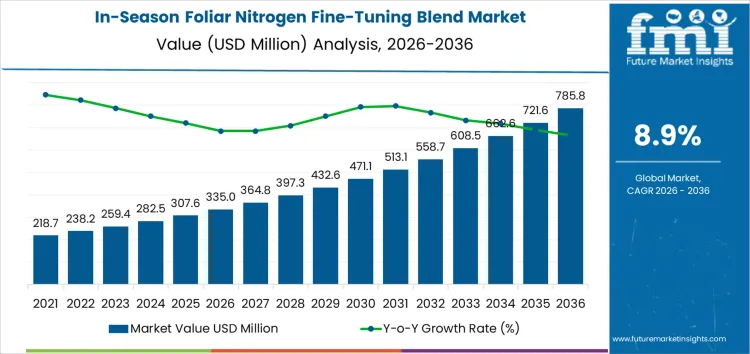
The in-season foliar nitrogen fine-tuning blend market is valued at USD 335 million in 2026 and is projected to reach USD 785.8 million by 2036, reflecting a CAGR of 8.9%. Growth during this period is shaped by mid-cycle crop assessment practices, responsiveness of foliar uptake, and timing precision rather than total nitrogen volume applied. Cost structures are influenced by formulation solubility, leaf absorption efficiency, and compatibility with existing spray programs. Blends are evaluated on rapid availability and minimal leaf stress. Suppliers offering predictable uptake under variable weather conditions retain stronger acceptance. Purchasing decisions emphasize correction reliability during critical growth stages.
Between 2026 and 2036, outcomes are driven by grower risk management and adaptive nutrient strategies. Foliar applications are used to address variability detected after planting, increasing dependence on performance consistency. Once integrated into crop management routines, switching remains limited due to learning curves and response timing risk. Sales channels providing agronomic interpretation and application guidance reinforce repeat use. Entry barriers persist through field validation and crop-specific performance data. Strategic trade offs arise between concentration strength and application safety. Competitive positioning favors suppliers aligned with in-season decision frameworks rather than pre-season bulk nutrient programs.
Quick Stats for In-Season Foliar Nitrogen Fine-Tuning Blend Market
- In-Season Foliar Nitrogen Fine-Tuning Blend Market Value (2026): USD 335 million
- In-Season Foliar Nitrogen Fine-Tuning Blend Market Forecast Value (2036): USD 785.8 million
- In-Season Foliar Nitrogen Fine-Tuning Blend Market Forecast CAGR (2026-2036): 8.9%
- Leading Application Type in In-Season Foliar Nitrogen Fine-Tuning Blend Market: Standard programs
- Key Growth Countries in In-Season Foliar Nitrogen Fine-Tuning Blend Market: India, China, United States, Germany
- Top Players in In-Season Foliar Nitrogen Fine-Tuning Blend Market: Yara International, ICL Group, Nutrien, Haifa Group, EuroChem, UPL
What Is the Growth Forecast for in Season Foliar Nitrogen Fine Tuning Blend Market through 2036?
Canopy level nutrient responsiveness and mid cycle yield optimization define the early growth phase of the in season foliar nitrogen fine tuning blend market between 2026 and 2031. During this period, the market expands from USD 335 million to USD 473 million, adding USD 138 million in value. Annual progression from USD 224 million to USD 335 million reflects increasing use of foliar applications to correct nitrogen variability after planting. Historical growth was constrained by uncertainty around uptake efficiency and timing sensitivity. Forward expansion in this phase is supported by improved formulation stability, better leaf absorption performance, and wider adoption by growers managing variable field conditions and split nitrogen programs.
Decision support integration and acreage expansion drive growth from 2031 to 2036. Over this period, the market increases from USD 473 million to USD 785.8 million, adding USD 312.8 million and representing the stronger expansion window. Annual values rise from USD 514 million to USD 785.8 million, indicating accelerating year over year momentum. Earlier demand focused on corrective use in high value crops, while future growth reflects broader incorporation into standard nutrient management plans. Greater reliance on tissue testing, tighter yield targets, and consistent performance under variable weather conditions support sustained expansion as foliar nitrogen fine tuning blends become routine tools in in season crop nutrition strategies.
In Season Foliar Nitrogen Fine Tuning Blend Market Key Takeaways
| Metric | Value |
|---|---|
| Market Value (2026) | USD 335 million |
| Forecast Value (2036) | USD 785.8 million |
| Forecast CAGR (2026-2036) | 8.9% |
What Is Driving Demand in the In-Season Foliar Nitrogen Fine-Tuning Blend Market?
Demand for in-season foliar nitrogen fine-tuning blends stems from operational needs to adjust nutrient status during critical crop growth periods rather than from baseline fertilization volumes alone. Traditional soil-applied nitrogen can be slow to correct deficiencies once crops begin rapid vegetative growth, especially under conditions that limit root uptake such as cool soils, moisture extremes, or soil compaction. Growers observed that visual deficiency symptoms and yield variability persisted even when overall nitrogen budgets were met, prompting use of foliar blends that deliver nitrogen directly to leaves for rapid assimilation. Early adoption occurred in high-value commodities like vegetables, fruiting crops, and seed crops where timing of nitrogen availability had measurable effects on flowering, canopy development, and yield consistency rather than general nutrient application.
Future growth in this market will be shaped by integration with crop monitoring data, agronomic response models, and objective performance metrics rather than incremental nutrient composition changes alone. Advances in remote sensing, tissue testing, and decision support tools allow growers to identify nutrient stress windows and apply fine-tuning blends at precise growth stages. Foliar nitrogen blends designed for in-season adjustment align with this data driven approach, enabling corrective nutrient delivery without altering soil chemistry. Demand will expand where growers evaluate nitrogen programs on responsiveness, yield impact, and operational efficiency rather than on total seasonal rates. As agronomy advisors and nutrient management frameworks prioritise documented in-season adjustments linked to crop performance outcomes, foliar fine-tuning blends will become integrated tools rather than ad-hoc supplements.
What Factors Are Affecting the Demand for in Season Foliar Nitrogen Fine Tuning Blend Market in Terms of Application and Form?
The in season foliar nitrogen fine tuning blend market is shaped by yield optimization strategies, variable crop nitrogen demand, and tighter margins on fertilizer inputs. Demand centers on corrective nitrogen applications applied during active growth stages to address shortfalls without overapplication. Adoption depends on timing flexibility, crop responsiveness, and compatibility with existing spray programs. Market leadership reflects ease of integration into routine field operations and reliable crop response rather than total nitrogen delivery capacity.
What Is Driving Leadership by Application in the In Season Foliar Nitrogen Fine Tuning Blend Market?
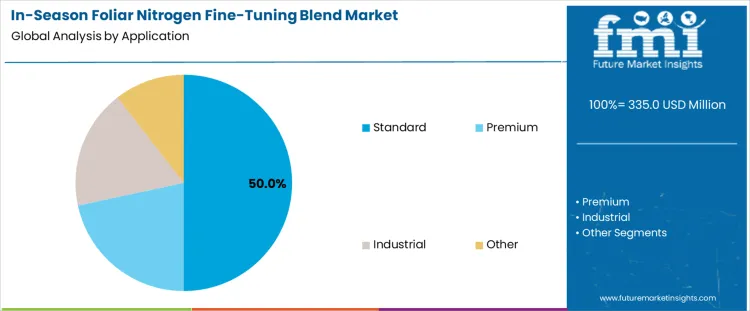
Standard programs account for about 50% of demand because they align with routine agronomic decision making and existing foliar spray schedules. These programs are typically used to correct moderate nitrogen deficiencies identified through visual assessment, tissue testing, or yield modeling. Growers favor standard approaches because they require limited additional planning and can be executed using conventional sprayers during scheduled crop protection passes. This reduces incremental labor and machinery costs while improving nitrogen use efficiency. Standard foliar programs also offer predictable responses across cereals, oilseeds, and row crops, supporting widespread adoption. Agronomy advisors frequently recommend these programs as low risk adjustments rather than major nutrient interventions, reinforcing confidence.
Premium programs involve advanced blends, enhanced uptake technologies, or diagnostic driven prescriptions, but they require closer monitoring and higher input costs. Industrial programs are oriented toward large scale or contract operations with structured nutrient management systems. Other applications address niche crops or stress scenarios. Application leadership therefore reflects operational simplicity, broad crop fit, and dependable response rather than intensity of nutrient optimization or analytical sophistication.
What Is Driving Leadership by Form in the In Season Foliar Nitrogen Fine Tuning Blend Market?
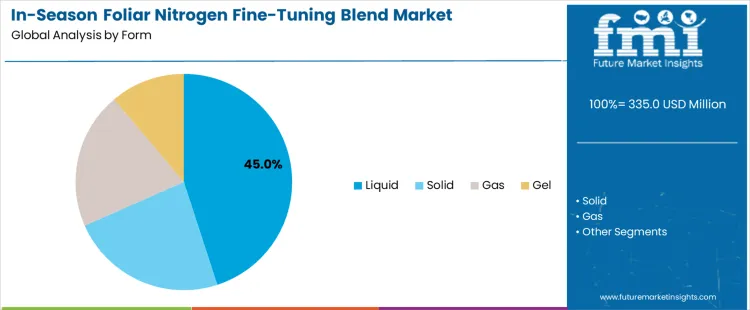
Liquid formulations account for about 45% of demand because they provide rapid leaf absorption and uniform coverage during foliar application. Liquids mix easily with crop protection products, allowing combined passes that reduce field traffic and application costs. Their flow properties support precise rate control and even droplet distribution, which is critical for consistent nitrogen uptake through leaf surfaces. Liquid nitrogen blends also allow inclusion of adjuvants that enhance penetration and reduce volatilization from the leaf surface. Growers value the immediate crop response associated with liquid foliar nitrogen, especially during key growth stages when deficiencies limit yield potential.
Solid and gas forms play limited roles in foliar programs due to handling and compatibility constraints. Gels offer controlled release but face nozzle and coverage challenges. As a result, liquids dominate because they align with sprayer based delivery systems, offer fast plant availability, and integrate smoothly into in season management practices.
How Is the In-Season Foliar Nitrogen Fine-Tuning Blend Being Applied Across Crop Management?
Use appears in cereals, vegetables, fruits, and high-value row crops where real-time nitrogen adjustment is required to optimize growth and yield. Farmers adopt foliar-applied nitrogen blends to correct deficiencies, improve canopy color, and enhance photosynthetic efficiency during critical growth stages. Application through sprayers or fertigation systems enables rapid nutrient uptake and targeted adjustment. These applications reflect operational and agronomic priorities rather than purely cost objectives, with adoption driven by in-season nutrient optimization, crop performance, and efficient nitrogen use.
What Operational and Material Conditions Support Adoption of In-Season Foliar Nitrogen Fine-Tuning Blends?
Selection aligns with nutrient formulations compatible with foliar application, providing soluble nitrogen with minimal leaf burn risk. Blends are optimized for pH, droplet size, and spreadability to ensure uniform coverage and rapid absorption. Farmers monitor crop growth stage, leaf area, weather conditions, and tank mixing protocols for effective application. Quality control evaluates nitrogen concentration, stability, and efficacy to comply with agronomic and environmental standards. These conditions emerge from operational precision, nutrient performance, and crop management priorities in structured foliar fertilization workflows.
Which Practical Considerations Limit Wider Use of In-Season Foliar Nitrogen Fine-Tuning Blends?
Higher cost per hectare and application timing constraints may restrict adoption in low-margin or large-scale operations. Compatibility with other foliar nutrients, pesticides, or adjuvants must be verified. Environmental factors such as rainfall, temperature, and wind can affect uptake and efficacy. Regulatory approvals and food-safety standards differ by region. These factors lead to selective deployment where targeted nitrogen correction, yield optimization, and operational precision justify incremental cost and careful application management.
What is the Demand for in Season Foliar Nitrogen Fine Tuning Blends by Country?
| Country | CAGR (%) |
|---|---|
| China | 11.2% |
| India | 12.0% |
| USA | 9.8% |
| Germany | 9.5% |
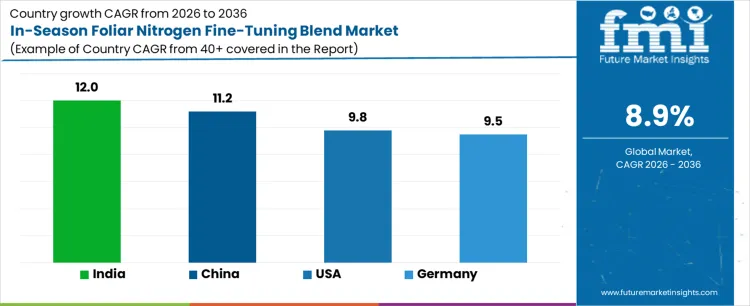
The demand for in season foliar nitrogen fine tuning blends is rising across key agricultural economies, driven by yield optimization needs, variable crop nutrient demand, and wider adoption of precision nutrient management. India leads with a 12.0% CAGR, supported by intensive cropping cycles, increasing use of foliar nutrition to correct mid-season deficiencies, and strong extension focus on improving nitrogen efficiency. China follows at 11.2%, shaped by policy driven reductions in basal fertilizer use and growing reliance on foliar applications to manage nutrient timing. The USA grows at 9.8%, reflecting adoption in row crops and specialty crops where in season adjustments improve yield stability. Germany records 9.5%, supported by strict nutrient runoff regulations, precision farming practices, and demand for controlled nitrogen supplementation during critical growth stages.
How are in-season foliar nitrogen fine-tuning blends expanding adoption in China?
In China, the in-season foliar nitrogen fine-tuning blend market is growing at a CAGR of 11.2% through 2036, driven by increasing adoption of precision agriculture, rapid expansion of high-value crop production, and focus on nutrient efficiency. Farmers are applying foliar nitrogen blends to optimize plant growth, correct in-season deficiencies, and improve overall yield and quality. Demand is concentrated in irrigated crop regions, horticultural zones, and industrial agricultural hubs. Compared to the USA, adoption emphasizes integration with large-scale mechanized operations and rapid deployment across diverse crop types. Domestic suppliers provide high-performance, chemically stable blends suitable for recurring in-season applications.
- Irrigated crop regions, horticultural zones, and industrial hubs drive adoption
- Foliar blends optimize growth and correct nitrogen deficiencies
- Domestic suppliers provide high-performance, chemically stable solutions
- Recurring in-season applications sustain adoption
How are nutrient management and high-value crop production driving growth in India?
In India, revenue is growing at a CAGR of 12% through 2036, supported by the adoption of foliar nutrient technologies, high-value horticulture, and large-scale crop production. Farmers are using in-season nitrogen blends to enhance nutrient absorption, correct deficiencies, and boost yield and quality. Demand is concentrated in irrigated horticultural regions, industrial crop zones, and precision farming clusters. Compared to China, adoption emphasizes rapid scalability and high-volume deployment for multiple crop types. Domestic suppliers provide cost-effective, high-performance blends suitable for recurring in-season nutrient management.
- Irrigated horticultural regions, industrial crop zones, and precision farming clusters drive adoption
- Blends enhance nutrient absorption and yield
- Domestic suppliers provide cost-effective, high-performance solutions
- Recurring in-season nutrient management sustains adoption
How are precision farming and environmental efficiency driving adoption in the United States?
In the United States, the market is expanding at a CAGR of 9.8% through 2036, fueled by precision agriculture adoption, large-scale row crop production, and environmental compliance initiatives. Farmers are integrating in-season foliar nitrogen blends to optimize nutrient timing, increase efficiency, and reduce nitrogen losses. Demand is concentrated in irrigated grain regions, industrial farming hubs, and high-value crop zones. Compared to India, adoption emphasizes regulatory compliance and precision application over large-scale volume. Domestic suppliers provide chemically stable, high-performance blends suitable for recurring in-season foliar applications.
- Irrigated grain regions, industrial farming hubs, and high-value crop zones drive adoption
- Blends optimize nutrient timing and reduce nitrogen losses
- Domestic suppliers provide chemically stable, high-performance solutions
- Recurring in-season applications sustain adoption
How are sustainable nutrient management and industrial agriculture driving growth in Germany?
In Germany, revenue is growing at a CAGR of 9.5% through 2036, supported by precision farming adoption, strict EU nutrient management standards, and high-value crop production. Farmers are adopting in-season foliar nitrogen blends to correct deficiencies, improve nutrient-use efficiency, and enhance yield and quality. Demand is concentrated in irrigated crop zones, industrial agricultural hubs, and horticultural regions. Compared to the USA, adoption emphasizes regulatory compliance and environmentally responsible nutrient management. Domestic suppliers provide EU-certified, high-performance foliar blends suitable for recurring in-season applications.
- Irrigated crop zones, industrial hubs, and horticultural regions drive adoption
- Blends correct nutrient deficiencies and improve efficiency
- Domestic suppliers provide EU-certified, high-performance solutions
- Recurring in-season applications sustain adoption
Which Strategic Factors Shape Competition in the in Season Foliar Nitrogen Fine Tuning Blend Market under Crop Responsiveness and Application Precision?
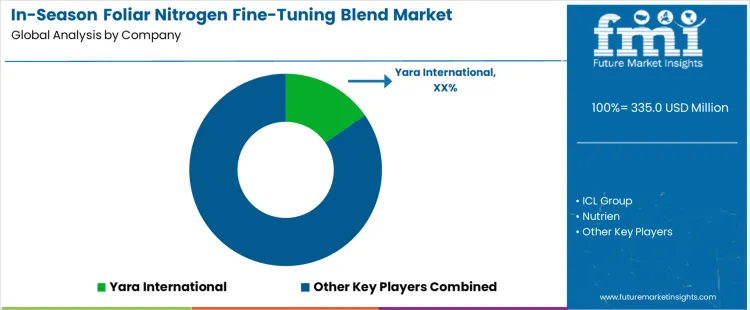
Competition in in season foliar nitrogen fine tuning blends is shaped by how precisely products correct nutrient gaps without disrupting crop physiology during active growth stages. Yara International and ICL Group focus on low burn formulations and rapid leaf absorption, recognizing that foliar nitrogen must act quickly while avoiding stress under heat or moisture variability. Their strategies emphasize controlled nitrogen forms, balanced concentrations, and compatibility with micronutrients commonly applied during the same pass. Nutrien positions foliar blends within broader in season nutrient programs, reinforcing use decisions through crop monitoring and timing guidance. Adoption depends on visible crop response, spray stability, and predictable results across short correction windows.
Formulation adaptability and regional crop focus further influence competitive positioning. Haifa Group emphasizes high purity foliar nutrients designed for rapid uptake and minimal residue, supporting precision correction in high value crops. EuroChem competes through blends tailored to regional agronomic practices and spray regimes, ensuring compatibility with common tank mixes. UPL aligns foliar nitrogen products with integrated crop programs, positioning fine tuning as part of yield optimization rather than rescue feeding. Across the market, competitive advantage is built through crop safety confidence, response consistency, and ease of integration into in season spray schedules.
Key Players in the In-Season Foliar Nitrogen Fine-Tuning Blend Market
- Yara International
- ICL Group
- Nutrien
- Haifa Group
- EuroChem
- UPL
Scope of the Report
| Items | Values |
|---|---|
| Quantitative Units | USD million |
| Type | Foliar nitrogen fine-tuning blends, corrective nitrogen formulations, rapid-uptake foliar nitrogen solutions |
| Application | In-season nitrogen correction, foliar nutrient adjustment during active growth stages, canopy-level nitrogen optimization |
| End User | Row crop growers, horticulture and specialty crop producers, precision agriculture farms, commercial crop operations |
| Regions Covered | Asia Pacific, Europe, North America, Latin America, Middle East & Africa |
| Countries Covered | India, China, United States, Germany, and other major agricultural economies |
| Key Companies Profiled | Yara International, ICL Group, Nutrien, Haifa Group, EuroChem, UPL |
| Additional Attributes | Dollar sales by application program and formulation form, adoption trends linked to tissue testing and mid-season crop assessment practices, competitive landscape focused on uptake efficiency and crop safety, formulation solubility and leaf absorption requirements, integration with in-season decision support and precision nutrient management frameworks |
In-Season Foliar Nitrogen Fine-Tuning Blend Market Segmentation
Application
- Standard
- Premium
- Industrial
- Other
Form
- Liquid
- Solid
- Gas
- Gel
Channel
- Direct
- Retail
- Online
- Distributor
Region
- Asia Pacific
- China
- Japan
- South Korea
- India
- Australia & New Zealand
- ASEAN
- Rest of Asia Pacific
- Europe
- Germany
- United Kingdom
- France
- Italy
- Spain
- Nordic
- BENELUX
- Rest of Europe
- North America
- United States
- Canada
- Mexico
- Latin America
- Brazil
- Chile
- Rest of Latin America
- Middle East & Africa
- Kingdom of Saudi Arabia
- Other GCC Countries
- Turkey
- South Africa
- Other African Union
- Rest of Middle East & Africa
Frequently Asked Questions
How big is the in-season foliar nitrogen fine-tuning blend market in 2026?
The global in-season foliar nitrogen fine-tuning blend market is estimated to be valued at USD 335.0 million in 2026.
What will be the size of in-season foliar nitrogen fine-tuning blend market in 2036?
The market size for the in-season foliar nitrogen fine-tuning blend market is projected to reach USD 785.8 million by 2036.
How much will be the in-season foliar nitrogen fine-tuning blend market growth between 2026 and 2036?
The in-season foliar nitrogen fine-tuning blend market is expected to grow at a 8.9% CAGR between 2026 and 2036.
What are the key application types in the in-season foliar nitrogen fine-tuning blend market?
The key application types in in-season foliar nitrogen fine-tuning blend market are standard, premium, industrial and other.
Which form segment will contribute significant share in the in-season foliar nitrogen fine-tuning blend market in 2026?
In terms of form, liquid segment to command 45.0% share in the in-season foliar nitrogen fine-tuning blend market in 2026.
Preview the report firsthand - request a free sample
Get SampleGet the brochure for pricing and purchase details.
Get PDFTable of Content
- Executive Summary
- Global Market Outlook
- Demand-side Trends
- Supply-side Trends
- Technology Roadmap Analysis
- Analysis and Recommendations
- Market Overview
- Market Coverage / Taxonomy
- Market Definition / Scope / Limitations
- Market Background
- Market Dynamics
- Drivers
- Restraints
- Opportunity
- Trends
- Scenario Forecast
- Demand in Optimistic Scenario
- Demand in Likely Scenario
- Demand in Conservative Scenario
- Opportunity Map Analysis
- Product Life Cycle Analysis
- Supply Chain Analysis
- Investment Feasibility Matrix
- Value Chain Analysis
- PESTLE and Porter’s Analysis
- Regulatory Landscape
- Regional Parent Market Outlook
- Production and Consumption Statistics
- Import and Export Statistics
- Market Dynamics
- Global Market Analysis 2021 to 2025 and Forecast, 2026 to 2036
- Historical Market Size Value (USD Million) Analysis, 2021 to 2025
- Current and Future Market Size Value (USD Million) Projections, 2026 to 2036
- Y-o-Y Growth Trend Analysis
- Absolute $ Opportunity Analysis
- Global Market Pricing Analysis 2021 to 2025 and Forecast 2026 to 2036
- Global Market Analysis 2021 to 2025 and Forecast 2026 to 2036, By Application
- Introduction / Key Findings
- Historical Market Size Value (USD Million) Analysis By Application , 2021 to 2025
- Current and Future Market Size Value (USD Million) Analysis and Forecast By Application , 2026 to 2036
- Standard
- Premium
- Industrial
- Other
- Standard
- Y-o-Y Growth Trend Analysis By Application , 2021 to 2025
- Absolute $ Opportunity Analysis By Application , 2026 to 2036
- Global Market Analysis 2021 to 2025 and Forecast 2026 to 2036, By Form
- Introduction / Key Findings
- Historical Market Size Value (USD Million) Analysis By Form, 2021 to 2025
- Current and Future Market Size Value (USD Million) Analysis and Forecast By Form, 2026 to 2036
- Liquid
- Solid
- Gas
- Gel
- Liquid
- Y-o-Y Growth Trend Analysis By Form, 2021 to 2025
- Absolute $ Opportunity Analysis By Form, 2026 to 2036
- Global Market Analysis 2021 to 2025 and Forecast 2026 to 2036, By Channel
- Introduction / Key Findings
- Historical Market Size Value (USD Million) Analysis By Channel, 2021 to 2025
- Current and Future Market Size Value (USD Million) Analysis and Forecast By Channel, 2026 to 2036
- Direct
- Retail
- Online
- Distributor
- Direct
- Y-o-Y Growth Trend Analysis By Channel, 2021 to 2025
- Absolute $ Opportunity Analysis By Channel, 2026 to 2036
- Global Market Analysis 2021 to 2025 and Forecast 2026 to 2036, By Region
- Introduction
- Historical Market Size Value (USD Million) Analysis By Region, 2021 to 2025
- Current Market Size Value (USD Million) Analysis and Forecast By Region, 2026 to 2036
- North America
- Latin America
- Western Europe
- Eastern Europe
- East Asia
- South Asia and Pacific
- Middle East & Africa
- Market Attractiveness Analysis By Region
- North America Market Analysis 2021 to 2025 and Forecast 2026 to 2036, By Country
- Historical Market Size Value (USD Million) Trend Analysis By Market Taxonomy, 2021 to 2025
- Market Size Value (USD Million) Forecast By Market Taxonomy, 2026 to 2036
- By Country
- USA
- Canada
- Mexico
- By Application
- By Form
- By Channel
- By Country
- Market Attractiveness Analysis
- By Country
- By Application
- By Form
- By Channel
- Key Takeaways
- Latin America Market Analysis 2021 to 2025 and Forecast 2026 to 2036, By Country
- Historical Market Size Value (USD Million) Trend Analysis By Market Taxonomy, 2021 to 2025
- Market Size Value (USD Million) Forecast By Market Taxonomy, 2026 to 2036
- By Country
- Brazil
- Chile
- Rest of Latin America
- By Application
- By Form
- By Channel
- By Country
- Market Attractiveness Analysis
- By Country
- By Application
- By Form
- By Channel
- Key Takeaways
- Western Europe Market Analysis 2021 to 2025 and Forecast 2026 to 2036, By Country
- Historical Market Size Value (USD Million) Trend Analysis By Market Taxonomy, 2021 to 2025
- Market Size Value (USD Million) Forecast By Market Taxonomy, 2026 to 2036
- By Country
- Germany
- UK
- Italy
- Spain
- France
- Nordic
- BENELUX
- Rest of Western Europe
- By Application
- By Form
- By Channel
- By Country
- Market Attractiveness Analysis
- By Country
- By Application
- By Form
- By Channel
- Key Takeaways
- Eastern Europe Market Analysis 2021 to 2025 and Forecast 2026 to 2036, By Country
- Historical Market Size Value (USD Million) Trend Analysis By Market Taxonomy, 2021 to 2025
- Market Size Value (USD Million) Forecast By Market Taxonomy, 2026 to 2036
- By Country
- Russia
- Poland
- Hungary
- Balkan & Baltic
- Rest of Eastern Europe
- By Application
- By Form
- By Channel
- By Country
- Market Attractiveness Analysis
- By Country
- By Application
- By Form
- By Channel
- Key Takeaways
- East Asia Market Analysis 2021 to 2025 and Forecast 2026 to 2036, By Country
- Historical Market Size Value (USD Million) Trend Analysis By Market Taxonomy, 2021 to 2025
- Market Size Value (USD Million) Forecast By Market Taxonomy, 2026 to 2036
- By Country
- China
- Japan
- South Korea
- By Application
- By Form
- By Channel
- By Country
- Market Attractiveness Analysis
- By Country
- By Application
- By Form
- By Channel
- Key Takeaways
- South Asia and Pacific Market Analysis 2021 to 2025 and Forecast 2026 to 2036, By Country
- Historical Market Size Value (USD Million) Trend Analysis By Market Taxonomy, 2021 to 2025
- Market Size Value (USD Million) Forecast By Market Taxonomy, 2026 to 2036
- By Country
- India
- ASEAN
- Australia & New Zealand
- Rest of South Asia and Pacific
- By Application
- By Form
- By Channel
- By Country
- Market Attractiveness Analysis
- By Country
- By Application
- By Form
- By Channel
- Key Takeaways
- Middle East & Africa Market Analysis 2021 to 2025 and Forecast 2026 to 2036, By Country
- Historical Market Size Value (USD Million) Trend Analysis By Market Taxonomy, 2021 to 2025
- Market Size Value (USD Million) Forecast By Market Taxonomy, 2026 to 2036
- By Country
- Kingdom of Saudi Arabia
- Other GCC Countries
- Turkiye
- South Africa
- Other African Union
- Rest of Middle East & Africa
- By Application
- By Form
- By Channel
- By Country
- Market Attractiveness Analysis
- By Country
- By Application
- By Form
- By Channel
- Key Takeaways
- Key Countries Market Analysis
- USA
- Pricing Analysis
- Market Share Analysis, 2025
- By Application
- By Form
- By Channel
- Canada
- Pricing Analysis
- Market Share Analysis, 2025
- By Application
- By Form
- By Channel
- Mexico
- Pricing Analysis
- Market Share Analysis, 2025
- By Application
- By Form
- By Channel
- Brazil
- Pricing Analysis
- Market Share Analysis, 2025
- By Application
- By Form
- By Channel
- Chile
- Pricing Analysis
- Market Share Analysis, 2025
- By Application
- By Form
- By Channel
- Germany
- Pricing Analysis
- Market Share Analysis, 2025
- By Application
- By Form
- By Channel
- UK
- Pricing Analysis
- Market Share Analysis, 2025
- By Application
- By Form
- By Channel
- Italy
- Pricing Analysis
- Market Share Analysis, 2025
- By Application
- By Form
- By Channel
- Spain
- Pricing Analysis
- Market Share Analysis, 2025
- By Application
- By Form
- By Channel
- France
- Pricing Analysis
- Market Share Analysis, 2025
- By Application
- By Form
- By Channel
- India
- Pricing Analysis
- Market Share Analysis, 2025
- By Application
- By Form
- By Channel
- ASEAN
- Pricing Analysis
- Market Share Analysis, 2025
- By Application
- By Form
- By Channel
- Australia & New Zealand
- Pricing Analysis
- Market Share Analysis, 2025
- By Application
- By Form
- By Channel
- China
- Pricing Analysis
- Market Share Analysis, 2025
- By Application
- By Form
- By Channel
- Japan
- Pricing Analysis
- Market Share Analysis, 2025
- By Application
- By Form
- By Channel
- South Korea
- Pricing Analysis
- Market Share Analysis, 2025
- By Application
- By Form
- By Channel
- Russia
- Pricing Analysis
- Market Share Analysis, 2025
- By Application
- By Form
- By Channel
- Poland
- Pricing Analysis
- Market Share Analysis, 2025
- By Application
- By Form
- By Channel
- Hungary
- Pricing Analysis
- Market Share Analysis, 2025
- By Application
- By Form
- By Channel
- Kingdom of Saudi Arabia
- Pricing Analysis
- Market Share Analysis, 2025
- By Application
- By Form
- By Channel
- Turkiye
- Pricing Analysis
- Market Share Analysis, 2025
- By Application
- By Form
- By Channel
- South Africa
- Pricing Analysis
- Market Share Analysis, 2025
- By Application
- By Form
- By Channel
- USA
- Market Structure Analysis
- Competition Dashboard
- Competition Benchmarking
- Market Share Analysis of Top Players
- By Regional
- By Application
- By Form
- By Channel
- Competition Analysis
- Competition Deep Dive
- Yara International
- Overview
- Product Portfolio
- Profitability by Market Segments (Product/Age /Sales Channel/Region)
- Sales Footprint
- Strategy Overview
- Marketing Strategy
- Product Strategy
- Channel Strategy
- ICL Group
- Nutrien
- Haifa Group
- EuroChem
- UPL
- Yara International
- Competition Deep Dive
- Assumptions & Acronyms Used
- Research Methodology


