

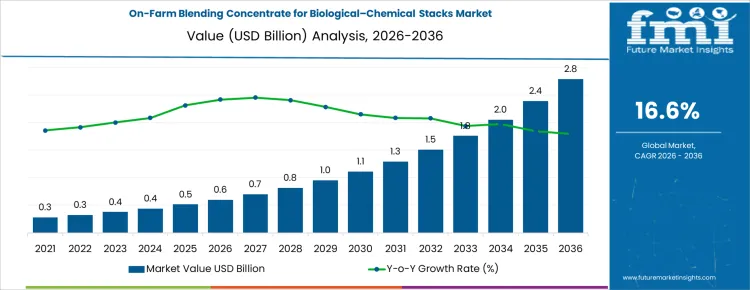
- Industry Size (2026)
- USD 0.6 Bn
- Forecast (2036)
- USD 2.8 Bn
- CAGR (2026 to 2036)
- 16.6%
On Farm Blending Concentrate for Biological Chemical Stacks Market Forecast and Outlook 2026 to 2036
The global on-farm blending concentrate for biological-chemical stacks market is poised to grow from USD 0.6 billion in 2026 to USD 2.8 billion by 2036, at a CAGR of 16.6%. Growth is driven by the rising demand for eco-friendly agriculture practices, with growers seeking integrated solutions that combine biological agents (such as microbial inoculants) and chemical inputs for enhanced pest, disease, and stress management. The on-farm blending concentrate for biological-chemical stacks market is primarily dominated by biological and reduced-dose chemical concentrates (38% share), which offer a more eco-friendly and effective approach to pest control. Microbial actives (bacteria and fungi) hold the largest share of the biological component market (41%) due to their proven ability to naturally control pests and improve soil health.
Quick Stats for On Farm Blending Concentrate for Biological Chemical Stacks Market
- On Farm Blending Concentrate for Biological Chemical Stacks Market Value (2026): USD 0.6 billion
- On Farm Blending Concentrate for Biological Chemical Stacks Market Forecast Value (2036): USD 2.8 billion
- On Farm Blending Concentrate for Biological Chemical Stacks Market Forecast CAGR: 16.6%
- Leading Stack Configuration in On Farm Blending Concentrate for Biological Chemical Stacks Market: Biological + Reduced-Dose Chemical Concentrates (38%)
- Key Growth Regions in On Farm Blending Concentrate for Biological Chemical Stacks Market: USA, Brazil, India, China, Australia
- Key Players in On Farm Blending Concentrate for Biological Chemical Stacks Market: BioConsortia Inc., Biotalys NV, Seipasa S.A., Futureco Bioscience, Daymsa
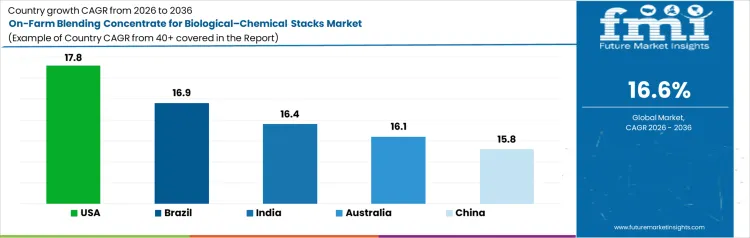
The USA leads the market with a 17.8% CAGR, supported by precision agriculture adoption and a push toward optimized input management. Brazil follows with a 16.9% growth rate, fueled by its large agricultural sector and the shift towards integrated crop management practices. India sees a 16.4% CAGR, as farmers increasingly adopt blending concentrates to improve productivity while reducing environmental impact. China’s market is expanding at 15.8% CAGR, driven by its focus on eco-friendly practices and enhancing food security. Australia also shows strong growth at 16.1%, as farmers embrace precision solutions to optimize biological and chemical inputs. These countries are at the forefront of adopting on-farm blending concentrates, driving market expansion globally.
On‑Farm Blending Concentrate for Biological–Chemical Stacks Market Key Takeaways
| Metric | Value |
|---|---|
| Industry Value (2026) | USD 0.6 billion |
| Forecast Value (2036) | USD 2.8 billion |
| Forecast CAGR (2026 to 2036) | 16.6% |
How Is the Global On-Farm Blending Concentrate for Biological–Chemical Stacks Sector Advancing?
The global on-farm blending concentrate for biological-chemical stacks market is growing rapidly as growers adopt integrated crop solutions that combine biological and chemical crop protection agents for enhanced effectiveness and durability. On-farm blending concentrates allow farmers to mix biologicals such as microbial inoculants or bio-fungicides with chemical actives in optimized ratios tailored to specific field conditions. This blended approach supports more robust pest, disease, and stress management than either biological or chemical inputs used alone, enhancing crop resilience and reducing reliance on high-volume chemical applications. As a result, these concentrates are gaining traction in precision agriculture systems where efficiency, flexibility, and environmental impact are key priorities.
Adoption of on-farm blending concentrates is driven by several factors including increased demand for eco-friendly agriculture practices, regulatory pressures to reduce chemical loads, and the desire for cost-effective crop protection strategies that maintain yield and quality. Advances in formulation science have improved the compatibility of biological and chemical agents, ensuring stable blends that remain effective through application without compromising the viability of sensitive biological components. These innovations empower growers to tailor tank mixes that address specific pest and disease pressures while minimizing environmental footprint.
Challenges such as ensuring consistent blend performance under diverse environmental conditions, navigating regulatory frameworks for combined biological–chemical products, and educating growers on optimal blending practices may influence adoption rates. Despite these challenges, the increasing focus on eco-friendly, adaptive, and high-performance crop protection solutions will sustain demand for on-farm blending concentrates worldwide.
What Is the Segment-Wise Analysis for the Global Biological and Chemical Agrochemical Stack Configuration Market?
Biological + reduced-dose chemical concentrates lead the market with a 38% share, offering an effective solution that combines both biological agents and reduced doses of chemicals for optimized pest and disease management. Other significant stack configurations include microbial–fungicide compatibility blends, bio-insecticide + selective chemical stacks, and multi-bio + chemical modular concentrates. In terms of biological components, microbial actives (bacteria & fungi) hold the largest share at 41%, followed by fermentation-derived metabolites, botanical & plant-extract biologics, and enzyme & protein-based biologics.
How Do Biological + Reduced-Dose Chemical Concentrates Lead the Global Agrochemical Stack Configuration Market?
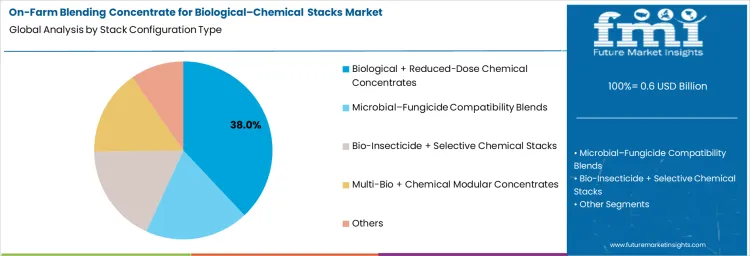
Biological + reduced-dose chemical concentrates lead the global agrochemical stack configuration market with a 38% share due to their ability to combine biological agents with reduced doses of chemicals for enhanced pest and disease management. This combination allows for an eco-friendlier approach, where biological methods help control pests naturally while chemicals are used in lower quantities, minimizing environmental impact. As demand for eco-friendly farming solutions increases, these concentrates offer an optimal balance of effectiveness and durability, providing farmers with reliable crop protection while reducing chemical dependency. The growing focus on eco-friendly agriculture continues to propel the adoption of these solutions.
Why Do Microbial Actives (Bacteria & Fungi) Hold the Largest Market Share in the Global Biological Component Type?
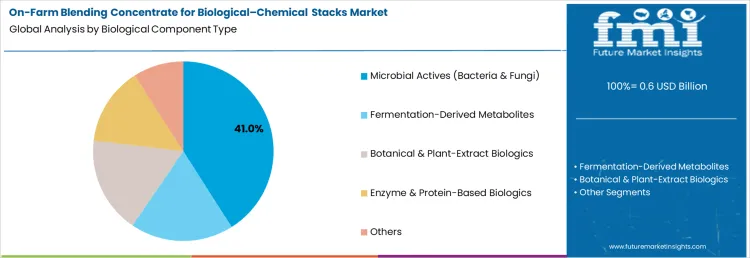
Microbial actives (bacteria & fungi) dominate the global biological component type market with a 41% share due to their effectiveness in controlling pests and diseases naturally, without the need for harmful chemicals. These microorganisms, such as beneficial bacteria and fungi, improve soil health, enhance plant resilience, and contribute to eco-friendly farming practices. With the rise of biological control methods, microbial actives provide a safe, reliable, and eco-friendly alternative to traditional chemical solutions, making them highly sought after in pest management. Their proven benefits in enhancing crop yield and reducing environmental impact ensure their leading position in the market.
Why is On-Farm Blending Gaining Traction in Crop Protection?
The on-farm blending concentrate for biological-chemical stacks market is rising as growers seek customizable crop protection strategies that combine biological agents (like beneficial microbes or RNA-based actives) with traditional chemical actives. Rather than relying on pre-mixed, one-size-fits-all products, on-farm blends allow tailored stacks that match pest pressures, soil conditions, and regulatory environments. This flexibility supports precision agriculture goals, helping farmers respond dynamically to evolving pest complexes and minimize unnecessary inputs while optimizing field performance.
What Barriers Are Influencing Market Uptake of On-Farm Blends?
Despite clear benefits, adoption is tempered by challenges around regulatory compliance, compatibility, and technical know-how. Many regions have strict rules governing how different actives can be mixed and applied, and on-farm blends must comply with diverse label requirements. Compatibility between biological and chemical components also varies by crop and condition, demanding agronomic expertise and testing. Smaller farms may lack blending infrastructure or prefer pre-formulated products to reduce complexity. Ensuring product stability and avoiding antagonism between stack components is a continual technical focus for formulators.
How Are Innovations Shaping the Future of On-Farm Blending Platforms?
Innovation in this market is centered on safer and more user-friendly blending concentrates paired with advanced digital guidance. Next-generation concentrates incorporate adjuvants that improve dispersion, uptake, and stability of mixed actives, reducing risk of segregation or reduced efficacy. Mobile apps and AI-driven platforms help growers select compatible stack combinations, predict pest pressure, and optimize timing and rates. IoT-enabled dispensing equipment integrates with farm management systems to automate precise dosing during mixing. These advances are enabling a shift from static, fixed tank mixes toward dynamic, data-informed crop protection stacks tailored to specific fields and seasons.
What is the Growth Outlook for the On Farm Blending Concentrate for Biological Chemical Stacks Market by Country?
| Country | CAGR (%) |
|---|---|
| USA | 17.8% |
| Brazil | 16.9% |
| India | 16.4% |
| China | 15.8% |
| Australia | 16.1% |
The on-farm blending concentrate for biological-chemical stacks market is growing steadily, with the USA leading at a 17.8% CAGR, driven by the increasing adoption of precision agriculture and the need for optimized biological and chemical input management. Brazil follows with 16.9%, supported by its large agricultural base and the rising demand for eco-friendlier farming practices. India’s market grows at 16.4%, driven by the need for effective and efficient farming inputs to enhance crop productivity. China’s market grows at 15.8%, fueled by its focus on improving agricultural productivity and durability. Australia’s market grows at 16.1%, as farmers seek integrated solutions that optimize biological and chemical inputs.
Why is the USA Leading in the On Farm Blending Concentrate for Biological Chemical Stacks Market?
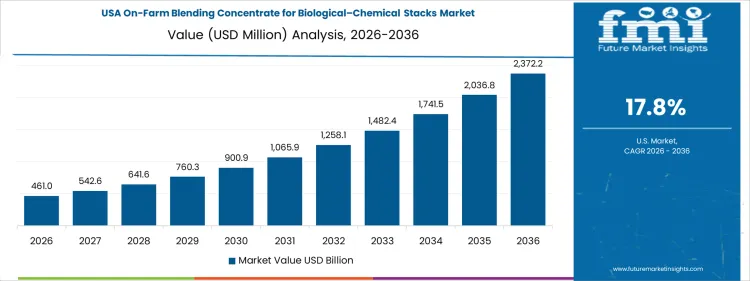
The USA’s on-farm blending concentrate for biological-chemical stacks market is growing at 17.8%, driven by the increasing need for eco-friendly, cost-effective, and optimized crop management solutions. As the demand for both biological and chemical inputs rises, the ability to blend them on the farm for more efficient use is gaining traction. The USA’s large agricultural sector, which heavily relies on innovative farming technologies, is adopting on-farm blending concentrates to improve productivity while reducing the environmental footprint. Farmers are increasingly using these concentrated blends to manage pests, diseases, and nutrient levels effectively, providing a tailored approach to crop protection. With strong government support for eco-friendly farming practices and an emphasis on reducing chemical inputs, the market for on-farm blending concentrates in the USA is expected to continue expanding rapidly.
What is Driving the Growth of the On Farm Blending Concentrate for Biological Chemical Stacks Market in Brazil?
Brazil’s on-farm blending concentrate for biological-chemical stacks market is growing at 16.9%, driven by the country’s large agricultural sector and the increasing adoption of integrated crop management practices. Brazil is one of the world’s largest producers of crops like soybeans, coffee, and sugarcane, and optimizing the use of both biological and chemical inputs is key to improving crop yields. On-farm blending concentrates help Brazilian farmers mix agrochemicals and biopesticides efficiently, reducing input costs and improving the precision of crop management. The market is also supported by Brazil’s growing focus on durability and reducing the environmental impact of traditional farming practices. As Brazilian farmers embrace precision agriculture and seek ways to improve productivity while minimizing environmental harm, the demand for on-farm blending concentrates is expected to grow steadily.
How is the On Farm Blending Concentrate for Biological Chemical Stacks Market Expanding in India?
India’s on-farm blending concentrate for biological-chemical stacks market is growing at 16.4%, driven by the need for effective and efficient crop management solutions to increase productivity. India, with its vast agricultural base, is increasingly adopting integrated solutions that combine biological agents with chemical inputs to enhance crop protection and nutrient management. On-farm blending concentrates allow Indian farmers to apply a precise mix of inputs, optimizing both biological control and chemical efficacy. This is especially important as farmers seek eco-friendlier ways to manage pests and diseases while improving crop yield. Government initiatives promoting eco-friendly agriculture and reducing chemical dependence are also driving market growth. As India continues to focus on improving food security and agricultural efficiency, the demand for on-farm blending concentrates is expected to rise.
What is Contributing to the Growth of the On Farm Blending Concentrate for Biological Chemical Stacks Market in China?
China’s on-farm blending concentrate for biological-chemical stacks market is growing at 15.8%, driven by the country’s focus on increasing agricultural productivity and durability. China’s agricultural sector is rapidly adopting integrated crop management solutions that combine both biological and chemical inputs for better efficiency. On-farm blending concentrates are becoming a key tool for farmers looking to improve pest control, nutrient management, and disease prevention while reducing environmental impact. With China’s large-scale farming operations and a push to improve food safety and reduce chemical residues, the demand for optimized blending solutions is increasing. The Chinese government’s support for eco-friendly farming practices, along with a growing interest in precision agriculture, is contributing to the market’s expansion.
What is Driving the Growth of the On Farm Blending Concentrate for Biological Chemical Stacks Market in Australia?
Australia’s on-farm blending concentrate for biological-chemical stacks market is growing at 16.1%, driven by the country’s emphasis on precision farming and eco-friendly agricultural practices. Australian farmers are increasingly adopting integrated solutions to optimize the use of both biological and chemical inputs, particularly in crops like wheat, barley, and cotton. On-farm blending concentrates allow farmers to tailor applications based on specific crop needs, improving the efficiency of pest control, disease management, and nutrient delivery. With a growing focus on reducing the environmental impact of farming, Australian farmers are turning to solutions that help them achieve better yields while minimizing chemical usage. As the demand for precision agriculture increases, the market for on-farm blending concentrates in Australia is expected to continue growing.
What Are the Competitive Dynamics in the On-Farm Blending Concentrate for Biological–Chemical Stacks Market?
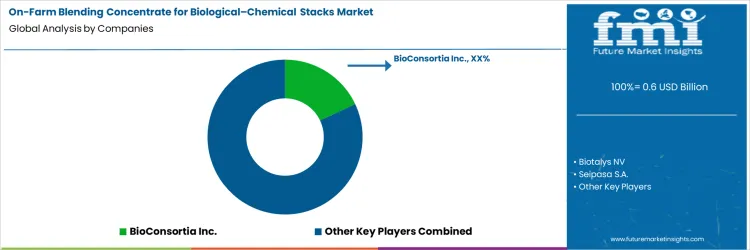
In the on-farm blending concentrate for biological–chemical stacks market BioConsortia Inc., Biotalys NV, Seipasa S.A., Futureco Bioscience, Daymsa, and others are featured with product brochures that emphasize synergy between biologicals and chemistry. At BioConsortia Inc. materials describe proprietary blending concentrates that support microbial performance when combined with compatible chemistries, with clear application guides and field evidence shown to help growers optimize stacks. Trial results are presented to demonstrate improved crop resilience and stress tolerance. Biotalys NV brochures focus on bio-based actives formulated for ease of blending with on-farm chemistries. Compatibility charts and usage guidance are provided to support agronomists in making precise blend choices. Performance summaries highlight reduced disease pressure with integrated applications.
Seipasa S.A. literature showcases biologically rich blending concentrates described with eco-profile data and crop-specific recommendations. Simple tables and dosing notes are included to assist with on-farm mixing and timing. Futureco Bioscience materials present blended products engineered to enhance both biological efficacy and chemical performance, with concise use instructions and crop response summaries. Daymsa brochures highlight specialty concentrates designed to integrate with on-farm stacks, with focus placed on formulation stability, ease of handling, and measured yield benefits. Others in this segment are presented with niche concentrates tailored for specific crop systems or regional needs.
Key Players On Farm Blending Concentrate for Biological Chemical Stacks Market
- BioConsortia Inc.
- Biotalys NV
- Seipasa S.A.
- Futureco Bioscience
- Daymsa
- Others
Scope of Report
| Items | Values |
|---|---|
| Quantitative Units (2026) | USD billion |
| Stack Configuration Type | Biological + Reduced-Dose Chemical Concentrates, Microbial–Fungicide Compatibility Blends, Bio-Insecticide + Selective Chemical Stacks, Multi-Bio + Chemical Modular Concentrates |
| Biological Component Type | Microbial Actives (Bacteria & Fungi), Fermentation-Derived Metabolites, Botanical & Plant-Extract Biologics, Enzyme & Protein-Based Biologics |
| Regions Covered | Asia Pacific, Europe, North America, Latin America, Middle East & Africa |
| Countries Covered | USA, China, Japan, South Korea, India, Australia & New Zealand, ASEAN, Germany, UK, France, Italy, Spain, Nordic, BENELUX, Brazil, Chile, Mexico, Saudi Arabia, Other GCC Countries, Turkey, South Africa, Other African Union |
| Key Companies Profiled | BioConsortia Inc., Biotalys NV, Seipasa S.A., Futureco Bioscience, Daymsa |
| Additional Attributes | Dollar sales by stack configuration type, biological component type, and region; regional CAGR and growth outlook; distribution channels including agrochemical manufacturers and service providers; innovation trends in biological-chemical stack formulations; competitive positioning of global vs regional suppliers. |
On Farm Blending Concentrate for Biological Chemical Stacks Market by Segments
Stack Configuration Type
- Biological + Reduced-Dose Chemical Concentrates
- Microbial-Fungicide Compatibility Blends
- Bio-Insecticide + Selective Chemical Stacks
- Multi-Bio + Chemical Modular Concentrates
- Others
Biological Component Type
- Microbial Actives (Bacteria & Fungi)
- Fermentation-Derived Metabolites
- Botanical & Plant-Extract Biologics
- Enzyme & Protein-Based Biologics
- Others
Region
- Asia Pacific
- China
- Japan
- South Korea
- India
- Australia & New Zealand
- ASEAN
- Rest of Asia Pacific
- Europe
- Germany
- United Kingdom
- France
- Italy
- Spain
- Nordic
- BENELUX
- Rest of Europe
- North America
- United States
- Canada
- Mexico
- Latin America
- Brazil
- Chile
- Rest of Latin America
- Middle East & Africa
- Kingdom of Saudi Arabia
- Other GCC Countries
- Turkey
- South Africa
- Other African Union
- Rest of Middle East & Africa
Frequently Asked Questions
How big is the on-farm blending concentrate for biological–chemical stacks market in 2026?
The global on-farm blending concentrate for biological–chemical stacks market is estimated to be valued at USD 0.6 billion in 2026.
What will be the size of on-farm blending concentrate for biological–chemical stacks market in 2036?
The market size for the on-farm blending concentrate for biological–chemical stacks market is projected to reach USD 2.8 billion by 2036.
How much will be the on-farm blending concentrate for biological–chemical stacks market growth between 2026 and 2036?
The on-farm blending concentrate for biological–chemical stacks market is expected to grow at a 16.6% CAGR between 2026 and 2036.
What are the key product types in the on-farm blending concentrate for biological–chemical stacks market?
The key product types in on-farm blending concentrate for biological–chemical stacks market are biological + reduced-dose chemical concentrates, microbial–fungicide compatibility blends, bio-insecticide + selective chemical stacks, multi-bio + chemical modular concentrates and others.
Which biological component type segment to contribute significant share in the on-farm blending concentrate for biological–chemical stacks market in 2026?
In terms of biological component type, microbial actives (bacteria & fungi) segment to command 41.0% share in the on-farm blending concentrate for biological–chemical stacks market in 2026.
Preview the report firsthand - request a free sample
Get SampleGet the brochure for pricing and purchase details.
Get PDFTable of Content
- Executive Summary
- Global Market Outlook
- Demand-side Trends
- Supply-side Trends
- Technology Roadmap Analysis
- Analysis and Recommendations
- Market Overview
- Market Coverage / Taxonomy
- Market Definition / Scope / Limitations
- Market Background
- Market Dynamics
- Drivers
- Restraints
- Opportunity
- Trends
- Scenario Forecast
- Demand in Optimistic Scenario
- Demand in Likely Scenario
- Demand in Conservative Scenario
- Opportunity Map Analysis
- Product Life Cycle Analysis
- Supply Chain Analysis
- Investment Feasibility Matrix
- Value Chain Analysis
- PESTLE and Porter’s Analysis
- Regulatory Landscape
- Regional Parent Market Outlook
- Production and Consumption Statistics
- Import and Export Statistics
- Market Dynamics
- Global Market Analysis 2021 to 2025 and Forecast, 2026 to 2036
- Historical Market Size Value (USD Million) Analysis, 2021 to 2025
- Current and Future Market Size Value (USD Million) Projections, 2026 to 2036
- Y-o-Y Growth Trend Analysis
- Absolute $ Opportunity Analysis
- Global Market Pricing Analysis 2021 to 2025 and Forecast 2026 to 2036
- Global Market Analysis 2021 to 2025 and Forecast 2026 to 2036, By Stack Configuration Type
- Introduction / Key Findings
- Historical Market Size Value (USD Million) Analysis By Stack Configuration Type , 2021 to 2025
- Current and Future Market Size Value (USD Million) Analysis and Forecast By Stack Configuration Type , 2026 to 2036
- Biological + Reduced-Dose Chemical Concentrates
- Microbial–Fungicide Compatibility Blends
- Bio-Insecticide + Selective Chemical Stacks
- Multi-Bio + Chemical Modular Concentrates
- Others
- Y-o-Y Growth Trend Analysis By Stack Configuration Type , 2021 to 2025
- Absolute $ Opportunity Analysis By Stack Configuration Type , 2026 to 2036
- Global Market Analysis 2021 to 2025 and Forecast 2026 to 2036, By Biological Component Type
- Introduction / Key Findings
- Historical Market Size Value (USD Million) Analysis By Biological Component Type, 2021 to 2025
- Current and Future Market Size Value (USD Million) Analysis and Forecast By Biological Component Type, 2026 to 2036
- Microbial Actives (Bacteria & Fungi)
- Fermentation-Derived Metabolites
- Botanical & Plant-Extract Biologics
- Enzyme & Protein-Based Biologics
- Others
- Y-o-Y Growth Trend Analysis By Biological Component Type, 2021 to 2025
- Absolute $ Opportunity Analysis By Biological Component Type, 2026 to 2036
- Global Market Analysis 2021 to 2025 and Forecast 2026 to 2036, By Region
- Introduction
- Historical Market Size Value (USD Million) Analysis By Region, 2021 to 2025
- Current Market Size Value (USD Million) Analysis and Forecast By Region, 2026 to 2036
- North America
- Latin America
- Western Europe
- Eastern Europe
- East Asia
- South Asia and Pacific
- Middle East & Africa
- Market Attractiveness Analysis By Region
- North America Market Analysis 2021 to 2025 and Forecast 2026 to 2036, By Country
- Historical Market Size Value (USD Million) Trend Analysis By Market Taxonomy, 2021 to 2025
- Market Size Value (USD Million) Forecast By Market Taxonomy, 2026 to 2036
- By Country
- USA
- Canada
- Mexico
- By Stack Configuration Type
- By Biological Component Type
- By Country
- Market Attractiveness Analysis
- By Country
- By Stack Configuration Type
- By Biological Component Type
- Key Takeaways
- Latin America Market Analysis 2021 to 2025 and Forecast 2026 to 2036, By Country
- Historical Market Size Value (USD Million) Trend Analysis By Market Taxonomy, 2021 to 2025
- Market Size Value (USD Million) Forecast By Market Taxonomy, 2026 to 2036
- By Country
- Brazil
- Chile
- Rest of Latin America
- By Stack Configuration Type
- By Biological Component Type
- By Country
- Market Attractiveness Analysis
- By Country
- By Stack Configuration Type
- By Biological Component Type
- Key Takeaways
- Western Europe Market Analysis 2021 to 2025 and Forecast 2026 to 2036, By Country
- Historical Market Size Value (USD Million) Trend Analysis By Market Taxonomy, 2021 to 2025
- Market Size Value (USD Million) Forecast By Market Taxonomy, 2026 to 2036
- By Country
- Germany
- UK
- Italy
- Spain
- France
- Nordic
- BENELUX
- Rest of Western Europe
- By Stack Configuration Type
- By Biological Component Type
- By Country
- Market Attractiveness Analysis
- By Country
- By Stack Configuration Type
- By Biological Component Type
- Key Takeaways
- Eastern Europe Market Analysis 2021 to 2025 and Forecast 2026 to 2036, By Country
- Historical Market Size Value (USD Million) Trend Analysis By Market Taxonomy, 2021 to 2025
- Market Size Value (USD Million) Forecast By Market Taxonomy, 2026 to 2036
- By Country
- Russia
- Poland
- Hungary
- Balkan & Baltic
- Rest of Eastern Europe
- By Stack Configuration Type
- By Biological Component Type
- By Country
- Market Attractiveness Analysis
- By Country
- By Stack Configuration Type
- By Biological Component Type
- Key Takeaways
- East Asia Market Analysis 2021 to 2025 and Forecast 2026 to 2036, By Country
- Historical Market Size Value (USD Million) Trend Analysis By Market Taxonomy, 2021 to 2025
- Market Size Value (USD Million) Forecast By Market Taxonomy, 2026 to 2036
- By Country
- China
- Japan
- South Korea
- By Stack Configuration Type
- By Biological Component Type
- By Country
- Market Attractiveness Analysis
- By Country
- By Stack Configuration Type
- By Biological Component Type
- Key Takeaways
- South Asia and Pacific Market Analysis 2021 to 2025 and Forecast 2026 to 2036, By Country
- Historical Market Size Value (USD Million) Trend Analysis By Market Taxonomy, 2021 to 2025
- Market Size Value (USD Million) Forecast By Market Taxonomy, 2026 to 2036
- By Country
- India
- ASEAN
- Australia & New Zealand
- Rest of South Asia and Pacific
- By Stack Configuration Type
- By Biological Component Type
- By Country
- Market Attractiveness Analysis
- By Country
- By Stack Configuration Type
- By Biological Component Type
- Key Takeaways
- Middle East & Africa Market Analysis 2021 to 2025 and Forecast 2026 to 2036, By Country
- Historical Market Size Value (USD Million) Trend Analysis By Market Taxonomy, 2021 to 2025
- Market Size Value (USD Million) Forecast By Market Taxonomy, 2026 to 2036
- By Country
- Kingdom of Saudi Arabia
- Other GCC Countries
- Turkiye
- South Africa
- Other African Union
- Rest of Middle East & Africa
- By Stack Configuration Type
- By Biological Component Type
- By Country
- Market Attractiveness Analysis
- By Country
- By Stack Configuration Type
- By Biological Component Type
- Key Takeaways
- Key Countries Market Analysis
- USA
- Pricing Analysis
- Market Share Analysis, 2025
- By Stack Configuration Type
- By Biological Component Type
- Canada
- Pricing Analysis
- Market Share Analysis, 2025
- By Stack Configuration Type
- By Biological Component Type
- Mexico
- Pricing Analysis
- Market Share Analysis, 2025
- By Stack Configuration Type
- By Biological Component Type
- Brazil
- Pricing Analysis
- Market Share Analysis, 2025
- By Stack Configuration Type
- By Biological Component Type
- Chile
- Pricing Analysis
- Market Share Analysis, 2025
- By Stack Configuration Type
- By Biological Component Type
- Germany
- Pricing Analysis
- Market Share Analysis, 2025
- By Stack Configuration Type
- By Biological Component Type
- UK
- Pricing Analysis
- Market Share Analysis, 2025
- By Stack Configuration Type
- By Biological Component Type
- Italy
- Pricing Analysis
- Market Share Analysis, 2025
- By Stack Configuration Type
- By Biological Component Type
- Spain
- Pricing Analysis
- Market Share Analysis, 2025
- By Stack Configuration Type
- By Biological Component Type
- France
- Pricing Analysis
- Market Share Analysis, 2025
- By Stack Configuration Type
- By Biological Component Type
- India
- Pricing Analysis
- Market Share Analysis, 2025
- By Stack Configuration Type
- By Biological Component Type
- ASEAN
- Pricing Analysis
- Market Share Analysis, 2025
- By Stack Configuration Type
- By Biological Component Type
- Australia & New Zealand
- Pricing Analysis
- Market Share Analysis, 2025
- By Stack Configuration Type
- By Biological Component Type
- China
- Pricing Analysis
- Market Share Analysis, 2025
- By Stack Configuration Type
- By Biological Component Type
- Japan
- Pricing Analysis
- Market Share Analysis, 2025
- By Stack Configuration Type
- By Biological Component Type
- South Korea
- Pricing Analysis
- Market Share Analysis, 2025
- By Stack Configuration Type
- By Biological Component Type
- Russia
- Pricing Analysis
- Market Share Analysis, 2025
- By Stack Configuration Type
- By Biological Component Type
- Poland
- Pricing Analysis
- Market Share Analysis, 2025
- By Stack Configuration Type
- By Biological Component Type
- Hungary
- Pricing Analysis
- Market Share Analysis, 2025
- By Stack Configuration Type
- By Biological Component Type
- Kingdom of Saudi Arabia
- Pricing Analysis
- Market Share Analysis, 2025
- By Stack Configuration Type
- By Biological Component Type
- Turkiye
- Pricing Analysis
- Market Share Analysis, 2025
- By Stack Configuration Type
- By Biological Component Type
- South Africa
- Pricing Analysis
- Market Share Analysis, 2025
- By Stack Configuration Type
- By Biological Component Type
- USA
- Market Structure Analysis
- Competition Dashboard
- Competition Benchmarking
- Market Share Analysis of Top Players
- By Regional
- By Stack Configuration Type
- By Biological Component Type
- Competition Analysis
- Competition Deep Dive
- BioConsortia Inc.
- Overview
- Product Portfolio
- Profitability by Market Segments (Product/Age /Sales Channel/Region)
- Sales Footprint
- Strategy Overview
- Marketing Strategy
- Product Strategy
- Channel Strategy
- Biotalys NV
- Seipasa S.A.
- Futureco Bioscience
- Daymsa
- Others
- BioConsortia Inc.
- Competition Deep Dive
- Assumptions & Acronyms Used
- Research Methodology


