

- Industry Size (2026)
- USD 300 Mn
- Forecast (2036)
- USD 1027.4 Mn
- CAGR (2026 to 2036)
- 13.1%
Variable-Rate Ready Concentrated Fertilizer Packs Market Forecast and Outlook 2026 to 2036
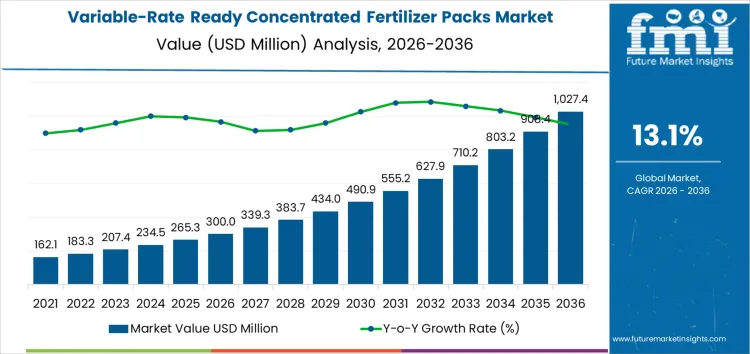
The variable-rate ready concentrated fertilizer packs market is valued at USD 300 million in 2026 and is projected to reach USD 1,027.4 million by 2036, reflecting a CAGR of 13.1%. Growth during this period is shaped by precision agriculture adoption, field-level variability management, and compatibility with digital application systems. Cost structures are influenced by formulation concentration, packaging modularity, and blending accuracy at the point of use. Packs must support flexible dosing without increasing handling complexity. Suppliers offering standardized concentrates that integrate smoothly with variable-rate equipment retain stronger acceptance. Purchasing decisions emphasize operational fit and application accuracy rather than nutrient cost per unit alone.
Between 2026 and 2036, outcomes are driven by grower risk management and data-driven input strategies. Variable-rate systems require alignment between prescription maps, equipment calibration, and fertilizer formulation. Once integrated, switching remains limited due to recalibration effort and yield exposure risk. Sales channels providing technical guidance and system support reinforce repeat adoption. Entry barriers persist through compatibility testing and field validation requirements. Strategic trade offs arise between maximizing concentration and maintaining ease of handling across farm scales. Competitive positioning favors suppliers embedded in precision farming workflows rather than transactional fertilizer supply models.
Quick Stats for Variable-Rate Ready Concentrated Fertilizer Packs Market
- Variable-Rate Ready Concentrated Fertilizer Packs Market Value (2026): USD 300 million
- Variable-Rate Ready Concentrated Fertilizer Packs Market Forecast Value (2036): USD 1,027.4 million
- Variable-Rate Ready Concentrated Fertilizer Packs Market Forecast CAGR (2026 to 2036): 13.1%
- Leading Crop Segment in Variable-Rate Ready Concentrated Fertilizer Packs Market: Cereals (about 50%)
- Key Growth Countries in Variable-Rate Ready Concentrated Fertilizer Packs Market: India, United States, Netherlands, China
- Top Players in Variable-Rate Ready Concentrated Fertilizer Packs Market: Nutrien, Yara International, ICL Group, EuroChem, Mosaic, Corteva
What Is the Growth Forecast for Variable Rate Ready Concentrated Fertilizer Packs Market through 2036?
Application precision requirements and equipment compatibility define the early growth phase of the variable rate ready concentrated fertilizer packs market between 2026 and 2031. During this period, the market expands from USD 300 million to USD 479 million, adding USD 179 million in value. Annual progression from USD 172 million to USD 300 million reflects increasing deployment of variable rate application systems that require pre calibrated, concentrated nutrient packs to reduce on field handling errors. Historical growth was constrained by limited variable rate infrastructure and inconsistent product formats. Forward expansion in this phase is supported by wider adoption of GPS enabled spreaders, improved pack standardization, and growing acceptance among large scale farms focused on input efficiency.
System level integration and acreage scale up drive growth from 2031 to 2036. Over this period, the market increases from USD 479 million to USD 1,027.4 million, adding USD 569 million and representing the stronger expansion window. Annual values rise from USD 536 million to USD 1,027.4 million, indicating accelerating year over year momentum. Earlier demand focused on progressive operators and pilot deployments, while future growth reflects broader rollout across commercial acreage. Higher variable rate penetration, reduced blending time at the field level, and tighter nutrient placement control support sustained expansion as concentrated fertilizer packs become core components of precision agriculture programs.
Variable Rate Ready Concentrated Fertilizer Packs Market Key Takeaways
| Metric | Value |
|---|---|
| Market Value (2026) | USD 300 million |
| Forecast Value (2036) | USD 1,027.4 million |
| Forecast CAGR (2026 to 2036) | 13.1% |
How Are Variable Rate Fertilizer Programs Changing the Role of Concentrated Pack Formats?
Variable rate ready concentrated fertilizer packs emerged to solve execution challenges created by precision agriculture. As prescription maps became more detailed, operators struggled with bulk products that required frequent mixing and tank cleanouts. Switching rates between fields slowed operations and increased dosing errors during peak application windows. Concentrated packs simplified this process by standardising nutrient density in predefined units that align with rate controller settings. Early demand came from large farms and custom applicators managing multiple prescriptions daily. These packs reduced transport volume, improved turnaround time, and lowered the risk of mismatched application during time sensitive planting and in season operations.
Future growth reflects operational scaling rather than changes in nutrient chemistry. Farms now manage dozens of variable rate prescriptions across crops, growth stages, and weather scenarios. Concentrated packs reduce complexity by supporting rapid changeovers without residual material waste. Inventory control improves because packs align with predictable dosing increments. Documentation and compliance tracking also become easier when applied nutrients are tied to discrete pack usage by field and date. Demand will rise where execution accuracy, applicator efficiency, and audit readiness outweigh formulation flexibility in fertilizer purchasing decisions.
What Factors Are Affecting the Demand for Variable Rate Ready Concentrated Fertilizer Packs Market in Terms of Crop and Form?
The variable rate ready concentrated fertilizer packs market is shaped by adoption of precision agriculture, rising input costs, and the need to improve nutrient placement efficiency. Demand focuses on fertilizer packs that simplify variable rate application while maintaining agronomic accuracy across field zones. Adoption depends on crop nutrient demand variability, compatibility with precision equipment, and handling convenience. Market leadership reflects operational fit with large scale precision farming systems rather than maximum nutrient concentration or formulation complexity.
What Is Driving Leadership by Crop in the Variable Rate Ready Concentrated Fertilizer Packs Market?
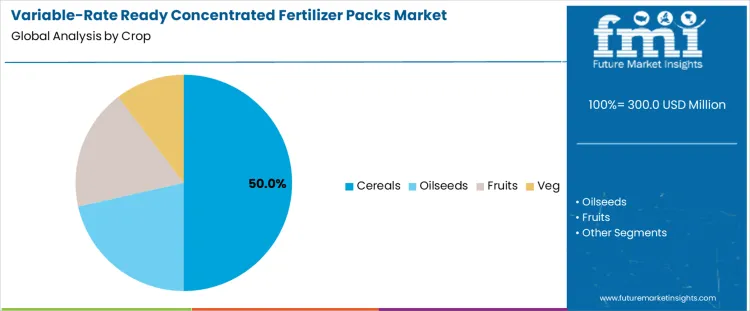
Cereals account for about 50% of demand because they are cultivated across large contiguous acreage with significant within field variability in soil fertility and yield potential. Variable rate application delivers clear economic benefits in cereal systems by aligning nutrient inputs with zone specific productivity. High nitrogen, phosphorus, and potassium demand during early and mid-growth stages makes cereals particularly responsive to targeted fertilizer placement. Growers increasingly rely on yield maps, soil sampling, and satellite data to guide variable rate programs in wheat, corn, and barley. Ready concentrated fertilizer packs simplify logistics by reducing on farm blending and minimizing handling errors during application. The scale of cereal farming operations justifies investment in precision compatible fertilizer formats that reduce waste and improve nutrient use efficiency. Regulatory pressure around nitrogen runoff in cereal producing regions further reinforces adoption. Oilseeds, fruits, and vegetables contribute secondary demand but operate on smaller acreage or use more uniform nutrient programs. Fruits often rely on fertigation rather than broadcast application. Vegetables require frequent adjustments but at lower per hectare volumes. Crop leadership therefore reflects acreage scale, economic return from precision inputs, and maturity of variable rate practices rather than crop diversity.
What Is Driving Leadership by Form in the Variable Rate Ready Concentrated Fertilizer Packs Market?
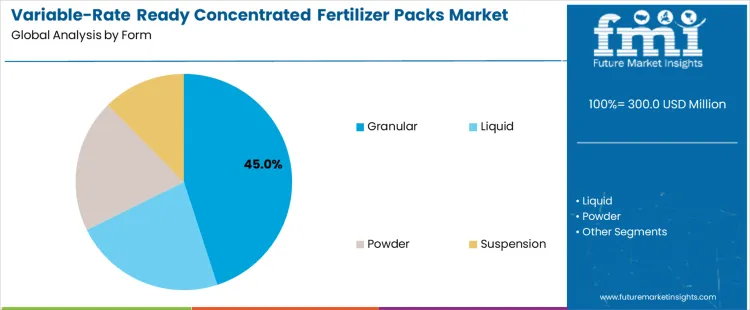
Granular formulations account for about 45% of demand because they integrate directly with existing variable rate spreaders used in broadacre farming. Granules offer stable flow characteristics, predictable spreading patterns, and compatibility with GPS controlled applicators. Their physical robustness supports transport and storage without segregation, which is critical when applying variable rates across zones. Granular packs also align with traditional fertilizer logistics, reducing transition barriers for growers adopting precision techniques. Liquid forms support variable rate injection but require additional equipment and tank management. Powders offer high concentration but face dusting and handling challenges. Suspensions allow nutrient blending flexibility but demand agitation systems and careful calibration. These alternatives are adopted selectively based on crop system and infrastructure. Form leadership therefore reflects ease of use, equipment compatibility, and reliability during high speed field operations rather than formulation novelty or nutrient density alone.
How Are Variable-Rate Ready Concentrated Fertilizer Packs Being Applied Across Precision Agriculture?
Use appears in row crops, vegetables, and high-value horticulture where site-specific nutrient management is critical. Farmers adopt variable-rate concentrated fertilizer packs to deliver tailored nitrogen, phosphorus, and potassium doses based on soil fertility, crop needs, and field variability. Application through fertigation, liquid injectors, or precision planters enables efficient nutrient distribution, reduces waste, and improves yield consistency. These applications reflect operational and agronomic priorities rather than purely cost objectives, with adoption driven by precision nutrient management, crop performance, and sustainable farming practices.
What Operational and Material Conditions Support Adoption of Variable-Rate Ready Concentrated Fertilizer Packs?
Selection aligns with formulations compatible with precision application equipment and capable of stable, high-concentration delivery. Packs are optimized for solubility, viscosity, and homogeneity to ensure accurate dosing and prevent clogging in irrigation or dispensing systems. Farmers monitor soil mapping, equipment calibration, and nutrient scheduling to achieve uniform application across variable terrains. Quality control evaluates nutrient concentration, stability, and accuracy to comply with agronomic standards and regulatory guidelines. These conditions emerge from operational reliability, nutrient efficiency, and sustainability priorities in structured precision agriculture workflows.
Which Practical Considerations Limit Wider Use of Variable-Rate Ready Concentrated Fertilizer Packs?
Higher cost per hectare and specialized application equipment can limit adoption in small-scale or low-margin operations. Compatibility with local irrigation, soil conditions, and crop species must be verified. Accurate mapping, calibration, and monitoring are required to ensure consistent nutrient delivery. Regulatory approvals for concentrated fertilizers differ by region. These factors lead to selective deployment where nutrient precision, operational efficiency, and yield optimization justify incremental cost and workflow management in precision farming operations.
What is the Demand for Variable Rate Ready Concentrated Fertilizer Packs by Country?
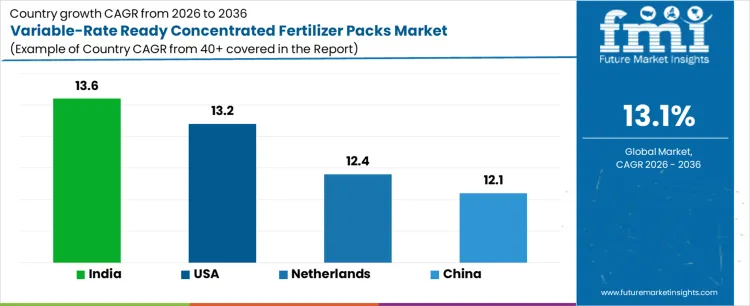
| Country | CAGR (%) |
|---|---|
| USA | 13.2% |
| Netherlands | 12.4% |
| China | 12.1% |
| India | 13.6% |
The demand for variable rate ready concentrated fertilizer packs is rising across advanced and transitioning agricultural systems, driven by precision farming adoption, equipment compatibility, and the need to reduce nutrient waste. India leads with a 13.6% CAGR, supported by rapid uptake of GPS enabled spreaders, government promotion of precision inputs, and growing use of concentrated packs to simplify on farm blending. The USA follows at 13.2%, reflecting widespread deployment of variable rate technology in row crops and strong integration with digital farm management platforms. The Netherlands records 12.4%, shaped by intensive farming, strict nutrient regulations, and advanced precision application practices. China grows at 12.1%, driven by mechanization of agriculture, policy pressure to improve fertilizer efficiency, and increasing adoption of variable rate compatible nutrient delivery systems.
How are variable-rate ready concentrated fertilizer packs expanding adoption in the United States?
In the United States, the variable-rate ready concentrated fertilizer packs market is growing at a CAGR of 13.2% through 2036, driven by widespread adoption of precision agriculture, increasing use of high-speed planters, and demand for improved nutrient efficiency. Farmers are using these packs to deliver tailored nutrient doses, reduce fertilizer waste, and optimize crop yields. Demand is concentrated in irrigated row crop regions, high-value horticultural zones, and industrial agricultural hubs. Compared to China, adoption emphasizes integration with precision planting equipment and compliance with environmental standards. Domestic suppliers provide high-performance, ready-to-use packs suitable for recurring seasonal applications.
- Irrigated row crop regions, horticultural zones, and industrial agricultural hubs drive adoption
- Fertilizer packs enable tailored nutrient delivery and reduce waste
- Domestic suppliers provide high-performance, ready-to-use solutions
- Recurring seasonal applications sustain adoption
How are advanced nutrient management and high-tech farming driving growth in the Netherlands?
In the Netherlands, revenue is growing at a CAGR of 12.4% through 2036, supported by precision horticulture, greenhouse operations, and strict EU environmental standards. Farmers are adopting variable-rate concentrated fertilizer packs to optimize nutrient application, improve plant growth, and reduce environmental runoff. Demand is concentrated in greenhouse clusters, high-value crop regions, and industrial horticultural zones. Compared to the USA, adoption emphasizes regulatory compliance and high-precision nutrient application over large-scale volume. Domestic suppliers provide EU-certified, high-performance packs suitable for recurring seasonal fertilization.
- Greenhouse clusters, high-value crop regions, and industrial horticultural zones drive adoption
- Packs optimize nutrient application and reduce runoff
- Domestic suppliers provide EU-certified, high-performance solutions
- Recurring seasonal fertilization sustains adoption
How are large-scale agriculture and mechanized operations driving adoption in China?
In China, the market is expanding at a CAGR of 12.1% through 2036, fueled by high-intensity cereal production, adoption of precision planting, and government incentives for nutrient efficiency. Farmers are integrating variable-rate concentrated fertilizer packs to improve nutrient-use efficiency, maintain soil health, and enhance early crop growth. Demand is concentrated in irrigated grain regions, industrial crop zones, and mechanized farming clusters. Compared to India, adoption emphasizes operational scale and integration with high-volume mechanized planting systems. Domestic suppliers provide cost-effective, precision-formulated packs suitable for recurring seasonal applications.
- Irrigated grain regions, industrial crop zones, and mechanized clusters drive adoption
- Packs improve nutrient efficiency and early crop growth
- Domestic suppliers provide cost-effective, precision-formulated solutions
- Recurring seasonal applications sustain adoption
How are high-value crops and precision farming driving market growth in India?
In India, the market is growing at a CAGR of 13.6% through 2036, supported by adoption of high-speed planters, precision irrigation, and increasing demand for efficiency in horticultural and cereal production. Farmers are using variable-rate concentrated fertilizer packs to optimize nutrient delivery, reduce losses, and improve yield and crop quality. Demand is concentrated in irrigated horticultural zones, industrial crop regions, and precision agriculture hubs. Compared to China, adoption emphasizes rapid large-scale deployment across diverse crop types. Domestic suppliers provide high-performance, ready-to-use packs suitable for recurring seasonal fertilization.
- Irrigated horticultural zones, industrial crop regions, and precision agriculture hubs drive adoption
- Packs optimize nutrient delivery and reduce losses
- Domestic suppliers provide high-performance, ready-to-use solutions
- Recurring seasonal fertilization sustains adoption
Which Strategic Factors Shape Competition in the Variable Rate Ready Concentrated Fertilizer Packs Market under Digital Agronomy and Field Execution Constraints?
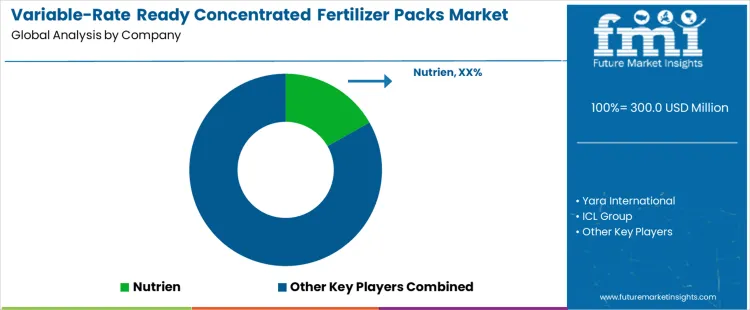
Competition in variable rate ready concentrated fertilizer packs is shaped by how reliably products translate prescription maps into consistent nutrient delivery at the nozzle. Nutrien and Yara International position concentrates around flow stability, rapid rate adjustment, and compatibility with common variable rate controllers. Their strategies emphasize uniform nutrient density, low segregation risk, and predictable response when equipment shifts rates at speed. ICL Group focuses on formulation precision, ensuring concentrates remain homogeneous across temperature swings and storage intervals. Grower acceptance depends on metering accuracy, reduced calibration burden, and confidence that on the go rate changes do not introduce crop safety risk or placement error.
Platform integration and advisory alignment further influence competitive positioning. EuroChem emphasizes regional formulation tuning to match soil variability and prevailing application practices, supporting smoother execution across heterogeneous fields. Mosaic aligns concentrated packs with phosphorus management needs, prioritizing stability during rapid rate transitions near sensitive placement zones. Corteva connects variable rate readiness with decision tools and agronomic protocols, reinforcing correct use rather than relying on formulation alone. Across the market, competitive advantage is built through equipment compatibility, dependable rate response, and clear field guidance. Success is defined by execution fidelity at scale, operational simplicity, and repeatable outcomes across seasons.
Key Players in the Variable-Rate Ready Concentrated Fertilizer Packs Market
- Nutrien
- Yara International
- ICL Group
- EuroChem
- Mosaic
- Corteva
Scope of the Report
| Items | Values |
|---|---|
| Quantitative Units | USD million |
| Type | Variable-rate ready concentrated fertilizer packs, pre-calibrated nutrient concentrate packs, precision-compatible fertilizer concentrates |
| Application | Variable-rate nutrient application, site-specific fertilizer dosing, precision agriculture nutrient delivery |
| End User | Large-scale row crop growers, precision agriculture farms, commercial cereal producers, custom fertilizer applicators |
| Regions Covered | Asia Pacific, Europe, North America, Latin America, Middle East & Africa |
| Countries Covered | India, United States, China, Netherlands, and other major precision agriculture economies |
| Key Companies Profiled | Nutrien, Yara International, ICL Group, EuroChem, Mosaic, Corteva |
| Additional Attributes | Dollar sales by crop type and formulation form, adoption trends linked to variable-rate technology penetration and digital agronomy platforms, competitive landscape shaped by equipment compatibility and dosing accuracy, packaging modularity and blending precision requirements, integration with prescription mapping, calibration workflows, and field-level nutrient accountability systems |
Variable-Rate Ready Concentrated Fertilizer Packs Market Segmentation
Crop:
- Cereals
- Oilseeds
- Fruits
- Vegetables
Form:
- Granular
- Liquid
- Powder
- Suspension
Sales Channel:
- Ag-Retailers
- Direct-to-Farmer
- Online Marketplaces
- Cooperatives
Region
- Asia Pacific
- China
- Japan
- South Korea
- India
- Australia & New Zealand
- ASEAN
- Rest of Asia Pacific
- Europe
- Germany
- United Kingdom
- France
- Italy
- Spain
- Nordic
- BENELUX
- Rest of Europe
- North America
- United States
- Canada
- Mexico
- Latin America
- Brazil
- Chile
- Rest of Latin America
- Middle East & Africa
- Kingdom of Saudi Arabia
- Other GCC Countries
- Turkey
- South Africa
- Other African Union
- Rest of Middle East & Africa
Frequently Asked Questions
How big is the variable-rate ready concentrated fertilizer packs market in 2026?
The global variable-rate ready concentrated fertilizer packs market is estimated to be valued at USD 300.0 million in 2026.
What will be the size of variable-rate ready concentrated fertilizer packs market in 2036?
The market size for the variable-rate ready concentrated fertilizer packs market is projected to reach USD 1,027.4 million by 2036.
How much will be the variable-rate ready concentrated fertilizer packs market growth between 2026 and 2036?
The variable-rate ready concentrated fertilizer packs market is expected to grow at a 13.1% CAGR between 2026 and 2036.
What are the key crop types in the variable-rate ready concentrated fertilizer packs market?
The key crop types in variable-rate ready concentrated fertilizer packs market are cereals, oilseeds, fruits and veg.
Which form segment will contribute significant share in the variable-rate ready concentrated fertilizer packs market in 2026?
In terms of form, granular segment to command 45.0% share in the variable-rate ready concentrated fertilizer packs market in 2026.
Preview the report firsthand - request a free sample
Get SampleGet the brochure for pricing and purchase details.
Get PDFTable of Content
- Executive Summary
- Global Market Outlook
- Demand-side Trends
- Supply-side Trends
- Technology Roadmap Analysis
- Analysis and Recommendations
- Market Overview
- Market Coverage / Taxonomy
- Market Definition / Scope / Limitations
- Market Background
- Market Dynamics
- Drivers
- Restraints
- Opportunity
- Trends
- Scenario Forecast
- Demand in Optimistic Scenario
- Demand in Likely Scenario
- Demand in Conservative Scenario
- Opportunity Map Analysis
- Product Life Cycle Analysis
- Supply Chain Analysis
- Investment Feasibility Matrix
- Value Chain Analysis
- PESTLE and Porter’s Analysis
- Regulatory Landscape
- Regional Parent Market Outlook
- Production and Consumption Statistics
- Import and Export Statistics
- Market Dynamics
- Global Market Analysis 2021 to 2025 and Forecast, 2026 to 2036
- Historical Market Size Value (USD Million) Analysis, 2021 to 2025
- Current and Future Market Size Value (USD Million) Projections, 2026 to 2036
- Y-o-Y Growth Trend Analysis
- Absolute $ Opportunity Analysis
- Global Market Pricing Analysis 2021 to 2025 and Forecast 2026 to 2036
- Global Market Analysis 2021 to 2025 and Forecast 2026 to 2036, By Crop
- Introduction / Key Findings
- Historical Market Size Value (USD Million) Analysis By Crop , 2021 to 2025
- Current and Future Market Size Value (USD Million) Analysis and Forecast By Crop , 2026 to 2036
- Cereals
- Oilseeds
- Fruits
- Veg
- Cereals
- Y-o-Y Growth Trend Analysis By Crop , 2021 to 2025
- Absolute $ Opportunity Analysis By Crop , 2026 to 2036
- Global Market Analysis 2021 to 2025 and Forecast 2026 to 2036, By Form
- Introduction / Key Findings
- Historical Market Size Value (USD Million) Analysis By Form, 2021 to 2025
- Current and Future Market Size Value (USD Million) Analysis and Forecast By Form, 2026 to 2036
- Granular
- Liquid
- Powder
- Suspension
- Granular
- Y-o-Y Growth Trend Analysis By Form, 2021 to 2025
- Absolute $ Opportunity Analysis By Form, 2026 to 2036
- Global Market Analysis 2021 to 2025 and Forecast 2026 to 2036, By Sales Channel
- Introduction / Key Findings
- Historical Market Size Value (USD Million) Analysis By Sales Channel, 2021 to 2025
- Current and Future Market Size Value (USD Million) Analysis and Forecast By Sales Channel, 2026 to 2036
- Ag-Retailers
- Direct-to-Farmer
- Online Marketplaces
- Cooperatives
- Ag-Retailers
- Y-o-Y Growth Trend Analysis By Sales Channel, 2021 to 2025
- Absolute $ Opportunity Analysis By Sales Channel, 2026 to 2036
- Global Market Analysis 2021 to 2025 and Forecast 2026 to 2036, By Region
- Introduction
- Historical Market Size Value (USD Million) Analysis By Region, 2021 to 2025
- Current Market Size Value (USD Million) Analysis and Forecast By Region, 2026 to 2036
- North America
- Latin America
- Western Europe
- Eastern Europe
- East Asia
- South Asia and Pacific
- Middle East & Africa
- Market Attractiveness Analysis By Region
- North America Market Analysis 2021 to 2025 and Forecast 2026 to 2036, By Country
- Historical Market Size Value (USD Million) Trend Analysis By Market Taxonomy, 2021 to 2025
- Market Size Value (USD Million) Forecast By Market Taxonomy, 2026 to 2036
- By Country
- USA
- Canada
- Mexico
- By Crop
- By Form
- By Sales Channel
- By Country
- Market Attractiveness Analysis
- By Country
- By Crop
- By Form
- By Sales Channel
- Key Takeaways
- Latin America Market Analysis 2021 to 2025 and Forecast 2026 to 2036, By Country
- Historical Market Size Value (USD Million) Trend Analysis By Market Taxonomy, 2021 to 2025
- Market Size Value (USD Million) Forecast By Market Taxonomy, 2026 to 2036
- By Country
- Brazil
- Chile
- Rest of Latin America
- By Crop
- By Form
- By Sales Channel
- By Country
- Market Attractiveness Analysis
- By Country
- By Crop
- By Form
- By Sales Channel
- Key Takeaways
- Western Europe Market Analysis 2021 to 2025 and Forecast 2026 to 2036, By Country
- Historical Market Size Value (USD Million) Trend Analysis By Market Taxonomy, 2021 to 2025
- Market Size Value (USD Million) Forecast By Market Taxonomy, 2026 to 2036
- By Country
- Germany
- UK
- Italy
- Spain
- France
- Nordic
- BENELUX
- Rest of Western Europe
- By Crop
- By Form
- By Sales Channel
- By Country
- Market Attractiveness Analysis
- By Country
- By Crop
- By Form
- By Sales Channel
- Key Takeaways
- Eastern Europe Market Analysis 2021 to 2025 and Forecast 2026 to 2036, By Country
- Historical Market Size Value (USD Million) Trend Analysis By Market Taxonomy, 2021 to 2025
- Market Size Value (USD Million) Forecast By Market Taxonomy, 2026 to 2036
- By Country
- Russia
- Poland
- Hungary
- Balkan & Baltic
- Rest of Eastern Europe
- By Crop
- By Form
- By Sales Channel
- By Country
- Market Attractiveness Analysis
- By Country
- By Crop
- By Form
- By Sales Channel
- Key Takeaways
- East Asia Market Analysis 2021 to 2025 and Forecast 2026 to 2036, By Country
- Historical Market Size Value (USD Million) Trend Analysis By Market Taxonomy, 2021 to 2025
- Market Size Value (USD Million) Forecast By Market Taxonomy, 2026 to 2036
- By Country
- China
- Japan
- South Korea
- By Crop
- By Form
- By Sales Channel
- By Country
- Market Attractiveness Analysis
- By Country
- By Crop
- By Form
- By Sales Channel
- Key Takeaways
- South Asia and Pacific Market Analysis 2021 to 2025 and Forecast 2026 to 2036, By Country
- Historical Market Size Value (USD Million) Trend Analysis By Market Taxonomy, 2021 to 2025
- Market Size Value (USD Million) Forecast By Market Taxonomy, 2026 to 2036
- By Country
- India
- ASEAN
- Australia & New Zealand
- Rest of South Asia and Pacific
- By Crop
- By Form
- By Sales Channel
- By Country
- Market Attractiveness Analysis
- By Country
- By Crop
- By Form
- By Sales Channel
- Key Takeaways
- Middle East & Africa Market Analysis 2021 to 2025 and Forecast 2026 to 2036, By Country
- Historical Market Size Value (USD Million) Trend Analysis By Market Taxonomy, 2021 to 2025
- Market Size Value (USD Million) Forecast By Market Taxonomy, 2026 to 2036
- By Country
- Kingdom of Saudi Arabia
- Other GCC Countries
- Turkiye
- South Africa
- Other African Union
- Rest of Middle East & Africa
- By Crop
- By Form
- By Sales Channel
- By Country
- Market Attractiveness Analysis
- By Country
- By Crop
- By Form
- By Sales Channel
- Key Takeaways
- Key Countries Market Analysis
- USA
- Pricing Analysis
- Market Share Analysis, 2025
- By Crop
- By Form
- By Sales Channel
- Canada
- Pricing Analysis
- Market Share Analysis, 2025
- By Crop
- By Form
- By Sales Channel
- Mexico
- Pricing Analysis
- Market Share Analysis, 2025
- By Crop
- By Form
- By Sales Channel
- Brazil
- Pricing Analysis
- Market Share Analysis, 2025
- By Crop
- By Form
- By Sales Channel
- Chile
- Pricing Analysis
- Market Share Analysis, 2025
- By Crop
- By Form
- By Sales Channel
- Germany
- Pricing Analysis
- Market Share Analysis, 2025
- By Crop
- By Form
- By Sales Channel
- UK
- Pricing Analysis
- Market Share Analysis, 2025
- By Crop
- By Form
- By Sales Channel
- Italy
- Pricing Analysis
- Market Share Analysis, 2025
- By Crop
- By Form
- By Sales Channel
- Spain
- Pricing Analysis
- Market Share Analysis, 2025
- By Crop
- By Form
- By Sales Channel
- France
- Pricing Analysis
- Market Share Analysis, 2025
- By Crop
- By Form
- By Sales Channel
- India
- Pricing Analysis
- Market Share Analysis, 2025
- By Crop
- By Form
- By Sales Channel
- ASEAN
- Pricing Analysis
- Market Share Analysis, 2025
- By Crop
- By Form
- By Sales Channel
- Australia & New Zealand
- Pricing Analysis
- Market Share Analysis, 2025
- By Crop
- By Form
- By Sales Channel
- China
- Pricing Analysis
- Market Share Analysis, 2025
- By Crop
- By Form
- By Sales Channel
- Japan
- Pricing Analysis
- Market Share Analysis, 2025
- By Crop
- By Form
- By Sales Channel
- South Korea
- Pricing Analysis
- Market Share Analysis, 2025
- By Crop
- By Form
- By Sales Channel
- Russia
- Pricing Analysis
- Market Share Analysis, 2025
- By Crop
- By Form
- By Sales Channel
- Poland
- Pricing Analysis
- Market Share Analysis, 2025
- By Crop
- By Form
- By Sales Channel
- Hungary
- Pricing Analysis
- Market Share Analysis, 2025
- By Crop
- By Form
- By Sales Channel
- Kingdom of Saudi Arabia
- Pricing Analysis
- Market Share Analysis, 2025
- By Crop
- By Form
- By Sales Channel
- Turkiye
- Pricing Analysis
- Market Share Analysis, 2025
- By Crop
- By Form
- By Sales Channel
- South Africa
- Pricing Analysis
- Market Share Analysis, 2025
- By Crop
- By Form
- By Sales Channel
- USA
- Market Structure Analysis
- Competition Dashboard
- Competition Benchmarking
- Market Share Analysis of Top Players
- By Regional
- By Crop
- By Form
- By Sales Channel
- Competition Analysis
- Competition Deep Dive
- Nutrien
- Overview
- Product Portfolio
- Profitability by Market Segments (Product/Age /Sales Channel/Region)
- Sales Footprint
- Strategy Overview
- Marketing Strategy
- Product Strategy
- Channel Strategy
- Yara International
- ICL Group
- EuroChem
- Mosaic
- Corteva
- Nutrien
- Competition Deep Dive
- Assumptions & Acronyms Used
- Research Methodology


