

- Industry Size (2026)
- USD 206 Mn
- Forecast (2036)
- USD 515.2 Mn
- CAGR (2026 to 2036)
- 9.6%
On-Farm Compost Activator Nutrient Starter Market Forecast and Outlook 2026 to 2036
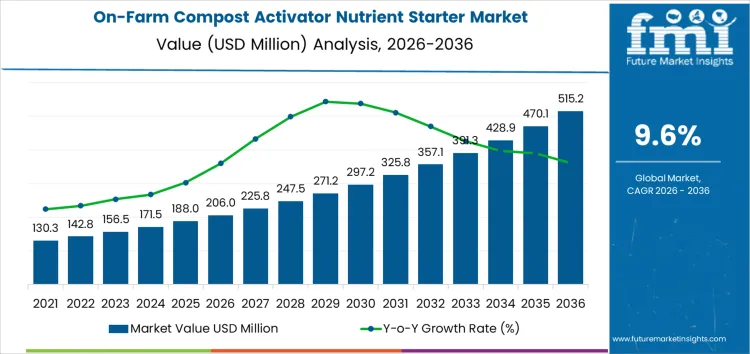
The on-farm compost activator nutrient starter market is valued at USD 206 million in 2026 and is projected to reach USD 515.2 million by 2036, reflecting a CAGR of 9.6%. Growth during this period is shaped by decomposition efficiency targets, feedstock variability, and time-to-maturity expectations in farm-managed compost systems. Cost structures are influenced by nutrient balance, microbial activation consistency, and application rates across diverse organic inputs. Products are evaluated on their ability to accelerate breakdown without causing nutrient losses or odor issues. Suppliers delivering predictable activation across climate conditions gain stronger acceptance. Purchasing decisions emphasize reliability in compost turnaround rather than starter nutrient concentration alone.
Quick Stats for On-Farm Compost Activator Nutrient Starter Market
- On-Farm Compost Activator Nutrient Starter Market Value (2026): USD 206 million
- On-Farm Compost Activator Nutrient Starter Market Forecast Value (2036): USD 515.2 million
- On-Farm Compost Activator Nutrient Starter Market Forecast CAGR: 9.6%
- Leading Equipment in On-Farm Compost Activator Nutrient Starter Market: High-Speed Planter
- Key Growth Regions in On-Farm Compost Activator Nutrient Starter Market: Asia Pacific, Latin America, Europe
- Top Players in On-Farm Compost Activator Nutrient Starter Market: BASF, UPL, Nutrien, ICL Group, Novonesis, Lallemand Plant Care
Between 2026 and 2036, outcomes are driven by grower risk management and operational discipline. Adoption advances where compost programs support residue management and soil amendment planning within tight seasonal windows. Once integrated into on-farm composting routines, switching remains limited due to process familiarity and performance tracking. Sales channels providing technical guidance and feedstock-specific recommendations reinforce repeat use. Entry barriers persist through field validation requirements and variability in organic material composition. Strategic trade offs arise between activation speed and stability of finished compost quality. Competitive positioning favors suppliers aligned with consistent on-farm nutrient recycling practices rather than episodic input use.
What Is the Growth Forecast for On Farm Compost Activator Nutrient Starter Market through 2036?
Between 2026 and 2031, the on farm compost activator nutrient starter market grows from USD 206 million in 2026 to USD 298 million by 2031, generating an absolute increase of USD 92 million. Year over year progression in this phase is steady, with annual values scaling to USD 206.0 million in 2026 and continuing upward through 2031. Early adoption is driven by farms seeking faster compost maturity, improved nutrient release, and more predictable organic matter quality. Growth during this period is application specific, supported by integration into existing composting routines rather than full scale operational redesign.
From 2031 to 2036, the market expands from USD 298 million in 2031 to USD 515.2 million by 2036, adding USD 220 million and representing the larger share of total forecast growth. Annual values increase from USD 326 million in 2032 to USD 515.2 million in 2036, indicating accelerating year over year momentum. This phase reflects wider normalization of compost activator use across commercial farms. Repeat performance confidence, rising compost utilization rates, and alignment with residue management and nutrient recycling practices drive stronger expansion, making 2031–2036 the dominant growth period.
On Farm Compost Activator Nutrient Starter Market Key Takeaways
| Metric | Value |
|---|---|
| Market Value (2026) | USD 206 million |
| Forecast Value (2036) | USD 515.2 million |
| Forecast CAGR (2026 to 2036) | 9.6% |
What Is Driving Demand in the On-Farm Compost Activator Nutrient Starter Market?
Demand for on-farm compost activator nutrient starters arises from consistent challenges in composting systems rather than general interest in organic amendments. Farmers and ranchers found that raw manure, crop residues, and food waste often decomposed slowly when mixed due to low microbial activity, imbalanced carbon-to-nitrogen ratios, or suboptimal moisture and temperature conditions. Slow composting increases labour, delays application timing, and can generate odours or nitrogen losses that undermine field planning. Activator nutrient starters supply targeted microbes, enzymes, and nutrient supplements that jumpstart decomposition by balancing microbial food sources and catalysing biochemical breakdown. Early use was driven by observed delays and variability in compost maturation rather than broad adoption, with growers optimising compost quality where timing and consistency were critical for planting schedules and soil health objectives.
Future growth in this market will be shaped by integration with soil fertility and waste management planning rather than incremental product substitution alone. On-farm composting is increasingly incorporated into nutrient management plans to recycle on-site materials, reduce reliance on external fertilisers, and improve soil organic matter. Compost activators that deliver predictable decomposition timelines support these strategies by ensuring reliable stabilisation and nutrient release before field application. Advances in microbial consortia and nutrient balancing improve efficacy across diverse feedstocks and environmental conditions, enabling growers to adapt compost systems to varying cropping rotations and climate challenges. Demand will expand where farms prioritise documented improvements in compost quality, nutrient availability, and operational efficiency rather than sporadic enhancements, embedding activator nutrient starters into systematic organic matter management and fertility programmes.
What Factors Are Affecting the Demand for On Farm Compost Activator Nutrient Starter Market in Terms of Equipment and Formulation?
The on farm compost activator nutrient starter market is driven by residue management needs, faster nutrient mineralization targets, and integration of biological inputs into planting operations. Demand centers on starter systems that accelerate compost activation while fitting existing field equipment. Adoption depends on delivery accuracy, compatibility with planting workflows, and predictable early season response. Market leadership reflects operational fit and reliable activation performance rather than breadth of nutrient composition.
What Is Driving Leadership by Equipment in the On Farm Compost Activator Nutrient Starter Market?
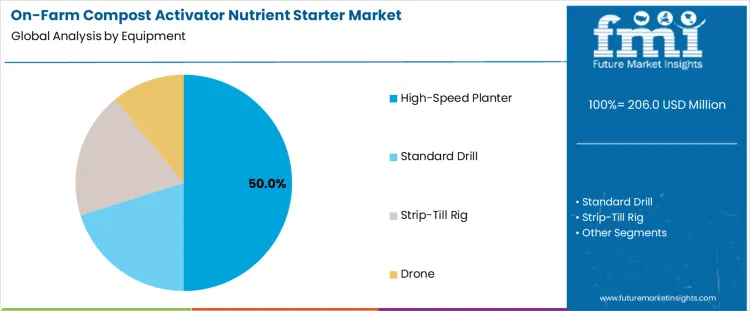
High speed planters account for about 50% of demand because large scale operations increasingly combine planting with biological and nutrient starter placement. These planters enable precise banding or in furrow delivery of compost activators at elevated ground speeds without sacrificing placement accuracy. Growers favor this integration to avoid additional passes while ensuring activators are positioned close to residues and emerging roots. The ability to synchronize activation with planting improves early nutrient release and supports uniform crop establishment across wide acreage.
High speed planters also incorporate advanced metering and control systems that handle low rate liquid or micro inputs consistently. This reduces variability in compost activation across fields and supports repeatable outcomes. Standard drills and strip till rigs contribute secondary demand but operate at lower speeds and often apply activators less precisely. Drone based delivery remains limited to niche scenarios. Equipment leadership therefore reflects acreage scale, integration efficiency, and consistency of placement rather than diversity of application platforms.
What Is Driving Leadership by Formulation in the On Farm Compost Activator Nutrient Starter Market?
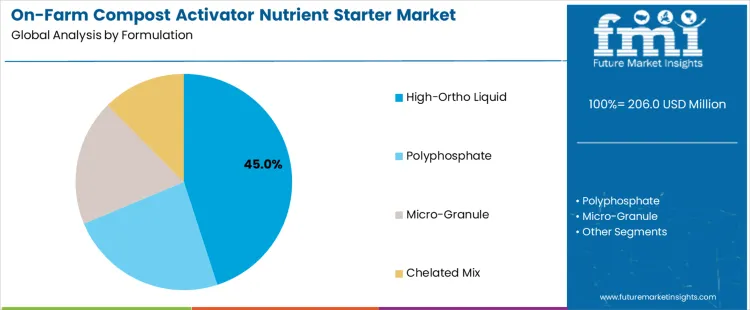
High ortho liquid formulations account for about 45% of demand because they provide immediately available phosphorus and nutrients that stimulate microbial activity during compost activation. These liquids mix easily with biological inoculants and carbon sources, supporting rapid microbial growth and residue breakdown. Their clear, low viscosity profile ensures reliable flow through planter delivery systems without clogging or separation. Growers value predictable early response when compost activation is synchronized with planting.
Polyphosphate, micro granule, and chelated mixes play supporting roles. Polyphosphates require conversion before availability, slowing activation. Micro granules offer placement precision but face flow challenges at high speeds. Chelated mixes support micronutrient balance but do not drive microbial activation alone. Formulation leadership therefore reflects immediacy of nutrient availability, equipment compatibility, and consistency of compost activation rather than nutrient diversity or long term release characteristics.
How Are On-Farm Compost Activator Nutrient Starters Being Applied Across Agriculture?
Use appears in row crops, orchards, and high-value horticulture where farm-generated organic waste is converted into nutrient-rich compost. Farmers adopt on-farm compost activator starters to accelerate microbial activity, enhance decomposition, and improve nutrient availability. Application involves mixing the activator with crop residues, manure, or organic matter in windrows, pits, or bins to produce stabilized compost for soil amendment. These applications reflect operational and environmental priorities rather than purely cost objectives, with adoption driven by soil fertility improvement, waste recycling, and sustainable nutrient management.
What Operational and Material Conditions Support Adoption of On-Farm Compost Activator Nutrient Starters?
Selection aligns with organic feedstocks requiring balanced microbial stimulation, moisture control, and aeration. Activator formulations are optimized for nutrient content, microbial diversity, and moisture retention to enhance decomposition and compost quality. Farmers monitor temperature, oxygen levels, and moisture during composting to maintain microbial activity and prevent nutrient losses. Quality control evaluates nutrient composition, microbial activity, and maturity of compost to comply with agronomic standards. These conditions emerge from operational efficiency, nutrient enhancement, and sustainable soil management priorities in structured on-farm compost workflows.
Which Practical Considerations Limit Wider Use of On-Farm Compost Activator Nutrient Starters?
Higher initial investment and careful process management may limit adoption in small-scale or low-margin farms. Feedstock variability, moisture, and aeration affect composting efficiency. Compatibility with farm machinery, residue type, and application timing must be validated. Regulatory approvals for organic inputs and compost quality standards differ by region. These factors lead to selective deployment where nutrient enhancement, soil fertility, and waste recycling justify incremental cost, monitoring, and careful operational oversight in on-farm composting programs.
What is the Demand for On Farm Compost Activator Nutrient Starters by Country?
| Country | CAGR (%) |
|---|---|
| India | 11.6% |
| Brazil | 10.8% |
| USA | 9.9% |
| Spain | 10.4% |
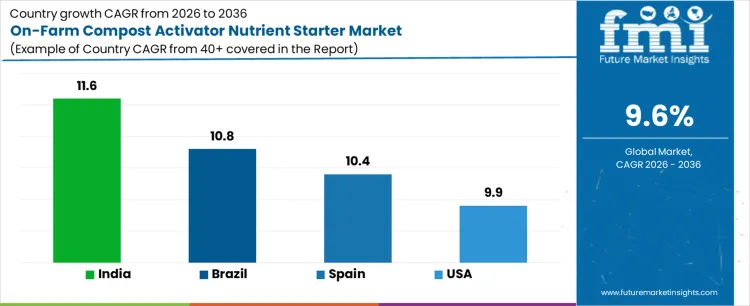
The demand for on farm compost activator nutrient starter products is increasing across regions focused on soil health improvement, residue management, and cost efficient nutrient recycling. India leads with an 11.6% CAGR, supported by widespread adoption of on farm composting, rising input cost pressures, and government promotion of organic and integrated nutrient management practices. Brazil follows at 10.8%, driven by large scale crop residue availability, adoption of biological soil amendments, and interest in reducing dependence on synthetic fertilizers. Spain records 10.4%, shaped by soil organic matter restoration efforts and regulatory encouragement for circular nutrient use in agriculture. The USA grows at 9.9%, reflecting steady adoption among row crop and specialty crop growers seeking improved soil structure, microbial activity, and nutrient availability through accelerated composting practices.
How are on-farm compost activator nutrient starters expanding adoption in India?
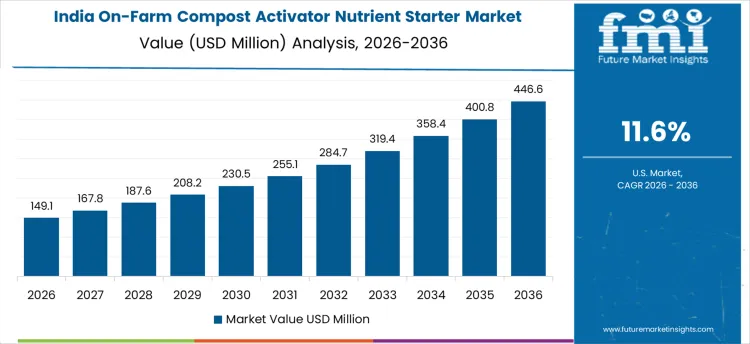
In India, the on-farm compost activator nutrient starter market is growing at a CAGR of 11.6% through 2036, driven by increasing adoption of organic farming practices, government incentives for soil health improvement, and growing demand for enhanced compost efficiency. Farmers are using these starters to accelerate decomposition, improve nutrient release, and enhance soil fertility for high-value crops. Demand is concentrated in irrigated horticultural regions, industrial crop zones, and precision farming hubs. Compared to Brazil, adoption emphasizes large-scale deployment for diverse crop types. Domestic suppliers provide high-performance, safe nutrient activators suitable for recurring seasonal applications.
- Irrigated horticultural regions, industrial crop zones, and precision farming hubs drive adoption
- Starters accelerate compost decomposition and improve nutrient release
- Domestic suppliers provide high-performance, safe solutions
- Recurring seasonal applications sustain adoption
How are soil health programs and sustainable agriculture driving growth in Brazil?
In Brazil, revenue is growing at a CAGR of 10.8% through 2036, supported by the adoption of organic farming, compost-based fertilization, and large-scale crop production. Farmers are integrating nutrient activators to enhance microbial activity, improve soil structure, and increase nutrient availability for crops. Demand is concentrated in industrial grain regions, irrigated crop zones, and high-intensity agricultural hubs. Compared to India, adoption emphasizes medium-scale deployment and integration with mechanized compost application. Domestic suppliers provide cost-effective, high-performance activators suitable for recurring composting cycles.
- Industrial grain regions, irrigated crop zones, and high-intensity hubs drive adoption
- Activators enhance microbial activity and improve soil structure
- Domestic suppliers provide cost-effective, high-performance solutions
- Recurring composting cycles sustain adoption
How are precision nutrient management and organic farming driving adoption in the United States?
In the United States, the market is expanding at a CAGR of 9.9% through 2036, fueled by the growth of organic crop production, environmental sustainability initiatives, and precision compost management practices. Farmers are using compost activator nutrient starters to accelerate decomposition, improve nutrient efficiency, and maintain soil health in irrigated row crop and horticultural regions. Demand is concentrated in high-value crop zones, irrigated farms, and industrial agricultural hubs. Compared to India, adoption emphasizes regulatory compliance and integration with precision farming practices. Domestic suppliers provide high-performance, chemically stable activators suitable for recurring seasonal applications.
- High-value crop zones, irrigated farms, and industrial hubs drive adoption
- Activators accelerate compost decomposition and improve nutrient efficiency
- Domestic suppliers provide high-performance, chemically stable solutions
- Recurring seasonal applications sustain adoption
How are sustainable agriculture and EU nutrient regulations driving growth in Spain?
In Spain, revenue is growing at a CAGR of 10.4% through 2036, supported by adoption of organic horticulture, EU environmental regulations, and precision composting practices. Farmers are integrating nutrient starters to enhance microbial activity, increase nutrient availability, and improve soil fertility in irrigated vegetable and fruit regions. Demand is concentrated in industrial horticultural zones, high-value crop clusters, and precision farming hubs. Compared to Brazil, adoption emphasizes compliance with EU environmental standards and precision nutrient management. Domestic suppliers provide certified, high-performance activators suitable for recurring seasonal compost applications.
- Industrial horticultural zones, high-value crop clusters, and precision farming hubs drive adoption
- Starters enhance microbial activity and nutrient availability
- Domestic suppliers provide certified, high-performance solutions
- Recurring seasonal compost applications sustain adoption
How Do Regional Adoption Patterns and Revenue Models Shape Competition in the On Farm Compost Activator Nutrient Starter Market?
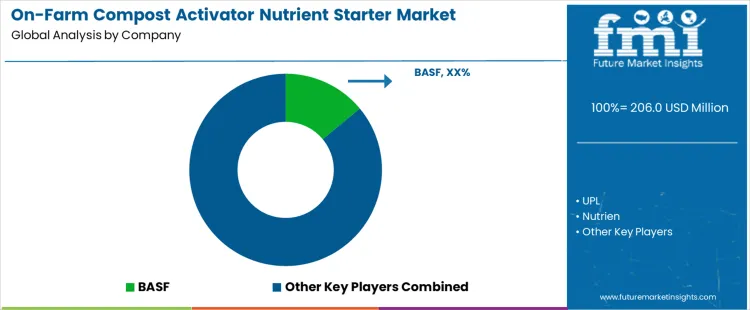
Competition in on farm compost activator nutrient starters is shaped by regional organic residue availability and farm level composting intensity rather than by product volume alone. BASF and UPL show stronger exposure in Europe and Latin America, where regulatory pressure and residue recycling incentives drive on farm composting. Their compost activator offerings are typically positioned as complementary inputs within soil health programs, representing a modest but recurring share of biological and specialty nutrition revenues. Nutrien participates primarily in North America and Australia, where compost starters are bundled with advisory services for mixed crop and livestock systems, resulting in limited standalone revenue but higher program stickiness. Adoption is driven by decomposition speed, odor control, and nutrient stabilization outcomes rather than input price.
Program architecture and microbial specialization further differentiate competitors. ICL Group approaches compost activation through nutrient priming, targeting faster carbon to nitrogen balancing in crop residue heavy systems, with clearer per hectare revenue attribution in intensive farms. Novonesis and Lallemand Plant Care concentrate on microbial consortia designed for specific residue types, leading to higher exposure in horticulture and organic farming regions. Their revenues depend on repeat seasonal use rather than scale deployment. Competitive advantage is defined by regional composting intensity, clarity of performance outcomes, and whether activators are sold as discrete inputs or embedded within broader soil fertility and biological programs.
Key Players in the On-Farm Compost Activator Nutrient Starter Market
- BASF
- UPL
- Nutrien
- ICL Group
- Novonesis
- Lallemand Plant Care
Scope of the Report
| Items | Values |
|---|---|
| Quantitative Units | USD Million |
| Equipment | High-speed planter, standard drill, strip-till rig, drone-assisted application |
| Formulation | High-ortho liquid, polyphosphate, micro-granule, chelated mix |
| Sales Channel | Ag-retailers, direct-to-farmer, online marketplaces, cooperatives |
| Application | On-farm compost activation, accelerated residue decomposition, nutrient mineralization and compost maturity improvement |
| End Users | Row crop growers, horticulture producers, mixed crop–livestock farms, organic and residue-intensive farming operations |
| Regions Covered | Asia Pacific, Europe, North America, Latin America, Middle East & Africa |
| Countries Covered | India, Brazil, United States, Spain, and other compost-intensive agricultural regions |
| Key Companies Profiled | BASF, UPL, Nutrien, ICL Group, Novonesis, Lallemand Plant Care |
| Additional Attributes | Dollar by sales across equipment and formulation types, adoption trends linked to residue management and compost turnaround time, competitive landscape shaped by microbial activation consistency and feedstock variability handling, integration with planting and composting workflows, process validation based on temperature, moisture, and maturity tracking, repeat demand driven by on-farm nutrient recycling practices |
On-Farm Compost Activator Nutrient Starter Market Segmentation
Equipment:
- High-Speed Planter
- Standard Drill
- Strip-Till Rig
- Drone
Formulation:
- High-Ortho Liquid
- Polyphosphate
- Micro-Granule
- Chelated Mix
Sales Channel:
- Ag-Retailers
- Direct-to-Farmer
- Online Marketplaces
- Cooperatives
Region
- Asia Pacific
- China
- Japan
- South Korea
- India
- Australia & New Zealand
- ASEAN
- Rest of Asia Pacific
- Europe
- Germany
- United Kingdom
- France
- Italy
- Spain
- Nordic
- BENELUX
- Rest of Europe
- North America
- United States
- Canada
- Mexico
- Latin America
- Brazil
- Chile
- Rest of Latin America
- Middle East & Africa
- Kingdom of Saudi Arabia
- Other GCC Countries
- Turkey
- South Africa
- Other African Union
- Rest of Middle East & Africa
Frequently Asked Questions
How big is the on-farm compost activator nutrient starter market in 2026?
The global on-farm compost activator nutrient starter market is estimated to be valued at USD 206.0 million in 2026.
What will be the size of on-farm compost activator nutrient starter market in 2036?
The market size for the on-farm compost activator nutrient starter market is projected to reach USD 515.2 million by 2036.
How much will be the on-farm compost activator nutrient starter market growth between 2026 and 2036?
The on-farm compost activator nutrient starter market is expected to grow at a 9.6% CAGR between 2026 and 2036.
What are the key equipment types in the on-farm compost activator nutrient starter market?
The key equipment types in on-farm compost activator nutrient starter market are high-speed planter, standard drill, strip-till rig and drone.
Which formulation segment will contribute significant share in the on-farm compost activator nutrient starter market in 2026?
In terms of formulation, high-ortho liquid segment to command 45.0% share in the on-farm compost activator nutrient starter market in 2026.
Preview the report firsthand - request a free sample
Get SampleGet the brochure for pricing and purchase details.
Get PDFTable of Content
- Executive Summary
- Global Market Outlook
- Demand-side Trends
- Supply-side Trends
- Technology Roadmap Analysis
- Analysis and Recommendations
- Market Overview
- Market Coverage / Taxonomy
- Market Definition / Scope / Limitations
- Market Background
- Market Dynamics
- Drivers
- Restraints
- Opportunity
- Trends
- Scenario Forecast
- Demand in Optimistic Scenario
- Demand in Likely Scenario
- Demand in Conservative Scenario
- Opportunity Map Analysis
- Product Life Cycle Analysis
- Supply Chain Analysis
- Investment Feasibility Matrix
- Value Chain Analysis
- PESTLE and Porter’s Analysis
- Regulatory Landscape
- Regional Parent Market Outlook
- Production and Consumption Statistics
- Import and Export Statistics
- Market Dynamics
- Global Market Analysis 2021 to 2025 and Forecast, 2026 to 2036
- Historical Market Size Value (USD Million) Analysis, 2021 to 2025
- Current and Future Market Size Value (USD Million) Projections, 2026 to 2036
- Y-o-Y Growth Trend Analysis
- Absolute $ Opportunity Analysis
- Global Market Pricing Analysis 2021 to 2025 and Forecast 2026 to 2036
- Global Market Analysis 2021 to 2025 and Forecast 2026 to 2036, By Equipment
- Introduction / Key Findings
- Historical Market Size Value (USD Million) Analysis By Equipment , 2021 to 2025
- Current and Future Market Size Value (USD Million) Analysis and Forecast By Equipment , 2026 to 2036
- High-Speed Planter
- Standard Drill
- Strip-Till Rig
- Drone
- High-Speed Planter
- Y-o-Y Growth Trend Analysis By Equipment , 2021 to 2025
- Absolute $ Opportunity Analysis By Equipment , 2026 to 2036
- Global Market Analysis 2021 to 2025 and Forecast 2026 to 2036, By Formulation
- Introduction / Key Findings
- Historical Market Size Value (USD Million) Analysis By Formulation, 2021 to 2025
- Current and Future Market Size Value (USD Million) Analysis and Forecast By Formulation, 2026 to 2036
- High-Ortho Liquid
- Polyphosphate
- Micro-Granule
- Chelated Mix
- High-Ortho Liquid
- Y-o-Y Growth Trend Analysis By Formulation, 2021 to 2025
- Absolute $ Opportunity Analysis By Formulation, 2026 to 2036
- Global Market Analysis 2021 to 2025 and Forecast 2026 to 2036, By Sales Channel
- Introduction / Key Findings
- Historical Market Size Value (USD Million) Analysis By Sales Channel, 2021 to 2025
- Current and Future Market Size Value (USD Million) Analysis and Forecast By Sales Channel, 2026 to 2036
- Ag-Retailers
- Direct-to-Farmer
- Online Marketplaces
- Cooperatives
- Ag-Retailers
- Y-o-Y Growth Trend Analysis By Sales Channel, 2021 to 2025
- Absolute $ Opportunity Analysis By Sales Channel, 2026 to 2036
- Global Market Analysis 2021 to 2025 and Forecast 2026 to 2036, By Region
- Introduction
- Historical Market Size Value (USD Million) Analysis By Region, 2021 to 2025
- Current Market Size Value (USD Million) Analysis and Forecast By Region, 2026 to 2036
- North America
- Latin America
- Western Europe
- Eastern Europe
- East Asia
- South Asia and Pacific
- Middle East & Africa
- Market Attractiveness Analysis By Region
- North America Market Analysis 2021 to 2025 and Forecast 2026 to 2036, By Country
- Historical Market Size Value (USD Million) Trend Analysis By Market Taxonomy, 2021 to 2025
- Market Size Value (USD Million) Forecast By Market Taxonomy, 2026 to 2036
- By Country
- USA
- Canada
- Mexico
- By Equipment
- By Formulation
- By Sales Channel
- By Country
- Market Attractiveness Analysis
- By Country
- By Equipment
- By Formulation
- By Sales Channel
- Key Takeaways
- Latin America Market Analysis 2021 to 2025 and Forecast 2026 to 2036, By Country
- Historical Market Size Value (USD Million) Trend Analysis By Market Taxonomy, 2021 to 2025
- Market Size Value (USD Million) Forecast By Market Taxonomy, 2026 to 2036
- By Country
- Brazil
- Chile
- Rest of Latin America
- By Equipment
- By Formulation
- By Sales Channel
- By Country
- Market Attractiveness Analysis
- By Country
- By Equipment
- By Formulation
- By Sales Channel
- Key Takeaways
- Western Europe Market Analysis 2021 to 2025 and Forecast 2026 to 2036, By Country
- Historical Market Size Value (USD Million) Trend Analysis By Market Taxonomy, 2021 to 2025
- Market Size Value (USD Million) Forecast By Market Taxonomy, 2026 to 2036
- By Country
- Germany
- UK
- Italy
- Spain
- France
- Nordic
- BENELUX
- Rest of Western Europe
- By Equipment
- By Formulation
- By Sales Channel
- By Country
- Market Attractiveness Analysis
- By Country
- By Equipment
- By Formulation
- By Sales Channel
- Key Takeaways
- Eastern Europe Market Analysis 2021 to 2025 and Forecast 2026 to 2036, By Country
- Historical Market Size Value (USD Million) Trend Analysis By Market Taxonomy, 2021 to 2025
- Market Size Value (USD Million) Forecast By Market Taxonomy, 2026 to 2036
- By Country
- Russia
- Poland
- Hungary
- Balkan & Baltic
- Rest of Eastern Europe
- By Equipment
- By Formulation
- By Sales Channel
- By Country
- Market Attractiveness Analysis
- By Country
- By Equipment
- By Formulation
- By Sales Channel
- Key Takeaways
- East Asia Market Analysis 2021 to 2025 and Forecast 2026 to 2036, By Country
- Historical Market Size Value (USD Million) Trend Analysis By Market Taxonomy, 2021 to 2025
- Market Size Value (USD Million) Forecast By Market Taxonomy, 2026 to 2036
- By Country
- China
- Japan
- South Korea
- By Equipment
- By Formulation
- By Sales Channel
- By Country
- Market Attractiveness Analysis
- By Country
- By Equipment
- By Formulation
- By Sales Channel
- Key Takeaways
- South Asia and Pacific Market Analysis 2021 to 2025 and Forecast 2026 to 2036, By Country
- Historical Market Size Value (USD Million) Trend Analysis By Market Taxonomy, 2021 to 2025
- Market Size Value (USD Million) Forecast By Market Taxonomy, 2026 to 2036
- By Country
- India
- ASEAN
- Australia & New Zealand
- Rest of South Asia and Pacific
- By Equipment
- By Formulation
- By Sales Channel
- By Country
- Market Attractiveness Analysis
- By Country
- By Equipment
- By Formulation
- By Sales Channel
- Key Takeaways
- Middle East & Africa Market Analysis 2021 to 2025 and Forecast 2026 to 2036, By Country
- Historical Market Size Value (USD Million) Trend Analysis By Market Taxonomy, 2021 to 2025
- Market Size Value (USD Million) Forecast By Market Taxonomy, 2026 to 2036
- By Country
- Kingdom of Saudi Arabia
- Other GCC Countries
- Turkiye
- South Africa
- Other African Union
- Rest of Middle East & Africa
- By Equipment
- By Formulation
- By Sales Channel
- By Country
- Market Attractiveness Analysis
- By Country
- By Equipment
- By Formulation
- By Sales Channel
- Key Takeaways
- Key Countries Market Analysis
- USA
- Pricing Analysis
- Market Share Analysis, 2025
- By Equipment
- By Formulation
- By Sales Channel
- Canada
- Pricing Analysis
- Market Share Analysis, 2025
- By Equipment
- By Formulation
- By Sales Channel
- Mexico
- Pricing Analysis
- Market Share Analysis, 2025
- By Equipment
- By Formulation
- By Sales Channel
- Brazil
- Pricing Analysis
- Market Share Analysis, 2025
- By Equipment
- By Formulation
- By Sales Channel
- Chile
- Pricing Analysis
- Market Share Analysis, 2025
- By Equipment
- By Formulation
- By Sales Channel
- Germany
- Pricing Analysis
- Market Share Analysis, 2025
- By Equipment
- By Formulation
- By Sales Channel
- UK
- Pricing Analysis
- Market Share Analysis, 2025
- By Equipment
- By Formulation
- By Sales Channel
- Italy
- Pricing Analysis
- Market Share Analysis, 2025
- By Equipment
- By Formulation
- By Sales Channel
- Spain
- Pricing Analysis
- Market Share Analysis, 2025
- By Equipment
- By Formulation
- By Sales Channel
- France
- Pricing Analysis
- Market Share Analysis, 2025
- By Equipment
- By Formulation
- By Sales Channel
- India
- Pricing Analysis
- Market Share Analysis, 2025
- By Equipment
- By Formulation
- By Sales Channel
- ASEAN
- Pricing Analysis
- Market Share Analysis, 2025
- By Equipment
- By Formulation
- By Sales Channel
- Australia & New Zealand
- Pricing Analysis
- Market Share Analysis, 2025
- By Equipment
- By Formulation
- By Sales Channel
- China
- Pricing Analysis
- Market Share Analysis, 2025
- By Equipment
- By Formulation
- By Sales Channel
- Japan
- Pricing Analysis
- Market Share Analysis, 2025
- By Equipment
- By Formulation
- By Sales Channel
- South Korea
- Pricing Analysis
- Market Share Analysis, 2025
- By Equipment
- By Formulation
- By Sales Channel
- Russia
- Pricing Analysis
- Market Share Analysis, 2025
- By Equipment
- By Formulation
- By Sales Channel
- Poland
- Pricing Analysis
- Market Share Analysis, 2025
- By Equipment
- By Formulation
- By Sales Channel
- Hungary
- Pricing Analysis
- Market Share Analysis, 2025
- By Equipment
- By Formulation
- By Sales Channel
- Kingdom of Saudi Arabia
- Pricing Analysis
- Market Share Analysis, 2025
- By Equipment
- By Formulation
- By Sales Channel
- Turkiye
- Pricing Analysis
- Market Share Analysis, 2025
- By Equipment
- By Formulation
- By Sales Channel
- South Africa
- Pricing Analysis
- Market Share Analysis, 2025
- By Equipment
- By Formulation
- By Sales Channel
- USA
- Market Structure Analysis
- Competition Dashboard
- Competition Benchmarking
- Market Share Analysis of Top Players
- By Regional
- By Equipment
- By Formulation
- By Sales Channel
- Competition Analysis
- Competition Deep Dive
- BASF
- Overview
- Product Portfolio
- Profitability by Market Segments (Product/Age /Sales Channel/Region)
- Sales Footprint
- Strategy Overview
- Marketing Strategy
- Product Strategy
- Channel Strategy
- UPL
- Nutrien
- ICL Group
- Novonesis
- Lallemand Plant Care
- BASF
- Competition Deep Dive
- Assumptions & Acronyms Used
- Research Methodology


