

- Industry Size (2026)
- USD 444 Mn
- Forecast (2036)
- USD 1441.8 Mn
- CAGR (2026 to 2036)
- 12.5%
Volatile Semiochemical-Only Pest Disruption Market Forecast and Outlook 2026 to 2036
The volatile semiochemical-only pest disruption market is set to grow from USD 444 million in 2026 to USD 1,441.8 million by 2036, with a robust CAGR of 12.5%. The market is advancing as agriculture increasingly adopts eco-friendly, non-toxic pest control solutions that utilize naturally occurring volatile semiochemicals. These compounds disrupt insect behavior, such as mating, feeding, or aggregation, without the broad-spectrum toxicity of traditional pesticides. This eco-friendly approach aligns with integrated pest management (IPM) practices and reduces environmental impacts, meeting consumer demand for food with lower chemical residues. Sex pheromones lead the market with a 46% share, while dispensers and emitters, which ensure controlled and long-term release of pheromones, hold a 42% share of the market. These systems offer a targeted and environmentally friendly pest control solution for various crops, including fruits, vegetables, cereals, and specialty crops.
Quick Stats for Volatile Semiochemical-Only Pest Disruption Market
- Volatile Semiochemical-Only Pest Disruption Market Value (2026): USD 444 million
- Volatile Semiochemical-Only Pest Disruption Market Forecast Value (2036): USD 1,441.8 million
- Volatile Semiochemical-Only Pest Disruption Market Forecast CAGR: 12.5%
- Leading Semiochemical Type in Volatile Semiochemical-Only Pest Disruption Market: Sex Pheromones (46%)
- Key Growth Regions in Volatile Semiochemical-Only Pest Disruption Market: USA, Spain, Italy, China, Brazil
- Key Players in Volatile Semiochemical-Only Pest Disruption Market: Suterra LLC, ISCA Technologies, Shin-Etsu Chemical, BASF SE, Russell IPM
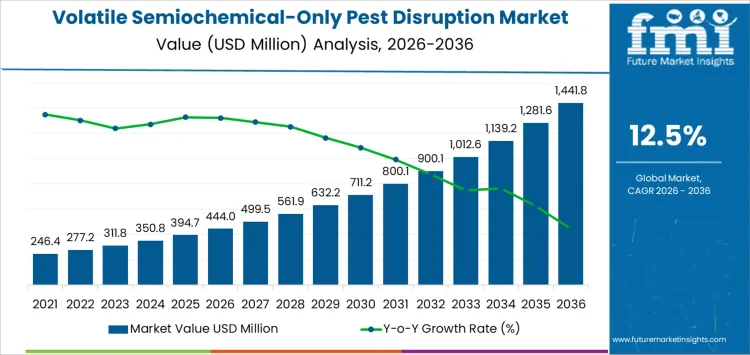
The demand for volatile semiochemical-only pest disruption technologies is accelerating as regulatory pressures tighten around synthetic pesticide use and the agricultural sector shifts towards eco-friendlier farming practices. The use of sex pheromones, particularly in disrupting mating behaviors in pests like moths and beetles, is central to this growth. Technological innovations in dispensers and emitters, as well as advancements in microencapsulation, are further boosting product performance and field adoption. While challenges such as development costs, formulation complexities, and varying field efficacy remain, the focus on durability, reduced pesticide residues, and environmental preservation is driving the widespread acceptance of semiochemical-based pest disruption solutions.
Volatile Semiochemical‑Only Pest Disruption Market Key Takeaways
| Metric | Value |
|---|---|
| Industry Value (2026) | USD 444 million |
| Forecast Value (2036) | USD 1,441.8 million |
| Forecast CAGR (2026–2036) | 12.5% |
How is the Global Volatile Semiochemical‑Only Pest Disruption Sector Advancing?
The global volatile semiochemical‑only pest disruption market is growing rapidly as agricultural producers seek eco-friendly, targeted pest management solutions that reduce reliance on conventional chemical pesticides. Volatile semiochemicals are naturally occurring compounds that influence insect behavior by disrupting mating, feeding, or aggregation patterns. Unlike traditional pesticides that kill pests directly, semiochemical‑only systems work by interfering with pest communication, reducing pest populations without harming beneficial organisms or the broader environment. This mode of action aligns with integrated pest management practices and helps producers meet consumer demand for reduced chemical residues in food.
Adoption of volatile semiochemical‑only pest disruption technologies is rising across a variety of crops including fruits, vegetables, cereals, and specialty crops. Growers are drawn to these solutions because they offer targeted disruption of pest life cycles, lower environmental impact, and compatibility with biological control methods. Advancements in formulation and delivery systems have improved the effectiveness and field performance of semiochemical products, enhancing stability, persistence, and ease of application in diverse agricultural settings.
The market is expected to expand strongly as regulatory pressures tighten around synthetic pesticide use and durability becomes a core component of crop protection strategies worldwide. Ongoing research into species‑specific semiochemicals and improved deployment technologies will further broaden their application and acceptance. Challenges such as development costs, the need for species‑specific optimization, and grower education on semiochemical use may influence adoption rates. Nonetheless, the growing focus on environmentally responsible pest management and ecosystem preservation will continue to drive demand for volatile semiochemical‑only pest disruption solutions globally.
What Is the Segment-Wise Analysis for the Global Volatile Semiochemical-Only Pest Disruption Market?
The global volatile semiochemical-only pest disruption market is segmented by semiochemical type and application format. Sex pheromones lead the market with a 46% share due to their widespread use in disrupting mating behavior in various pests. Other significant semiochemical types include aggregation pheromones, alarm pheromones, kairomones, and others. In terms of application formats, dispensers and emitters hold the largest share at 42%, followed by aerosol puffers, sprayable volatile blends, and microencapsulated systems.
How Do Sex Pheromones Lead the Global Volatile Semiochemical-Only Pest Disruption Market?
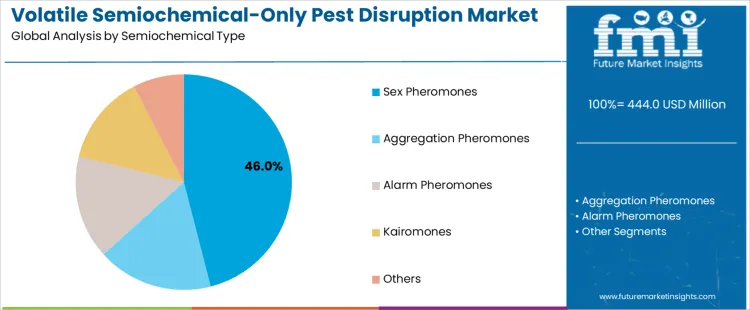
Sex pheromones hold a 46% share in the global volatile semiochemical-only pest disruption market due to their proven effectiveness in disrupting the mating behavior of pests. These pheromones interfere with the communication between male and female insects, preventing successful reproduction and significantly reducing pest populations. They are widely used in pest control programs, particularly for crops, where pests like moths and beetles cause extensive damage. Sex pheromones are increasingly popular due to their eco-friendly, non-toxic nature, offering an eco-friendly alternative to traditional chemical pesticides. As the agricultural industry shifts toward eco-friendlier pest management practices, the use of sex pheromones continues to grow, making them a dominant force in the market for pest disruption.
Why Do Dispensers & Emitters Hold the Largest Market Share in the Global Semiochemical Pest Disruption Market?
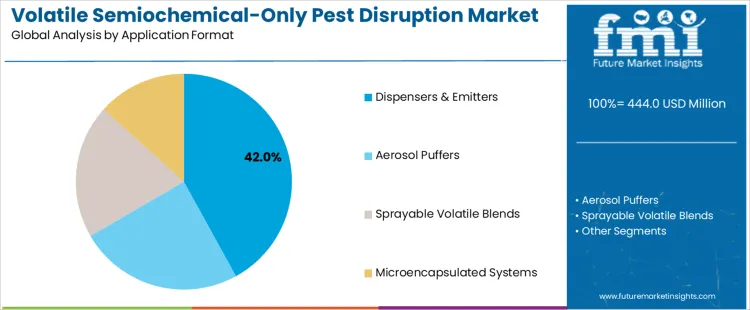
Dispensers and emitters hold the largest market share of 42% in the global volatile semiochemical-only pest disruption market because they provide a reliable and consistent method for releasing pheromones over extended periods. These systems ensure that pests are continuously exposed to the disruptive chemicals, which is critical for achieving long-term pest control. Dispensers and emitters are easy to use and highly effective in large-scale applications, such as agriculture and forestry. Their precision, ease of setup, and ability to deliver controlled doses of pheromones make them the preferred choice for eco-friendly pest management. As the demand for eco-friendly pest control solutions rises, dispensers and emitters remain the dominant application format in the market.
What Is Shaping the Volatile Semiochemical-Only Pest Disruption Market?
The volatile semiochemical only pest disruption market is shaped by the growing shift toward precision, ecologically sound pest management strategies. Semiochemicals are naturally occurring signaling compounds-such as pheromones and allelochemicals-that influence insect behavior without conventional toxicity. In pest disruption, volatile semiochemicals interfere with mating, host finding, or aggregation to reduce pest populations. As resistance to traditional pesticides rises and regulatory limits tighten on broad spectrum chemistries, growers and integrated pest management (IPM) programs increasingly adopt semiochemical tools that are species specific, low risk to non targets, and safe for beneficial organisms.
What Challenges Are Limiting Adoption of Volatile Semiochemical Only Pest Disruption Tools?
Adoption is constrained by perception and performance factors such as variable field efficacy across environmental conditions and pest pressures. Semiochemicals can be sensitive to temperature, humidity, and airflow, affecting distribution and behavior modifying outcomes. The upfront cost of semiochemical dispensers or emitters, along with the need for precise application timing and monitoring, can deter some growers. Limited awareness, experience, or agronomic support for integrating semiochemical disruption into existing pest programs also slows uptake, especially in regions where extension resources are scarce.
What Key Trends Are Shaping the Volatile Semiochemical Only Pest Disruption Market?
Key trends include innovation in high release, controlled emission dispensers and microencapsulation technologies that improve persistence and deployment flexibility. There is rising interest in combining semiochemical disruption with digital pest monitoring and predictive modeling to optimize timing and reduce product use. Multi species disruption strategies and “push pull” tactics that use attractants and repellents in concert are gaining traction. Partnerships between biotech firms and crop protection companies are accelerating product pipelines and market reach. Durability certifications and pressure from retail supply chains are encouraging adoption of low impact pest disruption tools in both conventional and organic systems.
What is the Growth Outlook for the Volatile Semiochemical-Only Pest Disruption Market by Country?
| Country | CAGR (%) |
|---|---|
| USA | 13.8% |
| Spain | 12.9% |
| Italy | 12.3% |
| China | 11.7% |
| Brazil | 11.1% |
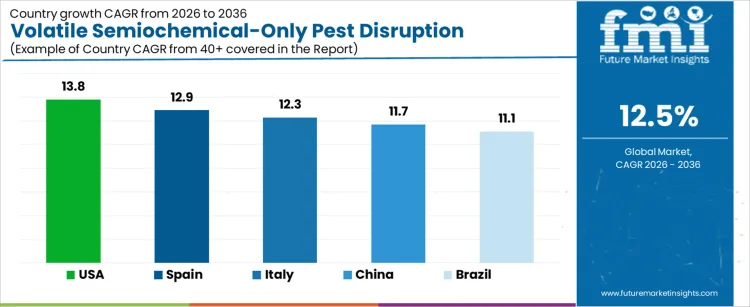
The volatile semiochemical-only pest disruption market is growing rapidly, with the USA leading at a 13.8% CAGR, driven by the increasing adoption of eco-friendly pest control solutions and rising demand for eco-friendlier agricultural practices. Spain follows with 12.9%, supported by strong interest in non-chemical pest management solutions. Italy’s market grows at 12.3%, fueled by rising demand for precision pest control methods. China’s market grows at 11.7%, driven by its vast agricultural base and increasing need for eco-friendly crop protection solutions. Brazil’s market grows at 11.1%, as its agricultural industry seeks effective, non-toxic alternatives to chemical pesticides.
Why is the USA Leading in the Volatile Semiochemical-Only Pest Disruption Market?
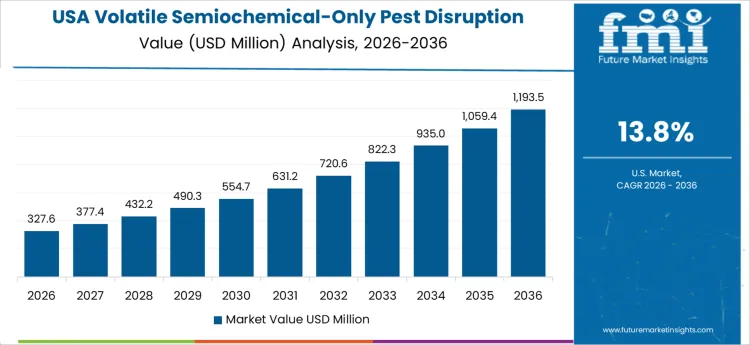
The USA’s volatile semiochemical-only pest disruption market is growing at 13.8%, driven by the increasing demand for eco-friendly pest control solutions. As agriculture in the USA faces growing challenges from pest resistance and environmental concerns, volatile semiochemicals are gaining popularity as an effective, eco-friendly alternative to traditional chemical pesticides. These semiochemicals offer a targeted approach to pest control, disrupting pest behavior without harming beneficial organisms. Government policies encouraging the reduction of pesticide use and the rise of organic farming are further boosting market growth. As farmers and agricultural industries in the USA continue to seek greener alternatives, the market for volatile semiochemicals in pest disruption is expected to grow rapidly, providing effective pest management solutions.
What is Driving the Growth of the Volatile Semiochemical-Only Pest Disruption Market in Spain?
Spain’s volatile semiochemical-only pest disruption market is growing at 12.9%, driven by a strong focus on eco-friendly agriculture and the need for alternative pest management solutions. As Spain's agricultural sector, particularly in crops like grapes, olives, and citrus, faces increasing pest challenges, volatile semiochemicals are becoming a preferred solution. These natural substances help disrupt pest behavior, reducing the need for chemical pesticides and minimizing environmental impact. With growing awareness of the benefits of integrated pest management (IPM) practices, Spanish farmers are increasingly adopting semiochemical-based solutions for effective pest disruption. EU regulations promoting the reduction of pesticide use are contributing to the adoption of more environmentally friendly pest control technologies in Spain.
How is the Volatile Semiochemical-Only Pest Disruption Market Expanding in Italy?
Italy’s volatile semiochemical-only pest disruption market is growing at 12.3%, fueled by the country’s large agricultural sector and increasing demand for eco-friendly pest control alternatives. Italy, known for its production of fruits, vegetables, and wine, is facing challenges from pest outbreaks, particularly in viticulture and orchards. Volatile semiochemicals are gaining popularity as a safe, non-toxic way to manage pests, especially in organic farming. These substances work by disrupting pest behavior, thus reducing pest populations without harmful chemical residues. As Italy focuses on improving crop protection and reducing the environmental impact of farming, the adoption of volatile semiochemical-based solutions is expected to continue growing, driven by both regulatory pressures and increasing consumer demand for eco-friendly agriculture.
What is Contributing to the Growth of the Volatile Semiochemical-Only Pest Disruption Market in China?
China’s volatile semiochemical-only pest disruption market is growing at 11.7%, driven by the country’s vast agricultural base and the increasing need for eco-friendly and effective pest management. As China seeks to improve food security and reduce the use of harmful chemical pesticides, volatile semiochemicals are emerging as an effective solution for pest disruption. These substances target pests specifically, reducing the need for broad-spectrum pesticides and minimizing environmental damage. The Chinese government’s push for eco-friendlier farming practices and the increasing demand for organic and pesticide-free produce are driving the adoption of semiochemical pest control technologies. As the market for integrated pest management grows in China, the demand for volatile semiochemical-only solutions is expected to rise steadily.
What is Driving the Growth of the Volatile Semiochemical-Only Pest Disruption Market in Brazil?
Brazil’s volatile semiochemical-only pest disruption market is growing at 11.1%, supported by the country’s large agricultural sector and the growing need for eco-friendly pest management practices. Brazil, a major producer of crops like soybeans, coffee, and sugarcane, is facing increasing pest challenges that threaten crop yields. The use of volatile semiochemicals offers an effective, non-toxic alternative to traditional chemical pesticides, helping to manage pests without harming the environment. As Brazil’s agricultural industry continues to focus on improving crop resilience and durability, the demand for semiochemical-based pest disruption solutions is expected to grow. The Brazilian government’s support for integrated pest management and reduction in pesticide usage is further accelerating the adoption of volatile semiochemical solutions in agriculture.
How Are Companies Competing in the Volatile Semiochemical-Only Pest Disruption Market?
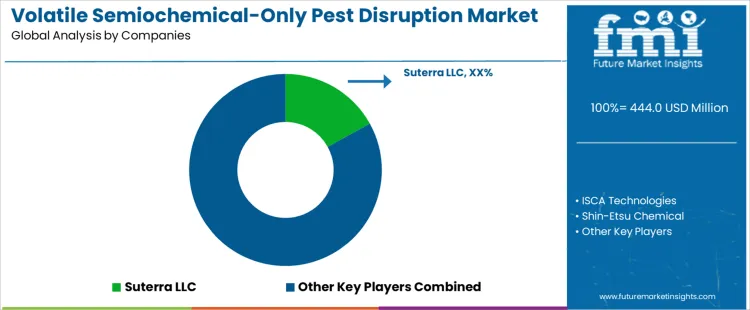
In the volatile semiochemical-only pest disruption market Suterra LLC, ISCA Technologies, Shin-Etsu Chemical, BASF SE, and Russell IPM are positioned with product brochures that emphasize innovative semiochemical chemistries and targeted pest behavior disruption. At Suterra LLC products are presented as pheromone-based lures and disruption systems designed for specific pest species. Detailed mode-of-action summaries are included alongside deployment guidance and expected field performance. ISCA Technologies is promoted with a portfolio of volatile semiochemical dispensers and attractants that are described with precision and ease of use. Application protocols and compatibility with integrated pest management programs are highlighted.
Shin-Etsu Chemical materials focus on high-purity semiochemical compounds formulated for consistent volatilization rates and long service life. Simple instructions and environmental stability data are featured to support adoption by crop consultants and pest control operators. BASF SE brochures describe volatile semiochemical sprays and dispensers tailored to key pests with emphasis on organism-specific disruption and minimal impact on beneficial species. Efficacy data is shown to support confidence in decision making. Russell IPM is positioned with catalogues that describe pheromone traps and disruptants engineered for orchard and specialty crop pests, with clear descriptions of placement strategies and expected longevity.
Key Players in Volatile Semiochemical‑Only Pest Disruption Market
- Suterra LLC
- ISCA Technologies
- Shin-Etsu Chemical
- BASF SE
- Russell IPM
Scope of Report
| Items | Values |
|---|---|
| Quantitative Units (2026) | USD million |
| Semiochemical Type | Sex Pheromones, Aggregation Pheromones, Alarm Pheromones, Kairomones, Others |
| Application Format | Dispensers & Emitters, Aerosol Puffers, Sprayable Volatile Blends, Microencapsulated Systems |
| Regions Covered | Asia Pacific, Europe, North America, Latin America, Middle East & Africa |
| Countries Covered | USA, China, Japan, South Korea, India, Australia & New Zealand, ASEAN, Germany, UK, France, Italy, Spain, Nordic, BENELUX, Brazil, Chile, Mexico, Saudi Arabia, Other GCC Countries, Turkey, South Africa, Other African Union |
| Key Companies Profiled | Suterra LLC, ISCA Technologies, Shin-Etsu Chemical, BASF SE, Russell IPM |
| Additional Attributes | Dollar sales by semiochemical type, application format, and region; regional CAGR and growth outlook; distribution channels including biocontrol service providers, pheromone-based solutions, and chemical suppliers; innovation trends in volatile semiochemicals; competitive positioning of global vs regional suppliers. |
Volatile Semiochemical‑Only Pest Disruption Market by Segments
Semiochemical Type:
- Sex Pheromones
- Aggregation Pheromones
- Alarm Pheromones
- Kairomones
- Others
Application Format:
- Dispensers & Emitters
- Aerosol Puffers
- Sprayable Volatile Blends
- Microencapsulated Systems
Region:
- Asia Pacific
- China
- Japan
- South Korea
- India
- Australia & New Zealand
- ASEAN
- Rest of Asia Pacific
- Europe
- Germany
- United Kingdom
- France
- Italy
- Spain
- Nordic
- BENELUX
- Rest of Europe
- North America
- United States
- Canada
- Mexico
- Latin America
- Brazil
- Chile
- Rest of Latin America
- Middle East & Africa
- Kingdom of Saudi Arabia
- Other GCC Countries
- Turkey
- South Africa
- Other African Union
- Rest of Middle East & Africa
Frequently Asked Questions
How big is the volatile semiochemical-only pest disruption market in 2026?
The global volatile semiochemical-only pest disruption market is estimated to be valued at USD 444.0 million in 2026.
What will be the size of volatile semiochemical-only pest disruption market in 2036?
The market size for the volatile semiochemical-only pest disruption market is projected to reach USD 1,441.8 million by 2036.
How much will be the volatile semiochemical-only pest disruption market growth between 2026 and 2036?
The volatile semiochemical-only pest disruption market is expected to grow at a 12.5% CAGR between 2026 and 2036.
What are the key product types in the volatile semiochemical-only pest disruption market?
The key product types in volatile semiochemical-only pest disruption market are sex pheromones, aggregation pheromones, alarm pheromones, kairomones and others.
Which application format segment to contribute significant share in the volatile semiochemical-only pest disruption market in 2026?
In terms of application format, dispensers & emitters segment to command 42.0% share in the volatile semiochemical-only pest disruption market in 2026.
Preview the report firsthand - request a free sample
Get SampleGet the brochure for pricing and purchase details.
Get PDFTable of Content
- Executive Summary
- Global Market Outlook
- Demand-side Trends
- Supply-side Trends
- Technology Roadmap Analysis
- Analysis and Recommendations
- Market Overview
- Market Coverage / Taxonomy
- Market Definition / Scope / Limitations
- Market Background
- Market Dynamics
- Drivers
- Restraints
- Opportunity
- Trends
- Scenario Forecast
- Demand in Optimistic Scenario
- Demand in Likely Scenario
- Demand in Conservative Scenario
- Opportunity Map Analysis
- Product Life Cycle Analysis
- Supply Chain Analysis
- Investment Feasibility Matrix
- Value Chain Analysis
- PESTLE and Porter’s Analysis
- Regulatory Landscape
- Regional Parent Market Outlook
- Production and Consumption Statistics
- Import and Export Statistics
- Market Dynamics
- Global Market Analysis 2021 to 2025 and Forecast, 2026 to 2036
- Historical Market Size Value (USD Million) Analysis, 2021 to 2025
- Current and Future Market Size Value (USD Million) Projections, 2026 to 2036
- Y-o-Y Growth Trend Analysis
- Absolute $ Opportunity Analysis
- Global Market Pricing Analysis 2021 to 2025 and Forecast 2026 to 2036
- Global Market Analysis 2021 to 2025 and Forecast 2026 to 2036, By Semiochemical Type
- Introduction / Key Findings
- Historical Market Size Value (USD Million) Analysis By Semiochemical Type , 2021 to 2025
- Current and Future Market Size Value (USD Million) Analysis and Forecast By Semiochemical Type , 2026 to 2036
- Sex Pheromones
- Aggregation Pheromones
- Alarm Pheromones
- Kairomones
- Others
- Y-o-Y Growth Trend Analysis By Semiochemical Type , 2021 to 2025
- Absolute $ Opportunity Analysis By Semiochemical Type , 2026 to 2036
- Global Market Analysis 2021 to 2025 and Forecast 2026 to 2036, By Application Format
- Introduction / Key Findings
- Historical Market Size Value (USD Million) Analysis By Application Format, 2021 to 2025
- Current and Future Market Size Value (USD Million) Analysis and Forecast By Application Format, 2026 to 2036
- Dispensers & Emitters
- Aerosol Puffers
- Sprayable Volatile Blends
- Microencapsulated Systems
- Y-o-Y Growth Trend Analysis By Application Format, 2021 to 2025
- Absolute $ Opportunity Analysis By Application Format, 2026 to 2036
- Global Market Analysis 2021 to 2025 and Forecast 2026 to 2036, By Region
- Introduction
- Historical Market Size Value (USD Million) Analysis By Region, 2021 to 2025
- Current Market Size Value (USD Million) Analysis and Forecast By Region, 2026 to 2036
- North America
- Latin America
- Western Europe
- Eastern Europe
- East Asia
- South Asia and Pacific
- Middle East & Africa
- Market Attractiveness Analysis By Region
- North America Market Analysis 2021 to 2025 and Forecast 2026 to 2036, By Country
- Historical Market Size Value (USD Million) Trend Analysis By Market Taxonomy, 2021 to 2025
- Market Size Value (USD Million) Forecast By Market Taxonomy, 2026 to 2036
- By Country
- USA
- Canada
- Mexico
- By Semiochemical Type
- By Application Format
- By Country
- Market Attractiveness Analysis
- By Country
- By Semiochemical Type
- By Application Format
- Key Takeaways
- Latin America Market Analysis 2021 to 2025 and Forecast 2026 to 2036, By Country
- Historical Market Size Value (USD Million) Trend Analysis By Market Taxonomy, 2021 to 2025
- Market Size Value (USD Million) Forecast By Market Taxonomy, 2026 to 2036
- By Country
- Brazil
- Chile
- Rest of Latin America
- By Semiochemical Type
- By Application Format
- By Country
- Market Attractiveness Analysis
- By Country
- By Semiochemical Type
- By Application Format
- Key Takeaways
- Western Europe Market Analysis 2021 to 2025 and Forecast 2026 to 2036, By Country
- Historical Market Size Value (USD Million) Trend Analysis By Market Taxonomy, 2021 to 2025
- Market Size Value (USD Million) Forecast By Market Taxonomy, 2026 to 2036
- By Country
- Germany
- UK
- Italy
- Spain
- France
- Nordic
- BENELUX
- Rest of Western Europe
- By Semiochemical Type
- By Application Format
- By Country
- Market Attractiveness Analysis
- By Country
- By Semiochemical Type
- By Application Format
- Key Takeaways
- Eastern Europe Market Analysis 2021 to 2025 and Forecast 2026 to 2036, By Country
- Historical Market Size Value (USD Million) Trend Analysis By Market Taxonomy, 2021 to 2025
- Market Size Value (USD Million) Forecast By Market Taxonomy, 2026 to 2036
- By Country
- Russia
- Poland
- Hungary
- Balkan & Baltic
- Rest of Eastern Europe
- By Semiochemical Type
- By Application Format
- By Country
- Market Attractiveness Analysis
- By Country
- By Semiochemical Type
- By Application Format
- Key Takeaways
- East Asia Market Analysis 2021 to 2025 and Forecast 2026 to 2036, By Country
- Historical Market Size Value (USD Million) Trend Analysis By Market Taxonomy, 2021 to 2025
- Market Size Value (USD Million) Forecast By Market Taxonomy, 2026 to 2036
- By Country
- China
- Japan
- South Korea
- By Semiochemical Type
- By Application Format
- By Country
- Market Attractiveness Analysis
- By Country
- By Semiochemical Type
- By Application Format
- Key Takeaways
- South Asia and Pacific Market Analysis 2021 to 2025 and Forecast 2026 to 2036, By Country
- Historical Market Size Value (USD Million) Trend Analysis By Market Taxonomy, 2021 to 2025
- Market Size Value (USD Million) Forecast By Market Taxonomy, 2026 to 2036
- By Country
- India
- ASEAN
- Australia & New Zealand
- Rest of South Asia and Pacific
- By Semiochemical Type
- By Application Format
- By Country
- Market Attractiveness Analysis
- By Country
- By Semiochemical Type
- By Application Format
- Key Takeaways
- Middle East & Africa Market Analysis 2021 to 2025 and Forecast 2026 to 2036, By Country
- Historical Market Size Value (USD Million) Trend Analysis By Market Taxonomy, 2021 to 2025
- Market Size Value (USD Million) Forecast By Market Taxonomy, 2026 to 2036
- By Country
- Kingdom of Saudi Arabia
- Other GCC Countries
- Turkiye
- South Africa
- Other African Union
- Rest of Middle East & Africa
- By Semiochemical Type
- By Application Format
- By Country
- Market Attractiveness Analysis
- By Country
- By Semiochemical Type
- By Application Format
- Key Takeaways
- Key Countries Market Analysis
- USA
- Pricing Analysis
- Market Share Analysis, 2025
- By Semiochemical Type
- By Application Format
- Canada
- Pricing Analysis
- Market Share Analysis, 2025
- By Semiochemical Type
- By Application Format
- Mexico
- Pricing Analysis
- Market Share Analysis, 2025
- By Semiochemical Type
- By Application Format
- Brazil
- Pricing Analysis
- Market Share Analysis, 2025
- By Semiochemical Type
- By Application Format
- Chile
- Pricing Analysis
- Market Share Analysis, 2025
- By Semiochemical Type
- By Application Format
- Germany
- Pricing Analysis
- Market Share Analysis, 2025
- By Semiochemical Type
- By Application Format
- UK
- Pricing Analysis
- Market Share Analysis, 2025
- By Semiochemical Type
- By Application Format
- Italy
- Pricing Analysis
- Market Share Analysis, 2025
- By Semiochemical Type
- By Application Format
- Spain
- Pricing Analysis
- Market Share Analysis, 2025
- By Semiochemical Type
- By Application Format
- France
- Pricing Analysis
- Market Share Analysis, 2025
- By Semiochemical Type
- By Application Format
- India
- Pricing Analysis
- Market Share Analysis, 2025
- By Semiochemical Type
- By Application Format
- ASEAN
- Pricing Analysis
- Market Share Analysis, 2025
- By Semiochemical Type
- By Application Format
- Australia & New Zealand
- Pricing Analysis
- Market Share Analysis, 2025
- By Semiochemical Type
- By Application Format
- China
- Pricing Analysis
- Market Share Analysis, 2025
- By Semiochemical Type
- By Application Format
- Japan
- Pricing Analysis
- Market Share Analysis, 2025
- By Semiochemical Type
- By Application Format
- South Korea
- Pricing Analysis
- Market Share Analysis, 2025
- By Semiochemical Type
- By Application Format
- Russia
- Pricing Analysis
- Market Share Analysis, 2025
- By Semiochemical Type
- By Application Format
- Poland
- Pricing Analysis
- Market Share Analysis, 2025
- By Semiochemical Type
- By Application Format
- Hungary
- Pricing Analysis
- Market Share Analysis, 2025
- By Semiochemical Type
- By Application Format
- Kingdom of Saudi Arabia
- Pricing Analysis
- Market Share Analysis, 2025
- By Semiochemical Type
- By Application Format
- Turkiye
- Pricing Analysis
- Market Share Analysis, 2025
- By Semiochemical Type
- By Application Format
- South Africa
- Pricing Analysis
- Market Share Analysis, 2025
- By Semiochemical Type
- By Application Format
- USA
- Market Structure Analysis
- Competition Dashboard
- Competition Benchmarking
- Market Share Analysis of Top Players
- By Regional
- By Semiochemical Type
- By Application Format
- Competition Analysis
- Competition Deep Dive
- Suterra LLC
- Overview
- Product Portfolio
- Profitability by Market Segments (Product/Age /Sales Channel/Region)
- Sales Footprint
- Strategy Overview
- Marketing Strategy
- Product Strategy
- Channel Strategy
- ISCA Technologies
- Shin-Etsu Chemical
- BASF SE
- Russell IPM
- Suterra LLC
- Competition Deep Dive
- Assumptions & Acronyms Used
- Research Methodology


