

- Industry Size (2026)
- USD 1.6 Bn
- Forecast (2036)
- USD 3.1 Bn
- CAGR (2026 to 2036)
- 7.2%
Protein Dispersion Aids Market Size, Market Forecast and Outlook By FMI
The protein dispersion aids market was valued at USD 1.5 billion in 2025. The sector is poised to cross USD 1.6 billion in 2026, with the 2026-2036 forecast period projecting a CAGR of 7.2%. Constant investment is leading the valuation to USD 3.1 billion through 2036 as beverage and food formulators systematically replace mechanical sheer requirements with chemical hydration kinetics to prevent protein agglomeration in high-concentration formats.
Formulation directors are currently being forced to shift from reactive troubleshooting, fixing grittiness or sedimentation late in the pilot phase, to upstream integration of precise dispersion aids during the initial protein specification. Delaying this integration functionally caps the total protein load a manufacturer can claim on the packaging without ruining the mouthfeel. Interestingly, the most intense formulation challenges are not occurring in complex solid matrices, but rather in clear ready to drink beverages where visual opacity and particulate suspension are immediately obvious to the consumer. This shift moves dispersion aids from a discretionary additive to a foundational ingredient in high-protein development.
Summary of Protein Dispersion Aids Market
- Protein Dispersion Aids Market Definition:
- This market tracks specialized functional additives that alter the surface tension and hydration kinetics of protein isolates. These aids are structurally necessary to achieve smooth mouthfeel and rapid solubility in high-concentration nutritional formats without relying solely on intensive mechanical sheer.
- Demand Drivers in the Market:
- Clean-label transition pressures compel brand formulation directors to seek natural phospholipids without sacrificing solubility.
- Increasing protein-per-serving targets in consumer goods push product development scientists to utilize advanced dispersion aids to prevent chalkiness at loads exceeding historical baselines.
- The shift toward non-dairy, plant-based substrates obligates processing engineers to adopt specialized wetting agents to handle inherently hydrophobic pulse and seed proteins.
- Key Segments Analyzed in the FMI Report:
- Lecithin: FMI’s proprietary estimates indicate Lecithin is expected to garner 41.2% share in 2026, as it remains a commercially scaled option that satisfies both amphiphilic functional requirements and clean-label consumer expectations.
- Plant-based: FMI’s proprietary estimates indicate Plant-based sources are anticipated to record 68.5% share in 2026, driven by the requirement to align the dispersion aid's origin with the underlying vegan protein base it is meant to hydrate.
- Beverages: FMI’s proprietary estimates indicate Beverages is poised to grab 35.4% share in 2026, because liquid formats have zero tolerance for particulate agglomeration, making dispersion aids functionally mandatory rather than optional.
- India: FMI’s proprietary estimates indicate 9.4% compound growth, reflecting the aggressive modernization of domestic dairy processing infrastructure to handle value-added nutritional powders.
- Analyst Opinion at FMI:
- Nandini Roy Choudhury Principal Analyst, Food and Beverage, at FMI, opines, "Standard market metrics accurately capture the rising volume of plant proteins moving through the supply chain. What they miss entirely is the disproportionate volume of dispersion aids required to make those specific proteins palatable. A switch from whey to pea protein does not mean a 1:1 replacement of the dispersion agent; it often requires a customized, higher-dose phospholipid blend to counter the intense hydrophobicity of the plant substrate, making the dispersion market grow faster than the underlying protein market."
- Strategic Implications / Executive Takeaways:
- Clean-label specification directors must prioritize sunflower-derived phospholipids to build resilience against emerging allergen-declaration mandates.
- Protein isolate manufacturers transitioning from animal to plant substrates should secure long-term enzymatic modification partnerships to ensure parity in dispersion kinetics.
- Pilot-plant engineers face the constraint of legacy mixing equipment lacking the shear necessary for new plant proteins, necessitating early-stage integration of tailored hydration agents rather than retroactive mechanical homogenization.
- Methodology:
- Research relies on technical interviews with formulation scientists and procurement heads at top-tier nutrition brands. Desk research aggregates clean-label registry data and regulatory standards. The baseline is mathematically derived from the total volume of high-purity protein isolates produced globally.
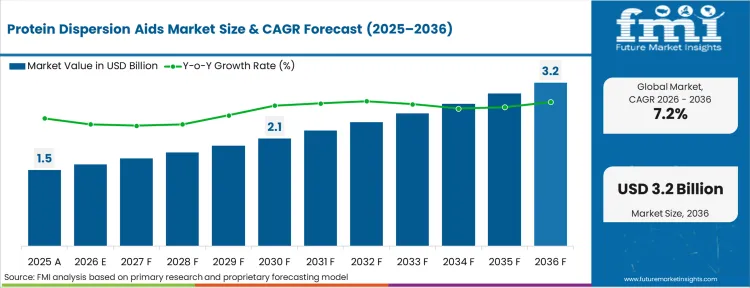
The gate for self-reinforcing growth is the achievement of instantized clean-label dispersibility without synthetic emulsifiers. Ingredient processors trigger this threshold when they successfully match the amphiphilic properties of legacy components using plant-derived phospholipids. Once this functional parity is established, brands can transition their entire portfolio without maintaining dual inventories for conventional and clean-label lines.
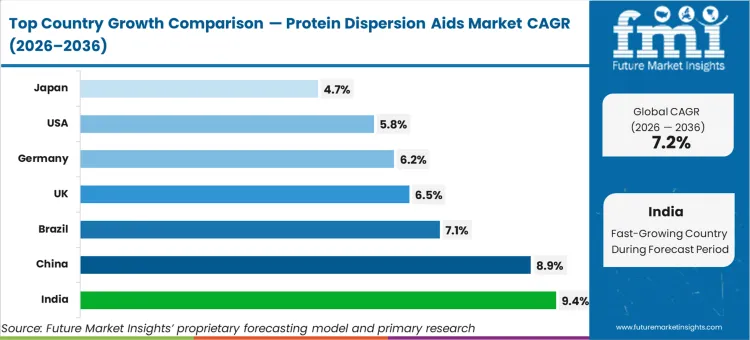
FMI’s proprietary estimates indicate India is anticipated to advance at a CAGR of 9.4%, followed by China, which is estimated to post an 8.9% compound rate. Brazil is projected to witness growth at 7.1%, while the United Kingdom is set to register 6.5%. Germany tracks closely behind, poised to expand at 6.2%, outpacing the United States at 5.8% and Japan at 4.7%. The divergence across these geographies stems fundamentally from the speed at which domestic dairy processors are forced to pivot toward high-concentration alternative protein lines to defend margins against import competition.
Protein Dispersion Aids Market Key Takeaways
| Metric | Details |
|---|---|
| Industry Size (2026) | USD 1.6 billion |
| Industry Value (2036) | USD 3.1 billion |
| CAGR (2026-2036) | 7.2% |
Source: Future Market Insights (FMI) analysis, based on proprietary forecasting model and primary research
Protein Dispersion Aids Market Definition
The protein dispersion aids market encompasses specialized chemical and biochemical additives used to reduce the surface tension between protein isolates and aqueous phases. These functional ingredients prevent the clumping, sedimentation, and grittiness associated with high-density protein formulations. The category is analytically distinct from general texturizers because these aids specifically target the hydration kinetics and micelle stability of complex protein polymers during mechanical mixing.
Protein Dispersion Aids Market Inclusions
This sector includes plant-derived lecithins, specialized mono- and diglycerides, polysorbates, and enzymatically modified starches that function directly as emulsifying stabilization agents for protein hydration. The scope covers both standalone dispersion powders and liquid aids integrated at the dry-blending stage by primary ingredient processors, as well as those added at the vat stage by consumer-packaged goods manufacturers.
Protein Dispersion Aids Market Exclusions
General hydrocolloids used purely for viscosity modification, such as xanthan gum or basic carrageenan without specific protein-interaction claims, are excluded. Standard bulk proteins and basic whey concentrates are also excluded, as they represent the substrate being dispersed rather than the functional aid. Based on Codex Alimentarius frameworks, if an ingredient solely thickens the continuous phase rather than actively modifying the protein's hydration shell, it falls outside this specific tracking boundary.
Protein Dispersion Aids Market Research Methodology
- Primary Research: FMI analysts interview principal formulation scientists, plant operations directors, and category procurement heads at tier-1 food and beverage manufacturers.
- Desk Research: Data aggregation focuses on regulatory food additive registries, patent filings for amphiphilic modification, and clean-label certification standards.
- Market-Sizing and Forecasting: The baseline anchors to the volume of concentrated protein isolates (>80% purity) moving through the global supply chain, calculating the stoichiometric ratios of dispersion aids required to hydrate those specific volumes. Note: Figures derived from internal stoichiometric modelling of protein isolate volumes; independent verification against public sources was not possible as of March 2026.
- Data Validation and Update Cycle: Forecast trajectories are cross-validated against the capital expenditure cycles of major ingredient processing facilities transitioning from synthetic to plant-based extraction capabilities.
Segmental Analysis
Protein Dispersion Aids Market Analysis by Product Type
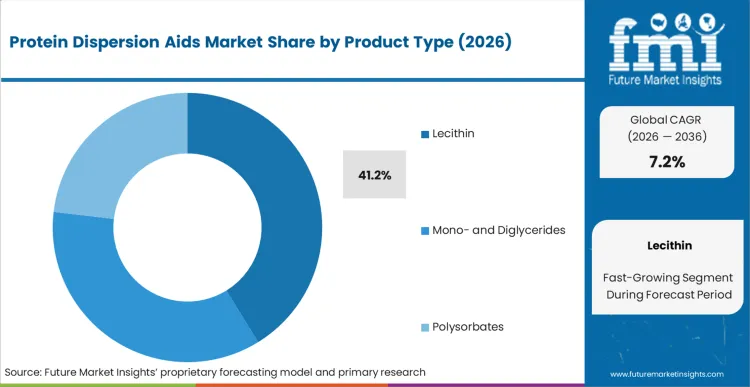
Legacy mono- and diglycerides fail to deliver the functional transparency modern brands require, creating a strict displacement cycle favoring natural phospholipids. FMI’s proprietary estimates indicate Lecithin, derived primarily from soy and sunflower, accounts for 41.2% of the total valuation in 2026. Procurement directors heavily favor this specific chemistry because it bridges the gap between effective hydration and short ingredient decks. The operational advantage lies in lecithin's ability to act as both a wetting agent and a viscosity modifier, reducing the total number of additives required in a beverage base. Moving to these advanced plant lecithins allows facilities to lower continuous processing temperatures, directly impacting energy expenditure per batch.
- Cost realization: Plant lecithins allow processors to decrease continuous blending temperatures by reducing the kinetic energy needed for hydration. Facilities capture this energy reduction and offset the higher per-kilo ingredient cost within a single production quarter.
- Hidden expenditures: Formulators attempting to use low-grade soy lecithins frequently encounter off-flavor masking requirements. Procurement teams end up spending the initial savings on expensive natural masking flavors to hide the earthy notes.
- Lifecycle parity: Total formulation cost analysis reveals that premium, enzymatically modified lecithins eliminate the need for secondary mechanical homogenization steps, proving more economical than standard commodity emulsifiers over the full production run.
Protein Dispersion Aids Market Analysis by Source
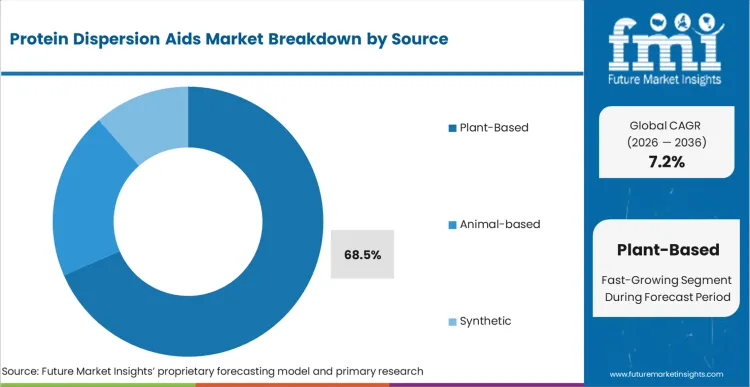
The reason plant-based dispersion aids are highly preferred lies in the rigid formulation rules of the vegan nutritional space, which prohibit the use of animal-derived emulsifiers. FMI analysts opine that formulators are locked into plant-derived sources because a single non-compliant processing aid invalidates the entire product's certification. FMI’s proprietary estimates indicate plant-based aids hold 68.5% of the sector. These plant-derived aids interact with the hydrophobic nodes of pea, rice, and soy proteins, physically preventing the protein chains from cross-linking and forming sediment. By integrating specialized sunflower or canola lecithins, R&D teams ensure the final product remains stable under varying thermal conditions on the retail shelf.
- Phase separation: Inferior plant lecithins fail to maintain the hydration shell around complex pulse proteins. The suspension collapses, forcing the brand to issue product recalls due to unacceptable visual separation in clear packaging.
- Residual flavor: Unrefined plant sources often carry distinct botanical notes that clash with delicate flavor profiles. Product developers must reformulate the entire flavor system to compensate, extending the launch timeline by months.
- Operational correction: To capture the full stabilization benefit of high-grade plant aids, facility engineers must calibrate high-shear mixers specifically to the hydration curve of the exact botanical source being used.
Protein Dispersion Aids Market Analysis by Application
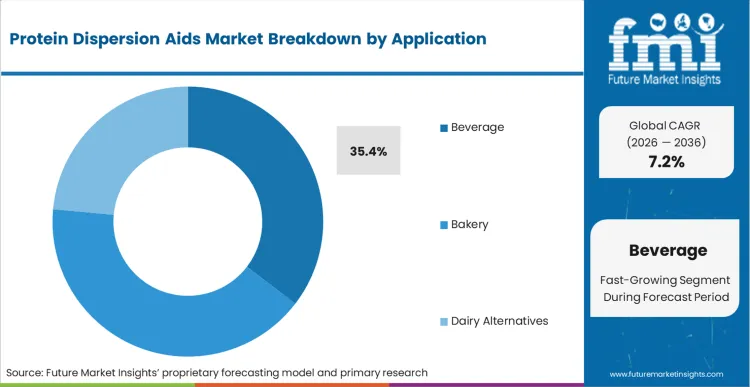
The commercial consequence of poor protein hydration is most severe in liquid formats, where gritty textures cannot be masked by baking or chewing, making precise dispersion aids structurally mandatory for the beverage category. FMI’s proprietary estimates indicate the beverage application dominates with 35.4% share in 2026, because the visual and textural tolerances for nutritional drinks are incredibly narrow. As per FMI's projection, formulation scientists working on ready-to-drink lines use specialized aids to lower the interfacial tension of the liquid, allowing the protein powder to wet out instantly without forming a gel layer. This immediate hydration eliminates the need for prolonged batch mixing, clearing bottlenecked mixing tanks faster.
- Initial specification: The decision to specify a premium dispersion aid occurs the moment marketing demands a protein-per-serving increase that exceeds the historical liquid baseline.
- Qualification validation: During pilot runs, the chosen aid validates its presence by demonstrating zero powder clumps at the bottom of the hydration vat, proving its efficacy to the plant operations director.
- Expansion trigger: Buyers renew and expand their contracts with specialized aid suppliers when they attempt to scale from neutral-pH dairy to acidic plant-beverage profiles, which require entirely different, highly specialized dispersion kinetics.
Protein Dispersion Aids Market Drivers, Restraints, and Opportunities
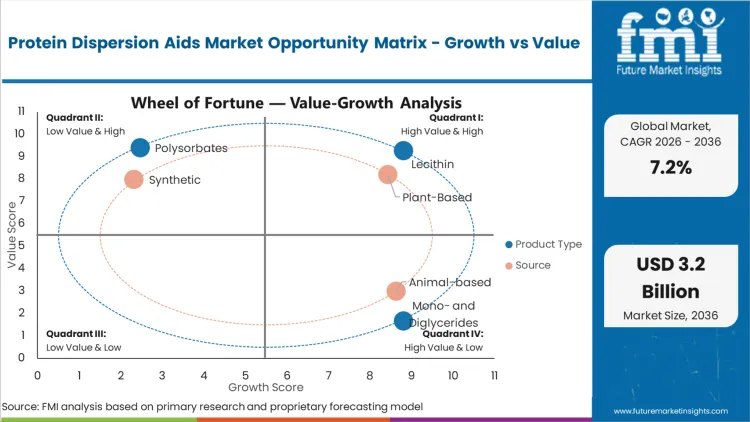
Formulation directors at tier-1 nutrition brands are being forced to solve a direct contradiction: marketing teams mandate higher protein loads, while retail buyers demand cleaner, shorter ingredient labels. This pressure requires formulation teams to shift away from legacy synthetic emulsifiers and specify high-performance, natural dispersion aids capable of handling extreme protein densities. The commercial stakes are absolute; failing to achieve a smooth mouthfeel in a high-protein format results in immediate consumer rejection after the first trial, destroying the entire return on investment for the new product launch regardless of the protein's nutritional quality.
The primary friction in this space is the complex, unpredictable interaction between novel alternative proteins and standard dispersion aids. Plant operations heads face a reality where an aid that perfectly disperses soy isolate completely fails when applied to novel lentil or chickpea proteins due to different surface charge profiles. This is not a temporary cost barrier but a limitation requiring bespoke matching of aid to protein substrate. While custom phospholipid blends are emerging to solve this, their development requires months of collaborative pilot testing between the ingredient supplier and the CPG manufacturer, significantly slowing the speed to market for new formulations.
Opportunities in the Protein Dispersion Aids Market
- Acidic beverage stabilization: Clear, high-protein acidic drinks inherently resist stable hydration. Formulators who master specialized enzymatically modified lecithins can capture the highly profitable sports hydration segment without relying on milky, neutral-pH formats.
- Pre-agglomerated powders: Protein isolate manufacturers face pressure to deliver ready-to-use ingredients. Bulk processors who pre-spray their protein lines with liquid dispersion aids capture premium pricing by eliminating the hydration step entirely for their downstream brand customers.
- Allergen-free transition: The move away from soy-derived ingredients leaves a massive gap in the supply chain. Processors who secure scalable yields of sunflower-derived phospholipids position themselves as the default supplier for all allergen-sensitive nutritional portfolios.
Regional Analysis
Based on the regional analysis, the protein dispersion aids market is segmented into North America, Europe, Asia Pacific, and other key global territories across 40 plus countries.
.webp "Top Country Growth Comparison Protein Dispersion Aids Market Cagr (2026 2036)")
| Country | CAGR (2026 to 2036) |
|---|---|
| India | 9.4% |
| China | 8.9% |
| Brazil | 7.1% |
| United Kingdom | 6.5% |
| Germany | 6.2% |
| United States | 5.8% |
| Japan | 4.7% |
Source: Future Market Insights (FMI) analysis, based on proprietary forecasting model and primary research
North America Protein Dispersion Aids Market Analysis
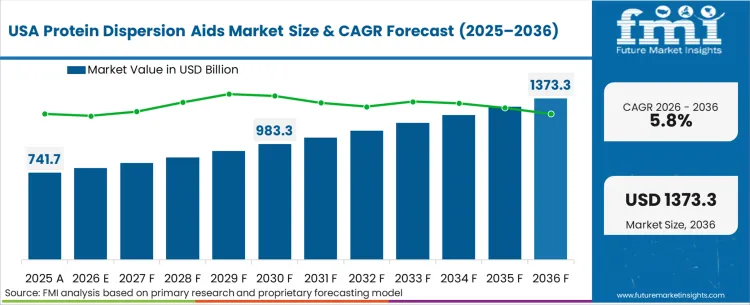
Procurement practices and qualification standards in North America food manufacturing create a distinct adoption pattern heavily weighted toward custom-blended, application-specific dispersion systems rather than bulk commodities. Buyers here do not purchase generic lecithins; they source highly calibrated systems designed to interface with specific proprietary protein blends. Based on FMI's assessment, this exactness stems from the region's hyper-fragmented sports nutrition sector, where mouthfeel is the primary differentiator between competing brands using identical base proteins. Formulators rely heavily on these tailored aids to push the boundaries of meal replacement bars and ready-to-drink shakes.
- United States: The intense fragmentation of the US sports nutrition sector forces contract manufacturers to run multiple different protein formulations on the same equipment daily. Facility managers rely on highly versatile, premium dispersion aids to ensure rapid line changeovers without requiring intense mechanical clean-outs between batches. FMI estimates the dispersion aids market in the United States to expand at an annual growth rate of 5.8%. Operations teams that master the application of these specific wetting agents open up capacity to take on complex, high-margin plant protein contracts that less sophisticated co-packers cannot handle.
FMI's report includes deep assessments of the Canadian and Mexican processing environments. Across these adjacent markets, the reliance on cross-border supply chains forces processors to heavily specify shelf-life extending dispersion aids to survive varied distribution temperatures.
Europe Protein Dispersion Aids Market Analysis
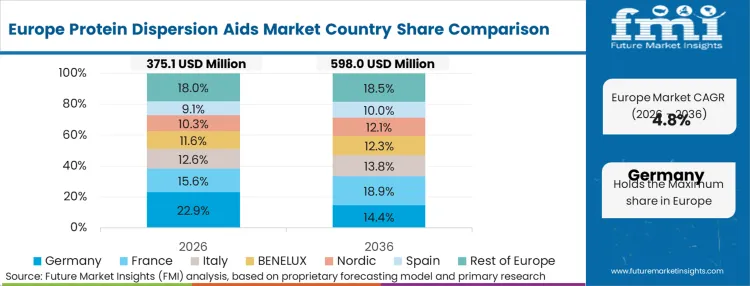
Europe’s trajectory is shaped by stringent clean-label consumer preferences and ongoing regulatory scrutiny of synthetic additives, which has accelerated the shift away from polysorbates toward natural phospholipid alternatives in many brand portfolios. The consumer environment here actively resists the use of E-numbers, pushing procurement directors to exhaust all natural phospholipid options before considering a synthetic fallback. In FMI's view, this clean-label pressure accelerates the development of specialized enzymatic modification techniques for raw plant materials. The region effectively serves as the global proving ground for clean-label emulsification technologies.
- United Kingdom: Highly consolidated retail grocery landscape in the UK exerts immense pressure on private-label manufacturers to perfectly mimic the smooth textures of premium international brands using strict clean-label ingredients. Formulation teams operating under these retailer mandates must utilize advanced enzymatically modified lecithins to achieve parity. Over the forecast period, demand for protein dispersion aids in the United Kingdom is set for a CAGR of 6.5%. Successfully integrating these specific aids simplifies the internal blending operation, permanently clearing the historical bottleneck associated with hydrating raw pea proteins.
- Germany: Germany's updated dietary guidelines and immense domestic processing capacity create a rigid boundary against highly processed food additives. Food engineers running German dairy-alternative lines operate under strict sourcing specifications. The German market for protein dispersion aids is likely to post a CAGR of 6.2%. By mastering complex natural phospholipid networks early, German manufacturers create a significant competitive gap, positioning themselves to easily export premium, clean-label formulations across the broader EU bloc.
FMI's report includes analysis of the Nordics and France, where stringent national nutrition profiles compel food engineers to adopt dispersion techniques that also protect the integrity of fortified micronutrients.
Asia Pacific Protein Dispersion Aids Market Analysis
The physical processing infrastructure across the Asia Pacific region dictates a fundamentally different adoption curve, heavily characterized by the rapid installation of new, massive-scale protein extraction facilities. Unlike mature markets retrofitting old equipment, processors here are designing new production lines that natively integrate dispersion aid spray-drying directly into the primary protein manufacturing process. FMI analysts opine that this infrastructure-led dynamic shifts the purchasing power from the downstream beverage brand back to the upstream ingredient processor. Consequently, the volume of dispersion aids moving through bulk channels significantly outpaces discrete ingredient sales to end-product formulators.
- India: The modernization of India's legacy dairy infrastructure specifically to handle value-added whey and plant-protein isolates dictates the procurement of bulk dispersion aids. Facility directors upgrading local cooperatives must adapt formulations to function within supply chains that experience extreme thermal fluctuations. FMI’s proprietary estimates indicate the market for protein dispersion aids in India is forecast to register a CAGR of 9.4%. The reality on the ground is that these aids are not being used to create hyper-premium sports drinks, but rather to ensure basic fortified nutritional powders remain soluble in cold water for the mass domestic consumer.
- China: Expansion of soy protein processing capabilities fundamentally requires the co-development of massive domestic lecithin extraction volumes. Plant managers operating these new mega-facilities embed liquid dispersion systems at the exact point of spray drying, effectively controlling the functionality of the global supply. China is expected to see its dispersion sector grow at a compound annual rate of 8.9%. This integration signals the transition of the Chinese market from a raw material exporter to the primary global supplier of pre-agglomerated, instantized protein ingredients.
- Japan: Japan's aging demographic profile forces medical nutrition formulators to push unprecedented volumes of protein into tiny liquid servings for consumers with swallowing difficulties. Research scientists in this highly specialized environment operate under extreme viscosity constraints, relying on cutting-edge nano-dispersion techniques. Sales of dispersion products in Japan are on track to record a CAGR of 4.7%. Formulators who crack the code on ultra-low viscosity, high-protein suspensions secure immediate, lucrative contracts within the heavily regulated clinical nutrition procurement networks.
FMI's report includes South Korea and Southeast Asian hubs, where rapid urbanization and Westernized dietary shifts structurally accelerate the need for highly soluble, on-the-go protein formats.
Competitive Aligners for Market Players
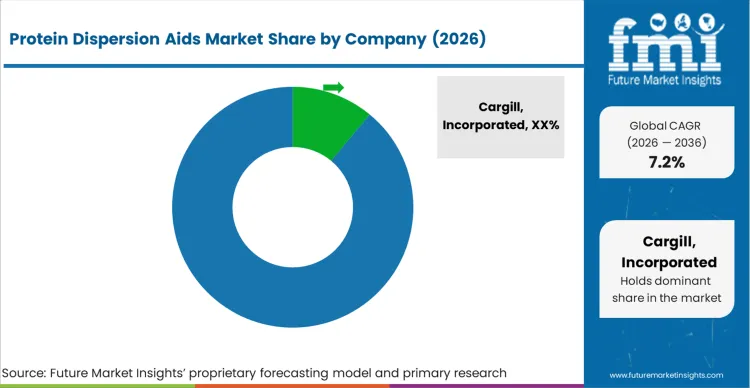
The competitive structure of this market is heavily concentrated around a few massive agribusiness conglomerates that control the primary extraction of both the base proteins and the raw lecithins. Because securing consistent, high-quality phospholipids requires immense raw material processing scale, smaller specialty chemical firms struggle to compete on bulk pricing. Procurement directors at major food brands use supply chain traceability as the primary variable to distinguish qualified from unqualified vendors, heavily favoring incumbents who own the entire chain from the seed crushing facility to the final functional blend.
Incumbents like ADM, Cargill, and Kerry Group possess a specific advantage: they can perfectly calibrate their proprietary dispersion aids to match the exact surface tension requirements of their own proprietary protein isolates. This advantage persists because the interaction between protein and aid is highly specific; an aid optimized for Cargill's pea protein may fail on a competitor's isolate. A challenger must build a highly adaptive, application-specific technical service network, a capability category focused entirely on pilot-plant troubleshooting, rather than simply matching the chemical specification of the base phospholipid to disrupt this dynamic.
Large food and beverage buyers actively resist this bundled lock-in by designing procurement frameworks that separate the purchase of bulk protein from the functional dispersion aids. There is a tension between buyers wanting modular, interchangeable ingredients and dominant vendors incentivized to sell inseparable, pre-agglomerated systems. Through 2036, the market is structurally biased toward further concentration, as the capital required to develop advanced enzymatic modification capabilities physically prices out mid-tier formulators, forcing them into narrow, niche application corners.
Key Players in Protein Dispersion Aids Market
- Cargill, Incorporated
- Archer Daniels Midland Company (ADM)
- Ingredion Incorporated
- Kerry Group plc
- Tate & Lyle PLC
- International Flavors & Fragrances Inc. (IFF)
- Palsgaard A/S
Scope of the Report
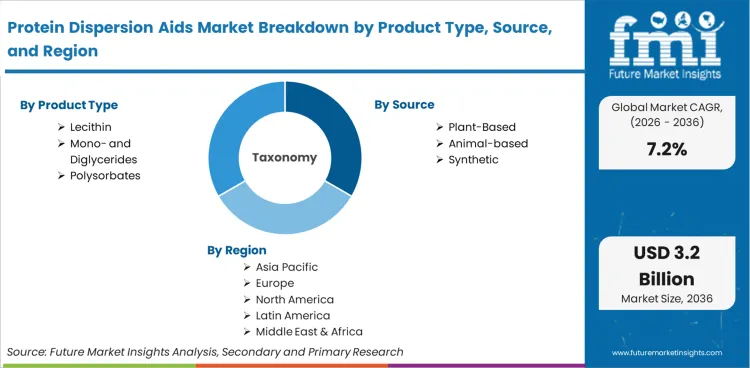
| Metric | Value |
|---|---|
| Quantitative Units | USD 1.6 billion to USD 3.1 billion, at a CAGR of 7.2% (Based on proprietary stoichiometric modeling) |
| Market Definition | The market tracks specialized chemical and biochemical additives that actively lower the surface tension and alter the hydration kinetics of protein isolates. This explicitly covers ingredients designed to prevent agglomeration and sedimentation in high-density protein formulations during mechanical mixing. |
| Product Type Segmentation | Lecithin, Mono- and Diglycerides, Polysorbates, Others |
| Source Segmentation | Plant-based, Animal-based, Synthetic |
| Application Segmentation | Beverages, Bakery, Dairy Alternatives, Sports Nutrition, Others |
| Regions Covered | North America, Latin America, Europe, Asia Pacific |
| Countries Covered | United States, Germany, United Kingdom, China, India, Japan, Brazil, and 40 plus countries |
| Key Companies Profiled | ADM, Cargill, Kerry Group, Ingredion, Tate & Lyle, IFF, Palsgaard, BASF |
| Forecast Period | 2026 to 2036 |
| Approach | Primary research targeted formulation scientists and operations heads. The data foundation anchors on internal stoichiometric modeling of global high-purity protein isolate volumes; independent verification against public sources was not possible as of March 2026. |
Source: Future Market Insights (FMI) analysis, based on proprietary forecasting model and primary research
Protein Dispersion Aids Market Analysis by Segments
Product Type:
- Lecithin
- Mono- and Diglycerides
- Polysorbates
- Others
Source:
- Plant-based
- Animal-based
- Synthetic
Application:
- Beverages
- Bakery
- Dairy Alternatives
- Sports Nutrition
- Others
Region:
- North America
- United States
- Canada
- Latin America
- Brazil
- Mexico
- Argentina
- Europe
- Germany
- United Kingdom
- France
- Asia Pacific
- China
- India
- Japan
- Middle East & Africa
- South Africa
- GCC Countries
Bibliography
- Liu, Y., Zhang, H., & Chen, X. (2024, March). Food emulsions stabilized by proteins and emulsifiers: Mechanisms and applications. Carbohydrate Polymers.
- Etzbach, L., et al. (2024, December). Opportunities and challenges of plant proteins as functional food ingredients. Proceedings of the National Academy of Sciences.
- Jiang, H., Zhang, L., & Liu, C. (2025, August). A comprehensive review of the rehydration of instant powders: Mechanisms and improvement strategies. Foods.
- Eskandari, B., et al. (2025, July). Effect of plant protein emulsifiers and carriers on spray-dried food emulsions. Scientific Reports.
- Aruchunan, U., et al. (2025, March). Role of protein-lipid interactions for food and food-based applications. International Dairy Journal.
- Mao, T., Xu, X., & Winkler, P. (2024, April). Amino acids stabilizing effect on protein and colloidal dispersions. Colloids and Interfaces Science (preprint research).
This bibliography is provided for reader reference. The full FMI report contains the complete reference list with primary source documentation.
This Report Addresses
- Market intelligence to support strategic decision making across plant-based lecithins, enzymatically modified starches, and synthetic polysorbate categories.
- Market size estimation and 10-year revenue forecasts from 2026 to 2036, supported by stoichiometric calculations of global protein isolate volumes.
- Growth opportunity mapping across product type, source, and application dimensions with emphasis on the achievement of instantized clean-label dispersibility.
- Segment and regional revenue forecasts covering clear acidic beverages and neutral dairy alternatives across clean-label consumer environments in Europe.
- Competition strategy assessment including supply chain traceability, proprietary protein-aid matching, and application-specific technical service network development.
- Product development tracking including clean-label phospholipid networks, nano-dispersion techniques, and extreme thermal-fluctuation stabilizers.
- Market access analysis covering European regulatory scrutiny on additives, vegan certification qualification standards, and medical nutrition procurement pathways.
- Market report delivery in PDF, Excel, PPT, and interactive dashboard formats for executive strategy, formulation R&D planning, and operational benchmarking use.
Frequently Asked Questions
How large is the protein dispersion aids market in 2026?
FMI’s proprietary estimates project the sector to reach USD 1.6 billion in 2026. This figure indicates the massive scale at which food manufacturers are deploying chemical additives specifically to manage the mechanical failures of high-protein formulations.
What will it be valued at by 2036?
The valuation is expected to reach USD 3.1 billion by 2036. This sustained trajectory signals a shift where dispersion technology becomes entirely integrated into the base protein manufacturing process rather than remaining an end-user formulation step.
What CAGR is projected?
The market advances at a CAGR of 7.2%. This rate reflects the timeline of brand reformulation toward natural emulsifiers, tightly tracking the capital expenditure cycles of major ingredient processing facilities.
Which product type segment leads?
Lecithin holds 41.2% of the market because it is the only commercially scalable additive that bridges the functional gap between powerful hydration kinetics and the strict requirements of clean-label consumer profiles.
Which source segment leads?
Plant-based sources dominate with 68.5% share because the rapidly expanding vegan and dairy-alternative sectors explicitly forbid the cross-contamination of animal-derived processing aids within their certified product portfolios.
Which application segment leads?
The beverages segment leads with 35.4% share, fundamentally driven by the reality that liquid formats offer zero masking potential for poorly hydrated proteins, making precise dispersion kinetics structurally mandatory.
What drives rapid growth?
Clean-label transition pressures force formulation scientists to systematically move away from synthetic polysorbates and re-engineer their entire liquid portfolios using complex, high-dose natural phospholipid networks.
What is the primary restraint?
The unpredictability of novel plant proteins forces plant managers to completely recalibrate their dispersion aids for every new substrate, as an aid that stabilizes soy will frequently cause a lentil isolate to precipitate entirely.
Which country grows fastest?
India advances at 9.4%, outpacing China's 8.9%. While China focuses on massive export-oriented protein extraction, India's growth is driven by the immediate retrofit of its legacy domestic dairy infrastructure to handle modern, fortified nutritional powder blending.
How do European clean-label trends impact product development?
Stringent consumer preferences and regulatory scrutiny in Europe actively push brands away from synthetic additives. This forces procurement teams to exhaust enzymatically modified plant lecithins before any product can enter pilot testing for regional retail distribution.
How does nano-dispersion change medical nutrition formulations?
In clinical settings, formulators must push unprecedented protein loads into very small liquid volumes. Nano-dispersion techniques break the hydration shell without massively increasing viscosity, allowing these dense formulations to remain pumpable and swallowable.
Why do bulk protein suppliers hold a competitive advantage?
Large agribusinesses calibrate proprietary dispersion aids specifically to their own protein isolates. By offering these as a pre-agglomerated, inseparable system, they effectively lock out specialty chemical firms who cannot guarantee the same performance on generic proteins.
Why is sunflower lecithin gaining traction over soy?
Sunflower-derived phospholipids allow processors to completely bypass the allergen declaration requirements associated with soy processing. Removing this single allergen label opens access to the highly profitable, allergen-sensitive school and clinical nutrition channels.
What is the operational penalty of using low-grade dispersion aids?
Facilities using inferior aids experience rapid phase separation in the vat, forcing operations directors to extend high-shear mixing times by hours, which bottlenecks the entire facility and degrades the nutritional profile of the base protein through excess heat.
How does the acidic beverage segment alter dispersion requirements?
Low-pH environments inherently cause complex proteins to denature and crash out of suspension. Formulating clear sports drinks requires an entirely different class of enzymatically modified aids compared to those used in neutral dairy milks.
Why is the United States market so heavily reliant on tailored systems?
The hyper-fragmentation of US sports nutrition forces contract manufacturers to run vastly different formulations daily. They rely on highly calibrated, custom dispersion systems to ensure rapid line changeovers without complete mechanical tear-downs.
How does pre-agglomeration shift market power?
When protein manufacturers spray liquid dispersion aids onto their powders during initial extraction, they eliminate the need for the downstream food brand to purchase wetting agents, effectively capturing that revenue stream entirely for themselves.
Why are mono- and diglycerides losing market share?
These legacy components fail to deliver the functional transparency required by modern nutrition brands. Their inability to match the performance of advanced lecithins in complex pulse-protein matrices renders them obsolete for new product development.
How do Japanese viscosity constraints shape local procurement?
Japan's aging demographic requires hyper-dense protein shots that remain water-thin. Research scientists in this region must source the most advanced, ultra-low viscosity wetting agents available, prioritizing fluid mechanics over raw ingredient cost.
What dictates the choice between liquid and powder dispersion aids?
The choice depends entirely on the facility's legacy equipment. Dry blending operations are structurally locked into powder aids, whereas facilities with advanced vat-injection systems utilize liquid aids to avoid the dust explosion hazards associated with fine powders.
Preview the report firsthand - request a free sample
Get SampleGet the brochure for pricing and purchase details.
Get PDFTable of Content
- Executive Summary
- Global Market Outlook
- Demand-side Trends
- Supply-side Trends
- Technology Roadmap Analysis
- Analysis and Recommendations
- Market Overview
- Market Coverage / Taxonomy
- Market Definition / Scope / Limitations
- Research Methodology
- Chapter Orientation
- Analytical Lens and Working Hypotheses
- Market Structure, Signals, and Trend Drivers
- Benchmarking and Cross-market Comparability
- Market Sizing, Forecasting, and Opportunity Mapping
- Research Design and Evidence Framework
- Desk Research Programme (Secondary Evidence)
- Company Annual and Sustainability Reports
- Peer-reviewed Journals and Academic Literature
- Corporate Websites, Product Literature, and Technical Notes
- Earnings Decks and Investor Briefings
- Statutory Filings and Regulatory Disclosures
- Technical White Papers and Standards Notes
- Trade Journals, Industry Magazines, and Analyst Briefs
- Conference Proceedings, Webinars, and Seminar Materials
- Government Statistics Portals and Public Data Releases
- Press Releases and Reputable Media Coverage
- Specialist Newsletters and Curated Briefings
- Sector Databases and Reference Repositories
- FMI Internal Proprietary Databases and Historical Market Datasets
- Subscription Datasets and Paid Sources
- Social Channels, Communities, and Digital Listening Inputs
- Additional Desk Sources
- Expert Input and Fieldwork (Primary Evidence)
- Primary Modes
- Qualitative Interviews and Expert Elicitation
- Quantitative Surveys and Structured Data Capture
- Blended Approach
- Why Primary Evidence is Used
- Field Techniques
- Interviews
- Surveys
- Focus Groups
- Observational and In-context Research
- Social and Community Interactions
- Stakeholder Universe Engaged
- C-suite Leaders
- Board Members
- Presidents and Vice Presidents
- R&D and Innovation Heads
- Technical Specialists
- Domain Subject-matter Experts
- Scientists
- Physicians and Other Healthcare Professionals
- Governance, Ethics, and Data Stewardship
- Research Ethics
- Data Integrity and Handling
- Primary Modes
- Tooling, Models, and Reference Databases
- Desk Research Programme (Secondary Evidence)
- Data Engineering and Model Build
- Data Acquisition and Ingestion
- Cleaning, Normalisation, and Verification
- Synthesis, Triangulation, and Analysis
- Quality Assurance and Audit Trail
- Market Background
- Market Dynamics
- Drivers
- Restraints
- Opportunity
- Trends
- Scenario Forecast
- Demand in Optimistic Scenario
- Demand in Likely Scenario
- Demand in Conservative Scenario
- Opportunity Map Analysis
- Product Life Cycle Analysis
- Supply Chain Analysis
- Investment Feasibility Matrix
- Value Chain Analysis
- PESTLE and Porter’s Analysis
- Regulatory Landscape
- Regional Parent Market Outlook
- Production and Consumption Statistics
- Import and Export Statistics
- Market Dynamics
- Global Market Analysis 2021 to 2025 and Forecast, 2026 to 2036
- Historical Market Size Value (USD Million) Analysis, 2021 to 2025
- Current and Future Market Size Value (USD Million) Projections, 2026 to 2036
- Y-o-Y Growth Trend Analysis
- Absolute $ Opportunity Analysis
- Global Market Pricing Analysis 2021 to 2025 and Forecast 2026 to 2036
- Global Market Analysis 2021 to 2025 and Forecast 2026 to 2036, By Product Type
- Introduction / Key Findings
- Historical Market Size Value (USD Million) Analysis By Product Type , 2021 to 2025
- Current and Future Market Size Value (USD Million) Analysis and Forecast By Product Type , 2026 to 2036
- Lecithin
- Mono- and Diglycerides
- Polysorbates
- Lecithin
- Y-o-Y Growth Trend Analysis By Product Type , 2021 to 2025
- Absolute $ Opportunity Analysis By Product Type , 2026 to 2036
- Global Market Analysis 2021 to 2025 and Forecast 2026 to 2036, By Source
- Introduction / Key Findings
- Historical Market Size Value (USD Million) Analysis By Source, 2021 to 2025
- Current and Future Market Size Value (USD Million) Analysis and Forecast By Source, 2026 to 2036
- Plant-Based
- Animal-based
- Synthetic
- Plant-Based
- Y-o-Y Growth Trend Analysis By Source, 2021 to 2025
- Absolute $ Opportunity Analysis By Source, 2026 to 2036
- Global Market Analysis 2021 to 2025 and Forecast 2026 to 2036, By Application
- Introduction / Key Findings
- Historical Market Size Value (USD Million) Analysis By Application, 2021 to 2025
- Current and Future Market Size Value (USD Million) Analysis and Forecast By Application, 2026 to 2036
- Beverage
- Bakery
- Dairy Alternatives
- Beverage
- Y-o-Y Growth Trend Analysis By Application, 2021 to 2025
- Absolute $ Opportunity Analysis By Application, 2026 to 2036
- Global Market Analysis 2021 to 2025 and Forecast 2026 to 2036, By Region
- Introduction
- Historical Market Size Value (USD Million) Analysis By Region, 2021 to 2025
- Current Market Size Value (USD Million) Analysis and Forecast By Region, 2026 to 2036
- North America
- Latin America
- Western Europe
- Eastern Europe
- East Asia
- South Asia and Pacific
- Middle East & Africa
- Market Attractiveness Analysis By Region
- North America Market Analysis 2021 to 2025 and Forecast 2026 to 2036, By Country
- Historical Market Size Value (USD Million) Trend Analysis By Market Taxonomy, 2021 to 2025
- Market Size Value (USD Million) Forecast By Market Taxonomy, 2026 to 2036
- By Country
- USA
- Canada
- Mexico
- By Product Type
- By Source
- By Application
- By Country
- Market Attractiveness Analysis
- By Country
- By Product Type
- By Source
- By Application
- Key Takeaways
- Latin America Market Analysis 2021 to 2025 and Forecast 2026 to 2036, By Country
- Historical Market Size Value (USD Million) Trend Analysis By Market Taxonomy, 2021 to 2025
- Market Size Value (USD Million) Forecast By Market Taxonomy, 2026 to 2036
- By Country
- Brazil
- Chile
- Rest of Latin America
- By Product Type
- By Source
- By Application
- By Country
- Market Attractiveness Analysis
- By Country
- By Product Type
- By Source
- By Application
- Key Takeaways
- Western Europe Market Analysis 2021 to 2025 and Forecast 2026 to 2036, By Country
- Historical Market Size Value (USD Million) Trend Analysis By Market Taxonomy, 2021 to 2025
- Market Size Value (USD Million) Forecast By Market Taxonomy, 2026 to 2036
- By Country
- Germany
- UK
- Italy
- Spain
- France
- Nordic
- BENELUX
- Rest of Western Europe
- By Product Type
- By Source
- By Application
- By Country
- Market Attractiveness Analysis
- By Country
- By Product Type
- By Source
- By Application
- Key Takeaways
- Eastern Europe Market Analysis 2021 to 2025 and Forecast 2026 to 2036, By Country
- Historical Market Size Value (USD Million) Trend Analysis By Market Taxonomy, 2021 to 2025
- Market Size Value (USD Million) Forecast By Market Taxonomy, 2026 to 2036
- By Country
- Russia
- Poland
- Hungary
- Balkan & Baltic
- Rest of Eastern Europe
- By Product Type
- By Source
- By Application
- By Country
- Market Attractiveness Analysis
- By Country
- By Product Type
- By Source
- By Application
- Key Takeaways
- East Asia Market Analysis 2021 to 2025 and Forecast 2026 to 2036, By Country
- Historical Market Size Value (USD Million) Trend Analysis By Market Taxonomy, 2021 to 2025
- Market Size Value (USD Million) Forecast By Market Taxonomy, 2026 to 2036
- By Country
- China
- Japan
- South Korea
- By Product Type
- By Source
- By Application
- By Country
- Market Attractiveness Analysis
- By Country
- By Product Type
- By Source
- By Application
- Key Takeaways
- South Asia and Pacific Market Analysis 2021 to 2025 and Forecast 2026 to 2036, By Country
- Historical Market Size Value (USD Million) Trend Analysis By Market Taxonomy, 2021 to 2025
- Market Size Value (USD Million) Forecast By Market Taxonomy, 2026 to 2036
- By Country
- India
- ASEAN
- Australia & New Zealand
- Rest of South Asia and Pacific
- By Product Type
- By Source
- By Application
- By Country
- Market Attractiveness Analysis
- By Country
- By Product Type
- By Source
- By Application
- Key Takeaways
- Middle East & Africa Market Analysis 2021 to 2025 and Forecast 2026 to 2036, By Country
- Historical Market Size Value (USD Million) Trend Analysis By Market Taxonomy, 2021 to 2025
- Market Size Value (USD Million) Forecast By Market Taxonomy, 2026 to 2036
- By Country
- Kingdom of Saudi Arabia
- Other GCC Countries
- Turkiye
- South Africa
- Other African Union
- Rest of Middle East & Africa
- By Product Type
- By Source
- By Application
- By Country
- Market Attractiveness Analysis
- By Country
- By Product Type
- By Source
- By Application
- Key Takeaways
- Key Countries Market Analysis
- USA
- Pricing Analysis
- Market Share Analysis, 2025
- By Product Type
- By Source
- By Application
- Canada
- Pricing Analysis
- Market Share Analysis, 2025
- By Product Type
- By Source
- By Application
- Mexico
- Pricing Analysis
- Market Share Analysis, 2025
- By Product Type
- By Source
- By Application
- Brazil
- Pricing Analysis
- Market Share Analysis, 2025
- By Product Type
- By Source
- By Application
- Chile
- Pricing Analysis
- Market Share Analysis, 2025
- By Product Type
- By Source
- By Application
- Germany
- Pricing Analysis
- Market Share Analysis, 2025
- By Product Type
- By Source
- By Application
- UK
- Pricing Analysis
- Market Share Analysis, 2025
- By Product Type
- By Source
- By Application
- Italy
- Pricing Analysis
- Market Share Analysis, 2025
- By Product Type
- By Source
- By Application
- Spain
- Pricing Analysis
- Market Share Analysis, 2025
- By Product Type
- By Source
- By Application
- France
- Pricing Analysis
- Market Share Analysis, 2025
- By Product Type
- By Source
- By Application
- India
- Pricing Analysis
- Market Share Analysis, 2025
- By Product Type
- By Source
- By Application
- ASEAN
- Pricing Analysis
- Market Share Analysis, 2025
- By Product Type
- By Source
- By Application
- Australia & New Zealand
- Pricing Analysis
- Market Share Analysis, 2025
- By Product Type
- By Source
- By Application
- China
- Pricing Analysis
- Market Share Analysis, 2025
- By Product Type
- By Source
- By Application
- Japan
- Pricing Analysis
- Market Share Analysis, 2025
- By Product Type
- By Source
- By Application
- South Korea
- Pricing Analysis
- Market Share Analysis, 2025
- By Product Type
- By Source
- By Application
- Russia
- Pricing Analysis
- Market Share Analysis, 2025
- By Product Type
- By Source
- By Application
- Poland
- Pricing Analysis
- Market Share Analysis, 2025
- By Product Type
- By Source
- By Application
- Hungary
- Pricing Analysis
- Market Share Analysis, 2025
- By Product Type
- By Source
- By Application
- Kingdom of Saudi Arabia
- Pricing Analysis
- Market Share Analysis, 2025
- By Product Type
- By Source
- By Application
- Turkiye
- Pricing Analysis
- Market Share Analysis, 2025
- By Product Type
- By Source
- By Application
- South Africa
- Pricing Analysis
- Market Share Analysis, 2025
- By Product Type
- By Source
- By Application
- USA
- Market Structure Analysis
- Competition Dashboard
- Competition Benchmarking
- Market Share Analysis of Top Players
- By Regional
- By Product Type
- By Source
- By Application
- Competition Analysis
- Competition Deep Dive
- Cargill, Incorporated
- Overview
- Product Portfolio
- Profitability by Market Segments (Product/Age /Sales Channel/Region)
- Sales Footprint
- Strategy Overview
- Marketing Strategy
- Product Strategy
- Channel Strategy
- Archer Daniels Midland Company (ADM)
- Ingredion Incorporated
- Kerry Group plc
- Tate & Lyle PLC
- International Flavors & Fragrances Inc. (IFF)
- Cargill, Incorporated
- Competition Deep Dive
- Assumptions & Acronyms Used


