

- Industry Size (2026)
- USD 2875.0 Mn
- Forecast (2036)
- USD 5708.6 Mn
- CAGR (2026 to 2036)
- 7.1%
Protein Texturizers and Functional Binders Market Forecast and Outlook 2026 to 2036
The protein texturizers and functional binders market is forecasted to reach USD 2,875.0 million in 2026 and expand to USD 5,708.6 million by 2036, advancing at a CAGR of 7.1%. Growth reflects increasing reliance on structural and binding systems as protein levels rise across plant-based meat, bakery, snacks, dairy alternatives, and nutrition products. High concentrations of protein isolates and concentrates often weaken cohesion, reduce moisture retention, and compromise bite quality. Texturizers and binders address these gaps by rebuilding structure, improving elasticity, and stabilizing water distribution without diluting nutritional targets. Their role becomes critical in extrusion-based meat alternatives and restructured foods where shape retention and cooking stability determine commercial viability.
Adoption patterns are shaped by formulation risk management and processing demands rather than simple expansion of protein consumption. Developers prioritize ingredients that perform consistently under shear, heat, and freeze-thaw conditions while maintaining label acceptability. Cost discipline influences selection where binders must deliver multiple functions, including moisture control, fat mimicry, and structural integrity, at low inclusion rates. Variability in plant protein quality further elevates dependence on robust texturizing systems to protect batch-to-batch consistency. Regulatory expectations around clean labeling narrow ingredient choices, reinforcing demand for multifunctional solutions that reduce formulation complexity. Market momentum persists where binders and texturizers protect sensory performance and yield across scaled manufacturing environments.
Quick Stats for Protein Texturizers and Functional Binders Market
- Protein Texturizers and Functional Binders Market Value (2026): USD 2,875.0 million
- Protein Texturizers and Functional Binders Market Forecast Value (2036): USD 5,708.6 million
- Protein Texturizers and Functional Binders Market Forecast CAGR 2026 to 2036: 7.1%
- Leading Ingredient Type by Demand Share: Plant protein-based texturizers
- Fastest-Growing Countries: India, China, Brazil, USA, UK
- Top Players in Global Demand: Ingredion, Cargill, ADM, Tate & Lyle, Roquette
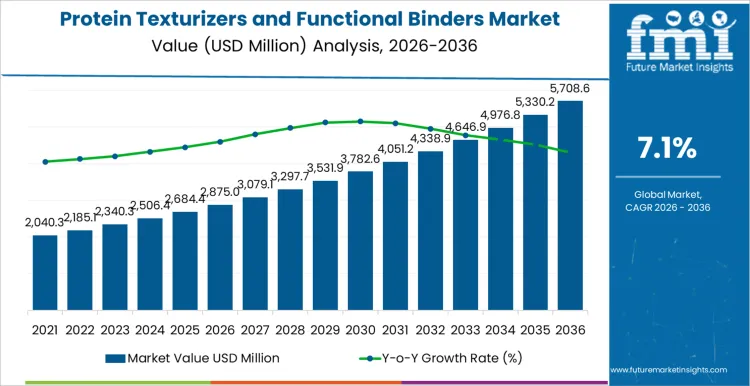
Protein Texturizers and Functional Binders Market Key Takeaways
| Metric | Value |
|---|---|
| Market Value (2026) | USD 2,875.0 million |
| Market Forecast Value (2036) | USD 5,708.6 million |
| Forecast CAGR 2026 to 2036 | 7.1% |
Why is the Demand for Protein Texturizers and Functional Binders Growing?
Formulators in the food and beverage industry are integrating protein texturizers and functional binders to address challenges created by high protein content in products that demand specific texture and bite characteristics. Protein ingredients such as isolates and concentrates can produce undesirable dryness, graininess, or crumbliness, particularly in products like meat analogues, high protein bars, and bakery mixes. Texturizers help create structure and cohesiveness, improving chew and firmness without altering the targeted protein level. Functional binders enhance water retention and network formation between proteins and other macromolecules, enabling production of plant protein patties, nuggets, and restructured meat products with consistent shape retention during cooking.
Beverage developers use specialized binders to maintain uniform suspension of protein particles in high protein shakes and ready-to-drink smoothies, avoiding phase separation and sedimentation during shelf life. Procurement of protein texturizers is reinforced by growth in health oriented and active lifestyle segments where consumers expect satisfying mouthfeel alongside nutritional benefits. Ingredient technologists refine combinations of hydrocolloids, modified proteins, and carbohydrate based binders that support processing demands such as extrusion, baking, and high shear mixing. Sensory evaluation and rheological testing guide selection to achieve target chewiness, elasticity, and moisture profile in diverse formats. Expansion of meat alternative portfolios and fortified foods underpins continuous integration of these functional components.
How Is the Protein Texturizers and Functional Binders Market Structured by Ingredient Type, Functional Role, and Application?
Protein texturizers and functional binders play a critical role in delivering structure, mouthfeel, and product stability in protein-enriched and plant-based formulations. Adoption is influenced by clean-label positioning, rising demand for meat analogs, processing compatibility, and cost-performance balance. Segmentation by ingredient type, functional role, and application highlights how manufacturers select specific systems to meet texture targets, moisture management requirements, and sensory expectations across diverse food categories.
Which Ingredient Type Holds the Largest Share in Protein Texturizers and Binders?
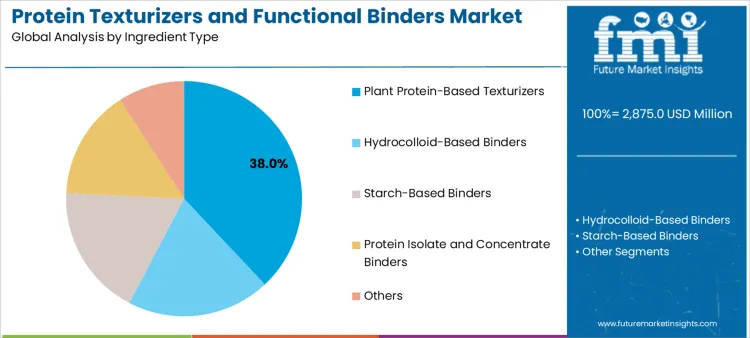
Plant protein-based texturizers account for 38.0%, driven by extensive use in plant-based meat and seafood formulations requiring fibrous structure and bite. Hydrocolloid-based binders hold 27.0%, supporting viscosity control and gel formation across bakery, dairy alternatives, and processed foods. Starch-based binders represent 19.0%, favored for cost efficiency and water-holding performance in snacks and convenience foods. Protein isolate and concentrate binders contribute 11.0%, used where label simplicity and protein reinforcement are required. Other ingredient systems account for 5.0%.
Key Points:
- Plant protein texturizers dominate structure-driven applications.
- Hydrocolloids provide versatile binding and viscosity control.
- Starch systems balance performance and cost considerations.
How Do Functional Roles Influence Ingredient Selection?
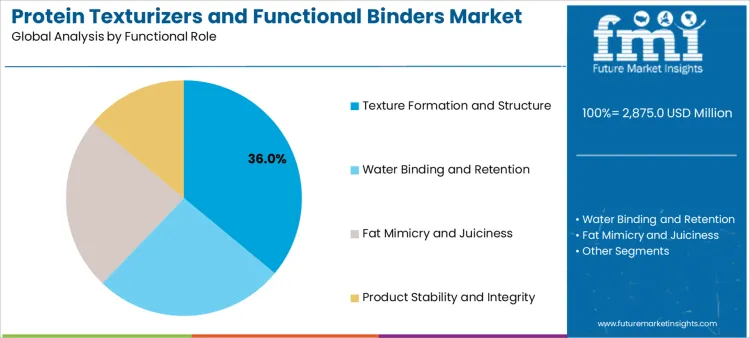
Texture formation and structure represent 36.0%, reflecting priority on bite, chew, and cohesiveness in high-protein and plant-based products. Water binding and retention account for 28.0%, essential for yield management, shelf-life stability, and freeze-thaw performance. Fat mimicry and juiciness hold 21.0%, supporting sensory enhancement in reduced-fat and meat-alternative formulations. Product stability and integrity represent 15.0%, addressing issues such as syneresis, crumbling, and phase separation during processing and storage.
Key Points:
- Structural performance remains the primary formulation objective.
- Moisture management directly impacts quality and yield.
- Fat-mimetic functionality supports sensory optimization.
Which Applications Are Driving Demand for These Ingredients?
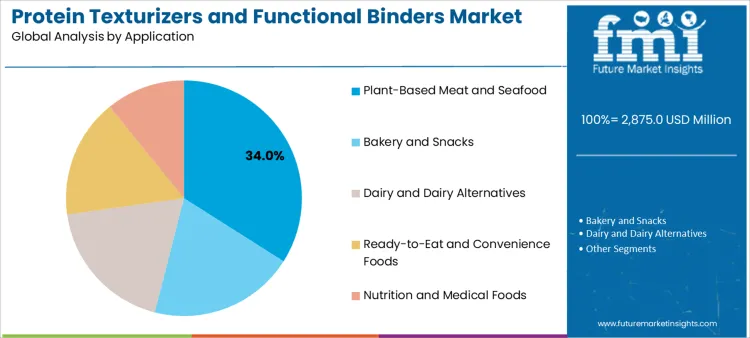
Plant-based meat and seafood applications lead with 34.0%, requiring complex texturization to replicate animal protein characteristics. Bakery and snacks account for 22.0%, using binders to improve dough handling and finished product consistency. Dairy and dairy alternatives represent 18.0%, relying on binders for creaminess and suspension stability. Ready-to-eat and convenience foods hold 16.0%, focused on reheating stability and texture retention. Nutrition and medical foods account for 10.0%, where controlled texture and digestibility are critical.
Key Points:
- Meat and seafood alternatives remain the strongest growth area.
- Bakery applications emphasize processing robustness.
- Medical nutrition prioritizes consistency and functionality.
What are the Key Dynamics in the protein texturizers and functional binders market?
Demand in the protein texturizers and functional binders market arises from formulators seeking to improve structure, bite, and cohesiveness in high-protein foods where lean formulations lose desirable texture. Activity is notable in meat alternatives, high-protein snacks, and dairy analogs where plant proteins and concentrated isolates require tuning for chew, sliceability, or moisture retention. Ingredient selection centers on gelation, water binding, and network formation that support sensory quality without compromising nutritional positioning.
How do formulation challenges in meat alternatives and high-protein foods shape market uptake?
Market uptake grows where structural roles of protein texturizers and functional binders are critical to product success. In plant-based meat analogs, texturizers must rebuild fibrous mouthfeel absent from isolated proteins, enabling bite and juiciness that resonate with consumer expectations. Grain and nut-based protein bars use binders to hold particulate matrices together, preventing crumbling while ensuring clean snap and chew during eating. High-protein dairy alternatives such as yogurts and puddings depend on functional binders to deliver creaminess and body lost when traditional dairy fats and proteins are reduced. Formulators evaluate performance under thermal processing and refrigerated or frozen storage to ensure stable texture through shelf life. Selection reflects how well a binder integrates with specific protein types, pH conditions, and processing stresses common to extrusion, shearing, and heat treatments.
What performance limits and regulatory considerations influence broader deployment?
Broader deployment is shaped by the functional limits of specific texturizers and binders and by regulatory interpretation of ingredient classes. Some hydrocolloids and polymeric binders lose effectiveness under extreme acidity or prolonged heat, requiring careful matching to target applications. Regional differences in ingredient classification and allowed usage levels affect where manufacturers include certain agents without triggering complex labeling or approval pathways. Cost sensitivity arises when multi-component systems are needed to balance texture, mouthfeel, and moisture control in products that target both sensory quality and high protein content. Sensory evaluation processes that measure texture attributes extend development timelines, influencing decisions about which binders to use across diverse high-protein categories where consistent eating quality drives repeat purchase behavior.
How Is Demand for the Protein Texturizers and Functional Binders Market Evolving Globally?
Global demand for protein texturizers and functional binders is increasing as food manufacturers expand protein enrichment while maintaining structure, bite, and process stability. Growth reflects rising use of plant proteins, hybrid protein systems, and clean label formulations across meat alternatives, bakery, snacks, and ready meals. Ingredient selection focuses on water binding, emulsification, and texture control under extrusion and thermal processing. India records 8.5% CAGR, China records 8.2% CAGR, Brazil records 7.8% CAGR, USA records 6.4% CAGR, and UK records 6.1% CAGR. Adoption remains driven by formulation performance requirements rather than protein volume expansion alone.
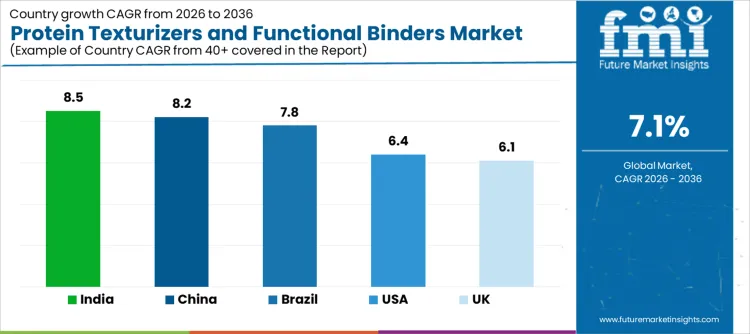
| Country | CAGR (%) |
|---|---|
| India | 8.5% |
| China | 8.2% |
| Brazil | 7.8% |
| USA | 6.4% |
| UK | 6.1% |
What is driving growth of protein texturizers and functional binders demand in India?
Demand for protein texturizers and functional binders in India is expanding as manufacturers scale production of protein-enriched snacks, meat analogs, and fortified staples. Growth at 8.5% CAGR reflects rising use of soy, pea, wheat, and pulse proteins requiring structure and moisture retention. Texture consistency under extrusion and frying remains critical for mass-market acceptance. Cost sensitivity encourages binders delivering strength and yield improvement at low inclusion levels. Domestic processors prioritize ingredients compatible with high-throughput operations and variable raw material quality. Demand concentrates within vegetarian protein foods, bakery fillings, and affordable ready-to-cook products targeting urban consumption.
- Expansion of vegetarian protein foods
- Need for extrusion-stable texture systems
- Cost-efficient binding solutions
- Growth of fortified staple formulations
Why is China seeing expansion in protein texturizers and functional binders adoption?
Protein texturizers and functional binders demand in China is rising as industrial food processors expand protein-rich product portfolios. Growth at 8.2% CAGR reflects strong activity in plant-based meat, restructured foods, and high-protein snacks. Large-scale manufacturing is driving demand for binders delivering uniform structure, sliceability, and moisture control. Protein blends increase formulation complexity, elevating reliance on functional texturizing systems. Domestic ingredient suppliers scale starch-protein hybrids and hydrocolloid-based binders for industrial use. Demand remains centered on centralized processing facilities supplying national retail and foodservice channels.
- Expansion of plant-based meat production
- Industrial need for structure uniformity
- Growth of restructured protein foods
- Scaling of domestic ingredient supply
What factors are shaping protein texturizers and functional binders sales in Brazil?
Sales of protein texturizers and functional binders in Brazil are increasing as manufacturers reformulate protein products aligned with nutrition labeling requirements. Growth at 7.8% CAGR reflects rising use in processed meats, meat alternatives, and protein-enriched bakery items. Texture retention during freezing and ambient storage drives binder selection. Tropical climate conditions increase demand for moisture management and structural stability. Local processors focus on yield improvement and bite consistency to protect mass-market acceptance. Demand remains strongest within processed protein foods serving price-sensitive consumers.
- Reformulation of processed protein foods
- Moisture control under tropical conditions
- Yield and bite consistency requirements
- Expansion of protein-enriched bakery
How is the USA supporting growth of protein texturizers and functional binders demand?
Protein texturizers and functional binders market demand in the USA is advancing as manufacturers expand protein content across mainstream categories. Growth at 6.4% CAGR reflects strong use in meat alternatives, protein snacks, and ready meals. Plant protein adoption introduces challenges in cohesion, juiciness, and mouthfeel. Ingredient strategies prioritize clean label binders with predictable performance. Large brands emphasize texture consistency across reformulated SKUs to protect brand equity. Demand is driven by formulation precision and processing reliability rather than category volume growth.
- Expansion of plant-based protein products
- Clean label binding requirements
- Focus on texture and juiciness control
- Portfolio-wide reformulation activity
What is driving expansion of protein texturizers and functional binders demand in the UK?
Demand for protein texturizers and functional binders in the UK is rising as protein enrichment spreads across meat alternatives, bakery, and convenience foods. Growth at 6.1% CAGR reflects reformulation driven by nutritional targets and retailer specifications. Texture stability under chilled and frozen conditions influences ingredient choice. Manufacturers prioritize binders supporting clean label positioning and regulatory compliance. Retail acceptance standards elevate focus on bite, cohesiveness, and visual appeal. Demand remains tied to protein-focused reformulation cycles rather than growth in processed food consumption.
- Retail-driven protein reformulation
- Expansion of meat alternative products
- Need for chilled and frozen stability
- Clean label texturizing solutions
What is the competitive landscape of demand for the protein texturizers and functional binders market globally?
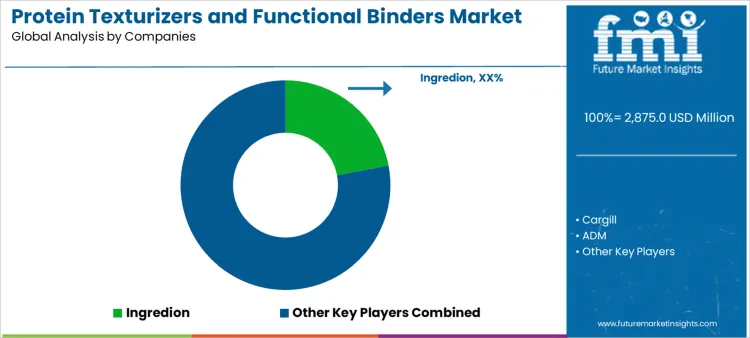
Functional performance needs in meat alternatives, high protein snacks, and fortified bakery products are shaping demand for protein texturizers and binders. Product developers assess water holding capacity, gel formation behavior, emulsification strength, and stability during extrusion and thermal processing. Buyer assessment includes clean label positioning, allergen considerations, interaction with starches and fibers, and consistency across protein sources. Procurement behavior reflects long formulation cycles, pilot scale validation, and reliance on suppliers offering application labs and processing guidance. Trend in the protein texturizers and functional binders market reflects emphasis on structure replication and bite integrity in plant based and hybrid foods.
Ingredion holds leading positioning through integrated protein and carbohydrate systems designed to deliver texture, binding, and moisture control. Cargill competes by combining protein functionality with formulation systems supporting scalability across alternative protein applications. ADM supports demand through soy and pea based binders aligned with extrusion and structured protein formats. Tate and Lyle maintains relevance by supplying functional ingredients enhancing cohesiveness and mouthfeel in reduced meat formulations. Roquette participates with plant protein binders emphasizing clean label compatibility and processing stability. Competitive differentiation centers on textural performance, formulation flexibility, supply reliability, and depth of technical collaboration.
Key Players in the Protein Texturizers and Functional Binders Market
- Ingredion
- Cargill
- ADM
- Tate & Lyle
- Roquette
- Others
Scope of the Report
| Items | Values |
|---|---|
| Quantitative Units | USD million |
| Ingredient Type | Plant Protein-Based Texturizers; Hydrocolloid-Based Binders; Starch-Based Binders; Protein Isolate and Concentrate Binders; Others |
| Functional Role | Texture Formation and Structure; Water Binding and Retention; Fat Mimicry and Juiciness; Product Stability and Integrity |
| Application | Plant-Based Meat and Seafood; Bakery and Snacks; Dairy and Dairy Alternatives; Ready-to-Eat and Convenience Foods; Nutrition and Medical Foods |
| Regions Covered | Asia Pacific, Europe, North America, Latin America, Middle East & Africa |
| Countries Covered | India, China, Brazil, USA, UK, and 40+ countries |
| Key Companies Profiled | Ingredion; Cargill; ADM; Tate & Lyle; Roquette; Others |
| Additional Attributes | Dollar sales by ingredient type, functional role, and application; performance in structuring and binding across plant-based meat, bakery, and dairy alternative matrices; water-holding capacity, fat mimicry, and juiciness delivery under thermal processing; impact on sliceability, bite, and product integrity during storage and reheating; compatibility with clean-label and allergen-reduction targets; procurement dynamics driven by plant-based product launches, reformulation cycles, and long-term ingredient supply partnerships. |
Protein Texturizers and Functional Binders Market by Segment
Ingredient Type:
- Plant Protein-Based Texturizers
- Hydrocolloid-Based Binders
- Starch-Based Binders
- Protein Isolate and Concentrate Binders
- Others
Functional Role:
- Texture Formation and Structure
- Water Binding and Retention
- Fat Mimicry and Juiciness
- Product Stability and Integrity
Application:
- Plant-Based Meat and Seafood
- Bakery and Snacks
- Dairy and Dairy Alternatives
- Ready-to-Eat and Convenience Foods
- Nutrition and Medical Foods
Region:
- Asia Pacific
- China
- Japan
- South Korea
- India
- Australia & New Zealand
- ASEAN
- Rest of Asia Pacific
- Europe
- Germany
- United Kingdom
- France
- Italy
- Spain
- Nordic
- BENELUX
- Rest of Europe
- North America
- United States
- Canada
- Mexico
- Latin America
- Brazil
- Chile
- Rest of Latin America
- Middle East & Africa
- Kingdom of Saudi Arabia
- Other GCC Countries
- Turkey
- South Africa
- Other African Union
- Rest of Middle East & Africa
Bibliography
- Food and Agriculture Organization of the United Nations. (2023). Plant-based protein foods: Processing, structure formation, and functional ingredient interactions. FAO.
- International Organization for Standardization. (2023). ISO 11036: Sensory analysis - Methodology - Texture profile analysis (latest confirmed edition). ISO.
- International Organization for Standardization. (2024). ISO 5492: Sensory analysis - Vocabulary (updated definitions relevant to texture, cohesiveness, and binding). ISO.
- McClements, D. J. (2023). Designing protein-based foods: Structure, texture, and stability considerations. Food Hydrocolloids, 139, 108470.
- Dekkers, B. L., Boom, R. M., & van der Goot, A. J. (2023). Structuring processes for meat analogues. Trends in Food Science & Technology, 131, 1-13.
Frequently Asked Questions
How big is the protein texturizers and functional binders market in 2026?
The global protein texturizers and functional binders market is estimated to be valued at USD 2,875.0 million in 2026.
What will be the size of protein texturizers and functional binders market in 2036?
The market size for the protein texturizers and functional binders market is projected to reach USD 5,708.6 million by 2036.
How much will be the protein texturizers and functional binders market growth between 2026 and 2036?
The protein texturizers and functional binders market is expected to grow at a 7.1% CAGR between 2026 and 2036.
What are the key product types in the protein texturizers and functional binders market?
The key product types in protein texturizers and functional binders market are plant protein-based texturizers, hydrocolloid-based binders, starch-based binders, protein isolate and concentrate binders and others.
Which functional role segment to contribute significant share in the protein texturizers and functional binders market in 2026?
In terms of functional role, texture formation and structure segment to command 36.0% share in the protein texturizers and functional binders market in 2026.
Preview the report firsthand - request a free sample
Get SampleGet the brochure for pricing and purchase details.
Get PDFTable of Content
- Executive Summary
- Global Market Outlook
- Demand-side Trends
- Supply-side Trends
- Technology Roadmap Analysis
- Analysis and Recommendations
- Market Overview
- Market Coverage / Taxonomy
- Market Definition / Scope / Limitations
- Market Background
- Market Dynamics
- Drivers
- Restraints
- Opportunity
- Trends
- Scenario Forecast
- Demand in Optimistic Scenario
- Demand in Likely Scenario
- Demand in Conservative Scenario
- Opportunity Map Analysis
- Product Life Cycle Analysis
- Supply Chain Analysis
- Investment Feasibility Matrix
- Value Chain Analysis
- PESTLE and Porter’s Analysis
- Regulatory Landscape
- Regional Parent Market Outlook
- Production and Consumption Statistics
- Import and Export Statistics
- Market Dynamics
- Global Market Analysis 2021 to 2025 and Forecast, 2026 to 2036
- Historical Market Size Value (USD Million) Analysis, 2021 to 2025
- Current and Future Market Size Value (USD Million) Projections, 2026 to 2036
- Y-o-Y Growth Trend Analysis
- Absolute $ Opportunity Analysis
- Global Market Pricing Analysis 2021 to 2025 and Forecast 2026 to 2036
- Global Market Analysis 2021 to 2025 and Forecast 2026 to 2036, By Ingredient Type
- Introduction / Key Findings
- Historical Market Size Value (USD Million) Analysis By Ingredient Type , 2021 to 2025
- Current and Future Market Size Value (USD Million) Analysis and Forecast By Ingredient Type , 2026 to 2036
- Plant Protein-Based Texturizers
- Hydrocolloid-Based Binders
- Starch-Based Binders
- Protein Isolate and Concentrate Binders
- Others
- Plant Protein-Based Texturizers
- Y-o-Y Growth Trend Analysis By Ingredient Type , 2021 to 2025
- Absolute $ Opportunity Analysis By Ingredient Type , 2026 to 2036
- Global Market Analysis 2021 to 2025 and Forecast 2026 to 2036, By Functional Role
- Introduction / Key Findings
- Historical Market Size Value (USD Million) Analysis By Functional Role, 2021 to 2025
- Current and Future Market Size Value (USD Million) Analysis and Forecast By Functional Role, 2026 to 2036
- Texture Formation and Structure
- Water Binding and Retention
- Fat Mimicry and Juiciness
- Product Stability and Integrity
- Texture Formation and Structure
- Y-o-Y Growth Trend Analysis By Functional Role, 2021 to 2025
- Absolute $ Opportunity Analysis By Functional Role, 2026 to 2036
- Global Market Analysis 2021 to 2025 and Forecast 2026 to 2036, By Application
- Introduction / Key Findings
- Historical Market Size Value (USD Million) Analysis By Application, 2021 to 2025
- Current and Future Market Size Value (USD Million) Analysis and Forecast By Application, 2026 to 2036
- Plant-Based Meat and Seafood
- Bakery and Snacks
- Dairy and Dairy Alternatives
- Ready-to-Eat and Convenience Foods
- Nutrition and Medical Foods
- Plant-Based Meat and Seafood
- Y-o-Y Growth Trend Analysis By Application, 2021 to 2025
- Absolute $ Opportunity Analysis By Application, 2026 to 2036
- Global Market Analysis 2021 to 2025 and Forecast 2026 to 2036, By Region
- Introduction
- Historical Market Size Value (USD Million) Analysis By Region, 2021 to 2025
- Current Market Size Value (USD Million) Analysis and Forecast By Region, 2026 to 2036
- North America
- Latin America
- Western Europe
- Eastern Europe
- East Asia
- South Asia and Pacific
- Middle East & Africa
- Market Attractiveness Analysis By Region
- North America Market Analysis 2021 to 2025 and Forecast 2026 to 2036, By Country
- Historical Market Size Value (USD Million) Trend Analysis By Market Taxonomy, 2021 to 2025
- Market Size Value (USD Million) Forecast By Market Taxonomy, 2026 to 2036
- By Country
- USA
- Canada
- Mexico
- By Ingredient Type
- By Functional Role
- By Application
- By Country
- Market Attractiveness Analysis
- By Country
- By Ingredient Type
- By Functional Role
- By Application
- Key Takeaways
- Latin America Market Analysis 2021 to 2025 and Forecast 2026 to 2036, By Country
- Historical Market Size Value (USD Million) Trend Analysis By Market Taxonomy, 2021 to 2025
- Market Size Value (USD Million) Forecast By Market Taxonomy, 2026 to 2036
- By Country
- Brazil
- Chile
- Rest of Latin America
- By Ingredient Type
- By Functional Role
- By Application
- By Country
- Market Attractiveness Analysis
- By Country
- By Ingredient Type
- By Functional Role
- By Application
- Key Takeaways
- Western Europe Market Analysis 2021 to 2025 and Forecast 2026 to 2036, By Country
- Historical Market Size Value (USD Million) Trend Analysis By Market Taxonomy, 2021 to 2025
- Market Size Value (USD Million) Forecast By Market Taxonomy, 2026 to 2036
- By Country
- Germany
- UK
- Italy
- Spain
- France
- Nordic
- BENELUX
- Rest of Western Europe
- By Ingredient Type
- By Functional Role
- By Application
- By Country
- Market Attractiveness Analysis
- By Country
- By Ingredient Type
- By Functional Role
- By Application
- Key Takeaways
- Eastern Europe Market Analysis 2021 to 2025 and Forecast 2026 to 2036, By Country
- Historical Market Size Value (USD Million) Trend Analysis By Market Taxonomy, 2021 to 2025
- Market Size Value (USD Million) Forecast By Market Taxonomy, 2026 to 2036
- By Country
- Russia
- Poland
- Hungary
- Balkan & Baltic
- Rest of Eastern Europe
- By Ingredient Type
- By Functional Role
- By Application
- By Country
- Market Attractiveness Analysis
- By Country
- By Ingredient Type
- By Functional Role
- By Application
- Key Takeaways
- East Asia Market Analysis 2021 to 2025 and Forecast 2026 to 2036, By Country
- Historical Market Size Value (USD Million) Trend Analysis By Market Taxonomy, 2021 to 2025
- Market Size Value (USD Million) Forecast By Market Taxonomy, 2026 to 2036
- By Country
- China
- Japan
- South Korea
- By Ingredient Type
- By Functional Role
- By Application
- By Country
- Market Attractiveness Analysis
- By Country
- By Ingredient Type
- By Functional Role
- By Application
- Key Takeaways
- South Asia and Pacific Market Analysis 2021 to 2025 and Forecast 2026 to 2036, By Country
- Historical Market Size Value (USD Million) Trend Analysis By Market Taxonomy, 2021 to 2025
- Market Size Value (USD Million) Forecast By Market Taxonomy, 2026 to 2036
- By Country
- India
- ASEAN
- Australia & New Zealand
- Rest of South Asia and Pacific
- By Ingredient Type
- By Functional Role
- By Application
- By Country
- Market Attractiveness Analysis
- By Country
- By Ingredient Type
- By Functional Role
- By Application
- Key Takeaways
- Middle East & Africa Market Analysis 2021 to 2025 and Forecast 2026 to 2036, By Country
- Historical Market Size Value (USD Million) Trend Analysis By Market Taxonomy, 2021 to 2025
- Market Size Value (USD Million) Forecast By Market Taxonomy, 2026 to 2036
- By Country
- Kingdom of Saudi Arabia
- Other GCC Countries
- Turkiye
- South Africa
- Other African Union
- Rest of Middle East & Africa
- By Ingredient Type
- By Functional Role
- By Application
- By Country
- Market Attractiveness Analysis
- By Country
- By Ingredient Type
- By Functional Role
- By Application
- Key Takeaways
- Key Countries Market Analysis
- USA
- Pricing Analysis
- Market Share Analysis, 2025
- By Ingredient Type
- By Functional Role
- By Application
- Canada
- Pricing Analysis
- Market Share Analysis, 2025
- By Ingredient Type
- By Functional Role
- By Application
- Mexico
- Pricing Analysis
- Market Share Analysis, 2025
- By Ingredient Type
- By Functional Role
- By Application
- Brazil
- Pricing Analysis
- Market Share Analysis, 2025
- By Ingredient Type
- By Functional Role
- By Application
- Chile
- Pricing Analysis
- Market Share Analysis, 2025
- By Ingredient Type
- By Functional Role
- By Application
- Germany
- Pricing Analysis
- Market Share Analysis, 2025
- By Ingredient Type
- By Functional Role
- By Application
- UK
- Pricing Analysis
- Market Share Analysis, 2025
- By Ingredient Type
- By Functional Role
- By Application
- Italy
- Pricing Analysis
- Market Share Analysis, 2025
- By Ingredient Type
- By Functional Role
- By Application
- Spain
- Pricing Analysis
- Market Share Analysis, 2025
- By Ingredient Type
- By Functional Role
- By Application
- France
- Pricing Analysis
- Market Share Analysis, 2025
- By Ingredient Type
- By Functional Role
- By Application
- India
- Pricing Analysis
- Market Share Analysis, 2025
- By Ingredient Type
- By Functional Role
- By Application
- ASEAN
- Pricing Analysis
- Market Share Analysis, 2025
- By Ingredient Type
- By Functional Role
- By Application
- Australia & New Zealand
- Pricing Analysis
- Market Share Analysis, 2025
- By Ingredient Type
- By Functional Role
- By Application
- China
- Pricing Analysis
- Market Share Analysis, 2025
- By Ingredient Type
- By Functional Role
- By Application
- Japan
- Pricing Analysis
- Market Share Analysis, 2025
- By Ingredient Type
- By Functional Role
- By Application
- South Korea
- Pricing Analysis
- Market Share Analysis, 2025
- By Ingredient Type
- By Functional Role
- By Application
- Russia
- Pricing Analysis
- Market Share Analysis, 2025
- By Ingredient Type
- By Functional Role
- By Application
- Poland
- Pricing Analysis
- Market Share Analysis, 2025
- By Ingredient Type
- By Functional Role
- By Application
- Hungary
- Pricing Analysis
- Market Share Analysis, 2025
- By Ingredient Type
- By Functional Role
- By Application
- Kingdom of Saudi Arabia
- Pricing Analysis
- Market Share Analysis, 2025
- By Ingredient Type
- By Functional Role
- By Application
- Turkiye
- Pricing Analysis
- Market Share Analysis, 2025
- By Ingredient Type
- By Functional Role
- By Application
- South Africa
- Pricing Analysis
- Market Share Analysis, 2025
- By Ingredient Type
- By Functional Role
- By Application
- USA
- Market Structure Analysis
- Competition Dashboard
- Competition Benchmarking
- Market Share Analysis of Top Players
- By Regional
- By Ingredient Type
- By Functional Role
- By Application
- Competition Analysis
- Competition Deep Dive
- Ingredion
- Overview
- Product Portfolio
- Profitability by Market Segments (Product/Age /Sales Channel/Region)
- Sales Footprint
- Strategy Overview
- Marketing Strategy
- Product Strategy
- Channel Strategy
- Cargill
- ADM
- Tate & Lyle
- Roquette
- Others
- Ingredion
- Competition Deep Dive
- Assumptions & Acronyms Used
- Research Methodology


