

- Industry Size (2026)
- USD 1625.0 Mn
- Forecast (2036)
- USD 3196.6 Mn
- CAGR (2026 to 2036)
- 7.0%
Protein Flavor Masking Agents Market Forecast and Outlook 2026 to 2036
The protein flavor masking agents market is expected to be valued at USD 1,625.0 million in 2026 and reach USD 3,196.6 million by 2036 at a CAGR of 7.0%. Value progression reflects structural dependence on masking systems as protein inclusion levels rise across beverages, nutrition bars, dairy alternatives, and clinical formulations. Concentrated whey, pea, soy, and blended proteins introduce bitterness, beany notes, and sulfur-like off-flavors that cannot be corrected through conventional sweeteners alone. Masking agents enable higher protein loading while preserving target macronutrient profiles, particularly in low-sugar formats where off-notes become more pronounced. Processing stability under heat, shear, and pH variation supports adoption in ready-to-drink and extruded products manufactured at scale.
Formulation economics and sensory risk management shape adoption patterns more than protein volume expansion. Developers prioritize masking systems that operate effectively at low inclusion rates to avoid texture interference and label complexity. Performance consistency across different protein sources remains critical, as variability in raw material quality can amplify taste defects. Regulatory scrutiny around ingredient disclosure narrows acceptable masking options in clean-label positioned products, influencing supplier selection and formulation architecture. Cost sensitivity increases where multi-component masking systems are required to balance bitterness suppression and processing tolerance. Demand persists where masking reliability reduces reformulation risk and protects brand flavor integrity across expanding high-protein product portfolios.
Quick Stats for Protein Flavor Masking Agents Market
- Protein Flavor Masking Agents Market Value (2026): USD 1,625.0 million
- Protein Flavor Masking Agents Market Forecast Value (2036): USD 3,196.6 million
- Protein Flavor Masking Agents Market Forecast CAGR 2026 to 2036: 7.0%
- Leading Protein Source by Demand Share: Plant-based proteins
- Fastest-Growing Countries: India, China, Brazil, USA, UK
- Top Players in Global Demand: Givaudan, IFF, Symrise, DSM-Firmenich, Sensient Technologies
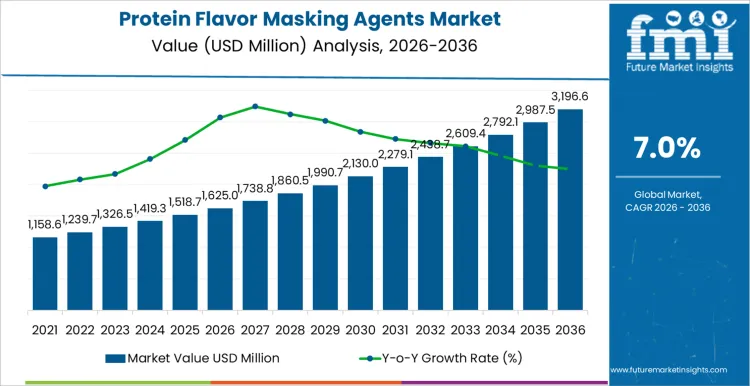
Protein Flavor Masking Agents Market Key Takeaways
| Metric | Value |
|---|---|
| Market Value (2026) | USD 1,625.0 million |
| Market Forecast Value (2036) | USD 3,196.6 million |
| Forecast CAGR 2026 to 2036 | 7.0% |
Why is the Demand for Protein Flavor Masking Agents Market Growing?
Protein flavor masking agents are gaining traction as formulators confront the strong, often bitter or beany off-notes inherent to high protein ingredients such as whey isolates, pea protein, and soy concentrates. High protein content is essential in sports nutrition, meal replacements, and fortified dairy alternatives, yet many proteins introduce sensory characteristics that detract from palatability. Masking agents interact at the receptor level to mitigate undesirable tastes without contributing additional sweetness or calories, allowing product developers to preserve targeted macronutrient profiles while delivering acceptable flavor. Beverage developers integrating proteins into ready-to-drink formats find that effective masking supports clarity and balance, particularly where low sugar or sugar-free positioning magnifies taste issues common to concentrated protein sources.
Snack bars, baked goods, and dairy alternative categories also rely on tailored masking solutions to smooth taste transitions between base ingredients and added functional compounds. Ingredient suppliers continue to innovate molecular structures and carrier systems that perform reliably across processing environments typical of extrusion, high shear mixing, and heat treatment. Sensory scientists carry out profiling to match specific agents to protein types and intended usage levels, helping brands meet both textural and taste expectations. Demand is reinforced by ongoing expansion of high protein products among mainstream consumers seeking weight management and functional benefits, not only traditional athletic segments. Regulatory focus on transparent ingredient disclosure and texture integrity further guides the selection of masking technologies that align with clean label preferences without compromising nutritional positioning.
How Is the Protein Flavor Masking Agents Industry Segmented by Protein Source, Technology, and Application?
Protein flavor masking agents address off-notes such as bitterness, astringency, and beany or sulfuric flavors that limit protein inclusion levels. Demand is shaped by rapid expansion of plant-based formulations, higher protein fortification targets, and stricter sensory expectations from consumers. Segmentation by protein source application, masking technology, and end-use category explains how ingredient suppliers tailor solutions for different formulation challenges faced by food, beverage, and nutrition manufacturers.
Which Protein Source Application Accounts for the Largest Share?
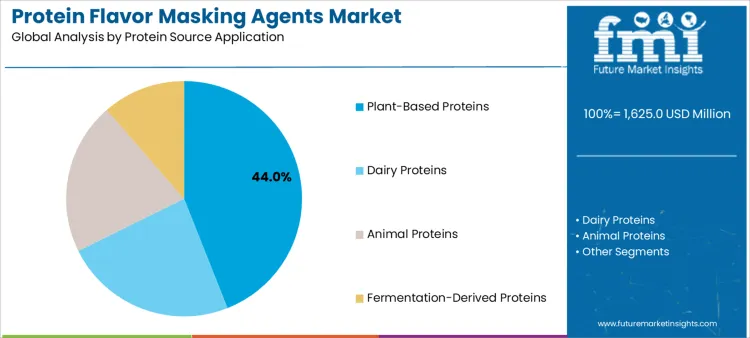
Plant-based proteins represent 44.0%, reflecting widespread use of masking systems in pea, soy, fava, and blended plant protein formulations. Dairy proteins account for 26.0%, primarily addressing bitterness and cooked notes in whey and casein systems. Animal proteins hold 17.0%, used in clinical, savory, and high-protein formulations where metallic or sulfur notes must be reduced. Fermentation-derived proteins contribute 13.0%, driven by emerging mycoprotein and precision-fermentation ingredients that present unique flavor challenges.
Key Points:
- Plant-based proteins require the most intensive masking support.
- Dairy proteins rely on masking for bitterness control.
- Fermentation proteins introduce new sensory management needs.
How Do Masking Technologies Differ in Their Functional Role?
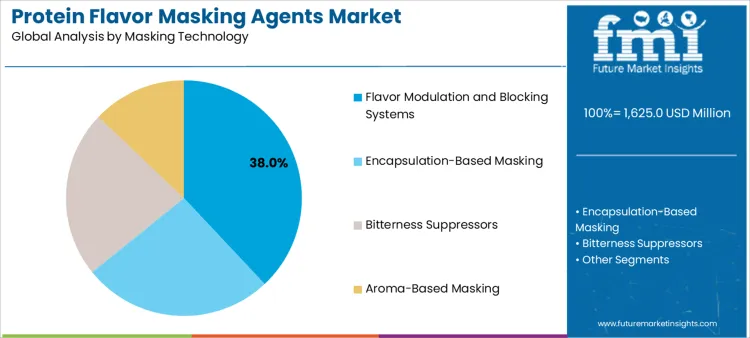
Flavor modulation and blocking systems lead with 38.0%, offering broad-spectrum suppression of undesirable taste perceptions without altering sweetness or aroma balance. Encapsulation-based masking holds 27.0%, enabling delayed flavor release and physical isolation of bitter compounds. Bitterness suppressors account for 21.0%, focused on receptor-level interaction to reduce sharp taste impact. Aroma-based masking represents 14.0%, used to redirect perception through complementary top notes rather than direct taste inhibition.
Key Points:
- Modulation systems provide versatile, formulation-friendly solutions.
- Encapsulation supports stability in complex matrices.
- Aroma masking plays a secondary, perception-driven role.
Which Applications Are Driving Commercial Adoption?
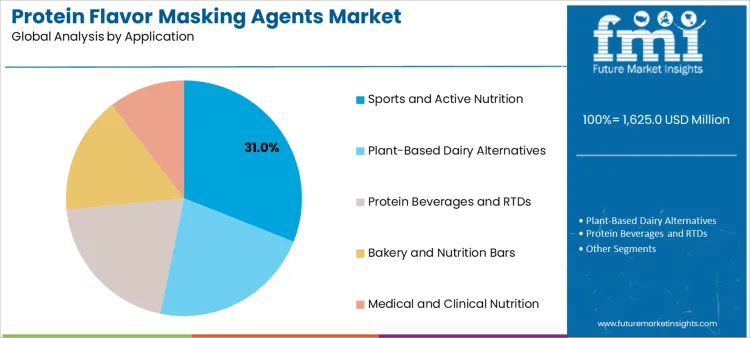
Sports and active nutrition leads with 31.0%, supported by high-protein powders, ready-to-mix products, and performance beverages. Plant-based dairy alternatives represent 24.0%, where neutral taste profiles are critical for repeat consumption. Protein beverages and RTDs account for 21.0%, requiring clean flavor delivery at high protein concentrations. Bakery and nutrition bars hold 14.0%, using masking to manage protein-fortified doughs and fillings. Medical and clinical nutrition represents 10.0%, prioritizing palatability for patient compliance.
Key Points:
- Sports nutrition remains the primary demand driver.
- Dairy alternatives depend on effective flavor neutrality.
- Clinical nutrition emphasizes consistency and acceptance.
What are the Key Dynamics in the protein flavor masking agents market?
Demand in the protein flavor masking agents market is shaped by the increasing incorporation of concentrated proteins in nutrition bars, ready-to-drink protein shakes, meal replacement powders, and functional beverages where bitter, beany, or off-notes can reduce consumer acceptance. Activity is high in segments targeting fitness enthusiasts and clinical nutrition, where taste quality directly influences repeat purchase. Ingredient choice depends on how well a masking system interacts with specific protein sources such as whey, pea, soy, and collagen without creating textural or sweetness distortions. Procurement reflects performance under typical processing conditions like high shear mixing and heat used in extrusion and spray drying.
How do protein source characteristics and application formats influence adoption?
Adoption of flavor masking agents grows where particular protein sources exhibit strong intrinsic tastes that are difficult to cover with standard sweeteners or flavors. Plant proteins such as pea and soy often contribute earthy or beany notes that become more pronounced in high-protein formulations. Dairy-derived proteins like whey can carry sulfurous or cooked milk nuances in heated beverage systems. Beverage formulators sourcing masking agents evaluate performance in cold-fill and UHT applications to ensure stability over shelf life without precipitating or interacting with emulsifiers. In ready-to-drink formats, masking systems must be effective at low pH and compatible with carbonation. Solid formats such as bars and powders demand agents that do not increase stickiness or affect texture, making targeted masking solutions essential for acceptance in specific product categories.
How do sensory performance limits and label positioning requirements affect scalability?
Scalability in the protein flavor masking agents market is influenced by the sensory performance of masking systems and the regulatory or consumer expectations tied to label claims. Some masking agents achieve effective suppression only at concentrations that impact mouthfeel, requiring careful balancing with texturizers. In products positioned for clean label or natural claims, formulators limit use to masking options with permissible names and minimal declaration burden, which narrows ingredient choices. Regional differences in permitted use levels and labeling requirements for masking compounds affect where certain agents can be deployed without triggering extensive regulatory review. Cost pressure emerges when multi-component systems are needed to balance bitter suppression, heat tolerance, and solubility in challenging matrices, affecting adoption in price-sensitive market segments. Sensory evaluation with trained panels adds time and resource requirements to development, influencing how quickly new formulations can reach retail.
How Is Demand for the Protein Flavor Masking Agents Market Evolving Globally?
Global demand for protein flavor masking agents is rising as food and nutrition manufacturers increase protein fortification across beverages, supplements, and functional foods. Growth reflects rising use of plant proteins, dairy proteins, and blended protein systems that introduce bitterness, beany notes, and sulfur-like off-flavors. Demand expansion remains linked to sports nutrition growth, medical nutrition expansion, and sugar reduction strategies that amplify protein-derived off-notes. India records 8.4% CAGR, China records 8.1% CAGR, Brazil records 7.7% CAGR, USA records 6.3% CAGR, and UK records 6.0% CAGR. Adoption intensity is driven by formulation complexity rather than protein volume growth alone.
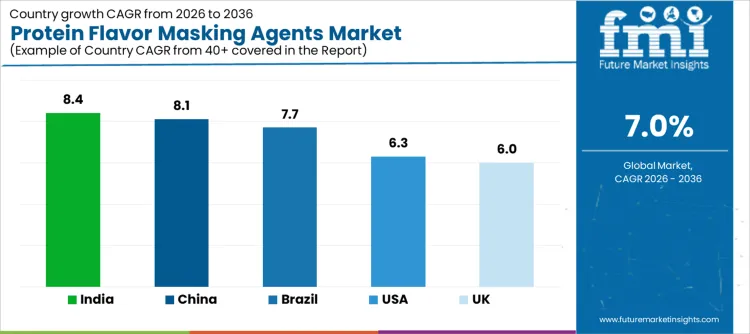
| Country | CAGR (%) |
|---|---|
| India | 8.4% |
| China | 8.1% |
| Brazil | 7.7% |
| USA | 6.3% |
| UK | 6.0% |
What is driving growth of protein flavor masking agents demand in India?
Demand for protein flavor masking agents in India is expanding as sports nutrition, nutraceutical, and fortified beverage production increases. Growth at 8.4% CAGR reflects rising usage of whey, soy, pea, and blended plant proteins in powders, ready-to-mix drinks, and medical nutrition products. Strong bitterness and lingering aftertaste from plant proteins require targeted masking systems to maintain consumer acceptance. Cost sensitivity encourages solutions that minimize flavor loading while improving palatability. Domestic formulators prioritize masking agents compatible with heat processing and dry mix applications. Demand remains concentrated within protein supplements, fortified beverages, and urban-focused nutrition products.
- Expansion of sports and medical nutrition
- Rising use of plant protein blends
- Need to manage bitterness and off-notes
- Cost-efficient flavor system optimization
Why is China seeing expansion in protein flavor masking agents adoption?
Protein flavor masking agents demand in China is rising as functional food and nutrition brands expand high-protein product portfolios. Growth at 8.1% CAGR reflects strong activity in protein beverages, meal replacements, and dairy-based nutrition drinks. High inclusion levels of soy, pea, and milk proteins intensify flavor challenges requiring consistent masking performance. Large-scale manufacturing environments demand stable sensory outcomes across high-volume production. Domestic ingredient suppliers scale masking technologies tailored for beverage and powdered nutrition systems. Demand remains strongest within functional nutrition categories serving modern retail and health-focused consumers.
- Growth of high-protein functional foods
- Large-scale beverage and powder production
- Flavor challenges from soy and pea proteins
- Need for industrial sensory consistency
What factors are shaping protein flavor masking agents sales in Brazil?
Sales of protein flavor masking agents in Brazil are increasing as nutrition labeling and wellness positioning drive protein fortification. Growth at 7.7% CAGR reflects expanding use of protein in beverages, dairy alternatives, and nutrition powders. Tropical flavor profiles amplify perception of protein bitterness and astringency, increasing reliance on masking solutions. Local manufacturers focus on preserving sweetness and mouthfeel in reduced sugar protein drinks. Demand remains concentrated within mass-market sports nutrition and fortified beverage segments serving price-sensitive consumers.
- Expansion of protein-fortified beverages
- Sensory challenges in tropical flavor systems
- Nutrition labeling driven formulation changes
- Focus on mass-market taste acceptance
How is the USA supporting growth of protein flavor masking agents demand?
Protein flavor masking agents market demand in the USA is advancing as brands expand protein content across mainstream food and beverage categories. Growth at 6.3% CAGR reflects widespread use in protein shakes, bars, dairy alternatives, and medical nutrition. High adoption of plant proteins increases bitterness and earthy notes requiring advanced masking systems. Regulatory scrutiny on labeling accuracy elevates focus on flavor neutrality and clean label positioning. Large manufacturers prioritize masking agents that preserve established brand flavor profiles during reformulation cycles.
- Expansion of plant-based protein products
- Growth of protein shakes and bars
- Clean label flavor management focus
- Brand flavor consistency protection
What is driving expansion of protein flavor masking agents demand in the UK?
Demand for protein flavor masking agents in the UK is rising as high-protein positioning spreads across beverages, snacks, and dairy alternatives. Growth at 6.0% CAGR reflects reformulation of products targeting satiety, weight management, and muscle health. Protein fortification introduces bitterness and metallic notes requiring precise masking. Retail quality standards influence sensory acceptance thresholds. Ingredient selection emphasizes regulatory compliance and neutral flavor impact. Demand remains linked to protein enrichment strategies rather than growth in overall food consumption.
- Expansion of high-protein product positioning
- Retail sensory quality expectations
- Flavor challenges from protein enrichment
- Regulatory compliance driven formulation
What is the competitive landscape of demand for the protein flavor masking agents market globally?
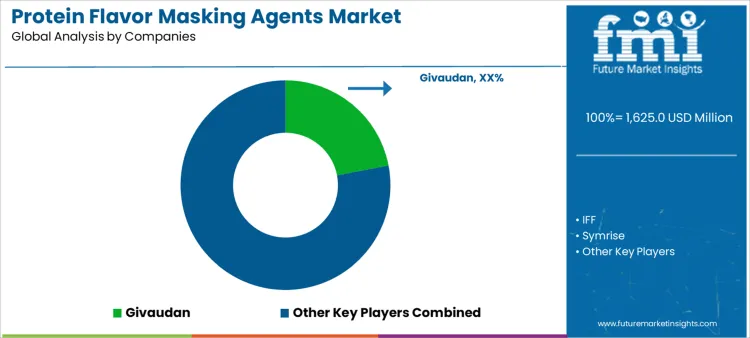
Protein fortification trends in beverages, nutrition bars, and plant-based foods are shaping demand for protein flavor masking agents. Product developers assess bitterness suppression, beany and sulfur note reduction, stability during heat treatment, and effectiveness across whey, soy, pea, and novel proteins. Buyer assessment includes clean label feasibility, allergen neutrality, dosage efficiency, and consistency across batch variability. Procurement behavior favors suppliers providing sensory panels, application trials, and rapid customization for specific protein sources. Trend in the protein flavor masking agents market reflects intensified reformulation to support higher protein loads without compromising palatability.
Givaudan leads competitive positioning through advanced masking systems developed using protein-specific sensory and analytical profiling. IFF competes by integrating masking agents within broader taste modulation platforms addressing bitterness and off-note persistence. Symrise supports demand with masking technologies optimized for plant proteins and ready-to-drink nutrition formats. DSM-Firmenich maintains relevance through protein-centric flavor science combined with formulation co-development capabilities. Sensient Technologies participates with targeted masking solutions emphasizing stability and repeatable performance across beverage and solid food matrices. Competitive differentiation centers on protein specificity, sensory effectiveness, formulation flexibility, and depth of collaborative development support.
Key Players in the Protein Flavor Masking Agents Market
- Givaudan
- IFF
- Symrise
- DSM-Firmenich
- Sensient Technologies
- Others
Scope of the Report
| Items | Values |
|---|---|
| Quantitative Units | USD million |
| Protein Source Application | Plant-Based Proteins; Dairy Proteins; Animal Proteins; Fermentation-Derived Proteins |
| Masking Technology | Flavor Modulation and Blocking Systems; Encapsulation-Based Masking; Bitterness Suppressors; Aroma-Based Masking |
| Application | Sports and Active Nutrition; Plant-Based Dairy Alternatives; Protein Beverages and RTDs; Bakery and Nutrition Bars; Medical and Clinical Nutrition |
| Regions Covered | Asia Pacific, Europe, North America, Latin America, Middle East & Africa |
| Countries Covered | India, China, Brazil, USA, UK, and 40+ countries |
| Key Companies Profiled | Givaudan; IFF; Symrise; DSM-Firmenich; Sensient Technologies; Others |
| Additional Attributes | Dollar sales by protein source application, masking technology, and end-use application; effectiveness in suppressing bitterness, beany, sulfurous, and astringent off-notes across plant, dairy, animal, and fermentation-derived proteins; performance of encapsulation and aroma-based systems under heat and shear; compatibility with high-protein RTDs and bars; clean-label considerations influencing formulation choices; procurement dynamics driven by rapid growth in sports nutrition and plant-based food reformulation programs. |
Protein Flavor Masking Agents Market by Segment
Protein Source Application:
- Plant-Based Proteins
- Dairy Proteins
- Animal Proteins
- Fermentation-Derived Proteins
Masking Technology:
- Flavor Modulation and Blocking Systems
- Encapsulation-Based Masking
- Bitterness Suppressors
- Aroma-Based Masking
Application:
- Sports and Active Nutrition
- Plant-Based Dairy Alternatives
- Protein Beverages and RTDs
- Bakery and Nutrition Bars
- Medical and Clinical Nutrition
Region:
- Asia Pacific
- China
- Japan
- South Korea
- India
- Australia & New Zealand
- ASEAN
- Rest of Asia Pacific
- Europe
- Germany
- United Kingdom
- France
- Italy
- Spain
- Nordic
- BENELUX
- Rest of Europe
- North America
- United States
- Canada
- Mexico
- Latin America
- Brazil
- Chile
- Rest of Latin America
- Middle East & Africa
- Kingdom of Saudi Arabia
- Other GCC Countries
- Turkey
- South Africa
- Other African Union
- Rest of Middle East & Africa
Bibliography
- Food and Agriculture Organization of the United Nations. (2023). Protein ingredients in food systems: Sensory challenges, processing effects, and mitigation strategies. FAO.
- International Organization for Standardization. (2023). ISO 13299: Sensory analysis - Methodology - General guidance for establishing a sensory profile (latest reaffirmed edition). ISO.
- International Organization for Standardization. (2024). ISO 5492: Sensory analysis - Vocabulary (updated terminology relevant to taste masking and off-flavour perception). ISO.
- USA Food and Drug Administration. (2024). Guidance for industry: Use of flavouring substances, taste modifiers, and masking agents in foods and medical nutrition. USA Department of Health and Human Services.
- European Commission. (2024). Interpretative guidance on flavouring substances, taste modifiers, and labelling considerations in high-protein foods. European Union.
- Loveday, S. M. (2023). Food proteins: Technological, nutritional, and sensory challenges in high-protein formulations. Food Research International, 169, 112-126.
- Roland, W. S. U., Pouvreau, L., & van de Velde, F. (2024). Bitterness and off-flavour perception in plant and dairy proteins: Mechanisms and mitigation strategies. Trends in Food Science & Technology, 145, 104-118.
Frequently Asked Questions
How big is the protein flavor masking agents market in 2026?
The global protein flavor masking agents market is estimated to be valued at USD 1,625.0 million in 2026.
What will be the size of protein flavor masking agents market in 2036?
The market size for the protein flavor masking agents market is projected to reach USD 3,196.6 million by 2036.
How much will be the protein flavor masking agents market growth between 2026 and 2036?
The protein flavor masking agents market is expected to grow at a 7.0% CAGR between 2026 and 2036.
What are the key product types in the protein flavor masking agents market?
The key product types in protein flavor masking agents market are plant-based proteins, dairy proteins, animal proteins and fermentation-derived proteins.
Which masking technology segment to contribute significant share in the protein flavor masking agents market in 2026?
In terms of masking technology, flavor modulation and blocking systems segment to command 38.0% share in the protein flavor masking agents market in 2026.
Preview the report firsthand - request a free sample
Get SampleGet the brochure for pricing and purchase details.
Get PDFTable of Content
- Executive Summary
- Global Market Outlook
- Demand-side Trends
- Supply-side Trends
- Technology Roadmap Analysis
- Analysis and Recommendations
- Market Overview
- Market Coverage / Taxonomy
- Market Definition / Scope / Limitations
- Market Background
- Market Dynamics
- Drivers
- Restraints
- Opportunity
- Trends
- Scenario Forecast
- Demand in Optimistic Scenario
- Demand in Likely Scenario
- Demand in Conservative Scenario
- Opportunity Map Analysis
- Product Life Cycle Analysis
- Supply Chain Analysis
- Investment Feasibility Matrix
- Value Chain Analysis
- PESTLE and Porter’s Analysis
- Regulatory Landscape
- Regional Parent Market Outlook
- Production and Consumption Statistics
- Import and Export Statistics
- Market Dynamics
- Global Market Analysis 2021 to 2025 and Forecast, 2026 to 2036
- Historical Market Size Value (USD Million) Analysis, 2021 to 2025
- Current and Future Market Size Value (USD Million) Projections, 2026 to 2036
- Y-o-Y Growth Trend Analysis
- Absolute $ Opportunity Analysis
- Global Market Pricing Analysis 2021 to 2025 and Forecast 2026 to 2036
- Global Market Analysis 2021 to 2025 and Forecast 2026 to 2036, By Protein Source Application
- Introduction / Key Findings
- Historical Market Size Value (USD Million) Analysis By Protein Source Application , 2021 to 2025
- Current and Future Market Size Value (USD Million) Analysis and Forecast By Protein Source Application , 2026 to 2036
- Plant-Based Proteins
- Dairy Proteins
- Animal Proteins
- Fermentation-Derived Proteins
- Plant-Based Proteins
- Y-o-Y Growth Trend Analysis By Protein Source Application , 2021 to 2025
- Absolute $ Opportunity Analysis By Protein Source Application , 2026 to 2036
- Global Market Analysis 2021 to 2025 and Forecast 2026 to 2036, By Masking Technology
- Introduction / Key Findings
- Historical Market Size Value (USD Million) Analysis By Masking Technology, 2021 to 2025
- Current and Future Market Size Value (USD Million) Analysis and Forecast By Masking Technology, 2026 to 2036
- Flavor Modulation and Blocking Systems
- Encapsulation-Based Masking
- Bitterness Suppressors
- Aroma-Based Masking
- Flavor Modulation and Blocking Systems
- Y-o-Y Growth Trend Analysis By Masking Technology, 2021 to 2025
- Absolute $ Opportunity Analysis By Masking Technology, 2026 to 2036
- Global Market Analysis 2021 to 2025 and Forecast 2026 to 2036, By Application
- Introduction / Key Findings
- Historical Market Size Value (USD Million) Analysis By Application, 2021 to 2025
- Current and Future Market Size Value (USD Million) Analysis and Forecast By Application, 2026 to 2036
- Sports and Active Nutrition
- Plant-Based Dairy Alternatives
- Protein Beverages and RTDs
- Bakery and Nutrition Bars
- Medical and Clinical Nutrition
- Sports and Active Nutrition
- Y-o-Y Growth Trend Analysis By Application, 2021 to 2025
- Absolute $ Opportunity Analysis By Application, 2026 to 2036
- Global Market Analysis 2021 to 2025 and Forecast 2026 to 2036, By Region
- Introduction
- Historical Market Size Value (USD Million) Analysis By Region, 2021 to 2025
- Current Market Size Value (USD Million) Analysis and Forecast By Region, 2026 to 2036
- North America
- Latin America
- Western Europe
- Eastern Europe
- East Asia
- South Asia and Pacific
- Middle East & Africa
- Market Attractiveness Analysis By Region
- North America Market Analysis 2021 to 2025 and Forecast 2026 to 2036, By Country
- Historical Market Size Value (USD Million) Trend Analysis By Market Taxonomy, 2021 to 2025
- Market Size Value (USD Million) Forecast By Market Taxonomy, 2026 to 2036
- By Country
- USA
- Canada
- Mexico
- By Protein Source Application
- By Masking Technology
- By Application
- By Country
- Market Attractiveness Analysis
- By Country
- By Protein Source Application
- By Masking Technology
- By Application
- Key Takeaways
- Latin America Market Analysis 2021 to 2025 and Forecast 2026 to 2036, By Country
- Historical Market Size Value (USD Million) Trend Analysis By Market Taxonomy, 2021 to 2025
- Market Size Value (USD Million) Forecast By Market Taxonomy, 2026 to 2036
- By Country
- Brazil
- Chile
- Rest of Latin America
- By Protein Source Application
- By Masking Technology
- By Application
- By Country
- Market Attractiveness Analysis
- By Country
- By Protein Source Application
- By Masking Technology
- By Application
- Key Takeaways
- Western Europe Market Analysis 2021 to 2025 and Forecast 2026 to 2036, By Country
- Historical Market Size Value (USD Million) Trend Analysis By Market Taxonomy, 2021 to 2025
- Market Size Value (USD Million) Forecast By Market Taxonomy, 2026 to 2036
- By Country
- Germany
- UK
- Italy
- Spain
- France
- Nordic
- BENELUX
- Rest of Western Europe
- By Protein Source Application
- By Masking Technology
- By Application
- By Country
- Market Attractiveness Analysis
- By Country
- By Protein Source Application
- By Masking Technology
- By Application
- Key Takeaways
- Eastern Europe Market Analysis 2021 to 2025 and Forecast 2026 to 2036, By Country
- Historical Market Size Value (USD Million) Trend Analysis By Market Taxonomy, 2021 to 2025
- Market Size Value (USD Million) Forecast By Market Taxonomy, 2026 to 2036
- By Country
- Russia
- Poland
- Hungary
- Balkan & Baltic
- Rest of Eastern Europe
- By Protein Source Application
- By Masking Technology
- By Application
- By Country
- Market Attractiveness Analysis
- By Country
- By Protein Source Application
- By Masking Technology
- By Application
- Key Takeaways
- East Asia Market Analysis 2021 to 2025 and Forecast 2026 to 2036, By Country
- Historical Market Size Value (USD Million) Trend Analysis By Market Taxonomy, 2021 to 2025
- Market Size Value (USD Million) Forecast By Market Taxonomy, 2026 to 2036
- By Country
- China
- Japan
- South Korea
- By Protein Source Application
- By Masking Technology
- By Application
- By Country
- Market Attractiveness Analysis
- By Country
- By Protein Source Application
- By Masking Technology
- By Application
- Key Takeaways
- South Asia and Pacific Market Analysis 2021 to 2025 and Forecast 2026 to 2036, By Country
- Historical Market Size Value (USD Million) Trend Analysis By Market Taxonomy, 2021 to 2025
- Market Size Value (USD Million) Forecast By Market Taxonomy, 2026 to 2036
- By Country
- India
- ASEAN
- Australia & New Zealand
- Rest of South Asia and Pacific
- By Protein Source Application
- By Masking Technology
- By Application
- By Country
- Market Attractiveness Analysis
- By Country
- By Protein Source Application
- By Masking Technology
- By Application
- Key Takeaways
- Middle East & Africa Market Analysis 2021 to 2025 and Forecast 2026 to 2036, By Country
- Historical Market Size Value (USD Million) Trend Analysis By Market Taxonomy, 2021 to 2025
- Market Size Value (USD Million) Forecast By Market Taxonomy, 2026 to 2036
- By Country
- Kingdom of Saudi Arabia
- Other GCC Countries
- Turkiye
- South Africa
- Other African Union
- Rest of Middle East & Africa
- By Protein Source Application
- By Masking Technology
- By Application
- By Country
- Market Attractiveness Analysis
- By Country
- By Protein Source Application
- By Masking Technology
- By Application
- Key Takeaways
- Key Countries Market Analysis
- USA
- Pricing Analysis
- Market Share Analysis, 2025
- By Protein Source Application
- By Masking Technology
- By Application
- Canada
- Pricing Analysis
- Market Share Analysis, 2025
- By Protein Source Application
- By Masking Technology
- By Application
- Mexico
- Pricing Analysis
- Market Share Analysis, 2025
- By Protein Source Application
- By Masking Technology
- By Application
- Brazil
- Pricing Analysis
- Market Share Analysis, 2025
- By Protein Source Application
- By Masking Technology
- By Application
- Chile
- Pricing Analysis
- Market Share Analysis, 2025
- By Protein Source Application
- By Masking Technology
- By Application
- Germany
- Pricing Analysis
- Market Share Analysis, 2025
- By Protein Source Application
- By Masking Technology
- By Application
- UK
- Pricing Analysis
- Market Share Analysis, 2025
- By Protein Source Application
- By Masking Technology
- By Application
- Italy
- Pricing Analysis
- Market Share Analysis, 2025
- By Protein Source Application
- By Masking Technology
- By Application
- Spain
- Pricing Analysis
- Market Share Analysis, 2025
- By Protein Source Application
- By Masking Technology
- By Application
- France
- Pricing Analysis
- Market Share Analysis, 2025
- By Protein Source Application
- By Masking Technology
- By Application
- India
- Pricing Analysis
- Market Share Analysis, 2025
- By Protein Source Application
- By Masking Technology
- By Application
- ASEAN
- Pricing Analysis
- Market Share Analysis, 2025
- By Protein Source Application
- By Masking Technology
- By Application
- Australia & New Zealand
- Pricing Analysis
- Market Share Analysis, 2025
- By Protein Source Application
- By Masking Technology
- By Application
- China
- Pricing Analysis
- Market Share Analysis, 2025
- By Protein Source Application
- By Masking Technology
- By Application
- Japan
- Pricing Analysis
- Market Share Analysis, 2025
- By Protein Source Application
- By Masking Technology
- By Application
- South Korea
- Pricing Analysis
- Market Share Analysis, 2025
- By Protein Source Application
- By Masking Technology
- By Application
- Russia
- Pricing Analysis
- Market Share Analysis, 2025
- By Protein Source Application
- By Masking Technology
- By Application
- Poland
- Pricing Analysis
- Market Share Analysis, 2025
- By Protein Source Application
- By Masking Technology
- By Application
- Hungary
- Pricing Analysis
- Market Share Analysis, 2025
- By Protein Source Application
- By Masking Technology
- By Application
- Kingdom of Saudi Arabia
- Pricing Analysis
- Market Share Analysis, 2025
- By Protein Source Application
- By Masking Technology
- By Application
- Turkiye
- Pricing Analysis
- Market Share Analysis, 2025
- By Protein Source Application
- By Masking Technology
- By Application
- South Africa
- Pricing Analysis
- Market Share Analysis, 2025
- By Protein Source Application
- By Masking Technology
- By Application
- USA
- Market Structure Analysis
- Competition Dashboard
- Competition Benchmarking
- Market Share Analysis of Top Players
- By Regional
- By Protein Source Application
- By Masking Technology
- By Application
- Competition Analysis
- Competition Deep Dive
- Givaudan
- Overview
- Product Portfolio
- Profitability by Market Segments (Product/Age /Sales Channel/Region)
- Sales Footprint
- Strategy Overview
- Marketing Strategy
- Product Strategy
- Channel Strategy
- IFF
- Symrise
- DSM-Firmenich
- Sensient Technologies
- Others
- Givaudan
- Competition Deep Dive
- Assumptions & Acronyms Used
- Research Methodology


