

- Industry Size (2026)
- USD 575.9 Mn
- Forecast (2036)
- USD 1453.5 Mn
- CAGR (2026 to 2036)
- 9.7%
Heat-Stable Plant Protein Texturizing Agents Market Forecast and Outlook 2026 to 2036
The heat-stable plant protein texturizing agents market is valued at USD 575.9 million in 2026 and is projected to reach USD 1,453.5 million by 2036, expanding at a CAGR of 9.7%. Growth reflects structural change in plant protein formulation rather than simple volume expansion. Thermal processing has become a central constraint in plant-based product development, particularly for extrusion, baking, UHT treatment, and retort applications. Conventional plant proteins lose structural coherence under heat, limiting repeatability at scale. Heat-stable texturizing agents address this limitation by preserving viscosity, water binding, and internal network strength during processing, enabling manufacturers to standardize texture across high-temperature production lines.
Demand formation is driven by formulation risk management and processing reliability rather than novelty-driven product launches. Food manufacturers prioritize ingredients that tolerate shear, moisture fluctuation, and prolonged thermal exposure without phase separation or structural collapse. Adoption remains strongest in applications where reformulation costs and batch failures carry material financial impact. Switching barriers remain high because texturizers are tightly integrated into processing parameters, hydration behavior, and sensory targets. Cost sensitivity persists in value-oriented segments, while premium applications absorb higher input pricing to secure performance stability. Long-term expansion depends on advances that reduce formulation complexity, improve cross-protein compatibility, and deliver predictable heat performance across regional processing standards and regulatory environments.
Quick Stats for Heat-Stable Plant Protein Texturizing Agents Market
- Heat-Stable Plant Protein Texturizing Agents Market Value (2026): USD 575.9 million
- Heat-Stable Plant Protein Texturizing Agents Market Forecast Value (2036): USD 1,453.5 million
- Forecast CAGR (2026–2036): 9.7%
- Leading Application Segment in Global Demand: Dairy Applications
- Fastest-Growing Countries: India, China, USA, Germany
- Key Players in Global Demand: Ingredion, IFF, ADM, Kerry, Tate & Lyle, Cargill
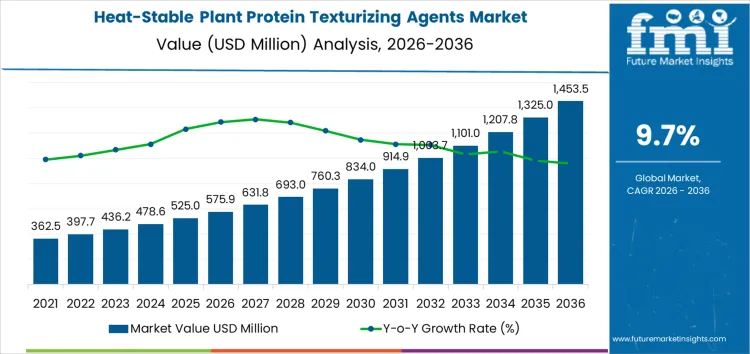
Heat-Stable Plant Protein Texturizing Agents Market Key Takeaways
| Metric | Value |
|---|---|
| Market Value (2026) | USD 575.9 million |
| Market Forecast Value (2036) | USD 1,453.5 million |
| Forecast CAGR (2026-2036) | 9.7% |
Why is the Demand for Heat-Stable Plant Protein Texturizing Agents Market Growing Globally?
Demand for heat-stable plant protein texturizing agents is growing globally due to increasing interest in plant based foods and the need to improve texture and sensory quality in high temperature processed products. Plant proteins often form coarse, brittle, or uneven structures when exposed to heat during extrusion, baking, canning, or retort processing, which can reduce palatability and consumer acceptance. Texturizing agents designed for thermal stability help create desirable mouthfeel, improved water retention, and structural integrity in meat alternatives, protein-fortified snacks, bakery goods, and ready-to-eat meals that undergo heat treatment. Food manufacturers adopt heat-stable texturizers to support product consistency and performance under industrial cooking conditions, which strengthens formulation flexibility across diverse processing platforms.
Growth in global interest for protein rich diets, flexitarian eating patterns, and plant driven nutrition encourages innovation in functional ingredients capable of maintaining quality during thermal exposure. Regulatory frameworks in multiple regions emphasize ingredient safety, labeling transparency, and clean ingredient credentials, which reinforces specification of texturizing systems that meet both performance and compliance criteria. Advances in plant protein modification, polysaccharide interactions, and hydrocolloid technologies improve heat resilience and texture profiles. Expanded distribution through retail, foodservice, and e-commerce increases accessibility for producers seeking competitive textural differentiation in global plant based product portfolios.
How Is the Global Heat-Stable Plant Protein Texturizing Agents Market Structured?
The global heat-stable plant protein texturizing agents market is shaped by rapid growth in plant-based food formulations that must withstand thermal processing without losing structure, mouthfeel, or functional performance. These texturizing agents are designed to maintain viscosity, gel strength, emulsification, and bite integrity during pasteurization, UHT treatment, baking, extrusion, and retort processing. Demand is closely linked to the expansion of plant-based dairy analogs, ready-to-drink beverages, baked goods, and hybrid meat alternatives. Manufacturers increasingly prioritize heat stability to ensure consistent sensory quality across industrial-scale production and extended shelf-life applications.
Which Application Segment Drives the Highest Global Demand?
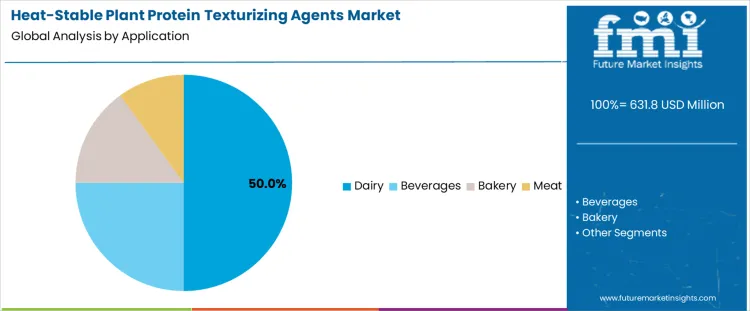
Dairy applications account for the largest share at 50.0%, reflecting strong demand from plant-based milk, yogurt, cheese analogs, and frozen dessert formulations that undergo high-temperature processing. Heat-stable protein texturizers are critical in these products to prevent phase separation, protein aggregation, and texture collapse during pasteurization and homogenization. Beverage applications represent 25.0% of demand, driven by protein-enriched drinks, nutritional shakes, and shelf-stable beverages requiring smooth viscosity and suspension stability under thermal stress. Bakery applications hold a 15.0% share, where these agents support crumb structure, moisture retention, and protein network stability during baking. Meat applications account for the remaining 10.0%, primarily in plant-based meat analogs where heat resistance is required during cooking and reheating.
Key Takeaways:
- Dairy leads due to intensive thermal processing requirements
- Beverages rely on heat stability for suspension and mouthfeel
- Bakery and meat applications reflect specialized functional needs
Which Protein Source Dominates Heat-Stable Texturizer Formulations?
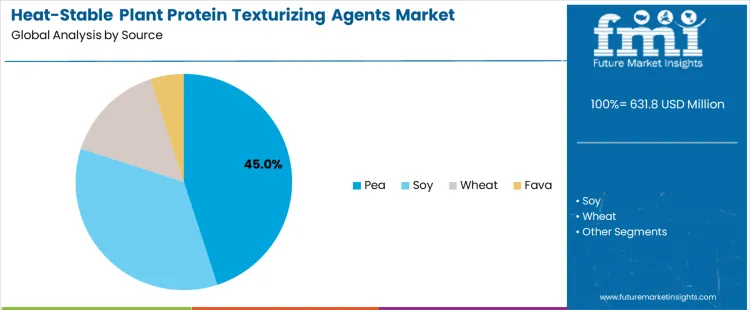
Pea protein-based texturizing agents lead the market with a 45.0% share, supported by their neutral flavor profile, strong heat tolerance, and favorable allergen positioning. Pea proteins perform well under high-temperature shear and are widely used across dairy and beverage applications. Soy-based texturizers account for 35.0%, benefiting from well-established functionality, high protein content, and proven thermal stability in large-scale processing. Wheat protein represents 15.0%, mainly used in bakery and structured food systems where gluten functionality enhances elasticity and chew. Fava bean protein holds a smaller 5.0% share, reflecting its emerging role in diversification strategies and clean-label formulations, despite more limited processing familiarity.
Key Takeaways
- Pea protein leads due to versatility and thermal robustness
- Soy remains significant because of established performance
- Wheat and fava serve targeted and emerging formulation needs
Which Sales Channel Accounts for the Majority of Global Distribution?
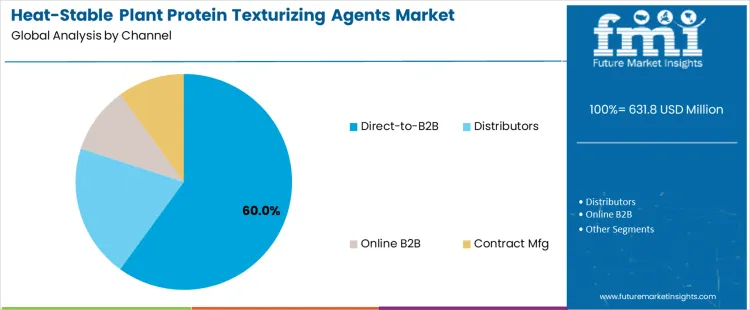
Direct-to-B2B channels dominate with a 60.0% share, highlighting the customized nature of heat-stable texturizing solutions and the need for close collaboration between ingredient suppliers and food manufacturers. These relationships support formulation optimization, thermal process validation, and performance testing at scale. Distributors account for 20.0%, supplying standardized grades to regional manufacturers and mid-sized processors. Online B2B platforms contribute 10.0%, primarily supporting smaller formulators and pilot-scale development through accessible sourcing. Contract manufacturing represents the remaining 10.0%, where texturizing systems are integrated into turnkey ingredient blends tailored for specific product categories.
Key Takeaways
- Direct B2B channels lead due to formulation complexity
- Distributors support broader regional access
- Online and contract models address niche and emerging demand
What are the Key Dynamics in the Heat-Stable Plant Protein Texturizing Agents Market?
Global demand rises as food manufacturers and alternative protein product developers adopt heat-stable plant protein texturizing agents that enhance texture, mouthfeel, and structural integrity in thermally processed foods. Heat-stable texturizing agents support development of plant-based meat analogs, dairy alternatives, and protein-fortified baked goods where processing temperatures exceed standard protein stability thresholds. Adoption aligns with rising global interest in plant-based diets, protein-rich formulations, and convenience foods across North America, Europe, Asia-Pacific, and Latin America. Usage spans meat analogs, snack bars, ready meals, and nutrition bars requiring preserved texture after heat treatment.
How do product performance requirements and processing demands shape adoption?
Manufacturers require plant protein texturizing agents that maintain gel strength, elasticity, and bite after exposure to high-temperature cooking, extrusion, and retort processing. Heat-stable agents improve water binding, reduce syneresis, and support desirable structural characteristics in products incorporating pea, soy, wheat, and other plant proteins. Food technologists integrate these agents to replicate sensory qualities of animal-derived proteins in target applications. Retailers and brands emphasize texture performance in product positioning to meet consumer expectations for palatability and satisfaction. Processing performance criteria include consistency across production batches, tolerance to thermal variation, and compatibility with other ingredients such as hydrocolloids and emulsifiers.
How do ingredient cost, formulation complexity, and regulatory compliance influence market scalability?
Heat-stable plant protein texturizing agents often involve specialized processing and formulation development, increasing raw material cost compared with conventional protein ingredients. Optimization requires precise balancing of protein-polysaccharide interactions, pH effects, and thermal stability, adding R&D and quality control effort. Ingredient cost dynamics influence pricing strategies for finished products, particularly in value-sensitive segments. Regulatory frameworks governing food additives, processing aids, and labeling vary across regions, affecting compliance documentation and permissible use levels. Supply chain variability for high-quality plant protein sources and texturizing agents impacts availability and cost stability. Long-term market growth depends on continued innovation in robust, cost-effective texturizing solutions and harmonized safety and labeling standards that support broad adoption across global plant-based and protein-enhanced food markets.
How Is Demand for Heat-Stable Plant Protein Texturizing Agents Evolving Globally?
Demand for heat-stable plant protein texturizing agents is increasing globally due to expansion of plant-based foods, high-temperature processing requirements, and need for consistent texture across cooking formats. India leads with a 14.8% CAGR, supported by rapid growth of vegetarian and flexitarian foods. China follows at 14.2%, driven by scale manufacturing of plant-based proteins and processed foods. USA records a 13.1% CAGR, shaped by extrusion-based meat alternatives and ready-to-eat product expansion. Germany posts 12.6%, reflecting strong demand for clean-label, heat-resilient protein systems. Growth reflects shift toward protein texturizers engineered to maintain structure, bite, and moisture retention under thermal stress.
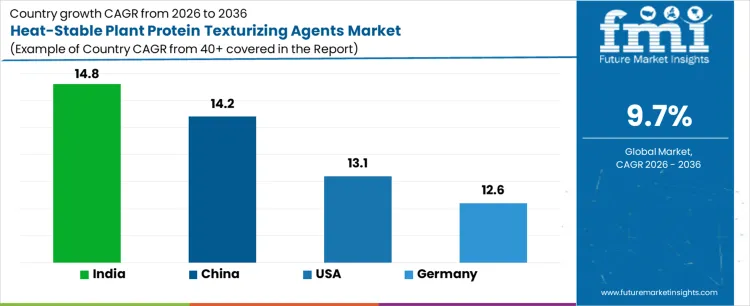
| Country | CAGR (%) |
|---|---|
| India | 14.8% |
| China | 14.2% |
| USA | 13.1% |
| Germany | 12.6% |
What is driving rapid adoption of heat-stable plant protein texturizers in India?
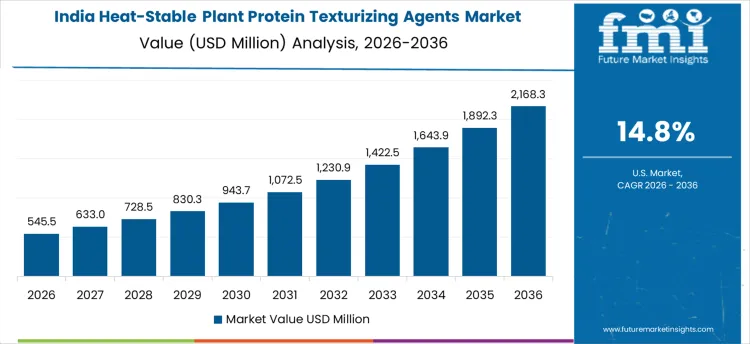
India demand is driven by strong vegetarian consumption patterns and increasing production of heat-processed plant-based foods. CAGR of 14.8% reflects adoption of texturizing agents that retain structure during frying, baking, and retort processing. Manufacturers require proteins that deliver consistent bite in snacks, meat analogs, and ready meals. Thermal stability supports long cooking cycles common in Indian cuisine. Domestic food processors scale plant protein formulations for institutional and retail markets. Suppliers invest in extrusion-compatible, pulse-based protein texturizers. Growth remains consumption-led and processing-focused, aligned with domestic dietary preferences and expansion of plant-based food manufacturing.
- High vegetarian and flexitarian food consumption
- Demand for texture stability during frying and baking
- Expansion of plant-based ready meals and snacks
- Scaling of pulse-based protein texturizer production
How is China sustaining strong growth in heat-stable protein texturizing agents?
China demand reflects large-scale production of plant-based foods and increasing adoption of high-temperature processing technologies. CAGR of 14.2% is supported by use of heat-stable texturizers in extrusion, retort, and frozen meal applications. Manufacturers prioritize consistency across batch production and distribution. Industrial food processing requires proteins that resist thermal collapse and moisture loss. Domestic suppliers expand soy and pea-based texturizing systems. Export-oriented processors align formulations with global thermal performance standards. Growth remains scale-driven and manufacturing-aligned, supported by infrastructure expansion and diversification of plant protein applications.
- Large-scale plant-based food manufacturing
- Use of extrusion and retort processing
- Need for batch consistency under thermal stress
- Expansion of domestic protein ingredient capacity
What factors are shaping demand growth in the USA for heat-stable plant protein texturizers?
USA demand is shaped by growth of meat analogs, ready-to-eat foods, and foodservice formats requiring thermal resilience. CAGR of 13.1% reflects adoption of texturizers that maintain fibrous structure during grilling, reheating, and frozen storage. Brands emphasize bite consistency and moisture retention. High-moisture extrusion drives need for protein systems with controlled denaturation. Clean-label positioning influences ingredient selection. Domestic suppliers develop functional blends tailored for heat performance. Growth remains innovation-led and application-driven, aligned with evolving plant-based consumption and processing complexity.
- Expansion of plant-based meat analogs
- Need for thermal stability during grilling and reheating
- Use of high-moisture extrusion processes
- Clean-label and functional ingredient development
Why is Germany showing steady expansion in heat-stable protein texturizer adoption?
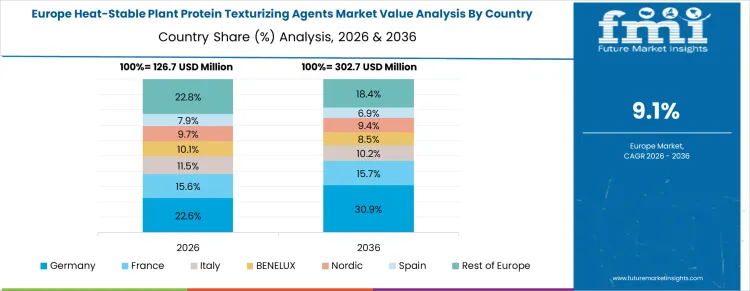
Germany demand reflects strong plant-based food penetration and emphasis on processing quality and ingredient transparency. CAGR of 12.6% is supported by adoption of heat-stable texturizers in bakery, prepared meals, and meat alternative products. Manufacturers require proteins that maintain structure during baking and thermal preservation. Regulatory expectations favor predictable functional performance. Research-led formulation supports selection of stable protein systems. Domestic and regional suppliers offer application-specific texturizers. Growth remains quality-driven and compliance-aligned, supported by premium plant-based product positioning and mature food processing standards.
- Strong plant-based food market penetration
- Demand for stability in baked and prepared foods
- Emphasis on functional predictability and compliance
- Application-specific protein texturizer solutions
What is the competitive landscape of demand for heat-stable plant protein texturizing agents globally?
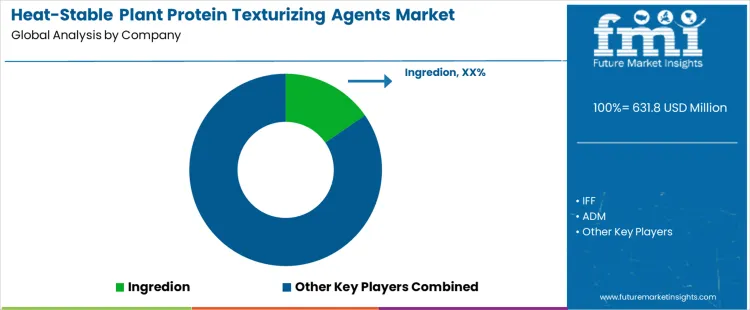
Demand for heat-stable plant protein texturizing agents is driven by growth of plant-based meat, dairy alternatives, and ready-to-eat foods requiring structural integrity during thermal processing. These agents are used to improve bite, juiciness, elasticity, and water retention in extrusion, retort, baking, and high-temperature cooking applications. Buyers evaluate heat stability, gelation behavior, emulsification capacity, neutral flavor profile, and compatibility with soy, pea, wheat, and blended protein systems. Procurement teams prioritize suppliers with application-specific formulation expertise, consistent functional performance at scale, and global regulatory compliance for food use. Trend in the global market reflects increased demand for clean-label plant proteins that maintain texture under harsh processing conditions without reliance on synthetic additives.
Ingredion holds leading positioning through functional plant protein systems and texturizing solutions designed for high-heat and high-shear food processes. ADM supports demand with textured vegetable proteins and functional protein ingredients optimized for thermal stability and scalability. IFF contributes texturizing and protein functionality platforms integrated with sensory and formulation expertise for plant-based foods. Kerry supplies protein systems and functional blends focused on texture retention and eating quality in cooked applications. Cargill participates through plant protein ingredients and application support serving global alternative protein manufacturers. Competitive differentiation depends on heat tolerance, texture consistency, formulation flexibility, and ability to support industrial-scale food processing.
Key Players in the Heat-Stable Plant Protein Texturizing Agents Market
- Ingredion
- IFF
- ADM
- Kerry
- Tate & Lyle
- Cargill
Scope of the Report
| Items | Values |
|---|---|
| Quantitative Units | USD million |
| Application | Dairy; Beverages; Bakery; Meat |
| Source | Pea; Soy; Wheat; Fava |
| Channel | Direct-to-B2B; Distributors; Online B2B; Contract Mfg |
| Regions Covered | Asia Pacific, Europe, North America, Latin America, Middle East & Africa |
| Countries Covered | India, China, USA, Germany, and 40+ countries |
| Key Companies Profiled | Ingredion; IFF; ADM; Kerry; Tate & Lyle; Cargill |
| Additional Attributes | Dollar sales by application and source; adoption trends for heat-stable plant protein texturizers in high-temperature processing; thermal stability, gel strength, and mouthfeel retention performance metrics; compatibility with extrusion, baking, UHT, and retort processes; hydration behavior, shear tolerance, and formulation robustness considerations; regulatory compliance and labeling standards influencing heat-stable plant protein texturizing agent selection. |
Heat-Stable Plant Protein Texturizing Agents Market by Segment
Application:
- Dairy
- Beverages
- Bakery
- Meat
Source:
- Pea
- Soy
- Wheat
- Fava
Channel:
- Direct-to-B2B
- Distributors
- Online B2B
- Contract Mfg
Region:
- Asia Pacific
- China
- Japan
- South Korea
- India
- Australia & New Zealand
- ASEAN
- Rest of Asia Pacific
- Europe
- Germany
- United Kingdom
- France
- Italy
- Spain
- Nordic
- BENELUX
- Rest of Europe
- North America
- United States
- Canada
- Mexico
- Latin America
- Brazil
- Chile
- Rest of Latin America
- Middle East & Africa
- Kingdom of Saudi Arabia
- Other GCC Countries
- Turkey
- South Africa
- Other African Union
- Rest of Middle East & Africa
Frequently Asked Questions
How big is the heat-stable plant protein texturizing agents market in 2026?
The global heat-stable plant protein texturizing agents market is estimated to be valued at USD 575.9 million in 2026
What will be the size of heat-stable plant protein texturizing agents market in 2036?
The market size for the heat-stable plant protein texturizing agents market is projected to reach USD 1,453.5 million by 2036.
How much will be the heat-stable plant protein texturizing agents market growth between 2026 and 2036?
The heat-stable plant protein texturizing agents market is expected to grow at a 9.7% CAGR between 2026 and 2036.
What are the key application types in the heat-stable plant protein texturizing agents market?
The key application types in heat-stable plant protein texturizing agents market are dairy, beverages, bakery and meat.
Which source segment will contribute significant share in the heat-stable plant protein texturizing agents market in 2026?
In terms of source, pea segment to command 45.0% share in the heat-stable plant protein texturizing agents market in 2026.
Preview the report firsthand - request a free sample
Get SampleGet the brochure for pricing and purchase details.
Get PDFTable of Content
- Executive Summary
- Global Market Outlook
- Demand-side Trends
- Supply-side Trends
- Technology Roadmap Analysis
- Analysis and Recommendations
- Market Overview
- Market Coverage / Taxonomy
- Market Definition / Scope / Limitations
- Market Background
- Market Dynamics
- Drivers
- Restraints
- Opportunity
- Trends
- Scenario Forecast
- Demand in Optimistic Scenario
- Demand in Likely Scenario
- Demand in Conservative Scenario
- Opportunity Map Analysis
- Product Life Cycle Analysis
- Supply Chain Analysis
- Investment Feasibility Matrix
- Value Chain Analysis
- PESTLE and Porter’s Analysis
- Regulatory Landscape
- Regional Parent Market Outlook
- Production and Consumption Statistics
- Import and Export Statistics
- Market Dynamics
- Global Market Analysis 2021 to 2025 and Forecast, 2026 to 2036
- Historical Market Size Value (USD Million) Analysis, 2021 to 2025
- Current and Future Market Size Value (USD Million) Projections, 2026 to 2036
- Y-o-Y Growth Trend Analysis
- Absolute $ Opportunity Analysis
- Global Market Pricing Analysis 2021 to 2025 and Forecast 2026 to 2036
- Global Market Analysis 2021 to 2025 and Forecast 2026 to 2036, By Application
- Introduction / Key Findings
- Historical Market Size Value (USD Million) Analysis By Application , 2021 to 2025
- Current and Future Market Size Value (USD Million) Analysis and Forecast By Application , 2026 to 2036
- Dairy
- Beverages
- Bakery
- Meat
- Dairy
- Y-o-Y Growth Trend Analysis By Application , 2021 to 2025
- Absolute $ Opportunity Analysis By Application , 2026 to 2036
- Global Market Analysis 2021 to 2025 and Forecast 2026 to 2036, By Source
- Introduction / Key Findings
- Historical Market Size Value (USD Million) Analysis By Source, 2021 to 2025
- Current and Future Market Size Value (USD Million) Analysis and Forecast By Source, 2026 to 2036
- Pea
- Soy
- Wheat
- Fava
- Pea
- Y-o-Y Growth Trend Analysis By Source, 2021 to 2025
- Absolute $ Opportunity Analysis By Source, 2026 to 2036
- Global Market Analysis 2021 to 2025 and Forecast 2026 to 2036, By Channel
- Introduction / Key Findings
- Historical Market Size Value (USD Million) Analysis By Channel, 2021 to 2025
- Current and Future Market Size Value (USD Million) Analysis and Forecast By Channel, 2026 to 2036
- Direct-to-B2B
- Distributors
- Online B2B
- Contract Mfg
- Direct-to-B2B
- Y-o-Y Growth Trend Analysis By Channel, 2021 to 2025
- Absolute $ Opportunity Analysis By Channel, 2026 to 2036
- Global Market Analysis 2021 to 2025 and Forecast 2026 to 2036, By Region
- Introduction
- Historical Market Size Value (USD Million) Analysis By Region, 2021 to 2025
- Current Market Size Value (USD Million) Analysis and Forecast By Region, 2026 to 2036
- North America
- Latin America
- Western Europe
- Eastern Europe
- East Asia
- South Asia and Pacific
- Middle East & Africa
- Market Attractiveness Analysis By Region
- North America Market Analysis 2021 to 2025 and Forecast 2026 to 2036, By Country
- Historical Market Size Value (USD Million) Trend Analysis By Market Taxonomy, 2021 to 2025
- Market Size Value (USD Million) Forecast By Market Taxonomy, 2026 to 2036
- By Country
- USA
- Canada
- Mexico
- By Application
- By Source
- By Channel
- By Country
- Market Attractiveness Analysis
- By Country
- By Application
- By Source
- By Channel
- Key Takeaways
- Latin America Market Analysis 2021 to 2025 and Forecast 2026 to 2036, By Country
- Historical Market Size Value (USD Million) Trend Analysis By Market Taxonomy, 2021 to 2025
- Market Size Value (USD Million) Forecast By Market Taxonomy, 2026 to 2036
- By Country
- Brazil
- Chile
- Rest of Latin America
- By Application
- By Source
- By Channel
- By Country
- Market Attractiveness Analysis
- By Country
- By Application
- By Source
- By Channel
- Key Takeaways
- Western Europe Market Analysis 2021 to 2025 and Forecast 2026 to 2036, By Country
- Historical Market Size Value (USD Million) Trend Analysis By Market Taxonomy, 2021 to 2025
- Market Size Value (USD Million) Forecast By Market Taxonomy, 2026 to 2036
- By Country
- Germany
- UK
- Italy
- Spain
- France
- Nordic
- BENELUX
- Rest of Western Europe
- By Application
- By Source
- By Channel
- By Country
- Market Attractiveness Analysis
- By Country
- By Application
- By Source
- By Channel
- Key Takeaways
- Eastern Europe Market Analysis 2021 to 2025 and Forecast 2026 to 2036, By Country
- Historical Market Size Value (USD Million) Trend Analysis By Market Taxonomy, 2021 to 2025
- Market Size Value (USD Million) Forecast By Market Taxonomy, 2026 to 2036
- By Country
- Russia
- Poland
- Hungary
- Balkan & Baltic
- Rest of Eastern Europe
- By Application
- By Source
- By Channel
- By Country
- Market Attractiveness Analysis
- By Country
- By Application
- By Source
- By Channel
- Key Takeaways
- East Asia Market Analysis 2021 to 2025 and Forecast 2026 to 2036, By Country
- Historical Market Size Value (USD Million) Trend Analysis By Market Taxonomy, 2021 to 2025
- Market Size Value (USD Million) Forecast By Market Taxonomy, 2026 to 2036
- By Country
- China
- Japan
- South Korea
- By Application
- By Source
- By Channel
- By Country
- Market Attractiveness Analysis
- By Country
- By Application
- By Source
- By Channel
- Key Takeaways
- South Asia and Pacific Market Analysis 2021 to 2025 and Forecast 2026 to 2036, By Country
- Historical Market Size Value (USD Million) Trend Analysis By Market Taxonomy, 2021 to 2025
- Market Size Value (USD Million) Forecast By Market Taxonomy, 2026 to 2036
- By Country
- India
- ASEAN
- Australia & New Zealand
- Rest of South Asia and Pacific
- By Application
- By Source
- By Channel
- By Country
- Market Attractiveness Analysis
- By Country
- By Application
- By Source
- By Channel
- Key Takeaways
- Middle East & Africa Market Analysis 2021 to 2025 and Forecast 2026 to 2036, By Country
- Historical Market Size Value (USD Million) Trend Analysis By Market Taxonomy, 2021 to 2025
- Market Size Value (USD Million) Forecast By Market Taxonomy, 2026 to 2036
- By Country
- Kingdom of Saudi Arabia
- Other GCC Countries
- Turkiye
- South Africa
- Other African Union
- Rest of Middle East & Africa
- By Application
- By Source
- By Channel
- By Country
- Market Attractiveness Analysis
- By Country
- By Application
- By Source
- By Channel
- Key Takeaways
- Key Countries Market Analysis
- USA
- Pricing Analysis
- Market Share Analysis, 2025
- By Application
- By Source
- By Channel
- Canada
- Pricing Analysis
- Market Share Analysis, 2025
- By Application
- By Source
- By Channel
- Mexico
- Pricing Analysis
- Market Share Analysis, 2025
- By Application
- By Source
- By Channel
- Brazil
- Pricing Analysis
- Market Share Analysis, 2025
- By Application
- By Source
- By Channel
- Chile
- Pricing Analysis
- Market Share Analysis, 2025
- By Application
- By Source
- By Channel
- Germany
- Pricing Analysis
- Market Share Analysis, 2025
- By Application
- By Source
- By Channel
- UK
- Pricing Analysis
- Market Share Analysis, 2025
- By Application
- By Source
- By Channel
- Italy
- Pricing Analysis
- Market Share Analysis, 2025
- By Application
- By Source
- By Channel
- Spain
- Pricing Analysis
- Market Share Analysis, 2025
- By Application
- By Source
- By Channel
- France
- Pricing Analysis
- Market Share Analysis, 2025
- By Application
- By Source
- By Channel
- India
- Pricing Analysis
- Market Share Analysis, 2025
- By Application
- By Source
- By Channel
- ASEAN
- Pricing Analysis
- Market Share Analysis, 2025
- By Application
- By Source
- By Channel
- Australia & New Zealand
- Pricing Analysis
- Market Share Analysis, 2025
- By Application
- By Source
- By Channel
- China
- Pricing Analysis
- Market Share Analysis, 2025
- By Application
- By Source
- By Channel
- Japan
- Pricing Analysis
- Market Share Analysis, 2025
- By Application
- By Source
- By Channel
- South Korea
- Pricing Analysis
- Market Share Analysis, 2025
- By Application
- By Source
- By Channel
- Russia
- Pricing Analysis
- Market Share Analysis, 2025
- By Application
- By Source
- By Channel
- Poland
- Pricing Analysis
- Market Share Analysis, 2025
- By Application
- By Source
- By Channel
- Hungary
- Pricing Analysis
- Market Share Analysis, 2025
- By Application
- By Source
- By Channel
- Kingdom of Saudi Arabia
- Pricing Analysis
- Market Share Analysis, 2025
- By Application
- By Source
- By Channel
- Turkiye
- Pricing Analysis
- Market Share Analysis, 2025
- By Application
- By Source
- By Channel
- South Africa
- Pricing Analysis
- Market Share Analysis, 2025
- By Application
- By Source
- By Channel
- USA
- Market Structure Analysis
- Competition Dashboard
- Competition Benchmarking
- Market Share Analysis of Top Players
- By Regional
- By Application
- By Source
- By Channel
- Competition Analysis
- Competition Deep Dive
- Ingredion
- Overview
- Product Portfolio
- Profitability by Market Segments (Product/Age /Sales Channel/Region)
- Sales Footprint
- Strategy Overview
- Marketing Strategy
- Product Strategy
- Channel Strategy
- IFF
- ADM
- Kerry
- Tate & Lyle
- Cargill
- Ingredion
- Competition Deep Dive
- Assumptions & Acronyms Used
- Research Methodology


