

- Industry Size (2026)
- USD 1.8 Bn
- Forecast (2036)
- USD 7.2 Bn
- CAGR (2026 to 2036)
- 14.9%
Protein Condiments Market Size, Market Forecast and Outlook By FMI
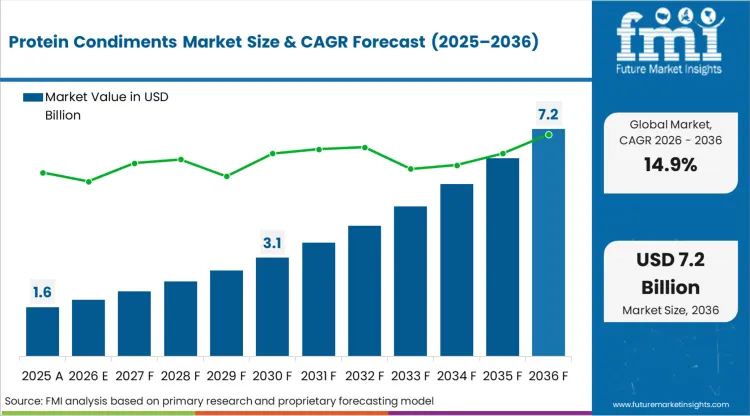
In 2025, the protein condiments market was worth USD 1.6 billion. It is expected to reach USD 1.8 billion in 2026 and USD 7.2 billion by 2036, implying a CAGR of 14.9%. Absolute dollar growth of USD 5.4 billion over the decade signals a transformational shift in how consumers view condiments, moving from flavor-only additions to functional meal components.
Procurement and formulation strategies are pivoting as obesity rates, affecting 1 in 8 people globally, compel regulators and retailers to favor nutrient-dense profiles [2]. With 2.5 billion adults classified as overweight in 2022, the food industry is under immense pressure to improve the nutritional quality of calorically dense additives like sauces and condiments [2]. Consequently, brands are reformulating recipes to replace empty calories with functional proteins, transforming condiments from dietary villains into vehicles for satiety and muscle maintenance.
Summary of Protein Condiments Market
- Protein Condiments Market Definition
- Condiments fortified with protein to offer functional nutrition alongside flavor.
- Demand Drivers in the Market
- Rising global obesity rates driving demand for satiating, nutrient-dense foods.
- Mainstream consumer desire to increase protein intake for general wellness.
- Innovation in ingredient solubility improving texture of fortified sauces.
- Key Segments Analyzed in the FMI Report
- Sauces segment holding 42.8% market share.
- Dressings segment growing at a rapid 17.3% CAGR.
- Plant-based protein sources outpacing dairy with 18.2% CAGR.
- Analyst Opinion at FMI
- Nandini Roy Choudhury, Principal Consultant for Food & Beverage, opines, "The 'sauce-ification' of nutrition is a critical unlocking mechanism for mass adoption. By embedding protein into familiar formats like ranch and barbecue sauce, manufacturers can capture the 'stealth health' consumer who refuses to compromise on taste but desires a better macronutrient profile."
- Strategic Implications/Executive Takeaways
- Invest in emulsion technology to mask the grit of plant proteins.
- Acquire emerging clean-label sauce brands to accelerate portfolio renovation.
- Target the "meat reducer" demographic with savory, plant-protein dips.
- Methodology
- Validated through first-hand corporate production and capacity data.
- Zero reliance on speculative third-party market research reports.
- Based on verifiable industrial benchmarks and verified sources.
Nick Hampton, Chief Executive of Tate & Lyle, noted regarding the industry's shift toward functional ingredients, "We are always looking to provide our customers with the latest innovation in the marketplace - this partnership with BioHarvest allows us to do just that." [8] This strategic focus on next-generation ingredients underscores the sector's move toward botanical and bioactive compounds that enhance health credentials without sacrificing the sensory experience consumers expect from their favorite toppings.
Growth is robust across diverse economies, with China (18.9%), India (17.4%), the United States (16.2%), the United Kingdom (14.8%), and Germany (13.6%) driving adoption. While Western markets prioritize "macro-friendly" claims for fitness-conscious demographics, emerging markets are leveraging protein-fortified condiments to address broader nutritional gaps in convenient, shelf-stable formats.
Protein Condiments Market Definition
The protein condiments market comprises the production and trade of flavor-enhancing food products, such as ketchup, mayonnaise, barbecue sauce, salad dressings, and dips, that are explicitly fortified with protein ingredients (whey, pea, soy, or egg white) to provide a nutritional benefit beyond taste. These products are marketed as functional foods, targeting health-conscious consumers, athletes, and weight-management demographics seeking to increase daily protein intake through ancillary meal components.
Protein Condiments Market Inclusions
The report covers shelf-stable and refrigerated condiments including high-protein mayonnaise, greek yogurt-based dips, protein-enriched salad dressings, and savory sauces fortified with plant or dairy proteins. It includes products sold through supermarkets, health food stores, online direct-to-consumer channels, and foodservice partnerships. The analysis encompasses both animal-based (whey, casein) and vegan sauces formulations utilizing pea, rice, or soy proteins.
Protein Condiments Market Exclusions
The scope excludes standard condiments with naturally occurring trace protein (like nut butters) unless they are specifically marketed as "protein-fortified" or "high-protein" condiments. It also omits high protein powders or shakes used as meal replacements, strictly focusing on products used to garnish or enhance solid meals. Plain greek yogurt or cottage cheese sold as dairy staples are excluded unless formulated and packaged specifically as savory dips or spreads.
Protein Condiments Market Research Methodology
- Primary Research: Interviews with R&D heads at major condiment firms, functional ingredient suppliers, and category managers at retail chains.
- Desk Research: Analysis of new product launches, patent filings for protein stabilization in emulsions, and nutrition labeling databases.
- Market-Sizing and Forecasting: A bottom-up approach aggregating revenue from functional food brands and specialized condiment lines, adjusted for retail penetration rates.
- Data Validation and Update Cycle: Cross-referencing sales data with annual reports from public CPG companies and trade association statistics.
Segmental Analysis
Protein Condiments Market Analysis by Product Type
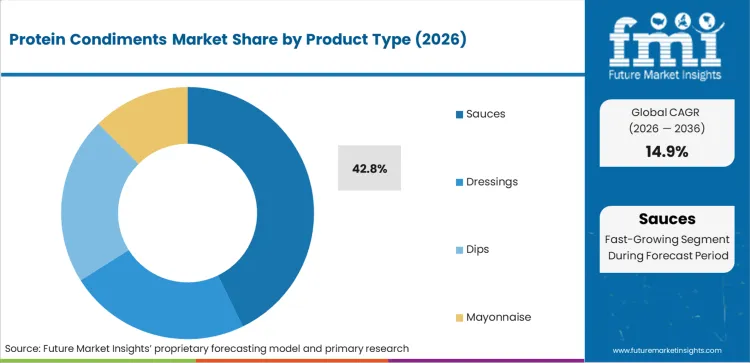
Sauces currently hold a 42.8% share of the market, serving as the primary entry point for protein fortification due to their bold flavor profiles which can effectively mask the sensory notes of added proteins. The dominance of this segment is reinforced by the "Taste Elevation" strategy of major players like Kraft Heinz, which generated $26 billion in net sales in 2024 by platforming condiments as central to meal experiences [7]. This scale allows for the rapid commercialization of functional variants across global distribution networks.
- Flavor masking: Sauces like barbecue or hot sauce have robust flavor profiles that easily cover the vegetal or chalky notes of protein isolates. This allows manufacturers to achieve higher protein claims per serving compared to milder products, driving adoption among consumers seeking measurable nutritional boosts.
- Usage frequency: The high frequency of sauce usage in daily meals, from stir-fries to marinades, creates a volume-driven consumption habit. Clorox's Hidden Valley Ranch, for instance, continues to unveil bold new flavors to keep the category sticky, providing a template for how protein-enhanced versions can piggyback on flavor innovation to enter household rotations [9].
- Premiumization: Dressings are the fastest-growing sub-segment at 17.3% CAGR, fueled by the salad dressings and mayonnaise category's pivot toward "macro-friendly" options. As salads remain a core meal for health-conscious consumers, there is a direct demand for dressings that add satiety rather than just empty calories.
Protein Condiments Market Analysis by Protein Source
Plant-based protein sources are expanding at an 18.2% CAGR, outpacing traditional dairy-based formulations. This shift is driven by the broader consumer migration toward flexitarian diets and the improved functionality of ingredients like hydrolyzed vegetable proteins.
- Ingredient innovation: New ingredient technologies, such as improved dispersibility pea proteins, are solving historical texture challenges in liquid applications. This technical advancement allows for smoother emulsions in vegan salad dressing, removing the grittiness that previously limited the appeal of plant-fortified condiments.
- Consumer alignment: With 71% of Americans trying to consume more protein, there is a strong preference for sources perceived as "clean" and sustainable [1]. Plant-based sources align with this dual mandate, allowing brands to market products that support both personal health and environmental sustainability.
- Market integration: The plant-based retail market in the USA alone is valued at $8.1 billion, creating a massive halo effect for adjacent categories [3]. Protein condiments are increasingly positioned as essential companions to plant-based meats, offering a complete "plant-forward" meal solution that reassures consumers about their total protein intake.
Protein Condiments Market Drivers, Restraints, and Opportunities
The relentless rise in global obesity is a primary structural driver, as it forces a re-evaluation of caloric sources in the diet. With obesity prevalence doubling in many OECD countries from 13% to 19% between 2003 and 2023, public health narratives are shifting toward higher protein diets to improve satiety and metabolic health [10]. This demographic pressure creates a "permission to eat" dynamic for protein condiments; consumers are willing to pay a premium for sauces that actively contribute to weight management goals rather than undermining them. Additionally, the proliferation of "meat reducer" demographics, 21% of Australians identify as such, creates a specific need for savory, protein-rich dips and vegan dips to compensate for reduced meat consumption [6].
Restraints
Taste and texture trade-offs remain the most significant restraint. High protein loads can destabilize emulsions, leading to separation or a "chalky" mouthfeel that alienates mainstream consumers. While ingredient innovation is mitigating this, the R&D cycle to achieve sensory parity with standard culinary sauces is capital intensive. Furthermore, regulatory scrutiny regarding "protein-washing", where products make prominent protein claims despite negligible quantities, poses a reputational risk. Brands must navigate complex labeling laws to ensure claims are substantiated, which can slow speed-to-market in strict jurisdictions like the EU.
Opportunities
- Functional Snacking: The "snackification" of meals presents a massive opportunity for protein dips. As consumers increasingly replace meals with snacks, substantial, nutrient-dense dips (like Greek yogurt-based ranch or hummus hybrids) can serve as mini-meal anchors. Launching convenient, single-serve formats targets the on-the-go consumer seeking reliable nutrition.
- Clean Label Renovation: Acquiring high-growth, clean-label sauce brands offers a pathway to rapid portfolio renovation. The Marzetti Company’s acquisition of Bachan’s highlights the industry appetite for premium, authentic sauce platforms that can be leveraged for future functional innovations [12].
- Flavor Fusion: Leveraging global flavor trends allows brands to introduce protein in novel formats. Hot sauce and spicy condiments, which naturally appeal to younger demographics, serve as ideal carriers for "stealth" protein fortification, tapping into the excitement around world flavors to drive trial of functional variants.
Regional Analysis
Based on the regional analysis, the Protein Condiments market is segmented into North America, Latin America, Europe, East Asia, South Asia, Oceania and Middle East & Africa across 40+ countries. The full report also offers market attractiveness analysis based on regional trends.
.webp "Top Country Growth Comparison Protein Condiments Market Cagr (2026 2036)")
| Country | CAGR (2026 to 2036) |
|---|---|
| China | 18.9% |
| India | 17.4% |
| United States | 16.2% |
| United Kingdom | 14.8% |
| Germany | 13.6% |
| Japan | 12.7% |
| Australia | 11.9% |
Source: Future Market Insights (FMI) analysis, based on proprietary forecasting model and primary research
Asia Pacific Protein Condiments Market Analysis
Asia Pacific is the fastest-growing region, driven by rapid urbanization and the westernization of diets, alongside a traditional emphasis on savory, umami-rich flavors.
- China: The China market is poised to expand at 18.9% CAGR during 2026 to 2036 because "stealth nutrition" sauces are scaling through ready-meal and home-cooking convenience, which lifts utilization rates and justifies technology refresh decisions. Global health pressures, with 1 in 8 people living with obesity worldwide, act as a tailwind for these functional adaptations in a market increasingly conscious of metabolic health [2].
- India: Demand for protein condiments in India is set to grow at 17.4% CAGR through 2036, supported by per-capita protein intake of 61.8-63.4 g/day before procurement and budgeting cycles translate into higher deployment volumes [4]. This trajectory is underpinned by the "mass-premium" trend where consumers seek protein-fortified versions of familiar chutneys and creamy sauces to supplement largely vegetarian diets.
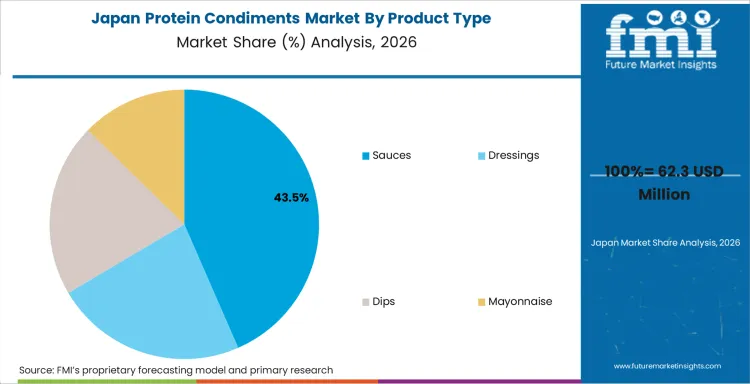
- Japan: Japan is likely to see revenue increase at 12.7% CAGR during 2026 to 2036, given the demand for portion-controlled "flavor boosters" aligned to convenience foods and the resulting push for capacity and workflow upgrades. The market leverages a highly developed retail food sector, valued at over $190 billion, to distribute functional, small-format condiments [20].
North America Protein Condiments Market Analysis
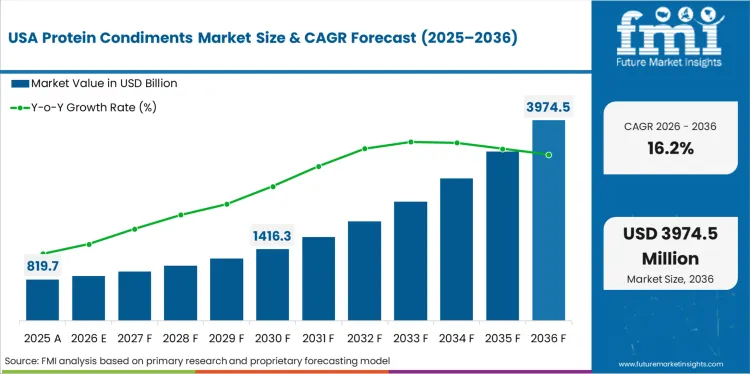
North America remains the innovation engine, characterized by a highly developed functional food market and consumers actively seeking protein claims.
- United States: The United States market is projected to grow at 16.2% CAGR through 2036, reflecting mainstream household penetration as 70-71% of consumers actively try to consume more protein, helping suppliers align positioning with local buying triggers [1]. This demand is supported by a robust plant-based ecosystem, where retail sales of $8.1 billion create a receptive audience for complementary protein-rich condiments [3].
Europe Protein Condiments Market Analysis
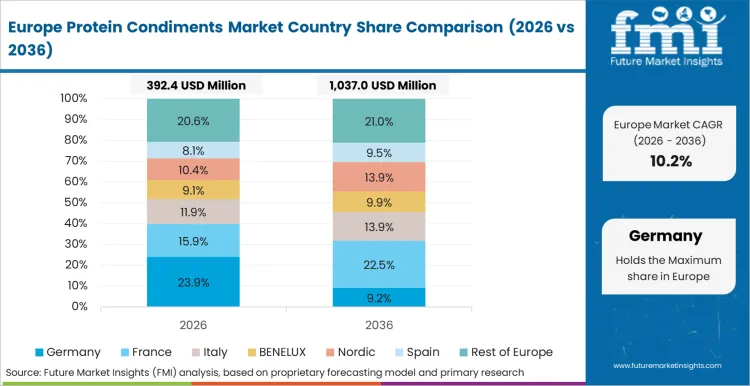
Europe prioritizes clean-label and organic attributes, with growth centered on integrating protein into everyday staples without "ultra-processed" stigmas.
- United Kingdom: In the UK, the market is expected to expand at 14.8% CAGR from 2026 to 2036, supported by the need to improve average adult protein intake (currently ~10% of energy) that increases ROI visibility for buyers [13]. This drives innovation in organic condiments that offer nutritional density for value-conscious households.
- Germany: The Germany sector is forecast to advance at 13.6% CAGR through 2036, with growth anchored in plant-forward trends and rising obesity rates (OECD average rising to 19%) that convert into measurable budget allocation for healthier food options [10]. Brands here focus on soy protein ingredient integration into bio-organic sauces.
Competitive Aligners for Market Players
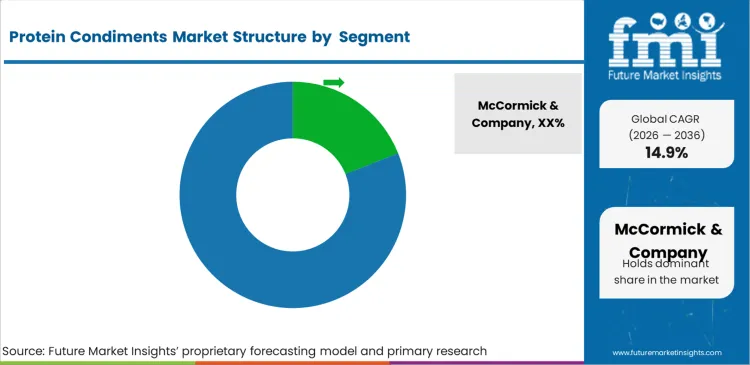
The competitive landscape is defined by aggressive M&A and platform consolidation. Market leaders are moving away from single-product strategies to building comprehensive sauce platforms. McCormick & Company’s acquisition of a controlling interest in McCormick de Mexico exemplifies this, consolidating scale in a major sauce market to strengthen route-to-market capabilities for future innovation [5]. Similarly, The Marzetti Company’s $400 million acquisition of Bachan’s underscores the race to acquire high-growth, authentic sauce brands that can serve as vehicles for portfolio modernization and "better-for-you" extensions [12].
Differentiation is increasingly achieved through cross-category partnerships. Collaborations like the one between Mattel and Heinz for "Barbiecue" sauce demonstrate how brands are using pop culture to create buzz and enter new consumption occasions [11]. These limited-edition drops create a "halo" of relevance that can then be leveraged to introduce more functional, permanent SKU additions. Furthermore, ingredient suppliers like Ingredion are playing a pivotal role by launching specialized proteins, such as high-dispersibility pea protein, which enable manufacturers to overcome technical barriers and launch superior-tasting protein condiments [9].
Recent Developments
The report includes full coverage of key trends from competitive benchmarking. Some of the recent developments covered in the reports:
- In February 2026, The Marzetti Company entered a definitive agreement to acquire Bachan’s, Inc. for $400 million.[12]
- In August 2025, McCormick & Co. signed an agreement to acquire a controlling interest in McCormick de Mexico.[5]
Key Players in Protein Condiments
- McCormick & Company
- The Marzetti Company (Lancaster Colony)
- Kraft Heinz
- Clorox (Hidden Valley Ranch)
- Unilever (Hellmann’s)
- Nestlé
- General Mills
- Primal Kitchen
- Kevin’s Natural Foods
- G Hughes
Scope of the Report
| Metric | Value |
|---|---|
| Quantitative Units | USD 1.8 billion (2026) to USD 7.2 billion (2036), at a CAGR of 14.9% |
| Market Definition | The protein condiments market comprises the production and trade of flavor-enhancing food products explicitly fortified with protein ingredients to provide a nutritional benefit beyond taste. |
| Product Type Segmentation | Sauces, Dressings, Dips, Mayonnaise |
| Protein Source Segmentation | Whey, Plant-based, Casein, Egg White |
| Packaging Segmentation | Bottles, Jars, Sachets |
| Distribution Channel Segmentation | Retail, Foodservice |
| Regions Covered | North America, Latin America, Europe, East Asia, South Asia, Oceania, Middle East and Africa |
| Countries Covered | United States, Canada, Mexico, Brazil, Argentina, Germany, France, United Kingdom, Italy, Spain, China, India, Japan, Australia and 40 plus countries |
| Key Companies Profiled | McCormick & Company, The Marzetti Company, Kraft Heinz, Clorox, Unilever, Nestlé, General Mills, Primal Kitchen, Kevin’s Natural Foods, G Hughes |
| Forecast Period | 2026 to 2036 |
| Approach | Hybrid top down and bottom up market modeling validated through primary interviews with condiment manufacturers and ingredient suppliers, supported by trade data benchmarking and plant level capacity verification |
Protein Condiments Market Analysis by Segments
Product Type:
- Sauces
- Dressings
- Dips
- Mayonnaise
Protein Source:
- Whey
- Plant-based
- Casein
- Egg White
Packaging:
- Bottles
- Jars
- Sachets
Distribution Channel:
- Retail
- Foodservice
Region:
- Asia Pacific
- India
- China
- Japan
- Australia
- ASEAN
- Rest of Asia Pacific
- Europe
- Germany
- United Kingdom
- France
- Italy
- Spain
- Rest of Europe
- North America
- United States
- Canada
- Mexico
- Latin America
- Brazil
- Argentina
- Rest of Latin America
- Middle East & Africa
- GCC Countries
- South Africa
- Turkey
- Rest of Middle East & Africa
Bibliography
- [1] IFIC. (2025). 70% of people trying to consume more protein.
- [2] World Health Organization. (2024). 1 in 8 people living with obesity globally.
- [3] The Good Food Institute. (2025). USA plant-based food retail market size $8.1B.
- [4] Press Information Bureau. (2025). Avg per-capita protein intake 61.8 g (rural) / 63.4 g (urban) in India.
- [5] ir.mccormick.com. (2025). Signed agreement to acquire controlling interest in McCormick de Mexico.
- [6] Food Frontier. (2024). “Meat reducer” share of population 21% in Australia.
- [7] SEC. (2025). Kraft Heinz net sales ~$26B in 2024.
- [8] Tate & Lyle. (2024). “We are always looking to provide our customers with the latest innovation”.
- [9] investors.thecloroxcompany.com. (2025). Unveiled seven new ranch flavors + packaging refresh.
- [10] OECD. (2025). Obesity rate trend 13% → 19% (avg OECD), 2003→2023.a
This bibliography is provided for reader reference and is not exhaustive. The full report contains the complete reference list and detailed citations.
This Report Addresses
- Market intelligence to enable structured strategic decision making across mature and emerging condiment economies
- Market size estimation and 10 year revenue forecasts from 2026 to 2036, supported by validated capacity and trade benchmarks
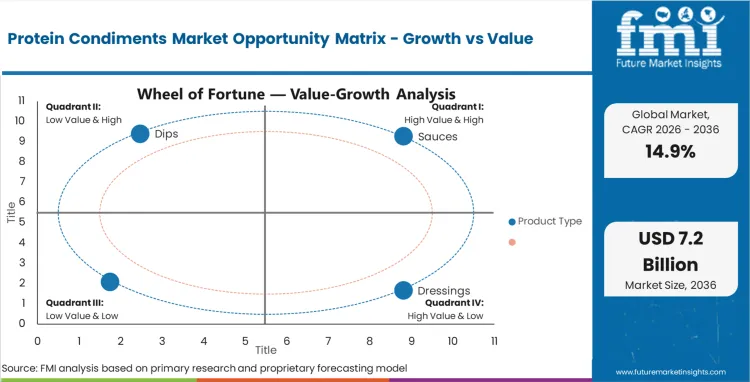
- Growth opportunity mapping across sauces, dressings, and dips with emphasis on protein fortification transitions
- Segment and regional revenue forecasts covering retail and foodservice applications
- Competition strategy assessment including integration models, cost survivability positioning, and compliance capability benchmarking
- Product reformulation and sustainability tracking including clean label, plant-based, and macro-friendly aligned grades
- Regulatory impact analysis covering nutritional labeling mandates, obesity thresholds, and export driven specification upgrades
- Market report delivery in PDF, Excel, PPT, and interactive dashboard formats for executive and operational use
Frequently Asked Questions
How large is the demand for Protein Condiments in the global market in 2026?
Demand for Protein Condiments in the global market is estimated to be valued at USD 1.8 billion in 2026.
What will be the market size of Protein Condiments in the global market by 2036?
Market size for Protein Condiments is projected to reach USD 7.2 billion by 2036.
What is the expected demand growth for Protein Condiments in the global market between 2026 and 2036?
Demand for Protein Condiments in the global market is expected to grow at a CAGR of 14.9% between 2026 and 2036.
Which Product Type is poised to lead global sales by 2026?
Sauces are expected to be the dominant form, capturing approximately 42.8% of global market share in 2026 due to robust flavor profiles that mask protein notes.
How significant is the role of Dressings in driving Protein Condiments adoption in 2026?
Dressings represent a critical segment, projected to grow at a rapid 17.3% CAGR as consumers seek macro-friendly options for salads.
What is Driving Demand in the United States?
Mainstream desire for higher protein intake and the expansion of functional food categories in retail are driving growth in the United States.
What Compliance Standards are Referenced for the United States?
FDA regulations regarding nutrient content claims and labeling for fortified foods are key compliance benchmarks.
What is the United States Growth Outlook in this Report?
The United States is projected to grow at a CAGR of 16.2% during 2026 to 2036.
Why is Europe described as an Important Clean Label Hub in this Report?
Europe drives demand for organic and natural protein sources, avoiding ultra-processed ingredients in functional foods.
What Type of Demand Dominates in Europe?
Demand for plant-based, clean-label, and organic protein condiments dominates regional consumption.
What is Germany Growth Outlook in this Report?
Germany is projected to expand at a CAGR of 13.6% during 2026 to 2036.
Does the Report Cover India in its Regional Analysis?
India is included within South Asia under the regional scope of analysis.
What are the Sources referred to for analyzing the Market in India?
Government data on dietary protein intake and urbanization trends are cited as primary reference sources.
What is the Main Demand Theme Linked to India in Asia Coverage?
Asia Pacific demand is associated with the "mass-premium" trend where consumers seek affordable protein fortification in familiar formats.
Does the Report Cover China in its Regional Analysis?
China is included within East Asia under the regional coverage framework.
What is the Main China Related Demand Theme in Asia Coverage?
Rising obesity rates and the adoption of "stealth nutrition" in convenient sauces drive the market theme in China.
Which Protein Sources are Strategically Important for Asia Pacific Supply Chains?
Plant-based and dairy proteins are prioritized due to their alignment with local dietary habits and supply chain availability.
What is Protein Condiments and What is It Mainly Used For?
Protein Condiments are savory sauces and dips fortified with protein, used to enhance the flavor and nutritional value of meals.
What does Protein Condiments Market Mean in this Report?
It refers to the global production, trade, and consumption of condiments explicitly marketed with protein fortification claims.
What is Included in the Scope of this Protein Condiments Market Report?
Scope covers sauces, dressings, dips, and mayonnaise fortified with whey, plant, or egg proteins.
What is Excluded from the Scope of this Report?
Standard condiments without fortification, meal replacement shakes, and plain dairy products are excluded.
What does Market Forecast Mean on this Page?
Market forecast represents a model based projection built on defined assumptions for strategic planning purposes.
How does FMI Build and Validate the Protein Condiments Forecast?
Forecast is developed using hybrid top down and bottom up market modeling validated through primary interviews and capacity verification.
What does Zero Reliance on Speculative Third Party Market Research Mean Here?
Primary interviews and verifiable public datasets are used instead of unverified syndicated market estimates.
Preview the report firsthand - request a free sample
Get SampleGet the brochure for pricing and purchase details.
Get PDFTable of Content
- Executive Summary
- Global Market Outlook
- Demand-side Trends
- Supply-side Trends
- Technology Roadmap Analysis
- Analysis and Recommendations
- Market Overview
- Market Coverage / Taxonomy
- Market Definition / Scope / Limitations
- Research Methodology
- Desk Research Programme (Secondary Evidence)
- Company Annual and Sustainability Reports
- Peer-reviewed Journals and Academic Literature
- Corporate Websites, Product Literature, and Technical Notes
- Earnings Decks and Investor Briefings
- Statutory Filings and Regulatory Disclosures
- Technical White Papers and Standards Notes
- Trade Journals, Industry Magazines, and Analyst Briefs
- Conference Proceedings, Webinars, and Seminar Materials
- Government Statistics Portals and Public Data Releases
- Press Releases and Reputable Media Coverage
- Specialist Newsletters and Curated Briefings
- Sector Databases and Reference Repositories
- FMI Internal Proprietary Databases and Historical Market Datasets
- Subscription Datasets and Paid Sources
- Social Channels, Communities, and Digital Listening Inputs
- Additional Desk Sources
- Expert Input and Fieldwork (Primary Evidence)
- Primary Modes
- Qualitative Interviews and Expert Elicitation
- Quantitative Surveys and Structured Data Capture
- Blended Approach
- Why Primary Evidence is Used
- Field Techniques
- Interviews
- Surveys
- Focus Groups
- Observational and In-context Research
- Social and Community Interactions
- Stakeholder Universe Engaged
- C-suite Leaders
- Board Members
- Presidents and Vice Presidents
- R&D and Innovation Heads
- Technical Specialists
- Domain Subject-matter Experts
- Scientists
- Physicians and Other Healthcare Professionals
- Governance, Ethics, and Data Stewardship
- Research Ethics
- Data Integrity and Handling
- Primary Modes
- Tooling, Models, and Reference Databases
- Desk Research Programme (Secondary Evidence)
- Data Engineering and Model Build
- Data Acquisition and Ingestion
- Cleaning, Normalisation, and Verification
- Synthesis, Triangulation, and Analysis
- Quality Assurance and Audit Trail
- Market Background
- Market Dynamics
- Drivers
- Restraints
- Opportunity
- Trends
- Scenario Forecast
- Demand in Optimistic Scenario
- Demand in Likely Scenario
- Demand in Conservative Scenario
- Opportunity Map Analysis
- Product Life Cycle Analysis
- Supply Chain Analysis
- Investment Feasibility Matrix
- Value Chain Analysis
- PESTLE and Porter’s Analysis
- Regulatory Landscape
- Regional Parent Market Outlook
- Production and Consumption Statistics
- Import and Export Statistics
- Market Dynamics
- Global Market Analysis 2021 to 2025 and Forecast, 2026 to 2036
- Historical Market Size Value (USD Million) Analysis, 2021 to 2025
- Current and Future Market Size Value (USD Million) Projections, 2026 to 2036
- Y-o-Y Growth Trend Analysis
- Absolute $ Opportunity Analysis
- Global Market Pricing Analysis 2021 to 2025 and Forecast 2026 to 2036
- Global Market Analysis 2021 to 2025 and Forecast 2026 to 2036, By Product Type
- Introduction / Key Findings
- Historical Market Size Value (USD Million) Analysis By Product Type , 2021 to 2025
- Current and Future Market Size Value (USD Million) Analysis and Forecast By Product Type , 2026 to 2036
- Sauces
- Dressings
- Dips
- Mayonnaise
- Sauces
- Y-o-Y Growth Trend Analysis By Product Type , 2021 to 2025
- Absolute $ Opportunity Analysis By Product Type , 2026 to 2036
- Global Market Analysis 2021 to 2025 and Forecast 2026 to 2036, By Region
- Introduction
- Historical Market Size Value (USD Million) Analysis By Region, 2021 to 2025
- Current Market Size Value (USD Million) Analysis and Forecast By Region, 2026 to 2036
- North America
- Latin America
- Western Europe
- Eastern Europe
- East Asia
- South Asia and Pacific
- Middle East & Africa
- Market Attractiveness Analysis By Region
- North America Market Analysis 2021 to 2025 and Forecast 2026 to 2036, By Country
- Historical Market Size Value (USD Million) Trend Analysis By Market Taxonomy, 2021 to 2025
- Market Size Value (USD Million) Forecast By Market Taxonomy, 2026 to 2036
- By Country
- USA
- Canada
- Mexico
- By Product Type
- By Country
- Market Attractiveness Analysis
- By Country
- By Product Type
- Key Takeaways
- Latin America Market Analysis 2021 to 2025 and Forecast 2026 to 2036, By Country
- Historical Market Size Value (USD Million) Trend Analysis By Market Taxonomy, 2021 to 2025
- Market Size Value (USD Million) Forecast By Market Taxonomy, 2026 to 2036
- By Country
- Brazil
- Chile
- Rest of Latin America
- By Product Type
- By Country
- Market Attractiveness Analysis
- By Country
- By Product Type
- Key Takeaways
- Western Europe Market Analysis 2021 to 2025 and Forecast 2026 to 2036, By Country
- Historical Market Size Value (USD Million) Trend Analysis By Market Taxonomy, 2021 to 2025
- Market Size Value (USD Million) Forecast By Market Taxonomy, 2026 to 2036
- By Country
- Germany
- UK
- Italy
- Spain
- France
- Nordic
- BENELUX
- Rest of Western Europe
- By Product Type
- By Country
- Market Attractiveness Analysis
- By Country
- By Product Type
- Key Takeaways
- Eastern Europe Market Analysis 2021 to 2025 and Forecast 2026 to 2036, By Country
- Historical Market Size Value (USD Million) Trend Analysis By Market Taxonomy, 2021 to 2025
- Market Size Value (USD Million) Forecast By Market Taxonomy, 2026 to 2036
- By Country
- Russia
- Poland
- Hungary
- Balkan & Baltic
- Rest of Eastern Europe
- By Product Type
- By Country
- Market Attractiveness Analysis
- By Country
- By Product Type
- Key Takeaways
- East Asia Market Analysis 2021 to 2025 and Forecast 2026 to 2036, By Country
- Historical Market Size Value (USD Million) Trend Analysis By Market Taxonomy, 2021 to 2025
- Market Size Value (USD Million) Forecast By Market Taxonomy, 2026 to 2036
- By Country
- China
- Japan
- South Korea
- By Product Type
- By Country
- Market Attractiveness Analysis
- By Country
- By Product Type
- Key Takeaways
- South Asia and Pacific Market Analysis 2021 to 2025 and Forecast 2026 to 2036, By Country
- Historical Market Size Value (USD Million) Trend Analysis By Market Taxonomy, 2021 to 2025
- Market Size Value (USD Million) Forecast By Market Taxonomy, 2026 to 2036
- By Country
- India
- ASEAN
- Australia & New Zealand
- Rest of South Asia and Pacific
- By Product Type
- By Country
- Market Attractiveness Analysis
- By Country
- By Product Type
- Key Takeaways
- Middle East & Africa Market Analysis 2021 to 2025 and Forecast 2026 to 2036, By Country
- Historical Market Size Value (USD Million) Trend Analysis By Market Taxonomy, 2021 to 2025
- Market Size Value (USD Million) Forecast By Market Taxonomy, 2026 to 2036
- By Country
- Kingdom of Saudi Arabia
- Other GCC Countries
- Turkiye
- South Africa
- Other African Union
- Rest of Middle East & Africa
- By Product Type
- By Country
- Market Attractiveness Analysis
- By Country
- By Product Type
- Key Takeaways
- Key Countries Market Analysis
- USA
- Pricing Analysis
- Market Share Analysis, 2025
- By Product Type
- Canada
- Pricing Analysis
- Market Share Analysis, 2025
- By Product Type
- Mexico
- Pricing Analysis
- Market Share Analysis, 2025
- By Product Type
- Brazil
- Pricing Analysis
- Market Share Analysis, 2025
- By Product Type
- Chile
- Pricing Analysis
- Market Share Analysis, 2025
- By Product Type
- Germany
- Pricing Analysis
- Market Share Analysis, 2025
- By Product Type
- UK
- Pricing Analysis
- Market Share Analysis, 2025
- By Product Type
- Italy
- Pricing Analysis
- Market Share Analysis, 2025
- By Product Type
- Spain
- Pricing Analysis
- Market Share Analysis, 2025
- By Product Type
- France
- Pricing Analysis
- Market Share Analysis, 2025
- By Product Type
- India
- Pricing Analysis
- Market Share Analysis, 2025
- By Product Type
- ASEAN
- Pricing Analysis
- Market Share Analysis, 2025
- By Product Type
- Australia & New Zealand
- Pricing Analysis
- Market Share Analysis, 2025
- By Product Type
- China
- Pricing Analysis
- Market Share Analysis, 2025
- By Product Type
- Japan
- Pricing Analysis
- Market Share Analysis, 2025
- By Product Type
- South Korea
- Pricing Analysis
- Market Share Analysis, 2025
- By Product Type
- Russia
- Pricing Analysis
- Market Share Analysis, 2025
- By Product Type
- Poland
- Pricing Analysis
- Market Share Analysis, 2025
- By Product Type
- Hungary
- Pricing Analysis
- Market Share Analysis, 2025
- By Product Type
- Kingdom of Saudi Arabia
- Pricing Analysis
- Market Share Analysis, 2025
- By Product Type
- Turkiye
- Pricing Analysis
- Market Share Analysis, 2025
- By Product Type
- South Africa
- Pricing Analysis
- Market Share Analysis, 2025
- By Product Type
- USA
- Market Structure Analysis
- Competition Dashboard
- Competition Benchmarking
- Market Share Analysis of Top Players
- By Regional
- By Product Type
- Competition Analysis
- Competition Deep Dive
- McCormick & Company
- Overview
- Product Portfolio
- Profitability by Market Segments (Product/Age /Sales Channel/Region)
- Sales Footprint
- Strategy Overview
- Marketing Strategy
- Product Strategy
- Channel Strategy
- The Marzetti Company (Lancaster Colony)
- Kraft Heinz
- Clorox (Hidden Valley Ranch)
- Unilever (Hellmann’s)
- Nestlé
- General Mills
- Primal Kitchen
- Kevin’s Natural Foods
- McCormick & Company
- Competition Deep Dive
- Assumptions & Acronyms Used


