

- Market Size (2026)
- USD 134 Mn
- Forecast (2036)
- USD 550 Mn
- CAGR (2026 to 2036)
- 15.2%
Seed Quality Imaging and Germination Prediction Test Systems Market Size, Market Forecast and Outlook
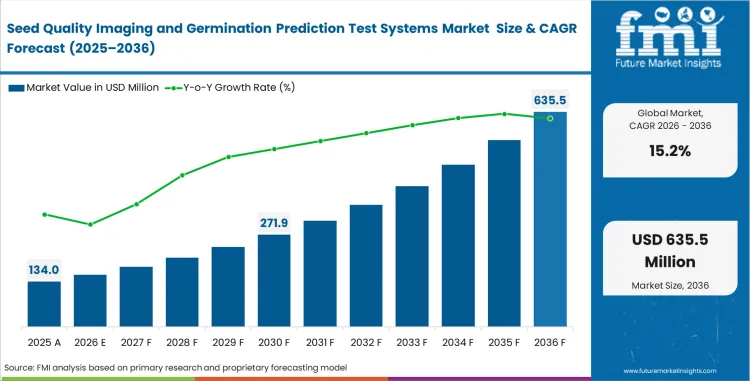
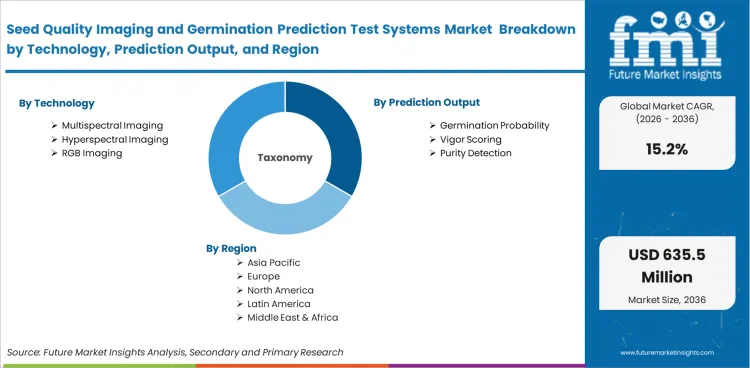
Seed quality imaging and germination prediction test systems market was valued at USD 116 million in 2025. Industry valuation is estimated to reach USD 134 million in 2026 at a CAGR of 15.2% during the forecast period from 2026 to 2036. Total valuation is projected to climb to USD 550 million by 2036 as seed companies and accredited laboratories use image-led systems to judge germination potential, seed defects, purity, and lot consistency before weak material moves deeper into handling and release cycles.
Summary of Seed Quality Imaging and Germination Prediction Test Systems Market
- The market is valued at USD 134 million in 2026, rising from USD 116 million in 2025, and is projected to reach USD 550 million by 2036.
- Expansion is projected at 15.2% CAGR through 2036 as seed companies and laboratories shift toward earlier lot-level evaluation before manual germination cycles are completed.
- Laboratory workflows are being adjusted to reduce interpretation variability, improve lot sequencing, and protect seed value before coating, packing, or dispatch begins.
- Equipment selection depends on image reliability, model validation effort, operator usability, and alignment with existing accreditation practices rather than imaging capability alone.
- Reflecting its balance between read depth and practical laboratory use, multispectral imaging is expected to account for 28.4% share in 2026.
- Vegetable seeds are projected to hold 31.6% share, where higher lot value and tighter uniformity expectations support earlier screening.
- Semi-automated systems are likely to represent 44.3% share, as laboratories maintain operator oversight while reducing repetitive manual reading effort.
Key Takeaways, Market Size, and Forecast
- Seed Quality Imaging and Germination Prediction Test Systems Market is projected to grow from USD 134 million in 2026 to USD 550 million by 2036, at a CAGR of 15.2%.
- The seed quality imaging and germination prediction test systems market was valued at USD 116 million in 2025.
- By 2036, the Seed Quality Imaging and Germination Prediction Test Systems Market is expected to be worth USD 550 million.
- From 2026 to 2036, the market is anticipated to expand at a CAGR of 15.2%.
- The market is predicted to create an incremental opportunity of USD 416 million between 2026 and 2036.
- In 2026, Multispectral Imaging is expected to account for 28.4% of the imaging technology segment.
- India (17.4%) is expected to remain the fastest growing country market through 2036.
Seed Quality Imaging and Germination Prediction Test Systems Market Key Takeaways
| Parameter | Details |
|---|---|
| Market value (2026) | USD 134 million |
| Forecast value (2036) | USD 550 million |
| CAGR (2026 to 2036) | 15.2% |
| Estimated market value (2025) | USD 116 million |
| Leading technology | Multispectral Imaging |
| Technology share (2026) | 28.4% |
| Leading prediction output | Germination Probability |
| Output share (2026) | 24.7% |
| Leading seed type | Vegetable Seeds |
| Seed type share (2026) | 31.6% |
| Leading deployment mode | At-line Benches |
| Deployment share (2026) | 34.2% |
| Leading throughput | Mid Throughput |
| Throughput share (2026) | 39.1% |
| Leading end user | Seed Companies |
| End-user share (2026) | 42.8% |
| Leading application stage | Quality Control |
| Application share (2026) | 36.5% |
| Leading automation level | Semi-automated |
| Automation share (2026) | 44.3% |
| Fastest-growing country | India |
| India CAGR | 17.4% |
Source: FMI Analysis
Laboratory teams are no longer focused only on whether a lot passes a final germination check. Greater attention now goes to how early weak lots can be separated, how much manual interpretation can be reduced, and how much lot value can be protected before coating, packing, or dispatch begins. Manual reading still carries weight, but it slows batch movement and adds variation when sample volumes rise or when small, high-value vegetable seeds need faster release.
Adoption improves when image outputs gain trust inside day-to-day release decisions. Quality managers, accreditation teams, and breeding support groups usually open that path when image-assisted ranking starts to function as a reliable front-end filter rather than a research-only tool. Once that point is reached, more lots can be screened early, retest pressure eases, and one platform can support purity, vigor, and germination-related work in the same laboratory.
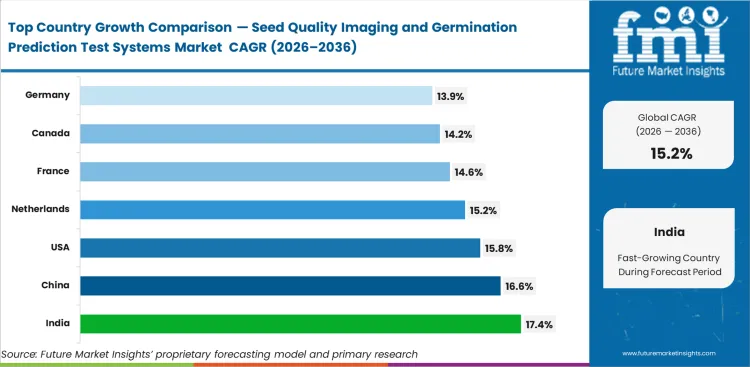
India is expected to record a CAGR of 17.4% in this market through 2036, followed by China at 16.6%, the United States at 15.8%, the Netherlands at 15.2%, France at 14.6%, Canada at 14.2%, and Germany at 13.9%. Faster expansion in India and China reflects seed production scale, vegetable seed intensity, and rising need to reduce manual reading time across large lot volumes. European countries remain important because breeding activity, laboratory discipline, and high-value seed handling continue to support steady equipment replacement and software upgrades.
Seed Quality Imaging and Germination Prediction Test Systems Market Key Takeaways
| Metric | Details |
|---|---|
| Industry Size (2026) | USD 134 million |
| Industry Value (2036) | USD 550 million |
| CAGR (2026-2036) | 15.2% |
Source: Future Market Insights analysis, based on proprietary forecasting model and primary research
Raw Material Price Trend Analysis for Packaging Inputs in Seed Quality Imaging and Germination Prediction Test Systems Market
Material cost dynamics for packaging components used in seed quality imaging and germination prediction test systems are shaped by requirements for precision-grade, contamination-resistant, and moisture-controlled substrates across polymers, paper-based media, glass slides, and specialty barrier materials used in sample handling and imaging workflows. According to the World Bank’s Commodity Markets Outlook (April 2025), global commodity prices are projected to decline by approximately 12% in 2025 followed by a further 5% decrease in 2026, reflecting easing supply constraints and softer global demand, although price volatility remains above historical norms. This environment has contributed to cost moderation for polymer-based consumables used in sample cartridges and imaging trays, while maintaining sensitivity to oil-linked feedstock fluctuations. Paper and cellulose-based materials used in germination testing continue to experience cyclical pricing adjustments linked to agricultural input dynamics, whereas glass and specialty optical materials used in imaging systems remain relatively stable but exposed to energy cost pressures. SGS expanded its agricultural testing and seed certification capabilities during 2024-2025 with increased focus on advanced diagnostic and imaging-based seed quality solutions, reinforcing demand for standardized, contamination-controlled packaging materials that ensure sample integrity and reproducibility. This trend aligns with the growing adoption of imaging-driven germination prediction technologies, supporting a transition toward cost-efficient, performance-consistent, and reliability-focused packaging solutions across seed testing ecosystems.
Segmental Analysis
Key Facts About Segments
- As laboratories require one platform capable of supporting purity checks, vigor review, and germination-related screening without increasing interpretation load, multispectral imaging is expected to hold 28.4% share in 2026.
- Germination probability is projected to account for 24.7% share, reflecting its role in early lot ranking and release sequencing before full test cycles are completed.
- Vegetable seeds are likely to represent 31.6% share in 2026, supported by higher value per lot, tighter emergence expectations, and lower tolerance for variation.
- As laboratories integrate imaging into existing workflows without full infrastructure changes, at-line benches are expected to contribute 34.2% share.
- Mid throughput systems are projected to capture 39.1% share, aligning with seasonal lot volumes and balancing capacity with review and validation requirements.
- Driven by direct exposure to lot quality risk, release timing, and margin protection, seed companies are estimated to account for 42.8% share.
- Quality control applications are expected to hold 36.5% share, where routine lot disposition creates repeated system use and model validation feedback.
- Semi-automated systems are likely to represent 44.3% share, combining software-led classification with operator review for borderline cases.
Seed Quality Imaging and Germination Prediction Test Systems Market Analysis by Technology
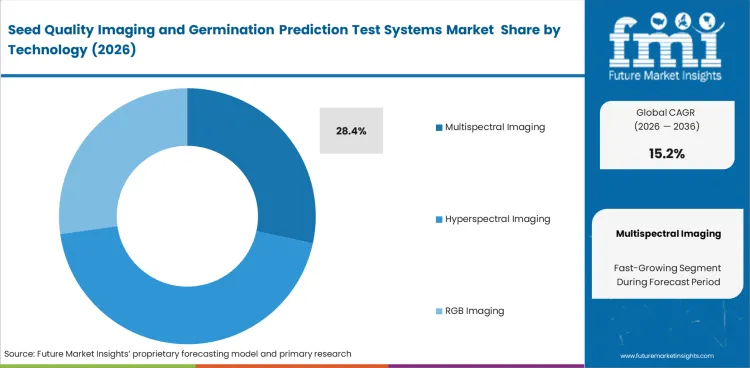
Routine seed testing loses time and consistency when visual inspection carries too much of the reading burden. Multispectral Imaging is expected to account for 28.4% share in 2026 because it gives laboratories deeper visibility than plain RGB while remaining easier to validate and operate than heavier hyperspectral setups. Seed labs prefer it when one platform must support several quality questions across multiple seed types rather than solve only one narrow diagnostic task. Broad usability matters in commercial settings where each install is expected to work across purity checks, vigor review, and lot screening. Poor technology fit usually shows up through low equipment use and slower interpretation, not through immediate test failure.
- Read depth: Wider wavelength capture helps quality teams separate visible defects from less obvious seed-condition cues. Better screening lowers avoidable retest pressure on borderline lots.
- Lab fit: Multi-use capability suits laboratories that need one platform for more than one task. Higher use across routines supports steadier returns from the install.
- Operating load: Buyers avoid systems that create more image complexity than the lab can validate and interpret comfortably. Excess data can slow release timing and weaken user confidence.
Seed Quality Imaging and Germination Prediction Test Systems Market Analysis by Prediction Output
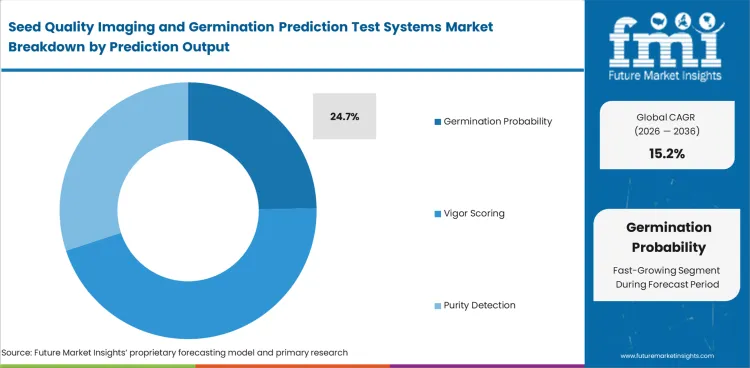
Commercial value in this category comes from what an image can reveal before a full test cycle finishes. Germination Probability is likely to secure 24.7% share in 2026 because early pass-risk ranking has the clearest link to lot release, reserve planning, and handling priority. Seed companies use that output to decide which lots deserve confirmatory work, which can move ahead, and which need closer attention before coating or dispatch. Buyers do not adopt prediction systems simply to collect more data. Adoption rises when the output improves timing and helps laboratories place limited manual effort where it matters most. Weak confidence in prediction output keeps manual confirmation tied to every batch and reduces the value of digital screening.
- Release timing: Early germination scoring lets lab teams rank lots before long-cycle confirmation is complete. Faster ranking improves dispatch planning for premium seed programs.
- Lot triage: Prediction outputs help quality managers assign storage, retest priority, and downstream handling more selectively. Better lot sorting protects margin on short-window seed sales.
- Trust level: Poorly trained models create hesitation even when image quality is strong. Routine workflow use rises only after quality teams accept the output in release decisions.
Seed Quality Imaging and Germination Prediction Test Systems Market Analysis by Seed Type
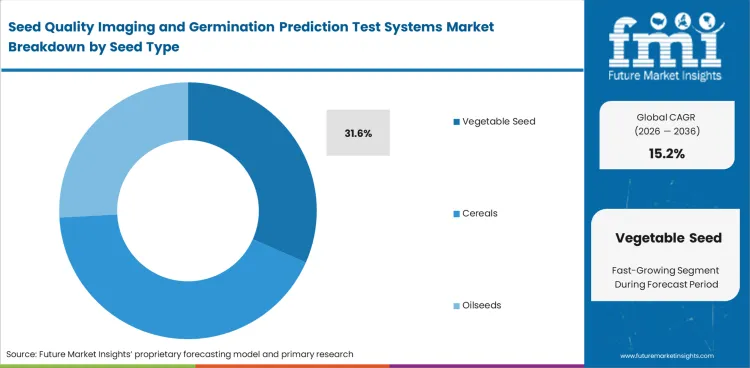
Vegetable Seeds are anticipated to represent 31.6% of the market in 2026. High lot value explains part of that lead, yet margin alone does not carry the whole case. Vegetable seed programs deal with smaller batch sizes, tighter purity expectations, stronger sensitivity to uneven emergence, and less room to absorb avoidable lot variation. Early imaging therefore becomes more commercially relevant because it helps identify weak or mixed material before costly downstream handling begins. Quality pressure is usually sharper in this seed class than in broad-acre categories, and that raises the value of faster, more consistent screening. Delayed visibility into lot condition is harder to absorb when each packet carries both high unit value and brand exposure.
- Value at risk: Premium lots justify closer pre-release analysis because more margin sits inside each batch. Early misclassification can erode contribution quickly.
- Uniformity pressure: Vegetable seed programs place heavy weight on emergence consistency and visual purity. Imaging tools help labs flag uneven lots sooner.
- Complaint exposure: Small, premium seed lots leave less room for field-performance variation. Better screening reduces after-sale quality disputes.
Seed Quality Imaging and Germination Prediction Test Systems Market Analysis by Deployment Mode
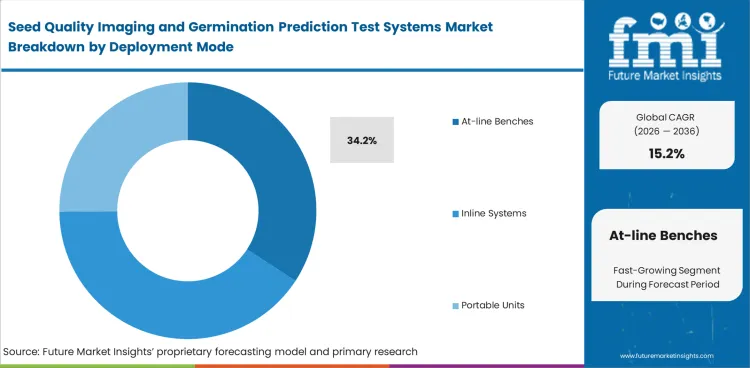
At-line Benches are forecast to represent 34.2% share in 2026 because most seed laboratories want faster decisions without rebuilding the entire test room around a new platform. Bench-top systems fit current sample flow, operator habits, and validation routines better than full inline formats. Labs can place them near incoming checks, interim screening, or release review while keeping human oversight where it is still needed. Ease of insertion matters more than maximum automation in the present buying cycle. Buyers often prefer a measured move into digital testing, especially when side-by-side comparison with current methods remains important. Wrong deployment choice usually leads to idle capacity rather than better lot decisions.
- Installation ease: Bench units fit current lab flow with less disruption to sample handling and analyst training. Shorter learning curves support earlier use.
- Method control: Quality teams can compare bench outputs with current methods more easily than line-integrated tools. Easier comparison helps internal acceptance.
- Capital pacing: Many labs prefer staged digitization over full-room replacement. Smaller entry points reduce hesitation around first-system adoption.
Seed Quality Imaging and Germination Prediction Test Systems Market Analysis by Throughput
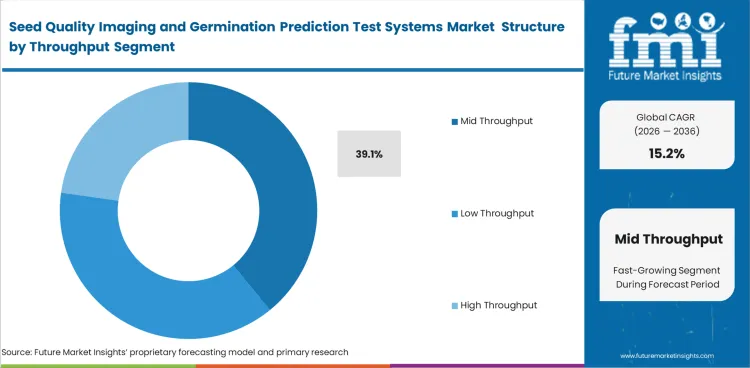
Mid Throughput is expected to contribute 39.1% of total market share in 2026 because it matches the way most commercial seed labs actually work. They do not run at research-level trickle, yet they also do not need full industrial speed for every application. Seasonal lot volumes require enough capacity to keep batches moving, but image review, exception handling, and model checking still take time. Mid-range systems therefore sit in the most practical band for many laboratories. Too little capacity delays release work. Oversized capacity can leave expensive equipment underused outside peak periods. Buyers respond best when a system removes enough manual pressure to matter while keeping capital exposure within reason.
- Volume balance: Mid-range systems align better with seasonal laboratory loads than entry or very-high-capacity formats. Better fit improves yearly use rates.
- Review tolerance: Image-led screening still requires exception handling and validation. Mid throughput leaves room for that oversight without choking lot flow.
- Payback clarity: Buyers can justify this capacity band more easily because labor relief and cycle-time gains are visible without oversizing the install.
Seed Quality Imaging and Germination Prediction Test Systems Market Analysis by End User
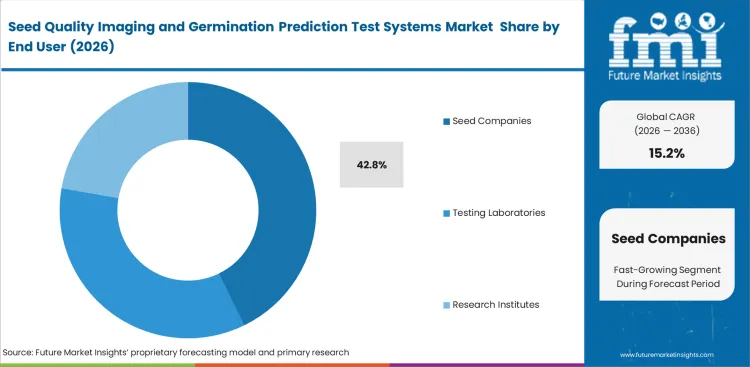
Seed Companies are set to make up 42.8% of the market in 2026, and that lead comes from direct ownership of lot quality risk. In-house quality teams feel the cost of retesting, delayed release, rejected inventory, and uneven field performance more immediately than outside institutions do. Imaging platforms give them earlier evidence on lot condition and a better basis for deciding where manual test time should be spent. Internal adoption usually moves ahead of outside use when brand exposure and inventory value sit inside the same business. Third-party labs remain relevant, but lot owners want faster answers before outside queues slow the calendar. Stronger internal control over seed quality reading carries clear commercial weight in premium seed categories.
- Lot ownership: Seed companies bear the direct cost of weak release decisions, delayed shipment, and customer complaints. Earlier imaging insight lowers avoidable exposure.
- Margin protection: Better lot triage helps reserve manual testing for batches that need it most. Smarter test allocation supports tighter laboratory spending.
- Brand control: Premium seed suppliers have little room for uneven emergence issues. Internal quality reading becomes more valuable as reputational exposure rises.
Seed Quality Imaging and Germination Prediction Test Systems Market Analysis by Application Stage
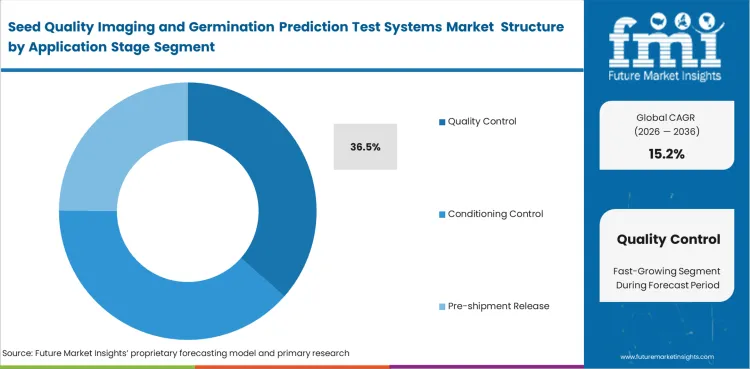
Quality Control is projected to emerge with 36.5% market share in 2026 because day-to-day lot disposition remains the most immediate commercial use for these systems. Incoming checks matter, and pre-shipment review matters, but routine QC is where image-led screening earns repeat use and builds internal trust. Laboratories can compare image results with current records, improve classification confidence, and widen the use of predicted outputs step by step. QC acts as the proving ground before broader use moves deeper into conditioning support or breeding workflows. When a platform cannot earn routine use in quality control, wider adoption usually slows. Regular QC use also creates the feedback loop needed to improve model reliability over time.
- Routine use: QC delivers the highest run frequency for digital seed analysis. Frequent use helps teams trust and refine the system faster.
- Record linkage: Quality control teams can compare image outputs against historical lot outcomes more easily than other functions can. Better comparison improves model tuning.
- Downstream protection: Earlier QC insight reduces the chance of coating, packing, or release activity being spent on weak lots. That saves time and handling cost.
Seed Quality Imaging and Germination Prediction Test Systems Market Analysis by Automation Level
Operator oversight still matters in seed testing, which is why Semi-automated systems are expected to account for 44.3% share in 2026. Laboratories want software-led consistency and faster image reading, but most are not ready to remove human review from every exception case, especially when lot release or accreditation compliance is involved. Semi-automated formats reduce repetitive manual work while keeping expert judgment in place for borderline outcomes. That balance is more useful in current commercial practice than fully closed systems for many laboratories. Too much automation can slow adoption when users do not trust what the model is classifying. Visibility into the result matters almost as much as the result itself.
- Expert review: Human validation remains important for exception cases and high-value lots. Semi-automated formats keep that safeguard available.
- Labor relief: Repetitive visual scoring can be reduced without handing full control to software. That improves consistency and analyst productivity.
- User confidence: Adoption rises faster when operators can review and challenge the output. Better transparency supports broader workflow use.
Seed Quality Imaging and Germination Prediction Test Systems Market Drivers, Restraints, and Opportunities
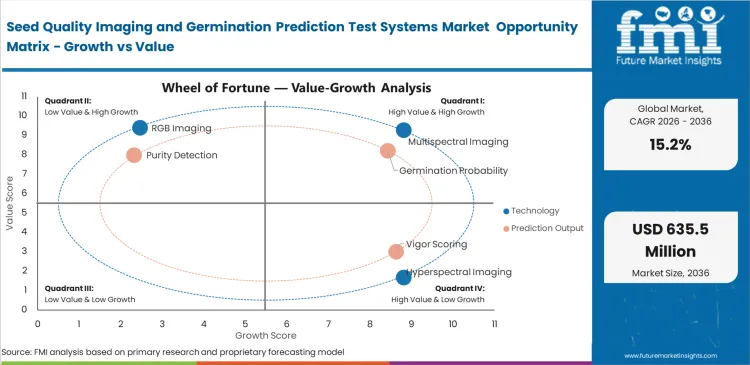
Lot release pressure is pushing this category higher. Seed companies need earlier evidence on weak lots, mixed seed lots, coating readiness, and likely emergence performance, particularly in premium vegetable and hybrid programs where delay ties up valuable inventory. Manual germination reading still carries authority, yet it consumes skilled labor and stretches cycle time when seasonal sample volumes climb. Image-led screening answers a practical business question: which lots deserve deeper testing and which can move ahead with more confidence.
Method acceptance remains the main restraint. Buyers can see the speed advantage, but internal validation, image-library training, crop-specific tuning, and operator confidence still take time. A lab may install hardware quickly, yet wider use develops only when quality managers trust the model on borderline lots and when image outputs fit audit and release routines. Adoption is therefore strongest where lot value and turnaround pressure justify that internal validation effort.
Opportunities in the Seed Quality Imaging and Germination Prediction Test Systems Market
- Vegetable seed digitization: Premium seed programs create a clear opening for image-led ranking because lot value, purity expectations, and release timing are all tighter. Seed companies focused on vegetables can capture this by linking imaging to lot disposition rules and exception review.
- Breeding support integration: Early-stage line screening benefits when germination prediction and seedling phenotyping sit in the same workflow. Breeding organizations gain by removing weak material before greenhouse and field resources are committed.
- Sorter-linked analytics: A wider opening is developing where image classification guides lot cleaning, grading, and release sequencing with better precision. Seed processors that connect testing insight with handling decisions can lower waste and improve lot consistency.
Regional Analysis
Based on the regional analysis, the Seed Quality Imaging and Germination Prediction Test Systems market is segmented into North America, Europe, and Asia Pacific across 40 plus countries.
.webp "Top Country Growth Comparison Seed Quality Imaging And Germination Prediction Test Systems Market Cagr (2026 2036)")
| Country | CAGR (2026 to 2036) |
|---|---|
| India | 17.4% |
| China | 16.6% |
| United States | 15.8% |
| Netherlands | 15.2% |
| France | 14.6% |
| Canada | 14.2% |
| Germany | 13.9% |
Source: Future Market Insights analysis, based on proprietary forecasting model and primary research
North America Seed Quality Imaging and Germination Prediction Test Systems Market Analysis
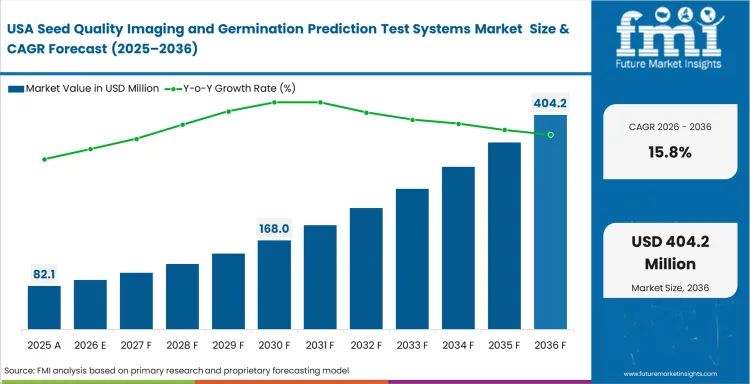
Laboratory discipline and commercial seed scale keep North America near the front of buying activity in this category. Seed companies in this region place high value on earlier lot insight because delayed release can disrupt seasonal dispatch, treatment planning, and inventory allocation. Image-led systems also fit well where accredited testing, internal quality review, and breeding support already operate side by side. Buying remains selective, though, because labs still want clear validation paths, crop-specific reliability, and visible relief from manual reading pressure before deployment widens.
- United States: Large commercial seed operations and a dense network of testing activity keep the United States central to this category. Public testing culture and routine method discipline give new imaging tools a stronger entry point inside everyday laboratory work. Industry outlook in the United States points to a CAGR of 15.8% through 2036 as seed companies seek earlier lot separation, better consistency in visual interpretation, and faster laboratory turnover on premium seed programs. Stronger buying intent does not remove the need for internal validation, but it shortens the path from pilot use to routine screening.
- Canada: Seed testing in Canada benefits from organized commercial agriculture, export-facing seed handling, and a quality culture that values reliable lot documentation. Adoption remains more selective than in the United States, yet the business case is still sound where vegetable, forage, and specialty seed programs need tighter release discipline. A CAGR of 14.2% is expected for this market in Canada during the forecast period from 2026 to 2036. Labs that connect image-led screening with practical lot triage are likely to get better value than those treating imaging as a stand-alone research purchase.
FMI’s report includes Mexico and additional seed-producing markets in North America. Commercial logic across those countries points to selective adoption first in premium seed categories and larger testing networks, where faster lot ranking matters more than headline automation.
Europe Seed Quality Imaging and Germination Prediction Test Systems Market Analysis
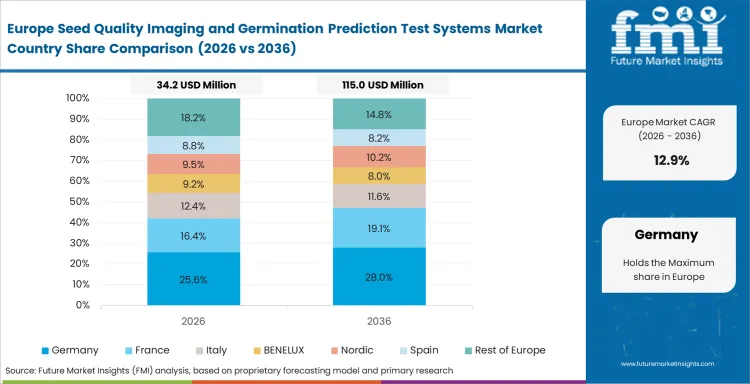
Europe remains one of the most important regional demand bases because breeding depth, laboratory practice, and premium seed handling standards are already well established. Buyers here rarely install imaging tools for novelty. More attention goes to repeatability, lower analyst-to-analyst variation, and cleaner separation of lots that need slower confirmatory work. That operating discipline supports steady replacement demand and measured new installations across premium seed chains.
- Netherlands: Breeding density, seed technology capability, and high-value vegetable seed activity make the Netherlands one of the strongest European markets for this category. Buyers place heavy weight on lot uniformity, emergence consistency, and analytical turnaround, which gives image-led systems a practical role inside routine lab work. Netherlands is likely to post a CAGR of 15.2% in this sector by 2036. That pace reflects both replacement activity and new installations where digital phenotyping and daily quality control increasingly meet in the same workflow.
- France: Seed businesses in France benefit from strong field crop and vegetable seed relevance, yet buying decisions remain grounded in laboratory practicality. Quality teams prefer systems that fit current workflows, support steady interpretation, and reduce manual reading pressure without lengthening method approval. France is expected to record a CAGR of 14.6% in the market during the forecast period from 2026 to 2036. Wider use will depend less on hardware novelty and more on how comfortably software output fits day-to-day release routines and analyst review.
- Germany: Germany retains a solid demand base through engineering-led adoption, research depth, and steady interest in reliable digital quality assessment. Vendors with stronger support, easier method setup, and dependable image handling are likely to perform better here than suppliers selling only technical promise. Market valuation in Germany is set to advance at a CAGR of 13.9% through 2036. Adoption may look more measured than in faster-moving Asian markets, yet installed systems here tend to be used with tighter validation discipline and clearer operating purpose.
FMI’s report includes Benelux and Nordic regions. Seed laboratories in these areas function as important European hubs for breeding support, analytical method refinement, and premium lot handling.
Asia Pacific Seed Quality Imaging and Germination Prediction Test Systems Market Analysis
Asia Pacific carries the fastest expansion profile because seed volumes are large, manual screening pressure remains heavy, and digital adoption still has more room to widen from a smaller installed base. Buyers in this region usually begin with a practical question: how much laboratory delay and inconsistency can be removed without making the workflow harder to manage. Mid-throughput, semi-automated, and at-line formats therefore fit especially well across many commercial settings.
- India: Seed multiplication scale, a large domestic crop base, and rising need for more consistent lot evaluation make India the fastest-growing country in this market. Laboratories and seed companies gain the most when imaging removes reading bottlenecks on high sample loads and helps classify lots before manual testing queues build up. Seed quality imaging and germination prediction systems in India are projected to expand at a CAGR of 17.4% through 2036. Stronger uptake is likely where image outputs guide batch priority rather than serving only as a research record.
- China: Seed regulation, seed quality labeling relevance, and large-scale agricultural production give China a strong commercial case for earlier lot-level diagnostics. Quality-focused testing discipline keeps laboratories and seed businesses interested in more dependable image-led assessment. China is forecast to post a CAGR of 16.6% in this market through 2036. Faster expansion will come from applications that connect imaging with practical release decisions rather than from stand-alone analytical interest.
FMI’s report includes Japan, South Korea, Australia, and Southeast Asian seed hubs within the wider Asia Pacific review. Regional demand remains strongest where digital methods help clear laboratory bottlenecks, improve lot consistency, and support premium seed programs with tighter release calendars.
Competitive Aligners for Market Players
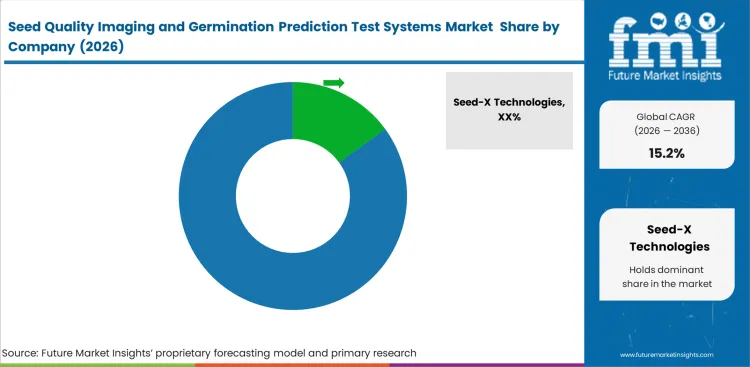
Competition in this market remains moderately fragmented because buyers can choose from seed-focused imaging vendors, broader phenotyping specialists, and sorting technology suppliers that can extend into seed quality applications. Seed-X Technologies, Videometer A/S, LemnaTec GmbH, MARViTECH GmbH, PhenoVation B.V., WSeen Detection Technology Co., Ltd., and Bühler Group all appear in the competitive discussion for different reasons. Some are stronger in AI-led classification and prediction work. Others stand out through spectral depth, seed phenotyping, throughput handling, or compatibility with broader sorting and quality workflows. Buyers usually separate qualified vendors by method confidence, software usability, training burden, and how well outputs fit current release logic rather than by hardware optics alone.
Installed know-how, crop-specific model training, and ability to turn image output into a routine laboratory decision give incumbents an edge. Videometer and LemnaTec benefit from established imaging credibility, while Seed-X carries stronger relevance where AI-driven sorting logic and germination-linked classification matter more directly. MARViTECH and Bühler remain relevant where purity detection, defect removal, and sorter-linked quality improvement sit close to the buying case. Challenger brands can still win when they reduce setup burden, improve software clarity, and prove dependable support in daily use.
Large seed companies still hold leverage because they can test vendors in stages, compare image outputs against current records, and avoid full dependence on one system before confidence is earned. Even so, once a platform is embedded in image libraries, operator habits, and lot release routines, switching becomes slower and more expensive. Competitive position through 2036 will depend less on selling a camera and more on proving repeatability, crop relevance, software clarity, and dependable support across the full life of the install.
Key Players in Seed Quality Imaging and Germination Prediction Test Systems Market
- Seed-X Technologies
- Videometer A/S
- LemnaTec GmbH
- MARViTECH GmbH
- PhenoVation B.V.
- WSeen Detection Technology Co., Ltd.
- Bühler Group
- GTA Sensorik GmbH
- Cimbria Bratney
- Satake Corporation
Scope of the Report
| Metric | Value |
|---|---|
| Quantitative Units | USD 134 million to USD 550 million, at a CAGR of 15.2% |
| Market Definition | Seed quality imaging and germination prediction test systems cover imaging-led hardware and analytical software used to assess seed condition, germination likelihood, vigor, purity, and defects before or during routine testing. Scope focuses on non-destructive or low-destruction platforms used in commercial seed quality, breeding support, and accredited laboratory workflows. |
| Technology Segmentation | Multispectral Imaging, Hyperspectral Imaging, RGB Imaging, X-ray Imaging, AI Vision |
| Prediction Output Segmentation | Germination Probability, Vigor Scoring, Purity Detection, Defect Detection, Seed Health Screening |
| Seed Type Segmentation | Vegetable Seeds, Cereals, Oilseeds, Pulses, Forage Seeds |
| Deployment Mode Segmentation | At-line Benches, Inline Systems, Laboratory Platforms, Portable Units |
| Throughput Segmentation | Low Throughput, Mid Throughput, High Throughput |
| End User Segmentation | Seed Companies, Testing Laboratories, Research Institutes, Breeders |
| Application Stage Segmentation | Incoming Lot Screening, Conditioning Control, Quality Control, Pre-shipment Release |
| Automation Level Segmentation | Manual-assist, Semi-automated, Fully Automated |
| Regions Covered | North America, Europe, Asia Pacific |
| Countries Covered | India, China, United States, Netherlands, France, Canada, Germany, and 40 plus countries |
| Key Companies Profiled | Seed-X Technologies, Videometer A/S, LemnaTec GmbH, MARViTECH GmbH, PhenoVation B.V., WSeen Detection Technology Co., Ltd., Bühler Group, GTA Sensorik GmbH, Cimbria Bratney, Satake Corporation |
| Forecast Period | 2026 to 2036 |
| Approach | Research design considers seed company quality leads, accredited laboratory managers, and breeding support teams as the main commercial users. Baseline logic is tied to likely installation values, software-plus-hardware bundles, and replacement timing across seed labs and commercial seed operations. Forecast direction is checked against public seed-testing modernization signals, vendor activity, and adjacent equipment analogues in machine vision, sorting, and seed processing. |
Source: Future Market Insights analysis, based on proprietary forecasting model and primary research
Seed Quality Imaging and Germination Prediction Test Systems Market Analysis by Segments
Technology
- Multispectral Imaging
- Hyperspectral Imaging
- RGB Imaging
- X-ray Imaging
- AI Vision
Prediction Output
- Germination Probability
- Vigor Scoring
- Purity Detection
- Defect Detection
- Seed Health Screening
Seed Type
- Vegetable Seeds
- Cereals
- Oilseeds
- Pulses
- Forage Seeds
Deployment Mode
- At-line Benches
- Inline Systems
- Laboratory Platforms
- Portable Units
Throughput
- Low Throughput
- Mid Throughput
- High Throughput
End User
- Seed Companies
- Testing Laboratories
- Research Institutes
- Breeders
Application Stage
- Incoming Lot Screening
- Conditioning Control
- Quality Control
- Pre-shipment Release
Automation Level
- Manual-assist
- Semi-automated
- Fully Automated
Region
- North America
- United States
- Canada
- Europe
- Netherlands
- France
- Germany
- Asia Pacific
- India
- China
Bibliography
- World Bank. (2025, April 29). Commodity prices expected to tumble 12% in 2025 and 5% in 2026. World Bank Press Release. View press release
- International Seed Testing Association. (2025, May 02). Advanced Technology Application for Seed Testing: Computer Vision. ISTA.https://www.seedtest.org/api/rm/UX29HU8N6KNQ63H/tcom-p-12-advanced-technology-guide-computer-visio-1.pdf
- Association of Official Seed Analysts / Society of Commercial Seed Technologists. (2025, June 12). 2025 Proceedings of AOSA/SCST. https://analyzeseeds.com/wp-content/uploads/2025/08/Annual-meeting-proceedings-2025.pdf
- USA Department of Agriculture, Agricultural Research Service. (2024). Research Programs and Projects at this Location. https://www.ars.usda.gov/research/programs-projects/project/?accnNo=444479&fy=2024
- Himmelboe, M., et al. (2025, April). Seed identification using machine vision. Computers and Electronics in Agriculture. https://www.sciencedirect.com/science/article/pii/S0168169924012754
This bibliography is provided for reader reference. The full Future Market Insights report contains the complete reference list with primary source documentation.
This Report Addresses
- Market intelligence to support strategic decision making across multispectral imaging, hyperspectral imaging, RGB imaging, X-ray imaging, and AI vision used in seed quality screening and germination prediction.
- Market size estimation and 10-year revenue forecasts from 2026 to 2036, supported by installation-value modelling, vendor activity review, and seed-lab digitization logic.
- Growth opportunity mapping across technology, prediction output, seed type, deployment mode, throughput, end user, application stage, and automation level with emphasis on earlier lot triage and release timing.
- Segment and regional revenue forecasts covering Multispectral Imaging, Germination Probability, Vegetable Seeds, At-line Benches, Mid Throughput, Seed Companies, Quality Control, and Semi-automated systems across major seed-testing countries.
- Competition assessment including software usability, image-model reliability, method acceptance, support quality, and compatibility with lot-release workflows.
- Product and capability tracking across digital seed phenotyping, non-destructive germination assessment, seed vigor analysis, purity detection, and sorter-linked image analytics.
- Market access analysis covering seed-testing guidance, laboratory standardization, image-validation requirements, and crop-specific model acceptance inside routine quality workflows.
- Market report delivery in PDF, Excel, PPT, and interactive dashboard formats for executive strategy, laboratory planning, and operational benchmarking use.
Frequently Asked Questions
What could the market be worth by 2036?
It is projected to reach USD 550 million by 2036 as image-led seed testing becomes more routine.
What CAGR is expected from 2026 to 2036?
The market is projected to expand at a CAGR of 15.2% during the 2026 to 2036 period.
Which technology segment leads the market?
Multispectral Imaging leads, expected to account for 28.4% share in 2026 due to balanced performance.
Which prediction output segment leads the market?
Germination Probability leads, likely securing 24.7% share in 2026 because early lot ranking matters most.
Which seed type leads the market?
Vegetable Seeds lead, anticipated to represent 31.6% share in 2026 because lot value is higher.
Why is this market rising?
Laboratories want faster insight into weak or uneven lots before manual testing consumes time and resources.
What is the main restraint?
Method acceptance remains the main restraint, especially where model trust and crop-specific validation still take time.
Which country is expanding the fastest?
India is expanding fastest, with a projected CAGR of 17.4% through 2036 in this market.
Why do laboratory rules matter here?
Clear testing rules help labs validate image outputs and use digital systems in routine quality workflows.
How is image-led testing different from older methods?
It helps labs rank lots earlier, while older methods rely more on manual observation and longer cycles.
What do buyers compare when choosing a vendor?
They compare software clarity, model reliability, training burden, and fit with current laboratory workflows.
Why do seed companies lead by end user?
Seed companies carry direct risk from delayed release, rejected inventory, and weak field performance outcomes.
Why do at-line benches lead deployment mode?
They fit current laboratory flow more easily and allow gradual adoption without full room redesign.
Why does mid throughput lead?
Most seed labs need practical volume handling, not maximum speed, making mid throughput the best fit.
Why do semi-automated systems lead?
They reduce repetitive manual work while keeping expert review available for difficult or borderline cases.
How does germination prediction help before full testing ends?
It helps laboratories sort lots early and focus deeper testing on batches with weaker potential.
Why is Europe important even with faster Asian expansion?
Europe remains important due to breeding depth, disciplined laboratory practice, and premium seed handling standards.
Why is the Netherlands important in Europe?
Its strong breeding base and vegetable seed activity support faster adoption of advanced imaging systems.
Why does North America remain a major regional market?
Large seed operations and organized testing activity support earlier adoption of digital quality assessment tools.
What role can sorter-linked analytics play?
They can connect test insight with cleaning, grading, and lot-routing decisions beyond the laboratory.
What is included in the market scope?
Scope includes imaging platforms and software used to assess germination likelihood, vigor, purity, and defects.
How was the market estimated?
It was modelled from public modernization signals, vendor offerings, likely installations, and adjacent equipment analogues.
Preview the report firsthand - request a free sample
Get SampleGet the brochure for pricing and purchase details.
Get PDFTable of Content
- Executive Summary
- Global Market Outlook
- Demand-side Trends
- Supply-side Trends
- Technology Roadmap Analysis
- Analysis and Recommendations
- Market Overview
- Market Coverage / Taxonomy
- Market Definition / Scope / Limitations
- Research Methodology
- Chapter Orientation
- Analytical Lens and Working Hypotheses
- Market Structure, Signals, and Trend Drivers
- Benchmarking and Cross-market Comparability
- Market Sizing, Forecasting, and Opportunity Mapping
- Research Design and Evidence Framework
- Desk Research Programme (Secondary Evidence)
- Company Annual and Sustainability Reports
- Peer-reviewed Journals and Academic Literature
- Corporate Websites, Product Literature, and Technical Notes
- Earnings Decks and Investor Briefings
- Statutory Filings and Regulatory Disclosures
- Technical White Papers and Standards Notes
- Trade Journals, Industry Magazines, and Analyst Briefs
- Conference Proceedings, Webinars, and Seminar Materials
- Government Statistics Portals and Public Data Releases
- Press Releases and Reputable Media Coverage
- Specialist Newsletters and Curated Briefings
- Sector Databases and Reference Repositories
- FMI Internal Proprietary Databases and Historical Market Datasets
- Subscription Datasets and Paid Sources
- Social Channels, Communities, and Digital Listening Inputs
- Additional Desk Sources
- Expert Input and Fieldwork (Primary Evidence)
- Primary Modes
- Qualitative Interviews and Expert Elicitation
- Quantitative Surveys and Structured Data Capture
- Blended Approach
- Why Primary Evidence is Used
- Field Techniques
- Interviews
- Surveys
- Focus Groups
- Observational and In-context Research
- Social and Community Interactions
- Stakeholder Universe Engaged
- C-suite Leaders
- Board Members
- Presidents and Vice Presidents
- R&D and Innovation Heads
- Technical Specialists
- Domain Subject-matter Experts
- Scientists
- Physicians and Other Healthcare Professionals
- Governance, Ethics, and Data Stewardship
- Research Ethics
- Data Integrity and Handling
- Primary Modes
- Tooling, Models, and Reference Databases
- Desk Research Programme (Secondary Evidence)
- Data Engineering and Model Build
- Data Acquisition and Ingestion
- Cleaning, Normalisation, and Verification
- Synthesis, Triangulation, and Analysis
- Quality Assurance and Audit Trail
- Market Background
- Market Dynamics
- Drivers
- Restraints
- Opportunity
- Trends
- Scenario Forecast
- Demand in Optimistic Scenario
- Demand in Likely Scenario
- Demand in Conservative Scenario
- Opportunity Map Analysis
- Product Life Cycle Analysis
- Supply Chain Analysis
- Investment Feasibility Matrix
- Value Chain Analysis
- PESTLE and Porter’s Analysis
- Regulatory Landscape
- Regional Parent Market Outlook
- Production and Consumption Statistics
- Import and Export Statistics
- Market Dynamics
- Global Market Analysis 2021 to 2025 and Forecast, 2026 to 2036
- Historical Market Size Value (USD Million) Analysis, 2021 to 2025
- Current and Future Market Size Value (USD Million) Projections, 2026 to 2036
- Y-o-Y Growth Trend Analysis
- Absolute $ Opportunity Analysis
- Global Market Pricing Analysis 2021 to 2025 and Forecast 2026 to 2036
- Global Market Analysis 2021 to 2025 and Forecast 2026 to 2036, By Technology
- Introduction / Key Findings
- Historical Market Size Value (USD Million) Analysis By Technology , 2021 to 2025
- Current and Future Market Size Value (USD Million) Analysis and Forecast By Technology , 2026 to 2036
- Multispectral Imaging
- Hyperspectral Imaging
- RGB Imaging
- Multispectral Imaging
- Y-o-Y Growth Trend Analysis By Technology , 2021 to 2025
- Absolute $ Opportunity Analysis By Technology , 2026 to 2036
- Global Market Analysis 2021 to 2025 and Forecast 2026 to 2036, By Prediction Output
- Introduction / Key Findings
- Historical Market Size Value (USD Million) Analysis By Prediction Output, 2021 to 2025
- Current and Future Market Size Value (USD Million) Analysis and Forecast By Prediction Output, 2026 to 2036
- Germination Probability
- Vigor Scoring
- Purity Detection
- Germination Probability
- Y-o-Y Growth Trend Analysis By Prediction Output, 2021 to 2025
- Absolute $ Opportunity Analysis By Prediction Output, 2026 to 2036
- Global Market Analysis 2021 to 2025 and Forecast 2026 to 2036, By Seed Type
- Introduction / Key Findings
- Historical Market Size Value (USD Million) Analysis By Seed Type, 2021 to 2025
- Current and Future Market Size Value (USD Million) Analysis and Forecast By Seed Type, 2026 to 2036
- Vegetable Seed
- Cereals
- Oilseeds
- Vegetable Seed
- Y-o-Y Growth Trend Analysis By Seed Type, 2021 to 2025
- Absolute $ Opportunity Analysis By Seed Type, 2026 to 2036
- Global Market Analysis 2021 to 2025 and Forecast 2026 to 2036, By Deployment Mode
- Introduction / Key Findings
- Historical Market Size Value (USD Million) Analysis By Deployment Mode, 2021 to 2025
- Current and Future Market Size Value (USD Million) Analysis and Forecast By Deployment Mode, 2026 to 2036
- At-line Benches
- Inline Systems
- Portable Value (USD Million)s
- At-line Benches
- Y-o-Y Growth Trend Analysis By Deployment Mode, 2021 to 2025
- Absolute $ Opportunity Analysis By Deployment Mode, 2026 to 2036
- Global Market Analysis 2021 to 2025 and Forecast 2026 to 2036, By Throughput
- Introduction / Key Findings
- Historical Market Size Value (USD Million) Analysis By Throughput, 2021 to 2025
- Current and Future Market Size Value (USD Million) Analysis and Forecast By Throughput, 2026 to 2036
- Mid Throughput
- Low Throughput
- High Throughput
- Mid Throughput
- Y-o-Y Growth Trend Analysis By Throughput, 2021 to 2025
- Absolute $ Opportunity Analysis By Throughput, 2026 to 2036
- Global Market Analysis 2021 to 2025 and Forecast 2026 to 2036, By End User
- Introduction / Key Findings
- Historical Market Size Value (USD Million) Analysis By End User, 2021 to 2025
- Current and Future Market Size Value (USD Million) Analysis and Forecast By End User, 2026 to 2036
- Seed Companies
- Testing Laboratories
- Research Institutes
- Seed Companies
- Y-o-Y Growth Trend Analysis By End User, 2021 to 2025
- Absolute $ Opportunity Analysis By End User, 2026 to 2036
- Global Market Analysis 2021 to 2025 and Forecast 2026 to 2036, By Application Stage
- Introduction / Key Findings
- Historical Market Size Value (USD Million) Analysis By Application Stage, 2021 to 2025
- Current and Future Market Size Value (USD Million) Analysis and Forecast By Application Stage, 2026 to 2036
- Quality Control
- Conditioning Control
- Pre-shipment Release
- Quality Control
- Y-o-Y Growth Trend Analysis By Application Stage, 2021 to 2025
- Absolute $ Opportunity Analysis By Application Stage, 2026 to 2036
- Global Market Analysis 2021 to 2025 and Forecast 2026 to 2036, By Region
- Introduction
- Historical Market Size Value (USD Million) Analysis By Region, 2021 to 2025
- Current Market Size Value (USD Million) Analysis and Forecast By Region, 2026 to 2036
- North America
- Latin America
- Western Europe
- Eastern Europe
- East Asia
- South Asia and Pacific
- Middle East & Africa
- Market Attractiveness Analysis By Region
- North America Market Analysis 2021 to 2025 and Forecast 2026 to 2036, By Country
- Historical Market Size Value (USD Million) Trend Analysis By Market Taxonomy, 2021 to 2025
- Market Size Value (USD Million) Forecast By Market Taxonomy, 2026 to 2036
- By Country
- USA
- Canada
- Mexico
- By Technology
- By Prediction Output
- By Seed Type
- By Deployment Mode
- By Throughput
- By End User
- By Application Stage
- By Country
- Market Attractiveness Analysis
- By Country
- By Technology
- By Prediction Output
- By Seed Type
- By Deployment Mode
- By Throughput
- By End User
- By Application Stage
- Key Takeaways
- Latin America Market Analysis 2021 to 2025 and Forecast 2026 to 2036, By Country
- Historical Market Size Value (USD Million) Trend Analysis By Market Taxonomy, 2021 to 2025
- Market Size Value (USD Million) Forecast By Market Taxonomy, 2026 to 2036
- By Country
- Brazil
- Chile
- Rest of Latin America
- By Technology
- By Prediction Output
- By Seed Type
- By Deployment Mode
- By Throughput
- By End User
- By Application Stage
- By Country
- Market Attractiveness Analysis
- By Country
- By Technology
- By Prediction Output
- By Seed Type
- By Deployment Mode
- By Throughput
- By End User
- By Application Stage
- Key Takeaways
- Western Europe Market Analysis 2021 to 2025 and Forecast 2026 to 2036, By Country
- Historical Market Size Value (USD Million) Trend Analysis By Market Taxonomy, 2021 to 2025
- Market Size Value (USD Million) Forecast By Market Taxonomy, 2026 to 2036
- By Country
- Germany
- UK
- Italy
- Spain
- France
- Nordic
- BENELUX
- Rest of Western Europe
- By Technology
- By Prediction Output
- By Seed Type
- By Deployment Mode
- By Throughput
- By End User
- By Application Stage
- By Country
- Market Attractiveness Analysis
- By Country
- By Technology
- By Prediction Output
- By Seed Type
- By Deployment Mode
- By Throughput
- By End User
- By Application Stage
- Key Takeaways
- Eastern Europe Market Analysis 2021 to 2025 and Forecast 2026 to 2036, By Country
- Historical Market Size Value (USD Million) Trend Analysis By Market Taxonomy, 2021 to 2025
- Market Size Value (USD Million) Forecast By Market Taxonomy, 2026 to 2036
- By Country
- Russia
- Poland
- Hungary
- Balkan & Baltic
- Rest of Eastern Europe
- By Technology
- By Prediction Output
- By Seed Type
- By Deployment Mode
- By Throughput
- By End User
- By Application Stage
- By Country
- Market Attractiveness Analysis
- By Country
- By Technology
- By Prediction Output
- By Seed Type
- By Deployment Mode
- By Throughput
- By End User
- By Application Stage
- Key Takeaways
- East Asia Market Analysis 2021 to 2025 and Forecast 2026 to 2036, By Country
- Historical Market Size Value (USD Million) Trend Analysis By Market Taxonomy, 2021 to 2025
- Market Size Value (USD Million) Forecast By Market Taxonomy, 2026 to 2036
- By Country
- China
- Japan
- South Korea
- By Technology
- By Prediction Output
- By Seed Type
- By Deployment Mode
- By Throughput
- By End User
- By Application Stage
- By Country
- Market Attractiveness Analysis
- By Country
- By Technology
- By Prediction Output
- By Seed Type
- By Deployment Mode
- By Throughput
- By End User
- By Application Stage
- Key Takeaways
- South Asia and Pacific Market Analysis 2021 to 2025 and Forecast 2026 to 2036, By Country
- Historical Market Size Value (USD Million) Trend Analysis By Market Taxonomy, 2021 to 2025
- Market Size Value (USD Million) Forecast By Market Taxonomy, 2026 to 2036
- By Country
- India
- ASEAN
- Australia & New Zealand
- Rest of South Asia and Pacific
- By Technology
- By Prediction Output
- By Seed Type
- By Deployment Mode
- By Throughput
- By End User
- By Application Stage
- By Country
- Market Attractiveness Analysis
- By Country
- By Technology
- By Prediction Output
- By Seed Type
- By Deployment Mode
- By Throughput
- By End User
- By Application Stage
- Key Takeaways
- Middle East & Africa Market Analysis 2021 to 2025 and Forecast 2026 to 2036, By Country
- Historical Market Size Value (USD Million) Trend Analysis By Market Taxonomy, 2021 to 2025
- Market Size Value (USD Million) Forecast By Market Taxonomy, 2026 to 2036
- By Country
- Kingdom of Saudi Arabia
- Other GCC Countries
- Turkiye
- South Africa
- Other African Union
- Rest of Middle East & Africa
- By Technology
- By Prediction Output
- By Seed Type
- By Deployment Mode
- By Throughput
- By End User
- By Application Stage
- By Country
- Market Attractiveness Analysis
- By Country
- By Technology
- By Prediction Output
- By Seed Type
- By Deployment Mode
- By Throughput
- By End User
- By Application Stage
- Key Takeaways
- Key Countries Market Analysis
- USA
- Pricing Analysis
- Market Share Analysis, 2025
- By Technology
- By Prediction Output
- By Seed Type
- By Deployment Mode
- By Throughput
- By End User
- By Application Stage
- Canada
- Pricing Analysis
- Market Share Analysis, 2025
- By Technology
- By Prediction Output
- By Seed Type
- By Deployment Mode
- By Throughput
- By End User
- By Application Stage
- Mexico
- Pricing Analysis
- Market Share Analysis, 2025
- By Technology
- By Prediction Output
- By Seed Type
- By Deployment Mode
- By Throughput
- By End User
- By Application Stage
- Brazil
- Pricing Analysis
- Market Share Analysis, 2025
- By Technology
- By Prediction Output
- By Seed Type
- By Deployment Mode
- By Throughput
- By End User
- By Application Stage
- Chile
- Pricing Analysis
- Market Share Analysis, 2025
- By Technology
- By Prediction Output
- By Seed Type
- By Deployment Mode
- By Throughput
- By End User
- By Application Stage
- Germany
- Pricing Analysis
- Market Share Analysis, 2025
- By Technology
- By Prediction Output
- By Seed Type
- By Deployment Mode
- By Throughput
- By End User
- By Application Stage
- UK
- Pricing Analysis
- Market Share Analysis, 2025
- By Technology
- By Prediction Output
- By Seed Type
- By Deployment Mode
- By Throughput
- By End User
- By Application Stage
- Italy
- Pricing Analysis
- Market Share Analysis, 2025
- By Technology
- By Prediction Output
- By Seed Type
- By Deployment Mode
- By Throughput
- By End User
- By Application Stage
- Spain
- Pricing Analysis
- Market Share Analysis, 2025
- By Technology
- By Prediction Output
- By Seed Type
- By Deployment Mode
- By Throughput
- By End User
- By Application Stage
- France
- Pricing Analysis
- Market Share Analysis, 2025
- By Technology
- By Prediction Output
- By Seed Type
- By Deployment Mode
- By Throughput
- By End User
- By Application Stage
- India
- Pricing Analysis
- Market Share Analysis, 2025
- By Technology
- By Prediction Output
- By Seed Type
- By Deployment Mode
- By Throughput
- By End User
- By Application Stage
- ASEAN
- Pricing Analysis
- Market Share Analysis, 2025
- By Technology
- By Prediction Output
- By Seed Type
- By Deployment Mode
- By Throughput
- By End User
- By Application Stage
- Australia & New Zealand
- Pricing Analysis
- Market Share Analysis, 2025
- By Technology
- By Prediction Output
- By Seed Type
- By Deployment Mode
- By Throughput
- By End User
- By Application Stage
- China
- Pricing Analysis
- Market Share Analysis, 2025
- By Technology
- By Prediction Output
- By Seed Type
- By Deployment Mode
- By Throughput
- By End User
- By Application Stage
- Japan
- Pricing Analysis
- Market Share Analysis, 2025
- By Technology
- By Prediction Output
- By Seed Type
- By Deployment Mode
- By Throughput
- By End User
- By Application Stage
- South Korea
- Pricing Analysis
- Market Share Analysis, 2025
- By Technology
- By Prediction Output
- By Seed Type
- By Deployment Mode
- By Throughput
- By End User
- By Application Stage
- Russia
- Pricing Analysis
- Market Share Analysis, 2025
- By Technology
- By Prediction Output
- By Seed Type
- By Deployment Mode
- By Throughput
- By End User
- By Application Stage
- Poland
- Pricing Analysis
- Market Share Analysis, 2025
- By Technology
- By Prediction Output
- By Seed Type
- By Deployment Mode
- By Throughput
- By End User
- By Application Stage
- Hungary
- Pricing Analysis
- Market Share Analysis, 2025
- By Technology
- By Prediction Output
- By Seed Type
- By Deployment Mode
- By Throughput
- By End User
- By Application Stage
- Kingdom of Saudi Arabia
- Pricing Analysis
- Market Share Analysis, 2025
- By Technology
- By Prediction Output
- By Seed Type
- By Deployment Mode
- By Throughput
- By End User
- By Application Stage
- Turkiye
- Pricing Analysis
- Market Share Analysis, 2025
- By Technology
- By Prediction Output
- By Seed Type
- By Deployment Mode
- By Throughput
- By End User
- By Application Stage
- South Africa
- Pricing Analysis
- Market Share Analysis, 2025
- By Technology
- By Prediction Output
- By Seed Type
- By Deployment Mode
- By Throughput
- By End User
- By Application Stage
- USA
- Market Structure Analysis
- Competition Dashboard
- Competition Benchmarking
- Market Share Analysis of Top Players
- By Regional
- By Technology
- By Prediction Output
- By Seed Type
- By Deployment Mode
- By Throughput
- By End User
- By Application Stage
- Competition Analysis
- Competition Deep Dive
- Seed-X Technologies
- Overview
- Product Portfolio
- Profitability by Market Segments (Product/Age /Sales Channel/Region)
- Sales Footprint
- Strategy Overview
- Marketing Strategy
- Product Strategy
- Channel Strategy
- Videometer A/S
- LemnaTec GmbH
- MARViTECH GmbH
- PhenoVation B.V.
- WSeen Detection Technology Co., Ltd.
- Bühler Group
- Seed-X Technologies
- Competition Deep Dive
- Assumptions & Acronyms Used


