

- Market Size (2026)
- USD 180 Mn
- Forecast (2036)
- USD 493 Mn
- CAGR (2026 to 2036)
- 10.6%
Continuous Tablet Manufacturing At-Line Quality Test Systems Market Size, Market Forecast and Outlook by FMI
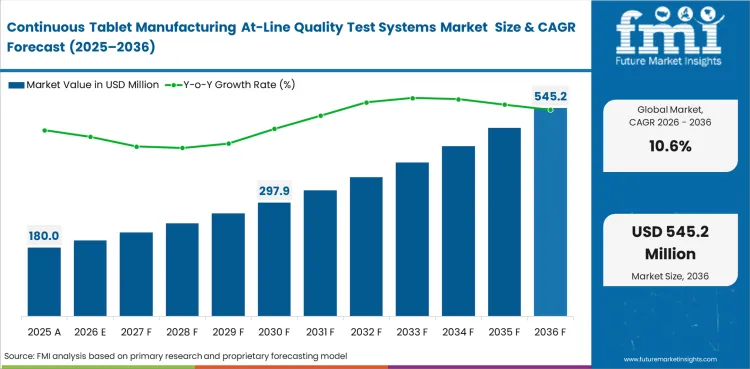
Continuous tablet manufacturing at-line quality test systems market crossed a valuation of USD 162.7 million in 2025 and is projected to reach USD 180 million in 2026. By 2036, the market is forecast to expand to USD 493 million at a 10.6% CAGR. Based on Future Market Insights analysis, the market is expected to create an incremental opportunity of USD 313 million during 2026 to 2036. Demand for continuous tablet manufacturing at-line quality test systems is rising because manufacturers need to detect variation earlier, keep tablet quality closer to production, and reply less on delayed laboratory results that come after the run.
Summary of Continuous Tablet Manufacturing At-Line Quality Test Systems Market
- Continuous tablet manufacturing at-line quality test systems market valuation is expected to reach USD 493 million by 2036.
- The industry is forecast to expand at a 10.6% CAGR from 2026 to 2036.
- The market was estimated at USD 162.7 million in 2025.
- Market value is expected to rise to USD 180 million in 2026.
- Direct Compression is projected to remain the leading line type with 53.6% share in 2026.
- Content Uniformity is set to lead quality attribute demand at 23.8% share in 2026.
- NIR Spectroscopy is expected to dominate test technology with 26.4% share in 2026.
- Compression captures 29.4% of the manufacturing stage segment in 2026, where finished-tablet properties become easier to assess accurately.
- Standalone Modules account for 35.1% of the system configuration segment, showing preference for phased deployment with lower disruption.
- Fully Automated Systems represent 48.7% of the automation level segment, supported by demand for stable sampling and lower operator dependence.
- Drug Manufacturers hold 43.6% of the end user segment, reflecting concentration in routine commercial tablet production environments.
- Mid Throughput accounts for 38.2% of the throughput segment in 2026, indicating stronger demand from scalable production settings.
Key Takeaways, Market Size, and Forecast
- Continuous Tablet Manufacturing At-Line Quality Test Systems Market is projected to increase from USD 180 million in 2026 to USD 493 million by 2036, at a CAGR of 10.6%.
- The continuous tablet manufacturing at-line quality test systems market was valued at USD 162.7 million in 2025.
- By 2036, the Continuous Tablet Manufacturing At-Line Quality Test Systems Market is expected to be worth USD 493 million.
- Across the 2026 to 2036 period, the market is expected to expand at a CAGR of 10.6%.
- The market is projected to create an incremental opportunity of USD 313 million during the study period.
- In 2026, Direct Compression is expected to account for 53.6% of the line type segment.
- India (11.8%) and China (11.2%) are two of the fastest growing markets.
Continuous Tablet Manufacturing At-Line Quality Test Systems Market Key Takeaways
| Parameter | Details |
| Market value (2026) | USD 180 million |
| Forecast value (2036) | USD 493 million |
| CAGR (2026 to 2036) | 10.6% |
| Estimated market value (2025) | USD 162.7 million |
| Incremental opportunity | USD 313 million |
| Leading test technology | NIR Spectroscopy (26.4% of test technology segment) |
| Leading quality attribute | Content Uniformity (23.8% of quality attribute segment) |
| Leading line type | Direct Compression (53.6% of line type segment) |
| Leading manufacturing stage | Compression (29.4% of manufacturing stage segment) |
| Leading system configuration | Standalone Modules (35.1% of system configuration segment) |
| Leading automation level | Fully Automated (48.7% of automation level segment) |
| Leading end user | Drug Manufacturers (43.6% of end user segment) |
| Leading throughput | Mid Throughput (38.2% of throughput segment) |
| Key players | Thermo Fisher Scientific, Bruker Corporation, SOTAX Group, Fette Compacting, GEA Group, Endress+Hauser, Sensum |
Source: Future Market Insights, 2026.
At-line measurements are becoming more important in tablet manufacturing because plant operations need faster visibility into variation during production. Early data helps teams fix problems before they affect more tablets. Equipment choice depends on measurement speed, stable readings and well-documented records. Adoption improves when manufacturers define how each reading supports routine process control and exception review.
India is expected to rise at 11.8% CAGR by 2036 because oral solid dosage expansion and line modernization are creating more room for first-time deployment. China is projected to grow at 11.2% CAGR as manufacturers continue adding capacity and upgrading line-side process control. Demand in the United States is anticipated to expand at 10.9% CAGR through 2036, supported by a large installed manufacturing base that can absorb added control systems without a full process reset. Germany is likely to register 10.1% CAGR, while Belgium is set to rise at 9.8% CAGR and Switzerland at 9.6% CAGR as established production environments continue adopting tighter control tools. Japan is expected to expand at 8.7% CAGR through 2036.
Continuous Tablet Manufacturing At-Line Quality Test Systems Market Definition
The continuous tablet manufacturing at-line quality test systems market includes instruments, modules, and software-linked testing units used near or within tablet production lines to assess critical quality attributes during continuous manufacturing. Scope remains limited to systems that support process control, better process visibility, exception review, and faster release readiness, which makes them functionally distinct from broader oral solid dosage pharmaceutical formulation activities that shape tablet design but do not themselves provide live line-side quality evidence.
Continuous Tablet Manufacturing At-Line Quality Test Systems Market Inclusions
The market includes spectroscopic, optical, imaging, and physical-testing systems used across blending, feed, compression, post-compression, and coating checkpoints in continuous tablet production. It also covers modular testers, integrated line units, and connected data-capture tools that support repeatable review during manufacturing, reflecting the same need for structured measurement and documented output seen in parts of the healthcare analytical testing services market, though here the role is tied directly to live production control rather than external laboratory support.
Continuous Tablet Manufacturing At-Line Quality Test Systems Market Exclusions
The scope excludes general offline laboratory analyzers, packaging counters, broad automation platforms that do not test tablet attributes directly, and downstream handling units used only for counting or secondary movement. Equipment used only after manufacturing is complete falls outside this market because it does not guide tablet quality decisions during production, unlike systems closer in purpose to process instrumentation equipment, where measurement has operational value only when it can influence real-time process understanding.
Continuous Tablet Manufacturing At-Line Quality Test Systems Market Research Methodology
- Primary Research: FMI analysis uses interviews with continuous manufacturing line managers, pharmaceutical quality assurance heads, PAT implementation specialists, tablet process development teams, and at-line testing system providers across the United States, Germany, Switzerland, India, and Japan. These discussions focused on adoption priorities, validation concerns, and selection
- Secondary Research: Research includes pharmaceutical manufacturing guidance documents, continuous manufacturing case studies, equipment supplier portfolios, regulatory publications, patent activity, company annual reports, and technical papers related to tablet testing automation, process monitoring, and quality assurance workflows.
- Market Sizing and Forecasting: Market estimates were developed through a bottom-up review of installed and planned continuous tablet manufacturing lines. These were assessed against average at-line testing system use by facility type, quality attribute coverage, and automation level.
- Validation and Update Process: FMI validated model outputs using supplier revenue trends, pharmaceutical capex patterns, equipment installation activity, and product launches in continuous manufacturing quality systems. Forecast assumptions are reviewed regularly to reflect changes in regulatory acceptance, technology integration cycles, and demand across innovator and contract manufacturing settings.
Why is the Continuous Tablet Manufacturing At-Line Quality Test Systems Market Growing?
- Direct compression is expected to account for 53.6% of line type demand in 2026, supported by simpler process flow and clearer linkage between readings and corrective action.
- Content uniformity is projected to hold 23.8% of quality attribute demand in 2026, reflecting its central role in release confidence during live production.
- India and China are reshaping regional demand for continuous tablet manufacturing at-line quality test systems, as expanding oral solid dosage capacity and line modernization programs increase the need for stronger at-line quality control.
Demand for continuous tablet manufacturing at-line quality test systems is rising because tablet producers need quality evidence closer to the process. In continuous manufacturing, a small disturbance can spread quickly if it is not detected and contained in time. At-line testing matters because it gives earlier visibility, faster response, and better control over material at risk.
Content uniformity remains the leading quality checkpoint because release credibility starts with proof that tablet composition stays within acceptable limits during production. Manufacturers are giving more importance to systems that support repeatable checks without interrupting line flow, especially where quality teams need data that can feed directly into routine review and exception handling.
Expansion in oral solid dosage manufacturing is also supporting market growth, particularly in countries where new line installations and modernization programs are increasing first-time deployment. Manufacturers are assessing these systems as part of a broader control strategy that can reduce review delays, improve deviation tracing, and strengthen process confidence without forcing a full reset of manufacturing practice. Demand is becoming more relevant in routine production settings.
Segmental Analysis
- NIR Spectroscopy is projected to hold 26.4% share of the test technology segment in 2026 because manufacturers prefer fast and repeatable at-line readings. Content Uniformity is expected to account for 23.8% share of the quality attribute segment in 2026 because release confidence depends on stable composition during the run.
- Direct Compression is expected to hold 53.6% share of the line type segment in 2026 because a simpler production flow improves signal-to-action clarity. Compression is projected to account for 29.4% share of the manufacturing stage segment in 2026 because finished-tablet properties are easier to assess at that stage.
- Standalone Modules are projected to hold 35.1% share of the system configuration segment in 2026 because manufacturers prefer phased deployment with lower disruption. Fully Automated Systems are expected to account for 48.7% share of the automation level segment in 2026 because stable sampling, cleaner alarm routing, and lower operator dependence matter more in continuous operations.
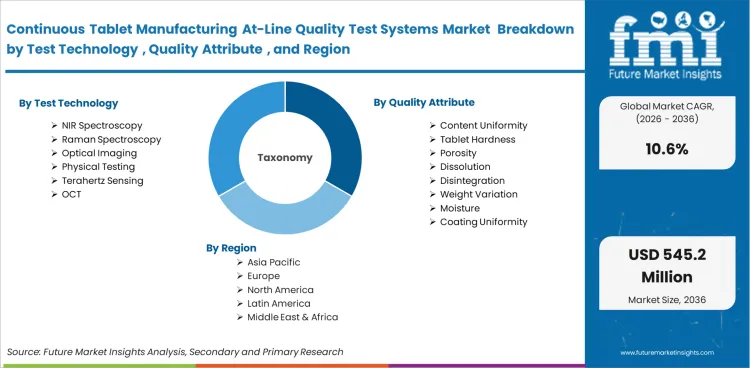
The continuous tablet manufacturing at-line quality test systems market is segmented by test technology, quality attribute, line type, manufacturing stage, system configuration, automation level, end user, and throughput. By Test technology, the market is divided into NIR spectroscopy, Raman spectroscopy, optical imaging, physical testing, terahertz sensing, and OCT. In terms of quality attribute, the market is classified into content uniformity, tablet hardness, porosity, dissolution, disintegration, weight variation, moisture, and coating uniformity. Based on line type, the market is segmented into direct compression, wet granulation, and dry granulation. By manufacturing stage, the market is divided into compression, blending, feed frame, post-compression, and coating. In terms of system configuration, the market is classified into standalone modules, integrated modules, skid systems, and portable units. Based on automation level, the market is segmented into fully automated, semi-automated, and manual assisted systems. By end user, the market is divided into drug manufacturers, CDMOs, technology centers, and academic labs. In terms of throughput, the market is classified into mid throughput, low throughput, high throughput, and pilot flexible systems.
Insights into the NIR Spectroscopy Test Technology Segment
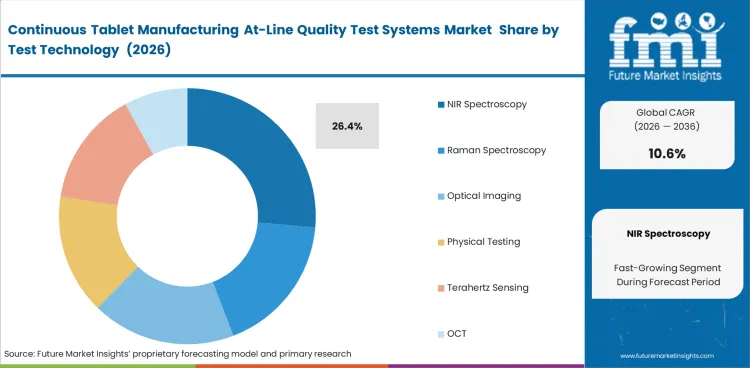
NIR Spectroscopy leads this segment because tablet manufacturing needs fast readings that fit routine review more easily. NIR Spectroscopy account for 26.4% share in 2026, supported by its ability to stay close to the process, limits sample handling, and supports repeat checks without interrupting production flow. Familiarity with IR spectroscopy and dual-wavelength Raman tools also helps to support adoption.
Insights into the Content Uniformity Quality Attribute Segment
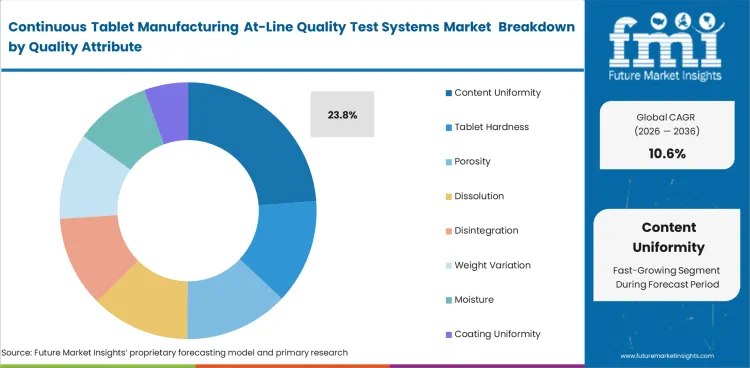
Content Uniformity leads this market because release decisions depend on stable tablet composition during the run. Content Uniformity is projected to hold 23.8% share in 2026 because many manufacturers keep at-line control focused on assay consistency until live production readings become more reliable. The relevance of healthcare analytical testing and pharmaceutical dissolution testing supports the same need.
Insights into the Direct Compression Line Type Segment
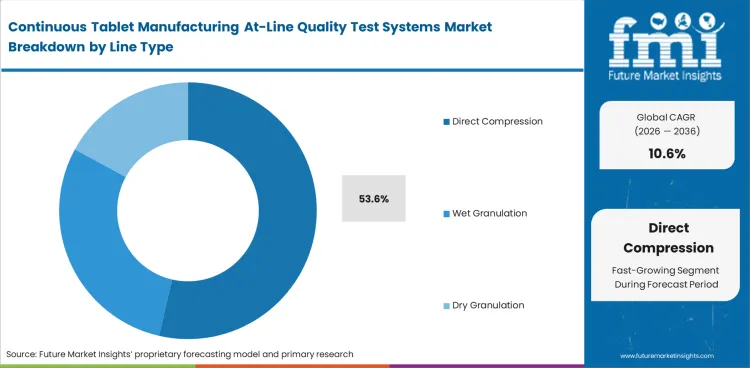
Direct Compression leads because continuous tablet manufacturing depends on testing points that fit one connected production flow. Direct Compression is likely to account for 53.6% share in 2026 because fewer unit operations make powder behavior, compression response, and finished tablet output easier to assess in sequence. Wet and dry granulation lines support at-line systems too, though added steps make data handoff and corrective action harder to standardize. The relevance of pharmaceutical continuous manufacturing equipment and oral solid dosage formulations supports this lead.
Insights into the Compression Manufacturing Stage Segment
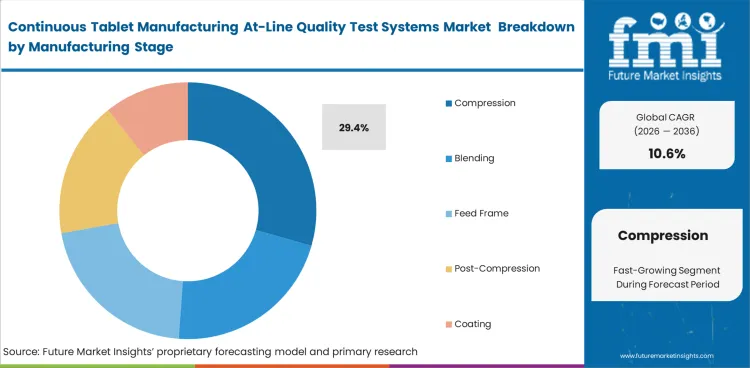
Compression is expected to account for 29.4% share in 2026 because weight consistency, hardness response, and visible defects become more important once the tablet is formed. Blending and feed stages remain relevant, though many manufacturers direct spending toward points where deviations have a clearer link to tablet acceptability. The relevance of tablet presses and process instrumentation equipment supports this lead because compression-stage decisions often combine machine behavior with attribute confirmation. Plants that invest too little at this stage may collect upstream signals without a clear view of finished-tablet impact.
Insights into the Standalone Modules System Configuration Segment
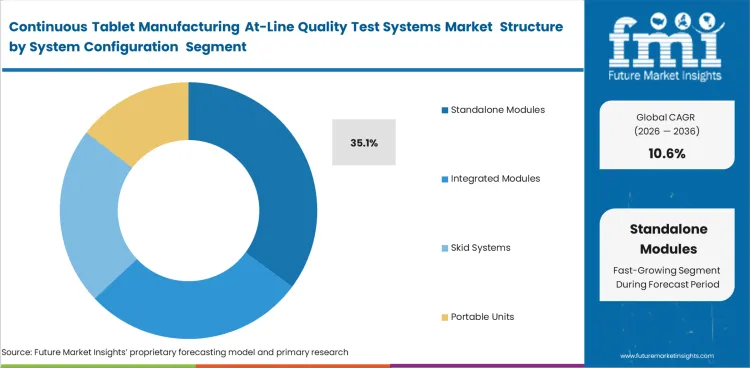
Standalone Modules is expected to account for 35.1% share in 2026 because phased adoption is easier when manufacturers are still deciding how data should be used, how alarms should be handled, and how validation requirements should be defined. Integrated modules gain become more important once programs are more established. Early spending often stays with equipment that can be introduced with less disruption to existing operations.
Insights into the Fully Automated Automation Level Segment
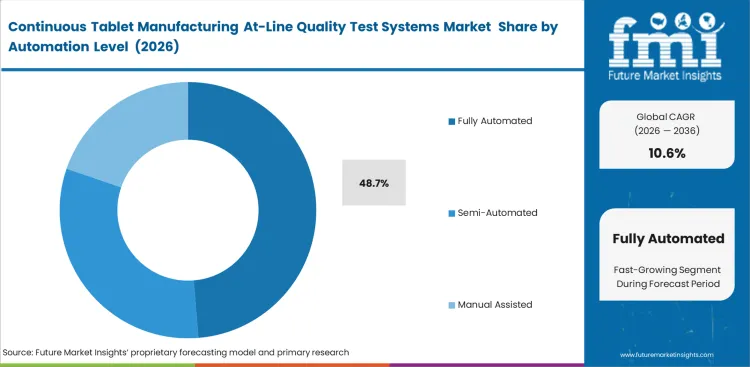
Manual review can support line operation, through it does not deliver the consistency continuous operations require. Fully Automated systems are anticipated to emerge with 48.7% market share in 2026 because repeatability depends on sampling, reading, alarm routing, and response with minimal operator variability. Semi-automated options fit smaller programs or development-heavy settings. Similar buying logic appears in adjacent process liquid analyzers and process spectroscopy categories.
What are the Drivers, Restraints, and Key Trends of the Continuous Tablet Manufacturing At-Line Quality Test Systems Market?
- Earlier detection of variation in continuous tablet production is increasing demand for line-side systems that support faster intervention and lower material risk.
- Internal qualification, validation burden, and uncertainty around alarm routing or operator response continue to slow wider deployment across active commercial lines.
- Growing emphasis on repeatable data handoff, automated review logic, and stronger process verification is favoring systems that fit routine plant control instead of isolated measurement use.
The continuous tablet manufacturing at-line quality test systems market is expanding steadily as manufacturers place more weight on earlier quality visibility, tighter process control, and faster review readiness during live production. Adoption depends on whether measurement output can support repeatable operating action, fit validation logic, and hold up in routine quality review. Growth remains strong, though adoption is still shaped by qualification burden, integration complexity, and the practical challenge of turning line-side readings into defensible production decisions.
Earlier Quality Visibility and Faster Process Response
Demand is rising because continuous manufacturing leaves less time to detect problems after output has already moved through the line. Plants need at-line systems that show where variation begins, how long it lasts, and whether corrective action can still protect acceptable material. This is increasing the relevance of line-side quality checks in blending, compression, and post-compression stages, where earlier signals can reduce review delay and improve deviation tracing. Commercial value comes from helping manufacturers respond before a disturbance spreads across production.
Qualification Burden and Integration into Plant Decision Logic
Wider uptake remains constrained by the effort required to qualify each system within existing production and review structures. Manufacturers need more than accurate readings. They need clear rules for exception handling, alarm routing, operator response, and documentation fit before at-line output becomes part of normal plant control. This slows adoption, especially in compliance-heavy environments where quality teams are cautious about adding new control points that may increase validation work or create ambiguity during review.
Analysis of the Continuous Tablet Manufacturing At-Line Quality Test Systems Market by Key Countries
- India leads tracked markets at 11.8% CAGR because oral solid dosage expansion and line modernization are widening first-time deployment room.
- China follows at 11.2% CAGR because capacity growth and stronger process control are supporting broader line-side testing adoption.
- The United States records 10.9% CAGR because a large installed base can add tighter control systems without full process reset.
- Germany, Belgium, Switzerland, and Japan remain important markets where validation discipline, plant fit, and data credibility shape supplier selection.
Based on the regional analysis, Continuous Tablet Manufacturing At-Line Quality Test Systems Market is segmented into North America, Latin America, Western Europe, Eastern Europe, East Asia, South Asia & Pacific, and Middle East & Africa across 40 plus countries.
.webp "Top Country Growth Comparison Continuous Tablet Manufacturing At Line Quality Test Systems Market Cagr (2026 2036)")
| Country | CAGR (2026 to 2036) |
|---|---|
| India | 11.8% |
| China | 11.2% |
| United States | 10.9% |
| Germany | 10.1% |
| Belgium | 9.8% |
| Switzerland | 9.6% |
| Japan | 8.7% |
Source: Future Market Insights analysis, based on proprietary forecasting model and primary research
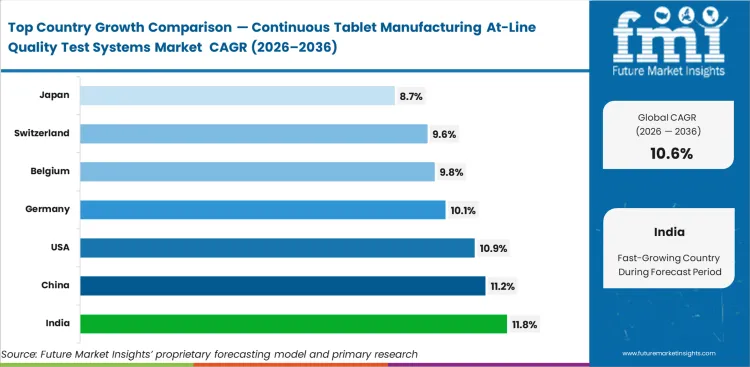
Demand Outlook for Continuous Tablet Manufacturing At-Line Quality Test Systems Market in India
India is projected to expand at an 11.8% CAGR through 2036. Strong oral solid dosage manufacturing depth, ongoing capacity addition, and line modernization are supporting first-time deployment of at-line systems. Manufacturers want better live-run visibility without dependence on delayed laboratory confirmation. Earlier adoption can reduce review drag and improve how quickly deviations are traced to the source, which makes India the strongest growth market among the countries tracked.
- Oral solid dosage expansion continues to widen system deployment potential.
- Line modernization is increasing acceptance of tighter process visibility tools.
- First-time installations benefit from fewer legacy constraints than mature markets.
Future Outlook for Continuous Tablet Manufacturing At-Line Quality Test Systems Market in China
China is expected to grow at a CAGR of 11.2% by 2036. Large-scale manufacturing and continued modernization support demand, through long-term adoption depends on how smoothly at-line systems fit high-throughput operations. Manufacturers want tools that improve control without increasing operator burden or slowing daily execution. Suppliers with stronger software handoff, cleaner integration, and practical plant support are better placed to expand in this market.
- Manufacturing scale supports wider commercial relevance for at-line control.
- Modernization is improving readiness for integrated quality systems.
- High-throughput environments support suppliers with lower operating burden.
Opportunity Analysis of Continuous Tablet Manufacturing At-Line Quality Test Systems Market in the United States
The United States is projected to record 10.9% CAGR from 2026 to 2036. A large installed manufacturing base gives the market greater capacity to absorb additional control systems without requiring a full process reset. Adoption is supported by familiarity with advanced manufacturing methods, though acceptance still moves through careful internal review. Plants gain value from at-line systems when they reduce review delay and improve operating confidence in routine production.
- Established oral solid dosage infrastructure supports system addition at active sites.
- Advanced manufacturing familiarity improves the case for tighter process control.
- Internal approval remains disciplined, preferring suppliers with stronger validation support.
In-depth Analysis of Continuous Tablet Manufacturing At-Line Quality Test Systems Market in Germany
Germany is projected to expand at 10.1% CAGR through 2036. The market is shaped by a strong pharmaceutical equipment base and clear preference for repeatable operating fit. Manufacturers evaluate at-line systems on signal quality, service depth, and installation support. Vendors that can support disciplined rollout under compliance-heavy production conditions are better placed in Germany.
- Engineering depth supports demand for technically reliable systems.
- Validation discipline raises the importance of documentation and service.
- Vendors need clean operating fit to move beyond pilot-stage interest.
In-depth Analysis of Continuous Tablet Manufacturing At-Line Quality Test Systems Market in Belgium
Belgium is expected to grow at a CAGR of 9.8% from 2026 to 2036. A concentrated pharmaceutical production base and strong process discipline support demand for at-line systems that shorten review cycles without weakening documentation quality. Adoption depends more on keeping quality decisions close to production while maintaining confidence during review.
- Concentrated pharma operations support focused equipment deployment.
- Process discipline favors systems that strengthen review readiness.
- Suppliers prefer tools that support action without weakening documentation quality.
Sales Analysis of Continuous Tablet Manufacturing At-Line Quality Test Systems Market in Switzerland
Switzerland is projected to register a 9.6% CAGR through 2036. Demand comes from high-value manufacturing conditions where data credibility matters as much as instrument speed. Plants invest in dependable control, though they move carefully when new systems may complicate validated routines. Vendor selection depends on technical clarity, service quality, and long-use operating fit.
- High-value manufacturing raises the importance of data credibility.
- Validation-sensitive environments reward dependable, support-backed systems.
- Operating fit carries more weight than rapid installation alone.
Demand Outlook for Continuous Tablet Manufacturing At-Line Quality Test Systems Market in Japan
Japan is expected to expand at 8.7% CAGR through 2036. Plants move carefully because new control points must improve execution without increasing operating burden. Qualification discipline and use-case clarity matter strongly in system selection. This keeps adoption measured and supports stronger preference for long-term consistency than for rapid rollout.
- Careful qualification slows adoption relative to faster-moving markets.
- Manufacturers prioritize dependable fit over aggressive deployment.
- Long-use consistency remains central to purchase decisions.
Competitive Landscape of Continuous Tablet Manufacturing At-Line Quality Test Systems Market
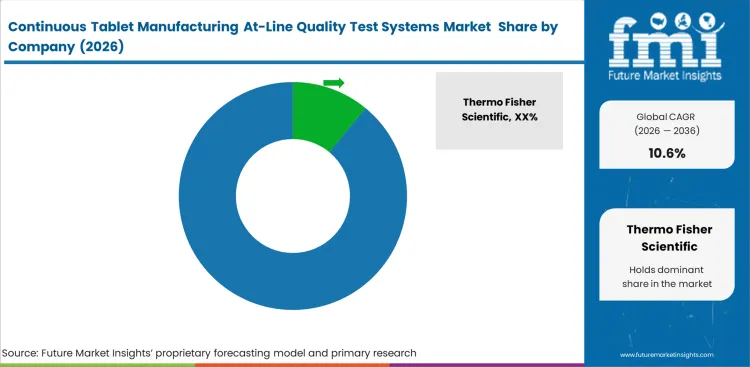
- Thermo Fisher Scientific, Bruker Corporation, and SOTAX Group compete through recognized analytical capability, broader installed-base familiarity, and stronger ability to support regulated pharmaceutical environments.
- The market remains moderately fragmented, with integration depth, validation support, and service quality shaping competition more than instrument performance alone.
- Suppliers that can combine line-side measurement, cleaner data handoff, and dependable plant fit hold an advantage as manufacturers move from pilot use to routine deployment.
The continuous tablet manufacturing at-line quality test systems market includes analytical instrument suppliers, tablet manufacturing technology specialists, and process-control participants serving pharmaceutical production environments that require repeatable quality evidence close to live operations. Competition depends on more than measurement capability. Manufacturers compare installation fit, service support, software handoff, validation readiness, and familiarity with oral solid dosage manufacturing before systems are accepted for routine use.
Thermo Fisher Scientific and Bruker Corporation remain well positioned because established analytical capability, technical credibility, and broader pharmaceutical reach support buyer confidence in regulated environments. SOTAX Group, Fette Compacting, and GEA Group benefit from closer alignment with tablet production workflows, where system acceptance depends on how well measurement tools fit operating practice rather than on reading speed in isolation. Endress+Hauser and Sensum remain relevant where buyers prioritize process integration, focused plant support, or more specialized deployment needs within continuous manufacturing lines.
Barriers to entry are moderate at the basic instrument level and higher where suppliers need to support validated plant use. A vendor may offer technically sound measurement, yet broader commercial adoption depends on proving that the system can hold up under documentation review, routine sampling discipline, and repeat-use production conditions.
Major Industry Players
Key global companies leading the continuous tablet manufacturing at-line quality test systems market include:
- Thermo Fisher Scientific, Bruker Corporation, and SOTAX Group are among the leading participants due to their analytical capability, broader pharmaceutical market presence, and stronger ability to support regulated production environments with dependable technical documentation and application support.
- Fette Compacting and GEA Group maintain strong competitive relevance through closer alignment with tablet manufacturing workflows, integration into production settings, and ability to support plants seeking cleaner operating fit between measurement systems and continuous tableting lines.
- Endress+Hauser and Sensum remain important specialized participants where process integration, focused plant support, and line-side measurement deployment matter more than broad portfolio scale, particularly in programs that prioritize practical control improvement within active manufacturing environments.
Competitive Benchmarking: Continuous Tablet Manufacturing At-Line Quality Test Systems Market
| Company | Analytical Capability | Validation Support | Integration Fit | Service / Application Support |
|---|---|---|---|---|
| Thermo Fisher Scientific | High | High | Moderate | Strong |
| Bruker Corporation | High | High | Moderate | Strong |
| SOTAX Group | High | High | Strong | Strong |
| Fette Compacting | Medium | Medium | Strong | Strong |
| GEA Group | Medium | Medium | Strong | Strong |
| Endress+Hauser | Medium | Medium | Moderate | Moderate |
| Sensum | Medium | Medium | Moderate | Moderate |
Source: Future Market Insights competitive analysis, 2026.
Recent Developments in Continuous Tablet Manufacturing At-Line Quality Test Systems Market
- In March 2025, GEA received two “Add Better” labels for its NexGen Press® 45 after external TÜV Rheinland auditing verified power-saving performance for tablet manufacturing operations.
- In September 2025, SOTAX Group announced q-doc® software certification by Körber for PAS-X MES integration, enabling compliant bidirectional IPC test-data processing and supporting faster batch review.
Key Players in the Continuous Tablet Manufacturing At-Line Quality Test Systems Market
Major Global Players
- Thermo Fisher Scientific
- Bruker Corporation
- SOTAX Group
- Fette Compacting
- GEA Group
Emerging Players / Specialized Participants
- Endress+Hauser
- Sensum
Scope of the Report
| Metric | Value |
|---|---|
| Quantitative Units | USD 162.7 million (2025) / USD 180.0 million (2026) to USD 493.0 million (2036), at a CAGR of 10.6% |
| Market Definition | The continuous tablet manufacturing at-line quality test systems market covers line-side and line-integrated tools used to measure tablet quality during continuous production. Scope remains limited to systems that support live manufacturing control, faster review, and repeatable quality decisions. General offline laboratory instruments without a direct continuous-tableting role remain outside scope. |
| Segmentation |
|
| Regions Covered | North America, Latin America, Western Europe, Eastern Europe, East Asia, South Asia & Pacific, Middle East & Africa |
| Countries Covered | India, China, United States, Germany, Belgium, Switzerland, Japan, and 40 plus countries |
| Key Companies Profiled | Thermo Fisher Scientific, Bruker Corporation, SOTAX Group, Fette Compacting, GEA Group, Endress+Hauser, Sensum |
| Forecast Period | 2026 to 2036 |
| Approach | FMI combined primary interviews with plant and quality personnel, desk review of continuous tablet manufacturing use cases, and a bottom-up view of likely module deployment by line. Baseline assumptions were tied to installed line activity, adoption depth by quality task, and system configuration choices. Forecasts were checked through supplier coverage, adjacent equipment categories, and recurring buyer behavior seen in oral solid dosage manufacturing. |
Source: Future Market Insights analysis, based on proprietary forecasting model and primary research
Continuous Tablet Manufacturing At-Line Quality Test Systems Market Analysis by Segments
Test Technology
- NIR Spectroscopy
- Raman Spectroscopy
- Optical Imaging
- Physical Testing
- Terahertz Sensing
- OCT
Quality Attribute
- Content Uniformity
- Tablet Hardness
- Porosity
- Dissolution
- Disintegration
- Weight Variation
- Moisture
- Coating Uniformity
Line Type
- Direct Compression
- Wet Granulation
- Dry Granulation
Manufacturing Stage
- Compression
- Blending
- Feed Frame
- Post-Compression
- Coating
System Configuration
- Standalone Modules
- Integrated Modules
- Skid Systems
- Portable Units
Automation Level
- Fully Automated
- Semi-Automated
- Manual Assisted
End User
- Drug Manufacturers
- CDMOs
- Technology Centers
- Academic Labs
Throughput
- Mid Throughput
- Low Throughput
- High Throughput
- Pilot Flexible
Region
- North America
- United States
- Europe
- Germany
- Belgium
- Switzerland
- Asia Pacific
- India
- China
- Japan
Bibliography
- GEA. (2025, March 17). Add better label for NexGen Press® 45.
- SOTAX Group. (2025, September 19). Certified q-doc® standard interface with Körber PAS-X MES.
- Celikovic, S., Rehrl, J., Fraga, R. M., Steinberger, M., Khinast, J., Horn, M., & Sacher, S. (2025). A modern strategy for digital real-time release testing in continuous tablet manufacturing. European Journal of Pharmaceutics and Biopharmaceutics, 211, 114700.
- Brands, R., Le, T. N., Bartsch, J., & Thommes, M. (2025, February 28). A step towards real-time release testing of pharmaceutical tablets: Utilization of CIELAB color space. Pharmaceutics, 17(3), 311.
- USA Food and Drug Administration. (2026, February). Graduated ETP technology. USA Food and Drug Administration.
- Indian Pharmacopoeia Commission. (2024, October 8). Draft Proposal for Comments and Inclusion in The Indian Pharmacopoeia. 2.5.2. Dissolution.
This bibliography is provided for reader reference. The full FMI report contains the complete reference list with primary source documentation.
This Report Addresses
- Market intelligence across tablet testing technologies used in continuous manufacturing.
- Revenue forecast from 2026 to 2036 using validated deployment assumptions.
- Opportunity mapping across technology, attributes, users, throughput, and stages.
- Regional outlook covering India, China, America, Germany, Belgium, Switzerland, Japan.
- Competitive comparison based on service, validation, integration, usability, and support.
- Technology review across NIR, Raman, imaging, physical testing, automation.
- Scope boundaries separating line side systems from offline laboratory tools.
- Delivery format supports strategy, planning, benchmarking, and investment review.
Frequently Asked Questions
How large is Continuous Tablet Manufacturing At-Line Quality Test Systems Market in 2026?
Continuous Tablet Manufacturing At-Line Quality Test Systems Market is expected to reach USD 180 million in 2026, showing clear commercial relevance.
What will the market be valued at by 2036?
FMI estimates market valuation will reach USD 493 million by 2036, reflecting broader use of line side testing.
What CAGR is projected for the market during 2026 to 2036?
FMI projects a CAGR of 10.6% from 2026 to 2036, indicating steady expansion in this specialized category.
Which Test Technology segment leads the market?
NIR Spectroscopy leads Test Technology, with 26.4% share expected in 2026 because it supports fast, repeatable checks.
Which Quality Attribute segment leads the market?
Content Uniformity leads the category, with 23.8% share expected in 2026, as assay consistency remains central.
Which Line Type segment leads the market?
Direct Compression leads Line Type, with 53.6% share expected in 2026 due to cleaner process flow.
Preview the report firsthand - request a free sample
Get SampleGet the brochure for pricing and purchase details.
Get PDFTable of Content
- Executive Summary
- Global Market Outlook
- Demand-side Trends
- Supply-side Trends
- Technology Roadmap Analysis
- Analysis and Recommendations
- Market Overview
- Market Coverage / Taxonomy
- Market Definition / Scope / Limitations
- Research Methodology
- Chapter Orientation
- Analytical Lens and Working Hypotheses
- Market Structure, Signals, and Trend Drivers
- Benchmarking and Cross-market Comparability
- Market Sizing, Forecasting, and Opportunity Mapping
- Research Design and Evidence Framework
- Desk Research Programme (Secondary Evidence)
- Company Annual and Sustainability Reports
- Peer-reviewed Journals and Academic Literature
- Corporate Websites, Product Literature, and Technical Notes
- Earnings Decks and Investor Briefings
- Statutory Filings and Regulatory Disclosures
- Technical White Papers and Standards Notes
- Trade Journals, Industry Magazines, and Analyst Briefs
- Conference Proceedings, Webinars, and Seminar Materials
- Government Statistics Portals and Public Data Releases
- Press Releases and Reputable Media Coverage
- Specialist Newsletters and Curated Briefings
- Sector Databases and Reference Repositories
- FMI Internal Proprietary Databases and Historical Market Datasets
- Subscription Datasets and Paid Sources
- Social Channels, Communities, and Digital Listening Inputs
- Additional Desk Sources
- Expert Input and Fieldwork (Primary Evidence)
- Primary Modes
- Qualitative Interviews and Expert Elicitation
- Quantitative Surveys and Structured Data Capture
- Blended Approach
- Why Primary Evidence is Used
- Field Techniques
- Interviews
- Surveys
- Focus Groups
- Observational and In-context Research
- Social and Community Interactions
- Stakeholder Universe Engaged
- C-suite Leaders
- Board Members
- Presidents and Vice Presidents
- R&D and Innovation Heads
- Technical Specialists
- Domain Subject-matter Experts
- Scientists
- Physicians and Other Healthcare Professionals
- Governance, Ethics, and Data Stewardship
- Research Ethics
- Data Integrity and Handling
- Primary Modes
- Tooling, Models, and Reference Databases
- Desk Research Programme (Secondary Evidence)
- Data Engineering and Model Build
- Data Acquisition and Ingestion
- Cleaning, Normalisation, and Verification
- Synthesis, Triangulation, and Analysis
- Quality Assurance and Audit Trail
- Market Background
- Market Dynamics
- Drivers
- Restraints
- Opportunity
- Trends
- Scenario Forecast
- Demand in Optimistic Scenario
- Demand in Likely Scenario
- Demand in Conservative Scenario
- Opportunity Map Analysis
- Product Life Cycle Analysis
- Supply Chain Analysis
- Investment Feasibility Matrix
- Value Chain Analysis
- PESTLE and Porter’s Analysis
- Regulatory Landscape
- Regional Parent Market Outlook
- Production and Consumption Statistics
- Import and Export Statistics
- Market Dynamics
- Global Market Analysis 2021 to 2025 and Forecast, 2026 to 2036
- Historical Market Size Value (USD Million) Analysis, 2021 to 2025
- Current and Future Market Size Value (USD Million) Projections, 2026 to 2036
- Y-o-Y Growth Trend Analysis
- Absolute $ Opportunity Analysis
- Global Market Pricing Analysis 2021 to 2025 and Forecast 2026 to 2036
- Global Market Analysis 2021 to 2025 and Forecast 2026 to 2036, By Test Technology
- Introduction / Key Findings
- Historical Market Size Value (USD Million) Analysis By Test Technology , 2021 to 2025
- Current and Future Market Size Value (USD Million) Analysis and Forecast By Test Technology , 2026 to 2036
- NIR Spectroscopy
- Raman Spectroscopy
- Optical Imaging
- Physical Testing
- Terahertz Sensing
- OCT
- NIR Spectroscopy
- Y-o-Y Growth Trend Analysis By Test Technology , 2021 to 2025
- Absolute $ Opportunity Analysis By Test Technology , 2026 to 2036
- Global Market Analysis 2021 to 2025 and Forecast 2026 to 2036, By Quality Attribute
- Introduction / Key Findings
- Historical Market Size Value (USD Million) Analysis By Quality Attribute, 2021 to 2025
- Current and Future Market Size Value (USD Million) Analysis and Forecast By Quality Attribute, 2026 to 2036
- Content Uniformity
- Tablet Hardness
- Porosity
- Dissolution
- Disintegration
- Weight Variation
- Moisture
- Coating Uniformity
- Content Uniformity
- Y-o-Y Growth Trend Analysis By Quality Attribute, 2021 to 2025
- Absolute $ Opportunity Analysis By Quality Attribute, 2026 to 2036
- Global Market Analysis 2021 to 2025 and Forecast 2026 to 2036, By Line Type
- Introduction / Key Findings
- Historical Market Size Value (USD Million) Analysis By Line Type, 2021 to 2025
- Current and Future Market Size Value (USD Million) Analysis and Forecast By Line Type, 2026 to 2036
- Direct Compression
- Wet Granulation
- Dry Granulation
- Direct Compression
- Y-o-Y Growth Trend Analysis By Line Type, 2021 to 2025
- Absolute $ Opportunity Analysis By Line Type, 2026 to 2036
- Global Market Analysis 2021 to 2025 and Forecast 2026 to 2036, By Manufacturing Stage
- Introduction / Key Findings
- Historical Market Size Value (USD Million) Analysis By Manufacturing Stage, 2021 to 2025
- Current and Future Market Size Value (USD Million) Analysis and Forecast By Manufacturing Stage, 2026 to 2036
- Compression
- Blending
- Feed Frame
- Post-Compression
- Coating
- Compression
- Y-o-Y Growth Trend Analysis By Manufacturing Stage, 2021 to 2025
- Absolute $ Opportunity Analysis By Manufacturing Stage, 2026 to 2036
- Global Market Analysis 2021 to 2025 and Forecast 2026 to 2036, By System Configuration
- Introduction / Key Findings
- Historical Market Size Value (USD Million) Analysis By System Configuration, 2021 to 2025
- Current and Future Market Size Value (USD Million) Analysis and Forecast By System Configuration, 2026 to 2036
- Standalone Modules
- Integrated Modules
- Skid Systems
- Portable Value (USD Million)s
- Standalone Modules
- Y-o-Y Growth Trend Analysis By System Configuration, 2021 to 2025
- Absolute $ Opportunity Analysis By System Configuration, 2026 to 2036
- Global Market Analysis 2021 to 2025 and Forecast 2026 to 2036, By Automation Level
- Introduction / Key Findings
- Historical Market Size Value (USD Million) Analysis By Automation Level, 2021 to 2025
- Current and Future Market Size Value (USD Million) Analysis and Forecast By Automation Level, 2026 to 2036
- Fully Automated
- Semi-Automated
- Manual Assisted
- Fully Automated
- Y-o-Y Growth Trend Analysis By Automation Level, 2021 to 2025
- Absolute $ Opportunity Analysis By Automation Level, 2026 to 2036
- Global Market Analysis 2021 to 2025 and Forecast 2026 to 2036, By Region
- Introduction
- Historical Market Size Value (USD Million) Analysis By Region, 2021 to 2025
- Current Market Size Value (USD Million) Analysis and Forecast By Region, 2026 to 2036
- North America
- Latin America
- Western Europe
- Eastern Europe
- East Asia
- South Asia and Pacific
- Middle East & Africa
- Market Attractiveness Analysis By Region
- North America Market Analysis 2021 to 2025 and Forecast 2026 to 2036, By Country
- Historical Market Size Value (USD Million) Trend Analysis By Market Taxonomy, 2021 to 2025
- Market Size Value (USD Million) Forecast By Market Taxonomy, 2026 to 2036
- By Country
- USA
- Canada
- Mexico
- By Test Technology
- By Quality Attribute
- By Line Type
- By Manufacturing Stage
- By System Configuration
- By Automation Level
- By Country
- Market Attractiveness Analysis
- By Country
- By Test Technology
- By Quality Attribute
- By Line Type
- By Manufacturing Stage
- By System Configuration
- By Automation Level
- Key Takeaways
- Latin America Market Analysis 2021 to 2025 and Forecast 2026 to 2036, By Country
- Historical Market Size Value (USD Million) Trend Analysis By Market Taxonomy, 2021 to 2025
- Market Size Value (USD Million) Forecast By Market Taxonomy, 2026 to 2036
- By Country
- Brazil
- Chile
- Rest of Latin America
- By Test Technology
- By Quality Attribute
- By Line Type
- By Manufacturing Stage
- By System Configuration
- By Automation Level
- By Country
- Market Attractiveness Analysis
- By Country
- By Test Technology
- By Quality Attribute
- By Line Type
- By Manufacturing Stage
- By System Configuration
- By Automation Level
- Key Takeaways
- Western Europe Market Analysis 2021 to 2025 and Forecast 2026 to 2036, By Country
- Historical Market Size Value (USD Million) Trend Analysis By Market Taxonomy, 2021 to 2025
- Market Size Value (USD Million) Forecast By Market Taxonomy, 2026 to 2036
- By Country
- Germany
- UK
- Italy
- Spain
- France
- Nordic
- BENELUX
- Rest of Western Europe
- By Test Technology
- By Quality Attribute
- By Line Type
- By Manufacturing Stage
- By System Configuration
- By Automation Level
- By Country
- Market Attractiveness Analysis
- By Country
- By Test Technology
- By Quality Attribute
- By Line Type
- By Manufacturing Stage
- By System Configuration
- By Automation Level
- Key Takeaways
- Eastern Europe Market Analysis 2021 to 2025 and Forecast 2026 to 2036, By Country
- Historical Market Size Value (USD Million) Trend Analysis By Market Taxonomy, 2021 to 2025
- Market Size Value (USD Million) Forecast By Market Taxonomy, 2026 to 2036
- By Country
- Russia
- Poland
- Hungary
- Balkan & Baltic
- Rest of Eastern Europe
- By Test Technology
- By Quality Attribute
- By Line Type
- By Manufacturing Stage
- By System Configuration
- By Automation Level
- By Country
- Market Attractiveness Analysis
- By Country
- By Test Technology
- By Quality Attribute
- By Line Type
- By Manufacturing Stage
- By System Configuration
- By Automation Level
- Key Takeaways
- East Asia Market Analysis 2021 to 2025 and Forecast 2026 to 2036, By Country
- Historical Market Size Value (USD Million) Trend Analysis By Market Taxonomy, 2021 to 2025
- Market Size Value (USD Million) Forecast By Market Taxonomy, 2026 to 2036
- By Country
- China
- Japan
- South Korea
- By Test Technology
- By Quality Attribute
- By Line Type
- By Manufacturing Stage
- By System Configuration
- By Automation Level
- By Country
- Market Attractiveness Analysis
- By Country
- By Test Technology
- By Quality Attribute
- By Line Type
- By Manufacturing Stage
- By System Configuration
- By Automation Level
- Key Takeaways
- South Asia and Pacific Market Analysis 2021 to 2025 and Forecast 2026 to 2036, By Country
- Historical Market Size Value (USD Million) Trend Analysis By Market Taxonomy, 2021 to 2025
- Market Size Value (USD Million) Forecast By Market Taxonomy, 2026 to 2036
- By Country
- India
- ASEAN
- Australia & New Zealand
- Rest of South Asia and Pacific
- By Test Technology
- By Quality Attribute
- By Line Type
- By Manufacturing Stage
- By System Configuration
- By Automation Level
- By Country
- Market Attractiveness Analysis
- By Country
- By Test Technology
- By Quality Attribute
- By Line Type
- By Manufacturing Stage
- By System Configuration
- By Automation Level
- Key Takeaways
- Middle East & Africa Market Analysis 2021 to 2025 and Forecast 2026 to 2036, By Country
- Historical Market Size Value (USD Million) Trend Analysis By Market Taxonomy, 2021 to 2025
- Market Size Value (USD Million) Forecast By Market Taxonomy, 2026 to 2036
- By Country
- Kingdom of Saudi Arabia
- Other GCC Countries
- Turkiye
- South Africa
- Other African Union
- Rest of Middle East & Africa
- By Test Technology
- By Quality Attribute
- By Line Type
- By Manufacturing Stage
- By System Configuration
- By Automation Level
- By Country
- Market Attractiveness Analysis
- By Country
- By Test Technology
- By Quality Attribute
- By Line Type
- By Manufacturing Stage
- By System Configuration
- By Automation Level
- Key Takeaways
- Key Countries Market Analysis
- USA
- Pricing Analysis
- Market Share Analysis, 2025
- By Test Technology
- By Quality Attribute
- By Line Type
- By Manufacturing Stage
- By System Configuration
- By Automation Level
- Canada
- Pricing Analysis
- Market Share Analysis, 2025
- By Test Technology
- By Quality Attribute
- By Line Type
- By Manufacturing Stage
- By System Configuration
- By Automation Level
- Mexico
- Pricing Analysis
- Market Share Analysis, 2025
- By Test Technology
- By Quality Attribute
- By Line Type
- By Manufacturing Stage
- By System Configuration
- By Automation Level
- Brazil
- Pricing Analysis
- Market Share Analysis, 2025
- By Test Technology
- By Quality Attribute
- By Line Type
- By Manufacturing Stage
- By System Configuration
- By Automation Level
- Chile
- Pricing Analysis
- Market Share Analysis, 2025
- By Test Technology
- By Quality Attribute
- By Line Type
- By Manufacturing Stage
- By System Configuration
- By Automation Level
- Germany
- Pricing Analysis
- Market Share Analysis, 2025
- By Test Technology
- By Quality Attribute
- By Line Type
- By Manufacturing Stage
- By System Configuration
- By Automation Level
- UK
- Pricing Analysis
- Market Share Analysis, 2025
- By Test Technology
- By Quality Attribute
- By Line Type
- By Manufacturing Stage
- By System Configuration
- By Automation Level
- Italy
- Pricing Analysis
- Market Share Analysis, 2025
- By Test Technology
- By Quality Attribute
- By Line Type
- By Manufacturing Stage
- By System Configuration
- By Automation Level
- Spain
- Pricing Analysis
- Market Share Analysis, 2025
- By Test Technology
- By Quality Attribute
- By Line Type
- By Manufacturing Stage
- By System Configuration
- By Automation Level
- France
- Pricing Analysis
- Market Share Analysis, 2025
- By Test Technology
- By Quality Attribute
- By Line Type
- By Manufacturing Stage
- By System Configuration
- By Automation Level
- India
- Pricing Analysis
- Market Share Analysis, 2025
- By Test Technology
- By Quality Attribute
- By Line Type
- By Manufacturing Stage
- By System Configuration
- By Automation Level
- ASEAN
- Pricing Analysis
- Market Share Analysis, 2025
- By Test Technology
- By Quality Attribute
- By Line Type
- By Manufacturing Stage
- By System Configuration
- By Automation Level
- Australia & New Zealand
- Pricing Analysis
- Market Share Analysis, 2025
- By Test Technology
- By Quality Attribute
- By Line Type
- By Manufacturing Stage
- By System Configuration
- By Automation Level
- China
- Pricing Analysis
- Market Share Analysis, 2025
- By Test Technology
- By Quality Attribute
- By Line Type
- By Manufacturing Stage
- By System Configuration
- By Automation Level
- Japan
- Pricing Analysis
- Market Share Analysis, 2025
- By Test Technology
- By Quality Attribute
- By Line Type
- By Manufacturing Stage
- By System Configuration
- By Automation Level
- South Korea
- Pricing Analysis
- Market Share Analysis, 2025
- By Test Technology
- By Quality Attribute
- By Line Type
- By Manufacturing Stage
- By System Configuration
- By Automation Level
- Russia
- Pricing Analysis
- Market Share Analysis, 2025
- By Test Technology
- By Quality Attribute
- By Line Type
- By Manufacturing Stage
- By System Configuration
- By Automation Level
- Poland
- Pricing Analysis
- Market Share Analysis, 2025
- By Test Technology
- By Quality Attribute
- By Line Type
- By Manufacturing Stage
- By System Configuration
- By Automation Level
- Hungary
- Pricing Analysis
- Market Share Analysis, 2025
- By Test Technology
- By Quality Attribute
- By Line Type
- By Manufacturing Stage
- By System Configuration
- By Automation Level
- Kingdom of Saudi Arabia
- Pricing Analysis
- Market Share Analysis, 2025
- By Test Technology
- By Quality Attribute
- By Line Type
- By Manufacturing Stage
- By System Configuration
- By Automation Level
- Turkiye
- Pricing Analysis
- Market Share Analysis, 2025
- By Test Technology
- By Quality Attribute
- By Line Type
- By Manufacturing Stage
- By System Configuration
- By Automation Level
- South Africa
- Pricing Analysis
- Market Share Analysis, 2025
- By Test Technology
- By Quality Attribute
- By Line Type
- By Manufacturing Stage
- By System Configuration
- By Automation Level
- USA
- Market Structure Analysis
- Competition Dashboard
- Competition Benchmarking
- Market Share Analysis of Top Players
- By Regional
- By Test Technology
- By Quality Attribute
- By Line Type
- By Manufacturing Stage
- By System Configuration
- By Automation Level
- Competition Analysis
- Competition Deep Dive
- Thermo Fisher Scientific
- Overview
- Product Portfolio
- Profitability by Market Segments (Product/Age /Sales Channel/Region)
- Sales Footprint
- Strategy Overview
- Marketing Strategy
- Product Strategy
- Channel Strategy
- Bruker Corporation
- SOTAX Group
- Fette Compacting
- GEA Group
- Thermo Fisher Scientific
- Competition Deep Dive
- Assumptions & Acronyms Used


