

- Market Size (2026)
- USD 287.3 Mn
- Forecast (2036)
- USD 575.8 Mn
- CAGR (2026 to 2036)
- 7.2%
Tablet Hardness Testers Market Size, Market Forecast and Outlook By FMI
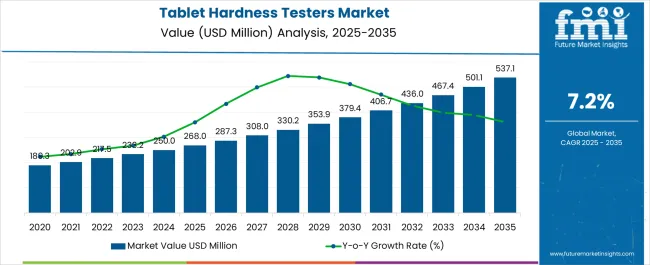
The tablet hardness testers market was valued at USD 268.0 million in 2025. The market is set to reach USD 287.3 million by 2026-end and grow at a CAGR of 7.2% between 2026-2036 to reach USD 575.8 million by 2036. Manual will dominate with a 45.0% share, while Portable will lead with a 50.0%% share.
Summary of the Tablet Hardness Testers Market
- Demand and Growth Drivers
- Growing pharmaceutical production volumes worldwide are creating sustained demand for tablet hardness testing equipment that ensures product quality and regulatory compliance across manufacturing operations.
- Increasingly stringent regulatory requirements from FDA, EMA, and national authorities are driving pharmaceutical manufacturers to invest in validated, compliant testing equipment with electronic data management capability.
- Expansion of generic drug and nutraceutical manufacturing in emerging markets is creating demand for quality control testing equipment across multiple price and automation levels.
- Product and Segment View
- Manual testers are expected to account for 45.0% of the automation type segment in 2026, reflecting their established presence in quality control laboratories and lower acquisition costs for routine testing applications.
- Portable testers are expected to represent 50.0% of the modularity segment in 2026, driven by their flexibility for use across multiple testing locations within pharmaceutical manufacturing facilities.
- Automatic testers are the fastest growing category as pharmaceutical manufacturers adopt integrated quality control systems with automated data recording and 21 CFR Part 11 compliance.
- Geography and Competitive Outlook
- China is expected to lead growth at 9.7%, reflecting its expanding pharmaceutical manufacturing base and increasing regulatory emphasis on quality control testing.
- India at 9.0% reflects growing pharmaceutical production, generic drug manufacturing expansion, and increasing adoption of quality control equipment.
- Companies that combine testing precision, regulatory compliance features, and service support are positioned to capture procurement across pharmaceutical and research markets.
- Analyst Opinion
- The tablet hardness testers market reflects the pharmaceutical industry's increasing investment in quality control infrastructure driven by regulatory compliance requirements and production volume growth.
- Adoption is shifting toward automated and semi automated systems as pharmaceutical manufacturers seek integrated quality control solutions with electronic data management and audit trail capability.
- Growth is supported by pharmaceutical manufacturing expansion in emerging markets, where new production facilities require complete quality control laboratory equipment installations.
- Companies investing in automation, data integrity features, and regulatory compliance certification are positioned to capture the premium segment of the quality control equipment market.
Key Takeaways, Market Size, and Forecast
- The tablet hardness testers market was valued at USD Million 268 million in 2025.
- By 2036, the Tablet Hardness Testers Market is expected to be worth USD Million 575.81 million.
- From 2026 to 2036, the market is projected to expand at a CAGR of 7.2%.
- The market is projected to create an incremental opportunity of USD Million 288.51 million between 2026 and 2036.
- In 2026, manual is expected to account for 45.0% of the automation type segment, driven by their established presence in pharmaceutical quality control laboratories, lower acquisition costs, and simplicity of operation for routine hardness testing applications.
- China (9.7%) and India (9.0%) are two of the fastest growing markets in the world.
Tablet Hardness Testers Market Definition
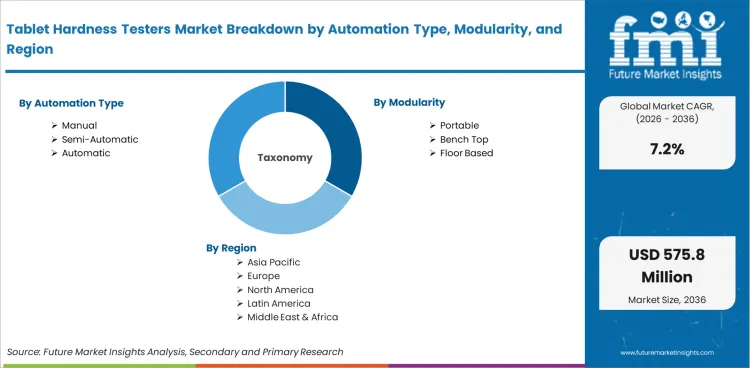
The tablet hardness testers market covers instruments used to measure the mechanical strength and breaking force of pharmaceutical tablets, ensuring product quality, consistency, and compliance with regulatory standards. Equipment ranges from manual testers for laboratory use to fully automatic systems integrated into production line quality control, available in portable, bench top, and floor based configurations.
Tablet Hardness Testers Market Inclusions
Market scope includes all commercially traded tablet hardness testing equipment categorized by automation type (manual, semi-automatic, automatic), modularity (portable, bench top, floor based), and end use industry (healthcare and pharmaceutical, educational institutes, analytical laboratory, clinical research). Revenue coverage spans 2026 to 2036.
Tablet Hardness Testers Market Exclusions
The scope does not include general material testing equipment not designed for tablet applications, dissolution testers, disintegration testers, or friability testing equipment.
Tablet Hardness Testers Market Research Methodology
- Primary Research: FMI analysts conducted interviews with manufacturers, technology specialists, and procurement professionals across key markets.
- Desk Research: Combined data from industry associations, regulatory bodies, and manufacturer disclosures.
- Market Sizing and Forecasting: Bottom up methodology aggregating segment and regional data with adoption velocity projections.
- Data Validation: Cross checked quarterly against production data, trade statistics, and manufacturer reporting.
Why is the Tablet Hardness Testers Market Growing?
- Pharmaceutical production volume growth requires proportional investment in quality control testing equipment including tablet hardness testers that verify product consistency across manufacturing batches.
- FDA 21 CFR Part 11 and EU Annex 11 data integrity requirements are driving adoption of electronic data management capable hardness testers that provide compliant audit trails for regulatory inspections.
- Generic drug manufacturing expansion in India, China, and Southeast Asia is creating demand for quality control equipment across multiple price points and automation levels.
Demand for tablet hardness testers is driven by the pharmaceutical industry's fundamental requirement to verify the mechanical strength of solid dosage forms. Tablet hardness directly affects drug dissolution, bioavailability, and shelf life stability. Regulatory agencies require manufacturers to demonstrate consistent tablet hardness within specified parameters as part of good manufacturing practices. This creates non discretionary demand for testing equipment that grows proportionally with pharmaceutical production volumes.
The regulatory environment is progressively tightening data integrity requirements for quality control testing. FDA 21 CFR Part 11 and EU Annex 11 mandate electronic records and signatures with complete audit trails for pharmaceutical quality data. This drives adoption of automated hardness testers with integrated data management systems that replace manual recording with validated electronic workflows. The transition from manual to automated testing creates equipment upgrade cycles in established facilities.
Geographic expansion of pharmaceutical manufacturing is broadening the demand base. India and China are the fastest growing markets due to their roles as global generic drug manufacturing hubs. New production facilities in these markets require complete quality control laboratory installations, creating greenfield equipment demand. Brazil and other emerging markets are similarly expanding pharmaceutical manufacturing capability, contributing to global demand growth.
Market Segmentation Analysis
- Manual testers represent 45.0% of the automation type segment, reflecting their established presence in pharmaceutical laboratories and lower acquisition costs for routine quality control testing.
- Portable testers account for 50.0% of the modularity segment, driven by flexibility for use across multiple locations within pharmaceutical facilities.
- Automatic testers represent the fastest growing segment as manufacturers adopt integrated systems with electronic data management and regulatory compliance features.
The tablet hardness testers market segments by automation type, modularity, and end use industry. By automation type, the market covers manual, semi-automatic, and automatic testers. By modularity, the market includes portable, bench top, and floor based configurations.
Insights into the Manual Automation Type Segment
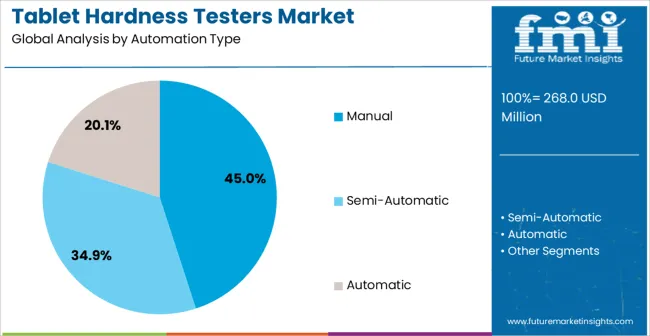
In 2026, manual testers are expected to account for 45.0% of the automation type segment. Their continued dominance reflects lower acquisition costs, simplicity of operation, and adequate functionality for routine quality control applications in pharmaceutical laboratories. Manual testers are particularly prevalent in educational institutes, smaller pharmaceutical companies, and facilities where testing volumes do not justify the investment in automated equipment.
Insights into the Portable Modularity Segment
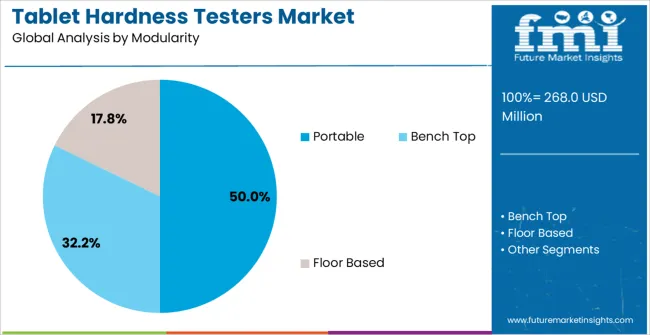
Portable testers are expected to represent 50.0% of the modularity segment in 2026. Their dominance reflects the practical advantage of flexibility within pharmaceutical manufacturing environments where testing may be required across multiple production areas, quality control laboratories, and incoming material inspection stations. Portable configurations minimize equipment duplication while maintaining testing accessibility.
Tablet Hardness Testers Market Drivers, Restraints, and Opportunities
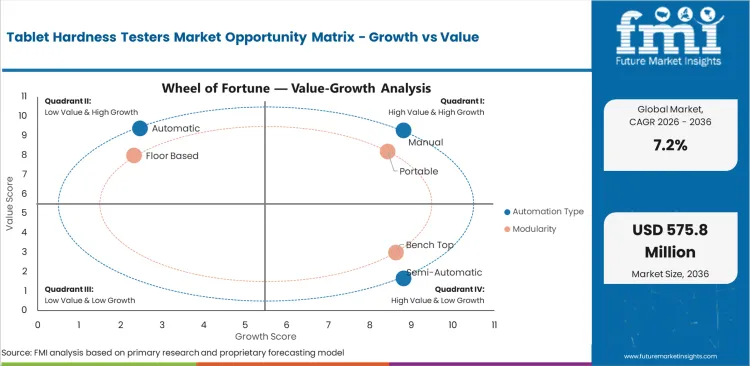
- Pharmaceutical production growth and regulatory compliance requirements create sustained non discretionary demand for quality control testing equipment.
- High equipment costs for automated systems and the adequacy of manual testers for basic applications slow the transition to fully automated hardness testing in smaller facilities.
- Emerging market pharmaceutical manufacturing expansion creates greenfield equipment demand across multiple automation levels and price points.
The tablet hardness testers market is expanding on the basis of pharmaceutical production growth, regulatory compliance demands, and emerging market manufacturing expansion.
Pharmaceutical Production Volume Growth
Growing global pharmaceutical production creates proportional demand for quality control testing equipment. Tablet hardness testing is a non discretionary requirement under GMP standards, ensuring demand correlates directly with production expansion.
Data Integrity Regulatory Requirements
FDA and EMA data integrity mandates drive adoption of automated testers with electronic data management capability. Manual recording methods face increasing regulatory scrutiny, creating upgrade pressure across established pharmaceutical facilities.
Emerging Market Manufacturing Expansion
Pharmaceutical manufacturing growth in India, China, and Southeast Asia creates greenfield demand for quality control equipment. New facilities require complete laboratory installations that include tablet hardness testing capability.
Integration with Production Line QC
Automated hardness testers integrated directly into tablet production lines enable real time quality monitoring that reduces batch rejection rates and improves manufacturing efficiency.
Analysis of Tablet Hardness Testers Market By Key Countries
.webp "Top Country Growth Comparison Tablet Hardness Testers Market Cagr (2026 2036)")
| Country | CAGR |
|---|---|
| China | 9.7% |
| India | 9.0% |
| Germany | 8.3% |
| Brazil | 7.6% |
| USA | 6.8% |
| UK | 6.1% |
| Japan | 5.4% |
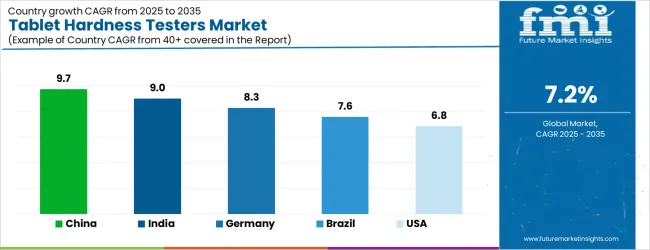
- China leads at 9.7% CAGR through 2036.
- India leads at 9.0% CAGR through 2036.
- Germany leads at 8.3% CAGR through 2036.
- Brazil leads at 7.6% CAGR through 2036.
The global tablet hardness testers market is projected to grow at a CAGR of 7.2% from 2026 to 2036. The analysis covers more than 30 countries, with the leading markets detailed below.
Demand Outlook for Tablet Hardness Testers Market in China
China is expected to lead growth at 9.7% through 2036, reflecting its expanding pharmaceutical manufacturing base and increasing investment in quality control infrastructure.
- Pharmaceutical manufacturing expansion drives testing equipment procurement.
- Regulatory compliance requirements increase demand for validated equipment.
- Generic drug production growth creates quality control investment.
Future Outlook for Tablet Hardness Testers Market in India
India is expected to grow at 9.0% through 2036, supported by its position as a global generic drug manufacturing hub with expanding quality control requirements.
- Generic drug manufacturing leadership drives quality control equipment demand.
- FDA and WHO compliance requirements for export markets increase testing standards.
- New facility construction creates greenfield equipment procurement.
Opportunity Analysis of Tablet Hardness Testers Market in Germany
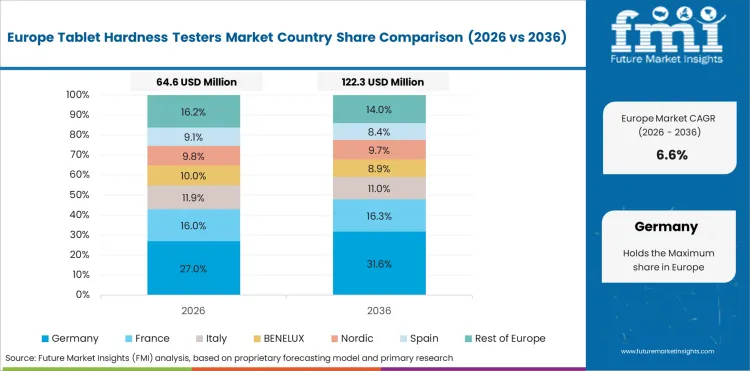
Germany is expected to grow at 8.3% through 2036, driven by its pharmaceutical manufacturing excellence, equipment manufacturing leadership, and high regulatory standards.
- Pharmaceutical manufacturing excellence supports premium equipment demand.
- Equipment manufacturing leadership drives technology development and export.
- High regulatory standards support adoption of advanced automated systems.
In-depth Analysis of Tablet Hardness Testers Market in Brazil
Brazil is expected to grow at 7.6% through 2036, reflecting its expanding pharmaceutical manufacturing sector and growing investment in quality control capability.
- Pharmaceutical manufacturing expansion creates equipment procurement demand.
- Quality control investment supports laboratory equipment installation.
- Regulatory compliance standards drive adoption of validated testing systems.
Sales Analysis of Tablet Hardness Testers Market in the United States
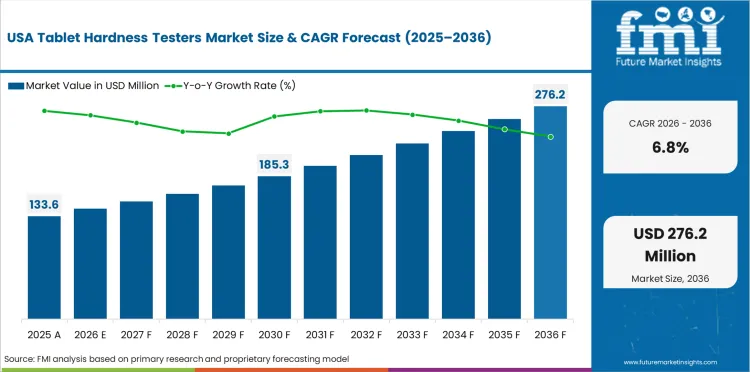
The USA is expected to grow at 6.8% through 2036, reflecting a mature pharmaceutical market with demand driven by equipment upgrades and data integrity compliance requirements.
- Equipment upgrade cycles driven by data integrity requirements.
- Pharmaceutical production growth supports incremental equipment demand.
- Automated testing adoption increases for production line integration.
Demand Outlook for Tablet Hardness Testers Market in Japan
Japan is expected to grow at 5.4% through 2036, reflecting its advanced pharmaceutical sector and high precision quality control standards.
- Advanced pharmaceutical sector supports premium testing equipment demand.
- High precision standards favor technically advanced automated testers.
- Quality control innovation drives technology development.
Competitive Landscape and Strategic Positioning
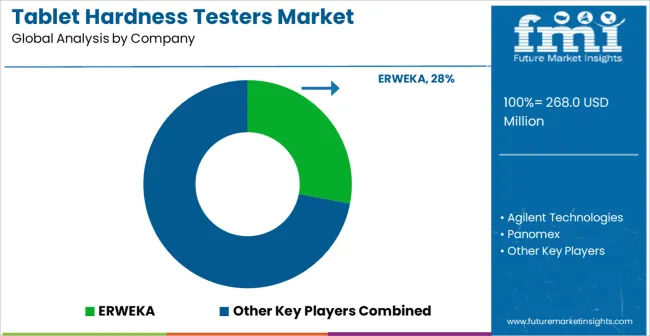
- ERWEKA leads the market with comprehensive product and service capabilities and established customer relationships.
- Multiple global and regional players compete on technology capability, certification credentials, and geographic reach.
- Emerging players are targeting specialized applications and next generation technology development.
ERWEKA leads the global market with comprehensive tablet testing portfolios that span manual through fully automated hardness testers, supported by established pharmaceutical industry relationships and global service networks. Agilent Technologies provides advanced analytical testing solutions including hardness testers as part of broader pharmaceutical quality control platforms.
Pharma Test and SOTAX serve the European pharmaceutical market with high precision testing equipment featuring advanced data management and regulatory compliance capability. Both companies maintain strong positions through technical expertise and certification credentials.
Panomex and Electrolab represent leading Indian manufacturers serving growing domestic and export markets with cost competitive testing equipment. Torontech Group provides testing solutions in North America with a focus on customer service and technical support.
Key Companies in the Tablet Hardness Testers Market
Key global companies leading the tablet hardness testers market include:
- ERWEKA (Germany), Agilent Technologies (USA), Panomex (India), Pharma Test (Germany), Electrolab (India) hold strong positions through manufacturing scale, certification credentials, and established customer relationships.
- Torontech Group (Canada), SOTAX (Switzerland) are expanding presence through regional focus and specialized product development.
Competitive Benchmarking: Tablet Hardness Testers Market
| Company | Testing Technology | Automation Level | Regulatory Compliance | Geographic Reach |
|---|---|---|---|---|
| ERWEKA | High | High | Strong | Global |
| Agilent Technologies | High | High | Strong | Global |
| Panomex | Medium | Medium | Strong | Asia, Global |
| Pharma Test | High | High | Strong | Europe, Global |
| Electrolab | Medium | High | Strong | Asia, Global |
| Torontech Group | Medium | Medium | Moderate | North America |
| SOTAX | High | High | Strong | Europe, Global |
Source: Future Market Insights competitive analysis, 2026.
Key Players in the Tablet Hardness Testers Market
Major Global Players
- ERWEKA (Germany)
- Agilent Technologies (USA)
- Panomex (India)
- Pharma Test (Germany)
- Electrolab (India)
Emerging Players/Startups
- Torontech Group (Canada)
- SOTAX (Switzerland)
Report Scope and Coverage
| Parameter | Details |
|---|---|
| Quantitative Units | USD Million 287.3 to USD Million 575.81, at a CAGR of 7.2% |
| Market Definition | The tablet hardness testers market covers instruments used to measure the mechanical strength and breaking force of pharmaceutical tablets, ensuring product quality, consistency, and compliance with regulatory standards. Equipment ranges from manual testers for laboratory use to fully automatic systems integrated into production line quality control, available in portable, bench top, and floor based configurations. |
| Regions Covered | North America, Latin America, Europe, East Asia, South Asia and Pacific, Middle East and Africa |
| Countries Covered | China, India, Germany, Brazil, USA, UK, Japan, and 30 plus countries |
| Key Companies Profiled | ERWEKA, Agilent Technologies, Panomex, Pharma Test, Electrolab, Torontech Group, SOTAX |
| Forecast Period | 2026 to 2036 |
| Approach | Hybrid bottom up and top down methodology starting with verified transaction data, projecting adoption velocity across segments and regions. |
Segmentation
Tablet Hardness Testers Market Segmented by Automation Type:
- Manual
- Semi-Automatic
- Automatic
Tablet Hardness Testers Market Segmented by Modularity:
- Portable
- Bench Top
- Floor Based
Tablet Hardness Testers Market Segmented by End Use Industry:
- Healthcare And Pharmaceutical
- Educational Institutes
- Analytical Laboratory
- Clinical Research
Tablet Hardness Testers Market by Region:
- North America
- USA
- Canada
- Mexico
- Latin America
- Brazil
- Chile
- Rest of Latin America
- Western Europe
- Germany
- UK
- Italy
- Spain
- France
- Nordic
- BENELUX
- Rest of Western Europe
- Eastern Europe
- Russia
- Poland
- Hungary
- Balkan & Baltic
- Rest of Eastern Europe
- East Asia
- China
- Japan
- South Korea
- South Asia and Pacific
- India
- ASEAN
- Australia & New Zealand
- Rest of South Asia and Pacific
- Middle East & Africa
- Kingdom of Saudi Arabia
- Other GCC Countries
- Turkiye
- South Africa
- Other African Union
- Rest of Middle East & Africa
Research Sources and Bibliography
- 1. USA Food and Drug Administration. (2025). FDA Guidance for Industry: Tablet Dissolution and Hardness Testing. FDA.
- 2. European Medicines Agency. (2024). EMA Guidelines on Quality Control of Solid Dosage Forms. EMA.
- 3. United States Pharmacopeia. (2025). USP General Chapter 1217: Tablet Breaking Force. USP.
- 4. International Society for Pharmaceutical Engineering. (2024). ISPE Good Practice Guide: Data Integrity. ISPE.
- 5. World Health Organization. (2025). WHO Technical Report Series: Quality Control of Pharmaceutical Products. WHO.
This bibliography is provided for reader reference. The full Future Market Insights report contains the complete reference list.
This Report Answers
- Estimating the size of the market and projected revenue from 2026 to 2036.
- Segmentation by automation type, modularity, end use industry, and region.
- Insights across more than 30 country markets.
- Analysis of automation and data integrity technology trends.
- Assessment of the competitive landscape and manufacturer positioning.
- Identification of investment opportunities in automated testing and emerging market expansion.
- Tracking regulatory developments in pharmaceutical quality control standards.
- Delivery of data in PDF and Excel formats.
Frequently Asked Questions
What is the global market demand for Tablet Hardness Testers in 2026?
In 2026, the global tablet hardness testers market is expected to be worth USD Million 287.3 million.
How big will the Tablet Hardness Testers Market be in 2036?
By 2036, the tablet hardness testers market is expected to be worth USD Million 575.81 million.
How much is demand for Tablet Hardness Testers expected to grow between 2026 and 2036?
Between 2026 and 2036, demand is expected to grow at a CAGR of 7.2%.
Which automation type segment is expected to lead in 2026?
Manual is expected to account for 45.0% of the automation type segment in 2026, driven by their established presence in pharmaceutical quality control laboratories, lower acquisition costs, and simplicity of operation for routine hardness testing applications.
What is causing demand to rise in China?
China is expected to grow at 9.7% CAGR through 2036. Pharmaceutical manufacturing expansion drives testing equipment procurement.
What is causing demand to rise in India?
India is expected to grow at 9.0% CAGR through 2036. Generic drug manufacturing leadership drives quality control equipment demand.
What does this report mean by 'Tablet Hardness Testers Market definition'?
The tablet hardness testers market covers instruments used to measure the mechanical strength and breaking force of pharmaceutical tablets, ensuring product quality, consistency, and compliance with regulatory standards. Equipment ranges from manual testers for laboratory use to fully automatic systems integrated into production line quality control, available in portable, bench top, and floor based configurations.
How does FMI make the Tablet Hardness Testers forecast and validate it?
Forecasting models use a hybrid bottom up and top down approach, starting with verified transaction data and validating against industry production statistics and manufacturer disclosures.
Preview the report firsthand - request a free sample
Get SampleGet the brochure for pricing and purchase details.
Get PDFTable of Content
- Executive Summary
- Global Market Outlook
- Demand-side Trends
- Supply-side Trends
- Technology Roadmap Analysis
- Analysis and Recommendations
- Market Overview
- Market Coverage / Taxonomy
- Market Definition / Scope / Limitations
- Research Methodology
- Chapter Orientation
- Analytical Lens and Working Hypotheses
- Market Structure, Signals, and Trend Drivers
- Benchmarking and Cross-market Comparability
- Market Sizing, Forecasting, and Opportunity Mapping
- Research Design and Evidence Framework
- Desk Research Programme (Secondary Evidence)
- Company Annual and Sustainability Reports
- Peer-reviewed Journals and Academic Literature
- Corporate Websites, Product Literature, and Technical Notes
- Earnings Decks and Investor Briefings
- Statutory Filings and Regulatory Disclosures
- Technical White Papers and Standards Notes
- Trade Journals, Industry Magazines, and Analyst Briefs
- Conference Proceedings, Webinars, and Seminar Materials
- Government Statistics Portals and Public Data Releases
- Press Releases and Reputable Media Coverage
- Specialist Newsletters and Curated Briefings
- Sector Databases and Reference Repositories
- FMI Internal Proprietary Databases and Historical Market Datasets
- Subscription Datasets and Paid Sources
- Social Channels, Communities, and Digital Listening Inputs
- Additional Desk Sources
- Expert Input and Fieldwork (Primary Evidence)
- Primary Modes
- Qualitative Interviews and Expert Elicitation
- Quantitative Surveys and Structured Data Capture
- Blended Approach
- Why Primary Evidence is Used
- Field Techniques
- Interviews
- Surveys
- Focus Groups
- Observational and In-context Research
- Social and Community Interactions
- Stakeholder Universe Engaged
- C-suite Leaders
- Board Members
- Presidents and Vice Presidents
- R&D and Innovation Heads
- Technical Specialists
- Domain Subject-matter Experts
- Scientists
- Physicians and Other Healthcare Professionals
- Governance, Ethics, and Data Stewardship
- Research Ethics
- Data Integrity and Handling
- Primary Modes
- Tooling, Models, and Reference Databases
- Desk Research Programme (Secondary Evidence)
- Data Engineering and Model Build
- Data Acquisition and Ingestion
- Cleaning, Normalisation, and Verification
- Synthesis, Triangulation, and Analysis
- Quality Assurance and Audit Trail
- Market Background
- Market Dynamics
- Drivers
- Restraints
- Opportunity
- Trends
- Scenario Forecast
- Demand in Optimistic Scenario
- Demand in Likely Scenario
- Demand in Conservative Scenario
- Opportunity Map Analysis
- Product Life Cycle Analysis
- Supply Chain Analysis
- Investment Feasibility Matrix
- Value Chain Analysis
- PESTLE and Porter’s Analysis
- Regulatory Landscape
- Regional Parent Market Outlook
- Production and Consumption Statistics
- Import and Export Statistics
- Market Dynamics
- Global Market Analysis 2021 to 2025 and Forecast, 2026 to 2036
- Historical Market Size Value (USD Million) Analysis, 2021 to 2025
- Current and Future Market Size Value (USD Million) Projections, 2026 to 2036
- Y-o-Y Growth Trend Analysis
- Absolute $ Opportunity Analysis
- Global Market Pricing Analysis 2021 to 2025 and Forecast 2026 to 2036
- Global Market Analysis 2021 to 2025 and Forecast 2026 to 2036, By Automation Type
- Introduction / Key Findings
- Historical Market Size Value (USD Million) Analysis By Automation Type , 2021 to 2025
- Current and Future Market Size Value (USD Million) Analysis and Forecast By Automation Type , 2026 to 2036
- Manual
- Semi-Automatic
- Automatic
- Manual
- Y-o-Y Growth Trend Analysis By Automation Type , 2021 to 2025
- Absolute $ Opportunity Analysis By Automation Type , 2026 to 2036
- Global Market Analysis 2021 to 2025 and Forecast 2026 to 2036, By Modularity
- Introduction / Key Findings
- Historical Market Size Value (USD Million) Analysis By Modularity, 2021 to 2025
- Current and Future Market Size Value (USD Million) Analysis and Forecast By Modularity, 2026 to 2036
- Portable
- Bench Top
- Floor Based
- Portable
- Y-o-Y Growth Trend Analysis By Modularity, 2021 to 2025
- Absolute $ Opportunity Analysis By Modularity, 2026 to 2036
- Global Market Analysis 2021 to 2025 and Forecast 2026 to 2036, By End Use Industry
- Introduction / Key Findings
- Historical Market Size Value (USD Million) Analysis By End Use Industry, 2021 to 2025
- Current and Future Market Size Value (USD Million) Analysis and Forecast By End Use Industry, 2026 to 2036
- Healthcare And Pharmaceutical
- Educational Institutes
- Analytical Laboratory
- Clinical Research
- Healthcare And Pharmaceutical
- Y-o-Y Growth Trend Analysis By End Use Industry, 2021 to 2025
- Absolute $ Opportunity Analysis By End Use Industry, 2026 to 2036
- Global Market Analysis 2021 to 2025 and Forecast 2026 to 2036, By Region
- Introduction
- Historical Market Size Value (USD Million) Analysis By Region, 2021 to 2025
- Current Market Size Value (USD Million) Analysis and Forecast By Region, 2026 to 2036
- North America
- Latin America
- Western Europe
- Eastern Europe
- East Asia
- South Asia and Pacific
- Middle East & Africa
- Market Attractiveness Analysis By Region
- North America Market Analysis 2021 to 2025 and Forecast 2026 to 2036, By Country
- Historical Market Size Value (USD Million) Trend Analysis By Market Taxonomy, 2021 to 2025
- Market Size Value (USD Million) Forecast By Market Taxonomy, 2026 to 2036
- By Country
- USA
- Canada
- Mexico
- By Automation Type
- By Modularity
- By End Use Industry
- By Country
- Market Attractiveness Analysis
- By Country
- By Automation Type
- By Modularity
- By End Use Industry
- Key Takeaways
- Latin America Market Analysis 2021 to 2025 and Forecast 2026 to 2036, By Country
- Historical Market Size Value (USD Million) Trend Analysis By Market Taxonomy, 2021 to 2025
- Market Size Value (USD Million) Forecast By Market Taxonomy, 2026 to 2036
- By Country
- Brazil
- Chile
- Rest of Latin America
- By Automation Type
- By Modularity
- By End Use Industry
- By Country
- Market Attractiveness Analysis
- By Country
- By Automation Type
- By Modularity
- By End Use Industry
- Key Takeaways
- Western Europe Market Analysis 2021 to 2025 and Forecast 2026 to 2036, By Country
- Historical Market Size Value (USD Million) Trend Analysis By Market Taxonomy, 2021 to 2025
- Market Size Value (USD Million) Forecast By Market Taxonomy, 2026 to 2036
- By Country
- Germany
- UK
- Italy
- Spain
- France
- Nordic
- BENELUX
- Rest of Western Europe
- By Automation Type
- By Modularity
- By End Use Industry
- By Country
- Market Attractiveness Analysis
- By Country
- By Automation Type
- By Modularity
- By End Use Industry
- Key Takeaways
- Eastern Europe Market Analysis 2021 to 2025 and Forecast 2026 to 2036, By Country
- Historical Market Size Value (USD Million) Trend Analysis By Market Taxonomy, 2021 to 2025
- Market Size Value (USD Million) Forecast By Market Taxonomy, 2026 to 2036
- By Country
- Russia
- Poland
- Hungary
- Balkan & Baltic
- Rest of Eastern Europe
- By Automation Type
- By Modularity
- By End Use Industry
- By Country
- Market Attractiveness Analysis
- By Country
- By Automation Type
- By Modularity
- By End Use Industry
- Key Takeaways
- East Asia Market Analysis 2021 to 2025 and Forecast 2026 to 2036, By Country
- Historical Market Size Value (USD Million) Trend Analysis By Market Taxonomy, 2021 to 2025
- Market Size Value (USD Million) Forecast By Market Taxonomy, 2026 to 2036
- By Country
- China
- Japan
- South Korea
- By Automation Type
- By Modularity
- By End Use Industry
- By Country
- Market Attractiveness Analysis
- By Country
- By Automation Type
- By Modularity
- By End Use Industry
- Key Takeaways
- South Asia and Pacific Market Analysis 2021 to 2025 and Forecast 2026 to 2036, By Country
- Historical Market Size Value (USD Million) Trend Analysis By Market Taxonomy, 2021 to 2025
- Market Size Value (USD Million) Forecast By Market Taxonomy, 2026 to 2036
- By Country
- India
- ASEAN
- Australia & New Zealand
- Rest of South Asia and Pacific
- By Automation Type
- By Modularity
- By End Use Industry
- By Country
- Market Attractiveness Analysis
- By Country
- By Automation Type
- By Modularity
- By End Use Industry
- Key Takeaways
- Middle East & Africa Market Analysis 2021 to 2025 and Forecast 2026 to 2036, By Country
- Historical Market Size Value (USD Million) Trend Analysis By Market Taxonomy, 2021 to 2025
- Market Size Value (USD Million) Forecast By Market Taxonomy, 2026 to 2036
- By Country
- Kingdom of Saudi Arabia
- Other GCC Countries
- Turkiye
- South Africa
- Other African Union
- Rest of Middle East & Africa
- By Automation Type
- By Modularity
- By End Use Industry
- By Country
- Market Attractiveness Analysis
- By Country
- By Automation Type
- By Modularity
- By End Use Industry
- Key Takeaways
- Key Countries Market Analysis
- USA
- Pricing Analysis
- Market Share Analysis, 2025
- By Automation Type
- By Modularity
- By End Use Industry
- Canada
- Pricing Analysis
- Market Share Analysis, 2025
- By Automation Type
- By Modularity
- By End Use Industry
- Mexico
- Pricing Analysis
- Market Share Analysis, 2025
- By Automation Type
- By Modularity
- By End Use Industry
- Brazil
- Pricing Analysis
- Market Share Analysis, 2025
- By Automation Type
- By Modularity
- By End Use Industry
- Chile
- Pricing Analysis
- Market Share Analysis, 2025
- By Automation Type
- By Modularity
- By End Use Industry
- Germany
- Pricing Analysis
- Market Share Analysis, 2025
- By Automation Type
- By Modularity
- By End Use Industry
- UK
- Pricing Analysis
- Market Share Analysis, 2025
- By Automation Type
- By Modularity
- By End Use Industry
- Italy
- Pricing Analysis
- Market Share Analysis, 2025
- By Automation Type
- By Modularity
- By End Use Industry
- Spain
- Pricing Analysis
- Market Share Analysis, 2025
- By Automation Type
- By Modularity
- By End Use Industry
- France
- Pricing Analysis
- Market Share Analysis, 2025
- By Automation Type
- By Modularity
- By End Use Industry
- India
- Pricing Analysis
- Market Share Analysis, 2025
- By Automation Type
- By Modularity
- By End Use Industry
- ASEAN
- Pricing Analysis
- Market Share Analysis, 2025
- By Automation Type
- By Modularity
- By End Use Industry
- Australia & New Zealand
- Pricing Analysis
- Market Share Analysis, 2025
- By Automation Type
- By Modularity
- By End Use Industry
- China
- Pricing Analysis
- Market Share Analysis, 2025
- By Automation Type
- By Modularity
- By End Use Industry
- Japan
- Pricing Analysis
- Market Share Analysis, 2025
- By Automation Type
- By Modularity
- By End Use Industry
- South Korea
- Pricing Analysis
- Market Share Analysis, 2025
- By Automation Type
- By Modularity
- By End Use Industry
- Russia
- Pricing Analysis
- Market Share Analysis, 2025
- By Automation Type
- By Modularity
- By End Use Industry
- Poland
- Pricing Analysis
- Market Share Analysis, 2025
- By Automation Type
- By Modularity
- By End Use Industry
- Hungary
- Pricing Analysis
- Market Share Analysis, 2025
- By Automation Type
- By Modularity
- By End Use Industry
- Kingdom of Saudi Arabia
- Pricing Analysis
- Market Share Analysis, 2025
- By Automation Type
- By Modularity
- By End Use Industry
- Turkiye
- Pricing Analysis
- Market Share Analysis, 2025
- By Automation Type
- By Modularity
- By End Use Industry
- South Africa
- Pricing Analysis
- Market Share Analysis, 2025
- By Automation Type
- By Modularity
- By End Use Industry
- USA
- Market Structure Analysis
- Competition Dashboard
- Competition Benchmarking
- Market Share Analysis of Top Players
- By Regional
- By Automation Type
- By Modularity
- By End Use Industry
- Competition Analysis
- Competition Deep Dive
- ERWEKA
- Overview
- Product Portfolio
- Profitability by Market Segments (Product/Age /Sales Channel/Region)
- Sales Footprint
- Strategy Overview
- Marketing Strategy
- Product Strategy
- Channel Strategy
- Agilent Technologies
- Panomex
- Pharma Test
- Electrolab
- Torontech Group
- SOTAX
- ERWEKA
- Competition Deep Dive
- Assumptions & Acronyms Used


