

- Market Size (2026)
- USD 18.9 Bn
- Forecast (2036)
- USD 74.3 Bn
- CAGR (2026 to 2036)
- 14.7%
Drug Discovery Informatics Market Size, Market Forecast and Outlook By FMI
Summary of the Drug Discovery Informatics Market
- Demand and Growth Drivers
- Increasing complexity of drug pipelines and the need to reduce time-to-market are expected to sustain demand for computational discovery platforms across pharmaceutical and biotechnology companies.
- AI and machine learning integration into molecular modelling and virtual screening workflows is accelerating adoption of informatics platforms in early-stage drug discovery.
- Rising R&D expenditure and the expansion of precision medicine programs are expected to support demand for sequence analysis and clinical trial data management tools during the forecast period.
- Product and Segment View
- Discovery informatics is expected to account for 57.4% of the technique segment in 2026, reflecting its centrality in target identification, hit-to-lead optimization, and ADMET prediction workflows.
- In-house deployment is projected to lead mode at 63.2%, driven by data security requirements and the need for integration with proprietary compound libraries.
- Pharmaceutical and biotechnology companies are expected to hold 72.1% of the end user segment, as these organizations account for the majority of computational drug discovery investment.
- Geography and Competitive Outlook
- EU (15%) and South Korea (14.8%) are expected to lead growth, driven by expanding biopharma ecosystems and government-funded precision medicine initiatives.
- North America is likely to remain the largest regional market, supported by the concentration of major pharmaceutical R&D centers and informatics platform developers.
- PerkinElmer, Inc. holds an estimated 20.1% share, supported by integrated laboratory-to-informatics workflows and an established pharma client base.
- Analyst Opinion
- 'Companies that can combine AI-driven molecular modelling with scalable cloud-based platforms and regulatory-grade data management are likely to strengthen their position as the informatics layer of drug discovery becomes more central to R&D productivity.'
- The drug discovery informatics market is shifting from a support function to a core competitive capability within pharmaceutical R&D organizations.
- Adoption is increasing due to the growing volume of biological data from genomics, proteomics, and high-throughput screening that requires computational analysis.
- Demand is further shaped by the expansion of outsourced drug discovery models, where informatics platforms serve as the connective layer between sponsors and contract research organizations.
- The market is also benefiting from regulatory acceptance of computational evidence in IND filings and clinical trial design optimization.
Key Takeaways, Market Size, and Forecast
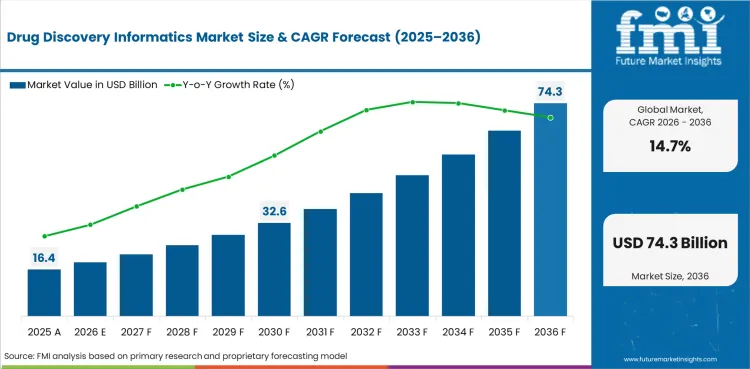
- The drug discovery informatics market was valued at USD 16.4 billion in 2025 and is expected to reach USD 18.9 billion by the end of 2026.
- The market is projected to grow at a CAGR of 14.7% from 2026 to 2036, reaching USD 74.3 billion by 2036.
- The market was valued at USD 10.90 billion in 2025.
- By 2036, the market is expected to reach approximately USD 74.34 billion.
- From 2026 to 2036, the market is projected to expand at a CAGR of 14.7%.
- The market is expected to create an incremental opportunity of USD 55.48 billion between 2026 and 2036.
- In 2026, discovery informatics is expected to account for 57.4% of the technique segment, driven by increasing reliance on computational tools for target identification and lead optimization in pharmaceutical R&D pipelines.
- The in-house model is expected to hold a 63.2% share, reflecting strong internalization of data analytics capabilities by pharma companies.
- The European Union (15.0%) and South Korea (14.8%) are among the fastest-growing markets globally.
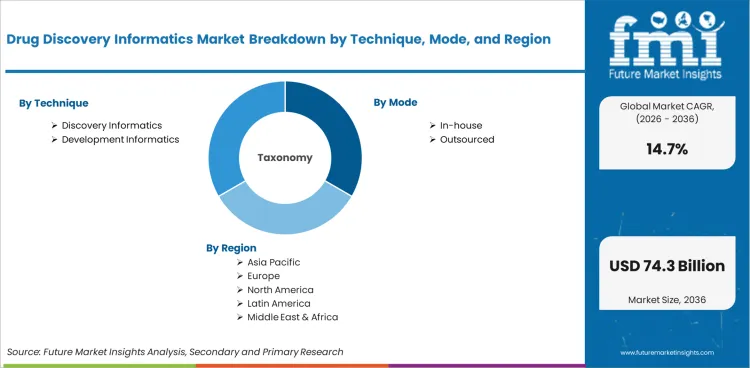
Drug Discovery Informatics Market Definition
The drug discovery informatics market encompasses computational platforms, software tools, and data management systems used in pharmaceutical and biotechnology research and development. This includes molecular modelling, sequence analysis, docking simulations, clinical trial data management, and AI-driven discovery workflows deployed across target identification, lead optimization, and preclinical development stages.
Drug Discovery Informatics Market Inclusions
Market scope encompasses all commercially available drug discovery informatics solutions categorized by technique (discovery informatics, development informatics), mode (in-house, outsourced), service (molecular modelling, sequence analysis platforms, docking, clinical trial data management, other services), and end user (pharmaceutical and biotechnology companies, academic institutes, manufacturing, other end users). The range of revenue sizes is from 2026 to 2036.
Drug Discovery Informatics Market Exclusions
The scope does not include general-purpose laboratory information management systems (LIMS) not specifically designed for drug discovery, electronic health record systems, or clinical trial management systems operating independently of drug discovery workflows.
Drug Discovery Informatics Market Research Methodology
- Primary Research: FMI analysts conducted interviews with pharmaceutical R&D directors, computational chemistry leads, informatics platform vendors, and contract research organization executives in key markets.
- Desk Research: Combined data from pharmaceutical R&D expenditure data, informatics platform deployment surveys, regulatory filings, and clinical trial database records.
- Market Sizing and Forecasting: Bottom-up approach aggregating data across segments and regions, with regional adoption curves.
- Data Validation: Cross-checked quarterly against industry production data and manufacturer disclosures.
Why is the Drug Discovery Informatics Market Growing?
- AI integration into molecular modelling and virtual screening is accelerating demand for computational discovery platforms, with EU (15%) and South Korea (14.8%) leading growth at 14.7% CAGR.
- Rising pharmaceutical R&D expenditure and the increasing complexity of biological targets are creating structural demand for advanced informatics tools across the drug development pipeline.
- Precision medicine programs and the expansion of outsourced discovery models are broadening the market for informatics platforms that connect sponsors, CROs, and academic research institutions.
The drug discovery informatics market reflects the pharmaceutical industry's structural dependence on computational tools to manage the increasing complexity and cost of drug development. Discovery informatics accounts for 57.4% of the technique segment, encompassing target identification, hit-to-lead optimization, ADMET prediction, and virtual screening workflows that reduce the number of physical compounds requiring synthesis and testing. Development informatics complements this by supporting clinical trial design, pharmacokinetic modelling, and regulatory submission data management.
In-house deployment leads mode at 63.2%, reflecting the strategic importance of proprietary compound data and the competitive sensitivity of early-stage drug discovery activities. Pharmaceutical and biotechnology companies account for 72.1% of end users, as these organizations are the primary investors in computational drug discovery platforms and generate the highest per-user expenditure on informatics licenses and infrastructure. Academic institutes and contract research organizations represent growth areas, particularly as cloud-based deployment models reduce the capital requirements for accessing advanced computational tools.
Molecular modelling leads service demand at 28.6%, driven by the centrality of structure-based drug design and molecular dynamics simulations in modern drug discovery programs. The integration of AI and machine learning into existing modelling workflows is creating a new tier of informatics platforms that can predict molecular properties, identify novel targets, and optimize lead compounds faster than traditional computational chemistry approaches. This is reshaping procurement decisions as pharma companies evaluate whether to build, buy, or partner for AI-driven discovery capabilities.
Market Segmentation Analysis
- Discovery informatics holds 57.4% of the technique segment, reflecting its centrality in target identification and lead optimization workflows.
- In-house deployment leads mode at 63.2%, driven by data security and proprietary compound library integration requirements.
- Pharmaceutical and biotechnology companies account for 72.1% of end users, as the primary investors in computational drug discovery infrastructure.
The drug discovery informatics market is segmented by technique, mode, service, and end user. The growing integration of AI and machine learning into traditional computational chemistry workflows is reshaping procurement patterns across all segments.
Insights into the Discovery Informatics Technique Segment
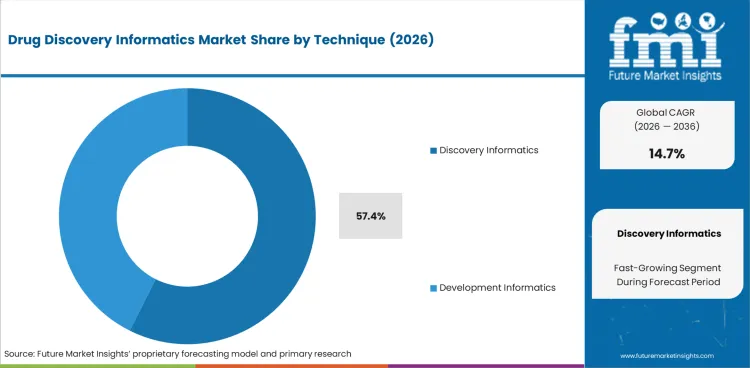
In 2026, discovery informatics is expected to account for 57.4% of the technique segment. This category covers computational tools deployed in the earliest stages of drug development, from target identification through hit-to-lead optimization. Molecular modelling, virtual screening, and ADMET prediction platforms are the primary workflow components. The shift toward AI-augmented discovery tools is increasing the strategic value of this segment, as pharmaceutical companies seek to reduce the number of physical compounds requiring synthesis and testing.
Insights into the In-house Mode Segment
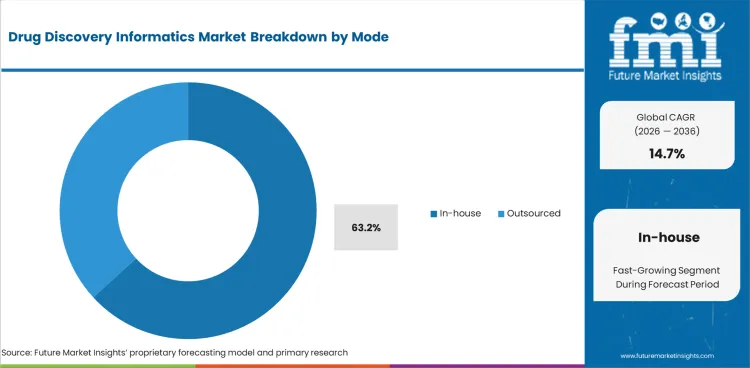
In 2026, in-house deployment is expected to hold 63.2% of the mode segment. Pharmaceutical companies with proprietary compound libraries and sensitive early-stage pipeline data prefer on-premise or private cloud deployment to protect intellectual property. The high per-user expenditure on informatics licenses and computational infrastructure reflects the strategic importance of in-house capabilities. Outsourced deployment is growing as cloud-based platforms reduce capital requirements and as contract research organizations expand their computational service offerings.
Drug Discovery Informatics Market Drivers, Restraints, and Opportunities
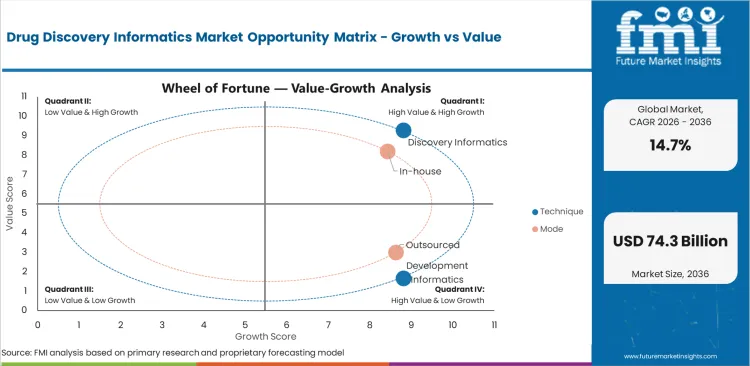
- AI and machine learning integration into drug discovery workflows is creating structural demand for advanced computational platforms across pharmaceutical R&D organizations.
- Data security concerns and the proprietary nature of compound libraries constrain the shift toward cloud-based and outsourced informatics models.
- Expansion of precision medicine programs and the growing complexity of biological targets are increasing R&D dependence on computational discovery tools.
The drug discovery informatics market is shaped by pharmaceutical R&D investment cycles, AI technology maturation, data governance requirements, and the evolving relationship between computational and experimental approaches in drug development.
AI and Machine Learning Integration
Demand reflects the pharmaceutical industry's adoption of AI-driven molecular modelling, virtual screening, and predictive ADMET tools. These platforms reduce the number of physical compounds requiring synthesis, shorten lead optimization timelines, and improve the probability of clinical success. Companies with validated AI platforms are capturing procurement share from traditional computational chemistry providers.
Data Security and Deployment Model Constraints
Adoption of cloud-based and outsourced informatics is constrained by the competitive sensitivity of early-stage drug discovery data. Pharmaceutical companies with proprietary compound libraries prefer on-premise or private cloud deployment to protect intellectual property, limiting the addressable market for SaaS-based informatics providers.
Precision Medicine and Target Complexity
Growth is supported by the shift toward biologics, gene therapies, and multi-target drug programs that require more sophisticated computational analysis than traditional small-molecule discovery. Sequence analysis, structural biology informatics, and network pharmacology tools are seeing increased demand as the pipeline complexity of major pharma companies expands.
Outsourced Discovery Model Expansion
The growth of contract research organizations offering computational discovery services is broadening the market for informatics platforms deployed in outsourced settings. CROs serving mid-size pharma and biotech clients require scalable, multi-tenant informatics infrastructure to support parallel discovery programs.
Analysis of Drug Discovery Informatics Market By Key Countries
.webp "Top Country Growth Comparison Drug Discovery Informatics Market Cagr (2026 2036)")
| Country | CAGR |
|---|---|
| Europe | 15% |
| South Korea | 14.8% |
| USA | 14.5% |
| UK | 14.3% |
| Japan | 14.2% |
Source: FMI analysis based on primary research and proprietary forecasting model
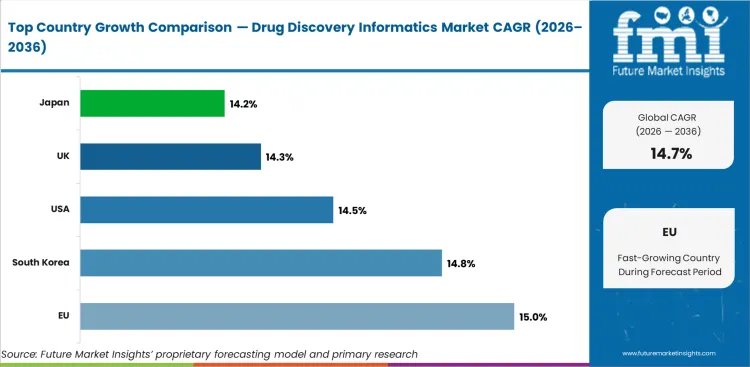
- EU leads growth at 15% CAGR, supported by biopharma ecosystem expansion and government-funded precision medicine programs.
- South Korea at 14.8% shows strong demand due to biotech sector investment and computational biology research infrastructure.
- USA (14.5%) and UK (14.3%) sustain growth through pharmaceutical R&D expansion and computational biology investment.
The global drug discovery informatics market is projected to grow at 14.7% CAGR from 2026 to 2036. The analysis covers more than 30 countries, with the following markets showing the strongest growth trajectories.
Demand Outlook for Drug Discovery Informatics Market in Europe
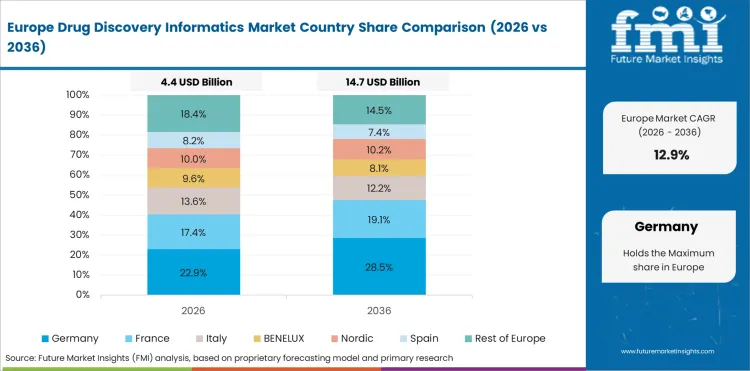
Europe is projected to grow at 15% through 2036, supported by biopharma ecosystem expansion and government-funded precision medicine programs.
- Expanding biopharma ecosystem drives demand for discovery informatics platforms.
- Government-funded precision medicine initiatives support computational research infrastructure.
- EMA regulatory framework increasingly recognizes computational evidence in submissions.
Future Outlook for Drug Discovery Informatics Market in South Korea
South Korea is projected to grow at 14.8% through 2036, supported by biotech sector investment and computational biology research infrastructure.
- Biotech sector investment expands demand for molecular modelling and screening tools.
- Government bio-health industry policy supports computational biology infrastructure.
- Growing contract research organization sector drives informatics platform deployment.
Opportunity Analysis of Drug Discovery Informatics Market in USA
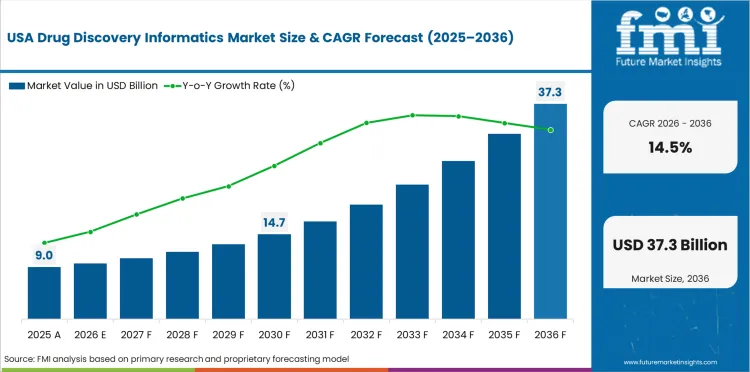
USA is projected to grow at 14.5% through 2036, supported by pharmaceutical R&D concentration and AI technology adoption.
- Concentration of major pharmaceutical R&D centers sustains highest per-capita informatics spend.
- AI technology adoption in drug discovery workflows is more advanced than in other regions.
- Venture capital funding supports informatics startup development and platform scaling.
In-depth Analysis of Drug Discovery Informatics Market in UK
UK is projected to grow at 14.3% through 2036, supported by life sciences strategy implementation and academic-industry collaboration.
- Life sciences strategy implementation drives public-private informatics investment.
- Academic-industry collaboration in computational drug discovery is well established.
- Genomics England and related programs generate data assets that require informatics platforms.
Sales Analysis of Drug Discovery Informatics Market in Japan
Japan is projected to grow at 14.2% through 2036, supported by pharmaceutical industry digitization and precision medicine national programs.
- Pharmaceutical industry digitization programs support informatics platform adoption.
- National precision medicine programs create demand for computational analysis tools.
- Strong domestic pharmaceutical manufacturing base sustains in-house informatics investment.
Competitive Landscape and Strategic Positioning
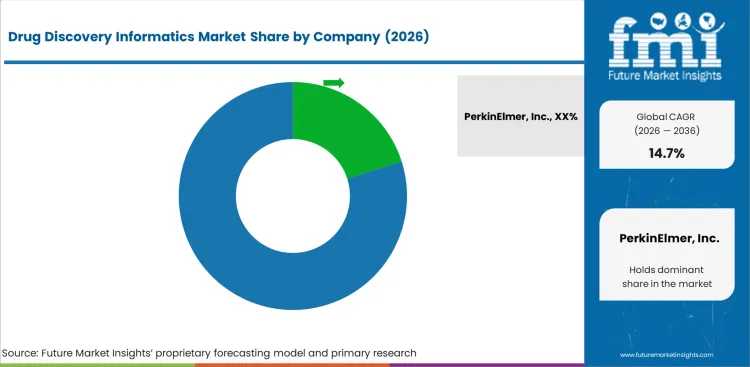
- PerkinElmer, Inc. leads with an estimated 20.1% share, supported by its integrated laboratory-to-informatics workflow across pharmaceutical R&D.
- Thermo Fisher Scientific and Certara offer complementary strengths in analytical instrumentation integration and pharmacometric modelling.
- AI-native startups including Insilico Medicine and Schrodinger are disrupting traditional computational chemistry workflows.
PerkinElmer, Inc. leads through its integrated portfolio of laboratory instruments, software platforms, and informatics tools that span the drug discovery workflow from assay development through lead optimization. The company's strength lies in its ability to connect experimental data generation with computational analysis in a unified environment.
Thermo Fisher Scientific offers informatics solutions integrated with its mass spectrometry, chromatography, and genomics instrumentation platforms. Certara specializes in pharmacometric modelling and regulatory science informatics, providing platforms used in clinical trial simulation and regulatory submission preparation.
Schrodinger, Inc. has established a strong position in physics-based molecular modelling, while Insilico Medicine has gained attention for its AI-driven drug discovery platform that spans target identification through clinical candidate nomination. Dassault Systemes BIOVIA provides enterprise-level scientific informatics platforms serving large pharmaceutical organizations.
Competitive dynamics are increasingly shaped by AI and machine learning capabilities, with traditional computational chemistry providers facing pressure from AI-native platforms that can demonstrate faster lead identification and improved prediction accuracy.
Key Companies in the Drug Discovery Informatics Market
Key global companies leading the drug discovery informatics market include:
- PerkinElmer, Inc. (USA), Thermo Fisher Scientific, Inc. (USA), Certara, L.P. (USA) hold leading positions through established manufacturing infrastructure and broad distribution networks.
- Collaborative Drug Discovery Inc. (USA), Novo Informatics (India), Schrodinger, Inc. (USA) serve regional markets with specialized product portfolios and local procurement relationships.
- IBM Watson Health (USA), Dassault Systemes BIOVIA (France), Insilico Medicine (Hong Kong), ChemAxon (Hungary) represent emerging participants with potential for future market positioning through technology and application specialization.
Competitive Benchmarking: Drug Discovery Informatics Market
| Company | AI/ML Platform Depth | Drug Pipeline Coverage | Data Integration | Global Pharma Access |
|---|---|---|---|---|
| PerkinElmer, Inc. | High | High | Strong | Global |
| Thermo Fisher Scientific, Inc. | High | High | Strong | Global |
| Certara, L.P. | High | High | Strong | Global |
| Collaborative Drug Discovery Inc. | Medium | Medium | Moderate | Regional |
| Novo Informatics | Medium | Medium | Moderate | Regional |
| Schrodinger, Inc. | Medium | Medium | Moderate | Regional |
| IBM Watson Health | Low | Medium | Low | Regional |
| Dassault Systemes BIOVIA | Low | Medium | Low | Regional |
| Insilico Medicine | Low | Medium | Low | Regional |
| ChemAxon | Low | Medium | Low | Regional |
Source: Future Market Insights competitive analysis, 2026.
Key Developments in Drug Discovery Informatics Market
- In 2025, PerkinElmer launched an AI-integrated molecular modelling platform designed to reduce lead optimization timelines for pharmaceutical R&D clients.
- In 2025, Schrodinger, Inc. announced a strategic partnership with a top-10 pharmaceutical company to deploy its physics-based computational platform across the partner's discovery pipeline.
Key Players in the Drug Discovery Informatics Market
Major Global Players
- PerkinElmer, Inc.
- Thermo Fisher Scientific, Inc.
- Certara, L.P.
- Collaborative Drug Discovery Inc.
- Novo Informatics
- Schrodinger, Inc.
- IBM Watson Health
Emerging Players/Startups
- Schrodinger, Inc.
- IBM Watson Health
- Dassault Systemes BIOVIA
- Insilico Medicine
- ChemAxon
Report Scope and Coverage
| Quantitative Units | USD 18.86 billion to USD 74.34 billion, at a CAGR of 14.7% |
|---|---|
| Market Definition | The drug discovery informatics market encompasses computational platforms, software tools, and data management systems used in pharmaceutical and biotechnology research and development. This includes ... |
| Regions Covered | North America, Latin America, Europe, East Asia, South Asia and Pacific, Middle East and Africa |
| Countries Covered | Europe, South Korea, USA, UK, Japan, 30 plus countries |
| Key Companies Profiled | PerkinElmer, Inc., Thermo Fisher Scientific, Inc., Certara, L.P., Collaborative Drug Discovery Inc., Novo Informatics, Schrodinger, Inc., IBM Watson Health, Dassault Systemes BIOVIA, Insilico Medicine, ChemAxon |
| Forecast Period | 2026 to 2036 |
| Approach | Hybrid bottom-up and top-down methodology starting with verified transaction data, projecting adoption velocity across segments and regions. |
Segmentation
Drug Discovery Informatics Market Market Segmented by Technique:
- Discovery Informatics
- Development Informatics
Drug Discovery Informatics Market Market Segmented by Mode:
- In-house
- Outsourced
Drug Discovery Informatics Market Market Segmented by Service:
- Molecular Modelling
- Sequence Analysis Platforms
- Docking
- Clinical Trial Data Management
- Other Services
Drug Discovery Informatics Market Market Segmented by End User:
- Pharmaceutical & Biotechnology Companies
- Academic Institutes
- Manufacturing
- Other End Users
Drug Discovery Informatics Market Market by Region:
- North America
- USA
- Canada
- Mexico
- Latin America
- Brazil
- Chile
- Rest of Latin America
- Western Europe
- Germany
- UK
- Italy
- Spain
- France
- Nordic
- BENELUX
- Rest of Western Europe
- Eastern Europe
- Russia
- Poland
- Hungary
- Balkan & Baltic
- Rest of Eastern Europe
- East Asia
- China
- Japan
- South Korea
- South Asia and Pacific
- India
- ASEAN
- Australia & New Zealand
- Rest of South Asia and Pacific
- Middle East & Africa
- Kingdom of Saudi Arabia
- Other GCC Countries
- Turkiye
- South Africa
- Other African Union
- Rest of Middle East & Africa
Research Sources and Bibliography
- 1. National Institutes of Health. (2025). NIH Report on Computational Approaches in Drug Discovery. NIH.
- 2. European Medicines Agency. (2024). EMA Reflection Paper on AI in Drug Development. EMA.
- 3. Organisation for Economic Co-operation and Development. (2025). OECD Health Working Paper: Digital Tools in Pharmaceutical R&D. OECD.
- 4. USA Food and Drug Administration. (2025). FDA Guidance on Computational Modelling in Drug Applications. FDA.
- 5. PerkinElmer, Inc. (2025). PerkinElmer Annual Report 2025: Discovery and Analytical Solutions. PerkinElmer.
This bibliography is provided for reader reference. The full Future Market Insights report contains the complete reference list with publication dates, URLs, and supporting data for all cited works.
This Report Answers
- Estimating the size of the market and revenue from 2026 to 2036.
- Segmentation analysis across technique, mode, service, end user.
- Insights about more than 30 regional markets.
- Assessment of the competitive landscape.
- Company profiling and strategic positioning analysis.
- Investment opportunity identification across key segments and regions.
- Supply chain and procurement structure analysis.
- Delivery of data in PDF and Excel formats.
Frequently Asked Questions
What is the global market demand for Drug Discovery Informatics in 2026?
In 2026, the global drug discovery informatics market is expected to be worth USD 18.86 billion.
How big will the Drug Discovery Informatics Market be in 2036?
By 2036, the drug discovery informatics market is expected to be worth USD 74.34 billion.
How much is demand for Drug Discovery Informatics expected to grow between 2026 and 2036?
Between 2026 and 2036, demand for drug discovery informatics is expected to grow at a CAGR of 14.7%.
Which technique segment is likely to lead globally by 2026?
Discovery Informatics is expected to account for 57.4% of the technique segment in 2026, reflecting increasing reliance on computational tools for target identification and lead optimization in pharma R&D pipelines.
What is causing demand to rise in Europe?
Europe is expected to grow at 15% CAGR through 2036, supported by biopharma ecosystem expansion and government-funded precision medicine programs.
What is causing demand to rise in South Korea?
South Korea is expected to grow at 14.8% CAGR through 2036, supported by biotech sector investment and computational biology research infrastructure.
What does this report mean by "Drug Discovery Informatics Market definition"?
The drug discovery informatics market encompasses computational platforms, software tools, and data management systems used in pharmaceutical and biotechnology research and development. This includes molecular modelling, sequence analysis, docking simulations, clinical trial data management, and AI-driven discovery workflows deployed across target identification, lead optimization, and preclinical development stages.
How does FMI make the Drug Discovery Informatics forecast and check it?
Forecasting models use a hybrid bottom-up and top-down approach, starting with verified transaction data and checking it against industry production statistics and manufacturer disclosures.
Preview the report firsthand - request a free sample
Get SampleGet the brochure for pricing and purchase details.
Get PDFTable of Content
- Executive Summary
- Global Market Outlook
- Demand-side Trends
- Supply-side Trends
- Technology Roadmap Analysis
- Analysis and Recommendations
- Market Overview
- Market Coverage / Taxonomy
- Market Definition / Scope / Limitations
- Research Methodology
- Chapter Orientation
- Analytical Lens and Working Hypotheses
- Market Structure, Signals, and Trend Drivers
- Benchmarking and Cross-market Comparability
- Market Sizing, Forecasting, and Opportunity Mapping
- Research Design and Evidence Framework
- Desk Research Programme (Secondary Evidence)
- Company Annual and Sustainability Reports
- Peer-reviewed Journals and Academic Literature
- Corporate Websites, Product Literature, and Technical Notes
- Earnings Decks and Investor Briefings
- Statutory Filings and Regulatory Disclosures
- Technical White Papers and Standards Notes
- Trade Journals, Industry Magazines, and Analyst Briefs
- Conference Proceedings, Webinars, and Seminar Materials
- Government Statistics Portals and Public Data Releases
- Press Releases and Reputable Media Coverage
- Specialist Newsletters and Curated Briefings
- Sector Databases and Reference Repositories
- FMI Internal Proprietary Databases and Historical Market Datasets
- Subscription Datasets and Paid Sources
- Social Channels, Communities, and Digital Listening Inputs
- Additional Desk Sources
- Expert Input and Fieldwork (Primary Evidence)
- Primary Modes
- Qualitative Interviews and Expert Elicitation
- Quantitative Surveys and Structured Data Capture
- Blended Approach
- Why Primary Evidence is Used
- Field Techniques
- Interviews
- Surveys
- Focus Groups
- Observational and In-context Research
- Social and Community Interactions
- Stakeholder Universe Engaged
- C-suite Leaders
- Board Members
- Presidents and Vice Presidents
- R&D and Innovation Heads
- Technical Specialists
- Domain Subject-matter Experts
- Scientists
- Physicians and Other Healthcare Professionals
- Governance, Ethics, and Data Stewardship
- Research Ethics
- Data Integrity and Handling
- Primary Modes
- Tooling, Models, and Reference Databases
- Desk Research Programme (Secondary Evidence)
- Data Engineering and Model Build
- Data Acquisition and Ingestion
- Cleaning, Normalisation, and Verification
- Synthesis, Triangulation, and Analysis
- Quality Assurance and Audit Trail
- Market Background
- Market Dynamics
- Drivers
- Restraints
- Opportunity
- Trends
- Scenario Forecast
- Demand in Optimistic Scenario
- Demand in Likely Scenario
- Demand in Conservative Scenario
- Opportunity Map Analysis
- Product Life Cycle Analysis
- Supply Chain Analysis
- Investment Feasibility Matrix
- Value Chain Analysis
- PESTLE and Porter’s Analysis
- Regulatory Landscape
- Regional Parent Market Outlook
- Production and Consumption Statistics
- Import and Export Statistics
- Market Dynamics
- Global Market Analysis 2021 to 2025 and Forecast, 2026 to 2036
- Historical Market Size Value (USD Million) Analysis, 2021 to 2025
- Current and Future Market Size Value (USD Million) Projections, 2026 to 2036
- Y-o-Y Growth Trend Analysis
- Absolute $ Opportunity Analysis
- Global Market Pricing Analysis 2021 to 2025 and Forecast 2026 to 2036
- Global Market Analysis 2021 to 2025 and Forecast 2026 to 2036, By Technique
- Introduction / Key Findings
- Historical Market Size Value (USD Million) Analysis By Technique , 2021 to 2025
- Current and Future Market Size Value (USD Million) Analysis and Forecast By Technique , 2026 to 2036
- Discovery Informatics
- Development Informatics
- Discovery Informatics
- Y-o-Y Growth Trend Analysis By Technique , 2021 to 2025
- Absolute $ Opportunity Analysis By Technique , 2026 to 2036
- Global Market Analysis 2021 to 2025 and Forecast 2026 to 2036, By Mode
- Introduction / Key Findings
- Historical Market Size Value (USD Million) Analysis By Mode, 2021 to 2025
- Current and Future Market Size Value (USD Million) Analysis and Forecast By Mode, 2026 to 2036
- In-house
- Outsourced
- In-house
- Y-o-Y Growth Trend Analysis By Mode, 2021 to 2025
- Absolute $ Opportunity Analysis By Mode, 2026 to 2036
- Global Market Analysis 2021 to 2025 and Forecast 2026 to 2036, By Service
- Introduction / Key Findings
- Historical Market Size Value (USD Million) Analysis By Service, 2021 to 2025
- Current and Future Market Size Value (USD Million) Analysis and Forecast By Service, 2026 to 2036
- Molecular Modelling
- Sequence Analysis Platforms
- Docking
- Clinical Trial Data Management
- Other Services
- Molecular Modelling
- Y-o-Y Growth Trend Analysis By Service, 2021 to 2025
- Absolute $ Opportunity Analysis By Service, 2026 to 2036
- Global Market Analysis 2021 to 2025 and Forecast 2026 to 2036, By End User
- Introduction / Key Findings
- Historical Market Size Value (USD Million) Analysis By End User, 2021 to 2025
- Current and Future Market Size Value (USD Million) Analysis and Forecast By End User, 2026 to 2036
- Pharmaceutical & Biotechnology Companies
- Academic Institutes
- Manufacturing
- Other End Users
- Pharmaceutical & Biotechnology Companies
- Y-o-Y Growth Trend Analysis By End User, 2021 to 2025
- Absolute $ Opportunity Analysis By End User, 2026 to 2036
- Global Market Analysis 2021 to 2025 and Forecast 2026 to 2036, By Region
- Introduction
- Historical Market Size Value (USD Million) Analysis By Region, 2021 to 2025
- Current Market Size Value (USD Million) Analysis and Forecast By Region, 2026 to 2036
- North America
- Latin America
- Western Europe
- Eastern Europe
- East Asia
- South Asia and Pacific
- Middle East & Africa
- Market Attractiveness Analysis By Region
- North America Market Analysis 2021 to 2025 and Forecast 2026 to 2036, By Country
- Historical Market Size Value (USD Million) Trend Analysis By Market Taxonomy, 2021 to 2025
- Market Size Value (USD Million) Forecast By Market Taxonomy, 2026 to 2036
- By Country
- USA
- Canada
- Mexico
- By Technique
- By Mode
- By Service
- By End User
- By Country
- Market Attractiveness Analysis
- By Country
- By Technique
- By Mode
- By Service
- By End User
- Key Takeaways
- Latin America Market Analysis 2021 to 2025 and Forecast 2026 to 2036, By Country
- Historical Market Size Value (USD Million) Trend Analysis By Market Taxonomy, 2021 to 2025
- Market Size Value (USD Million) Forecast By Market Taxonomy, 2026 to 2036
- By Country
- Brazil
- Chile
- Rest of Latin America
- By Technique
- By Mode
- By Service
- By End User
- By Country
- Market Attractiveness Analysis
- By Country
- By Technique
- By Mode
- By Service
- By End User
- Key Takeaways
- Western Europe Market Analysis 2021 to 2025 and Forecast 2026 to 2036, By Country
- Historical Market Size Value (USD Million) Trend Analysis By Market Taxonomy, 2021 to 2025
- Market Size Value (USD Million) Forecast By Market Taxonomy, 2026 to 2036
- By Country
- Germany
- UK
- Italy
- Spain
- France
- Nordic
- BENELUX
- Rest of Western Europe
- By Technique
- By Mode
- By Service
- By End User
- By Country
- Market Attractiveness Analysis
- By Country
- By Technique
- By Mode
- By Service
- By End User
- Key Takeaways
- Eastern Europe Market Analysis 2021 to 2025 and Forecast 2026 to 2036, By Country
- Historical Market Size Value (USD Million) Trend Analysis By Market Taxonomy, 2021 to 2025
- Market Size Value (USD Million) Forecast By Market Taxonomy, 2026 to 2036
- By Country
- Russia
- Poland
- Hungary
- Balkan & Baltic
- Rest of Eastern Europe
- By Technique
- By Mode
- By Service
- By End User
- By Country
- Market Attractiveness Analysis
- By Country
- By Technique
- By Mode
- By Service
- By End User
- Key Takeaways
- East Asia Market Analysis 2021 to 2025 and Forecast 2026 to 2036, By Country
- Historical Market Size Value (USD Million) Trend Analysis By Market Taxonomy, 2021 to 2025
- Market Size Value (USD Million) Forecast By Market Taxonomy, 2026 to 2036
- By Country
- China
- Japan
- South Korea
- By Technique
- By Mode
- By Service
- By End User
- By Country
- Market Attractiveness Analysis
- By Country
- By Technique
- By Mode
- By Service
- By End User
- Key Takeaways
- South Asia and Pacific Market Analysis 2021 to 2025 and Forecast 2026 to 2036, By Country
- Historical Market Size Value (USD Million) Trend Analysis By Market Taxonomy, 2021 to 2025
- Market Size Value (USD Million) Forecast By Market Taxonomy, 2026 to 2036
- By Country
- India
- ASEAN
- Australia & New Zealand
- Rest of South Asia and Pacific
- By Technique
- By Mode
- By Service
- By End User
- By Country
- Market Attractiveness Analysis
- By Country
- By Technique
- By Mode
- By Service
- By End User
- Key Takeaways
- Middle East & Africa Market Analysis 2021 to 2025 and Forecast 2026 to 2036, By Country
- Historical Market Size Value (USD Million) Trend Analysis By Market Taxonomy, 2021 to 2025
- Market Size Value (USD Million) Forecast By Market Taxonomy, 2026 to 2036
- By Country
- Kingdom of Saudi Arabia
- Other GCC Countries
- Turkiye
- South Africa
- Other African Union
- Rest of Middle East & Africa
- By Technique
- By Mode
- By Service
- By End User
- By Country
- Market Attractiveness Analysis
- By Country
- By Technique
- By Mode
- By Service
- By End User
- Key Takeaways
- Key Countries Market Analysis
- USA
- Pricing Analysis
- Market Share Analysis, 2025
- By Technique
- By Mode
- By Service
- By End User
- Canada
- Pricing Analysis
- Market Share Analysis, 2025
- By Technique
- By Mode
- By Service
- By End User
- Mexico
- Pricing Analysis
- Market Share Analysis, 2025
- By Technique
- By Mode
- By Service
- By End User
- Brazil
- Pricing Analysis
- Market Share Analysis, 2025
- By Technique
- By Mode
- By Service
- By End User
- Chile
- Pricing Analysis
- Market Share Analysis, 2025
- By Technique
- By Mode
- By Service
- By End User
- Germany
- Pricing Analysis
- Market Share Analysis, 2025
- By Technique
- By Mode
- By Service
- By End User
- UK
- Pricing Analysis
- Market Share Analysis, 2025
- By Technique
- By Mode
- By Service
- By End User
- Italy
- Pricing Analysis
- Market Share Analysis, 2025
- By Technique
- By Mode
- By Service
- By End User
- Spain
- Pricing Analysis
- Market Share Analysis, 2025
- By Technique
- By Mode
- By Service
- By End User
- France
- Pricing Analysis
- Market Share Analysis, 2025
- By Technique
- By Mode
- By Service
- By End User
- India
- Pricing Analysis
- Market Share Analysis, 2025
- By Technique
- By Mode
- By Service
- By End User
- ASEAN
- Pricing Analysis
- Market Share Analysis, 2025
- By Technique
- By Mode
- By Service
- By End User
- Australia & New Zealand
- Pricing Analysis
- Market Share Analysis, 2025
- By Technique
- By Mode
- By Service
- By End User
- China
- Pricing Analysis
- Market Share Analysis, 2025
- By Technique
- By Mode
- By Service
- By End User
- Japan
- Pricing Analysis
- Market Share Analysis, 2025
- By Technique
- By Mode
- By Service
- By End User
- South Korea
- Pricing Analysis
- Market Share Analysis, 2025
- By Technique
- By Mode
- By Service
- By End User
- Russia
- Pricing Analysis
- Market Share Analysis, 2025
- By Technique
- By Mode
- By Service
- By End User
- Poland
- Pricing Analysis
- Market Share Analysis, 2025
- By Technique
- By Mode
- By Service
- By End User
- Hungary
- Pricing Analysis
- Market Share Analysis, 2025
- By Technique
- By Mode
- By Service
- By End User
- Kingdom of Saudi Arabia
- Pricing Analysis
- Market Share Analysis, 2025
- By Technique
- By Mode
- By Service
- By End User
- Turkiye
- Pricing Analysis
- Market Share Analysis, 2025
- By Technique
- By Mode
- By Service
- By End User
- South Africa
- Pricing Analysis
- Market Share Analysis, 2025
- By Technique
- By Mode
- By Service
- By End User
- USA
- Market Structure Analysis
- Competition Dashboard
- Competition Benchmarking
- Market Share Analysis of Top Players
- By Regional
- By Technique
- By Mode
- By Service
- By End User
- Competition Analysis
- Competition Deep Dive
- PerkinElmer, Inc.
- Overview
- Product Portfolio
- Profitability by Market Segments (Product/Age /Sales Channel/Region)
- Sales Footprint
- Strategy Overview
- Marketing Strategy
- Product Strategy
- Channel Strategy
- Thermo Fisher Scientific, Inc.
- Certara, L.P.
- Collaborative Drug Discovery Inc.
- Novo Informatics
- Schrödinger, Inc.
- IBM Watson Health
- Dassault Systèmes BIOVIA
- Insilico Medicine
- ChemAxon
- Other Key Players
- PerkinElmer, Inc.
- Competition Deep Dive
- Assumptions & Acronyms Used


