

- Industry Size (2026): USD 3.4 Bn
- Forecast (2036): USD 6.4 Bn
- CAGR: 6.5%
Tablet Coating Machine Market Forecast and Outlook 2026 to 2036
The tablet coating machine market is projected to reach USD 6.4 billion by 2036, growing at a CAGR of 6.5% from its 2026 value of USD 3.4 billion. Commercial performance in this sector will be influenced by the need for stringent pricing discipline, as competition from low-cost producers may put pressure on margins. Buyer leverage is expected to increase, particularly among large pharmaceutical companies that demand high-quality, cost-efficient solutions. Volume predictability remains a challenge, as fluctuations in demand for pharmaceutical products and regulatory changes can impact the pace of growth.
Companies must navigate these challenges by managing operational costs and focusing on technological differentiation, as innovation in coating technologies may become a key competitive factor. While growth is expected, the market will require companies to balance short-term pricing pressures with long-term investments in product development and customer relationships, ensuring continued relevance in an increasingly cost-sensitive environment.
Quick Stats for the Tablet Coating Machine Market
- Tablet Coating Machine Market Value (2026): USD 3.4 billion
- Tablet Coating Machine Market Forecast Value (2036): USD 6.4 billion
- Tablet Coating Machine Market Global Forecast CAGR 2026 to 2036: 6.5%
- Tablet Coating Machine Market Leading Segment: Perforated Pan Coaters (66%)
- Key Growth Regions in Tablet Coating Machine Market: India
- Top Players in Tablet Coating Machine Market: IMA Group, GEA Group, Glatt, Freund-Vector, L.B. Bohle, Romaco, ACG Engineering, Thomas Engineering, O'Hara Technologies, Kikusui Seisakusho
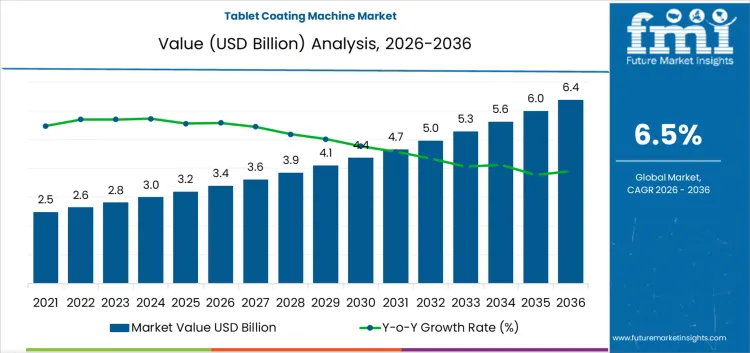
What is the Long-Term Value Accumulation Curve for the Tablet Coating Machine Market through 2036?
The long-term value accumulation curve of the tablet coating machine market shows a steady and consistent rise over the forecast period, driven by the growing pharmaceutical industry and technological advancements in coating technologies. In the initial years of the forecast (2026 to 2028), the market will experience moderate growth, with values increasing from USD 3.4 billion to USD 3.9 billion. This early phase of growth reflects the ongoing demand for efficient tablet coating solutions in the pharmaceutical sector, particularly for improved coating uniformity and the development of controlled-release drugs.
The growth rate will begin to accelerate slightly from 2029 onwards, with the market reaching USD 4.4 billion in 2030. During this period, the technological shift toward more advanced, automated coating machines and an increased focus on high-quality drug delivery will be key drivers. By 2036, the market will reach USD 6.4 billion, demonstrating the long-term accumulation of value as the adoption of new technologies becomes widespread, particularly in emerging markets with expanding pharmaceutical manufacturing capacities.
The long-term accumulation curve reflects a consistent growth trend, driven not only by increasing demand for pharmaceutical products but also by technological innovations that allow for more efficient, customizable, and sustainable coating processes. This will lead to steady increases in market value, reinforcing the importance of tablet coating machines in modern drug production.
Tablet Coating Machine Market Key Takeaways
| Metric | Value |
|---|---|
| Industry Sales Value (2026) | USD 3.4 billion |
| Industry Forecast Value (2036) | USD 6.4 billion |
| Industry Forecast CAGR 2026 to 2036 | 6.5% |
What Is Driving the Tablet Coating Machine Market?
Historically, the tablet coating machine market developed as pharmaceutical and nutraceutical manufacturers sought consistent surface finishes, taste masking, and controlled release profiles for solid dosage forms. Early coating methods relied on manual pans and simple spray systems that lacked uniform distribution of coating solution, leading to variability in film thickness and color. As production volumes grew and regulatory expectations for product uniformity tightened, automated coating machines with controlled spray nozzles, heated air systems, and rotating drums became standard.
These early systems were adopted primarily by large contract manufacturers and branded drug producers where compliance with pharmacopoeial standards and visual quality mattered. Development of aqueous and solvent-based coatings further shaped equipment capability requirements. Manufacturers evaluated machine performance by measuring coating uniformity, drying efficiency, and impact on tablet integrity, establishing baseline specifications for equipment. This period clarified the value of precision coating technology in reducing rejects, improving patient acceptability, and enabling formulation complexity beyond immediate-release products.
Future demand for tablet coating machines is expected to be shaped by growth in modified-release therapies, biologics formulated as solid dosage, and increasing production in emerging markets. Growth factors include expansion of controlled-release and targeted delivery products that depend on multi-layer coatings and precise film application, elevating equipment requirements for process control and scalability. Advances in process analytical technologies and machine-integrated sensors will enable real-time monitoring of coating parameters, reducing variation and supporting quality-by-design frameworks.
Manufacturers are also expected to invest in flexible machines that accommodate small-batch and personalized medicine production without sacrificing throughput. Sustainability considerations will influence equipment design, with greater focus on energy efficiency, reduced solvent usage, and closed-loop air handling. Barriers include capital cost for advanced systems and operator training for sophisticated controls. Long-term growth will depend on alignment between machine capabilities, regulatory expectations, and the evolving landscape of solid dosage form complexity across global pharmaceutical and supplement production.
What are the Key Segments in the Tablet Coating Machine Market?
The Tablet Coating Machine market is segmented by coating type and pan type. Coating types include film coating systems, enteric coating systems, sugar coating systems, and others, with film coating systems holding the largest market share at 62%. Pan types include perforated pan coaters, non-perforated pan coaters, and continuous coaters, with perforated pan coaters leading the market at 66%. The market is driven by the growing demand for coated tablets in the pharmaceutical and nutraceutical industries, where coating is essential for improving tablet stability, appearance, and controlled release of active ingredients. Key regions driving growth include North America, Europe, and Asia Pacific, where pharmaceutical manufacturing is expanding and technological advancements in coating systems are being adopted.
What is Driving Growth in the Film Coating Systems Segment?
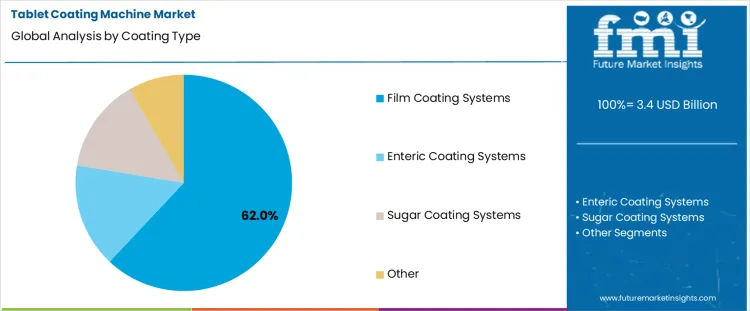
Film coating systems lead the coating type segment in the Tablet Coating Machine market, accounting for 62% of the market share. This growth is primarily driven by the advantages of film coating, including its ability to improve the stability, appearance, and functionality of tablets. Film coating systems are widely used in pharmaceutical manufacturing for tablets that require controlled release, protection from environmental factors like moisture and light, or masking unpleasant tastes or odors.
Additionally, film coatings are more efficient and cost-effective compared to traditional sugar coatings, making them the preferred choice in modern tablet production. The growing demand for oral dosage forms, particularly in the pharmaceutical sector, and the increasing emphasis on patient compliance and ease of administration, are further driving the adoption of film coating systems. As the pharmaceutical industry continues to innovate in drug delivery systems, film coating systems are expected to remain the dominant technology, particularly in regions like North America and Europe, where the demand for high-quality, precise coating systems is high.
What is Driving the Demand for Perforated Pan Coaters in the Pan Type Segment?
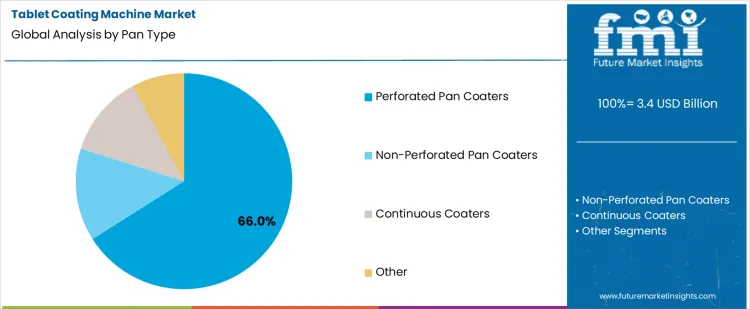
Perforated pan coaters are the dominant pan type in the Tablet Coating Machine market, holding 66% of the market share. This is largely due to their effectiveness in achieving uniform coating on tablets, which is crucial for ensuring consistent drug release, stability, and appearance. Perforated pan coaters allow for better air circulation, making the coating process more efficient and uniform by enhancing the drying of the coating material during the process. These coaters are particularly favored in pharmaceutical and nutraceutical tablet production, where precision in coating thickness and uniformity is essential for achieving the desired therapeutic outcomes.
Perforated pan coaters also offer flexibility in handling different types of coatings, such as film, sugar, and enteric coatings, further driving their demand. As the demand for high-quality tablets increases, particularly with the rise of complex formulations, perforated pan coaters are expected to maintain their dominance in the market. The adoption of advanced coating technologies in regions with strong pharmaceutical manufacturing, such as North America, Europe, and parts of Asia Pacific, will continue to support the growth of this segment.
What are the Key Dynamics in the Tablet Coating Machine Market?
The tablet coating machine market is experiencing significant growth due to the increasing demand for high-quality pharmaceutical tablets and capsules. Tablet coating machines are essential in the pharmaceutical industry, where they are used to apply coatings on tablets for purposes such as improving taste, controlling the release of active ingredients, protecting the drug from environmental factors, and enhancing patient compliance. The market is driven by the rising demand for oral solid dosage forms, advancements in coating technologies, and the growing emphasis on pharmaceutical product quality and patient convenience. Additionally, the trend toward more personalized medicine and the increasing focus on sustainability are fueling innovation and market growth, as manufacturers seek to develop coating solutions that are both effective and environmentally friendly.
What are the Key Drivers of Growth in the Tablet Coating Machine Market?
The growth of the tablet coating machine market is primarily driven by the increasing demand for oral solid dosage forms, which are favored for their convenience, precise dosage, and ease of administration. As the pharmaceutical industry continues to grow, manufacturers are looking for ways to enhance the performance of tablets through advanced coating techniques, which help improve the stability, bioavailability, and controlled release of medications. The rise in demand for specialized coatings, such as enteric coatings for targeted drug delivery and sustained-release coatings for long-lasting effects, is also contributing to market growth. The growing focus on improving patient compliance and the aesthetics of tablets, including the need for coatings that make pills easier to swallow, is another key driver. Additionally, advancements in coating technologies, such as film coating and sugar coating, are increasing the efficiency and quality of tablet production, driving further adoption of tablet coating machines in the pharmaceutical industry.
What are the Key Restraints in the Tablet Coating Machine Market?
Despite its growth prospects, the tablet coating machine market faces several challenges. One of the main restraints is the high cost of advanced tablet coating machines, which may be prohibitive for smaller pharmaceutical companies or manufacturers operating with limited budgets. The complexity of these machines, which often require specialized installation and training, also adds to the initial investment. Additionally, the maintenance and operational costs associated with tablet coating machines can be significant, particularly when high throughput and continuous production are required. Another challenge is the regulatory scrutiny and compliance requirements for pharmaceutical manufacturing, which can slow down the adoption of new coating technologies or require additional certifications and validation processes. Furthermore, the need for precision and consistency in coating thickness and uniformity can be difficult to achieve with some older or less advanced machines, potentially limiting their effectiveness and impacting product quality.
What are the Key Trends in the Tablet Coating Machine Market?
Several key trends are shaping the tablet coating machine market. One significant trend is the increasing integration of automation and digital technologies in tablet coating machines, enabling manufacturers to enhance precision, reduce human error, and improve production efficiency. The use of real-time monitoring systems, sensors, and feedback loops is helping to optimize coating processes and ensure consistent quality. Another trend is the growing demand for eco-friendly and sustainable coatings, which is driving the development of more environmentally conscious tablet coating solutions.
Manufacturers are increasingly focusing on reducing solvent emissions and using natural, biodegradable ingredients in their coatings. Additionally, the trend toward personalized medicine is pushing the demand for tablet coating machines that can handle small batch production and customized formulations. Finally, there is a rising focus on multifunctional coating systems, which can be used for various types of coatings, such as enteric, film, and sustained-release coatings, making them more versatile and cost-effective for manufacturers. These trends are expected to further drive innovation and demand for tablet coating machines in the pharmaceutical sector.
What is the Country-Wise Analysis of the Tablet Coating Machine Market?
The tablet coating machine market is growing as the pharmaceutical industry increasingly demands efficient and precise coating solutions for tablet production. Tablet coating machines are essential for the pharmaceutical industry to apply protective coatings, control drug release, and improve the appearance and taste of tablets. The market is being driven by the growing pharmaceutical production, increasing consumer demand for oral dosage forms, and the rising focus on quality control in manufacturing processes. Countries like India, China, Vietnam, Indonesia, and Saudi Arabia are seeing significant growth in this market, driven by expanding pharmaceutical sectors, increasing healthcare needs, and government initiatives to enhance drug production capacities.
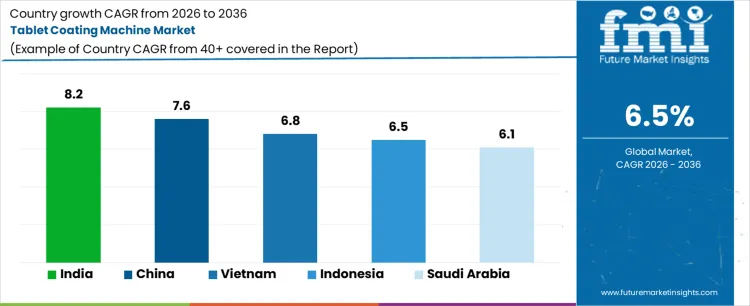
| Country | CAGR (%) |
|---|---|
| India | 8.2 |
| China | 7.6 |
| Vietnam | 6.8 |
| Indonesia | 6.5 |
| Saudi Arabia | 6.1 |
What is Driving the Growth of the Tablet Coating Machine Market in India?
India’s tablet coating machine market is growing at a CAGR of 8.2%, the highest among the countries analyzed. India’s rapidly expanding pharmaceutical industry, which is one of the largest in the world, is driving the demand for advanced tablet coating solutions. As the country increases its production of generic medicines and pharmaceutical exports, the need for high-quality tablet coating machines to meet international standards is rising. India’s strong pharmaceutical manufacturing base, along with government initiatives to boost healthcare and industrial infrastructure, is further contributing to market growth. With the growing demand for oral dosage forms and the rising focus on quality control and manufacturing efficiency, the demand for tablet coating machines in India is expected to continue to grow.
How is the Tablet Coating Machine Market Performing in China?
China’s tablet coating machine market is growing at a CAGR of 7.6%. As one of the largest pharmaceutical manufacturing markets globally, China is experiencing significant demand for tablet coating machines to meet the needs of its growing pharmaceutical sector. The country’s focus on improving drug quality, increasing the production of generic drugs, and expanding its pharmaceutical exports are driving the market for coating equipment. Additionally, China’s increasing investments in pharmaceutical manufacturing technology and the rising demand for oral dosage forms are further contributing to market growth. As China’s pharmaceutical industry continues to modernize and expand, the demand for advanced coating machines is expected to rise steadily.
What Factors are Shaping the Tablet Coating Machine Market in Vietnam?
Vietnam’s tablet coating machine market is growing at a CAGR of 6.8%. The growth in Vietnam is largely driven by the expansion of its pharmaceutical industry and increasing local production of oral dosage forms. As the pharmaceutical sector in Vietnam grows, there is an increasing need for advanced tablet coating machines to improve production efficiency and product quality. The country’s growing investments in pharmaceutical manufacturing infrastructure, along with the rising demand for affordable medicines, are contributing to market growth. As Vietnam continues to focus on improving manufacturing standards and complying with international regulations, the demand for tablet coating machines is expected to increase, further boosting market expansion.
How is the Tablet Coating Machine Market Evolving in Indonesia?
Indonesia’s tablet coating machine market is growing at a CAGR of 6.5%. The market is driven by the country’s growing pharmaceutical sector, which is increasingly focused on improving production quality and expanding local drug manufacturing capabilities. With the rising demand for oral tablets and controlled-release formulations, there is a growing need for efficient and reliable tablet coating solutions. Indonesia’s pharmaceutical industry is modernizing and adopting advanced manufacturing technologies, which is further supporting the demand for tablet coating machines. The government’s focus on improving the healthcare sector and drug production capabilities is expected to drive steady growth in the tablet coating machine market in Indonesia.
What is Contributing to the Growth of the Tablet Coating Machine Market in Saudi Arabia?
Saudi Arabia’s tablet coating machine market is growing at a CAGR of 6.1%. The growth is driven by the country’s expanding pharmaceutical industry, which is increasingly focused on improving local drug production and ensuring high-quality manufacturing standards. Saudi Arabia’s growing healthcare sector, combined with the rising demand for pharmaceutical products and oral dosage forms, is fueling the need for efficient tablet coating solutions. The government’s efforts to enhance local pharmaceutical production and improve healthcare infrastructure are contributing to market growth. As the pharmaceutical sector in Saudi Arabia continues to expand and modernize, the demand for tablet coating machines is expected to increase, supporting further market development.
What is the Competitive Landscape for the Tablet Coating Machine Market?
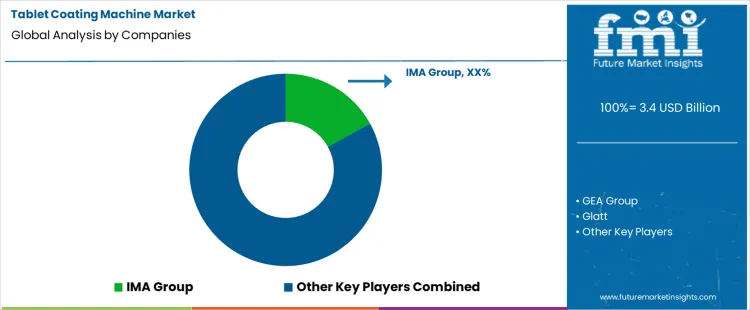
The tablet coating machine market is growing rapidly as the pharmaceutical industry demands high-performance equipment for precise coating applications, particularly for tablets, to enhance product stability, appearance, and efficacy. IMA Group leads the market with its advanced tablet coating systems, providing customizable solutions for a wide range of pharmaceutical needs. Known for its high efficiency, precision, and flexibility, IMA Group’s products cater to both small and large-scale production environments. GEA Group is a key player, offering state-of-the-art tablet coating machines that prioritize uniform coating, optimized efficiency, and minimal solvent use.
GEA’s equipment is widely used for the production of coated tablets in the pharmaceutical and nutraceutical industries. Glatt also competes in the market with its robust and innovative tablet coating machines, emphasizing ease of operation, efficiency, and precision. The company’s technology is particularly valued in the pharmaceutical sector for ensuring consistent coating and precise control of the coating process.
Freund-Vector, known for its expertise in solid dose processing, provides high-quality coating machines with enhanced flexibility, making them ideal for diverse tablet formulations. L.B. Bohle focuses on offering tablet coating systems that combine high throughput and quality, ensuring a seamless operation for large-scale pharmaceutical production. Romaco offers specialized tablet coating solutions, combining state-of-the-art technology and efficiency to meet the stringent requirements of the pharmaceutical industry.
ACG Engineering delivers versatile tablet coating machines that ensure uniform coating and high productivity, while Thomas Engineering and O’Hara Technologies cater to niche applications with innovative, customizable machines that focus on ease of use and flexibility. Kikusui Seisakusho contributes with reliable and efficient tablet coating systems, ensuring uniform application and meeting industry standards.
To stay competitive in the tablet coating machine market, companies are focusing on product innovation, efficiency improvements, and customization to meet the evolving needs of the pharmaceutical industry. IMA Group continues to lead by enhancing its tablet coating systems with automated processes, reducing production time and ensuring uniformity in coating applications. GEA Group is investing in improving the sustainability of its tablet coating machines by reducing energy consumption and solvent use, catering to the increasing demand for eco-friendly solutions.
Glatt focuses on improving the user interface and control systems in its coating machines to offer greater precision and flexibility. Freund-Vector is advancing its technology by integrating more sophisticated coating techniques that improve consistency and reduce operational costs. L.B. Bohle continues to innovate by providing customizable machines that allow for easy scaling in pharmaceutical production lines. Romaco is enhancing its systems with features that increase throughput and reduce downtime, ensuring high productivity in tablet coating processes.
ACG Engineering is emphasizing flexibility and adaptability in its machines, offering customizable features for various tablet formulations. Thomas Engineering and O'Hara Technologies are improving the user-friendliness and scalability of their machines to cater to both small and large-scale manufacturing environments. Kikusui Seisakusho focuses on creating reliable, cost-effective solutions that meet the growing demand for high-quality tablet coating in the pharmaceutical industry. These strategies ensure that these companies remain at the forefront of the rapidly growing tablet coating machine market, meeting the industry's increasing demand for efficiency, precision, and sustainability.
Key Players of the Tablet Coating Machine Market
- IMA Group
- GEA Group
- Glatt
- Freund-Vector
- L.B. Bohle
- Romaco
- ACG Engineering
- Thomas Engineering
- O'Hara Technologies
- Kikusui Seisakusho
Scope of the Report
| Items | Values |
|---|---|
| Quantitative Units (2026) | USD Billion |
| Coating Type | Film Coating Systems, Enteric Coating Systems, Sugar Coating Systems, Other |
| Pan Type | Perforated Pan Coaters, Non-Perforated Pan Coaters, Continuous Coaters, Other |
| Batch Size | Up to 50 kg, 50-250 kg, Above 250 kg, Other |
| Sales Channel | Direct OEM Sales, Distributors, Process or Plant Integrators, Other |
| Companies | IMA Group, GEA Group, Glatt, Freund-Vector, L.B. Bohle, Romaco, ACG Engineering, Thomas Engineering, O'Hara Technologies, Kikusui Seisakusho |
| Regions Covered | North America, Latin America, Western Europe, Eastern Europe, South Asia and Pacific, East Asia, Middle East & Africa |
| Countries Covered | United States, Canada, Mexico, Brazil, Argentina, Germany, France, United Kingdom, Italy, Spain, Netherlands, China, India, Japan, South Korea, ANZ, GCC Countries, South Africa |
| Additional Attributes | Dollar by sales by coating type, pan type, batch size, and sales channel. Includes market trends towards automation, regulatory compliance, cost-effectiveness, and the role of tablet coating machines in enhancing pharmaceutical manufacturing processes. |
Tablet Coating Machine Market Segmentation
By Coating Type:
- Film Coating Systems
- Enteric Coating Systems
- Sugar Coating Systems
- Other
By Pan Type:
- Perforated Pan Coaters
- Non-Perforated Pan Coaters
- Continuous Coaters
- Other
By Batch Size:
- Up to 50 kg
- 50-250 kg
- Above 250 kg
- Other
By Sales Channel:
- Direct OEM Sales
- Distributors
- Process or Plant Integrators
- Other
By Region:
- Asia Pacific
- China
- Japan
- India
- Australia & New Zealand
- ASEAN
- Rest of Asia Pacific
- Europe
- Germany
- United Kingdom
- France
- Italy
- Spain
- Nordic
- BENELUX
- Rest of Europe
- North America
- United States
- Canada
- Mexico
- Latin America
- Brazil
- Argentina
- Rest of Latin America
- Middle East & Africa
- Kingdom of Saudi Arabia
- Other GCC Countries
- South Africa
- Rest of Middle East & Africa
Bibliography
- International Organization for Standardization. (2023). ISO 13849-1: Safety of machinery-Safety-related parts of control systems-General principles for design. International Organization for Standardization.
- European Committee for Standardization. (2024). EN 60204-1: Safety of machinery-Electrical equipment of machines-Part 1: General requirements. CEN.
- U.S. Food and Drug Administration. (2024). Current Good Manufacturing Practice (CGMP) regulations for pharmaceutical manufacturing equipment, including coating systems. U.S. Department of Health and Human Services.
- International Society for Pharmaceutical Engineering. (2023). ISPE good practice guide: Equipment lifecycle management in pharmaceutical manufacturing. ISPE.
- World Health Organization. (2023). Annex 2: WHO good manufacturing practices for pharmaceutical products-Main principles (TRS No. 1025). World Health Organization.
Frequently Asked Questions
How big is the tablet coating machine market in 2026?
The global tablet coating machine market is estimated to be valued at USD 3.4 billion in 2026.
What will be the size of tablet coating machine market in 2036?
The market size for the tablet coating machine market is projected to reach USD 6.4 billion by 2036.
How much will be the tablet coating machine market growth between 2026 and 2036?
The tablet coating machine market is expected to grow at a 6.5% CAGR between 2026 and 2036.
What are the key product types in the tablet coating machine market?
The key product types in tablet coating machine market are film coating systems, enteric coating systems, sugar coating systems and other.
Which pan type segment to contribute significant share in the tablet coating machine market in 2026?
In terms of pan type, perforated pan coaters segment to command 66.0% share in the tablet coating machine market in 2026.
Preview the report firsthand - request a free sample
Get SampleGet the brochure for pricing and purchase details.
Get PDFTable of Content
- Executive Summary
- Global Market Outlook
- Demand-side Trends
- Supply-side Trends
- Technology Roadmap Analysis
- Analysis and Recommendations
- Market Overview
- Market Coverage / Taxonomy
- Market Definition / Scope / Limitations
- Market Background
- Market Dynamics
- Drivers
- Restraints
- Opportunity
- Trends
- Scenario Forecast
- Demand in Optimistic Scenario
- Demand in Likely Scenario
- Demand in Conservative Scenario
- Opportunity Map Analysis
- Product Life Cycle Analysis
- Supply Chain Analysis
- Investment Feasibility Matrix
- Value Chain Analysis
- PESTLE and Porter’s Analysis
- Regulatory Landscape
- Regional Parent Market Outlook
- Production and Consumption Statistics
- Import and Export Statistics
- Market Dynamics
- Global Market Analysis 2021 to 2025 and Forecast, 2026 to 2036
- Historical Market Size Value (USD Million) Analysis, 2021 to 2025
- Current and Future Market Size Value (USD Million) Projections, 2026 to 2036
- Y-o-Y Growth Trend Analysis
- Absolute $ Opportunity Analysis
- Global Market Pricing Analysis 2021 to 2025 and Forecast 2026 to 2036
- Global Market Analysis 2021 to 2025 and Forecast 2026 to 2036, By Coating Type
- Introduction / Key Findings
- Historical Market Size Value (USD Million) Analysis By Coating Type , 2021 to 2025
- Current and Future Market Size Value (USD Million) Analysis and Forecast By Coating Type , 2026 to 2036
- Film Coating Systems
- Enteric Coating Systems
- Sugar Coating Systems
- Other
- Film Coating Systems
- Y-o-Y Growth Trend Analysis By Coating Type , 2021 to 2025
- Absolute $ Opportunity Analysis By Coating Type , 2026 to 2036
- Global Market Analysis 2021 to 2025 and Forecast 2026 to 2036, By Pan Type
- Introduction / Key Findings
- Historical Market Size Value (USD Million) Analysis By Pan Type, 2021 to 2025
- Current and Future Market Size Value (USD Million) Analysis and Forecast By Pan Type, 2026 to 2036
- Perforated Pan Coaters
- Non-Perforated Pan Coaters
- Continuous Coaters
- Other
- Perforated Pan Coaters
- Y-o-Y Growth Trend Analysis By Pan Type, 2021 to 2025
- Absolute $ Opportunity Analysis By Pan Type, 2026 to 2036
- Global Market Analysis 2021 to 2025 and Forecast 2026 to 2036, By Batch Size
- Introduction / Key Findings
- Historical Market Size Value (USD Million) Analysis By Batch Size, 2021 to 2025
- Current and Future Market Size Value (USD Million) Analysis and Forecast By Batch Size, 2026 to 2036
- Up to 50 kg
- 50–250 kg
- Above 250 kg
- Other
- Up to 50 kg
- Y-o-Y Growth Trend Analysis By Batch Size, 2021 to 2025
- Absolute $ Opportunity Analysis By Batch Size, 2026 to 2036
- Global Market Analysis 2021 to 2025 and Forecast 2026 to 2036, By Sales Channel
- Introduction / Key Findings
- Historical Market Size Value (USD Million) Analysis By Sales Channel, 2021 to 2025
- Current and Future Market Size Value (USD Million) Analysis and Forecast By Sales Channel, 2026 to 2036
- Direct OEM Sales
- Distributors
- Process or Plant Integrators
- Other
- Direct OEM Sales
- Y-o-Y Growth Trend Analysis By Sales Channel, 2021 to 2025
- Absolute $ Opportunity Analysis By Sales Channel, 2026 to 2036
- Global Market Analysis 2021 to 2025 and Forecast 2026 to 2036, By Region
- Introduction
- Historical Market Size Value (USD Million) Analysis By Region, 2021 to 2025
- Current Market Size Value (USD Million) Analysis and Forecast By Region, 2026 to 2036
- North America
- Latin America
- Western Europe
- Eastern Europe
- East Asia
- South Asia and Pacific
- Middle East & Africa
- Market Attractiveness Analysis By Region
- North America Market Analysis 2021 to 2025 and Forecast 2026 to 2036, By Country
- Historical Market Size Value (USD Million) Trend Analysis By Market Taxonomy, 2021 to 2025
- Market Size Value (USD Million) Forecast By Market Taxonomy, 2026 to 2036
- By Country
- USA
- Canada
- Mexico
- By Coating Type
- By Pan Type
- By Batch Size
- By Sales Channel
- By Country
- Market Attractiveness Analysis
- By Country
- By Coating Type
- By Pan Type
- By Batch Size
- By Sales Channel
- Key Takeaways
- Latin America Market Analysis 2021 to 2025 and Forecast 2026 to 2036, By Country
- Historical Market Size Value (USD Million) Trend Analysis By Market Taxonomy, 2021 to 2025
- Market Size Value (USD Million) Forecast By Market Taxonomy, 2026 to 2036
- By Country
- Brazil
- Chile
- Rest of Latin America
- By Coating Type
- By Pan Type
- By Batch Size
- By Sales Channel
- By Country
- Market Attractiveness Analysis
- By Country
- By Coating Type
- By Pan Type
- By Batch Size
- By Sales Channel
- Key Takeaways
- Western Europe Market Analysis 2021 to 2025 and Forecast 2026 to 2036, By Country
- Historical Market Size Value (USD Million) Trend Analysis By Market Taxonomy, 2021 to 2025
- Market Size Value (USD Million) Forecast By Market Taxonomy, 2026 to 2036
- By Country
- Germany
- UK
- Italy
- Spain
- France
- Nordic
- BENELUX
- Rest of Western Europe
- By Coating Type
- By Pan Type
- By Batch Size
- By Sales Channel
- By Country
- Market Attractiveness Analysis
- By Country
- By Coating Type
- By Pan Type
- By Batch Size
- By Sales Channel
- Key Takeaways
- Eastern Europe Market Analysis 2021 to 2025 and Forecast 2026 to 2036, By Country
- Historical Market Size Value (USD Million) Trend Analysis By Market Taxonomy, 2021 to 2025
- Market Size Value (USD Million) Forecast By Market Taxonomy, 2026 to 2036
- By Country
- Russia
- Poland
- Hungary
- Balkan & Baltic
- Rest of Eastern Europe
- By Coating Type
- By Pan Type
- By Batch Size
- By Sales Channel
- By Country
- Market Attractiveness Analysis
- By Country
- By Coating Type
- By Pan Type
- By Batch Size
- By Sales Channel
- Key Takeaways
- East Asia Market Analysis 2021 to 2025 and Forecast 2026 to 2036, By Country
- Historical Market Size Value (USD Million) Trend Analysis By Market Taxonomy, 2021 to 2025
- Market Size Value (USD Million) Forecast By Market Taxonomy, 2026 to 2036
- By Country
- China
- Japan
- South Korea
- By Coating Type
- By Pan Type
- By Batch Size
- By Sales Channel
- By Country
- Market Attractiveness Analysis
- By Country
- By Coating Type
- By Pan Type
- By Batch Size
- By Sales Channel
- Key Takeaways
- South Asia and Pacific Market Analysis 2021 to 2025 and Forecast 2026 to 2036, By Country
- Historical Market Size Value (USD Million) Trend Analysis By Market Taxonomy, 2021 to 2025
- Market Size Value (USD Million) Forecast By Market Taxonomy, 2026 to 2036
- By Country
- India
- ASEAN
- Australia & New Zealand
- Rest of South Asia and Pacific
- By Coating Type
- By Pan Type
- By Batch Size
- By Sales Channel
- By Country
- Market Attractiveness Analysis
- By Country
- By Coating Type
- By Pan Type
- By Batch Size
- By Sales Channel
- Key Takeaways
- Middle East & Africa Market Analysis 2021 to 2025 and Forecast 2026 to 2036, By Country
- Historical Market Size Value (USD Million) Trend Analysis By Market Taxonomy, 2021 to 2025
- Market Size Value (USD Million) Forecast By Market Taxonomy, 2026 to 2036
- By Country
- Kingdom of Saudi Arabia
- Other GCC Countries
- Turkiye
- South Africa
- Other African Union
- Rest of Middle East & Africa
- By Coating Type
- By Pan Type
- By Batch Size
- By Sales Channel
- By Country
- Market Attractiveness Analysis
- By Country
- By Coating Type
- By Pan Type
- By Batch Size
- By Sales Channel
- Key Takeaways
- Key Countries Market Analysis
- USA
- Pricing Analysis
- Market Share Analysis, 2025
- By Coating Type
- By Pan Type
- By Batch Size
- By Sales Channel
- Canada
- Pricing Analysis
- Market Share Analysis, 2025
- By Coating Type
- By Pan Type
- By Batch Size
- By Sales Channel
- Mexico
- Pricing Analysis
- Market Share Analysis, 2025
- By Coating Type
- By Pan Type
- By Batch Size
- By Sales Channel
- Brazil
- Pricing Analysis
- Market Share Analysis, 2025
- By Coating Type
- By Pan Type
- By Batch Size
- By Sales Channel
- Chile
- Pricing Analysis
- Market Share Analysis, 2025
- By Coating Type
- By Pan Type
- By Batch Size
- By Sales Channel
- Germany
- Pricing Analysis
- Market Share Analysis, 2025
- By Coating Type
- By Pan Type
- By Batch Size
- By Sales Channel
- UK
- Pricing Analysis
- Market Share Analysis, 2025
- By Coating Type
- By Pan Type
- By Batch Size
- By Sales Channel
- Italy
- Pricing Analysis
- Market Share Analysis, 2025
- By Coating Type
- By Pan Type
- By Batch Size
- By Sales Channel
- Spain
- Pricing Analysis
- Market Share Analysis, 2025
- By Coating Type
- By Pan Type
- By Batch Size
- By Sales Channel
- France
- Pricing Analysis
- Market Share Analysis, 2025
- By Coating Type
- By Pan Type
- By Batch Size
- By Sales Channel
- India
- Pricing Analysis
- Market Share Analysis, 2025
- By Coating Type
- By Pan Type
- By Batch Size
- By Sales Channel
- ASEAN
- Pricing Analysis
- Market Share Analysis, 2025
- By Coating Type
- By Pan Type
- By Batch Size
- By Sales Channel
- Australia & New Zealand
- Pricing Analysis
- Market Share Analysis, 2025
- By Coating Type
- By Pan Type
- By Batch Size
- By Sales Channel
- China
- Pricing Analysis
- Market Share Analysis, 2025
- By Coating Type
- By Pan Type
- By Batch Size
- By Sales Channel
- Japan
- Pricing Analysis
- Market Share Analysis, 2025
- By Coating Type
- By Pan Type
- By Batch Size
- By Sales Channel
- South Korea
- Pricing Analysis
- Market Share Analysis, 2025
- By Coating Type
- By Pan Type
- By Batch Size
- By Sales Channel
- Russia
- Pricing Analysis
- Market Share Analysis, 2025
- By Coating Type
- By Pan Type
- By Batch Size
- By Sales Channel
- Poland
- Pricing Analysis
- Market Share Analysis, 2025
- By Coating Type
- By Pan Type
- By Batch Size
- By Sales Channel
- Hungary
- Pricing Analysis
- Market Share Analysis, 2025
- By Coating Type
- By Pan Type
- By Batch Size
- By Sales Channel
- Kingdom of Saudi Arabia
- Pricing Analysis
- Market Share Analysis, 2025
- By Coating Type
- By Pan Type
- By Batch Size
- By Sales Channel
- Turkiye
- Pricing Analysis
- Market Share Analysis, 2025
- By Coating Type
- By Pan Type
- By Batch Size
- By Sales Channel
- South Africa
- Pricing Analysis
- Market Share Analysis, 2025
- By Coating Type
- By Pan Type
- By Batch Size
- By Sales Channel
- USA
- Market Structure Analysis
- Competition Dashboard
- Competition Benchmarking
- Market Share Analysis of Top Players
- By Regional
- By Coating Type
- By Pan Type
- By Batch Size
- By Sales Channel
- Competition Analysis
- Competition Deep Dive
- IMA Group
- Overview
- Product Portfolio
- Profitability by Market Segments (Product/Age /Sales Channel/Region)
- Sales Footprint
- Strategy Overview
- Marketing Strategy
- Product Strategy
- Channel Strategy
- GEA Group
- Glatt
- Freund-Vector
- L.B. Bohle
- Romaco
- ACG Engineering
- Thomas Engineering
- O'Hara Technologies
- Kikusui Seisakusho
- IMA Group
- Competition Deep Dive
- Assumptions & Acronyms Used
- Research Methodology


