

- Industry Size (2026)
- USD 4.0 Bn
- Forecast (2036)
- USD 7.0 Bn
- CAGR (2026 to 2036)
- 5.7%
Pump Jack Market Size and Share Forecast Outlook By FMI
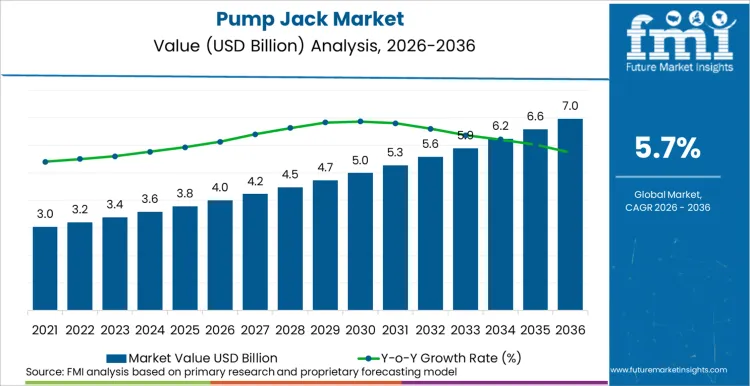
Based on Future Market Insights analysis, demand for pump jacks is estimated to grow to USD 4.0 billion in 2026 and USD 7.0 billion by 2036, reflecting a 5.7% CAGR over the forecast period. The baseline is anchored in FMI’s published 2025 to 2035 trajectory and extended one year forward using the same growth rate and valuation pattern.
Absolute dollar growth of USD 3.0 billion across the decade signals a market where value is built through upgrades and instrumentation rather than purely by unit shipments. Operators extend the life of mature wells by tightening runtime discipline, shifting procurement from heavy mechanical builds toward electric drives, controllers, and services that reduce unplanned downtime and power losses.
Summary of Pump Jack Market
- Pump Jack Market Definition
- Surface lifting systems (beam pumping units and associated controls) sold to onshore operators to sustain production as reservoir pressure declines.
- Demand Drivers in the Market
- Mature well economics keep mechanical lift relevant because workover and recompletion budgets favour extending existing assets rather than drilling-only growth.
- Electrification and variable control reduce energy waste per barrel, which is increasingly treated as an operating constraint in high power cost regions.
- Remote monitoring and pad-level controllers reduce field labour intensity and shorten response time on downtime events.
- Key Segments Analyzed in the FMI Report
- Type: Electric pump jacks lead, estimated at 39.4% share in the base year.
- Operations: Automated leads operations, estimated at 42.7% share in the base year.
- Geography: Growth is pulled by Asia and selected OECD markets where retrofit demand and monitoring adoption rise in parallel.
- Analyst Opinion at FMI
- Nikhil Kaitwade, Principal Consultant at Future Market Insights, opines, ‘CXOs will see pump jack value shifting toward electrified fleets, controller attach, and monitoring-driven uptime programs rather than purely mechanical replacement buying.’
- Strategic Implications or Executive Takeaways
- Treat electrification as a total cost programme: bundle VFDs, motors, and controllers with service terms tied to runtime and failure reduction.
- Build a retrofit-first playbook in mature basins: standardise kits for legacy units, with fast installation and spares availability to win downtime-sensitive operators.
- Compete on data integration: buyers increasingly evaluate whether pump data can flow into a unified surveillance layer across production assets.
- Methodology
- Validated using public upstream activity and production outlook data.
- Corporate actions included only when traceable to a press release or filing.
- Segment shares and country CAGRs align with FMI’s published base-year statements where disclosed.
As Girish Saligram, CEO of Weatherford, emphasized regarding capital discipline and operational resilience, “We are laser focused on driving cost and CapEx to be at optimal levels.” He further reinforced the company’s operating durability, stating, “Our margins proved resilient, and the expansion in the second half is a tangible proof point of our operating thesis.” [1]
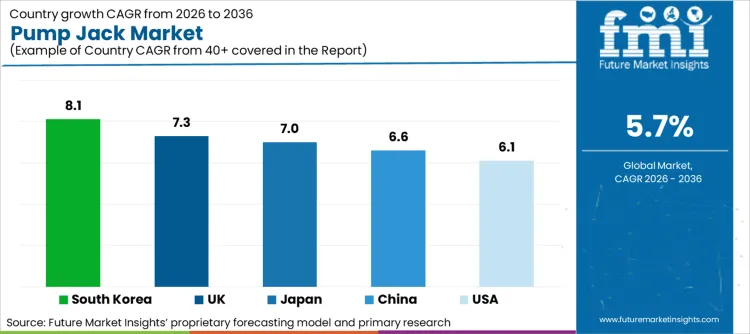
Country-level adoption remains led by markets balancing mature-well recovery needs with automation pull. South Korea is forecast at 8.1% CAGR, the United Kingdom at 7.3%, Japan at 7.0%, China at 6.6%, and the United States at 6.1%, with mature regions increasingly behaving like retrofit markets where power optimisation and remote monitoring drive replacement demand.
Pump Jack Market Definition
The pump jack market comprises surface-mounted mechanical lifting systems used primarily in onshore oil production to lift fluids from wells with declining reservoir pressure. It covers the pumping unit, prime mover configuration (electric, hydraulic, conventional), and associated control and monitoring systems used to manage stroke rate, load, runtime, and maintenance scheduling.
Market Inclusions
The report includes global and regional market sizing (value basis) with a 10-year forecast for 2026 to 2036, plus segmentation by type, operations, capacity, end use, distribution channel, and region. It also covers adoption drivers linked to electrification, automation, and remote monitoring across onshore production environments.
Market Exclusions
The scope excludes downhole artificial lift systems that do not require a surface beam pumping unit (for example ESP-only deployments), downstream oilfield services unrelated to lifting equipment, and well construction hardware not directly tied to pump jack installation or operation. It also excludes speculative laboratory concepts without commercial field deployment.
Research Methodology
- Primary Research: Interviews with pump jack OEMs, oilfield automation vendors, upstream operators, and service contractors focused on replacement cycles, controller adoption, and failure modes in mature fields.
- Desk Research: Public upstream indicators (rig counts, production outlooks, and productivity releases), company product literature, and verified corporate announcements were used to validate demand patterns.
- Market-Sizing and Forecasting: A hybrid model triangulates installed base replacement, electrification retrofits, and automation attach rates, then stress-tests the output against upstream activity and production scenarios.
- Data Validation and Update Cycle: Outputs are checked through variance screening against public production and activity series, cross-source verification of corporate actions, and internal peer review before release.
Pump Jack Market Drivers, Restraints, and Opportunities
Future Market Insights analysis indicates the pump jack market exists at scale because onshore production has a long tail of wells where reservoir pressure decline is predictable and mechanical lift remains the lowest-complexity option for sustained recovery. In this setting, the economic driver is not new drilling alone, but the installed base that needs replacement units, spares, and controls to keep runtime stable.
The current transition is a shift in how value is captured. Standard mechanical units face pricing pressure during softer commodity cycles, yet electrified and automated configurations can defend price because they reduce field visits, power draw, and downtime. This is why controller platforms, remote telemetry, and unified data layers are increasingly bundled into procurement decisions.
- Electrification Pull: Electric units and drive optimisation are adopted to reduce power losses and enable tighter stroke control, especially where operators run multi-well pads with central oversight.
- Uptime Economics: Downtime reduction is monetised directly in marginal wells, so buyers favour OEMs that combine hardware with monitoring and predictive maintenance workflows.
- Data Integration: Operators want pump data integrated into broader well surveillance, which raises the value of platforms that unify analytics and field decision-making.
Segmental Analysis
Pump Jack Market Analysis by Type
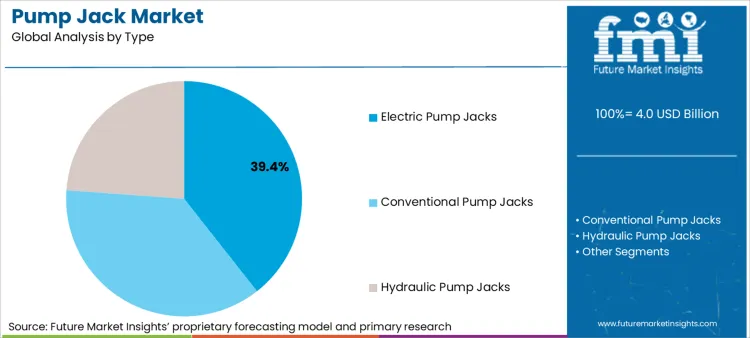
Based on FMI’s pump jack market assessment, electric pump jacks are estimated to hold 39.4% share in 2026. Growth in demand for electric configurations comes from operators embedding Variable Speed Drive (VSD) systems that convert potential energy into electrical energy, lowering lease operating expenses while supporting emissions reduction mandates across mature onshore basins.
- Regenerative Efficiency: Weatherford highlights that operators achieve “Lower power consumption without sacrificing performance using real-time adjustments.” [2]
- Carbon-Neutral Incentives: The company further quantifies impact, noting “For every one kWh reclaimed, 1.7 lbs of CO2 is eliminated or about 254 tons per year, or 55 cars driving 638,352 miles per year.” [3]
- LOE Optimization: Electrified drive systems enable smoother stroke control and energy recovery, reducing mechanical stress and maintenance cycles compared to conventional mechanical crank systems.
Pump Jack Market Analysis by Operations
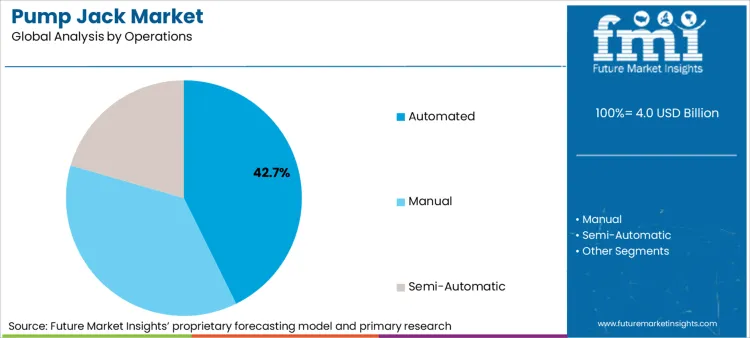
The 42.7% market share for automated operations in 2026 stems from a structural shift toward management by exception, where IoT-enabled controllers decouple production scale from field labor intensity and enable centralized digital supervision of dispersed well inventories.
- Portfolio Integration: SLB states, “The integration of ChampionX production chemicals and its complementary artificial lift, digital, and emissions technologies enhances the SLB portfolio, helping to drive performance and extend asset life along the production lifecycle.” [4]
- Remote Field Visibility: ChampionX notes, “Leveraging a cellular or local WiFi connection, the SMARTEN™ Live feature allows you to access the controller remotely and make operational changes as if you were on location.” [5]
- Labor Decoupling: Automated controllers enable a single technician to supervise hundreds of wells, compressing site visit frequency while stabilizing uptime performance across mature asset portfolios.
Regional Analysis
Based on the regional analysis, pump jack market is segmented into North America, Latin America, Europe, East Asia, South Asia & Pacific, and Middle East & Africa across multiple producing basins and mature onshore fields. The full report also offers market attractiveness analysis based on retrofit intensity, automation adoption, and upstream production stability.
| Country | CAGR (2026 to 2036) |
|---|---|
| South Korea | 8.1% |
| United Kingdom | 7.3% |
| Japan | 7.0% |
| China | 6.6% |
| United States | 6.1% |
Source: Future Market Insights (FMI) analysis, based on proprietary forecasting model and primary research
North America Pump Jack Market Analysis
North America is currently characterized by a "Management by Efficiency" phase, where plateauing production in key basins shifts capital allocation from aggressive drilling toward lifecycle optimisation of existing wells. Operators increasingly prioritise electrified units, controllers, and remote monitoring to stabilise output under capital discipline constraints.
- United States: Demand for pump jacks in the United States is projected to rise at 6.1% CAGR through 2036. Growth is anchored in mature basin optimisation, as “By 2026, production from the Permian is expected to plateau, constrained by infrastructure limitations and capital discipline among producers.” [6]
FMI’s report includes a detailed analysis of growth in the North American region, along with a country-wise assessment that includes the USA and Canada. Readers can also find regional production trends, capital discipline themes, and automation adoption patterns across basins in North America.
Asia Pacific Pump Jack Market Analysis
Asia Pacific remains the primary growth engine for the pump jack market, supported by stricter safety enforcement, automation upgrades, and structured energy transition frameworks that encourage efficiency in mature fields.
- China: Leading with a 6.6% CAGR, the market is influenced by new industrial safety standards coming into force in 2026, as “These standards, covering coatings, fire-protection systems, textile dust hazards, confined spaces, and industrial gas safety, will come into force through various dates in 2026.” [7]
- South Korea: Demand is accelerating at an 8.1% CAGR, supported by broader energy-efficiency mandates, where “Recent policy updates, most notably the June 2025 Zero Energy Building (ZEB) mandate now extended to private residential complexes, mark a turning point.” [8]
- Japan: A projected 7.0% CAGR reflects high-value, safety-driven demand, as “Japan and South Korea represent high-value markets with stringent quality and safety standards, particularly for chemical and food-grade applications.” [9]
The full report analyzes the pump jack market across East Asia and South Asia & Pacific from 2026 to 2036, covering automation penetration, electrification retrofits, and regulatory-driven equipment upgrades in China, Japan, South Korea, India, ASEAN, and Australia.
Europe Pump Jack Market Analysis
Europe is positioned as a "Sustainable Transition" zone, where demand is concentrated in the North Sea and mature onshore fields. Operators integrate advanced artificial lift systems with decarbonised power grids and digital monitoring platforms to maintain output while aligning with long-term energy transition frameworks.
- United Kingdom: Demand for pump jacks in the UK is rising at 7.3% CAGR through 2036, supported by policy direction stating, “Oil and gas production will continue to play an important role and as the world embraces the drive to clean energy, the North Sea gives Britain a chance to show new leadership once again.” [10]
FMI’s analysis of the pump jack market in Europe consists of country-wise assessment including the United Kingdom, Germany, France, Italy, Spain, and Rest of Europe. Readers can understand how energy transition policies, safety standards, and digitalisation mandates shape regional retrofit demand and equipment modernisation cycles.
Competitive Aligners for Market Players
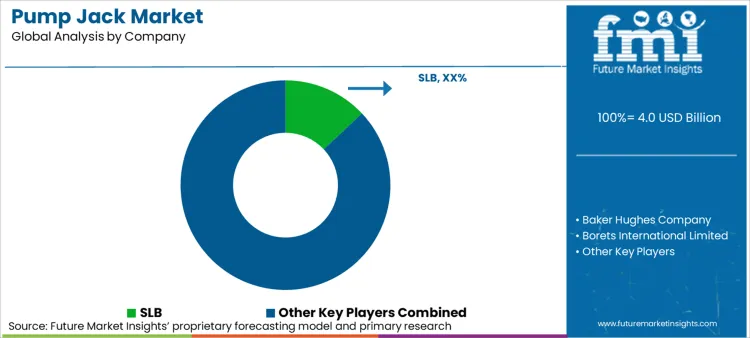
Market structure remains moderately consolidated at the functional level, yet practical competition is concentrated among a limited group of OEMs capable of supplying beam units, electric drives, controllers, and lifecycle service support at scale. A significant share of the installed base is controlled by established brands with field service networks, while smaller fabricators operate with limited pricing leverage and high exposure to replacement-cycle volatility [8]. The primary competitive variable is uptime assurance under mid-cycle oil pricing, not peak-cycle unit margin expansion.
Suppliers with integrated electrification, controller platforms, and digital surveillance capabilities absorb pricing pressure more effectively and defend multi-year service contracts. Vendors dependent solely on mechanical unit sales face margin compression when operators defer replacement and prioritise retrofit kits. Data integration further narrows the field. The ability to stream pump performance into unified production dashboards requires software capability, cybersecurity compliance, and analytics infrastructure, creating natural attrition among hardware-only providers.
Customer concentration reinforces buyer leverage. Large upstream operators multi-source pump units and automation layers to avoid vendor lock-in, limiting full price pass-through and forcing OEMs to compete on runtime reliability, energy efficiency, and controller interoperability rather than structural steel differentiation alone.
Recent Developments
- In September 2024, Weatherford announced the acquisition of Datagration Solutions to expand unified data integration, analytics, and machine learning capabilities for well lifecycle decision-making. [11]
- In February 2026, EIA reiterated expectations of lower oil prices in 2026 amid rising inventories, a macro condition that typically increases focus on power efficiency and uptime economics in mature wells. [12]
Key Players in Pump Jack Market
- SLB
- Baker Hughes Company
- Borets International Limited
- Dover Corporation
- Halliburton Company
- Lufkin Industries LLC
- NOV Inc.
- Tenaris S.A.
- Weatherford International plc
- Flowco Production Solutions
Scope of the Report
| Metric | Value |
|---|---|
| Quantitative Units | USD 4.0 billion (2026) to USD 7.0 billion (2036), at a CAGR of 5.7% |
| Market Definition | The pump jack market comprises surface-mounted mechanical beam pumping units and associated electric drives, hydraulic systems, and digital controllers used primarily in onshore oil production to lift fluids from wells with declining reservoir pressure and sustain output across mature fields. |
| Type Segmentation | Electric Pump Jacks, Conventional Pump Jacks, Hydraulic Pump Jacks, Others |
| Operations Segmentation | Automated, Manual, Semi-Automatic |
| Capacity Segmentation | Up to 100 BPD, 100 to 500 BPD, 500 to 1,000 BPD, Above 1,000 BPD |
| End Use Coverage | Oil and Gas Industry, Mining Industry, Agriculture, Others |
| Distribution Channel | Direct, Indirect |
| Regions Covered | North America, Latin America, Europe, East Asia, South Asia & Pacific, Middle East & Africa |
| Countries Covered | United States, Canada, Mexico, Brazil, Argentina, United Kingdom, Germany, France, Italy, Spain, China, Japan, South Korea, India, ASEAN, Australia & New Zealand and 40 plus countries |
| Key Companies Profiled | SLB, Baker Hughes Company, Borets International Limited, Dover Corporation, Halliburton Company, Lufkin Industries LLC, NOV Inc., Tenaris S.A., Weatherford International plc, Flowco Production Solutions |
| Forecast Period | 2026 to 2036 |
| Approach | Hybrid top-down and bottom-up market modeling triangulating installed base replacement cycles, electrification retrofit rates, and automation attach ratios, validated through primary interviews with OEMs, upstream operators, and publicly traceable upstream activity data. |
Pump Jack Market Analysis by Segments
Type
- Electric Pump Jacks
- Conventional Pump Jacks
- Hydraulic Pump Jacks
- Others
Operations
- Automated
- Manual
- Semi-Automatic
Capacity
- Up to 100 BPD
- 100 to 500 BPD
- 500 to 1,000 BPD
- Above 1,000 BPD
End Use
- Oil and Gas Industry
- Mining Industry
- Agriculture
- Others
Distribution Channel
- Direct
- Indirect
Bibliography
- [1] Investing.com. (2026). Earnings call transcript: Weatherford Q4 2025 beats EPS forecast by 29.93%. Investing.com.
- [2] Weatherford International plc. (2025). IoT-enabled automation. Weatherford.
- [3] Weatherford International plc. (2025). Power regenerative system. Weatherford.
- [4] SLB. (2025). SLB completes acquisition of ChampionX. SLB Press Release.
- [5] ChampionX. (2025). SMARTEN controls - Rod lift artificial lift technologies. ChampionX.
- [6] Energy, Oil & Gas Magazine. (2026). EIA sees 2026 oil production decline despite regional growth.
- [7] APA Engineering. (2026). China GB safety rules 2026 compliance update. APA Engineering.
- [8] Veolia Korea. (2024). Building energy efficiency regulations and smart solutions. Veolia.
- [9] IndexBox. (2025). Eastern Asia big bags (FIBC) market analysis: Forecast, size, trends and insights. IndexBox.
- [10] UK Government. (2024). Building the North Sea’s energy future: Consultation document. GOV.UK.
- [11] Weatherford International plc. (2025). Investor news release. Weatherford.
- [12] USA Energy Information Administration (EIA). (2026). Today in Energy. EIA.
This Report Addresses
- Market intelligence to enable structured strategic decision making across mature onshore oil basins and emerging automation-driven production environments
- Market size estimation and 10 year revenue forecasts from 2026 to 2036, supported by validated installed base benchmarks, replacement cycles, and upstream activity indicators
- Growth opportunity mapping across electric, conventional, and hydraulic pump jacks with emphasis on electrification, VSD integration, and remote monitoring attach rates
- Segment and regional revenue forecasts covering type, operations, capacity bands, end use industries, and distribution channels across North America, Europe, East Asia, South Asia & Pacific, Latin America, and Middle East & Africa
- Competition strategy assessment including electrification bundling models, controller ecosystem positioning, lifecycle service integration, and uptime assurance benchmarking
- Product and platform evolution tracking including energy recovery drives, IoT-enabled controllers, and pad-level production optimisation systems
- Regulatory and macro impact analysis covering upstream capital discipline, production plateau scenarios, industrial safety standards, and energy efficiency mandates
- Market report delivery in PDF, Excel, PPT, and interactive dashboard formats for executive, operational, and field-automation planning use
Frequently Asked Questions
How large is the demand for Pump Jacks in the global market in 2026?
Demand for pump jacks in the global market is estimated to be valued at USD 4.0 billion in 2026.
What will be the market size of Pump Jacks in the global market by 2036?
Market size for pump jacks is projected to reach USD 7.0 billion by 2036.
What is the expected demand growth for Pump Jacks in the global market between 2026 and 2036?
Demand for pump jacks in the global market is expected to grow at a CAGR of 5.7% between 2026 and 2036.
Which Type is poised to lead global sales by 2026?
Electric pump jacks are expected to be the dominant type, capturing approximately 39.4% of global market share in 2026 due to energy optimisation and electrification-led retrofits.
How significant is the role of Automated Operations in driving Pump Jack adoption in 2026?
Automated operations represent a critical segment, projected to hold approximately 42.7% share of the total market in 2026 as operators prioritise management-by-exception and remote field visibility.
What is Driving Pump Jack Demand in the United States?
Mature basin optimisation, electrification retrofits, and capital discipline focused on uptime rather than new drilling are driving demand in the United States.
What Macro Indicators are Referenced for the United States?
EIA production outlooks and Baker Hughes rig activity data are referenced as contextual indicators supporting installed base replacement and automation demand trends.
What is the United States Growth Outlook in this Report?
The United States is projected to grow at a CAGR of 6.1% during 2026 to 2036.
Why is Europe described as a Sustainable Transition Zone in this Report?
Demand is shaped by mature North Sea assets and policy direction that integrates artificial lift systems with decarbonised grids and long-term energy transition frameworks.
What Type of Demand Dominates in Europe?
Retrofit-driven demand for electrified and digitally monitored pump units dominates rather than large-scale new field deployment.
What is the United Kingdom Growth Outlook in this Report?
The United Kingdom is projected to expand at a CAGR of 7.3% during 2026 to 2036.
Does the Report Cover Japan in its Regional Analysis?
Japan is included within East Asia under the regional scope of analysis.
What is the Main Demand Theme Linked to Japan in Asia Coverage?
Safety-driven and quality-focused automation upgrades in mature production environments are emphasized.
Does the Report Cover South Korea in its Regional Analysis?
South Korea is included within East Asia under the regional coverage framework.
What is the Main Korea Related Demand Theme in Asia Coverage?
Energy-efficiency mandates and automation-led field optimisation programs drive demand growth.
Which Product Formats are Strategically Important for Asia Pacific Supply Chains?
Electric pump jacks with integrated controllers and remote telemetry systems are prioritized to support efficiency and regulatory compliance across mature well portfolios.
What is a Pump Jack and What is It Mainly Used For?
A pump jack is a surface-mounted mechanical beam pumping system used to lift fluids from onshore oil wells with declining reservoir pressure.
What does Pump Jack Market Mean in this Report?
Pump jack market refers to the global production, trade, installation, and servicing of beam pumping units, prime movers, and associated control and monitoring systems.
What is Included in the Scope of this Pump Jack Market Report?
Scope covers pump jacks by type, operations mode, capacity, end use, distribution channel, and region, including electrification and automation-driven upgrades.
What is Excluded from the Scope of this Report?
Downhole-only artificial lift systems without surface beam units, unrelated oilfield services, and non-commercial laboratory concepts are excluded.
What does Market Forecast Mean on this Page?
Market forecast represents a model-based projection built on installed base dynamics, retrofit rates, automation penetration, and upstream production outlook assumptions.
How does FMI Build and Validate the Pump Jack Market Forecast?
Forecast is developed using hybrid top-down and bottom-up modeling validated through primary interviews, installed base analysis, and publicly traceable upstream activity data.
What does Zero Reliance on Speculative Third Party Market Research Mean Here?
Primary interviews and verifiable public datasets are used instead of unverified syndicated market estimates.
Preview the report firsthand - request a free sample
Get SampleGet the brochure for pricing and purchase details.
Get PDFTable of Content
- Executive Summary
- Global Market Outlook
- Demand-side Trends
- Supply-side Trends
- Technology Roadmap Analysis
- Analysis and Recommendations
- Market Overview
- Market Coverage / Taxonomy
- Market Definition / Scope / Limitations
- Research Methodology
- Chapter Orientation
- Analytical Lens and Working Hypotheses
- Market Structure, Signals, and Trend Drivers
- Benchmarking and Cross-market Comparability
- Market Sizing, Forecasting, and Opportunity Mapping
- Research Design and Evidence Framework
- Desk Research Programme (Secondary Evidence)
- Company Annual and Sustainability Reports
- Peer-reviewed Journals and Academic Literature
- Corporate Websites, Product Literature, and Technical Notes
- Earnings Decks and Investor Briefings
- Statutory Filings and Regulatory Disclosures
- Technical White Papers and Standards Notes
- Trade Journals, Industry Magazines, and Analyst Briefs
- Conference Proceedings, Webinars, and Seminar Materials
- Government Statistics Portals and Public Data Releases
- Press Releases and Reputable Media Coverage
- Specialist Newsletters and Curated Briefings
- Sector Databases and Reference Repositories
- FMI Internal Proprietary Databases and Historical Market Datasets
- Subscription Datasets and Paid Sources
- Social Channels, Communities, and Digital Listening Inputs
- Additional Desk Sources
- Expert Input and Fieldwork (Primary Evidence)
- Primary Modes
- Qualitative Interviews and Expert Elicitation
- Quantitative Surveys and Structured Data Capture
- Blended Approach
- Why Primary Evidence is Used
- Field Techniques
- Interviews
- Surveys
- Focus Groups
- Observational and In-context Research
- Social and Community Interactions
- Stakeholder Universe Engaged
- C-suite Leaders
- Board Members
- Presidents and Vice Presidents
- R&D and Innovation Heads
- Technical Specialists
- Domain Subject-matter Experts
- Scientists
- Physicians and Other Healthcare Professionals
- Governance, Ethics, and Data Stewardship
- Research Ethics
- Data Integrity and Handling
- Primary Modes
- Tooling, Models, and Reference Databases
- Desk Research Programme (Secondary Evidence)
- Data Engineering and Model Build
- Data Acquisition and Ingestion
- Cleaning, Normalisation, and Verification
- Synthesis, Triangulation, and Analysis
- Quality Assurance and Audit Trail
- Market Background
- Market Dynamics
- Drivers
- Restraints
- Opportunity
- Trends
- Scenario Forecast
- Demand in Optimistic Scenario
- Demand in Likely Scenario
- Demand in Conservative Scenario
- Opportunity Map Analysis
- Product Life Cycle Analysis
- Supply Chain Analysis
- Investment Feasibility Matrix
- Value Chain Analysis
- PESTLE and Porter’s Analysis
- Regulatory Landscape
- Regional Parent Market Outlook
- Production and Consumption Statistics
- Import and Export Statistics
- Market Dynamics
- Global Market Analysis 2021 to 2025 and Forecast, 2026 to 2036
- Historical Market Size Value (USD Million) Analysis, 2021 to 2025
- Current and Future Market Size Value (USD Million) Projections, 2026 to 2036
- Y-o-Y Growth Trend Analysis
- Absolute $ Opportunity Analysis
- Global Market Pricing Analysis 2021 to 2025 and Forecast 2026 to 2036
- Global Market Analysis 2021 to 2025 and Forecast 2026 to 2036, By Type
- Introduction / Key Findings
- Historical Market Size Value (USD Million) Analysis By Type , 2021 to 2025
- Current and Future Market Size Value (USD Million) Analysis and Forecast By Type , 2026 to 2036
- Electric Pump Jacks
- Conventional Pump Jacks
- Hydraulic Pump Jacks
- Electric Pump Jacks
- Y-o-Y Growth Trend Analysis By Type , 2021 to 2025
- Absolute $ Opportunity Analysis By Type , 2026 to 2036
- Global Market Analysis 2021 to 2025 and Forecast 2026 to 2036, By Operations
- Introduction / Key Findings
- Historical Market Size Value (USD Million) Analysis By Operations, 2021 to 2025
- Current and Future Market Size Value (USD Million) Analysis and Forecast By Operations, 2026 to 2036
- Automated
- Manual
- Semi-Automatic
- Automated
- Y-o-Y Growth Trend Analysis By Operations, 2021 to 2025
- Absolute $ Opportunity Analysis By Operations, 2026 to 2036
- Global Market Analysis 2021 to 2025 and Forecast 2026 to 2036, By Region
- Introduction
- Historical Market Size Value (USD Million) Analysis By Region, 2021 to 2025
- Current Market Size Value (USD Million) Analysis and Forecast By Region, 2026 to 2036
- North America
- Latin America
- Western Europe
- Eastern Europe
- East Asia
- South Asia and Pacific
- Middle East & Africa
- Market Attractiveness Analysis By Region
- North America Market Analysis 2021 to 2025 and Forecast 2026 to 2036, By Country
- Historical Market Size Value (USD Million) Trend Analysis By Market Taxonomy, 2021 to 2025
- Market Size Value (USD Million) Forecast By Market Taxonomy, 2026 to 2036
- By Country
- USA
- Canada
- Mexico
- By Type
- By Operations
- By Country
- Market Attractiveness Analysis
- By Country
- By Type
- By Operations
- Key Takeaways
- Latin America Market Analysis 2021 to 2025 and Forecast 2026 to 2036, By Country
- Historical Market Size Value (USD Million) Trend Analysis By Market Taxonomy, 2021 to 2025
- Market Size Value (USD Million) Forecast By Market Taxonomy, 2026 to 2036
- By Country
- Brazil
- Chile
- Rest of Latin America
- By Type
- By Operations
- By Country
- Market Attractiveness Analysis
- By Country
- By Type
- By Operations
- Key Takeaways
- Western Europe Market Analysis 2021 to 2025 and Forecast 2026 to 2036, By Country
- Historical Market Size Value (USD Million) Trend Analysis By Market Taxonomy, 2021 to 2025
- Market Size Value (USD Million) Forecast By Market Taxonomy, 2026 to 2036
- By Country
- Germany
- UK
- Italy
- Spain
- France
- Nordic
- BENELUX
- Rest of Western Europe
- By Type
- By Operations
- By Country
- Market Attractiveness Analysis
- By Country
- By Type
- By Operations
- Key Takeaways
- Eastern Europe Market Analysis 2021 to 2025 and Forecast 2026 to 2036, By Country
- Historical Market Size Value (USD Million) Trend Analysis By Market Taxonomy, 2021 to 2025
- Market Size Value (USD Million) Forecast By Market Taxonomy, 2026 to 2036
- By Country
- Russia
- Poland
- Hungary
- Balkan & Baltic
- Rest of Eastern Europe
- By Type
- By Operations
- By Country
- Market Attractiveness Analysis
- By Country
- By Type
- By Operations
- Key Takeaways
- East Asia Market Analysis 2021 to 2025 and Forecast 2026 to 2036, By Country
- Historical Market Size Value (USD Million) Trend Analysis By Market Taxonomy, 2021 to 2025
- Market Size Value (USD Million) Forecast By Market Taxonomy, 2026 to 2036
- By Country
- China
- Japan
- South Korea
- By Type
- By Operations
- By Country
- Market Attractiveness Analysis
- By Country
- By Type
- By Operations
- Key Takeaways
- South Asia and Pacific Market Analysis 2021 to 2025 and Forecast 2026 to 2036, By Country
- Historical Market Size Value (USD Million) Trend Analysis By Market Taxonomy, 2021 to 2025
- Market Size Value (USD Million) Forecast By Market Taxonomy, 2026 to 2036
- By Country
- India
- ASEAN
- Australia & New Zealand
- Rest of South Asia and Pacific
- By Type
- By Operations
- By Country
- Market Attractiveness Analysis
- By Country
- By Type
- By Operations
- Key Takeaways
- Middle East & Africa Market Analysis 2021 to 2025 and Forecast 2026 to 2036, By Country
- Historical Market Size Value (USD Million) Trend Analysis By Market Taxonomy, 2021 to 2025
- Market Size Value (USD Million) Forecast By Market Taxonomy, 2026 to 2036
- By Country
- Kingdom of Saudi Arabia
- Other GCC Countries
- Turkiye
- South Africa
- Other African Union
- Rest of Middle East & Africa
- By Type
- By Operations
- By Country
- Market Attractiveness Analysis
- By Country
- By Type
- By Operations
- Key Takeaways
- Key Countries Market Analysis
- USA
- Pricing Analysis
- Market Share Analysis, 2025
- By Type
- By Operations
- Canada
- Pricing Analysis
- Market Share Analysis, 2025
- By Type
- By Operations
- Mexico
- Pricing Analysis
- Market Share Analysis, 2025
- By Type
- By Operations
- Brazil
- Pricing Analysis
- Market Share Analysis, 2025
- By Type
- By Operations
- Chile
- Pricing Analysis
- Market Share Analysis, 2025
- By Type
- By Operations
- Germany
- Pricing Analysis
- Market Share Analysis, 2025
- By Type
- By Operations
- UK
- Pricing Analysis
- Market Share Analysis, 2025
- By Type
- By Operations
- Italy
- Pricing Analysis
- Market Share Analysis, 2025
- By Type
- By Operations
- Spain
- Pricing Analysis
- Market Share Analysis, 2025
- By Type
- By Operations
- France
- Pricing Analysis
- Market Share Analysis, 2025
- By Type
- By Operations
- India
- Pricing Analysis
- Market Share Analysis, 2025
- By Type
- By Operations
- ASEAN
- Pricing Analysis
- Market Share Analysis, 2025
- By Type
- By Operations
- Australia & New Zealand
- Pricing Analysis
- Market Share Analysis, 2025
- By Type
- By Operations
- China
- Pricing Analysis
- Market Share Analysis, 2025
- By Type
- By Operations
- Japan
- Pricing Analysis
- Market Share Analysis, 2025
- By Type
- By Operations
- South Korea
- Pricing Analysis
- Market Share Analysis, 2025
- By Type
- By Operations
- Russia
- Pricing Analysis
- Market Share Analysis, 2025
- By Type
- By Operations
- Poland
- Pricing Analysis
- Market Share Analysis, 2025
- By Type
- By Operations
- Hungary
- Pricing Analysis
- Market Share Analysis, 2025
- By Type
- By Operations
- Kingdom of Saudi Arabia
- Pricing Analysis
- Market Share Analysis, 2025
- By Type
- By Operations
- Turkiye
- Pricing Analysis
- Market Share Analysis, 2025
- By Type
- By Operations
- South Africa
- Pricing Analysis
- Market Share Analysis, 2025
- By Type
- By Operations
- USA
- Market Structure Analysis
- Competition Dashboard
- Competition Benchmarking
- Market Share Analysis of Top Players
- By Regional
- By Type
- By Operations
- Competition Analysis
- Competition Deep Dive
- SLB
- Overview
- Product Portfolio
- Profitability by Market Segments (Product/Age /Sales Channel/Region)
- Sales Footprint
- Strategy Overview
- Marketing Strategy
- Product Strategy
- Channel Strategy
- Baker Hughes Company
- Borets International Limited
- Dover Corporation
- Halliburton Company
- Lufkin Industries LLC
- NOV Inc.
- Tenaris S.A.
- SLB
- Competition Deep Dive
- Assumptions & Acronyms Used


