

- Industry Size (2026)
- USD USD 613.8 Mn
- Forecast (2036)
- USD USD 891.2 Mn
- CAGR (2026 to 2036)
- 3.8%
Fire Pump Market Size, Market Forecast and Outlook By FMI
The fire pump market is expected to increase from USD 613.8 million in 2026 to USD 891.2 million by 2036. The market is anticipated to register a 3.8% CAGR during the forecast period. Horizontal split case pumps are likely to lead product type demand with 26.3% share in 2036 across high-flow installations. Industrial applications are projected to account for 23.4% share as factories and warehouses require reliable water delivery during fire events.
Summary of the Fire Pump Market
- Demand and Growth Drivers
- Stricter fire safety codes are expected to lift certified pump adoption across commercial and industrial building projects.
- Insurance testing rules are likely to push building owners toward documented performance checks and remote monitoring systems.
- High-rise construction and offshore energy projects are anticipated to increase demand for reliable high-pressure pump packages.
- Product and Segment View
- Horizontal split case pumps are expected to lead product type demand with high-flow handling across large facilities.
- Industrial applications are likely to use larger fire pump systems for factories and warehouses with higher safety exposure.
- Vertical in-line and packaged pump systems are anticipated to gain attention as space-saving installation needs rise.
- Geography and Competitive Outlook
- United States demand is expected to advance through NFPA code enforcement and a large installed suppression base.
- India is likely to register stronger adoption as high-rise construction and state fire safety rules expand.
- Suppliers with certified designs and digital monitoring capability are anticipated to improve buyer confidence in critical installations.
- Analyst Opinion
- Nikhil Kaitwade, at FMI serves as Principal Consultant for Process Automation and suggests: “Fire pump demand is likely to favor certified manufacturers able to pair code compliance with monitored performance. Suppliers offering high-pressure designs and remote testing visibility are expected to gain preference among contractors managing commercial and industrial protection projects.”
- Fire Pump Market Value Analysis
- The fire pump market is transitioning from mechanical procurement into monitored infrastructure with compliance and testing value.
- Certified pump installations are likely to gain from stricter building codes and insurance documentation needs across major facilities.
- Remote monitoring is expected to reduce inspection gaps and improve service planning for high-risk buildings over long equipment life.
- Spending is anticipated to be backed by commercial construction and offshore energy projects needing reliable suppression systems.
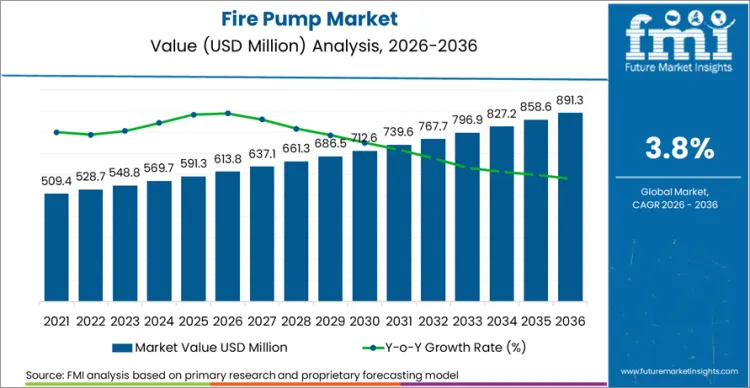
Key Takeaways, Market Size, and Forecast
- The fire pump market is expected to reach USD 613.8 million in 2026 as fire protection upgrades increase.
- By 2036, the fire pump market is projected to reach USD 891.2 million across certified installations.
- From 2026 to 2036, the market is anticipated to expand at a 3.8% CAGR across fire protection systems.
- Horizontal split case pumps are likely to account for 26.3% share of the product type segment in 2036.
- Industrial applications are expected to hold 23.4% share of the application segment by 2036.
- United Kingdom is projected to record the fastest country-level expansion at 4.5% CAGR through 2036.
Summary of Fire Pump Market
What Is Growth Outlook for Fire Pump Market as per Future Market Insights Projection?
Future Market Insights projects the fire pump market to expand at a CAGR of 3.8% from 2026 to 2036, increasing from USD 613.8 Million in 2026 to USD 891.2 Million by 2036.
FMI Research Approach: FMI proprietary forecasting model based on commercial construction permits and fire safety code revision cycles.
How Do FMI Analysts Perceive Fire Pump Market to Evolve?
FMI analysts perceive the market evolving toward digitally connected fire pump systems where remote monitoring and performance analytics become specification requirements rather than optional features.
FMI Research Approach: NFPA 20 (2025 edition) and insurance industry remote testing documentation requirements.
Which Country Holds Largest Share in Global Fire Pump Market?
The United States holds a significant share of the global fire pump market by value, which is supported by stringent NFPA code enforcement and the largest installed base of commercial fire suppression systems.
FMI Research Approach: FMI country-level revenue modeling by commercial construction permits and NFPA code adoption rates.
How Large Will Fire Pump Market Be by 2036?
The global fire pump market is projected to reach USD 891.2 Million by 2036.
FMI Research Approach: FMI long-term revenue forecast derived from global commercial construction activity projections and fire safety code upgrade cycles.
What Is Definition of Fire Pump Market?
The fire pump market includes revenue from centrifugal, vertical turbine, and positive displacement pumps specifically designed and certified for fire suppression systems in commercial, industrial, and marine applications.
FMI Research Approach: FMI market taxonomy aligned with NFPA 20 and FM Global classification.
What Are Globally Unique Trends Shaping Fire Pump Market?
Globally unique trends include the integration of IoT remote monitoring into fire pump hardware, the expansion of high-pressure vertical-in-line pump formats, and the growth of offshore FPSO fire pump specification requirements.
FMI Research Approach: Armstrong Design Envelope technology launch (2025 to 2026) and Sulzer Petrobras FPSO contract (November 2025).
Fire Pump Market Key Takeaways
| Metric | Details |
|---|---|
| Industry Size (2026) | USD USD 613.8 Million |
| Industry Value (2036) | USD USD 891.2 Million |
| CAGR (2026 to 2036) | 3.8% |
Source: Future Market Insights (FMI) analysis, based on proprietary forecasting model and primary research
Semi-annual Update
The table below presents a comparative assessment of the variation in CAGR over six months for the base year (2025) and current year (2026) for the fire pump market. This analysis reveals crucial shifts in market performance and indicates revenue realization patterns, thus providing stakeholders with a better vision of the market growth trajectory over the year. The first half of the year, or H1, spans from January to June. The second half, H2, includes the months from July to December.
In the first half (H1) from 2025 to 2035, the business is predicted to surge at a CAGR of 3.4%, followed by a slightly higher growth rate of 3.6% in the second half (H2).
| Particular | Value CAGR |
|---|---|
| H1 | 3.4% (2025 to 2035) |
| H2 | 3.6% (2025 to 2035) |
| H1 | 3.7% (2026 to 2036) |
| H2 | 3.9% (2026 to 2036) |
Moving into the subsequent period, from H1 2026 to H2 2036, the CAGR is projected to increase slightly to 3.7% in the first half and remain relatively moderate at 3.9% in the second half. In the first half (H1) the market witnessed an increase of 30 BPS while in the second half (H2), the market witnessed an increase of 30 BPS.
Category-wise Insights
The section contains information about the leading segments in the industry. By product type, horizontal split case segment is estimated to grow at a CAGR of 3.4% throughout 2036. Additionally, Industry Application is projected to expand at 3.1% by 2036.
Horizontal Split Case Fire Pumps Lead Due to Efficiency, High Flow Rates, and Easy Maintenance, Outperforming others
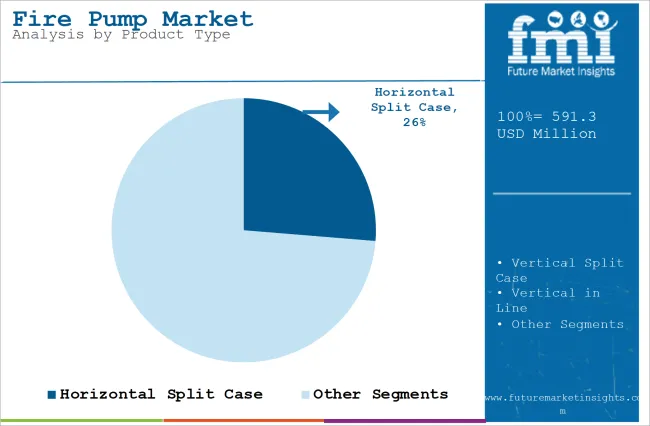
| Product Type | Value Share (2036) |
|---|---|
| Horizontal Split Case | 26.3% |
Horizontal Split Case pumps typically operate in a pressure range of 40 to 175 psi. The specific requirements of the application determine the operating pressure. The design of these pumps allows them to handle large volumes of water, with flow rates ranging from 500 to 15,000 GPM. They are therefore suitable for large-scale infrastructure, such as high-rise buildings and industrial facilities.
This design features a horizontal case split for excellent access during its maintenance that minimizes operative downtime and extended service life through critical commercial industrial fire protection pumping systems.
Similar performance but require more installation space in comparison to the vertical split case pumps. More compact than the others, vertical in-line pumps cannot be used as efficiently for large applications. Deep-well applications are mainly covered by vertical turbine pumps, but they cannot be as effective in high-flow systems, whereas end suction pumps are good for smaller systems but not scalable or efficient for large fire protection applications.
Fire Pumps in Industrial Applications Dominate Due to High Performance, Safety Requirements, and Need for Large-Scale Water Flow in Critical Environments
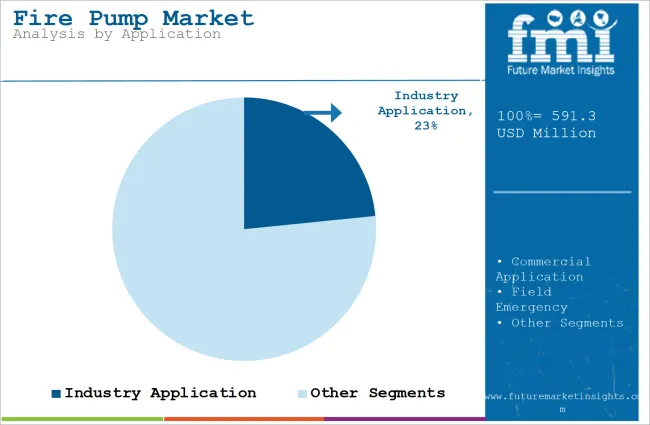
| Application | Value Share (2036) |
|---|---|
| Industry Application | 23.4% |
Industrial applications still form a significant proportion of the fire pump market because of the risk involved in these sectors, such as manufacturing, chemical plants, and warehouses. Here, high-capacity and high-performance fire pumps are required which can handle large volumes of water flow, which is often over 1000 GPM.
Pumps are designed to run continuously when needed and minimize downtime to the maximum limits for industrial purposes. Highly reliable systems can ensure that the same volume of water flows constantly in firefighting, mainly to protect infrastructure and minimize operations losses.
Industrial applications are far more powerful compared to commercial ones, which are usually smaller and less demanding. Field emergency applications use fire pumps in temporary setups, which call for more compact and flexible models, while public infrastructure applications, like airports or hospitals, require high-pressure pumps, with rapid response being the emphasis. Fire pumps in these sectors, generally, operate on a smaller scale compared to industrial applications.
Key Industry Highlights
Integration of Smart Monitoring and Control Systems Elevates Fire Pump Market Efficiency with Automation and Remote Access
The fire pump market has been increasing use of smart technologies, particularly sensors and real-time data analytics to enhance the fire safety management in this field. This is going to make advanced proactive monitoring systems that will allow the possibility of detection for issues like lower water pressure and pump malfunctions early, meaning immediate action will be possible, avoiding system failure.
With more businesses demanding higher levels of automation and remote access to fire protection systems, the demand for integrated solutions is expected to increase. The real-time insights provided by these systems improve operational efficiency and extend the service life of fire pumps.
Xylem, with its Xylem SMART technology platform, provides advanced monitoring solutions. The Xylem SMART technology platform gives predictive maintenance and real-time monitoring of fire pump systems for optimal performance.
Similarly, Grundfos offers integrated pump solutions with real-time monitoring, known as Grundfos Remote Monitoring, allowing operators to remotely oversee the performance of fire protection systems. As fire pump systems evolve, these technologies will be a standard offering.
Growing Opportunity for Solar and Energy-Efficient Fire Pump Solutions Driven by Sustainability and Green Certifications
Increasing pressures on businesses and governments to meet sustainability goals were reflected in a significant shift of the fire pump market toward renewable energy-powered fire pumps, especially solar-powered systems.
These solutions were not just minimizing the carbon footprint of fire protection systems but also helped lower long-term operational costs by saving energy consumption. Because both construction and industries are adopting more green building certification such as LEED, more demands can be expected concerning energy-efficient pumps from manufacturers.
Companies such as Davey Water Products lead in terms of Solar Smart Pump solutions that integrate solar power to drive the fire pump in remote or off-grid locations. KSB Group highly stands out among the companies providing eco-friendly fire pump systems, accompanied by the KSB-Solar System that uses renewable sources of energy. With already prominent concerns of environmental sustainability becoming a priority of all industries, such innovations will surely gain much more momentum in the near future.
Stringent Global Fire Safety Regulations Drive Increased Adoption of Fire Pump Systems in High-Risk Buildings
The stringent global fire safety standards are leading to increased regulation in the fire pump market. There are standards that are coming into effect such as NFPA 20(Standards for the Installation of Stationary Pumps for Fire Protection) as well as local fire codes.
These standards establish the need for operational fire protection systems, especially in hazardous locations, for example, industrial and manufacturing plants, commercial buildings and high-rise structures. Such regulations will also enforce that the fire pump remain a core aspect of integral fire safety policies across industries.
In fact, the International Code Council, by its International Fire Code, sets regulations mandating the installation of fire pumps in certain types of buildings that involve high occupant loads or those with hazardous materials.
Rising legal demands for the business and commercial sectors make the institutions focus more on fire protection measures, thereby continuing to register positive growth in terms of installing fire pumps as an essential means to meet statutory provisions.
2021 to 2025 Global Fire Pump Sales Outlook Compared to Demand Forecast from 2026 to 2036
The global fire pump system market recorded a CAGR of 3.4% during the historical period between 2021 and 2025. The growth of fire pump market was positive as it reached a value of USD 858.6 million in 2025 from USD 498.4 million in 2020.
Between 2021 and 2025, several challenges affected the fire pump market, primarily due to supply chain disruptions, labor shortages, and increased raw material costs. The manufacturing sector was adversely affected during the COVID-19 pandemic, resulting in delayed production and shipments. Due to the rising demand for fire pumps in industrial and commercial sectors, the need to offer high-performance systems also strained manufacturers' capacities to meet requirements.
The increased water flow to be handled by the pumps required companies to innovate more, as it had to handle up to 15,000 GPM with pressures as high as 175 psi. To enhance productivity and lessen the need for manual intervention, manufacturers explored the usage of digital solutions including IoT capable pumps. In addition, improved supply chains ensured that delays were significantly reduced, thus making the product availability more reliable.
As an outlook of growth from 2026 through to 2036, increasing urbanization will add to growing pressures for firmer safety regulations while pumping technologies also progress. For instance, demand in the region of high efficiency will be strongly generated in such segments as industrial manufacturing, infrastructure and public safety by high-efficiency pumps.
Power requirements for operating fire pumps are expected to rise, especially for larger systems that can handle higher flows up to 15,000 GPM or more, with higher pressures for large-scale applications. The incorporation of solar powered fire pumps will greatly increase the demand for the product in regions with sustainable goals. As a result, the market will place greater emphasis on new efficiencies, innovation and smart fire protection systems, as well as multifaceted automation to cut operational costs.
Market Concentration
Tier 1 companies comprise market leaders with a market revenue of above USD 25 million capturing a significant market share of 25-30% in the fire pump market. These market leaders are characterized by extensive expertise in manufacturing across a range of packaging formats and have a wide geographic reach, with a strong foundation of consumers.
They offer an extensive range of series, which includes recycling and manufacturing with the latest technology to meet regulatory requirements and deliver quality. Prominent companies within Tier 1 include Xylem Inc., Grundfos Pumps Corporation, Pentair Ltd., CET Fire Pumps Mfg. Inc and Eaton.
Tier 2 and other includes the majority of small-scale companies operating at the local presence and serving niche markets having revenue below USD 25 million. These companies are notably oriented towards fulfilling local market demands and are consequently classified within the tier 2 share segment. They are small-scale players and have limited geographical reach. Tier 2, within this context, is recognized as an unorganized market, denoting a sector characterized by a lack of extensive structure and formalization when compared to organized competitors.
Country-wise Insights
The section below covers the industry analysis for the fire pump market for different countries. Market demand analysis on key countries is provided. The USA is anticipated to remain at the forefront in North America, with a value share of 72.3% through 2036. In East Asia, China is projected to witness a CAGR of 3.1% by 2036.
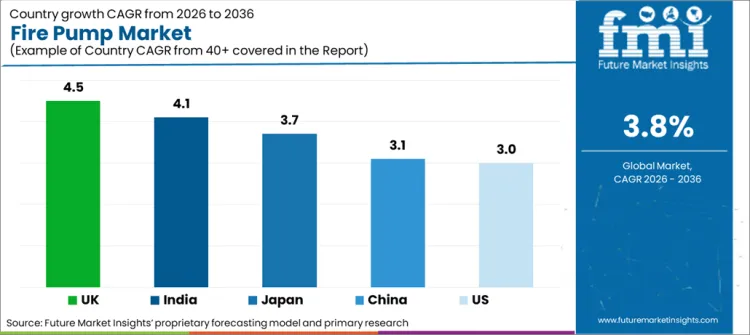
| Country | Value CAGR (2026 to 2036) |
|---|---|
| USA | 3.0% |
| UK | 4.5% |
| China | 3.1% |
| Japan | 3.7% |
| India | 4.1% |
Surge in USA Fire Pump Market Driven by Rising Fire Incidents and Stricter Safety Regulations
The USA fire pump market is growing significantly with the stricter regulations of NFPA 20 that requires installations of fire pumps on buildings where there is a lower municipal water pressure. In the past few years, large scale fires have surged especially in areas such as the state of California.
These incidents have made people more conscious of fire protection systems and the government as well as the private sectors have been investing in high-end fire safety infrastructure. Thus, the demand for fire pumps is on the rise, especially for domestic, commercial, or industrial usage, for the purposes of fire safety regulations and increased emergency preparedness.
The market is predicted to grow during the period between 2025 and 2036 at a CAGR of 3.0% from increasing fire incidences, resulting in regulatory responses and safety overhauls. States prone to wildfires and other fire hazards can expect stricter requirements, which increases the demand for high-performance fire pump systems, hence this explains why fire pumps play a core role in providing security to property and human life hence ensuring that market growth is retained in the US.
Rising Demand for Horizontal Split Case Fire Pumps Driven by Urbanization, Efficiency, and Strict Fire Safety Regulations in China
The fire pump market in China is booming as it grows amid stringent fire safety regulations and quick urbanization processes. As prescribed by the "Fire Protection Law of the People's Republic of China, all sectors will require full-scale fire safety; therefore, provision of adequate supply of water when emergencies occur by installing fire pumps in buildings would be required in the building constructions.
The "Code of Practice for Fire Safety in Buildings" is also a document that gives detailed information on fire safety infrastructure, further emphasizing the requirement for reliable fire pump systems.
Horizontal split case fire pumps are currently the most in demand in China due to their efficiency, reliability, and versatility. Horizontal split case fire pumps find application in a diverse range of industries including high-rise buildings, factories, large commercial buildings and urban projects.
The need for horizontal split case fire pumps is basically because of the benefits such as efficiency, ease of maintenance, sufficiency in fire safety and easy scalability. Considering the rate of urbanization and the growing focus on league infrastructure projects, these pumps will continue to be a good option and help in combating fire in China.
Fire Safety Regulations in India Accelerate Adoption of Fire Pumps in Buildings and Commercial Complexes
In India, fire safety regulations are largely governed by the National Building Code of India and several local/state fire safety acts. According to the NBC 2016, specific requirements exist in relation to fire safety for various categories of buildings, including high-rise structures, commercial complexes, industrial zones, and residential buildings. The fire protection systems have to install fire pumps to provide water supply to the critical areas in case of a fire.
The code addresses issues like the type, capacity, and performance of fire pumps. In addition to the NBC, the state-specific fire safety laws enforce strict fire safety norms. For instance, in Mumbai, the Mumbai Fire Brigade (MFB) has rules that install automatic sprinkler systems and fire pumps in buildings above a certain height.
A similar law in Delhi and Kolkata calls The Fire Safety and Fire Prevention Act, giving Indian states the ability to establish stricter regulations in regard to things like high standards for fire pumps and emergency lighting systems and other pertinent fire protection practices.
These regulations, combined with the Indian Standards (IS 904) for fire pumps, have a comprehensive approach to fire safety and ensure that fire protection systems, including pumps, are integrated into the building's design and maintenance plans. Therefore, the increasing demand for fire pumps in high-rise buildings, commercial complexes, and industrial sectors across India is driven by these stringent fire safety standards.
Competitive Landscape
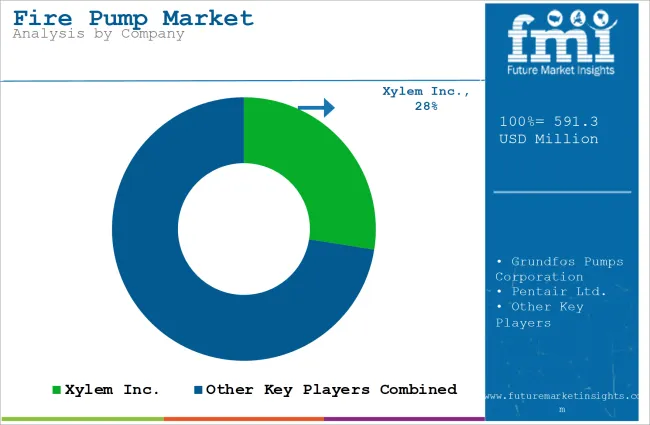
The fire pump market is experiencing significant advancements driven by technological innovations and an evolving regulatory framework. The sector is benefiting from trends such as increased emphasis on safety, environmental sustainability, and improved operational efficiency. As industries focus on enhancing fire safety measures, developments in pump technologies, including higher efficiency and more reliable materials, are shaping the market landscape.
Key players in the fire pump market are integrating cutting-edge technologies to enhance durability and performance. These advancements aim to optimize energy consumption, reduce maintenance costs, and ensure compliance with stringent fire safety standards.
With the rising adoption of smart building technologies, fire pumps are being equipped with IoT capabilities, enabling real-time monitoring and predictive maintenance, which are expected to drive demand for intelligent fire protection solutions
Geographic expansion remains a pivotal strategy for leading companies, particularly in emerging markets where industrialization and urbanization are accelerating. Additionally, the entry of start-ups and smaller firms is intensifying competition and fostering innovation. This dynamic market environment is expected to propel the industry forward, with continuous introduction of advanced fire pump systems to meet the evolving safety and operational requirements of various sectors.
Recent Developments:
- In January 2026, Armstrong Fluid Technology introduced a new range of Constant Speed Vertical-In-Line Fire Pumps with high-pressure ratings up to 160 PSI for 60Hz and 50Hz markets.
- In November 2025, Sulzer won a contract to supply multiple integrated pump skids for Petrobras P-84 and P-85 FPSOs, with delivery scheduled for early 2026.
- In June 2024, Halma acquired Global Fire Equipment, S.A. for approximately EUR 42.5 million to enhance its global fire safety and protection capabilities across 90 countries.
Key Players
- Xylem Inc.
- Grundfos Pumps Corporation
- Pentair Ltd.
- CET Fire Pumps Mfg. Inc
- Eaton
- Waterous
- NAFFCO
- Armstrong Fluid Technology
- Canariis Corporation
- EBARA CORPORATION
Market Definition
The fire pump market represents revenue generated from pumps specifically designed, certified, and installed for fire suppression and fire protection systems in commercial buildings, industrial facilities, and marine vessels. The market measures the value of fire pump units, controllers, and integrated skid packages sold to fire protection contractors, building owners, and shipyards.
Inclusions cover horizontal split-case pumps, vertical turbine pumps, vertical in-line pumps, and end-suction pumps certified under NFPA 20 or equivalent standards. It includes fire pump controllers, jockey pumps, and integrated pump room skid packages. Diesel-driven and electric motor-driven configurations are both included.
Exclusions include portable fire extinguisher equipment, fire hydrant infrastructure, and water mist systems that do not use dedicated fire pump units. General-purpose industrial pumps not certified for fire protection service and residential sprinkler booster pumps below commercial thresholds are outside the scope.
Scope of Report
| Items | Values |
|---|---|
| Quantitative Units (2026) | USD 613.8 Million |
| Product Type | Horizontal Split-Case, Vertical Turbine, Vertical In-Line, End-Suction, Packaged Pump Systems |
| Drive Type | Electric Motor, Diesel Engine |
| End User | Commercial Buildings, Industrial Facilities, Oil and Gas (Offshore), Marine and Shipbuilding |
| Regions Covered | North America, Europe, Asia Pacific, Latin America, Middle East and Africa |
| Key Companies Profiled | Armstrong Fluid Technology, Grundfos, Sulzer, Pentair, Xylem, Halma |
Key Segmentation
By Product Type:
In terms of product type, the industry is divided into horizontal split case, vertical split case, vertical in line, vertical turbine and end suction.
By Power for Operating:
In terms of power for operating, the industry is divided into electric fire pumps, diesel fire pumps, steam turbine and dual fire pumps.
By Application:
In terms of application, the industry is divided into Industry application, commercial application, field emergency, public infrastructure and others.
By Region:
Key regions of North America, Latin America, Western Europe, Eastern Europe, East Asia, South Asia Pacific and Middle East & Africa have been covered in the report.
Bibliography
- Armstrong Fluid Technology. (2026, January). Armstrong introduces new range of vertical-in-line fire pumps. Impeller.net.
- Sulzer Ltd. (2025, November). Seatrium selects Sulzer leading pumps packages for Petrobras. Sulzer Press Releases.
- Pentair plc. (2025, December). Pentair announces 8 percent rate increase to quarterly cash dividend and authorizes new USD 1 billion share repurchase program. Pentair Investor Relations.
- National Fire Protection Association. (2025). NFPA 20: Standard for the installation of stationary pumps for fire protection. NFPA.
Frequently Asked Questions
What is the current global market size for Fire Pump?
The global market is valued at USD 613.8 Million in 2026, driven by the enforcement of fire safety codes in commercial and industrial construction and the growing demand for high-pressure systems in energy infrastructure.
What is the projected Compound Annual Growth Rate (CAGR) for the market over the next 10 years?
The market is projected to grow at a CAGR of 3.8% from 2026 to 2036.
Which regions are experiencing the fastest expansion?
Asia Pacific leads driven by rapid urbanization and construction safety code enforcement in India and China, followed by Latin America where offshore energy infrastructure is expanding.
What are the primary market drivers?
Tightening fire safety code enforcement in high-rise construction and the expansion of offshore energy infrastructure requiring specialized fire suppression systems are the primary market drivers.
Who are the leading suppliers in the industry?
Armstrong Fluid Technology, Sulzer, Halma (GFE), Pentair, and Kirloskar Brothers are key players, differentiating through high-pressure VIL technology and offshore-rated fire suppression systems.
Preview the report firsthand - request a free sample
Get SampleGet the brochure for pricing and purchase details.
Get PDFTable of Content
- Executive Summary
- Global Market Outlook
- Demand-side Trends
- Supply-side Trends
- Technology Roadmap Analysis
- Analysis and Recommendations
- Market Overview
- Market Coverage / Taxonomy
- Market Definition / Scope / Limitations
- Research Methodology
- Chapter Orientation
- Analytical Lens and Working Hypotheses
- Market Structure, Signals, and Trend Drivers
- Benchmarking and Cross-market Comparability
- Market Sizing, Forecasting, and Opportunity Mapping
- Research Design and Evidence Framework
- Desk Research Programme (Secondary Evidence)
- Company Annual and Sustainability Reports
- Peer-reviewed Journals and Academic Literature
- Corporate Websites, Product Literature, and Technical Notes
- Earnings Decks and Investor Briefings
- Statutory Filings and Regulatory Disclosures
- Technical White Papers and Standards Notes
- Trade Journals, Industry Magazines, and Analyst Briefs
- Conference Proceedings, Webinars, and Seminar Materials
- Government Statistics Portals and Public Data Releases
- Press Releases and Reputable Media Coverage
- Specialist Newsletters and Curated Briefings
- Sector Databases and Reference Repositories
- FMI Internal Proprietary Databases and Historical Market Datasets
- Subscription Datasets and Paid Sources
- Social Channels, Communities, and Digital Listening Inputs
- Additional Desk Sources
- Expert Input and Fieldwork (Primary Evidence)
- Primary Modes
- Qualitative Interviews and Expert Elicitation
- Quantitative Surveys and Structured Data Capture
- Blended Approach
- Why Primary Evidence is Used
- Field Techniques
- Interviews
- Surveys
- Focus Groups
- Observational and In-context Research
- Social and Community Interactions
- Stakeholder Universe Engaged
- C-suite Leaders
- Board Members
- Presidents and Vice Presidents
- R&D and Innovation Heads
- Technical Specialists
- Domain Subject-matter Experts
- Scientists
- Physicians and Other Healthcare Professionals
- Governance, Ethics, and Data Stewardship
- Research Ethics
- Data Integrity and Handling
- Primary Modes
- Tooling, Models, and Reference Databases
- Desk Research Programme (Secondary Evidence)
- Data Engineering and Model Build
- Data Acquisition and Ingestion
- Cleaning, Normalisation, and Verification
- Synthesis, Triangulation, and Analysis
- Quality Assurance and Audit Trail
- Market Background
- Market Dynamics
- Drivers
- Restraints
- Opportunity
- Trends
- Scenario Forecast
- Demand in Optimistic Scenario
- Demand in Likely Scenario
- Demand in Conservative Scenario
- Opportunity Map Analysis
- Product Life Cycle Analysis
- Supply Chain Analysis
- Investment Feasibility Matrix
- Value Chain Analysis
- PESTLE and Porter’s Analysis
- Regulatory Landscape
- Regional Parent Market Outlook
- Production and Consumption Statistics
- Import and Export Statistics
- Market Dynamics
- Global Market Analysis 2021 to 2025 and Forecast, 2026 to 2036
- Historical Market Size Value (USD Million) Analysis, 2021 to 2025
- Current and Future Market Size Value (USD Million) Projections, 2026 to 2036
- Y-o-Y Growth Trend Analysis
- Absolute $ Opportunity Analysis
- Global Market Pricing Analysis 2021 to 2025 and Forecast 2026 to 2036
- Global Market Analysis 2021 to 2025 and Forecast 2026 to 2036, By Product Type
- Introduction / Key Findings
- Historical Market Size Value (USD Million) Analysis By Product Type , 2021 to 2025
- Current and Future Market Size Value (USD Million) Analysis and Forecast By Product Type , 2026 to 2036
- Horizontal Split Case
- Vertical Split Case
- Vertical in Line
- Vertical Turbine
- End Suction
- Horizontal Split Case
- Y-o-Y Growth Trend Analysis By Product Type , 2021 to 2025
- Absolute $ Opportunity Analysis By Product Type , 2026 to 2036
- Global Market Analysis 2021 to 2025 and Forecast 2026 to 2036, By Application
- Introduction / Key Findings
- Historical Market Size Value (USD Million) Analysis By Application, 2021 to 2025
- Current and Future Market Size Value (USD Million) Analysis and Forecast By Application, 2026 to 2036
- Industry Application
- Commercial Application
- Field Emergency
- Public Infrastructure
- Industry Application
- Y-o-Y Growth Trend Analysis By Application, 2021 to 2025
- Absolute $ Opportunity Analysis By Application, 2026 to 2036
- Global Market Analysis 2021 to 2025 and Forecast 2026 to 2036, By Region
- Introduction
- Historical Market Size Value (USD Million) Analysis By Region, 2021 to 2025
- Current Market Size Value (USD Million) Analysis and Forecast By Region, 2026 to 2036
- North America
- Latin America
- Western Europe
- Eastern Europe
- East Asia
- South Asia and Pacific
- Middle East & Africa
- Market Attractiveness Analysis By Region
- North America Market Analysis 2021 to 2025 and Forecast 2026 to 2036, By Country
- Historical Market Size Value (USD Million) Trend Analysis By Market Taxonomy, 2021 to 2025
- Market Size Value (USD Million) Forecast By Market Taxonomy, 2026 to 2036
- By Country
- USA
- Canada
- Mexico
- By Product Type
- By Application
- By Country
- Market Attractiveness Analysis
- By Country
- By Product Type
- By Application
- Key Takeaways
- Latin America Market Analysis 2021 to 2025 and Forecast 2026 to 2036, By Country
- Historical Market Size Value (USD Million) Trend Analysis By Market Taxonomy, 2021 to 2025
- Market Size Value (USD Million) Forecast By Market Taxonomy, 2026 to 2036
- By Country
- Brazil
- Chile
- Rest of Latin America
- By Product Type
- By Application
- By Country
- Market Attractiveness Analysis
- By Country
- By Product Type
- By Application
- Key Takeaways
- Western Europe Market Analysis 2021 to 2025 and Forecast 2026 to 2036, By Country
- Historical Market Size Value (USD Million) Trend Analysis By Market Taxonomy, 2021 to 2025
- Market Size Value (USD Million) Forecast By Market Taxonomy, 2026 to 2036
- By Country
- Germany
- UK
- Italy
- Spain
- France
- Nordic
- BENELUX
- Rest of Western Europe
- By Product Type
- By Application
- By Country
- Market Attractiveness Analysis
- By Country
- By Product Type
- By Application
- Key Takeaways
- Eastern Europe Market Analysis 2021 to 2025 and Forecast 2026 to 2036, By Country
- Historical Market Size Value (USD Million) Trend Analysis By Market Taxonomy, 2021 to 2025
- Market Size Value (USD Million) Forecast By Market Taxonomy, 2026 to 2036
- By Country
- Russia
- Poland
- Hungary
- Balkan & Baltic
- Rest of Eastern Europe
- By Product Type
- By Application
- By Country
- Market Attractiveness Analysis
- By Country
- By Product Type
- By Application
- Key Takeaways
- East Asia Market Analysis 2021 to 2025 and Forecast 2026 to 2036, By Country
- Historical Market Size Value (USD Million) Trend Analysis By Market Taxonomy, 2021 to 2025
- Market Size Value (USD Million) Forecast By Market Taxonomy, 2026 to 2036
- By Country
- China
- Japan
- South Korea
- By Product Type
- By Application
- By Country
- Market Attractiveness Analysis
- By Country
- By Product Type
- By Application
- Key Takeaways
- South Asia and Pacific Market Analysis 2021 to 2025 and Forecast 2026 to 2036, By Country
- Historical Market Size Value (USD Million) Trend Analysis By Market Taxonomy, 2021 to 2025
- Market Size Value (USD Million) Forecast By Market Taxonomy, 2026 to 2036
- By Country
- India
- ASEAN
- Australia & New Zealand
- Rest of South Asia and Pacific
- By Product Type
- By Application
- By Country
- Market Attractiveness Analysis
- By Country
- By Product Type
- By Application
- Key Takeaways
- Middle East & Africa Market Analysis 2021 to 2025 and Forecast 2026 to 2036, By Country
- Historical Market Size Value (USD Million) Trend Analysis By Market Taxonomy, 2021 to 2025
- Market Size Value (USD Million) Forecast By Market Taxonomy, 2026 to 2036
- By Country
- Kingdom of Saudi Arabia
- Other GCC Countries
- Turkiye
- South Africa
- Other African Union
- Rest of Middle East & Africa
- By Product Type
- By Application
- By Country
- Market Attractiveness Analysis
- By Country
- By Product Type
- By Application
- Key Takeaways
- Key Countries Market Analysis
- USA
- Pricing Analysis
- Market Share Analysis, 2025
- By Product Type
- By Application
- Canada
- Pricing Analysis
- Market Share Analysis, 2025
- By Product Type
- By Application
- Mexico
- Pricing Analysis
- Market Share Analysis, 2025
- By Product Type
- By Application
- Brazil
- Pricing Analysis
- Market Share Analysis, 2025
- By Product Type
- By Application
- Chile
- Pricing Analysis
- Market Share Analysis, 2025
- By Product Type
- By Application
- Germany
- Pricing Analysis
- Market Share Analysis, 2025
- By Product Type
- By Application
- UK
- Pricing Analysis
- Market Share Analysis, 2025
- By Product Type
- By Application
- Italy
- Pricing Analysis
- Market Share Analysis, 2025
- By Product Type
- By Application
- Spain
- Pricing Analysis
- Market Share Analysis, 2025
- By Product Type
- By Application
- France
- Pricing Analysis
- Market Share Analysis, 2025
- By Product Type
- By Application
- India
- Pricing Analysis
- Market Share Analysis, 2025
- By Product Type
- By Application
- ASEAN
- Pricing Analysis
- Market Share Analysis, 2025
- By Product Type
- By Application
- Australia & New Zealand
- Pricing Analysis
- Market Share Analysis, 2025
- By Product Type
- By Application
- China
- Pricing Analysis
- Market Share Analysis, 2025
- By Product Type
- By Application
- Japan
- Pricing Analysis
- Market Share Analysis, 2025
- By Product Type
- By Application
- South Korea
- Pricing Analysis
- Market Share Analysis, 2025
- By Product Type
- By Application
- Russia
- Pricing Analysis
- Market Share Analysis, 2025
- By Product Type
- By Application
- Poland
- Pricing Analysis
- Market Share Analysis, 2025
- By Product Type
- By Application
- Hungary
- Pricing Analysis
- Market Share Analysis, 2025
- By Product Type
- By Application
- Kingdom of Saudi Arabia
- Pricing Analysis
- Market Share Analysis, 2025
- By Product Type
- By Application
- Turkiye
- Pricing Analysis
- Market Share Analysis, 2025
- By Product Type
- By Application
- South Africa
- Pricing Analysis
- Market Share Analysis, 2025
- By Product Type
- By Application
- USA
- Market Structure Analysis
- Competition Dashboard
- Competition Benchmarking
- Market Share Analysis of Top Players
- By Regional
- By Product Type
- By Application
- Competition Analysis
- Competition Deep Dive
- Xylem Inc.
- Overview
- Product Portfolio
- Profitability by Market Segments (Product/Age /Sales Channel/Region)
- Sales Footprint
- Strategy Overview
- Marketing Strategy
- Product Strategy
- Channel Strategy
- Grundfos Pumps Corporation
- Pentair Ltd.
- CET Fire Pumps Mfg. Inc
- Eaton
- Xylem Inc.
- Competition Deep Dive
- Assumptions & Acronyms Used


