

- Industry Size (2026)
- USD 2.32 Bn
- Forecast (2036)
- USD 3.69 Bn
- CAGR (2026 to 2036)
- 4.7%
Compostable Foodservice Packaging Outlook in the UK 2026 to 2036
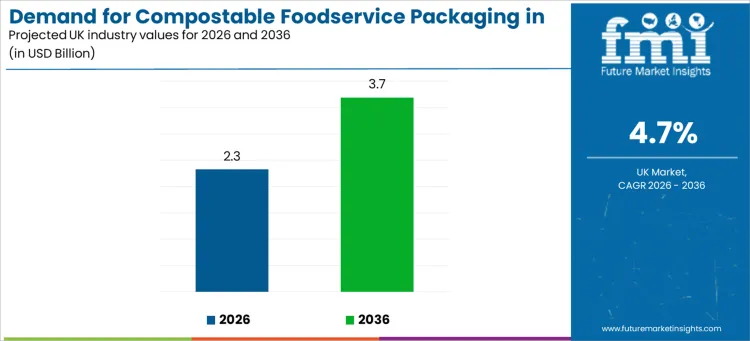
The scope for compostable foodservice packaging in the UK is projected to reach USD 2.32 billion in 2026. Demand is expected to rise to USD 3.69 billion by 2036, expanding at a 4.7% CAGR. This demand curve is shaped by day-to-day decisions made by chain restaurant operators, café networks, delivery-focused kitchens, catering firms, and packaging procurement teams.
The compostable foodservice packaging landscape in UK has become a practical tool for addressing food-contact safety expectations, brand sustainability commitments, waste-handling realities, and packaging reporting duties. Consumers no longer prefer materials only for appearance or cost. They evaluate whether packaging holds heat, resists grease, stacks efficiently, survives last-mile delivery, and still supports credible end-of-life outcomes in the UK’s waste stream.
At the operational level, performance still wins orders. A plate that warps under hot food, a bowl that leaks, or a cup that softens too quickly can disrupt service speed and damage customer trust. At the leadership level, procurement is being aligned with a wider set of targets such as packaging weight discipline, material traceability, and reduced dependence on hard-to-recycle formats.
Quick Stats for Compostable Foodservice Packaging Demand in the UK
- Compostable Foodservice Packaging Valuation in the UK (2026): USD 2.32 billion
- Compostable Foodservice Packaging Forecast Valuation in the UK (2036): USD 3.69 billion
- Compostable Foodservice Packaging Forecast CAGR 2026 to 2036: 4.7%
- Leading Regional Growth: England (5.2%)
- Leading Material Type: Paper & Paperboard (36.1% share)
- Leading Packaging Type: Plates (36.4% share)
- Leading End Use: Chain Restaurants (41.0% share)
- Key Companies Profiled: Huhtamaki Oyj; Stora Enso Oyj; Georgia-Pacific LLC; WestRock Companies; Mondi Group
Compostable Foodservice Packaging Demand in UK Key Takeaways
| Metric | Value |
|---|---|
| Industry Value (2026) | USD 2.32 billion |
| Industry Forecast Value (2036) | USD 3.69 billion |
| Forecast CAGR 2026 to 2036 | 4.7% |
Why is the UK Scaling Compostable Foodservice Packaging Adoption?
UK foodservice operators are scaling adoption because policy direction, waste accountability, and consumer expectations are forcing packaging decisions to become more defensible. Regulatory pressure is a direct driver. The UK government’s guidance on bans and restrictions highlights that certain single-use plastic items are banned in England, including plastic cutlery and food and drink containers made of expanded and extruded polystyrene. These rules steer buyers toward fibre-based alternatives and certified compostable options where food contamination makes conventional recycling impractical.
Producer accountability is tightening as well. The UK government’s extended producer responsibility (EPR) guidance explains that organisations responsible for packaging may need to report packaging data and pay fees based on what they place on the UK market. For many foodservice brands, packaging is shifting from a back-office cost line into a compliance-visible input that needs measurement and governance.
Material claims and disposal instructions now matter as much as physical performance. Confusion around compostability is a known risk when packaging resembles conventional plastics. The UK government’s review of standards for bio-based, biodegradable, and compostable plastics highlights EN 13432 as a key composting standard and notes concerns about compostable plastics being confused with conventional plastics.
In response, brand owners are paying closer attention to how packaging is labelled, how it is routed in waste streams, and whether the packaging meets recognised compostability criteria. Strategic planning for this category often runs alongside trends in compostable foodservice packaging, with packaging portfolio work extending into adjacent formats such as compostable packaging films used in wraps, liners, and barrier applications.
How is Compostable Foodservice Packaging Demand Segmented by Material Type, Packaging Type, and End Use?
The compostable foodservice landscape in the UK is segmented by what operators need to deliver: speed of service, reliable handling, consistent presentation, and packaging that fits disposal realities.
Why are paper and paperboard formats becoming the default choice for high-volume foodservice operators?
Paper & paperboard account for a 36.1% share, making them the leading material category in the UK. This reflects the balance that fibre packaging offers across usability, supply availability, printability, and disposal familiarity. Operators prefer materials that provide a predictable customer experience and consistent stacking, especially in fast-moving service environments.
Paper and paperboard also support brand identity. They print cleanly, communicate sustainability positioning with minimal explanation, and allow rapid design refresh cycles. For stakeholders building roll-out programs across hundreds of outlets, this simplifies standardisation and reduces the risk of inconsistent presentation across locations. Material roadmaps are often planned in tandem with broader packaging portfolios tracked in the food packaging outlook, particularly where organisations want a common material strategy across dine-in, takeaway, and delivery packaging.
What makes plates the most specified format across chain-led service models?
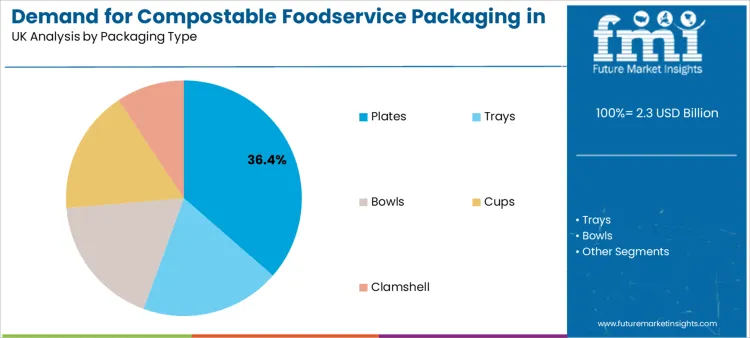
Plates hold a 36.4% share, placing them as the leading packaging type. This is driven by the volume reality of ready-to-eat meals, quick-service menus, and high-turnover dining formats where plates need to feel sturdy while staying cost-controlled. Plates are also among the most visible packaging items for consumers. Their feel and rigidity influence perceived quality even before the first bite.
Chain operators prioritise plates that resist grease and moisture, maintain shape under heat, and remain stable during carrying and stacking. Compostable formats compete best when they deliver these functional outcomes without requiring operational changes in kitchen prep, serving routines, or collection points.
Where plates are paired with delivery and last-mile packaging, operators often evaluate companion formats such as trays and clamshells. Packaging buyers frequently cross-evaluate this with compostable food trays share analysis when assessing stackability and food separation performance in high-volume order fulfillment.
Why are chain restaurants leading end-use demand for compostable foodservice packaging?
Chain restaurants represent a 41.0% share, making them the leading end-use segment. Chains scale packaging decisions quickly because standardisation is a business advantage. A single approved packaging format can be deployed across hundreds of outlets, improving procurement leverage, reducing operational variability, and strengthening brand consistency.
Chains also face the highest visibility. They receive greater scrutiny from customers, local authorities, and sustainability watchdogs. This creates a stronger incentive to use packaging that can be explained clearly, justified with certification, and integrated into a defensible waste-handling narrative. For chain leadership teams, the decision is frequently tied to reputational risk, franchise alignment, and standard operating procedures.
Non-chain restaurants, cafés, and delivery catering remain meaningful buyers as well. Their purchasing behaviour can be more fragmented, with a heavier focus on unit economics and local supplier availability. Their adoption rises fastest when compostable packaging delivers clear functional performance and avoids cost surprises.
For brands building takeout and delivery capabilities, demand also connects to fast-growing e-grocery and courier logistics packaging formats, including compostable delivery bags for e-grocery where durability and moisture control shape material selection.
What are the Dynamics, Restraints, Opportunities, and Threats Shaping this Space?
How are policy pressure and food waste management realities driving adoption?
Policy restrictions are pushing operators away from certain plastics, especially polystyrene food containers. UK government guidance confirms bans covering specific single-use plastic items including food and drink containers made of expanded and extruded polystyrene. This shifts procurement toward fibre-based formats and compostable alternatives, especially where food contamination reduces recycling feasibility.
Food waste collection and handling also influence decision-making. Compostable materials can be attractive where food-contact packaging is likely to carry contamination, creating an opportunity for co-collection strategies in the right local infrastructure contexts. WRAP’s guidance notes compostables can play a role when they are well-designed, clearly labelled, and supported by the right waste infrastructure.
What restraints slow wider adoption across all foodservice outlets?
Cost and performance trade-offs remain the biggest restraints. Operators need packaging that survives heat, moisture, handling speed, and delivery movement. If compostable options underperform on rigidity or leak resistance, buyer confidence drops fast.
Disposal uncertainty is another restraint. Confusion in waste streams increases contamination risk, which can trigger pushback from waste operators and lead brands to limit compostable usage to specific applications. UK government research on standards highlights the risk of compostable plastics being mistaken for conventional plastics. That risk drives stronger attention to labelling, certification, and staff training.
Compliance workload also increases. EPR rules require packaging data reporting for affected organisations. This adds internal workload and increases attention to packaging formats that are easier to classify, track, and report.
Where do the strongest opportunities sit for packaging suppliers and foodservice operators?
- Standardised portfolio conversion for chains: Chain operators can scale change across outlets quickly once a packaging set is approved. Suppliers that support consistent quality and capacity can win multi-year contracts. Many organisations align this work with broader compostable formats tracked in compostable packaging portfolio analysis.
- Barrier and grease-resistance innovation: Performance upgrades expand addressable use cases for bowls, clamshells, and trays. Development priorities often map to adoption patterns in compostable plastic packaging materials where functionality improvements expand food-contact applications.
- Delivery-first packaging optimisation: Operators want packaging that maintains heat retention, avoids sogginess, and protects food presentation through transit. This creates demand for formats aligned with compostable packaging films for liners and barrier layers.
What threats can disrupt growth trajectories?
Green claim risk is a growing threat. If compostability claims are not aligned with recognised standards, brands risk reputational damage and enforcement attention. Another threat is infrastructure mismatch. Compostable packaging works best when waste systems support correct routing. Without that alignment, packaging can end up as contamination in recycling streams or as residual waste, weakening the sustainability value case.
How is Compostable Foodservice Packaging Demand Evolving across Key Regions in the UK?
Regional demand varies with outlet density, chain penetration, procurement maturity, and local waste-handling practices.
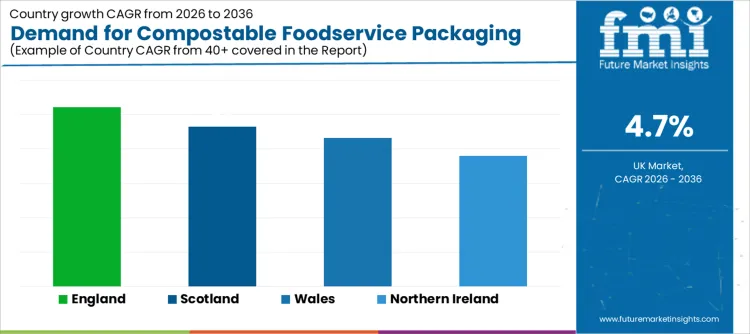
| Region | CAGR 2026 to 2036 |
|---|---|
| England | 5.2% |
| Scotland | 4.6% |
| Wales | 4.3% |
| Northern Ireland | 3.8% |
Why is England leading adoption through chain density and packaged meal volumes?
England grows at 5.2%, supported by higher concentration of chain outlets, delivery-first kitchens, and high-frequency takeaway demand. Larger procurement teams push standardisation faster, which accelerates adoption once packaging is approved. England’s retail and foodservice footprint also drives higher volumes of plates, cups, and clamshells, making conversion programs more impactful at scale.
How is Scotland building steady uptake through regulation-led shifts and packaging replacement cycles?
Scotland expands at 4.6%, driven by steady replacement cycles in cafés, takeaway operators, and catering services. Adoption is typically led by packaging functionality and supplier availability, with a strong focus on clear disposal communication and product reliability in colder weather conditions where temperature retention and moisture performance can matter.
What is shaping Wales as it grows demand through practical substitution in food-to-go formats?
Wales advances at 4.3%, supported by small-to-mid scale operators adopting compostable plates and bowls when they fit price targets and performance needs. Adoption rises when packaging suppliers offer simplified buying pathways, consistent stock availability, and formats that reduce operational friction for staff.
Why is Northern Ireland progressing with measured adoption focused on proven formats?
Northern Ireland grows at 3.8%, reflecting measured adoption where operators prioritise proven formats and stable performance. Buyers often adopt compostable packaging first in plates and cups, then extend into trays and bowls when customer response and service performance are validated.
What Defines the Competitive Landscape for Compostable Foodservice Packaging in the UK?
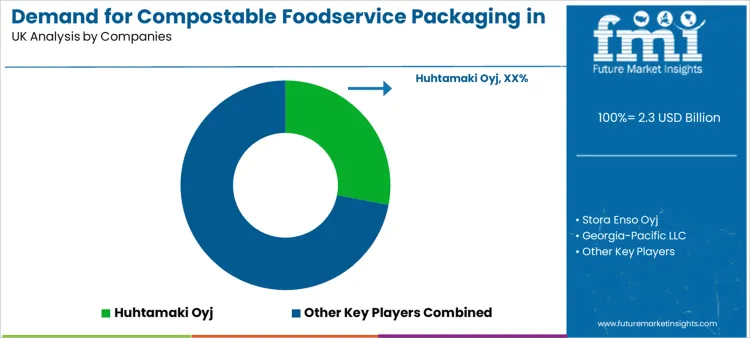
Competition is shaped by performance reliability, supply stability, and the ability to scale consistent products across national foodservice networks. Buyers evaluate suppliers on three practical questions: Does the packaging work under real service conditions, can it be delivered reliably at volume, and are claims defensible through recognised standards and certification pathways?
Huhtamaki Oyj competes through broad foodservice packaging portfolios and production scale suited to high-volume needs. Stora Enso Oyj brings fibre-based material strength and packaging capability aligned with paper-driven transitions.
Georgia-Pacific LLC operates across paper-based solutions relevant to food-contact and service packaging requirements. WestRock Companies contributes strong capabilities in paperboard packaging conversion and scalable formats. Mondi Group is positioned through packaging design, material innovation, and supply chain reach across multiple foodservice packaging needs.
Partnerships with chain restaurants often determine share gains. Suppliers that can support trial programs, provide consistent batch quality, and help operators optimise packaging SKUs across menus gain stronger long-term traction.
Key Industry Participants
- Huhtamaki Oyj
- Stora Enso Oyj
- Georgia-Pacific LLC
- WestRock Companies
- Mondi Group
Scope of Report
| Items | Values |
|---|---|
| Quantitative Units | USD Billion |
| Material Type | Paper & Paperboard; Plastic; Bagasse & Seaweed |
| Packaging Type | Plates; Trays; Bowls; Cups; Clamshell |
| End Use | Chain Restaurants; Non-Chain Restaurants; Chain Cafe; Non-Chain Cafe; Delivery Catering |
| Regions Covered | England; Scotland; Wales; Northern Ireland |
| Key Companies Profiled | Huhtamaki Oyj; Stora Enso Oyj; Georgia-Pacific LLC; WestRock Companies; Mondi Group |
Compostable Foodservice Packaging Demand in the UK by Segment
By Material Type
- Paper & Paperboard
- Plastic
- Bagasse & Seaweed
By Packaging Type
- Plates
- Trays
- Bowls
- Cups
- Clamshell
By End Use
- Chain Restaurants
- Non-Chain Restaurants
- Chain Café
- Non-Chain Café
- Delivery Catering
By Region
- England
- Scotland
- Wales
- Northern Ireland
Bibliography
- Department for Environment, Food and Rural Affairs. (2024). Single-use plastics: bans and restrictions.
- Department for Environment, Food and Rural Affairs. (2021). Standards for bio-based, biodegradable, and compostable plastics: Call for evidence.
- UK Government. (2024). Extended producer responsibility for packaging: who is affected and what to do.
- WRAP. (2025). Considerations for compostable plastic packaging. Organics Recycling Group. (n.d.). EN 13432: Compostable products and packaging.
- Renewable Energy Assurance Limited. (2021). Compostables labelling guidance.
Frequently Asked Questions
How big is the demand for compostable foodservice packaging in uk in 2026?
The demand for compostable foodservice packaging in uk is estimated to be valued at USD 2.3 billion in 2026.
What will be the size of compostable foodservice packaging in uk in 2036?
The market size for the compostable foodservice packaging in uk is projected to reach USD 3.7 billion by 2036.
How much will be the demand for compostable foodservice packaging in uk growth between 2026 and 2036?
The demand for compostable foodservice packaging in uk is expected to grow at a 4.7% CAGR between 2026 and 2036.
What are the key product types in the compostable foodservice packaging in uk?
The key product types in compostable foodservice packaging in uk are paper & paperboard, plastic and bagasse & seaweed.
Which packaging type segment is expected to contribute significant share in the compostable foodservice packaging in uk in 2026?
In terms of packaging type, plates segment is expected to command 36.4% share in the compostable foodservice packaging in uk in 2026.
Preview the report firsthand - request a free sample
Get SampleGet the brochure for pricing and purchase details.
Get PDFTable of Content
- Executive Summary
- UK Market Outlook
- Demand-side Trends
- Supply-side Trends
- Technology Roadmap Analysis
- Analysis and Recommendations
- Market Overview
- Market Coverage / Taxonomy
- Market Definition / Scope / Limitations
- Market Background
- Market Dynamics
- Drivers
- Restraints
- Opportunity
- Trends
- Scenario Forecast
- Demand in Optimistic Scenario
- Demand in Likely Scenario
- Demand in Conservative Scenario
- Opportunity Map Analysis
- Product Life Cycle Analysis
- Supply Chain Analysis
- Investment Feasibility Matrix
- Value Chain Analysis
- PESTLE and Porter’s Analysis
- Regulatory Landscape
- Regional Parent Market Outlook
- Production and Consumption Statistics
- Import and Export Statistics
- Market Dynamics
- UK Market Analysis 2021 to 2025 and Forecast, 2026 to 2036
- Historical Market Size Value (USD Million) Analysis, 2021 to 2025
- Current and Future Market Size Value (USD Million) Projections, 2026 to 2036
- Y-o-Y Growth Trend Analysis
- Absolute $ Opportunity Analysis
- UK Market Pricing Analysis 2021 to 2025 and Forecast 2026 to 2036
- UK Market Analysis 2021 to 2025 and Forecast 2026 to 2036, By Material Type
- Introduction / Key Findings
- Historical Market Size Value (USD Million) Analysis By Material Type , 2021 to 2025
- Current and Future Market Size Value (USD Million) Analysis and Forecast By Material Type , 2026 to 2036
- Paper & Paperboard
- Plastic
- Bagasse & Seaweed
- Paper & Paperboard
- Y-o-Y Growth Trend Analysis By Material Type , 2021 to 2025
- Absolute $ Opportunity Analysis By Material Type , 2026 to 2036
- UK Market Analysis 2021 to 2025 and Forecast 2026 to 2036, By Packaging Type
- Introduction / Key Findings
- Historical Market Size Value (USD Million) Analysis By Packaging Type, 2021 to 2025
- Current and Future Market Size Value (USD Million) Analysis and Forecast By Packaging Type, 2026 to 2036
- Plates
- Trays
- Bowls
- Cups
- Clamshell
- Plates
- Y-o-Y Growth Trend Analysis By Packaging Type, 2021 to 2025
- Absolute $ Opportunity Analysis By Packaging Type, 2026 to 2036
- UK Market Analysis 2021 to 2025 and Forecast 2026 to 2036, By End Use
- Introduction / Key Findings
- Historical Market Size Value (USD Million) Analysis By End Use, 2021 to 2025
- Current and Future Market Size Value (USD Million) Analysis and Forecast By End Use, 2026 to 2036
- Chain Restaurants
- Non-Chain Restaurants
- Chain Cafe
- Non-Chain Cafe
- Delivery Catering
- Chain Restaurants
- Y-o-Y Growth Trend Analysis By End Use, 2021 to 2025
- Absolute $ Opportunity Analysis By End Use, 2026 to 2036
- Market Structure Analysis
- Competition Dashboard
- Competition Benchmarking
- Market Share Analysis of Top Players
- By Regional
- By Material Type
- By Packaging Type
- By End Use
- Competition Analysis
- Competition Deep Dive
- Huhtamaki Oyj
- Overview
- Product Portfolio
- Profitability by Market Segments (Product/Age /Sales Channel/Region)
- Sales Footprint
- Strategy Overview
- Marketing Strategy
- Product Strategy
- Channel Strategy
- Stora Enso Oyj
- Georgia-Pacific LLC
- WestRock Companies
- Mondi Group
- Huhtamaki Oyj
- Competition Deep Dive
- Assumptions & Acronyms Used
- Research Methodology


