

- Industry Size (2026)
- USD 3.2 Bn
- Forecast (2036)
- USD 5.1 Bn
- CAGR (2026 to 2036)
- 4.7%
Demand for Moisture-resistant Packaging in the UK 2026-2036
The moisture-resistant packaging industry in the UK is expected to grow from USD 3.2 billion in 2026 to USD 5.1 billion by 2036, reflecting a 4.7% CAGR. This growth is driven by industries such as food, pharmaceuticals, and electronics that require packaging solutions to protect sensitive products from moisture and extend their shelf life. Moisture-resistant packaging prevents degradation, microbial growth, and loss of functionality during storage and transit, aligning with consumer demand for products that maintain their integrity.
Retailers and manufacturers are increasingly prioritizing materials like coated films, laminates, and resealable pouches to offer reliable product protection. As sustainability concerns grow, manufacturers are also focusing on using recyclable and biodegradable materials in packaging, further reinforcing demand. In the UK, packaging solutions that offer both high performance and environmental responsibility are increasingly vital, particularly in sectors where quality preservation is crucial for maintaining consumer confidence and reducing returns.
Quick Stats for Moisture-Resistant Packaging Industry in the UK
- Moisture-Resistant Packaging Industry Value (2026): USD 3.2 billion
- Moisture-Resistant Packaging Industry Forecast Value (2036): USD 5.1 billion
- Moisture-Resistant Packaging Industry Forecast CAGR (2026-2036): 4.7%
- Leading Material by Demand Share: Glass
- Fastest-Growing Regions: England, Scotland, Wales, Northern Ireland
- Key Industry Participants: Amcor plc, Sonoco Products Company, Mondi Group, Westrock Company, Smurfit Kappa Group plc, DS Smith Plc
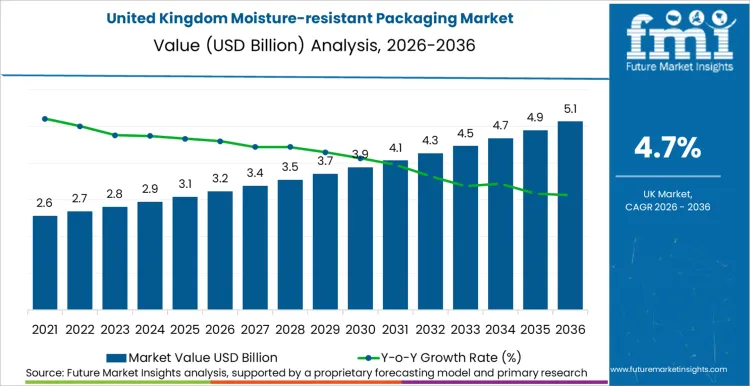
Moisture-resistant Packaging Industry in the UK Key Takeaways
| Metric | Value |
|---|---|
| Industry Value (2026) | USD 3.2 billion |
| Industry Forecast Value (2036) | USD 5.1 billion |
| Forecast CAGR (2026 to 2036) | 4.7% |
Why is the UK Building Steady Demand for Moisture Resistant Packaging?
Brands and buyers across the UK prioritize moisture‑resistant packaging because it markedly improves product protection during storage and transit. Goods that are susceptible to spoilage, clumping or degradation when exposed to moisture perform better when enclosed in protective layers that limit water vapour ingress. This reliability appeals to manufacturers who need to reduce stock losses and quality complaints.
Retail environments in the UK shape demand through practical handling and display expectations. Supermarkets, pharmacies and online fulfilment centres handle products through varied temperature and humidity conditions, which can compromise items like powders, electronics and hygroscopic ingredients. Moisture resistant packaging keeps goods stable on shelf and in warehouse racks, which aligns with buyer priorities for consistent performance rather than occasional use.
Consumer purchase behaviour also influences uptake. UK shoppers evaluate packaging based on perceived product freshness and integrity when unboxing or using an item for the first time. Visible signs of moisture exposure erode confidence and increase return rates, prompting brands to specify moisture barriers early in design. Materials such as coated films, laminates and sealable pouches become standard when preserving product quality matters, driving sustained demand across categories where moisture sensitivity is a concern.
How is Moisture-Resistant Packaging Demand Segmented by Material, Packaging Type, and End Use in the UK?
Demand for moisture-resistant packaging in the UK reflects the growing need for reliable solutions that protect products from environmental factors such as moisture, air, and light. Segmentation follows material preferences, packaging requirements, and the specific needs of industries that rely on moisture protection to maintain product quality and shelf life.
Why does glass lead material-level demand?
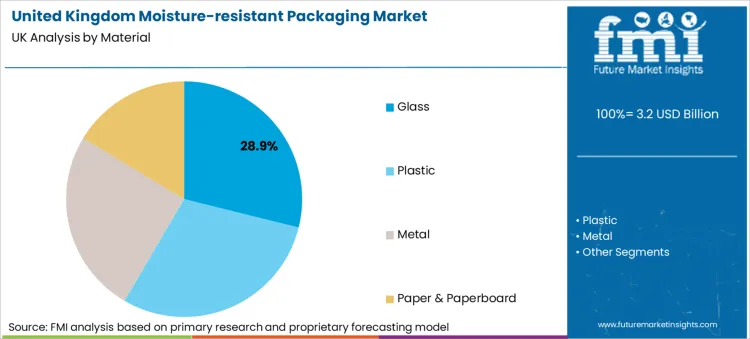
Glass accounts for 28.9% of the demand, reflecting its widespread use in moisture-sensitive applications. Glass packaging provides a high level of impermeability, protecting products from moisture and other contaminants. Its rigid structure, combined with its ability to create airtight seals, makes it an ideal choice for preserving the integrity of contents in sectors like food and beverages, pharmaceuticals, and cosmetics.
Consumers and manufacturers alike value glass for its sustainability and premium appeal, as it is 100% recyclable and maintains its protective qualities throughout the supply chain. Glass is a preferred material for high-end products, as it conveys a sense of quality and stability.
What keeps bags and pouches as the dominant packaging type?
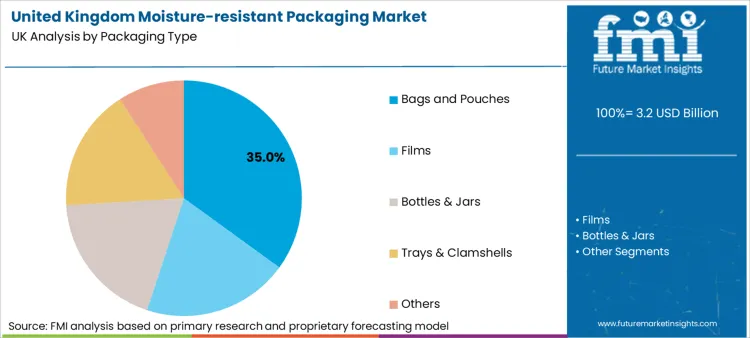
Bags and pouches account for 35.0% of the demand, driven by their versatility, convenience, and effectiveness in providing moisture protection. These packaging formats are commonly used in the food and beverage industry, particularly for products like snacks, dried foods, and pet food, where moisture resistance is crucial for preserving freshness and preventing spoilage.
Bags and pouches offer easy transport, storage, and cost-effective packaging solutions, especially when combined with moisture-resistant films. Their ability to be custom-designed with resealable closures further adds to their popularity, enhancing product usability and prolonging shelf life.
Why does the chemical and fertilizer industry lead end-use demand?
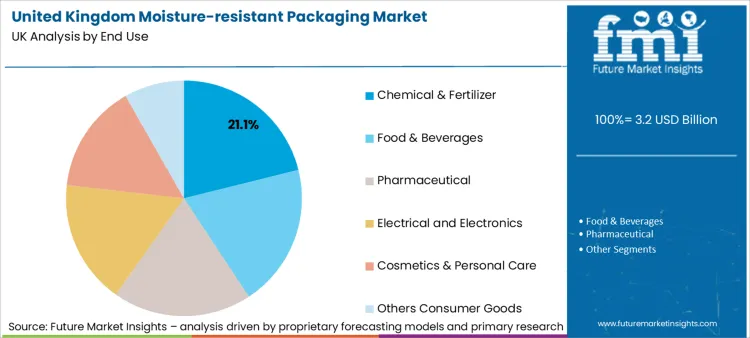
The chemical and fertilizer industry accounts for 21.1% of the demand, reflecting the critical need for moisture-resistant packaging to protect sensitive chemical products. Many chemicals and fertilizers are hygroscopic, meaning they absorb moisture from the air, which can affect their efficacy, stability, and performance. Packaging solutions that offer strong moisture barriers, such as metal, plastic, or specialized laminated bags, are essential for maintaining product quality.
Moisture-resistant packaging also helps ensure that these materials are safely transported, stored, and used in a variety of conditions, meeting industry standards for safety and regulatory compliance.
What are the Key Dynamics in Demand for Moisture Resistant Packaging in the UK?
Demand for moisture‑resistant packaging in the UK is driven by the need to protect products that are sensitive to water vapour during storage, transport, and display. Sectors such as chilled and ambient food, pharmaceuticals, electronics, and personal care prioritise barrier performance to prevent quality degradation, microbial growth, and loss of functionality. Brands and retailers seek materials that extend shelf life while maintaining appearance, structural integrity, and safety compliance. Consumer awareness of hygiene, freshness and product durability also shapes uptake of moisture‑barrier solutions across grocery, healthcare and durable goods categories.
How does product protection need in specific categories influence uptake?
Moisture‑resistant packaging demand rises sharply where product quality and safety outcomes are at stake. In food categories such as chilled meats, dairy products, bakery, snacks and dehydrated foods, effective barrier films and laminates prevent moisture ingress that can accelerate spoilage, texture loss or microbial contamination. Multi‑layer films with tailored moisture transmission rates are required to match different moisture sensitivities, for example ultra‑low moisture transmission for crisp snacks versus moderate resistance for produce. In pharmaceuticals and nutraceuticals, moisture can degrade active ingredients; blister packs, foil laminates and desiccant‑integrated packaging are specified to maintain potency and meet regulatory stability requirements.
How do sustainability expectations and material performance constraints shape ongoing demand?
Growth in moisture‑resistant packaging in the UK is influenced by balancing functional performance with sustainability expectations. Brands face pressure to reduce plastic use, increase recycled content and enhance recyclability, but moisture‑barrier structures often involve multi‑layer polymers that can complicate recycling streams. Innovation in mono‑material barrier films and high‑barrier coatings helps reconcile performance with recycling infrastructure limitations in UK waste systems. Cost considerations affect adoption where premium barrier materials command higher price points, especially in commodity categories such as ambient snacks. Regulatory focus on packaging waste reduction and consumer demand for clear environmental claims shape where brands invest in advanced moisture‑barrier solutions that also support circularity goals.
How is Moisture-resistant Packaging Demand Evolving across Key Regions in the UK?
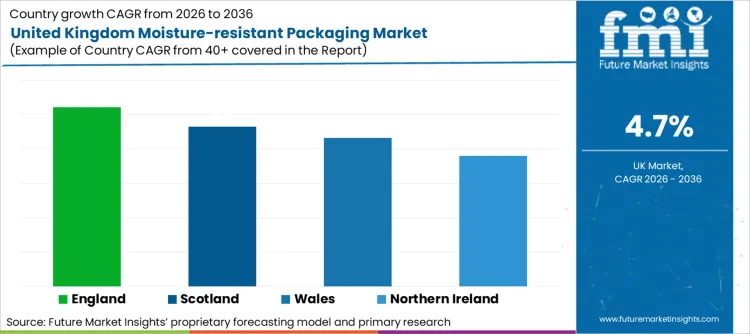
Demand for moisture-resistant packaging across the UK grows as industries focus on preserving product integrity and enhancing shelf life. Regional variation reflects production needs, packaging material innovation, and how manufacturers address challenges related to moisture control, product protection, and sustainability in sectors like food, pharmaceuticals, and electronics.
| Region | CAGR (2026-2036) |
|---|---|
| England | 5.2% |
| Scotland | 4.6% |
| Wales | 4.3% |
| Northern Ireland | 3.8% |
Why is England leading expansion through high-demand packaging and supply chain innovation?
England grows at 5.2%, supported by large-scale production and widespread demand for moisture-resistant packaging across the food, beverage, and pharmaceutical sectors. Demand rises where manufacturers prioritize packaging that ensures long shelf life and protects sensitive products from moisture, ensuring integrity during storage and transport. Companies focus on materials and designs that optimize product protection and reduce spoilage risk.
How is Scotland progressing through targeted adoption in specialized industries?
Scotland expands at 4.6%, driven by steady adoption in sectors where moisture control is crucial, such as pharmaceuticals and personal care. Demand builds where packaging solutions meet strict regulatory standards while preserving product performance. Manufacturers in Scotland favour materials that offer high moisture resistance while being adaptable to smaller production runs and specific industry requirements.
What is shaping Wales as manufacturers focus on practical, cost-effective moisture protection?
Wales advances at 4.3%, driven by manufacturers who balance functionality and cost when selecting moisture-resistant packaging. Demand strengthens when companies utilise moisture-proof materials that align with sustainability goals and reduce environmental impact. Packaging solutions that offer a good balance between moisture resistance and material cost are key for product segments with moderate volume needs.
Why is Northern Ireland showing measured growth tied to niche applications and small-scale production?
Northern Ireland records 3.8% growth, reflecting selective adoption in niche industries where moisture-resistant packaging is crucial. Adoption progresses where manufacturers require packaging that addresses specific product needs without large-scale production constraints. Demand improves when companies focus on targeted sectors such as specialty foods or cosmetics, where moisture resistance is vital but production volumes remain more limited.
What Defines the Competitive Landscape for Moisture-resistant Packaging in the UK?
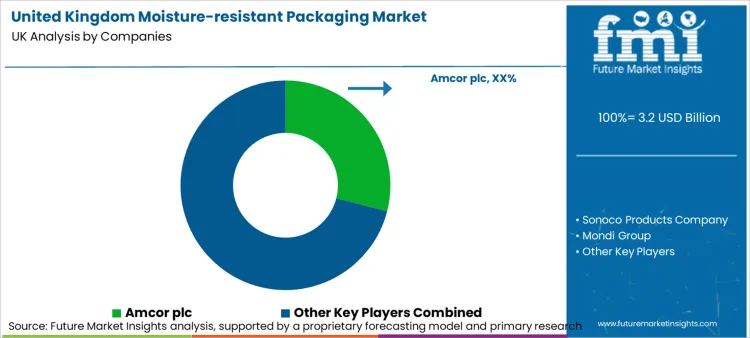
Demand for moisture-resistant packaging in the UK is driven by the need to preserve product quality and extend shelf life, especially in food, pharmaceuticals, and electronics. Buyers assess packaging solutions based on barrier properties, sealing integrity, durability under varying environmental conditions, and the ability to prevent moisture infiltration. Evaluation also includes material sustainability, recyclability, and ease of use, especially for products requiring long-term storage or transportation. Procurement behavior focuses on suppliers offering reliable moisture resistance, strong customization capabilities, and alignment with eco-friendly initiatives. The trend in the UK industry reflects increasing interest in sustainable, biodegradable, or recyclable moisture-resistant packaging as environmental concerns continue to rise.
Amcor plc leads competitive positioning in the UK by offering advanced moisture-resistant packaging solutions that meet strict regulatory standards for food safety and pharmaceutical packaging. Sonoco Products Company competes with its diverse portfolio of moisture-resistant packaging for various industries, providing robust and reliable solutions for the food and consumer goods sectors. Mondi Group maintains relevance with sustainable moisture-resistant packaging, emphasizing the use of paper-based materials and eco-friendly solutions that reduce plastic waste. Westrock Company supports demand by offering moisture-resistant corrugated packaging and solutions tailored to e-commerce and industrial applications. Smurfit Kappa Group plc participates with high-performance, moisture-resistant corrugated packaging aimed at the food and beverage industry. DS Smith Plc is also active in this industry, providing innovative moisture-resistant packaging, particularly for the food and beverage sector, with a strong focus on sustainability. Competitive differentiation centers on material quality, barrier performance, sustainability credentials, and the ability to support a wide range of industries with tailored moisture-resistant solutions.
Key Industry Participants
- Amcor plc
- Sonoco Products Company
- Mondi Group
- Westrock Company
- Smurfit Kappa Group plc
- DS Smith Plc
Scope of Report
| Items | Values |
|---|---|
| Quantitative Units | USD billion |
| Material | Glass; Plastic; Metal; Paper & Paperboard |
| Packaging Type | Bags and Pouches; Films; Bottles & Jars; Trays & Clamshells; Others |
| End Use | Chemical & Fertilizer; Food & Beverages; Pharmaceutical; Electrical and Electronics; Cosmetics & Personal Care; Others Consumer Goods |
| Regions Covered | England; Scotland; Wales; Northern Ireland |
| Key Companies Profiled | Amcor plc; Sonoco Products Company; Mondi Group; Westrock Company; Smurfit Kappa Group plc; DS Smith Plc |
Moisture-resistant Packaging Demand in the UK by Segments
Material:
- Glass
- Plastic
- Metal
- Paper & Paperboard
Packaging Type:
- Bags and Pouches
- Films
- Bottles & Jars
- Trays & Clamshells
- Others
End Use:
- Chemical & Fertilizer
- Food & Beverages
- Pharmaceutical
- Electrical and Electronics
- Cosmetics & Personal Care
- Others Consumer Goods
By Region:
- England
- Scotland
- Wales
- Northern Ireland
Bibliography
- Food Standards Agency. (2023). Food contact materials and packaging safety requirements. UK Government.
- Medicines and Healthcare products Regulatory Agency. (2023). Guidance on packaging and moisture protection for medicinal products. UK Government.
- European Commission. (2023). Commission Regulation (EU) 2022/1616 on recycled plastic materials for food contact applications. European Union.
Frequently Asked Questions
How big is the moisture-resistant packaging industry in the UK in 2026?
The moisture-resistant packaging industry in the UK is projected to be valued at USD 3.2 billion in 2026.
What will be the size of the moisture-resistant packaging industry in the UK in 2036?
The industry size for moisture-resistant packaging in the UK is projected to reach USD 5.1 billion by 2036.
How much will the demand for moisture-resistant packaging in the UK grow between 2026 and 2036?
Demand for moisture-resistant packaging in the UK is projected to grow at a 4.7% CAGR between 2026 and 2036.
Which material type holds a significant share in the moisture-resistant packaging industry in the UK in 2026?
In terms of material type, glass is expected to account for a 28.9% share in 2026.
Which end-user segment contributes a major share in the moisture-resistant packaging industry in the UK in 2026?
The chemical & fertilizer industry is expected to account for 21.1% of the moisture-resistant packaging industry in the UK in 2026.
Preview the report firsthand - request a free sample
Get SampleGet the brochure for pricing and purchase details.
Get PDFTable of Content
- Executive Summary
- UK Market Outlook
- Demand-side Trends
- Supply-side Trends
- Technology Roadmap Analysis
- Analysis and Recommendations
- Market Overview
- Market Coverage / Taxonomy
- Market Definition / Scope / Limitations
- Research Methodology
- Chapter Orientation
- Analytical Lens and Working Hypotheses
- Market Structure, Signals, and Trend Drivers
- Benchmarking and Cross-market Comparability
- Market Sizing, Forecasting, and Opportunity Mapping
- Research Design and Evidence Framework
- Desk Research Programme (Secondary Evidence)
- Company Annual and Sustainability Reports
- Peer-reviewed Journals and Academic Literature
- Corporate Websites, Product Literature, and Technical Notes
- Earnings Decks and Investor Briefings
- Statutory Filings and Regulatory Disclosures
- Technical White Papers and Standards Notes
- Trade Journals, Industry Magazines, and Analyst Briefs
- Conference Proceedings, Webinars, and Seminar Materials
- Government Statistics Portals and Public Data Releases
- Press Releases and Reputable Media Coverage
- Specialist Newsletters and Curated Briefings
- Sector Databases and Reference Repositories
- Roots Internal Knowledge Base and Historical Datasets
- Subscription Datasets and Paid Sources
- Social Channels, Communities, and Digital Listening Inputs
- Additional Desk Sources
- Expert Input and Fieldwork (Primary Evidence)
- Primary Modes
- Qualitative Interviews and Expert Elicitation
- Quantitative Surveys and Structured Data Capture
- Blended A8oach
- Why Primary Evidence is Used
- Field Techniques
- Interviews
- Surveys
- Focus Groups
- Observational and In-context Research
- Social and Community Interactions
- Stakeholder Universe Engaged
- C-suite Leaders
- Board Members
- Presidents and Vice Presidents
- R&D and Innovation Heads
- Technical Specialists
- Domain Subject-matter Experts
- Scientists
- Physicians and Other Healthcare Professionals
- Governance, Ethics, and Data Stewardship
- Research Ethics
- Data Integrity and Handling
- Primary Modes
- Tooling, Models, and Reference Databases
- Desk Research Programme (Secondary Evidence)
- Data Engineering and Model Build
- Data Acquisition and Ingestion
- Cleaning, Normalisation, and Verification
- Synthesis, Triangulation, and Analysis
- Quality Assurance and Audit Trail
- Market Background
- Market Dynamics
- Drivers
- Restraints
- Opportunity
- Trends
- Scenario Forecast
- Demand in Optimistic Scenario
- Demand in Likely Scenario
- Demand in Conservative Scenario
- Opportunity Map Analysis
- Product Life Cycle Analysis
- Supply Chain Analysis
- Investment Feasibility Matrix
- Value Chain Analysis
- PESTLE and Porter’s Analysis
- Regulatory Landscape
- Regional Parent Market Outlook
- Production and Consumption Statistics
- Import and Export Statistics
- Market Dynamics
- UK Market Analysis 2021 to 2025 and Forecast, 2026 to 2036
- Historical Market Size Value (USD Million) Analysis, 2021 to 2025
- Current and Future Market Size Value (USD Million) Projections, 2026 to 2036
- Y-o-Y Growth Trend Analysis
- Absolute $ Opportunity Analysis
- UK Market Pricing Analysis 2021 to 2025 and Forecast 2026 to 2036
- UK Market Analysis 2021 to 2025 and Forecast 2026 to 2036, By Product Type
- Introduction / Key Findings
- Historical Market Size Value (USD Million) Analysis By Product Type , 2021 to 2025
- Current and Future Market Size Value (USD Million) Analysis and Forecast By Product Type , 2026 to 2036
- Laminated Tubes
- Aluminum Tubes
- Plastic Co-extrusion Tubes
- Laminated Tubes
- Y-o-Y Growth Trend Analysis By Product Type , 2021 to 2025
- Absolute $ Opportunity Analysis By Product Type , 2026 to 2036
- UK Market Analysis 2021 to 2025 and Forecast 2026 to 2036, By Capacity
- Introduction / Key Findings
- Historical Market Size Value (USD Million) Analysis By Capacity, 2021 to 2025
- Current and Future Market Size Value (USD Million) Analysis and Forecast By Capacity, 2026 to 2036
- 51 to 100 ml
- 101 to 150 ml
- Above 150 ml
- Less than 50 ml
- 51 to 100 ml
- Y-o-Y Growth Trend Analysis By Capacity, 2021 to 2025
- Absolute $ Opportunity Analysis By Capacity, 2026 to 2036
- UK Market Analysis 2021 to 2025 and Forecast 2026 to 2036, By End Use
- Introduction / Key Findings
- Historical Market Size Value (USD Million) Analysis By End Use, 2021 to 2025
- Current and Future Market Size Value (USD Million) Analysis and Forecast By End Use, 2026 to 2036
- Pharmaceuticals
- Cosmetics
- Oral Care
- Commercial & Industrial
- Home & Other Personal Care
- Food
- Others
- Pharmaceuticals
- Y-o-Y Growth Trend Analysis By End Use, 2021 to 2025
- Absolute $ Opportunity Analysis By End Use, 2026 to 2036
- Market Structure Analysis
- Competition Dashboard
- Competition Benchmarking
- Market Share Analysis of Top Players
- By Regional
- By Product Type
- By Capacity
- By End Use
- Competition Analysis
- Competition Deep Dive
- CCL Industries
- Overview
- Product Portfolio
- Profitability by Market Segments (Product/Age /Sales Channel/Region)
- Sales Footprint
- Strategy Overview
- Marketing Strategy
- Product Strategy
- Channel Strategy
- Amcor plc
- Albéa
- Berry Global Group, Inc.
- Huhtamaki Oyj
- EPL Limited
- CCL Industries
- Competition Deep Dive
- Assumptions & Acronyms Used


