

- Industry Size (2026)
- USD 4.8 Bn
- Forecast (2036)
- USD 12.5 Bn
- CAGR (2026 to 2036)
- 10.0%
On-the-go Snack Disposable Packaging Market Forecast and Outlook 2026 to 2036
The global on-the-go snack disposable packaging market is expected to cross USD 4.8 billion in 2026, advancing toward USD 12.5 billion by 2036, representing a robust 10.0% CAGR. Growth is primarily driven by rising consumer demand for convenient, hygienic, and ready‑to‑eat snack formats, combined with evolving retail patterns such as the expansion of convenience stores and quick‑service channels.
Rapid expansion is set against a backdrop where, according to UNEP data from May 2023, the world produces 430 million metric tonnes of plastic annually, necessitating a structural shift in packaging formats. Peter Konieczny, CEO of Amcor, captured this imperative in October 2024.
“Amcor has led the way in making incredible progress designing our products to be recyclable and more efficient, but design alone is not enough. Society needs consumer participation and infrastructure development to make circularity real,to make sure used packaging is not left in nature but recycled to become new packaging.”
Manufacturers are increasingly aligning product development with regulatory frameworks, which targets a 50% reduction in food waste by 2030 through advanced bio-based food packaging solutions. Amcor responded to this demand in July 2024 by collaborating with Lorenz Snacks to launch 'AmPrima,' a recycle-ready mono-material pouch that achieved a 51% carbon footprint reduction. Such developments signal a decisive strategic implication: companies that successfully commercialize high-barrier, mono-material films will dominate the convenience snack sector through 2036.
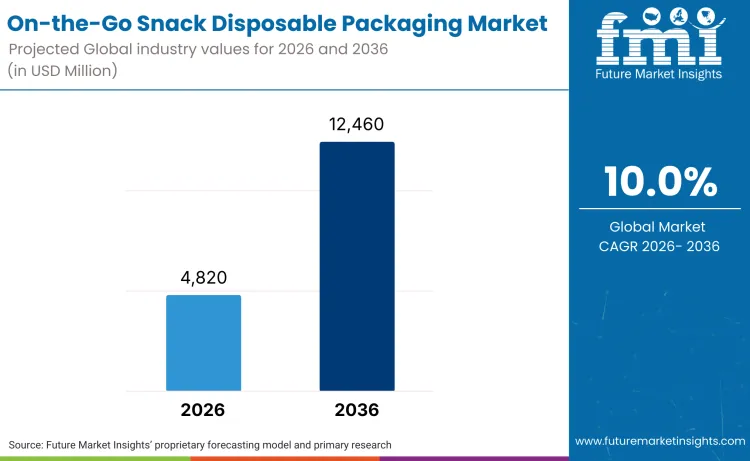
Summary of On the Go Snack Disposable Packaging Market
- What Is Growth Outlook for On‑the‑Go Snack Disposable Packaging Market as per Future Market Insights Projection?
- Future Market Insights projects the on‑the‑go snack disposable packaging market to grow at a CAGR of 10.0% from 2026 to 2036, expanding from USD 4.8 billion in 2026 to USD 12.5 billion by 2036.
- FMI Research Approach: Based on FMI’s proprietary bottom‑up packaging volume and pricing forecast model, channel‑level demand modeling across convenience retail, QSR, and vending, normalization of consumption frequency for single‑serve snack formats, and scenario analysis aligned with tightening global packaging regulations.
- How Do FMI Analysts Perceive the On‑the‑Go Snack Disposable Packaging Market to Evolve?
- FMI analysts perceive the market shifting from low‑cost, volume‑driven flexible packaging toward high‑barrier, regulation‑compliant mono‑material snack packs integrated into retail‑first consumption ecosystems.
- FMI Research Approach: Supported by evidence of retail transformation toward meal‑centric convenience stores, the shift from rigid containers to lightweight flexible formats, increasing recyclability mandates, and the strengthening link between packaging compliance and shelf access.
- Which Country Holds the Largest Share in the Global On‑the‑Go Snack Disposable Packaging Market?
- The United States holds the largest share of the global on‑the‑go snack disposable packaging market by value.
- FMI Research Approach: Derived from country‑level revenue modeling across retail and foodservice channels, high penetration of convenience retail and QSR‑driven snack consumption, early adoption of mono‑material & recycle‑ready formats, and strong presence of global packaging converters supplying premium solutions.
- How Large Will the On‑the‑Go Snack Disposable Packaging Market Be by 2036?
- The global on‑the‑go snack disposable packaging market is expected to reach USD 12.5 billion by 2036.
- FMI Research Approach: Based on long‑term forecasts segmented by packaging format and end‑use channels, scaling assumptions for single‑serve snack penetration, exclusion of reusable containers and secondary transport packaging, and cross‑validation against historical flexible packaging growth.
- What Is the Definition of the On‑the‑Go Snack Disposable Packaging Market?
- The market comprises single‑use packaging formats designed for immediate consumption of snack foods, particularly those sold through convenience stores, QSRs, vending machines, and travel retail.
- FMI Research Approach: Derived from FMI’s taxonomy covering pouches, wraps, cups, trays, and boxes; application mapping across savory snacks, confectionery, and protein snacks; and exclusion criteria for beverage‑only packaging and reusable containers.
- What Are Globally Unique Trends Shaping the On‑the‑Go Snack Disposable Packaging Market?
- Globally unique trends include retail‑centric consumption shifts, mono‑material adoption pressure, and regulation‑driven recovery mandates reshaping packaging value chains.
- FMI Research Approach: Evidenced by mandatory recovery targets across Latin America and Europe, consolidation among global packaging converters to scale compliant capacity, strong preference for lightweight high‑barrier formats, and procurement‑led enforcement of recyclability and traceability in supply chains.
On-the-go Snack Disposable Packaging Market Key Takeaways
| Metric | Details |
|---|---|
| Industry Size (2026) | USD 4.8 billion |
| Industry Value (2036) | USD 12.5 billion |
| CAGR (2026-2036) | 10.0% |
Source: Future Market Insights (FMI) analysis, based on proprietary forecasting model and primary research
Why is the Demand for Sustainable Snack Packaging Growing?
Consumer consciousness regarding environmental impact is fundamentally reshaping the industry, particularly in advanced economies where consumers now consider sustainability in purchasing decisions. Sealed Air validated this trend in November 2025 by announcing a strategic "rotation into retail and food service end markets," pivoting its portfolio to capture value in on-the-go packaging. Structural support for this shift is cemented by regulations, formally adopted in December 2024, which mandates that takeaway sectors offer reusable packaging options by 2030. FMI analysis suggests that these regulatory pressures are forcing brands to abandon cheap plastics in favor of circular materials to maintain market access. Manufacturers are now compelled to redesign snack food packaging to meet these rigorous circularity standards while ensuring product freshness is not compromised.
How is the on-the-go snack disposable packaging market segmented?
The market is segmented by end use, packaging format, and material type to address specific consumption needs. By end use, the market includes convenience stores, supermarkets/hypermarkets, and quick-service restaurants. By packaging format, solutions are categorized into pouches & wraps, bottles & jars, cups & trays, and boxes. By material, the industry utilizes multilayer films, paperboard, rigid plastics, and metal. FMI observes a distinct shift where single serve packaging is moving toward lighter, flexible formats to reduce transport emissions.
Why do Convenience Stores hold a dominant share?
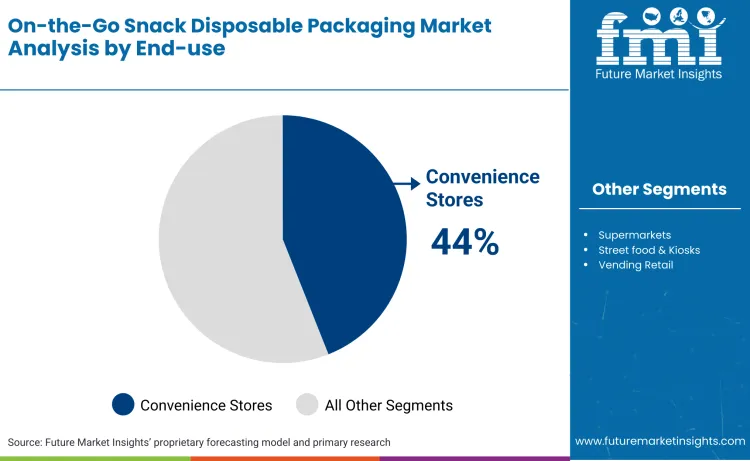
Convenience stores command a 44% market share, driven by the immediate consumption nature of the category where impulse purchases dominate revenue. Retailers are becoming the primary gatekeepers for compliance, forcing suppliers to innovate in disposable food containers that meet strict shelf-space and hygiene requirements. The sheer velocity of sales in this channel necessitates packaging that is both durable for display and easy to dispose of responsibly.
Why do Pouches & Wraps lead packaging formats?
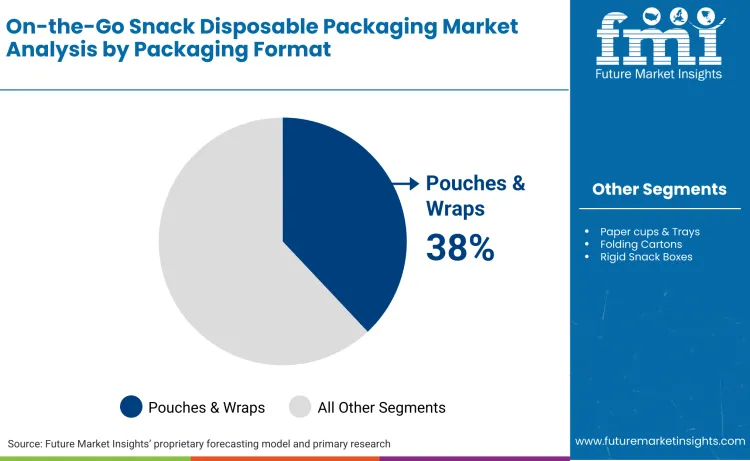
Pouches & wraps hold a 38% share, expanding as lightweighting becomes critical for reducing logistics costs and carbon footprints. Amcor's FPA Award in 2025 for the "Once Upon a Farm" spouted pouch validates the innovation focus here, where manufacturers are replacing rigid containers with flexible premade pouch packaging. Advancements in barrier technology allow brands to maintain protection against moisture and oxygen without relying on non-recyclable metallic layers. This format is particularly favored for pillow pouch packaging applications in the chips and confectionery segments, where volume-to-weight ratios are crucial for profitability.
Why do Multilayer Films dominate materials?
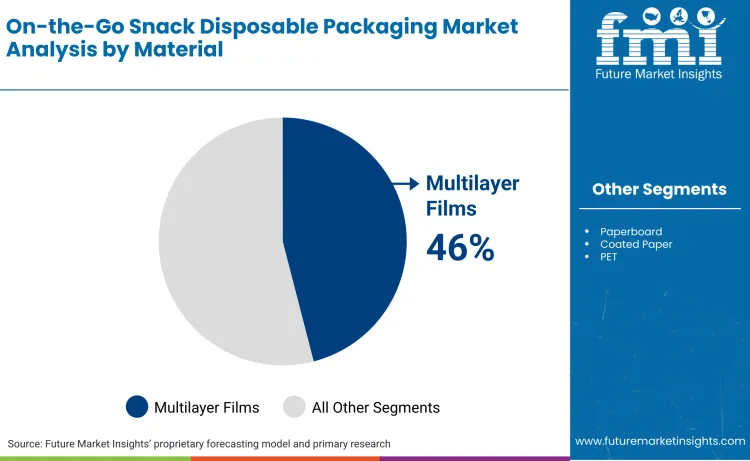
Multilayer films account for 46% of material share due to their superior ability to extend shelf life for processed snacks. While traditional laminates pose recycling challenges, the sector is rapidly evolving toward mono-material polyethylene or polypropylene structures that retain high-barrier qualities. Innovations are increasingly focused on these mono-material films, which offer the protection of multi-layers while remaining compatible with standard recycling streams. This material evolution is critical for stick packaging, which relies on high-performance films to protect hygroscopic powders and drink mixes.
Why Is the Mono-Material Revolution Accelerating?
The shift from multi-layer laminates to single-polymer (PE/PP) structures is accelerating to meet recyclability mandates. Amcor launched "AmPrima" recycle-ready packaging with Lorenz Snacks in July 2024, replacing complex laminates with a structure that lowers carbon footprint by 51%. Piotr Nagalski, Sales & Marketing Director for Snacks & Confectionery at Amcor, highlighted the significance of this technical breakthrough.
“The Amcor AmPrima solution solves one of the biggest problems in snack packaging. It preserves barrier protection, physical durability, and visual appeal while enabling consumers to easily recycle packs - something that was typically not possible before.”
Adoption of such formats ensures brands can claim 100% recyclability without sacrificing the crispness or freshness of the product, effectively addressing the primary criticism of ready-to-eat food packaging.
How Is Consolidation Driving Capacity for Circularity?
Major players are acquiring regional manufacturers to secure the infrastructure needed for large-scale sustainable production. Mondi completed the acquisition of Schumacher Packaging's Western Europe operations in April 2025, a move designed to integrate corrugated capacity for e-commerce and retail. A corporate statement from Mondi Group emphasized the strategic intent.
“Mondi completes acquisition of Schumacher Packaging’s Western Europe operations enhancing security of supply, reliability and innovation for customers adding over 1 billion square metres of additional packaging capacity.” Consolidation allows these giants to standardize rigid food containers across borders, ensuring that multinational snack brands have a consistent supply of compliant packaging in every market.
Why Are Mandatory Recovery Targets Reshaping Logistics?
Governments are moving from voluntary guidelines to strict legal mandates for packaging recovery. Brazil's Decree No. 12,688, enacted in October 2025, mandates a 32% recovery rate of plastic packaging by 2026, forcing companies to fund reverse logistics systems. Adalberto Maluf, Secretary of Urban Environment for Brazil, explained the socio-economic impact.
“The decree encourages the return of plastic packaging to the production cycle, creating green jobs, promoting social inclusion for waste pickers, preserving natural resources, and reducing improper disposal, which in turn lowers soil and water pollution and the impact on marine biodiversity.”
Brands operating in these regions must now treat waste management as a core operational cost rather than an externality, influencing the design of ready-to-eat cups to facilitate easier collection and sorting.
How Will On-the-Go Snack Disposable Packaging Market Expansion Unfold Across Key Global Regions?
Market expansion varies significantly across regions, shaped by each geography’s regulatory environment, retail maturity, and consumer lifestyle shifts. Developed markets such as the USA are prioritizing advanced material innovation, focusing on recyclable mono‑material solutions, high‑barrier flexible films, and biobased packaging aligned with national food‑waste and sustainability strategies. Emerging markets like India and China are witnessing growth driven by rapid urbanization, rising disposable incomes, and a structural movement from informal to organized retail. These markets are also experiencing increasingly strict government crackdowns on single‑use plastics, prompting manufacturers to pivot toward compostable, biodegradable, and fiber‑based packaging formats.
| Country | CAGR (2026 to 2036) |
|---|---|
| USA | 9.2% |
| Germany | 8.8% |
| China | 11.6% |
| Japan | 7.8% |
| India | 13.6% |
| Brazil | 10.0% |
Source: FMI historical analysis and forecast data.
Why is Brazil emerging as a regulatory bellwether?
On-the-go snack disposable packaging demand in Brazil is set to rise at 10.0% CAGR. Growth is catalyzed by regulations, implemented in September 2024, which simplified food product registration and boosted SKU launches. However, the market faces immediate compliance pressure, requiring a high recovery rate by 2026.
FMI analysis suggests that Brazil's aggressive stance on reverse logistics will serve as a blueprint for the wider Latin American sector, forcing local manufacturers to adopt food portion pack designs that are compatible with new recycling streams. As a result, companies that innovate in sustainable packaging solutions will likely gain a competitive edge in an increasingly environmentally-conscious marketplace.
How is Japan leading in functional sustainability?
Demand in Japan is projected to expand at 7.8% CAGR during the forecast period. The Japan Paper Association validated the industry's commitment in their 2024 report.
“As a producer of paper and also a consumer of recovered paper, the pulp and paper industry is making further efforts to use as much recovered paper as possible and to further improve its recycling technologies.”
Japan remains the global leader in high-hygiene sustainable packaging, balancing strict sanitation standards with circularity. This dual focus is driving the adoption of grab and go containers that use advanced barrier coatings on fiber bases.
What is driving the massive volume growth in India?
The market in India is forecast to grow at 13.6% CAGR. Rapid urbanization and a thriving street food culture are modernizing toward organized retail, necessitating hygienic packaging solutions. The Plastic Waste Management (Amendment) Rules, 2024, redefined biodegradable plastics to ensure they leave "no microplastics," eliminating oxo-degradable greenwashing options. Li Yanxia, Senior Programme Officer at INBAR, noted the potential for alternative materials in such Asian markets.
“The promotion and use of biodegradable and renewable non-plastic substitutions is a critical approach to reducing plastic waste. Bamboo is one of the nature-based solutions for mitigating plastic pollution and climate change.”
India's push for "no microplastics" is forcing a hard pivot toward certified compostable and fiber-based solutions, creating a lucrative environment for on-the-go packaging share analysis that favors non-plastic innovators.
How is the USA pivoting to retail-focused packaging?
Sales in the USA are expected to grow at a 9.2% CAGR. Major industrial players are responding by reorienting their business models to address this gap. Dustin Semach, CEO of Sealed Air, confirmed this direction in November 2025. “We are more intentionally making a rotation into retail and food service end markets by applying the transformation playbook we developed in protective to our food business.” US market expansion is defined by the migration of industrial-grade protective technologies into the consumer food service space, specifically targeting the high-volume snack food packaging market share analysis.
Why is Germany focusing on high-recycling infrastructure?
The industry in Germany is anticipated to rise at 8.8% CAGR. Mondi's acquisition of Schumacher Packaging assets in April 2025 solidifies the country's role as a central hub for paper-based packaging innovation. FMI observes that German manufacturers are aggressively adopting recycled content to meet these impending deadlines, positioning the country as a testing ground for next-generation circular economy models.
How is China enforcing green packaging in takeaway services?
China is poised to register an 11.6% CAGR. New Green Packaging Regulations effective 2025 ban non-degradable single-use plastic utensils in cities and mandate a 30% reduction in towns. Japan-China trade data shows consistent exports of packaging paper, reaching 216,000 metric tons, highlighting the cross-border flow of fiber materials replacing plastics. FMI analysis indicates that the sheer scale of China's food delivery sector makes it the primary volume driver for global fiber packaging demand, radically altering the supply chain dynamics for raw pulp and paperboard in the region.
How is the Competition in the On-the-Go Snack Disposable Packaging Market?
The on-the-go snack disposable packaging market is characterized by intense consolidation as leaders race to acquire sustainable technologies. Sonoco's acquisition of Eviosys, integrated in May 2025, created a multi-billion dollar metal and fiber giant, while Mondi's purchase of Schumacher Packaging in April 2025 solidified its European footprint. These moves are direct responses to regulations like the EU PPWR, requiring scale to manage complex reverse logistics. Howard Coker, President & CEO of Sonoco, emphasized this purpose-driven strategy.
“Our teams are innovating, investing and collaborating across the globe to build a more sustainable future for our customers, communities and our planet. Our Better Packaging. Better Life. purpose continues to guide everything we do.”
Companies are pivoting from "volume" to "value" via sustainability, with Huhtamaki aggressively expanding fiber capacity by opening a new lid production line in Northern Ireland in November 2024. Fredrik Davidsson, President Fiber Foodservice E-A-O at Huhtamaki, validated the timing of this expansion.
“It is fantastic to see the ribbon cut on the new SMF production line in Lurgan, the culmination of months of hard work by the fantastic team at the site. With production now up and running and the potential to add further capacity in the coming years, we are perfectly placed to supply the growing demand for a fully sustainable lid across the UK and Ireland.” Competitive escalation suggests that by 2026, the ability to supply certified circular solutions will be the primary differentiator.
Recent Developments:
- In July 2024, Amcor partnered with Lorenz Snacks to launch an innovative recycle-ready packaging solution for lentil-coated peanut products, promoting sustainability in single-serve, on-the-go snack formats. This collaboration showcases the commercial viability of mono‑material structures that maintain freshness, barrier protection, and visual appeal without relying on traditional non‑recyclable laminates.
- In April 2025, Amcor completed its combination with Berry Global, significantly enhancing capabilities in flexible and disposable packaging tailored for on‑the‑go snacks. The integration brings together Amcor’s leadership in sustainable flexible packaging with Berry Global’s vast manufacturing footprint, enabling faster commercialization of mono‑material and recycle‑ready formats.
- In July 2025, KIND Snacks launched a fully recyclable paper wrapper pilot for its snack bars, initially available at select locations, advancing sustainable disposable packaging for on-the-go consumption. The pilot aims to assess real‑world recyclability performance and consumer acceptance, marking a major step forward in replacing plastic‑based flexible films in the bar snack category.
Key Players in On-the-Go Snack Disposable Packaging Market
- Amcor
- Sonoco
- Mondi
- Sealed Air
- Huhtamaki
- WestRock
- Berry Global
- DS Smith
- Reynolds Consumer Products
- Constantia Flexibles
- ProAmpac
- Printpack
- Winpak Ltd.
Market Definition
The on-the-go snack disposable packaging market represents revenue generated from the sale of single-use packaging solutions designed for immediate consumption of snack foods. As operationally defined in the article, the market measures packaging formats including pouches, wraps, cups, trays, and boxes made from materials such as plastic, paperboard, and metal, specifically utilized by convenience stores, quick-service restaurants, and retail outlets. Market sizing reflects the value of packaging sold to food manufacturers and food service providers, analyzed by end-use channel, packaging format, and material type, and expressed in USD billion.
The market includes flexible and rigid packaging solutions explicitly segmented in the article, such as mono-material films, biodegradable containers, and recyclable paperboard cartons. It covers adoption by convenience retail chains, supermarkets, and vending channels. Revenue generated from sustainable alternatives, including fiber-based lids and plant-based bioplastics, is included where these function as primary snack packaging.
The market excludes secondary and tertiary packaging used solely for logistics and shipping. Reusable containers sold directly to consumers (e.g., Tupperware) are not included. Packaging for beverages is excluded unless sold as part of a combo-snack unit defined within the scope. Industrial food processing packaging not intended for the final consumer point-of-sale is also outside the scope.
Scope of Report
| Items | Values |
|---|---|
| Quantitative Units (2026) | USD 4.8 billion |
| Product Type | Pouches, Wraps, Cups, Trays, Boxes, Lids, Clamshells |
| Material Type | Multilayer Films, Mono-material Plastics (PE, PP), Paperboard, Molded Fiber, Metal, Bioplastics |
| End Use | Convenience Stores, Supermarkets/Hypermarkets, Quick Service Restaurants (QSR), Vending Machines, Travel Retail |
| Regions Covered | North America, Europe, Asia Pacific, Latin America, Middle East & Africa |
| Countries Covered | United States, Germany, United Kingdom, India, China, Japan, Brazil, and 40+ countries |
| Key Companies Profiled | Amcor, Sonoco, Mondi, Sealed Air, Huhtamaki, WestRock, Berry Global, DS Smith, Constantia Flexibles, ProAmpac |
| Additional Attributes | Revenue analysis by packaging format and material, adoption trends in convenience retail, regulatory impact assessment (EU PPWR, Brazil Decree 12,688), sustainable material penetration, mono-material adoption trends, and competitive consolidation analysis |
Source: FMI historical analysis and forecast data.
On-the-Go Snack Disposable Packaging Market by Segments
By End Use:
- Convenience Stores
- Supermarkets/Hypermarkets
- Quick Service Restaurants
- Vending Machines
By Packaging Format:
- Pouches & Wraps
- Bottles & Jars
- Cups & Trays
- Boxes
By Material:
- Multilayer Films
- Paperboard
- Rigid Plastics
- Metal
By Region:
- North America
- Europe
- East Asia
- South Asia
- Latin America
- Middle East & Africa
Bibliography
- European Parliament & Council of the European Union. (2024, December). Regulation (EU) 2024/2829 on packaging and packaging waste (PPWR). Official Journal of the European Union.
- U.S. Environmental Protection Agency. (2024, June). National strategy for reducing food loss and waste and recycling organics. EPA.
- Ministry of Environment and Climate Change, Government of Brazil. (2025, October). Decree No. 12,688: Reverse logistics system for plastic packaging. Government of Brazil.
- Ministry of Economy, Trade and Industry, Government of Japan. (2025, November). Ordinance on promotion of usage of recycled resources (rPET mandate). METI.
- Ministry of Environment, Forest and Climate Change, Government of India. (2024, March). Plastic Waste Management (Amendment) Rules, 2024. Government of India.
- National Development and Reform Commission, People’s Republic of China. (2025, September). Notice on further strengthening treatment of plastic pollution. NDRC.
- European Environment Agency. (2024). Packaging waste statistics and circular material use in the EU. EEA.
- Food and Agriculture Organization of the United Nations. (2024). Sustainable pulp, paper, and fiber-based packaging materials. FAO.
- Amcor plc. (2024, October). Sustainability report 2024. Amcor.
- Mondi Group. (2025, April). Acquisition of Schumacher Packaging Western Europe operations. Mondi.
- Sonoco Products Company. (2025, May). Corporate sustainability report 2024. Sonoco.
- Japan Paper Association. (2024). Sustainability report 2024. JPA.
Frequently Asked Questions
What is the current global market size for On-the-Go Snack Disposable Packaging?
The global market is valued at USD 4.8 billion in 2026, driven by strict environmental regulations and consumer demand for sustainable convenience.
What is the projected CAGR for the On-the-Go Snack Disposable Packaging market?
Market revenues are projected to grow at a robust 10.0% CAGR from 2026 to 2036.
Which segment currently dominates the industry?
Convenience stores hold the dominant market share at 44%, serving as the primary channel for immediate-consumption snack purchases.
What are the primary risks or barriers to adoption?
Inconsistent global recycling infrastructure and the high cost of developing mono-material films that match the barrier properties of traditional laminates remain significant hurdles.
Who are the leading players in the On-the-Go Snack Disposable Packaging space?
Amcor, Sonoco, Mondi, Sealed Air, and Huhtamaki lead the sector, leveraging massive scale to navigate complex regulatory landscapes across regions.
Preview the report firsthand - request a free sample
Get SampleGet the brochure for pricing and purchase details.
Get PDFTable of Content
- On-the-go Snack Disposable Packaging Market Forecast and Outlook 2026 to 2036
- On-the-go Snack Disposable Packaging Market Key Takeaways
- Why is the Demand for Sustainable Snack Packaging Growing?
- How is the On-the-go Snack Disposable Packaging Market Segmented?
- Why do Convenience Stores hold a dominant share?
- Why do Pouches & Wraps lead packaging formats?
- Why do Multilayer Films dominate materials?
- Why Is the Mono-Material Revolution Accelerating?
- How Is Consolidation Driving Capacity for Circularity?
- Why Are Mandatory Recovery Targets Reshaping Logistics?
- How Will On-the-go Snack Disposable Packaging Market Expansion Unfold Across Key Global Regions?
- Why is Brazil emerging as a regulatory bellwether?
- How is Japan leading in functional sustainability?
- What is driving the massive volume growth in India?
- How is the USA pivoting to retail-focused packaging?
- Why is Germany focusing on high-recycling infrastructure?
- How is China enforcing green packaging in takeaway services?
- How is the Competition in the On-the-go Snack Disposable Packaging Market?
- Key Players in On-the-go Snack Disposable Packaging Market
- Market Definition
- Scope of Report
- On-the-go Snack Disposable Packaging Market by Segments
- By End Use
- By Packaging Format
- By Material
- By Region
- Bibliography
- Frequently Asked Questions


