

- Industry Size (2026)
- USD 2.4 Bn
- Forecast (2036)
- USD 7.3 Bn
- CAGR (2026 to 2036)
- 11.6%
Airport and Duty-Free Disposable Packaging Market Size, Market Forecast and Outlook By FMI
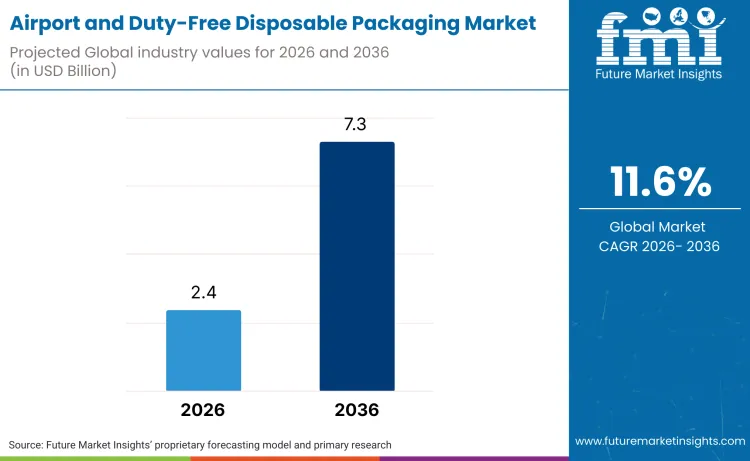
The global airport and duty-free disposable packaging sector is on track to achieve a valuation of USD 7.3 billion by 2036, accelerating from USD 2.4 billion in 2026 at a robust CAGR of 11.6%. As per Future Market Insights, expansion is structurally underpinned by a complete rebound in aviation connectivity which has restored the captive audience necessary for high-volume transit retail. The International Air Transport Association (IATA) confirmed in December 2024 that global passenger traffic had successfully recovered to 99% of 2019 levels, validating the industry's return to pre-pandemic operational capacity. This resurgence compels manufacturers to move beyond survival mode and invest heavily in scalable and sustainable production infrastructure that can handle the renewed velocity of passenger throughput. Simultaneously the regulatory landscape is shifting from voluntary guidelines to binding mandates which forces a major overhaul in packaging materials across the supply chain.
Quick Stats for Airport and Duty-Free Disposable Packaging Market
- Market Overview
- The airport and duty-free disposable packaging market is valued at USD 2.4 billion in 2026.
- The airport and duty-free disposable packaging market is projected to reach USD 7.3 billion by 2036.
- The market is growing at a CAGR of 11.6% during 2026 to 2036.
- Demand and Growth Drivers
- Recovery of global air passenger traffic to 99% of 2019 levels is restoring demand for transit retail packaging.
- Regulatory mandates such as the EU PPWR require a 5% reduction in packaging waste by 2030.
- The EU Single-Use Plastics Directive mandates a 77% plastic bottle collection target by 2025.
- Product and Segment View
- Duty-free retail accounts for 46% of total market demand driven by premium shopping environments.
- Folding cartons hold 34% of the packaging mix due to branding and transport efficiency advantages.
- Paperboard represents 42% of material usage supported by a global recycling rate of 59.9%.
- Geography and Competitive Outlook
- The United States holds a significant share supported by airport infrastructure investments.
- India leads growth with a CAGR of 14.8% followed by China at 13.6% and Brazil at 11.0%.
- Key companies include AptarGroup, DS Smith, Toppan Holdings, Rengo Co., Ltd., Amcor, WestRock, Sealed Air, Huhtamaki, Mondi, and Sonoco.
Willie Walsh, Director General of IATA, stated: "The demand for travel is strong. As we look to 2025 and beyond, the industry's focus must remain on sustainability and efficiency. Airlines and airports are united in the goal of net-zero emissions, and this extends to every aspect of the passenger journey, including retail." This alignment between aviation bodies and commercial retailers confirms that carbon reduction is no longer optional but a central pillar of operational strategy.
The operational reality for packaging converters is defined by the need to balance aesthetic luxury with strict circularity requirements. The European Parliament adoption of the Packaging and Packaging Waste Regulation (PPWR) in April 2024 has introduced binding targets to reduce packaging waste by 5% by 2030, effectively ending the era of mixed-material disposables in European hubs. Market leaders are proactively adapting to this new baseline to secure their license to operate in premium jurisdictions.
Summary of Airport and Duty-free Disposable Packaging Market
What Is Growth Outlook for Airport and Duty-Free Disposable Packaging Market as per Future Market Insights Projection?
Future Market Insights projects the airport and duty-free disposable packaging industry to expand at a CAGR of 11.6% from 2026 to 2036, increasing from USD 2.4 Billion in 2026 to USD 7.3 Billion by 2036.
FMI Research Approach: FMI proprietary forecasting model based on airport retailing revenue and passenger traffic correlation.
How Do FMI Analysts Perceive Airport and Duty-Free Disposable Packaging Market to Evolve?
FMI analysts perceive the market evolving toward sustainable premiumization where packaging must simultaneously convey luxury status and meet strict environmental compliance through material innovation and lightweighting.
FMI Research Approach: Regulatory convergence under the European Parliament PPWR.
Which Country Holds Largest Share in Global Airport and Duty-Free Disposable Packaging Market?
The United States holds a significant share of the global airport and duty-free disposable packaging market by value which is supported by massive infrastructure investment.
FMI Research Approach: FMI country-level revenue modeling by terminal grants and retail turnover.
How Large Will Airport and Duty-Free Disposable Packaging Market Be by 2036?
The global airport and duty-free disposable packaging market is projected to reach USD 7.3 Billion by 2036.
FMI Research Approach: FMI long-term revenue forecast derived from tourism receipt projections. FMI also scales impact of premium packaging solutions for luxury spirits and cosmetics.
What Is Definition of Airport and Duty-Free Disposable Packaging Market?
The airport and duty-free disposable packaging market comprises primary and secondary packaging products designed for retail goods sold within airport security zones including folding cartons, shopping bags, and food service disposables.
FMI Research Approach: FMI market taxonomy and inclusion-exclusion framework.
What Are Globally Unique Trends Shaping Airport and Duty-Free Disposable Packaging Market?
Globally unique trends include the enforcement of green mandates like the EU PPWR and the rise of destination exclusives along with the transition to hybrid recyclable films.
FMI Research Approach: European Commission Single-Use Plastics Directive mandating collection targets.
Airport and Duty-Free Disposable Packaging Market Key Takeaways
| Metric | Details |
|---|---|
| Industry Size (2026) | USD 2.4 Billion |
| Industry Value (2036) | USD 7.3 Billion |
| CAGR (2026-2036) | 11.6% |
Source: Future Market Insights (FMI) analysis, based on proprietary forecasting model and primary research
Which Factors Propel Adoption of Airport and Duty-Free Disposable Packaging?
Legislative pressure serves as the primary catalyst for material adoption in this sector which transforms sustainability from a corporate social responsibility initiative into a fundamental condition for market entry. The European Commission Single-Use Plastics Directive has mandated a 77% separate collection target for plastic bottles by 2025 which is a requirement that forces airport concessionaires to radically rethink their inventory. This regulatory environment creates a distinct competitive advantage for suppliers who can provide immediate and compliant alternatives to fossil-fuel plastics, driving interest in compostable plastic packaging.
How is the Airport and Duty-Free Disposable Packaging Market Segmented?
The overall segmentation outlook reveals a market that is heavily skewed toward high-value formats that can support the premium pricing of duty-free goods. While volume is driven by food service disposables, the value is concentrated in rigid and folding formats that enhance the consumer experience. The industry is currently witnessing a material convergence where traditional plastics are being systematically replaced by advanced paperboards and hybrid films across all distribution channels. This shift is most visible in the duty-free retail segment where the packaging must serve the dual purpose of protecting the product during transit and serving as a luxury gift presentation.
Why does Duty-Free Retail hold a Dominant Share?
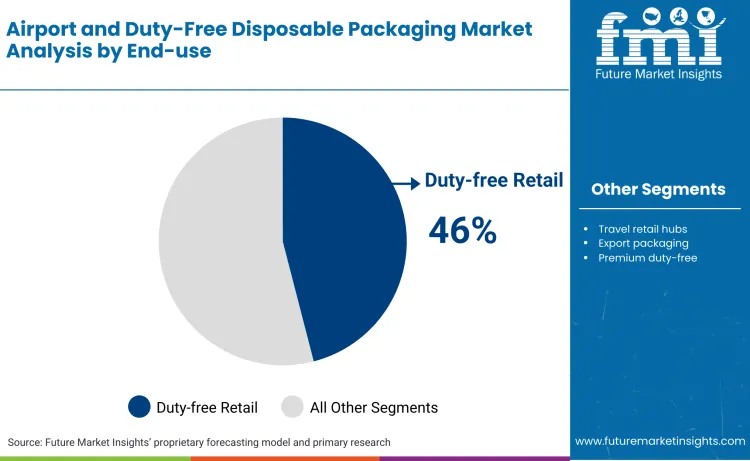
The dominance of duty-free retail, capturing 46% of the total market, is fueled by the transformation of airport terminals into high-end shopping destinations that rival downtown luxury districts. Passengers are increasingly treating transit time as a prime opportunity for revenge spending which necessitates retail environments that match this elevated mindset. ACI World data from November 2024 highlights that non-aeronautical revenue per passenger rose by 8% which indicates a deepening engagement with airport commercial offers. Brands are responding by investing in flagship-style experiences within the sterile zone such as Nestlé International Travel Retail opening a dedicated boutique at Mumbai International Airport in June 2025. This focus on premium retail environments also extends to inflight retail and advertising, creating a cohesive high-value ecosystem.
Why are Folding Cartons the preferred Packaging Format?
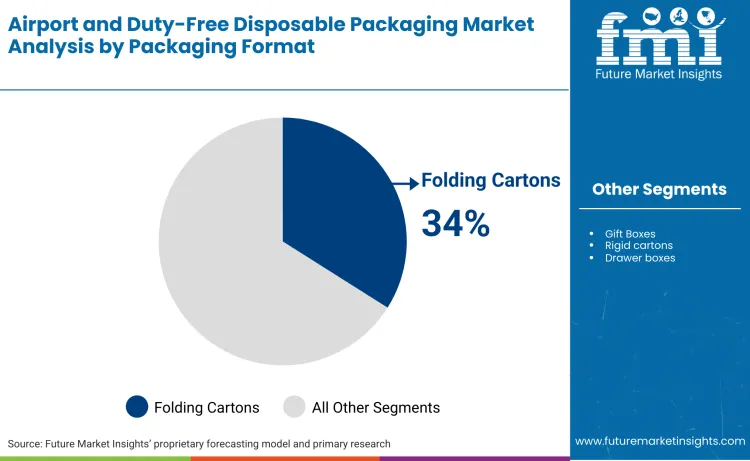
Folding cartons remain the structural backbone of the travel retail ecosystem, accounting for 34% of the packaging mix, because they offer an unmatched combination of branding real estate and logistical efficiency. This format is particularly critical for navigating complex regulatory landscapes such as the WHO recommendations on tobacco control which pressure duty-free zones to adopt plain packaging measures. Despite such constraints folding cartons allow brands to utilize high-quality paperboard to maintain a premium feel even under strict design limitations. The grab-and-go nature of airport commerce requires packaging that is lightweight yet rigid enough to withstand the rigors of carry-on travel. The industry's ability to innovate within this format was highlighted when Rengo Co., Ltd. secured multiple awards at the Japan Packaging Contest 2024 for its "Asahi Super Dry Eco-Friendly Carton" which proved that functional sustainability and consumer appeal can coexist.
Why does Paperboard dominate the Material Mix?
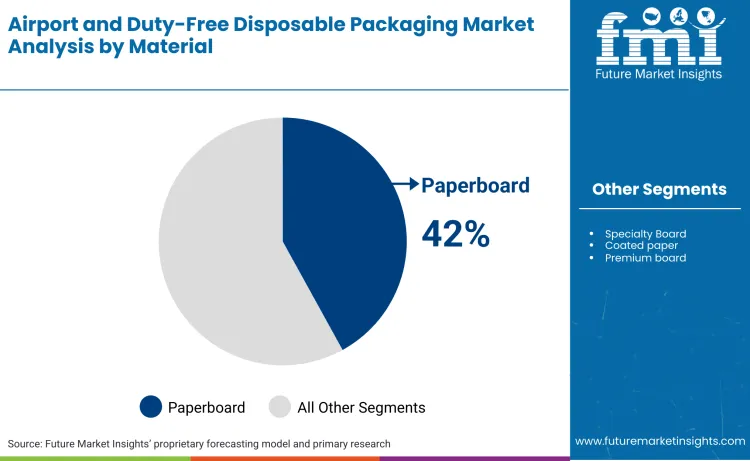
Paperboard has secured its position as the material of choice, holding a 42% market share, largely due to its superior end-of-life profile compared to plastics which aligns perfectly with the aviation industry's broader decarbonization goals. The International Council of Forest and Paper Associations (ICFPA) reported in May 2024 that global paper recycling rates have reached 59.9% and this statistic provides brands with a verified circularity narrative. This high recovery rate makes paperboard the safest bet for multinational retailers who must comply with a patchwork of global waste regulations. Major packaging converters are prioritizing fiber-based innovations to replace rigid plastics in everything from cosmetic boxes to food service trays. This trend is not merely about substitution but about enhancing the sustainability credentials of the entire airport retail value chain.
What Trends Are Shaping Industry Evolution?
The psychology of the traveler has shifted toward seeking trophy assets or exclusive products that serve as mementos of the journey. This behavior drives brands to develop elaborate packaging that functions as a collectible item in its own right. Bacardi leveraged this trend by launching the Patron El Alto tequila at Delhi Duty Free in September 2024 utilizing bespoke packaging materials to justify its ultra-premium positioning. A China Duty Free Group (CDFG) White Paper noted: "The industry's recovery and growth are driven by three key factors: macroeconomic rebound, the revival of tourism consumption, and policy benefits. Consumption boundaries are continuously expanding, extending from traditional luxury goods and cosmetics to emerging categories like wellness." This validates the industry's pivot toward high-value travel pouches and collector boxes.
Manufacturers are racing to decarbonize their material portfolios by integrating bio-based feedstocks and mono-material designs that simplify the recycling process. The OECD Global Plastics Outlook 2024 emphasizes that policy-driven demand for recycled content will likely triple the market for secondary plastics by 2030 creating a massive incentive for innovation. Toppan's hybrid manufacturing lines represent a tangible response to this forecast allowing for the mass production of flexible films that do not rely on fossil fuels. This transition is essential for ensuring that single-use formats which are indispensable for hygiene in airports can survive in a regulatory environment that increasingly penalizes waste.
The physical package is increasingly serving as a gateway to a digital experience which bridges the gap between the transient airport environment and the brand's long-term relationship with the consumer. AptarGroup strengthened its capabilities in this arena by completing a joint venture in China in October 2024 positioning itself to integrate smart dispensing and connectivity into its Asian portfolio. By embedding QR codes and NFC tags brands can offer travelers instant access to product origins and sustainability certifications along with personalized offers, adding distinct value to mini packaging formats. This connected packaging approach is becoming standard for luxury goods where proof of authenticity is paramount.
How Will Airport and Duty-Free Disposable Packaging Market Expansion Unfold Across Key Global Regions?
The airport and duty-free disposable packaging market is poised for significant expansion across key global regions, with varying growth rates projected from 2026 to 2036. India leads the way with an impressive compound annual growth rate (CAGR) of 14.8%, driven by a burgeoning travel sector and increasing demand for disposable packaging solutions. China follows closely behind at 13.6%, benefiting from its massive outbound tourism and expanding airport infrastructure. In Brazil, the market is anticipated to grow at a robust 11.0%, reflecting a rising middle class and increased international travel. The United States, with a CAGR of 10.8%, exemplifies the ongoing modernization of airports and duty-free shops, bolstered by federal support for infrastructure improvements. Germany (10.4%) and Japan (9.2%) also present steady growth opportunities, fueled by their established travel industries and commitment to enhancing airport experiences.
Airport and Duty-Free Disposable Packaging Market Regional CAGR (2026-2036)
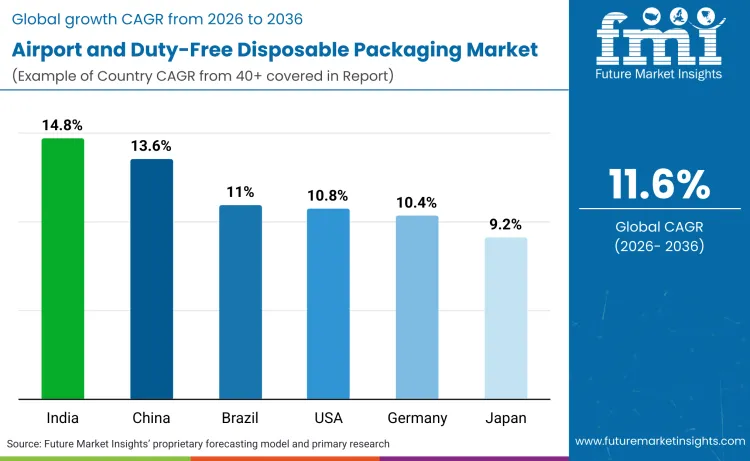
| Country | CAGR (2026-2036) |
|---|---|
| India | 14.8% |
| China | 13.6% |
| Brazil | 11.0% |
| USA | 10.8% |
| Germany | 10.4% |
| Japan | 9.2% |
Source: Future Market Insights (FMI) analysis, based on proprietary forecasting model and primary research
How is Infrastructure Fueling India's 14.8% Growth?
With a projected expansion rate of 14.8% annually, India stands as the most aggressive growth engine for the airport packaging sector. The industry is experiencing a structural transformation driven by the National Monetisation Pipeline which is aggressively privatizing and upgrading airport infrastructure across the subcontinent. The India Brand Equity Foundation (IBEF) projects that the tourism sector's contribution to GDP will grow at 11.9% annually which provides a robust macroeconomic tailwind for retail consumption and consumer packaging industry analysis in India. This exploding demand profile is attracting significant foreign direct investment into local manufacturing, including the production of heavy duty bags and sacks for backend logistics.
Why is China's Inbound Tourism Critical?
The trajectory for demand in China is set at a 13.6% CAGR which is heavily influenced by the centralized power of state-owned enterprises and a massive resurgence in visitor numbers. The China Tourism Academy reported a staggering 60.8% year-on-year increase in inbound tourists in 2024 creating a flood of new consumers for the duty-free sector. The China Duty Free Group (CDFG) has capitalized on this by expanding its user base to 104 million in 2025 effectively creating the world's largest captive audience for travel retail. This scale allows for unparalleled efficiency in packaging procurement as suppliers can standardize formats, including retort packaging for local food souvenirs, across hundreds of locations. The sheer volume of throughput in hubs like Shanghai and Hainan necessitates a supply chain that can deliver high-quality and standardized packaging at a velocity unmatched anywhere else in the world.
What Drives the USA's Replacement Market?
The outlook in the United States is marked by a consistent annual growth rate of 10.8%, driven by a significant wave of terminal modernization supported by federal grants. The Federal Aviation Administration (FAA) awarded USD 970 Million in grants in 2024 specifically for terminal improvements creating expanded footprints for concessions. Geoff Freeman, President and CEO of the USA Travel Association, stated: "International inbound travel is finally poised for a full recovery. The return of visitors from key markets like China and Japan is accelerating, which will have a multiplier effect on airport retail and local economies." This recovery supports sustained demand for specialized transport packaging and food service disposables. Growth is tempered by strict technical mandates as the USA Food and Drug Administration 2024 ban on PFAS grease-proofing substances is forcing a rapid reformulation of packaging, driving value growth through material substitution.
How is Germany Leading in Circularity?
Germany is poised to advance at a 10.4% CAGR serving as the global benchmark for closed-loop packaging systems driven by rigorous enforcement of national laws. The Umweltbundesamt (UBA) began enforcing stricter mandates for reusable options in transport hubs in January 2024 which fundamentally alters the economics of single-use items. This regulatory pressure has spurred rapid innovation among local suppliers with DS Smith's development of advanced bio-coatings being a direct response to the need for fully recyclable alternatives, effectively challenging the dominance of metal packaging in certain segments. The market here is less about volume expansion and more about the qualitative shift toward green solutions with retailers willing to pay a premium for packaging that guarantees compliance and appeals to the environmentally conscious European traveler.
Why is Brazil's Tourism Revenue Boosting Packaging?
Sales volume in Brazil is anticipated to rise at an 11.0% CAGR supported by a robust recovery in its travel sector which is translating directly into increased demand for retail packaging. The Ministry of Tourism (Brazil) reported that international tourism revenue hit record highs in 2024 and grew by 15% compared to the previous year. This influx of capital is revitalizing airport commercial zones where retailers are stocking more premium local spirits and cosmetics that require high-quality rigid boxes and retail paper bags. The stabilization of the economy is empowering a new class of travelers to engage in duty-free shopping pushing suppliers to upgrade the aesthetic quality of their offerings to match international standards.
How does Japan's 'Omotenashi' Influence Design?
Efficiency-focused design strategies will drive a 9.2% annual increase in Japan where the market is unique in its fusion of deep cultural traditions of hospitality with cutting-edge environmental targets. Ministry of the Environment, Japan updated its roadmap to target 2 million tons of biomass plastic usage by 2030 setting a clear direction for the industry. A Rengo Co., Ltd. corporate statement noted: "Less is more is the key concept for the Rengo Group’s packaging manufacturing and environmental management as well. This is the ideal that the Rengo Group seeks through all of its business activities in fulfilling social responsibilities as a company toward contributing to the development of a better and sustainable society." This philosophy drives the creation of packaging that is minimalist in material use yet exceptionally sophisticated in design catering to a consumer base that views wastefulness as a breach of etiquette.
What Strategic Moves Are Defining Competitive Landscape?
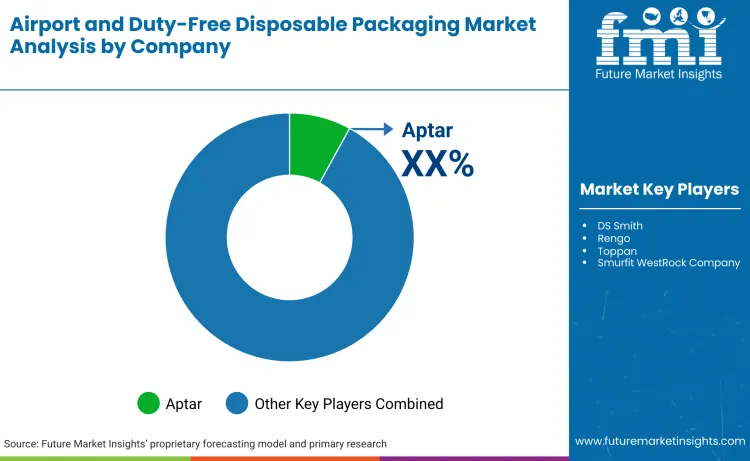
The competitive landscape is currently defined by a local-for-local manufacturing doctrine as major players seek to insulate themselves from global supply chain volatility and carbon tariffs. Toppan Holdings achieved a critical milestone in February 2025 by being named to the CDP "A List" for both Climate Change and Water Security which is a recognition that serves as a powerful validation tool when pitching to global multinational corporations. This third-party verification of sustainability credentials is becoming just as important as price and performance in securing long-term contracts. Furthermore, industry leaders are exploring returnable transport packaging systems to close the logistics loop.
Stephan B. Tanda, President and CEO of AptarGroup, Inc., stated: "Aptar achieved another strong quarter and year, delivering back-to-back years of double-digit earnings per share growth. Our beauty segment was able to improve its margin even with a challenged top line, driven by increased productivity and cost management efforts." Such resilience underscores the strategy of focusing on high-margin defensive categories like beauty dispensing which remain robust even during economic headwinds. Companies are increasingly moving away from generic solutions, such as standard hazardous goods packaging, to form deep strategic partnerships with retailers co-creating bespoke packaging formats that reinforce brand identity while meeting rigorous sustainability metrics.
Recent Developments:
- In November 2025, Toppan Holdings launched a hybrid production line in India capable of manufacturing recyclable BOPP and BOPE films to boost output capacity by 40%.
- In February 2025, DS Smith showcased renewable bio-based coatings at "Packaging Innovations 2025" to replace plastic laminates in fibre-based food packaging.
- In October 2024, AptarGroup completed a joint venture transaction in China to strengthen its dispensing technology footprint in the high-growth Asian beauty market.
Key Players in Airport and Duty-Free Disposable Packaging Market
- AptarGroup, Inc.
- DS Smith Plc
- Toppan Holdings Inc.
- Rengo Co., Ltd.
- Amcor plc
- WestRock Company
- Sealed Air Corporation
- Huhtamaki Oyj
- Mondi Group
- Sonoco Products Company
Market Definition
The airport and duty-free disposable packaging market represents revenue generated from primary and secondary packaging solutions specifically designed for products sold within airport sterile zones and duty-free retail environments. The market measures the value of folding cartons, flexible films, shopping bags, and food service disposables sold to travel retailers, airlines, and concessionaires.
Inclusions cover packaging for cosmetics, perfumes, confectionery, tobacco, and luxury goods, as well as grab-and-go food packaging used in airport terminals. It encompasses materials such as paperboard, bio-plastics, recycled PET (rPET), and glass used in retail-facing applications. Smart packaging technologies integrated for security or engagement are also included.
Exclusions include bulk industrial cargo packaging, shipping crates, and tertiary returnable transport packaging not intended for the retail consumer. Standard packaging for non-retail logistics and permanent store fixtures are outside the scope.
Scope of Report
| Items | Values |
|---|---|
| Quantitative Units (2026) | USD 2.4 Billion |
| Product Type | Folding Cartons, Carrier Bags, Flexible Packaging, Food Service Disposables, Rigid Boxes |
| Material Type | Paperboard, Plastic (PE, PP, PET, Bio-based), Glass, Metal |
| Retail Channel | Duty-Free Stores, Airport Food & Beverage, Inflight Retail and Advertising, Travel Convenience |
| Regions Covered | North America, Europe, Asia Pacific, Latin America, Middle East & Africa |
| Countries Covered | USA, Germany, China, Japan, India, Brazil, and 40+ countries |
| Key Companies Profiled | Aptar, DS Smith, Rengo, Toppan, Amcor, WestRock, Sealed Air, Huhtamaki |
| Additional Attributes | Revenue analysis by retail channel and material type, adoption of sustainable materials and recyclability trends, regulatory landscape assessment (EU PPWR impact), competitive market share analysis, and supplier positioning |
Airport and Duty-Free Disposable Packaging Market by Segments
By Product Type:
- Folding Cartons
- Shopping/Carrier Bags
- Flexible Films & Pouches
- Food Service Disposables (Cups, Trays)
- Rigid Luxury Boxes
By Material Type:
- Paper & Paperboard
- Plastics (PE, PP, PET)
- Bio-based & Biodegradable
- Glass
- Metal
By Region:
- North America
- Europe
- East Asia
- South Asia
- Latin America
- Middle East & Africa
Bibliography
- Organisation for Economic Co-operation and Development. (2024, February). Global plastics outlook: Policy scenarios to 2060. OECD.
- International Air Transport Association. (2024, December). Passenger demand recovery and air travel trends. IATA.
- AptarGroup, Inc. (2025, February). Fourth quarter and annual 2024 results. Aptar Investor Relations.
- Rengo Co., Ltd. (2024, September). Integrated report 2024. Rengo Investor Relations.
Frequently Asked Questions
What is the current global market size for Airport and Duty-Free Disposable Packaging?
The global market is valued at USD 2.4 Billion in 2026, driven by a 99% recovery in global passenger traffic and increased retail spend.
What is the projected Compound Annual Growth Rate (CAGR) for the market over the next 10 years?
The market is projected to grow at a robust 11.6% CAGR from 2026 to 2036.
Which regions are experiencing the fastest expansion?
India leads with 14.8% growth, followed closely by China at 13.6% due to surging inbound tourism.
What are the primary market drivers?
Sustainability mandates like the EU PPWR and the global recovery of travel retail volumes are fueling adoption.
Who are the leading suppliers in the industry?
Aptar, DS Smith, Rengo, and Toppan are key players, differentiating through sustainable and region-specific packaging solutions.
Preview the report firsthand - request a free sample
Get SampleGet the brochure for pricing and purchase details.
Get PDFTable of Content
- Executive Summary
- Global Market Outlook
- Demand Side Trends
- Supply Side Trends
- Technology Roadmap Analysis
- Analysis and Recommendations
- Market Overview
- Market Coverage / Taxonomy
- Market Definition / Scope / Limitations
- Research Methodology
- Chapter Orientation
- Analytical Lens and Working Hypotheses
- Market Structure, Signals, and Trend Drivers
- Benchmarking and Cross-market Comparability
- Market Sizing, Forecasting, and Opportunity Mapping
- Research Design and Evidence Framework
- Desk Research Programme (Secondary Evidence)
- Company Annual and Sustainability Reports
- Peer-reviewed Journals and Academic Literature
- Corporate Websites, Product Literature, and Technical Notes
- Earnings Decks and Investor Briefings
- Statutory Filings and Regulatory Disclosures
- Technical White Papers and Standards Notes
- Trade Journals, Industry Magazines, and Analyst Briefs
- Conference Proceedings, Webinars, and Seminar Materials
- Government Statistics Portals and Public Data Releases
- Press Releases and Reputable Media Coverage
- Specialist Newsletters and Curated Briefings
- Sector Databases and Reference Repositories
- FMI Internal Knowledge Base and Historical Datasets
- Subscription Datasets and Paid Sources
- Social Channels, Communities, and Digital Listening Inputs
- Additional Desk Sources
- Expert Input and Fieldwork (Primary Evidence)
- Primary Modes
- Qualitative Interviews and Expert Elicitation
- Quantitative Surveys and Structured Data Capture
- Blended Approach
- Why Primary Evidence is Used
- Field Techniques
- Interviews
- Surveys
- Focus Groups
- Observational and In-context Research
- Social and Community Interactions
- Stakeholder Universe Engaged
- C-suite Leaders
- Board Members
- Presidents and Vice Presidents
- R&D and Innovation Heads
- Technical Specialists
- Domain Subject-matter Experts
- Scientists
- Physicians and Other Healthcare Professionals
- Governance, Ethics, and Data Stewardship
- Research Ethics
- Data Integrity and Handling
- Primary Modes
- Tooling, Models, and Reference Databases
- Desk Research Programme (Secondary Evidence)
- Data Engineering and Model Build
- Data Acquisition and Ingestion
- Cleaning, Normalisation, and Verification
- Synthesis, Triangulation, and Analysis
- Quality Assurance and Audit Trail
- Market Background
- Market Dynamics
- Drivers
- Restraints
- Opportunity
- Trends
- Scenario Forecast
- Demand in Optimistic Scenario
- Demand in Likely Scenario
- Demand in Conservative Scenario
- Opportunity Map Analysis
- Product Life Cycle Analysis
- Supply Chain Analysis
- Investment Feasibility Matrix
- Value Chain Analysis
- PESTLE and Porter's Analysis
- Regulatory Landscape
- Regional Parent Market Outlook
- Production and Consumption Statistics
- Import and Export Statistics
- Market Dynamics
- Global Market Analysis 2021 to 2025 and Forecast, 2026 to 2036
- Historical Market Size Value (USD billion) Analysis, 2021 to 2025
- Current and Future Market Size Value (USD billion) Projections, 2026 to 2036
- Y-o-Y Growth Trend Analysis
- Absolute $ Opportunity Analysis
- Global Market Pricing Analysis 2021 to 2025 and Forecast 2026 to 2036
- Y-o-Y Growth Trend Analysis 2021 to 2025
- Absolute $ Opportunity Analysis 2026 to 2036
- Global Market Analysis 2021 to 2025 and Forecast 2026 to 2036, By Product Type
- Introduction / Key Findings
- Historical Market Size Value (USD billion) Analysis By Product Type, 2021 to 2025
- Current and Future Market Size Value (USD billion) Analysis and Forecast By Product Type, 2026 to 2036
- Folding Cartons
- Shopping/Carrier Bags
- Flexible Films & Pouches
- Food Service Disposables
- Rigid Luxury Boxes
- Y-o-Y Growth Trend Analysis By Product Type, 2021 to 2025
- Absolute $ Opportunity Analysis By Product Type, 2026 to 2036
- Global Market Analysis 2021 to 2025 and Forecast 2026 to 2036, By Material Type
- Introduction / Key Findings
- Historical Market Size Value (USD billion) Analysis By Material Type, 2021 to 2025
- Current and Future Market Size Value (USD billion) Analysis and Forecast By Material Type, 2026 to 2036
- Paper & Paperboard
- Plastics (PE, PP, PET)
- Bio-based & Biodegradable
- Glass
- Metal
- Y-o-Y Growth Trend Analysis By Material Type, 2021 to 2025
- Absolute $ Opportunity Analysis By Material Type, 2026 to 2036
- Global Market Analysis 2021 to 2025 and Forecast 2026 to 2036, By Retail Channel
- Introduction / Key Findings
- Historical Market Size Value (USD billion) Analysis By Retail Channel, 2021 to 2025
- Current and Future Market Size Value (USD billion) Analysis and Forecast By Retail Channel, 2026 to 2036
- Duty-Free Stores
- Airport Food & Beverage
- Inflight Retail and Advertising
- Travel Convenience
- Y-o-Y Growth Trend Analysis By Retail Channel, 2021 to 2025
- Absolute $ Opportunity Analysis By Retail Channel, 2026 to 2036
- Global Market Analysis 2021 to 2025 and Forecast 2026 to 2036, By Region
- Introduction
- Historical Market Size Value (USD billion) Analysis By Region, 2021 to 2025
- Current Market Size Value (USD billion) Analysis and Forecast By Region, 2026 to 2036
- North America
- Latin America
- Western Europe
- Eastern Europe
- East Asia
- South Asia and Pacific
- Middle East & Africa
- Market Attractiveness Analysis By Region
- North America Market Analysis 2021 to 2025 and Forecast 2026 to 2036, By Country
- Historical Market Size Value (USD billion) Trend Analysis By Market Taxonomy, 2021 to 2025
- Market Size Value (USD billion) Forecast By Market Taxonomy, 2026 to 2036
- By Country
- USA
- Canada
- Mexico
- By Product Type
- By Material Type
- By Retail Channel
- By Country
- Market Attractiveness Analysis
- By Country
- By Product Type
- By Material Type
- By Retail Channel
- Key Takeaways
- Latin America Market Analysis 2021 to 2025 and Forecast 2026 to 2036, By Country
- Historical Market Size Value (USD billion) Trend Analysis By Market Taxonomy, 2021 to 2025
- Market Size Value (USD billion) Forecast By Market Taxonomy, 2026 to 2036
- By Country
- Brazil
- Chile
- Rest of Latin America
- By Product Type
- By Material Type
- By Retail Channel
- By Country
- Market Attractiveness Analysis
- By Country
- By Product Type
- By Material Type
- By Retail Channel
- Key Takeaways
- Western Europe Market Analysis 2021 to 2025 and Forecast 2026 to 2036, By Country
- Historical Market Size Value (USD billion) Trend Analysis By Market Taxonomy, 2021 to 2025
- Market Size Value (USD billion) Forecast By Market Taxonomy, 2026 to 2036
- By Country
- Germany
- UK
- Italy
- Spain
- France
- Nordic
- BENELUX
- Rest of Western Europe
- By Product Type
- By Material Type
- By Retail Channel
- By Country
- Market Attractiveness Analysis
- By Country
- By Product Type
- By Material Type
- By Retail Channel
- Key Takeaways
- Eastern Europe Market Analysis 2021 to 2025 and Forecast 2026 to 2036, By Country
- Historical Market Size Value (USD billion) Trend Analysis By Market Taxonomy, 2021 to 2025
- Market Size Value (USD billion) Forecast By Market Taxonomy, 2026 to 2036
- By Country
- Russia
- Poland
- Hungary
- Balkan & Baltic
- Rest of Eastern Europe
- By Product Type
- By Material Type
- By Retail Channel
- By Country
- Market Attractiveness Analysis
- By Country
- By Product Type
- By Material Type
- By Retail Channel
- Key Takeaways
- East Asia Market Analysis 2021 to 2025 and Forecast 2026 to 2036, By Country
- Historical Market Size Value (USD billion) Trend Analysis By Market Taxonomy, 2021 to 2025
- Market Size Value (USD billion) Forecast By Market Taxonomy, 2026 to 2036
- By Country
- China
- Japan
- South Korea
- By Product Type
- By Material Type
- By Retail Channel
- By Country
- Market Attractiveness Analysis
- By Country
- By Product Type
- By Material Type
- By Retail Channel
- Key Takeaways
- South Asia and Pacific Market Analysis 2021 to 2025 and Forecast 2026 to 2036, By Country
- Historical Market Size Value (USD billion) Trend Analysis By Market Taxonomy, 2021 to 2025
- Market Size Value (USD billion) Forecast By Market Taxonomy, 2026 to 2036
- By Country
- India
- ASEAN
- Australia & New Zealand
- Rest of South Asia and Pacific
- By Product Type
- By Material Type
- By Retail Channel
- By Country
- Market Attractiveness Analysis
- By Country
- By Product Type
- By Material Type
- By Retail Channel
- Key Takeaways
- Middle East & Africa Market Analysis 2021 to 2025 and Forecast 2026 to 2036, By Country
- Historical Market Size Value (USD billion) Trend Analysis By Market Taxonomy, 2021 to 2025
- Market Size Value (USD billion) Forecast By Market Taxonomy, 2026 to 2036
- By Country
- Kingdom of Saudi Arabia
- Other GCC Countries
- Turkiye
- South Africa
- Other African Union
- Rest of Middle East & Africa
- By Product Type
- By Material Type
- By Retail Channel
- By Country
- Market Attractiveness Analysis
- By Country
- By Product Type
- By Material Type
- By Retail Channel
- Key Takeaways
- Key Countries Market Analysis
- USA
- Pricing Analysis
- Market Share Analysis, 2025
- By Product Type
- By Material Type
- By Retail Channel
- Canada
- Pricing Analysis
- Market Share Analysis, 2025
- By Product Type
- By Material Type
- By Retail Channel
- Mexico
- Pricing Analysis
- Market Share Analysis, 2025
- By Product Type
- By Material Type
- By Retail Channel
- Brazil
- Pricing Analysis
- Market Share Analysis, 2025
- By Product Type
- By Material Type
- By Retail Channel
- Germany
- Pricing Analysis
- Market Share Analysis, 2025
- By Product Type
- By Material Type
- By Retail Channel
- UK
- Pricing Analysis
- Market Share Analysis, 2025
- By Product Type
- By Material Type
- By Retail Channel
- Italy
- Pricing Analysis
- Market Share Analysis, 2025
- By Product Type
- By Material Type
- By Retail Channel
- Spain
- Pricing Analysis
- Market Share Analysis, 2025
- By Product Type
- By Material Type
- By Retail Channel
- France
- Pricing Analysis
- Market Share Analysis, 2025
- By Product Type
- By Material Type
- By Retail Channel
- India
- Pricing Analysis
- Market Share Analysis, 2025
- By Product Type
- By Material Type
- By Retail Channel
- ASEAN
- Pricing Analysis
- Market Share Analysis, 2025
- By Product Type
- By Material Type
- By Retail Channel
- Australia & New Zealand
- Pricing Analysis
- Market Share Analysis, 2025
- By Product Type
- By Material Type
- By Retail Channel
- China
- Pricing Analysis
- Market Share Analysis, 2025
- By Product Type
- By Material Type
- By Retail Channel
- Japan
- Pricing Analysis
- Market Share Analysis, 2025
- By Product Type
- By Material Type
- By Retail Channel
- South Korea
- Pricing Analysis
- Market Share Analysis, 2025
- By Product Type
- By Material Type
- By Retail Channel
- Russia
- Pricing Analysis
- Market Share Analysis, 2025
- By Product Type
- By Material Type
- By Retail Channel
- Poland
- Pricing Analysis
- Market Share Analysis, 2025
- By Product Type
- By Material Type
- By Retail Channel
- Hungary
- Pricing Analysis
- Market Share Analysis, 2025
- By Product Type
- By Material Type
- By Retail Channel
- Kingdom of Saudi Arabia
- Pricing Analysis
- Market Share Analysis, 2025
- By Product Type
- By Material Type
- By Retail Channel
- Turkiye
- Pricing Analysis
- Market Share Analysis, 2025
- By Product Type
- By Material Type
- By Retail Channel
- South Africa
- Pricing Analysis
- Market Share Analysis, 2025
- By Product Type
- By Material Type
- By Retail Channel
- USA
- Market Structure Analysis
- Competition Dashboard
- Competition Benchmarking
- Market Share Analysis of Top Players
- By Regional
- By Product Type
- By Material Type
- By Retail Channel
- Competition Analysis
- Competition Deep Dive
- AptarGroup, Inc.
- DS Smith Plc
- Toppan Holdings Inc.
- Rengo Co., Ltd.
- Amcor plc
- WestRock Company
- Sealed Air Corporation
- Huhtamaki Oyj
- Mondi Group
- Sonoco Products Company
- Competition Deep Dive
- Assumptions & Acronyms Used


