

- Industry Size (2026)
- USD 1.1 Bn
- Forecast (2036)
- USD 3.6 Bn
- CAGR (2026 to 2036)
- 12.40%
Airline Amenity Kit Disposable Packaging Market Forecast and Outlook for 2026 to 2036
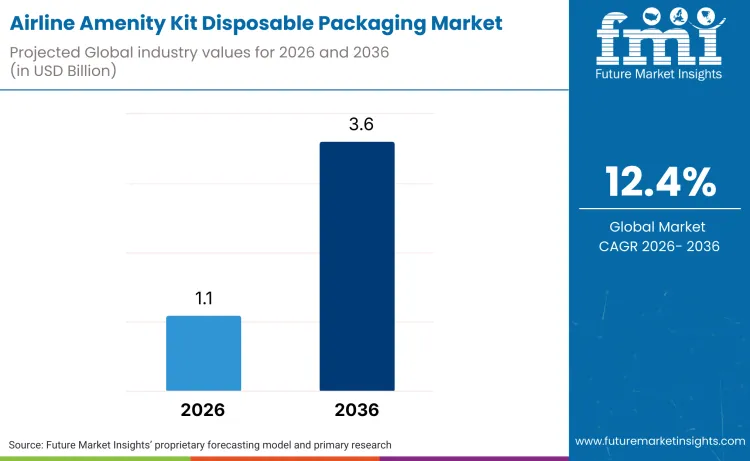
Global estimates place the airline amenity kit disposable packaging market at USD 1.1 billion in 2026, with forecasts projecting a climb to USD 3.6 billion by 2036. The industry is set to expand at a 12.40% CAGR over the next decade. Propelling this growth is a 4.9% year-on-year increase in global passenger traffic projected for 2026, led by a 7.3% surge in the Asia Pacific region. IATA data confirms that airlines are upgrading premium kit boxes and sustainable enclosures to differentiate their service in a recovery phase where load factors are hitting record highs of 83.8%.
Supply chains are witnessing a definitive pivot toward "keepsake" quality as airlines race to align with the EU Single Use Plastics Directive (SUPD), which mandates 25% recycled content in PET formats by 2025. Mauricio Parise, Vice President of Brand Experience Design at Delta Air Lines, validated this strategic pivot in June 2024: "We’ve been intentional about creating a Delta One experience-both on the ground and in the air, that feels truly premium and elevated, and Missoni’s elegance and prestige aligns perfectly with that vision. The Missoni-designed amenity kits, along with unique design elements that will be featured in our Delta One Lounge at JFK, will offer a distinct, high-end enhancement to our most premium spaces." Such statement highlights how major carriers are leveraging exclusive partnerships to redefine the cabin experience. Companies successfully commercializing high-end, fiber-based solutions will likely dominate the aviation supply chain through 2036.
Summary of Airline Amenity Kit Disposable Packaging Market
What Is the Growth Outlook for the Airline Amenity Kit Disposable Packaging Market as per Future Market Insights Projection?
Future Market Insights projects the airline amenity kit disposable packaging market to grow at a CAGR of 12.40% from 2026 to 2036, expanding from USD 1.1 billion in 2026 to USD 3.6 billion by 2036.
FMI Research Approach: Based on FMI’s proprietary bottom-up revenue forecasting model, passenger load factor normalization using IATA and ICAO traffic data, airline procurement cycle analysis for full-service and premium economy classes, and scenario modeling aligned with global plastic ban enforcement timelines.
How Do FMI Analysts Perceive the Airline Amenity Kit Disposable Packaging Market to Evolve?
FMI analysts perceive the market shifting from utilitarian, single-use plastic wrappings toward collectible, reusable bags and high-barrier paperboard systems integrated into digital inventory management.
FMI Research Approach: Supported by evidence of major fleet upgrades incorporating premium cabin differentiation, the transition to circular economy materials like rPET and bamboo, and the adoption of RFID technology for inventory visibility in high-value stock.
Which Country Holds the Largest Share in the Global Airline Amenity Kit Disposable Packaging Market?
India holds the largest share of the global airline amenity kit disposable packaging market at 15.60%.
FMI Research Approach: Derived from country-level fleet expansion orders (e.g., Air India’s A350 deployment), enforcement of strict single-use plastic bans effective July 2025, and the rapid urbanization driving first-time flyer volume in the Asia Pacific region.
How Large Will the Airline Amenity Kit Disposable Packaging Market Be by 2036?
The global airline amenity kit disposable packaging market is expected to reach USD 3.6 billion by 2036.
FMI Research Approach: Based on long-term forecasts segmented by packaging format (box, pouch, bag) and material type, scaling assumptions for international long-haul frequency, and exclusion of non-disposable permanent galley equipment.
What Is the Definition of the Airline Amenity Kit Disposable Packaging Market?
The market comprises primary and secondary packaging formats designed for the containment and presentation of personal care items distributed to airline passengers.
FMI Research Approach: Derived from FMI’s taxonomy covering kit boxes, fabric pouches, plastic zip bags, and paper wrappers; application mapping across First, Business, Premium Economy, and Economy classes; and exclusion criteria for bulk cargo containers.
What Are Globally Unique Trends Shaping the Airline Amenity Kit Disposable Packaging Market?
Globally unique trends include the "unboxing" of the flight experience, the integration of solid skincare to reduce liquid weight, and regulatory-driven shifts to mono-material recycling.
FMI Research Approach: Evidenced by corporate partnerships between airlines and luxury fashion houses (e.g., Delta/Missoni), mandates for 90% plastic collection efficiency in Europe, and the rise of "keepsake" kits that double as post-flight travel organizers.
Airline Amenity Kit Disposable Packaging Market Key Takeaways
| Metric | Details |
|---|---|
| Industry Size (2026) | USD 1.1 billion |
| Industry Value (2036) | USD 3.6 billion |
| CAGR (2026-2036) | 12.40% |
Source: Future Market Insights (FMI) analysis, based on proprietary forecasting model and primary research
Why Is the Demand for Sustainable Amenity Packaging Growing?
Institutional pressure to decarbonize aviation supply chains is fundamentally reshaping procurement practices. Airlines now face intense public scrutiny over cabin waste, accelerating the need for change. ICAO's 2025 Environmental Report confirms that the sector's commitment to net-zero emissions by 2050 is forcing carriers to eliminate non-essential weight and non-recyclable materials. The regulatory landscape has moved beyond voluntary targets, with the EU's 90% collection target for plastic bottles by 2029 compelling airlines to rethink every disposable item on the tray table.
Tangible operational changes by major manufacturers further validate this shift. Berry Global reported a 43% year-over-year increase in post-consumer resin (PCR) purchases in 2024, raising usage to 5.1% of total volume. Such a surge in recycled material adoption indicates that the aviation sector is moving from pilot programs to mass adoption of eco-compliant compact containers and PCR-based amenity kits. Adopting these materials is critical to avoiding punitive compliance costs and meeting passenger expectations for green travel.
How Is the Airline Amenity Kit Disposable Packaging Market Segmented?
The market is segmented by end use, packaging format, and material type to address the specific tiers of cabin service. By end use, the market includes full-service airlines, low-cost carriers, and charter services. By packaging format, solutions are categorized into kit boxes, fabric pouches, plastic zip bags, and rigid cases. By material, the industry utilizes paperboard, textile blends, PE films, and recycled plastics. FMI observes a distinct shift where premium cabins are adopting rigid paperboard and textiles while economy classes move toward biodegradable films.
Why Do Full-Service Airlines Hold a Dominant Share?
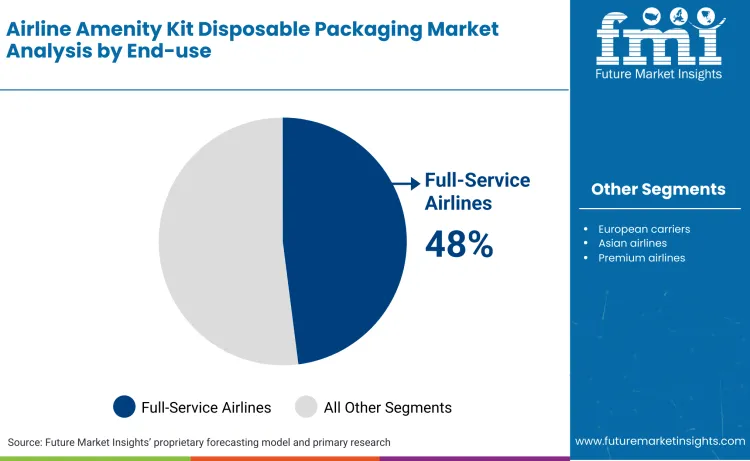
Competitive necessity drives full-service airlines to command a 48% market share. These carriers must distinguish their brand through superior onboard merchandising and passenger comfort. Significant investments in designer partnerships require high-quality packaging to convey exclusivity. The "spa in the sky" concept relies heavily on packaging that protects premium personal care items while signaling luxury. A move away from generic plastic wraps to branded, tactile experiences that passengers want to document and share characterizes this segment.
Why Are Rigid Kit Boxes Rising as Collector Items?
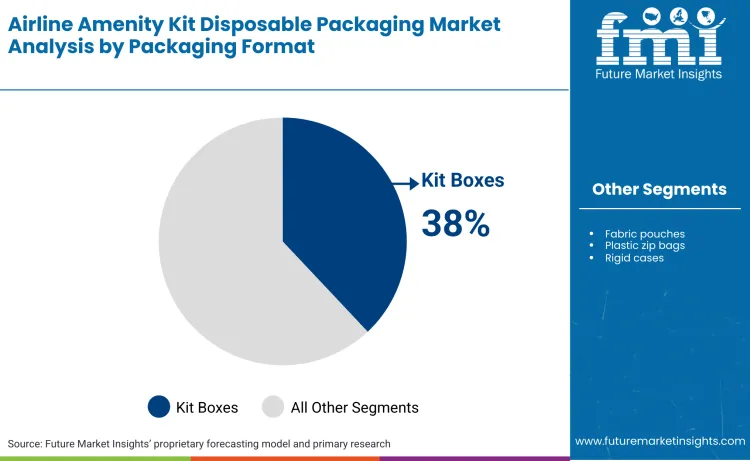
Rigid kit boxes hold a 38% share and are expanding as airlines seek surfaces that tell a brand story and protect fragile contents like glass vials. Unlike flexible pouches, rigid boxes offer superior protection and branding real estate. Such features make them ideal for high-value amenities. Creating a "gift-like" interaction for passengers significantly increases the likelihood of post-flight reuse and brand recall. The structural integrity of these boxes also allows for the safe inclusion of glass-bottled serums and perfumes, which are becoming standard in First Class.
Why Does Paperboard Dominate Materials in the Post-Plastic Era?
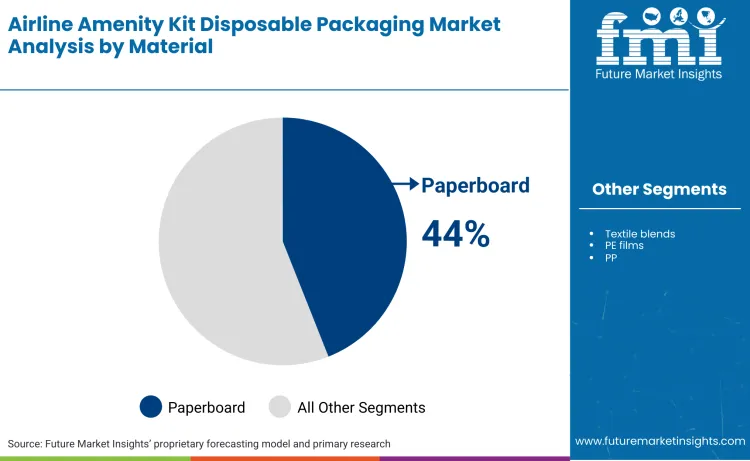
Recyclability and premium tactile quality drive paperboard to account for 44% of material share. Plastic films lack these attributes. The consolidation of fiber packaging giants, such as the Smurfit WestRock merger in 2024, has created a robust global supply chain for sustainable fiber options. Global scale ensures that airlines can source consistent, high-quality paperboard for textile folding solutions and amenity boxes across all their global hubs. Such availability removes the logistical friction that previously hindered the switch from plastic to paper.
Why Is the Shift to Zero-Waste Driving Mono-Material Innovation?
Bans in key markets like India and Europe are forcing airlines to eliminate single-use plastics. Cathay Pacific exemplified this shift in 2024 by partnering with Bamford to introduce kits featuring paper-wrapped bamboo toothbrushes and glass-bottled liquid dispensers. Explicit removal of plastic waste is now a compliance necessity rather than just an aesthetic choice. Suppliers are responding by innovating with sustainable hair care bars and dry amenities that require minimal protective packaging. These innovations effectively "dematerialize" the amenity kit without sacrificing functionality.
How Is RFID Optimizing Inventory Management?
Integrating RFID tags into high-value amenity kits transforms inventory accuracy and reduces waste from overstocking. Technology leaders like Avery Dennison expanded their RFID collaboration in late 2024 to enhance visibility across retail supply chains, and aviation is now replicating this model. Airlines utilize these data points to predict consumption rates of buy-on-board options and complimentary kits with precision. Precise forecasting ensures that perishable items or surplus kits do not become waste. Leaner provisioning directly contributes to weight reduction and fuel savings.
Why Are 'Collectable' Kits Driving Reusability?
Designing high-quality kits intended for long-term use as travel organizers allows carriers to effectively remove the "disposable" label. British Airways' launch of a collectable range with Anatomē in November 2025, using recyclable aluminum and fabric, exemplifies this strategy. Encouraging passengers to keep the items reduces the volume of waste left on aircraft and aligns with the growing consumer preference for durable transparent storage solutions. The amenity kit transforms from a single-use cost center into a long-lasting brand ambassador that travels with the passenger long after the flight.
How Will Airline Amenity Kit Disposable Packaging Market Expansion Unfold Across Key Global Regions?
Market expansion varies significantly across regions, driven by the pace of fleet modernization, local environmental regulations, and the maturity of the luxury travel sector. The Asia Pacific region is witnessing explosive growth due to massive aircraft orders and government-led plastic reduction mandates. In contrast, North American and European markets are focused on replacing existing plastic inventories with sustainable alternatives to meet passenger expectations for "green" travel. FMI analysis indicates that airlines in emerging markets are leapfrogging traditional plastic phases, moving directly to compostable and fiber-based solutions.
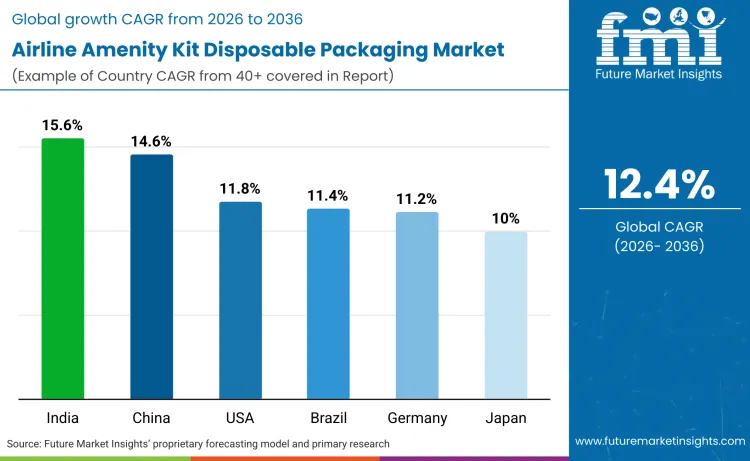
| Country | CAGR (2026 to 2036) |
|---|---|
| USA | 11.8% |
| Germany | 11.2% |
| China | 14.6% |
| Japan | 10.0% |
| India | 15.6% |
| Brazil | 11.4% |
Why Is India Leading the Global Market Expansion?
The demand for airline amenity kit disposable packaging is projected to expand at a massive 15.6% CAGR, driven by aggressive fleet modernization typified by Air India’s recent acquisition of 470 aircraft and rigid government policy. A comprehensive ban on single-use plastics enforced by the Government of India in July 2025 effectively outlawed traditional poly-wrapped economy kits overnight. Domestic carriers must now pivot entirely to kraft paper and compostable films, creating a surge in demand for fiber-based converters. FMI anticipates that as India’s passenger volume doubles, the region will become the global testbed for low-cost, high-volume sustainable packaging solutions.
How Is China Enforcing Whole-Chain Plastic Control?
Centralized efficiency and strict governance mandated by the NDRC are steering China toward a 14.6% CAGR. China is enforcing whole‑chain plastic control through a highly centralized governance model driven by the National Development and Reform Commission (NDRC), pushing the aviation amenity packaging market toward a rapid 14.6% CAGR by mandating strict sustainability compliance across all operational stages. Unlike regions that depend on voluntary environmental targets, Chinese airlines must meet binding 2025 pollution‑control requirements, which obligate carriers to implement closed‑loop recycling systems for all onboard waste. These regulations ensure full traceability, from material sourcing to in‑flight usage to post‑flight waste processing, creating a tightly managed circular system that eliminates leakage and accelerates national plastic‑reduction goals.
How Are Lifestyle Partnerships Defining the USA Market?
Industry in US is poised to grow at an 11.8% CAGR, fueled by the intensification of "lifestyle wars" among major carriers like Delta and United. Consumer-facing brand equity drives the market here more than government mandates, with the amenity kit serving as a tangible touchpoint for airline loyalty. Removing plastics is viewed as a baseline expectation, whereas exclusive partnerships with wellness and fashion brands drive real value. Sustained demand for sophisticated, rigid packaging formats that can house premium skincare and wellness products characterizes this competitive environment.
Why Is Biodiversity Branding Key to Brazil's Strategy?
Leveraging natural capital allows the Brazil sector to grow at an 11.4% CAGR, carving a unique niche in premium travel. Airlines are moving beyond generic luxury to offer "eco-chic" kits that utilize regionally sourced materials like canvas and natural fibers, aligning with the national agenda for sustainable infrastructure.
Stephan Heinz, Vice President of Customer Experience at LATAM Airlines, highlighted this regional strategy during the launch of their nature-inspired "Altitude Series" kits:"This is just the beginning of what promises to be an exciting and innovative partnership, featuring lounge activations, onboard entertainment content, and joint spa takeovers. Stay tuned - there’s much more to come!" This suggests that transforming the amenity kit into a storytelling medium for South American biodiversity allows Brazil to successfully premiumize its cabin offerings while adhering to environmental goals.
How Is Circular Infrastructure Supporting Market Maturity in Germany?
Advancing at an 11.2% CAGR, Germany represents the mature, infrastructure-led approach to sustainable packaging heavily influenced by the EU Single Use Plastics Directive. Prioritizing materials that fit seamlessly into existing municipal recycling streams, such as rPET and certified paperboard, is key in this market. Tony Smurfit, CEO of Smurfit WestRock, noted the capability of European giants to support this transition following recent consolidation:
"In September, we announced an agreement to combine with WestRock to form Smurfit WestRock. Since then we have had the opportunity to expand our knowledge of the WestRock organisation, and its people, and have visited many of their facilities. With a deeper understanding of the WestRock business, we are increasingly excited about the potential this combination presents." Industrial scale allows German carriers to implement closed-loop models efficiently, as Smurfit points out. This maintains high recycling rates even as passenger volumes recover.
How Is the Competition in the Airline Amenity Kit Disposable Packaging Market?
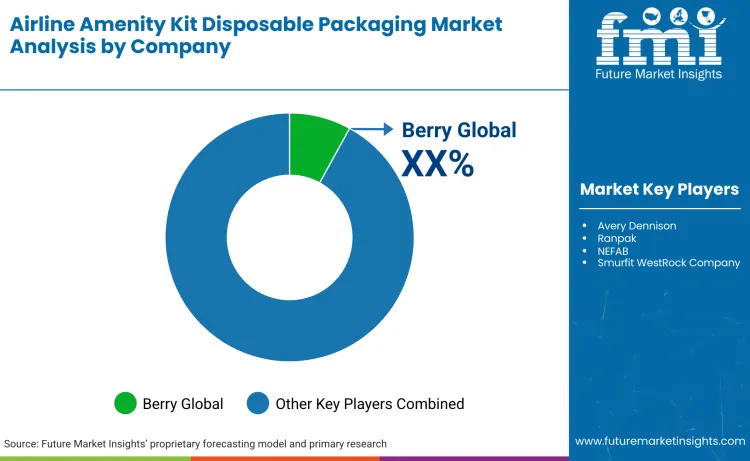
Strategic consolidation and a race for vertical integration currently define the competitive landscape of the airline amenity kit disposable packaging market. The 2024 merger of Smurfit Kappa and WestRock fundamentally altered the supply chain by creating a fiber-based powerhouse capable of servicing global airline alliances with uniform, plastic-free solutions. Smaller regional converters now face intense pressure to either merge or specialize in niche sustainable materials to survive against such scale.
A distinct tier of "integrators" such as Kaelis, Formia, and Wessco has evolved to bridge the critical gap between airlines and luxury brands. These firms no longer just supply packaging; they manage complex design-to-delivery ecosystems that ensure products like the Delta-Missoni kit meet strict weight and waste regulations. Innovation in verification is also becoming a key differentiator. Suppliers like Nefab and Ranpak are winning contracts by providing audited lifecycle assessments (LCA). By leveraging data to prove carbon reduction, they secure their place in the supply chains of airlines committed to Scope 3 emission targets.
Recent Developments:
- In September 2025, American Airlines partnered with ethically sourced leather goods brand Raven + Lily to launch limited-edition amenity kits for premium cabin customers on select international and transcontinental flights. These kits feature upgraded contents, including skincare products from Joanna Vargas, and emphasize elevated travel experiences through sustainable and stylish disposable packaging designs.
- In October 2025, Austrian Airlines collaborated with the Museum of Applied Arts (MAK) to introduce new Business Class amenity kits on long-haul flights, inspired by historical Wiener Werkstätte textile designs. The kits, available in six variations, include travel essentials packaged in artistically designed paper sleeves, marking the start of a long-term partnership focused on cultural and sustainable disposable packaging.
- In June 2025, United Airlines teamed up with wellness brand Therabody and amenity provider WESSCO International to launch innovative amenity kits that transform in-flight offerings into a holistic wellness journey. The kits incorporate science-backed products and thoughtful disposable packaging to address travel stress, extending to lounge experiences and redefining passenger well-being in the airline industry.
Key Players in Airline Amenity Kit Disposable Packaging Market
- Berry Global
- Avery Dennison
- Ranpak
- Smurfit WestRock Company
- NEFAB
- Kaelis
- FORMIA
- WESSCO International
- Orvec International
- Buzz Products
Market Definition
The airline amenity kit disposable packaging market represents revenue generated from the sale of packaging solutions designed to contain personal care and comfort items for airline passengers. As operationally defined in the article, the market measures packaging formats including kit boxes, fabric pouches, zippers, and paper wraps made from materials such as paperboard, textiles, and recycled plastics. Market sizing reflects the value of packaging sold to airlines and amenity kit aggregators, analyzed by end-use cabin class, packaging format, and material type, and expressed in USD billion.
The market includes primary packaging for individual items (e.g., hygiene packets) and secondary packaging (the kit bag/box itself). It covers adoption by full-service carriers, low-cost airlines, and charter services. Revenue generated from sustainable alternatives, such as bamboo wraps and rPET textiles, is included. The market excludes the value of the amenity items themselves (e.g., socks, cosmetics) and permanent galley equipment. Bulk cargo packaging not intended for passenger presentation is outside the scope.
Scope of Report
| Items | Values |
|---|---|
| Quantitative Units (2026) | USD 1.1 billion |
| Packaging Format | Kit Boxes, Fabric Pouches, Plastic Zip Bags, Rigid Cases |
| Material Type | Paperboard, Textile Blends, PE Films, Recycled Plastics |
| End Use | Full-Service Airlines, Low-Cost Carriers, Charter Services |
| Regions Covered | North America, Europe, Asia Pacific, Latin America, Middle East & Africa |
| Countries Covered | United States, Germany, China, Japan, India, Brazil, and 40+ countries |
| Key Companies Profiled | Berry Global, Avery Dennison, Ranpak, Smurfit WestRock, NEFAB, Kaelis, FORMIA |
| Additional Attributes | Revenue and volume analysis by packaging format and airline category, cabin-class level demand mapping, material substitution and lightweighting trends, regulatory impact assessment of plastic bans and waste directives (EU SUPD, India Plastic Waste Management Rules), adoption of recycled and mono-material solutions, RFID and smart-tag integration in inflight service kits, sustainability and circularity performance indicators, procurement and supplier consolidation trends across global airline groups |
Source: FMI historical analysis and forecast data.
Airline Amenity Kit Disposable Packaging Market by Segments
By End Use:
- Full-service Airlines
- Low-cost Carriers
- Charter Services
By Packaging Format:
- Kit Boxes
- Fabric Pouches
- Plastic Zip Bags
- Rigid Cases
By Material:
- Paperboard
- Textile Blends
- PE Films
- Recycled Plastics
By Region:
- North America
- Europe
- East Asia
- South Asia
- Latin America
- Middle East & Africa
Bibliography
- International Air Transport Association (IATA). (2025, December). Global Outlook for Air Transport. IATA Economics.
- International Civil Aviation Organization (ICAO). (2025). 2025 Environmental Report: Net Zero 2050. ICAO.
- National Development and Reform Commission (NDRC). (2025). China Plastic Pollution Control Mechanism. G20 Portal.
- Japan Airlines (JAL Group). (2025, March). JAL Group Medium Term Management Plan - Rolling Plan 2025. JAL Press.
- Berry Global. (2025, March). 2024 Sustainability Report. Berry Global.
- Ranpak. (2025, August). 2024 Sustainability Impact Report. Ranpak Investor Relations.
Frequently Asked Questions
What is the current global market size for Airline Amenity Kit Disposable Packaging?
The global market is valued at USD 1.1 billion in 2026, driven by the recovery of international travel and the demand for sustainable premium cabin experiences.
What is the projected CAGR for the Airline Amenity Kit Disposable Packaging market?
The market is projected to expand at a CAGR of 12.40% from 2026 to 2036, outpacing general aviation growth due to the higher value of sustainable materials.
Which segment currently dominates the industry?
Full-service airlines hold the dominant share at 48%, as these carriers utilize amenity kits as a primary tool for brand differentiation in First and Business class.
What are the primary regulatory drivers for adoption?
The EU Single Use Plastics Directive (SUPD) and India's ban on single-use plastics are the primary regulatory forces compelling airlines to switch to paperboard and rPET formats.
Who are the leading players in the Airline Amenity Kit Disposable Packaging space?
Berry Global, Smurfit WestRock, and specialized integrators like Kaelis and FORMIA lead the market, leveraging global supply chains to meet airline volume requirements.
Preview the report firsthand - request a free sample
Get SampleGet the brochure for pricing and purchase details.
Get PDFTable of Content
- Executive Summary
- Global Market Outlook
- Demand Side Trends
- Supply Side Trends
- Technology Roadmap Analysis
- Analysis and Recommendations
- Market Overview
- Market Coverage / Taxonomy
- Market Definition / Scope / Limitations
- Research Methodology
- Chapter Orientation
- Analytical Lens and Working Hypotheses
- Market Structure, Signals, and Trend Drivers
- Benchmarking and Cross-market Comparability
- Market Sizing, Forecasting, and Opportunity Mapping
- Research Design and Evidence Framework
- Desk Research Programme (Secondary Evidence)
- Company Annual and Sustainability Reports
- Peer-reviewed Journals and Academic Literature
- Corporate Websites, Product Literature, and Technical Notes
- Earnings Decks and Investor Briefings
- Statutory Filings and Regulatory Disclosures
- Technical White Papers and Standards Notes
- Trade Journals, Industry Magazines, and Analyst Briefs
- Conference Proceedings, Webinars, and Seminar Materials
- Government Statistics Portals and Public Data Releases
- Press Releases and Reputable Media Coverage
- Specialist Newsletters and Curated Briefings
- Sector Databases and Reference Repositories
- FMI Internal Knowledge Base and Historical Datasets
- Subscription Datasets and Paid Sources
- Social Channels, Communities, and Digital Listening Inputs
- Additional Desk Sources
- Expert Input and Fieldwork (Primary Evidence)
- Primary Modes
- Qualitative Interviews and Expert Elicitation
- Quantitative Surveys and Structured Data Capture
- Blended Approach
- Why Primary Evidence is Used
- Field Techniques
- Interviews
- Surveys
- Focus Groups
- Observational and In-context Research
- Social and Community Interactions
- Stakeholder Universe Engaged
- C-suite Leaders
- Board Members
- Presidents and Vice Presidents
- R&D and Innovation Heads
- Technical Specialists
- Domain Subject-matter Experts
- Scientists
- Physicians and Other Healthcare Professionals
- Governance, Ethics, and Data Stewardship
- Research Ethics
- Data Integrity and Handling
- Primary Modes
- Tooling, Models, and Reference Databases
- Desk Research Programme (Secondary Evidence)
- Data Engineering and Model Build
- Data Acquisition and Ingestion
- Cleaning, Normalisation, and Verification
- Synthesis, Triangulation, and Analysis
- Quality Assurance and Audit Trail
- Market Background
- Market Dynamics
- Drivers
- Restraints
- Opportunity
- Trends
- Scenario Forecast
- Demand in Optimistic Scenario
- Demand in Likely Scenario
- Demand in Conservative Scenario
- Opportunity Map Analysis
- Product Life Cycle Analysis
- Supply Chain Analysis
- Investment Feasibility Matrix
- Value Chain Analysis
- PESTLE and Porter's Analysis
- Regulatory Landscape
- Regional Parent Market Outlook
- Production and Consumption Statistics
- Import and Export Statistics
- Market Dynamics
- Global Market Analysis 2021 to 2025 and Forecast, 2026 to 2036
- Historical Market Size Value (USD Billion) Analysis, 2021 to 2025
- Current and Future Market Size Value (USD Billion) Projections, 2026 to 2036
- Y-o-Y Growth Trend Analysis
- Absolute $ Opportunity Analysis
- Global Market Pricing Analysis 2021 to 2025 and Forecast 2026 to 2036
- Y-o-Y Growth Trend Analysis 2021 to 2025
- Absolute $ Opportunity Analysis 2026 to 2036
- Global Market Analysis 2021 to 2025 and Forecast 2026 to 2036, By Packaging Format
- Introduction / Key Findings
- Historical Market Size Value (USD Billion) Analysis By Packaging Format, 2021 to 2025
- Current and Future Market Size Value (USD Billion) Analysis and Forecast By Packaging Format, 2026 to 2036
- Kit Boxes
- Fabric Pouches
- Plastic Zip Bags
- Rigid Cases
- Y-o-Y Growth Trend Analysis By Packaging Format, 2021 to 2025
- Absolute $ Opportunity Analysis By Packaging Format, 2026 to 2036
- Global Market Analysis 2021 to 2025 and Forecast 2026 to 2036, By Material Type
- Introduction / Key Findings
- Historical Market Size Value (USD Billion) Analysis By Material Type, 2021 to 2025
- Current and Future Market Size Value (USD Billion) Analysis and Forecast By Material Type, 2026 to 2036
- Paperboard
- Textile Blends
- PE Films
- Recycled Plastics
- Y-o-Y Growth Trend Analysis By Material Type, 2021 to 2025
- Absolute $ Opportunity Analysis By Material Type, 2026 to 2036
- Global Market Analysis 2021 to 2025 and Forecast 2026 to 2036, By End Use
- Introduction / Key Findings
- Historical Market Size Value (USD Billion) Analysis By End Use, 2021 to 2025
- Current and Future Market Size Value (USD Billion) Analysis and Forecast By End Use, 2026 to 2036
- Full-service Airlines
- Low-cost Carriers
- Charter Services
- Y-o-Y Growth Trend Analysis By End Use, 2021 to 2025
- Absolute $ Opportunity Analysis By End Use, 2026 to 2036
- Global Market Analysis 2021 to 2025 and Forecast 2026 to 2036, By Region
- Introduction
- Historical Market Size Value (USD Billion) Analysis By Region, 2021 to 2025
- Current Market Size Value (USD Billion) Analysis and Forecast By Region, 2026 to 2036
- North America
- Latin America
- Western Europe
- Eastern Europe
- East Asia
- South Asia and Pacific
- Middle East & Africa
- Market Attractiveness Analysis By Region
- North America Market Analysis 2021 to 2025 and Forecast 2026 to 2036, By Country
- Historical Market Size Value (USD Billion) Trend Analysis By Market Taxonomy, 2021 to 2025
- Market Size Value (USD Billion) Forecast By Market Taxonomy, 2026 to 2036
- By Country
- USA
- Canada
- Mexico
- By Packaging Format
- By Material Type
- By End Use
- By Country
- Market Attractiveness Analysis
- By Country
- By Packaging Format
- By Material Type
- By End Use
- Key Takeaways
- Latin America Market Analysis 2021 to 2025 and Forecast 2026 to 2036, By Country
- Historical Market Size Value (USD Billion) Trend Analysis By Market Taxonomy, 2021 to 2025
- Market Size Value (USD Billion) Forecast By Market Taxonomy, 2026 to 2036
- By Country
- Brazil
- Chile
- Rest of Latin America
- By Packaging Format
- By Material Type
- By End Use
- By Country
- Market Attractiveness Analysis
- By Country
- By Packaging Format
- By Material Type
- By End Use
- Key Takeaways
- Western Europe Market Analysis 2021 to 2025 and Forecast 2026 to 2036, By Country
- Historical Market Size Value (USD Billion) Trend Analysis By Market Taxonomy, 2021 to 2025
- Market Size Value (USD Billion) Forecast By Market Taxonomy, 2026 to 2036
- By Country
- Germany
- UK
- Italy
- Spain
- France
- Nordic
- BENELUX
- Rest of Western Europe
- By Packaging Format
- By Material Type
- By End Use
- By Country
- Market Attractiveness Analysis
- By Country
- By Packaging Format
- By Material Type
- By End Use
- Key Takeaways
- Eastern Europe Market Analysis 2021 to 2025 and Forecast 2026 to 2036, By Country
- Historical Market Size Value (USD Billion) Trend Analysis By Market Taxonomy, 2021 to 2025
- Market Size Value (USD Billion) Forecast By Market Taxonomy, 2026 to 2036
- By Country
- Russia
- Poland
- Hungary
- Balkan & Baltic
- Rest of Eastern Europe
- By Packaging Format
- By Material Type
- By End Use
- By Country
- Market Attractiveness Analysis
- By Country
- By Packaging Format
- By Material Type
- By End Use
- Key Takeaways
- East Asia Market Analysis 2021 to 2025 and Forecast 2026 to 2036, By Country
- Historical Market Size Value (USD Billion) Trend Analysis By Market Taxonomy, 2021 to 2025
- Market Size Value (USD Billion) Forecast By Market Taxonomy, 2026 to 2036
- By Country
- China
- Japan
- South Korea
- By Packaging Format
- By Material Type
- By End Use
- By Country
- Market Attractiveness Analysis
- By Country
- By Packaging Format
- By Material Type
- By End Use
- Key Takeaways
- South Asia and Pacific Market Analysis 2021 to 2025 and Forecast 2026 to 2036, By Country
- Historical Market Size Value (USD Billion) Trend Analysis By Market Taxonomy, 2021 to 2025
- Market Size Value (USD Billion) Forecast By Market Taxonomy, 2026 to 2036
- By Country
- India
- ASEAN
- Australia & New Zealand
- Rest of South Asia and Pacific
- By Packaging Format
- By Material Type
- By End Use
- By Country
- Market Attractiveness Analysis
- By Country
- By Packaging Format
- By Material Type
- By End Use
- Key Takeaways
- Middle East & Africa Market Analysis 2021 to 2025 and Forecast 2026 to 2036, By Country
- Historical Market Size Value (USD Billion) Trend Analysis By Market Taxonomy, 2021 to 2025
- Market Size Value (USD Billion) Forecast By Market Taxonomy, 2026 to 2036
- By Country
- Kingdom of Saudi Arabia
- Other GCC Countries
- Turkiye
- South Africa
- Other African Union
- Rest of Middle East & Africa
- By Packaging Format
- By Material Type
- By End Use
- By Country
- Market Attractiveness Analysis
- By Country
- By Packaging Format
- By Material Type
- By End Use
- Key Takeaways
- Key Countries Market Analysis
- USA
- Pricing Analysis
- Market Share Analysis, 2025
- By Packaging Format
- By Material Type
- By End Use
- Germany
- Pricing Analysis
- Market Share Analysis, 2025
- By Packaging Format
- By Material Type
- By End Use
- China
- Pricing Analysis
- Market Share Analysis, 2025
- By Packaging Format
- By Material Type
- By End Use
- Japan
- Pricing Analysis
- Market Share Analysis, 2025
- By Packaging Format
- By Material Type
- By End Use
- India
- Pricing Analysis
- Market Share Analysis, 2025
- By Packaging Format
- By Material Type
- By End Use
- Brazil
- Pricing Analysis
- Market Share Analysis, 2025
- By Packaging Format
- By Material Type
- By End Use
- USA
- Market Structure Analysis
- Competition Dashboard
- Competition Benchmarking
- Market Share Analysis of Top Players
- By Regional
- By Packaging Format
- By Material Type
- By End Use
- Competition Analysis
- Competition Deep Dive
- Berry Global
- Avery Dennison
- Ranpak
- Smurfit WestRock Company
- NEFAB
- Kaelis
- FORMIA
- WESSCO International
- Orvec International
- Buzz Products
- Competition Deep Dive
- Assumptions & Acronyms Used


