

- Industry Size (2026)
- USD 1.1 Bn
- Forecast (2036)
- USD 3.4 Bn
- CAGR (2026 to 2036)
- 12.2%
Office Starter Kit Packaging Market Forecast and Outlook 2026 to 2036
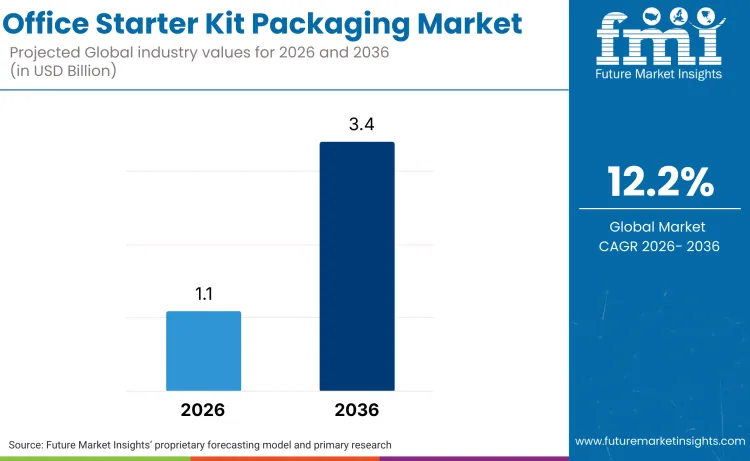
The office starter kit packaging market is positioned to expand from USD 1.1 billion in 2026 toward USD 3.4 billion by 2036, driven by a 12.2% CAGR. Growth stems from increasing corporate investment in employee experience programs and the rise of hybrid work models requiring home office equipment distribution.
As per FMI's projection, this expansion is supported by human resources departments allocating larger budgets for onboarding materials and branded welcome kits that communicate company culture. Mondi Group, a leading packaging solutions provider, reported in its 2023 Integrated Report that the company is advancing sustainable packaging innovations and digital solutions, though specific office kit packaging revenue was not disclosed separately.
Emerging trends across global corporate sectors are reinforcing the momentum of the office starter kit packaging market. Increasing emphasis on sustainability reporting, rising demand for customization, and the expansion of distributed workforces are reshaping procurement patterns and elevating the importance of value‑added packaging solutions.
To capture the industry sentiment, Colleen Costello, Senior Manager at Avery Dennison, stated in March 2024: "Sustainability is ingrained in everything we do as a business, and a key part of this is helping our clients identify ways to operate in a more environmentally responsible manner and progress to reach their respective sustainability goals." This underscores the shift toward sustainable procurement in corporate supply chains. Companies are increasingly seeking packaging that can balance durability with aesthetic appeal while meeting strict sustainability criteria.
Summary of the Office Starter Kit Packaging Market
What is Growth Outlook for Office Starter Kit Packaging Market as per Future Market Insights Projection?
Future Market Insights projects the office starter kit packaging market to grow at a CAGR of 12.2% from 2026 to 2036, expanding from USD 1.1 billion to USD 3.4 billion.
FMI research approach: Bottom-up revenue modeling by end-use channel and packaging format, primary interviews with corporate procurement directors and packaging converters, and human resources budget allocation analysis for employee onboarding programs.
How do FMI Analysts Perceive Office Starter Kit Packaging Market to Evolve?
FMI analysts perceive the market transitioning from commodity shipping containers toward branded experience packaging where sustainability certifications and customization capabilities drive supplier selection for corporate buyers.
FMI research approach: Comparative analysis of standard versus premium packaging specifications, adoption patterns across Fortune 500 procurement departments, and sustainability reporting requirements tracking for corporate supply chains.
Which Country Holds Largest Share in the Global Office Starter Kit Packaging Market?
The United States holds the largest share of the global office starter kit packaging market by value, driven by large corporate sector employment and established employee onboarding program infrastructure.
FMI research approach: Country-level revenue modeling by corporate employment statistics and procurement spending patterns, analysis of office supply chain maturity, and packaging customization adoption rates across enterprise segments.
How Large Will the Office Starter Kit Packaging Market be by 2036?
The global office starter kit packaging market is estimated to reach USD 3.4 billion by 2036.
FMI research approach: Long-term revenue forecast based on corporate employment growth projections, remote work infrastructure investment trends, and packaging material cost trajectories for sustainable alternatives.
What is Definition of Office Starter Kit Packaging Market?
The office starter kit packaging market comprises specialized packaging solutions designed to contain, protect, and present assorted office supplies, technology accessories, and branded materials distributed to new employees during onboarding processes.
FMI research approach: Market taxonomy validation across packaging formats and end-use applications, alignment with corporate procurement and office supply classification systems, and exclusion mapping for retail consumer packaging and industrial shipping containers.
What are Globally Unique Trends Shaping Office Starter Kit Packaging Market?
Globally unique trends include corporate sustainability mandates requiring plastic-free materials, digital integration with QR codes linking to onboarding content, and personalization technology enabling variable data printing for individual employee names and roles.
FMI research approach: Analysis of corporate environmental, social, and governance reporting requirements, packaging digitization patent filings and technology adoption, and corporate branding customization spend trends.
| Metric | Details |
|---|---|
| Industry Size (2026) | USD 1.1 billion |
| Industry Value (2036) | USD 3.4 billion |
| CAGR (2026-2036) | 12.2% |
Source: Future Market Insights (FMI) analysis, based on proprietary forecasting model and primary research
What is Driving Demand for Office Starter Kit Packaging?
Rising investment in employee experience programs is significantly reshaping corporate onboarding strategies, creating demand for branded packaging that communicates company values from day one. Human resources departments recognize that first impressions influence employee retention, driving budget allocation toward premium welcome kits with customized packaging. This shift positions starter kit packaging as strategic brand communication rather than merely functional shipping material, directly influencing the broader office supply market as companies bundle premium items.
The "Zero-Waste Office" initiative is no longer optional but a regulatory imperative reshaping packaging design. The US EPA reports that containers and packaging still constitute 28.1% of municipal solid waste, a statistic that has forced manufacturers to eliminate single-use plastics from starter kits. This direct-to-employee fulfillment requires packaging that protects contents during individual shipping while providing unboxing experiences comparable to consumer e-commerce. As remote setups become standard, the inclusion of ergonomic equipment has surged, creating specific packaging needs for items like standing desks and monitors within larger onboarding bundles.
Sustainability commitments in corporate supply chains are creating requirements for recyclable materials, plastic-free designs, and carbon footprint transparency. Procurement departments face pressure to source packaging from suppliers with environmental certifications and transparent material sourcing. This trend is converting packaging from a cost center to a sustainability metric, where supplier selection influences corporate environmental, social, and governance reporting scores. This shift is particularly evident in the sourcing of packaging supplies where biodegradable fillers are replacing Styrofoam.
How is the Office Starter Kit Packaging Market Segmented?
The office starter kit packaging market has been segmented based on end-use, packaging format, material, and region. In terms of end-use, the market is divided into corporate procurement, office supply chains, OEM export, and premium corporate kits. By packaging format, the market encompasses kit cartons, folding cartons, master cartons, and rigid boxes. By material, the market includes corrugated board, paperboard, corrugated kraft, and specialty board. Regionally, the market spans North America, Europe, East Asia, South Asia, Latin America, and Middle East and Africa.
Why Does Corporate Procurement Dominate End-Use Channels?
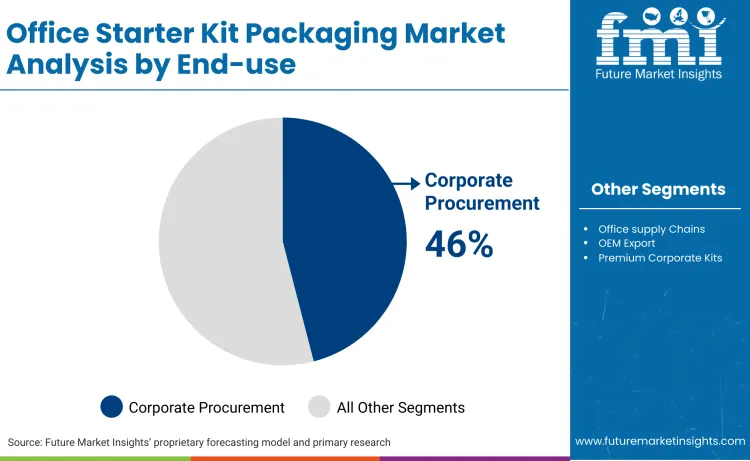
Corporate procurement channels command 46% end-use share in 2026, driven by direct supplier relationships that enable customization, volume pricing, and sustainability verification. Enterprise purchasing departments consolidate starter kit packaging under strategic sourcing agreements that standardize specifications across global locations. This centralization creates predictable order volumes and multi-year contracts that packaging manufacturers prioritize, often integrating packaging materials sourcing directly into the contract to lock in fiber prices.
Procurement departments require suppliers to meet corporate sustainability standards, provide transparent material sourcing documentation, and integrate with enterprise resource planning systems for automated ordering. These technical and compliance requirements create barriers to entry that favor established packaging suppliers with corporate account management capabilities. Small-scale packaging producers struggle to meet the documentation and system integration demands of Fortune 500 procurement processes.
How Do Packaging Formats Serve Different Kit Applications?
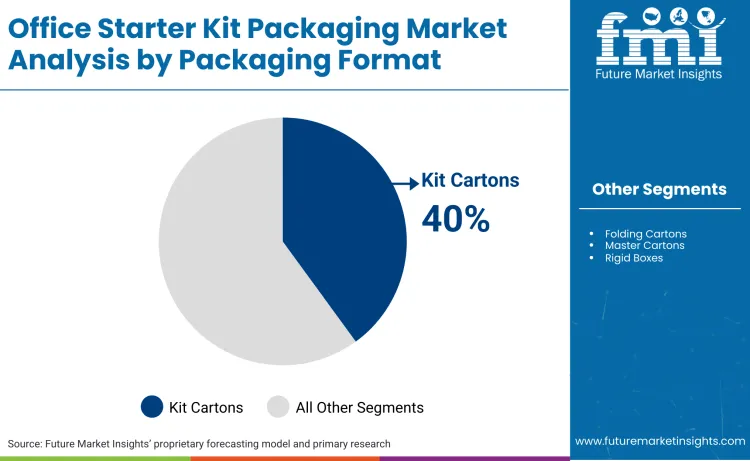
Kit cartons lead with 40% format share, driven by structural versatility that accommodates varied product dimensions from laptops to stationery product assortments. Die-cut designs create custom compartments that organize contents and prevent shifting during shipping. Graphics capabilities allow full-surface brand printing that transforms functional packaging into marketing communication, often utilizing litho laminated packaging for high-impact visual fidelity.
Folding cartons serve lighter-weight kits and individual component packaging within master kits, often utilizing standard boxboard packaging grades. Meanwhile, master cartons protect bulk shipments of multiple starter kits sent to corporate distribution centers. Rigid boxes capture premium applications including executive onboarding kits and client gift programs where packaging quality signals brand positioning. These high-end segments significantly drive the gift boxes market, favoring robust construction and magnetic closures.
How are Technology and Material Innovations driving Market Momentum?
Digital printing adoption is accelerating, enabling short-run customization and variable data printing without traditional plate costs. This technology allows corporations to personalize starter kit packaging for different employee cohorts, departments, or regional offices without minimum order quantity constraints that previously limited customization accessibility. This is increasing demand for specialty paper substrates that can handle high-speed digital inks without bleeding.
Water-based coatings and inks are replacing solvent-based alternatives to meet corporate volatile organic compound reduction goals and improve end-of-life recyclability. Packaging manufacturers are reformulating barrier coatings to maintain moisture protection while ensuring compatibility with paper recycling streams.
How is the Office Starter Kit Packaging Market Evolving Globally?
Across major markets, growth rates highlight the dynamic nature of this sector. India leads with an impressive 15% CAGR, driven by its fast‑growing technology workforce and expanding startup ecosystem. China follows with a 13.6% CAGR, supported by its massive packaging production capacity and global OEM export role. Brazil and the United States each post strong growth at 11%, reflecting economic recovery in Brazil and mature corporate onboarding infrastructures in the USA European markets such as Germany (10.4% CAGR) continue to emphasize sustainability and regulatory compliance, shaping premium packaging standards. Japan, while growing at a slower but steady 9%, maintains demand rooted in its cultural emphasis on presentation quality and meticulous onboarding traditions. Together, these regional dynamics capture how corporate culture, economic development, and sustainability priorities are reshaping the global office starter kit packaging landscape.
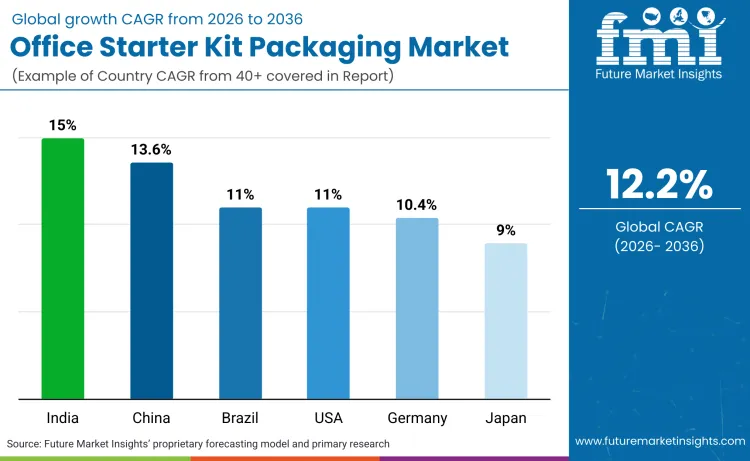
| Country | CAGR (2026-2036) |
|---|---|
| India | 15.0% |
| China | 13.6% |
| Brazil | 11.0% |
| United States | 11.0% |
| Germany | 10.4% |
| Japan | 9.0% |
Source: Future Market Insights (FMI) analysis, based on proprietary forecasting model and primary research
How is India’s Startup Ecosystem Growth Driving Packaging Demand?
India's office starter kit packaging sector is experiencing rapid expansion driven by technology sector employment growth and startup ecosystem maturity. India's IT and business process management sector employed over 5.4 million professionals as of 2024, with continued hiring supporting onboarding material demand. The Indian office starter kit packaging market is set to grow at 15% CAGR during the study period. Corporate office expansion in tier-2 and tier-3 cities is creating distributed fulfillment requirements as companies establish regional hubs. This drives demand for robust paper goods capable of surviving domestic transit networks.
How is Manufacturing Capacity Supporting Domestic and Export Markets in China?
China demand outlook shows strong domestic corporate sector expansion combined with OEM export packaging production for international brands. China's packaging industry produced over 120 million tons of paper and board products in 2023, providing substantial capacity for starter kit applications. The Chinese office starter kit packaging market is set to grow at 13.6% CAGR during the study period. Export-oriented packaging manufacturers serve international corporate clients through supply chain partnerships, leveraging local moving supplies infrastructure to produce customized kits for brands headquartered outside China.
How is Hybrid Work Infrastructure Investment Driving US Market Leadership?
The office starter kit packaging industry in USA maintains leadership through mature corporate onboarding programs and substantial investment in employee experience initiatives. The United States Bureau of Labor Statistics reported total nonfarm payroll employment of approximately 158 million in 2024, with corporate sector hiring supporting consistent starter kit demand.
"The logistics grade linerless labels from Avery Dennison are a true innovation that can have a significant positive impact on operational efficiency and sustainability," noted John Paxton, CEO of MHI, highlighting the focus on efficiency in the US logistics sector. The USA office starter kit packaging industry is set to grow at 11% CAGR during the study period. Hybrid work models are creating demand for home office equipment kits that companies ship directly to employees' residences, often utilizing polyethylene mailers with high recycled content for weatherproofing.
How Are Germany’s Sustainability Mandates Establishing Premium Packaging Standards?
The sales of office starter kit packaging are influenced by stringent corporate sustainability reporting requirements and consumer preference for environmental responsibility. Germany's packaging waste regulation framework, including extended producer responsibility, drives adoption of recyclable materials. The German office starter kit packaging market is set to grow at 10.4% CAGR during the study period. Corporate procurement departments prioritize suppliers with transparent carbon footprint documentation, favoring paperboard mailer solutions over plastic alternatives.
How is Economic Recovery Accelerating Corporate Sector Growth in Brazil?
Brazil's expansion shows improving economic conditions supporting corporate employment growth and infrastructure investment. The market in Brazil is set to grow at 11% CAGR during the study period. Brazil's formal employment in services and commercial sectors is expanding as economic stabilization encourages business investment. Irani Papel e Embalagem, a major player, noted: "For more than five decades, the Brazilian corrugated cardboard market has maintained a consistent growth trajectory, with an average annual growth rate of 6.1%."Multinational corporations operating in Brazil are standardizing onboarding practices across Latin American operations, utilizing local retail paper bags manufacturing capacity to create cohesive welcome bundles.
How Does Corporate Culture in Japan Sustain Premium Packaging Demand?
Demand for Japan is influenced by corporate formality traditions that emphasize presentation quality and attention to detail in employee onboarding. Japan's corporate sector maintains structured welcome procedures where starter kit quality reflects organizational values. The Japanese office starter kit packaging market is set to grow at 9% CAGR during the study period. Domestic packaging manufacturers serve corporate clients with high-quality printing and structural design, often incorporating hinged lid tins for premium, reusable kit components that align with "Omotenashi" principles.
Who are the Major Players Active in the Office Starter Kit Packaging Market?
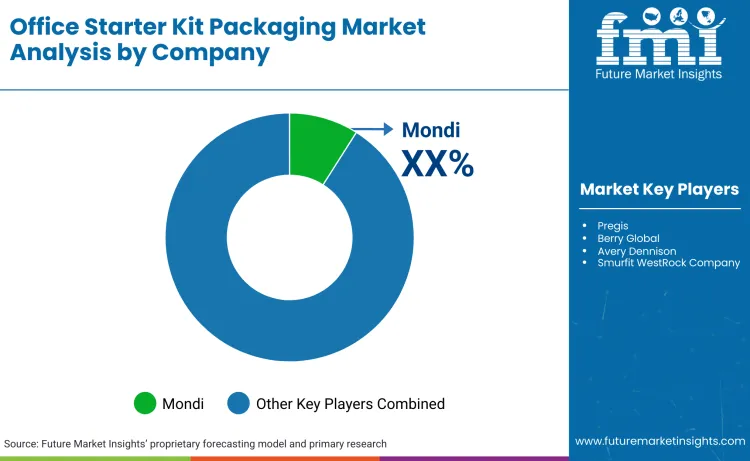
The competitive landscape experiences consolidation activity as global packaging manufacturers pursue scale advantages and geographic reach to serve multinational corporate procurement agreements. Major players are investing in sustainable material development, digital printing capabilities, and supply chain integration to meet evolving corporate buyer requirements. These companies are building comprehensive solution portfolios that span packaging design, production, fulfillment, and sustainability reporting.
Leading packaging manufacturers compete on sustainability credentials, customization flexibility, and global production footprint. Mondi Group maintains strong positioning through sustainable innovation and technical expertise in paper-based solutions. Smurfit WestRock Company leverages its recently combined global network to serve large corporate accounts with standardized packaging across multiple regions. Pregis LLC focuses on protective packaging solutions that address shipping protection requirements. Berry Global Inc. offers integrated packaging systems, while Avery Dennison Corporation provides digital printing and labeling technologies enabling personalization capabilities.
Competitive differentiation increasingly depends on environmental certifications including Forest Stewardship Council approval, carbon footprint transparency, and recycled content documentation. Suppliers that cannot provide comprehensive sustainability reporting face disadvantages in corporate procurement evaluations. Technical capabilities in structural design, digital printing, and rapid prototyping are becoming minimum requirements for serving enterprise accounts with customization demands, leading to a rise in demand for premium gift packaging solutions within the corporate sector.
Key Players in the Office Starter Kit Packaging Market
- Mondi Group
- Smurfit WestRock Company
- Pregis LLC
- Berry Global Inc.
- Avery Dennison Corporation
- International Paper Company
- DS Smith Plc
- Sealed Air Corporation
- Sonoco Products Company
- Georgia-Pacific LLC
Market Definition
The office starter kit packaging market represents revenue generated from specialized packaging solutions designed to contain, protect, and present assorted office supplies, technology accessories, and branded materials distributed to new employees during corporate onboarding processes. As operationally defined in the analysis, the market measures commercially deployed starter kit packaging sold through corporate procurement, office supply chains, and OEM export channels, analyzed by end-use, packaging format, material, and region, and expressed in USD billion.
Market Inclusion
Included in the office starter kit packaging market are products explicitly segmented by end-use application: corporate procurement direct purchases, office supply chain distribution, OEM export production for international brands, and premium corporate kits for executive onboarding. Packaging format coverage spans kit cartons (structural designs for complete starter kits), folding cartons (component packaging), master cartons (bulk shipping containers), and rigid boxes (premium applications). Material types include corrugated board, paperboard, corrugated kraft, and specialty board substrates. Geographic scope covers North America, Europe, East Asia, South Asia, Latin America, and Middle East and Africa.
Market Exclusion
Excluded from the market scope are retail consumer packaging for office products sold through commercial channels to individual consumers. Industrial shipping containers and palletization materials not specifically designed for starter kit applications are not included. Reusable plastic totes and containers are outside market definition. Office furniture packaging and technology device packaging produced by OEM manufacturers for retail distribution are excluded. Promotional gift packaging and corporate event materials not related to employee onboarding are not counted. Internal office supply storage containers and organizational systems are outside market scope.
| Items | Values |
|---|---|
| Quantitative Units (2026) | USD 1.1 billion |
| End-Use Segments | Corporate Procurement, Office Supply Chains, OEM Export, Premium Corporate Kits |
| Packaging Format | Kit Cartons, Folding Cartons, Master Cartons, Rigid Boxes |
| Material Type | Corrugated Board, Paperboard, Corrugated Kraft, Specialty Board |
| Application Context | Employee Onboarding Kits, Hybrid & Remote Work Equipment Distribution, Executive Onboarding and Corporate Gift Programs |
| Regions Covered | North America, Europe, East Asia, South Asia, Latin America, Middle East & Africa |
| Countries Covered | United States, Germany, China, Japan, India, Brazil, and 40+ countries |
| Key Companies Profiled | Mondi Group, Smurfit WestRock Company, Pregis LLC, Berry Global Inc., Avery Dennison Corporation, International Paper Company, DS Smith Plc, Sealed Air Corporation, Sonoco Products Company, Georgia-Pacific LLC |
| Additional Attributes | Revenue analysis by end-use channel and packaging format, corporate procurement share analysis, material mix and recyclability assessment, sustainability compliance and certification tracking, digital printing and customization adoption, hybrid work fulfillment impact analysis, supply chain consolidation trends, and competitive positioning across multinational packaging suppliers |
Office Starter Kit Packaging Market by Segments
End-Use:
- Corporate Procurement
- Office Supply Chains
- OEM Export
- Premium Corporate Kits
Packaging Format:
- Kit Cartons
- Folding Cartons
- Master Cartons
- Rigid Boxes
Material:
- Corrugated Board
- Paperboard
- Corrugated Kraft
- Specialty Board
Region:
- North America (United States, Canada, Mexico)
- Europe (Germany, France, UK, Italy, Spain, BENELUX, Nordics)
- East Asia (China, Japan, South Korea)
- South Asia (India, Australia & New Zealand, Southeast Asia)
- Latin America (Brazil, Chile, Colombia, Argentina)
- Middle East & Africa
Bibliography
- World Customs Organization (WCO). (2024). HS Nomenclature Explanatory Notes for paperboard containers, labels, and packaging materials. WCO.
- UN Statistics Division. (2024). International Standard Industrial Classification (ISIC Rev.4)-Manufacture of paper and paper products. UNSD.
- Joint Research Centre, European Commission. (2024). Material flow analysis of paper, board, and packaging waste streams in the EU. JRC.
- USA Geological Survey (USGS). (2024). Mineral commodity summaries: Industrial minerals used in paper and packaging. USGS.
- Bureau of Transportation Statistics (BTS). (2024). Freight flows for paper and packaging commodities. USA DOT.
- Ministry of the Environment, Japan. (2024). Containers and Packaging Recycling Law performance report. Government of Japan.
- National Development and Reform Commission (NDRC). (2024). Circular economy action plan for packaging materials. Government of China.
- Central Pollution Control Board (CPCB). (2024). Annual report on plastic and packaging waste management. Government of India.
- European Food Safety Authority (EFSA). (2024). Guidance on substances used in food contact materials including labels and adhesives. EFSA.
- USA National Institute of Standards and Technology (NIST). (2024). Traceability and standards for printed labeling systems in supply chains. NIST.
Frequently Asked Questions
What is the current global office starter kit packaging market size in 2026?
The global office starter kit packaging market is valued at USD 1.1 billion in 2026, driven by corporate investment in employee onboarding programs and hybrid work infrastructure.
What is the projected CAGR for the office starter kit packaging industry from 2026 to 2036?
The office starter kit packaging industry is projected to grow at 12.2% CAGR from 2026 to 2036, reaching USD 3.4 billion by 2036.
Which packaging formats dominate the office starter kit packaging market?
Kit cartons lead with 40% share in the office starter kit packaging market, followed by folding cartons, master cartons, and rigid boxes for premium applications.
What materials are most commonly used in office starter kit packaging manufacturing?
Corrugated board dominates with 48% material share in office starter kit packaging, followed by paperboard, corrugated kraft, and specialty board substrates.
Which countries show the fastest growth in the office starter kit packaging market?
India leads with 15% CAGR in office starter kit packaging, followed by China at 13.6% and Brazil at 11%, driven by corporate sector expansion and employment growth.
Preview the report firsthand - request a free sample
Get SampleGet the brochure for pricing and purchase details.
Get PDFTable of Content
- Executive Summary
- Global Market Outlook
- Demand Side Trends
- Supply Side Trends
- Technology Roadmap Analysis
- Analysis and Recommendations
- Market Overview
- Market Coverage / Taxonomy
- Market Definition / Scope / Limitations
- Research Methodology
- Chapter Orientation
- Analytical Lens and Working Hypotheses
- Market Structure, Signals, and Trend Drivers
- Benchmarking and Cross-market Comparability
- Market Sizing, Forecasting, and Opportunity Mapping
- Research Design and Evidence Framework
- Desk Research Programme (Secondary Evidence)
- Company Annual and Sustainability Reports
- Peer-reviewed Journals and Academic Literature
- Corporate Websites, Product Literature, and Technical Notes
- Earnings Decks and Investor Briefings
- Statutory Filings and Regulatory Disclosures
- Technical White Papers and Standards Notes
- Trade Journals, Industry Magazines, and Analyst Briefs
- Conference Proceedings, Webinars, and Seminar Materials
- Government Statistics Portals and Public Data Releases
- Press Releases and Reputable Media Coverage
- Specialist Newsletters and Curated Briefings
- Sector Databases and Reference Repositories
- FMI Internal Knowledge Base and Historical Datasets
- Subscription Datasets and Paid Sources
- Social Channels, Communities, and Digital Listening Inputs
- Additional Desk Sources
- Expert Input and Fieldwork (Primary Evidence)
- Primary Modes
- Qualitative Interviews and Expert Elicitation
- Quantitative Surveys and Structured Data Capture
- Blended Approach
- Why Primary Evidence is Used
- Field Techniques
- Interviews
- Surveys
- Focus Groups
- Observational and In-context Research
- Social and Community Interactions
- Stakeholder Universe Engaged
- C-suite Leaders
- Board Members
- Presidents and Vice Presidents
- R&D and Innovation Heads
- Technical Specialists
- Domain Subject-matter Experts
- Scientists
- Procurement Directors
- Governance, Ethics, and Data Stewardship
- Research Ethics
- Data Integrity and Handling
- Primary Modes
- Tooling, Models, and Reference Databases
- Desk Research Programme (Secondary Evidence)
- Data Engineering and Model Build
- Data Acquisition and Ingestion
- Cleaning, Normalisation, and Verification
- Synthesis, Triangulation, and Analysis
- Quality Assurance and Audit Trail
- Market Background
- Market Dynamics
- Drivers
- Restraints
- Opportunity
- Trends
- Scenario Forecast
- Demand in Optimistic Scenario
- Demand in Likely Scenario
- Demand in Conservative Scenario
- Opportunity Map Analysis
- Product Life Cycle Analysis
- Supply Chain Analysis
- Investment Feasibility Matrix
- Value Chain Analysis
- PESTLE and Porter's Analysis
- Regulatory Landscape
- Regional Parent Market Outlook
- Production and Consumption Statistics
- Import and Export Statistics
- Market Dynamics
- Global Market Analysis 2021 to 2025 and Forecast, 2026 to 2036
- Historical Market Size Value (USD Billion) Analysis, 2021 to 2025
- Current and Future Market Size Value (USD Billion) Projections, 2026 to 2036
- Y-o-Y Growth Trend Analysis
- Absolute $ Opportunity Analysis
- Global Market Pricing Analysis 2021 to 2025 and Forecast 2026 to 2036
- Y-o-Y Growth Trend Analysis 2021 to 2025
- Absolute $ Opportunity Analysis 2026 to 2036
- Global Market Analysis 2021 to 2025 and Forecast 2026 to 2036, By End-Use
- Introduction / Key Findings
- Historical Market Size Value (USD Billion) Analysis By End-Use, 2021 to 2025
- Current and Future Market Size Value (USD Billion) Analysis and Forecast By End-Use, 2026 to 2036
- Corporate Procurement
- Office Supply Chains
- OEM Export
- Premium Corporate Kits
- Y-o-Y Growth Trend Analysis By End-Use, 2021 to 2025
- Absolute $ Opportunity Analysis By End-Use, 2026 to 2036
- Global Market Analysis 2021 to 2025 and Forecast 2026 to 2036, By Packaging Format
- Introduction / Key Findings
- Historical Market Size Value (USD Billion) Analysis By Packaging Format, 2021 to 2025
- Current and Future Market Size Value (USD Billion) Analysis and Forecast By Packaging Format, 2026 to 2036
- Kit Cartons
- Folding Cartons
- Master Cartons
- Rigid Boxes
- Y-o-Y Growth Trend Analysis By Packaging Format, 2021 to 2025
- Absolute $ Opportunity Analysis By Packaging Format, 2026 to 2036
- Global Market Analysis 2021 to 2025 and Forecast 2026 to 2036, By Material
- Introduction / Key Findings
- Historical Market Size Value (USD Billion) Analysis By Material, 2021 to 2025
- Current and Future Market Size Value (USD Billion) Analysis and Forecast By Material, 2026 to 2036
- Corrugated Board
- Paperboard
- Corrugated Kraft
- Specialty Board
- Y-o-Y Growth Trend Analysis By Material, 2021 to 2025
- Absolute $ Opportunity Analysis By Material, 2026 to 2036
- Global Market Analysis 2021 to 2025 and Forecast 2026 to 2036, By Region
- Introduction
- Historical Market Size Value (USD Billion) Analysis By Region, 2021 to 2025
- Current Market Size Value (USD Billion) Analysis and Forecast By Region, 2026 to 2036
- North America
- Latin America
- Western Europe
- Eastern Europe
- East Asia
- South Asia and Pacific
- Middle East & Africa
- Market Attractiveness Analysis By Region
- North America Market Analysis 2021 to 2025 and Forecast 2026 to 2036, By Country
- Historical Market Size Value (USD Billion) Trend Analysis By Market Taxonomy, 2021 to 2025
- Market Size Value (USD Billion) Forecast By Market Taxonomy, 2026 to 2036
- By Country
- USA
- Canada
- Mexico
- By End-Use
- By Packaging Format
- By Material
- By Country
- Market Attractiveness Analysis
- By Country
- By End-Use
- By Packaging Format
- By Material
- Key Takeaways
- Latin America Market Analysis 2021 to 2025 and Forecast 2026 to 2036, By Country
- Historical Market Size Value (USD Billion) Trend Analysis By Market Taxonomy, 2021 to 2025
- Market Size Value (USD Billion) Forecast By Market Taxonomy, 2026 to 2036
- By Country
- Brazil
- Chile
- Rest of Latin America
- By End-Use
- By Packaging Format
- By Material
- By Country
- Market Attractiveness Analysis
- By Country
- By End-Use
- By Packaging Format
- By Material
- Key Takeaways
- Western Europe Market Analysis 2021 to 2025 and Forecast 2026 to 2036, By Country
- Historical Market Size Value (USD Billion) Trend Analysis By Market Taxonomy, 2021 to 2025
- Market Size Value (USD Billion) Forecast By Market Taxonomy, 2026 to 2036
- By Country
- Germany
- UK
- Italy
- Spain
- France
- Nordic
- BENELUX
- Rest of Western Europe
- By End-Use
- By Packaging Format
- By Material
- By Country
- Market Attractiveness Analysis
- By Country
- By End-Use
- By Packaging Format
- By Material
- Key Takeaways
- Eastern Europe Market Analysis 2021 to 2025 and Forecast 2026 to 2036, By Country
- Historical Market Size Value (USD Billion) Trend Analysis By Market Taxonomy, 2021 to 2025
- Market Size Value (USD Billion) Forecast By Market Taxonomy, 2026 to 2036
- By Country
- Russia
- Poland
- Hungary
- Balkan & Baltic
- Rest of Eastern Europe
- By End-Use
- By Packaging Format
- By Material
- By Country
- Market Attractiveness Analysis
- By Country
- By End-Use
- By Packaging Format
- By Material
- Key Takeaways
- East Asia Market Analysis 2021 to 2025 and Forecast 2026 to 2036, By Country
- Historical Market Size Value (USD Billion) Trend Analysis By Market Taxonomy, 2021 to 2025
- Market Size Value (USD Billion) Forecast By Market Taxonomy, 2026 to 2036
- By Country
- China
- Japan
- South Korea
- By End-Use
- By Packaging Format
- By Material
- By Country
- Market Attractiveness Analysis
- By Country
- By End-Use
- By Packaging Format
- By Material
- Key Takeaways
- South Asia and Pacific Market Analysis 2021 to 2025 and Forecast 2026 to 2036, By Country
- Historical Market Size Value (USD Billion) Trend Analysis By Market Taxonomy, 2021 to 2025
- Market Size Value (USD Billion) Forecast By Market Taxonomy, 2026 to 2036
- By Country
- India
- ASEAN
- Australia & New Zealand
- Rest of South Asia and Pacific
- By End-Use
- By Packaging Format
- By Material
- By Country
- Market Attractiveness Analysis
- By Country
- By End-Use
- By Packaging Format
- By Material
- Key Takeaways
- Middle East & Africa Market Analysis 2021 to 2025 and Forecast 2026 to 2036, By Country
- Historical Market Size Value (USD Billion) Trend Analysis By Market Taxonomy, 2021 to 2025
- Market Size Value (USD Billion) Forecast By Market Taxonomy, 2026 to 2036
- By Country
- Kingdom of Saudi Arabia
- Other GCC Countries
- Turkiye
- South Africa
- Other African Union
- Rest of Middle East & Africa
- By End-Use
- By Packaging Format
- By Material
- By Country
- Market Attractiveness Analysis
- By Country
- By End-Use
- By Packaging Format
- By Material
- Key Takeaways
- Key Countries Market Analysis
- USA
- Pricing Analysis
- Market Share Analysis, 2025
- By End-Use
- By Packaging Format
- By Material
- Canada
- Pricing Analysis
- Market Share Analysis, 2025
- By End-Use
- By Packaging Format
- By Material
- Mexico
- Pricing Analysis
- Market Share Analysis, 2025
- By End-Use
- By Packaging Format
- By Material
- Brazil
- Pricing Analysis
- Market Share Analysis, 2025
- By End-Use
- By Packaging Format
- By Material
- Chile
- Pricing Analysis
- Market Share Analysis, 2025
- By End-Use
- By Packaging Format
- By Material
- Germany
- Pricing Analysis
- Market Share Analysis, 2025
- By End-Use
- By Packaging Format
- By Material
- UK
- Pricing Analysis
- Market Share Analysis, 2025
- By End-Use
- By Packaging Format
- By Material
- Italy
- Pricing Analysis
- Market Share Analysis, 2025
- By End-Use
- By Packaging Format
- By Material
- Spain
- Pricing Analysis
- Market Share Analysis, 2025
- By End-Use
- By Packaging Format
- By Material
- France
- Pricing Analysis
- Market Share Analysis, 2025
- By End-Use
- By Packaging Format
- By Material
- India
- Pricing Analysis
- Market Share Analysis, 2025
- By End-Use
- By Packaging Format
- By Material
- ASEAN
- Pricing Analysis
- Market Share Analysis, 2025
- By End-Use
- By Packaging Format
- By Material
- Australia & New Zealand
- Pricing Analysis
- Market Share Analysis, 2025
- By End-Use
- By Packaging Format
- By Material
- China
- Pricing Analysis
- Market Share Analysis, 2025
- By End-Use
- By Packaging Format
- By Material
- Japan
- Pricing Analysis
- Market Share Analysis, 2025
- By End-Use
- By Packaging Format
- By Material
- South Korea
- Pricing Analysis
- Market Share Analysis, 2025
- By End-Use
- By Packaging Format
- By Material
- Russia
- Pricing Analysis
- Market Share Analysis, 2025
- By End-Use
- By Packaging Format
- By Material
- Poland
- Pricing Analysis
- Market Share Analysis, 2025
- By End-Use
- By Packaging Format
- By Material
- Hungary
- Pricing Analysis
- Market Share Analysis, 2025
- By End-Use
- By Packaging Format
- By Material
- Kingdom of Saudi Arabia
- Pricing Analysis
- Market Share Analysis, 2025
- By End-Use
- By Packaging Format
- By Material
- Turkiye
- Pricing Analysis
- Market Share Analysis, 2025
- By End-Use
- By Packaging Format
- By Material
- South Africa
- Pricing Analysis
- Market Share Analysis, 2025
- By End-Use
- By Packaging Format
- By Material
- USA
- Market Structure Analysis
- Competition Dashboard
- Competition Benchmarking
- Market Share Analysis of Top Players
- By Regional
- By End-Use
- By Packaging Format
- By Material
- Competition Analysis
- Competition Deep Dive
- Mondi Group
- Smurfit WestRock Company
- Pregis LLC
- Berry Global Inc.
- Avery Dennison Corporation
- International Paper Company
- DS Smith Plc
- Sealed Air Corporation
- Sonoco Products Company
- Georgia-Pacific LLC
- Competition Deep Dive
- Assumptions & Acronyms Used


