

- Industry Size (2026)
- USD 1420 Mn
- Forecast (2036)
- USD 4860 Mn
- CAGR (2026 to 2036)
- 13.1%
Yoga and Wellness Kits Packaging Market Forecast and Outlook By FMI
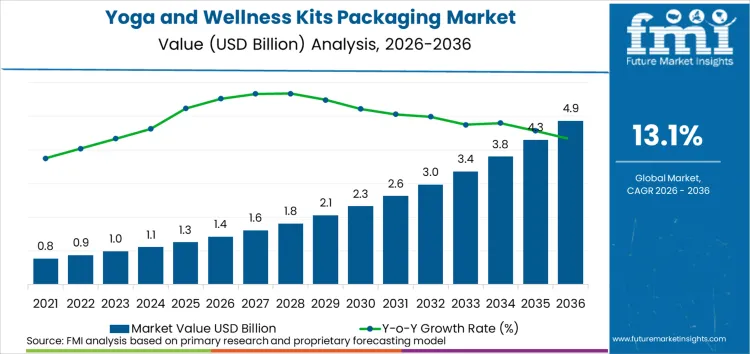
The global yoga and wellness kits packaging market is estimated to be valued at USD 1,420 million in 2026 and is projected to reach USD 4,860 million by 2036, expanding at a CAGR of 13.1% over the forecast period. This growth trajectory reflects a structural reconfiguration of the global wellness economy, in which product bundling, ritual-based consumption, and subscription-driven replenishment models are replacing single-SKU transactional sales across both digital and physical wellness channels.
Yoga and wellness kits packaging has evolved into a distinct secondary packaging category, driven by the need to consolidate multiple heterogeneous products such as yoga accessories, aromatherapy items, supplements, meditation tools, and wellness literature into a single, ship-ready unit. Unlike conventional consumer goods packaging, these kits require engineered structural integrity, internal organisation, and presentation coherence, all while maintaining parcel compatibility for e-commerce distribution. This has materially expanded the addressable value of packaging per transaction, as brands increasingly specify customised rigid and semi-rigid fibre-based formats rather than standard folding cartons or generic mailers.
Summary of Yoga and Wellness Kits Packaging Market
- The yoga and wellness kits packaging market refers to the global market for paper-based and fibre-based secondary and tertiary packaging solutions used to bundle, protect, and present curated wellness product assortments.
- Within FMI’s defined scope, the market includes kit boxes and mailers, rigid set-up boxes, folding cartons, drawer boxes, and master cartons, manufactured primarily from corrugated board, paperboard, kraft board, and specialty paper substrates. The scope explicitly excludes primary product containers, flexible plastic pouches, non-paper packaging formats, and downstream logistics or fulfilment services.
- FMI projects the yoga and wellness kits packaging market to expand from USD 1,420 million in 2026 to USD 4,860 million by 2036, registering a 13.1% CAGR. This expansion is driven by the rapid proliferation of kit-based wellness offerings, which increase the packaging value per order and necessitate more complex, higher-specification packaging designs than single-product shipments.
- Structurally, the market is transitioning from aesthetic-led packaging decisions toward performance- and compliance-led packaging procurement. Early-stage wellness brands often emphasised unboxing experience and visual differentiation; however, as volumes scale, the dominant considerations shift toward transit durability, pack-out efficiency, material standardisation, and recyclability credibility. This transition favours packaging suppliers capable of delivering program-level kit solutions rather than one-off custom boxes.
- North America remains the largest market due to the high concentration of D2C wellness brands and subscription commerce models. India is projected to be the fastest-growing country market, supported by export-oriented wellness manufacturing and the increasing formalisation of organised yoga and wellness retail. Europe’s market evolution is strongly influenced by regulatory harmonisation under PPWR, which accelerates the adoption of fibre-aligned kit packaging architectures.
From an operational perspective, the market is shaped by the industrialisation of kit assembly workflows. As wellness brands scale beyond artisanal volumes, packaging must support high-throughput fulfilment environments with predictable pack-out times, reduced handling complexity, and minimal error rates. This requirement has driven adoption of pre-partitioned corrugated mailers, rigid set-up boxes with die-cut paperboard inserts, and hybrid folding carton-mailer formats that combine protection, presentation, and shipping efficiency within a single packaging architecture.
Regulatory alignment has emerged as a critical secondary driver reinforcing these structural shifts. In Europe, the Packaging and Packaging Waste Regulation (PPWR), which applies from August 2026, establishes harmonised recyclability and sustainability requirements that directly affect secondary packaging choices for wellness kits shipped into the EU. While implementation details vary by requirement, the direction of regulation is clear: packaging designs that rely on mono-material fibre structures and avoid complex composites are increasingly favoured from both compliance and risk-management perspectives. As a result, wellness brands with international footprints are proactively redesigning kit packaging well ahead of enforcement timelines.
In North America, the gradual expansion of Extended Producer Responsibility (EPR) frameworks is exerting a similar influence. Although EPR implementation is staggered across jurisdictions and fee structures are not uniformly finalised, the cumulative effect is a shift in procurement philosophy. Brands are increasingly prioritising future-proof packaging formats that minimise exposure to redesign costs as regulatory thresholds tighten. Fibre-based kit packaging, with its established recycling infrastructure and lower regulatory ambiguity, is emerging as the preferred solution.
Over the 2026-2036 period, the yoga and wellness kits packaging market will continue to benefit from the convergence of wellness lifestyle adoption, digital commerce penetration, and compliance-driven packaging rationalisation. Growth will not be uniform across all formats or materials; instead, it will concentrate around packaging solutions that successfully balance protection, presentation, logistics efficiency, and regulatory credibility at scale.
Yoga and Wellness Kits Packaging Market Key Takeaways
| Metric | Value |
|---|---|
| Expected Value (2026E) | USD 1,420 million |
| Projected Value (2036F) | USD 4,860 million |
| CAGR (2026-2036) | 13.1% |
Source: FMI analysis based on primary research and proprietary forecasting model
Why is the Yoga and Wellness Kits Packaging Market Growing?
The yoga and wellness kits packaging market is growing primarily due to the commercialisation of wellness rituals into bundled product ecosystems. Modern consumers increasingly purchase wellness experiences rather than individual products, seeking curated solutions that address fitness, mindfulness, recovery, and self-care within a single purchase. This shift has transformed packaging from a protective afterthought into a central component of the product offering, responsible for organising, narrating, and safeguarding the wellness experience.
E-commerce has amplified this effect. Wellness kits are disproportionately sold through direct-to-consumer channels, where packaging must survive multi-node parcel networks while preserving premium presentation. Damage rates, leakage incidents, and internal product movement directly erode margins and brand trust, making packaging performance a core commercial variable. As shipment volumes rise, even marginal improvements in structural efficiency or damage reduction yield significant financial returns, driving sustained investment in engineered kit packaging solutions.
A third growth vector is the operational scaling of wellness brands. As brands move from limited runs to national and international distribution, packaging specifications become formalised and centralised. Procurement teams increasingly favour standardised kit architectures that can be reproduced across multiple SKUs and geographies, reducing complexity and ensuring consistency. This shift benefits packaging suppliers capable of delivering repeatable quality, tight dimensional tolerances, and scalable production capacity.
Regulatory direction reinforces these dynamics. While sustainability was initially a brand-driven narrative within the wellness sector, it is now increasingly codified into compliance expectations, particularly in Europe. The upcoming application of PPWR accelerates the replacement of mixed-material and decorative-heavy packaging with fibre-based solutions that align with established recycling systems. Even in regions with less prescriptive regulation, global brands are standardising packaging designs to the highest common denominator to avoid future redesign costs.
How is the Yoga and Wellness Kits Packaging Market Segmented?
The segmentation of the yoga and wellness kits packaging market reflects the functional complexity and commercial diversity of wellness kit offerings. Unlike traditional consumer goods packaging, segmentation in this market is not driven purely by material or format, but by how packaging integrates into commerce models, fulfilment workflows, and regulatory exposure. End-use, packaging format, and material segmentation are tightly interlinked, with purchasing decisions often made holistically rather than in isolation.
Does the D2C Wellness Brands segment represent the largest end-use category?
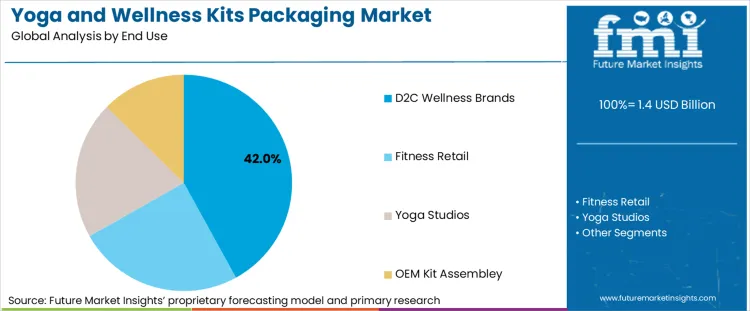
D2C wellness brands account for 42% of total market demand in 2026, making them the dominant end-use segment. This dominance is structural rather than cyclical. D2C brands control the entire value chain, allowing them to specify packaging designs that simultaneously optimise marketing impact, logistics efficiency, and regulatory alignment. Unlike third-party retail channels, D2C brands are not constrained by shelf-ready requirements, enabling greater experimentation with integrated kit packaging formats.
As these brands scale, packaging procurement becomes increasingly centralised and data-driven. Early-stage wellness brands often prioritise aesthetics and storytelling, but as shipment volumes increase, performance metrics such as damage rates, fulfilment time per order, and parcel dimensional efficiency take precedence. This transition favours packaging solutions that are engineered rather than visually ornamental. Consequently, D2C brands increasingly lock in long-term packaging programs with defined board grades, insert configurations, and box geometries, driving repeat demand for high-specification kit packaging.
Why do Kit Boxes and Mailers dominate packaging format segmentation?
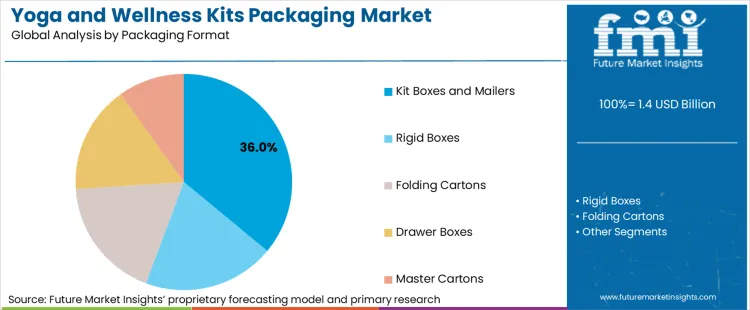
Kit boxes and mailers collectively account for 36% of total packaging format demand in 2026, making them the leading format category. Their dominance stems from their ability to integrate secondary and tertiary packaging functions into a single unit. In e-commerce contexts, these formats enable “ship-ready” designs that eliminate the need for outer cartons, reducing material consumption, packing time, and shipping costs.
From an engineering standpoint, kit mailers and boxes are highly adaptable. They can be customised with internal partitions, suspension features, and reinforcement zones to accommodate mixed product sets. This adaptability is critical for wellness kits, which often include combinations of rigid containers, flexible sachets, accessories, and printed materials. By consolidating these items into a single structural unit, kit boxes reduce internal movement and minimise breakage risk.
Why does Corrugated Board remain the dominant material?
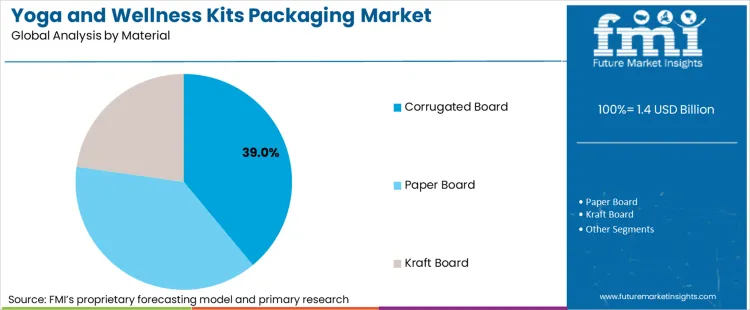
Corrugated board holds a 39% share of total material demand, with corrugated kraft contributing an additional 8%, bringing total corrugated utilisation to 47%. Corrugated’s dominance is driven by its strength-to-weight efficiency, cost-effectiveness at scale, and compatibility with global fibre recycling systems. These attributes make it particularly well-suited to e-commerce distribution, where packaging must absorb impact forces while minimising shipping weight.
From a regulatory and risk-management perspective, corrugated board offers lower uncertainty than alternative materials. Its recyclability is well-established across major markets, reducing compliance ambiguity as packaging regulations tighten. Additionally, corrugated structures can be engineered to replace plastic inserts and void fill, further increasing fibre content and simplifying end-of-life handling.
What Drivers, Restraints, Opportunities, and Trends Influence the Yoga and Wellness Kits Packaging Landscape?
The most significant driver is the scaling of kit-based wellness commerce. As wellness brands expand product portfolios, kits allow them to increase average order value and simplify purchasing decisions for consumers. Packaging becomes the physical infrastructure that enables this bundling strategy. Each additional component added to a kit increases packaging complexity and value, driving demand for higher-specification solutions. Another driver is the economics of parcel distribution. E-commerce carriers penalise dimensional inefficiency and damage-related returns. Packaging that reduces void space, prevents internal movement, and withstands repeated handling directly improves unit economics. As shipment volumes grow, these benefits compound, making investment in engineered packaging financially rational rather than discretionary.
Despite strong growth, the market faces several constraints. Fibre price volatility can compress margins for packaging suppliers and buyers alike. Supply-demand imbalances in recycled fibre streams introduce cost uncertainty, especially during periods of high e-commerce activity. Technical limitations also persist. Many wellness kits include oils, liquids, or semi-liquids that pose leakage risks. Fibre-based packaging requires additional barrier solutions to manage these risks, which can increase costs and introduce recyclability trade-offs if not carefully specified. Brands must balance protection requirements against sustainability goals, complicating material selection.
A major opportunity lies in the replacement of plastic internal components with fibre-based alternatives. Moulded pulp inserts, paperboard partitions, and die-cut corrugated structures can fully replace plastic trays in many kit configurations. This not only improves recyclability but also strengthens sustainability narratives, which are particularly influential in the wellness sector. Another opportunity is the development of modular kit packaging platforms. Standardised box sizes and insert systems that can be adapted across multiple SKUs reduce tooling costs and speed time-to-market. Packaging suppliers that offer modular solutions are well-positioned to capture long-term contracts with scaling wellness brands.
Lightweighting is a dominant trend, driven by both cost and sustainability considerations. Advances in corrugated flute design and paperboard strength allow brands to reduce material usage without compromising performance. This trend is reinforced by parcel carrier pricing structures that reward lower dimensional weight. Aesthetic trends are also evolving. Wellness brands increasingly favour natural, minimalist packaging designs that visually communicate sustainability and authenticity. Uncoated kraft surfaces, muted colour palettes, and tactile finishes are becoming common, provided they do not undermine structural performance.
What is the Yoga and Wellness Kits Packaging Landscape Distribution in Key Countries?
| Country | CAGR |
|---|---|
| India | 15.8% |
| China | 13.2% |
| USA | 12.4% |
| Germany | 11.6% |
| Japan | 9.8% |
Source: Future Market Insights analysis, supported by a proprietary forecasting model and primary research
What is the Scope for Yoga and Wellness Kits Packaging in India?
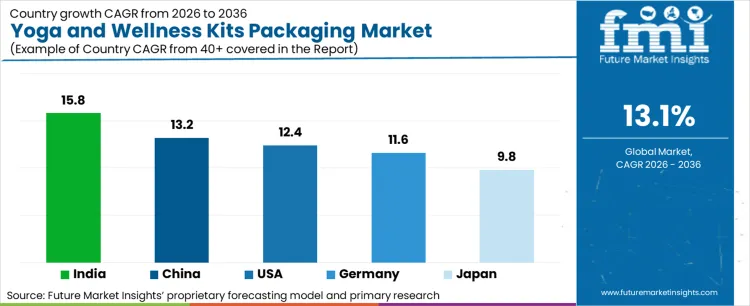
Advancing at a CAGR of 15.8%, India represents the fastest-growing country market for yoga and wellness kits packaging over the forecast period, reflecting its dual role as both a domestic consumption market and a global manufacturing hub for wellness products. India’s export-oriented ecosystem for yoga accessories, herbal wellness products, meditation aids, and Ayurvedic formulations increasingly supplies brands in North America and Europe that rely on pre-assembled kits rather than loose SKU shipment. This shift materially increases packaging value per unit, as export kits require structurally robust, presentation-grade packaging that can withstand international transit while meeting destination-market sustainability expectations.
From a packaging procurement perspective, Indian manufacturers are transitioning away from low-cost, single-wall cartons toward engineered corrugated mailers, rigid boxes, and compartmentalised paperboard systems. This evolution is driven by buyer requirements rather than local regulation alone. International wellness brands increasingly mandate fibre-based packaging that aligns with EU and USA recyclability norms, forcing Indian suppliers to upgrade packaging specifications to remain competitive. As a result, demand is rising for higher-quality linerboard, precision die-cut inserts, and consistent print quality-supporting above-average market growth through 2036.
Why is USA considered an Important Hub for Yoga and Wellness Kits Packaging?
USA remains the largest country market in value terms, expected to advance at a 12.4% CAGR. Growth is underpinned by a dense concentration of D2C wellness brands, subscription-based commerce models, and digitally native yoga and fitness platforms. In the USA market, packaging is treated as an operational lever, not merely a branding tool. Brands rigorously evaluate packaging performance based on damage rates, fulfilment efficiency, customer feedback, and return costs, making packaging procurement highly data-driven.
Growth in the USA is further supported by the steady expansion of kit-based offerings beyond physical products into routine-based wellness programs, where packaging plays a central role in organising daily or weekly consumption. From a regulatory standpoint, while Extended Producer Responsibility frameworks are being implemented on a state-by-state basis, the direction of policy has already influenced packaging decisions. Brands increasingly specify packaging formats that minimise regulatory risk across jurisdictions, reinforcing the shift toward recyclable, fibre-dominant solutions and supporting sustained double-digit growth.
How is Germany establishing Growth Standards in Yoga and Wellness Kits Packaging?
Advancing at an 11.6% CAGR, Germany’s yoga and wellness kits packaging market is shaped by high consumer environmental awareness, mature recycling infrastructure, and stringent packaging compliance norms. Brands shipping kits into Germany face elevated expectations around material transparency, recyclability, and waste reduction, making Germany a benchmark market for packaging specification within Europe. As wellness kits gain traction through e-commerce and specialty retail, packaging designs must align with established fibre collection systems and avoid ambiguous material combinations.
The upcoming application of EU-wide harmonised packaging rules further reinforces Germany’s influence on regional packaging trends. Wellness brands serving the German market increasingly standardise packaging formats across Europe to avoid country-specific redesigns, driving demand for compliant, mono-material fibre solutions. Although growth rates are lower than in emerging markets, Germany’s market expansion is characterised by high specification intensity, favouring premium corrugated and paperboard solutions over low-cost alternatives.
How is China expected to perform in the Yoga and Wellness Kits Packaging Landscape?
China’s yoga and wellness kits packaging market growth is slated to register a 13.2% CAGR, primarily driven by its role as a large-scale contract manufacturing base for global wellness brands. Chinese manufacturers supply a wide range of wellness kits, from entry-level yoga accessories to premium gift-oriented sets destined for international markets. This export orientation necessitates packaging that meets international quality and sustainability standards, increasing demand for higher-grade corrugated board and precision-engineered packaging formats.
China’s rapidly expanding e-commerce infrastructure also contributes to demand growth. As wellness consumption increases among urban middle-class consumers, brands are adopting kit-based formats to differentiate offerings and increase order value. This trend reinforces demand for cost-efficient yet structurally reliable packaging, positioning China as one of the strongest growth markets globally despite intense pricing competition.
What is Japan’s Outlook with respect to Yoga and Wellness Kits Packaging?
With a 9.8% CAGR, Japan represents a mature but high-value market for yoga and wellness kits packaging. Consumer expectations in Japan emphasise presentation quality, compact efficiency, and material refinement, which influences packaging format selection. Rigid boxes, drawer boxes, and premium paperboard structures are more prevalent than in other markets, particularly for gifting-oriented wellness kits and seasonal promotions.
While overall growth is slower relative to emerging markets, Japan’s market is characterised by high per-unit packaging value. Brands invest in precise structural design and high-quality finishes to meet cultural expectations around craftsmanship and minimal waste. As a result, Japan remains strategically important for packaging suppliers specialising in premium fibre-based solutions, even as volume growth moderates.
Competitive Landscape Analysis of the Yoga and Wellness Kits Packaging Market
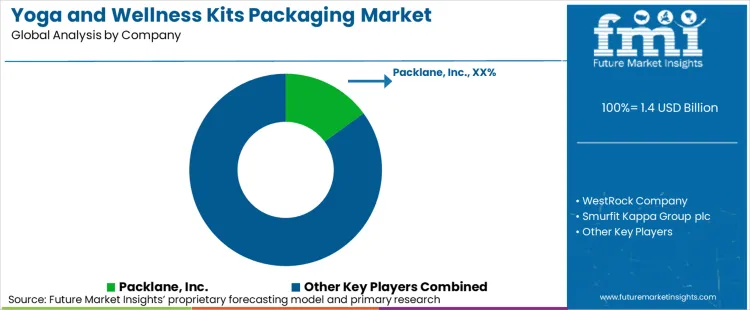
The competitive landscape of the yoga and wellness kits packaging market is defined less by price competition and more by capability depth, program execution reliability, and alignment with brand operating models. As wellness brands scale kit-based offerings, packaging procurement increasingly shifts from transactional purchasing to long-term program sourcing, favouring suppliers that can deliver consistency across volumes, SKUs, and geographies.
A defining characteristic of competition in this market is the convergence of structural engineering and brand presentation requirements. Packaging suppliers are no longer evaluated solely on print quality or unit pricing; instead, they are assessed on their ability to deliver packaging architectures that reduce fulfilment friction, minimise damage rates, and support sustainability narratives without introducing regulatory risk. This has elevated the role of in-house design studios, transit testing capabilities, and prototyping speed as core competitive differentiators.
Large integrated packaging groups benefit from scale advantages in fibre sourcing, recycled content access, and multi-regional manufacturing footprints. These capabilities allow them to support global wellness brands with standardised packaging programs while maintaining local production to reduce logistics costs and lead times. At the same time, specialised digital-first packaging providers compete by offering low minimum order quantities, rapid customisation, and short-run flexibility, which appeal to emerging wellness brands and seasonal kit programs.
Another important dimension of competition is internal component innovation. Suppliers that can replace plastic trays and void fill with fibre-based inserts, moulded pulp forms, or die-cut corrugated partitions gain a strategic edge. These solutions help brands increase fibre content, simplify recyclability claims, and align with evolving regulatory expectations, particularly for EU-facing SKUs.
Overall, the competitive environment rewards suppliers that can position themselves as packaging program partners rather than box manufacturers-embedding themselves into clients’ product development, fulfilment, and compliance planning processes.
Key Players Profiled in the Yoga and Wellness Kits Packaging Market
- Packlane, Inc.
- WestRock Company
- Smurfit Kappa Group plc
- DS Smith Plc
- TCPL Packaging Limited
- ITC Packaging (ITC Limited)
- Nine Dragons Paper (Holdings) Limited
- Greatview Aseptic Packaging Co., Ltd.
- Amcor plc
Market Definition
The yoga and wellness kits packaging market comprises paper-based and fibre-based secondary and tertiary packaging solutions used to bundle, organise, protect, and present curated wellness product assortments. These assortments typically include yoga accessories, meditation tools, aromatherapy products, supplements, personal care items, and wellness literature, sold as integrated kits across direct-to-consumer platforms, yoga studios, fitness retail, gifting channels, and export-oriented OEM supply chains.
Packaging formats within scope include kit boxes and mailers, rigid set-up boxes, folding cartons, drawer boxes, and master cartons, manufactured primarily from corrugated board, paperboard, kraft board, and specialty paper substrates. The market excludes primary product containers (bottles, jars, tubes), flexible plastic pouches, non-paper packaging materials, and logistics or fulfilment services.
Scope of the Report
| Attribute | Details |
|---|---|
| Quantitative Units (USD Million) | USD 1,420 million |
| Packaging Formats | Kit Boxes & Mailers, Rigid Boxes, Folding Cartons, Drawer Boxes, Master Cartons |
| Materials | Corrugated Board, Paperboard, Kraft Board, Corrugated Kraft, Specialty Paper |
| End Uses | D2C Wellness Brands, Fitness Retail, Yoga Studios & Exports, OEM Kit Assembly, Premium Gifting |
| Regions Covered | North America, Europe, South Asia, East Asia, Japan, Rest of the World |
| Countries Covered | USA, Germany, India, China, Japan, and others |
| Key Companies | Packlane, WestRock, Smurfit Kappa, DS Smith, TCPL Packaging, ITC Packaging, Nine Dragons, Greatview, Amcor |
Yoga and Wellness Kits Packaging Market Key Segments
By End Use
- D2C Wellness Brands
- Fitness Retail
- Yoga Studios & Exports
- OEM Kit Assembly
- Premium Wellness Gifting
By Packaging Format
- Kit Boxes & Mailers
- Rigid Boxes
- Folding Cartons
- Drawer Boxes
- Master Cartons
By Material
- Corrugated Board
- Paperboard
- Kraft Board
- Corrugated Kraft
- Specialty Paper
By Region
- North America
- Europe
- South Asia
- East Asia
- Japan
- Rest of the World
Bibliography
- International Organization for Standardization. (2024). ISO 18601: Packaging and the environment-General requirements for the use of packaging and the environment. ISO.
- International Organization for Standardization. (2025). ISO 18604: Packaging and the environment-Material recycling. ISO.
- European Parliament and Council of the European Union. (2024). Regulation (EU) 2024/… on packaging and packaging waste (Packaging and Packaging Waste Regulation). Official Journal of the European Union.
- Organisation for Economic Co-operation and Development. (2025). Extended Producer Responsibility: Updated guidance for efficient waste management. OECD Publishing.
- World Packaging Organisation. (2025). Global packaging trends and sustainability outlook. World Packaging Organisation.
Frequently Asked Questions
What is the projected growth outlook for the yoga and wellness kits packaging market?
The yoga and wellness kits packaging market is projected to grow at a CAGR of 13.1% from 2026 to 2036.
How large will the yoga and wellness kits packaging market be by 2036?
FMI estimates the market will reach USD 4,860 million by 2036, up from USD 1,420 million in 2026.
Which end-use segment dominates demand?
D2C wellness brands represent the largest end-use segment, accounting for 42% of total demand, due to their reliance on bundled offerings and centralised packaging procurement.
What packaging formats are most widely used?
Kit boxes and mailers dominate the market, holding a 36% share, as they combine protection, presentation, and shipping efficiency in a single format.
Which country is expected to grow the fastest?
India is the fastest-growing country market, with a projected CAGR of 15.8%, supported by export-oriented wellness manufacturing and increasing formalisation of yoga retail channels.
Preview the report firsthand - request a free sample
Get SampleGet the brochure for pricing and purchase details.
Get PDFTable of Content
- Executive Summary
- Global Market Outlook
- Demand-side Trends
- Supply-side Trends
- Technology Roadmap Analysis
- Analysis and Recommendations
- Market Overview
- Market Coverage / Taxonomy
- Market Definition / Scope / Limitations
- Research Methodology
- Chapter Orientation
- Analytical Lens and Working Hypotheses
- Market Structure, Signals, and Trend Drivers
- Benchmarking and Cross-market Comparability
- Market Sizing, Forecasting, and Opportunity Mapping
- Research Design and Evidence Framework
- Desk Research Programme (Secondary Evidence)
- Company Annual and Sustainability Reports
- Peer-reviewed Journals and Academic Literature
- Corporate Websites, Product Literature, and Technical Notes
- Earnings Decks and Investor Briefings
- Statutory Filings and Regulatory Disclosures
- Technical White Papers and Standards Notes
- Trade Journals, Industry Magazines, and Analyst Briefs
- Conference Proceedings, Webinars, and Seminar Materials
- Government Statistics Portals and Public Data Releases
- Press Releases and Reputable Media Coverage
- Specialist Newsletters and Curated Briefings
- Sector Databases and Reference Repositories
- FMI Internal Proprietary Databases and Historical Market Datasets
- Subscription Datasets and Paid Sources
- Social Channels, Communities, and Digital Listening Inputs
- Additional Desk Sources
- Expert Input and Fieldwork (Primary Evidence)
- Primary Modes
- Qualitative Interviews and Expert Elicitation
- Quantitative Surveys and Structured Data Capture
- Blended Approach
- Why Primary Evidence is Used
- Field Techniques
- Interviews
- Surveys
- Focus Groups
- Observational and In-context Research
- Social and Community Interactions
- Stakeholder Universe Engaged
- C-suite Leaders
- Board Members
- Presidents and Vice Presidents
- R&D and Innovation Heads
- Technical Specialists
- Domain Subject-matter Experts
- Scientists
- Physicians and Other Healthcare Professionals
- Governance, Ethics, and Data Stewardship
- Research Ethics
- Data Integrity and Handling
- Primary Modes
- Tooling, Models, and Reference Databases
- Desk Research Programme (Secondary Evidence)
- Data Engineering and Model Build
- Data Acquisition and Ingestion
- Cleaning, Normalisation, and Verification
- Synthesis, Triangulation, and Analysis
- Quality Assurance and Audit Trail
- Market Background
- Market Dynamics
- Drivers
- Restraints
- Opportunity
- Trends
- Scenario Forecast
- Demand in Optimistic Scenario
- Demand in Likely Scenario
- Demand in Conservative Scenario
- Opportunity Map Analysis
- Product Life Cycle Analysis
- Supply Chain Analysis
- Investment Feasibility Matrix
- Value Chain Analysis
- PESTLE and Porter’s Analysis
- Regulatory Landscape
- Regional Parent Market Outlook
- Production and Consumption Statistics
- Import and Export Statistics
- Market Dynamics
- Global Market Analysis 2021 to 2025 and Forecast, 2026 to 2036
- Historical Market Size Value (USD Million) Analysis, 2021 to 2025
- Current and Future Market Size Value (USD Million) Projections, 2026 to 2036
- Y-o-Y Growth Trend Analysis
- Absolute $ Opportunity Analysis
- Global Market Pricing Analysis 2021 to 2025 and Forecast 2026 to 2036
- Global Market Analysis 2021 to 2025 and Forecast 2026 to 2036, By End Use
- Introduction / Key Findings
- Historical Market Size Value (USD Million) Analysis By End Use , 2021 to 2025
- Current and Future Market Size Value (USD Million) Analysis and Forecast By End Use , 2026 to 2036
- D2C Wellness Brands
- Fitness Retail
- Yoga Studios
- OEM Kit Assembley
- D2C Wellness Brands
- Y-o-Y Growth Trend Analysis By End Use , 2021 to 2025
- Absolute $ Opportunity Analysis By End Use , 2026 to 2036
- Global Market Analysis 2021 to 2025 and Forecast 2026 to 2036, By Packaging Format
- Introduction / Key Findings
- Historical Market Size Value (USD Million) Analysis By Packaging Format, 2021 to 2025
- Current and Future Market Size Value (USD Million) Analysis and Forecast By Packaging Format, 2026 to 2036
- Kit Boxes and Mailers
- Rigid Boxes
- Folding Cartons
- Drawer Boxes
- Master Cartons
- Kit Boxes and Mailers
- Y-o-Y Growth Trend Analysis By Packaging Format, 2021 to 2025
- Absolute $ Opportunity Analysis By Packaging Format, 2026 to 2036
- Global Market Analysis 2021 to 2025 and Forecast 2026 to 2036, By Material
- Introduction / Key Findings
- Historical Market Size Value (USD Million) Analysis By Material, 2021 to 2025
- Current and Future Market Size Value (USD Million) Analysis and Forecast By Material, 2026 to 2036
- Corrugated Board
- Paper Board
- Kraft Board
- Corrugated Board
- Y-o-Y Growth Trend Analysis By Material, 2021 to 2025
- Absolute $ Opportunity Analysis By Material, 2026 to 2036
- Global Market Analysis 2021 to 2025 and Forecast 2026 to 2036, By Region
- Introduction
- Historical Market Size Value (USD Million) Analysis By Region, 2021 to 2025
- Current Market Size Value (USD Million) Analysis and Forecast By Region, 2026 to 2036
- North America
- Latin America
- Western Europe
- Eastern Europe
- East Asia
- South Asia and Pacific
- Middle East & Africa
- Market Attractiveness Analysis By Region
- North America Market Analysis 2021 to 2025 and Forecast 2026 to 2036, By Country
- Historical Market Size Value (USD Million) Trend Analysis By Market Taxonomy, 2021 to 2025
- Market Size Value (USD Million) Forecast By Market Taxonomy, 2026 to 2036
- By Country
- USA
- Canada
- Mexico
- By End Use
- By Packaging Format
- By Material
- By Country
- Market Attractiveness Analysis
- By Country
- By End Use
- By Packaging Format
- By Material
- Key Takeaways
- Latin America Market Analysis 2021 to 2025 and Forecast 2026 to 2036, By Country
- Historical Market Size Value (USD Million) Trend Analysis By Market Taxonomy, 2021 to 2025
- Market Size Value (USD Million) Forecast By Market Taxonomy, 2026 to 2036
- By Country
- Brazil
- Chile
- Rest of Latin America
- By End Use
- By Packaging Format
- By Material
- By Country
- Market Attractiveness Analysis
- By Country
- By End Use
- By Packaging Format
- By Material
- Key Takeaways
- Western Europe Market Analysis 2021 to 2025 and Forecast 2026 to 2036, By Country
- Historical Market Size Value (USD Million) Trend Analysis By Market Taxonomy, 2021 to 2025
- Market Size Value (USD Million) Forecast By Market Taxonomy, 2026 to 2036
- By Country
- Germany
- UK
- Italy
- Spain
- France
- Nordic
- BENELUX
- Rest of Western Europe
- By End Use
- By Packaging Format
- By Material
- By Country
- Market Attractiveness Analysis
- By Country
- By End Use
- By Packaging Format
- By Material
- Key Takeaways
- Eastern Europe Market Analysis 2021 to 2025 and Forecast 2026 to 2036, By Country
- Historical Market Size Value (USD Million) Trend Analysis By Market Taxonomy, 2021 to 2025
- Market Size Value (USD Million) Forecast By Market Taxonomy, 2026 to 2036
- By Country
- Russia
- Poland
- Hungary
- Balkan & Baltic
- Rest of Eastern Europe
- By End Use
- By Packaging Format
- By Material
- By Country
- Market Attractiveness Analysis
- By Country
- By End Use
- By Packaging Format
- By Material
- Key Takeaways
- East Asia Market Analysis 2021 to 2025 and Forecast 2026 to 2036, By Country
- Historical Market Size Value (USD Million) Trend Analysis By Market Taxonomy, 2021 to 2025
- Market Size Value (USD Million) Forecast By Market Taxonomy, 2026 to 2036
- By Country
- China
- Japan
- South Korea
- By End Use
- By Packaging Format
- By Material
- By Country
- Market Attractiveness Analysis
- By Country
- By End Use
- By Packaging Format
- By Material
- Key Takeaways
- South Asia and Pacific Market Analysis 2021 to 2025 and Forecast 2026 to 2036, By Country
- Historical Market Size Value (USD Million) Trend Analysis By Market Taxonomy, 2021 to 2025
- Market Size Value (USD Million) Forecast By Market Taxonomy, 2026 to 2036
- By Country
- India
- ASEAN
- Australia & New Zealand
- Rest of South Asia and Pacific
- By End Use
- By Packaging Format
- By Material
- By Country
- Market Attractiveness Analysis
- By Country
- By End Use
- By Packaging Format
- By Material
- Key Takeaways
- Middle East & Africa Market Analysis 2021 to 2025 and Forecast 2026 to 2036, By Country
- Historical Market Size Value (USD Million) Trend Analysis By Market Taxonomy, 2021 to 2025
- Market Size Value (USD Million) Forecast By Market Taxonomy, 2026 to 2036
- By Country
- Kingdom of Saudi Arabia
- Other GCC Countries
- Turkiye
- South Africa
- Other African Union
- Rest of Middle East & Africa
- By End Use
- By Packaging Format
- By Material
- By Country
- Market Attractiveness Analysis
- By Country
- By End Use
- By Packaging Format
- By Material
- Key Takeaways
- Key Countries Market Analysis
- USA
- Pricing Analysis
- Market Share Analysis, 2025
- By End Use
- By Packaging Format
- By Material
- Canada
- Pricing Analysis
- Market Share Analysis, 2025
- By End Use
- By Packaging Format
- By Material
- Mexico
- Pricing Analysis
- Market Share Analysis, 2025
- By End Use
- By Packaging Format
- By Material
- Brazil
- Pricing Analysis
- Market Share Analysis, 2025
- By End Use
- By Packaging Format
- By Material
- Chile
- Pricing Analysis
- Market Share Analysis, 2025
- By End Use
- By Packaging Format
- By Material
- Germany
- Pricing Analysis
- Market Share Analysis, 2025
- By End Use
- By Packaging Format
- By Material
- UK
- Pricing Analysis
- Market Share Analysis, 2025
- By End Use
- By Packaging Format
- By Material
- Italy
- Pricing Analysis
- Market Share Analysis, 2025
- By End Use
- By Packaging Format
- By Material
- Spain
- Pricing Analysis
- Market Share Analysis, 2025
- By End Use
- By Packaging Format
- By Material
- France
- Pricing Analysis
- Market Share Analysis, 2025
- By End Use
- By Packaging Format
- By Material
- India
- Pricing Analysis
- Market Share Analysis, 2025
- By End Use
- By Packaging Format
- By Material
- ASEAN
- Pricing Analysis
- Market Share Analysis, 2025
- By End Use
- By Packaging Format
- By Material
- Australia & New Zealand
- Pricing Analysis
- Market Share Analysis, 2025
- By End Use
- By Packaging Format
- By Material
- China
- Pricing Analysis
- Market Share Analysis, 2025
- By End Use
- By Packaging Format
- By Material
- Japan
- Pricing Analysis
- Market Share Analysis, 2025
- By End Use
- By Packaging Format
- By Material
- South Korea
- Pricing Analysis
- Market Share Analysis, 2025
- By End Use
- By Packaging Format
- By Material
- Russia
- Pricing Analysis
- Market Share Analysis, 2025
- By End Use
- By Packaging Format
- By Material
- Poland
- Pricing Analysis
- Market Share Analysis, 2025
- By End Use
- By Packaging Format
- By Material
- Hungary
- Pricing Analysis
- Market Share Analysis, 2025
- By End Use
- By Packaging Format
- By Material
- Kingdom of Saudi Arabia
- Pricing Analysis
- Market Share Analysis, 2025
- By End Use
- By Packaging Format
- By Material
- Turkiye
- Pricing Analysis
- Market Share Analysis, 2025
- By End Use
- By Packaging Format
- By Material
- South Africa
- Pricing Analysis
- Market Share Analysis, 2025
- By End Use
- By Packaging Format
- By Material
- USA
- Market Structure Analysis
- Competition Dashboard
- Competition Benchmarking
- Market Share Analysis of Top Players
- By Regional
- By End Use
- By Packaging Format
- By Material
- Competition Analysis
- Competition Deep Dive
- Packlane, Inc.
- Overview
- Product Portfolio
- Profitability by Market Segments (Product/Age /Sales Channel/Region)
- Sales Footprint
- Strategy Overview
- Marketing Strategy
- Product Strategy
- Channel Strategy
- WestRock Company
- Smurfit Kappa Group plc
- DS Smith Plc
- TCPL Packaging Limited
- ITC Packaging (ITC Limited)
- Packlane, Inc.
- Competition Deep Dive
- Assumptions & Acronyms Used


