

- Industry Size (2026)
- USD 6.2 Bn
- Forecast (2036)
- USD 11.9 Bn
- CAGR (2026 to 2036)
- 6.7%
Stick-Format Face Serums Market Forecast and Outlook 2026 to 2036
The stick-format face serums market is projected to expand from USD 6.2 billion in 2026 to USD 11.9 billion by 2036, registering a 6.7% CAGR. As per FMI, this growth reflects a decisive shift in skincare engineering where precision delivery and portability are becoming as important as ingredient strength. Stick serums are no longer viewed as novelty applicators. They are evolving into high-concentration treatment tools that allow targeted application on wrinkle-prone zones, under-eye areas, and pigmentation spots without product waste or hand contact. This format supports controlled dosing, travel convenience, and better stability for sensitive actives such as retinol, peptides, and fermented extracts.
“A breakthrough in hybrid beauty, that integrates three distinct textures-creamy blush, glossy balm, and radiant highlighter-into a single, travel-friendly tool. Engineered with advanced molding technology, it preserves the integrity of each formula, ensuring seamless application and optimal performance. Its ergonomic triangular design enhances precision, catering to the demand for intuitive, multi-functional beauty solutions. Compliant with Sephora and Ulta Beauty CLEAN standards, this innovation reflects the market shift toward high-performance, responsibly formulated products. By combining sensorial richness with cutting-edge technology, ARTCOSMETICS delivers a versatile, on-the-go essential for modern beauty routines.”
- Artcosmetics Executive Team, via Leila Rochet, Chief Inspiration Officer at Cosmetics Inspiration & Creation
Retail normalization through Sephora and Ulta Beauty is reinforcing stick serums as serious treatment formats. The driver is clear: concentrated performance, mess-free use, and formulation stability aligned with modern skincare routines.
Quick Stats for Stick-Format Face Serums Market
- Stick-Format Face Serums Industry Value (2026): USD 6.2 Billion
- Stick-Format Face Serums Industry Forecast Value (2036): USD 11.9 Billion
- Stick-Format Face Serums Industry Forecast CAGR: 6.7%
- Stick-Format Face Serums Industry Leading Product: Anti-Aging Serum Sticks (32.4%)
- Stick-Format Face Serums Industry Key Growth Regions: South Korea, India, United States, Japan, United Kingdom
- Stick-Format Face Serums Industry Key Players: L'Oréal S.A., Shiseido Company Limited, Beiersdorf AG, Amorepacific Group, KOSÉ Corporation
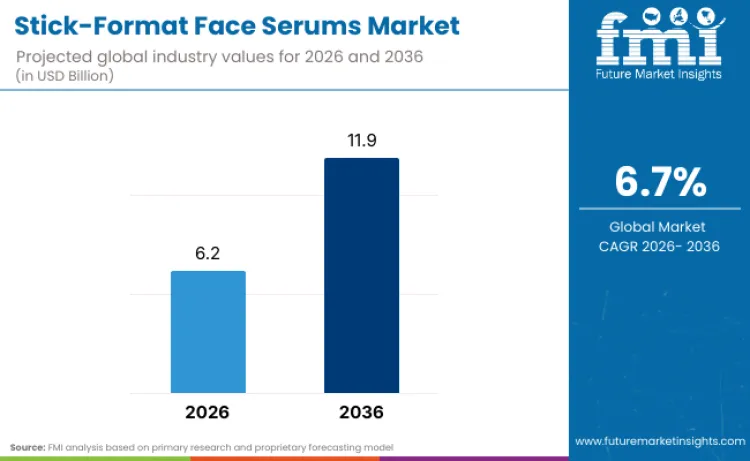
Stick-Format Face Serums Market Key Takeaways
| Metric | Value |
|---|---|
| Market Size (2026) | USD 6.2 billion |
| Market Forecast (2036) | USD 11.9 billion |
| CAGR (2026 to 2036) | 6.7% |
Source: Future Market Insights’ proprietary forecasting model and primary research
Key Shift in the Stick-Format Face Serums Market During 2026 to 2036
Before 2026, stick-format face serums were seen as convenience-led tools, often sidelined by professional users and dermatologists due to perceived limitations in penetration depth, active compatibility, and dosage accuracy. Most products focused on glow enhancement or hydration, lacking the targeted treatment credentials expected in clinical skincare. Formulation was typically secondary to format, and technical rigor was minimal in mass-market launches.
By 2026, the category transitions into what FMI defines as the “Precision Dermaceutical Phase.” Ingredient science and device ergonomics converge, with brands shifting from glow sticks to precision-engineered active systems. Data-backed ingredient delivery becomes central. As stated in L’Oréal’s January 2025 release, “L’Oréal Cell BioPrint minimizes guesswork by helping to predict responsiveness to certain key ingredients such as retinol.” This marks the shift from reactive application to predictive targeting, anchoring sticks within serious treatment pathways.
The industrial base is also evolving. Players are rebuilding around carbon-aware packaging models. According to GCI Magazine, “Using recycled plastic sourced from Amcor’s proprietary CleanStream technology, each applicator offers 87% rPP and a 17% lower CO2 impact versus virgin resin.” Stick packaging moves toward rPP mono-materials to reduce Scope 3 emissions and simplify recycling.
Meanwhile, format expectations reset entirely. Zenpack states, “In 2026, refillable packaging is no longer an option-it’s an expectation... the conversation is evolving from substitution to innovation-from using less to creating better.” Cartridge-based stick serums become default, not premium exceptions, reinforcing refill logic as standard.
What are the Various Segments of the Stick-Format Face Serums Market?
Stick-format face serums are segmented by type, form, distribution channel, and price point. By type, offerings include anti-aging serums, skin brightening serums, acne-fighting serums, hydrating face serums, exfoliating face serums, and others. By form, products are positioned as oil-based, gel-based, water-based, and others depending on glide, absorption, and finish. By distribution channel, brands scale through online retailers, supermarkets and hypermarkets, drugstores and pharmacies, specialty beauty stores, and others. By price point, portfolios are structured across premium, mass-market, and luxury tiers.
Which Product Type Holds the Largest Share in Stick Serums?
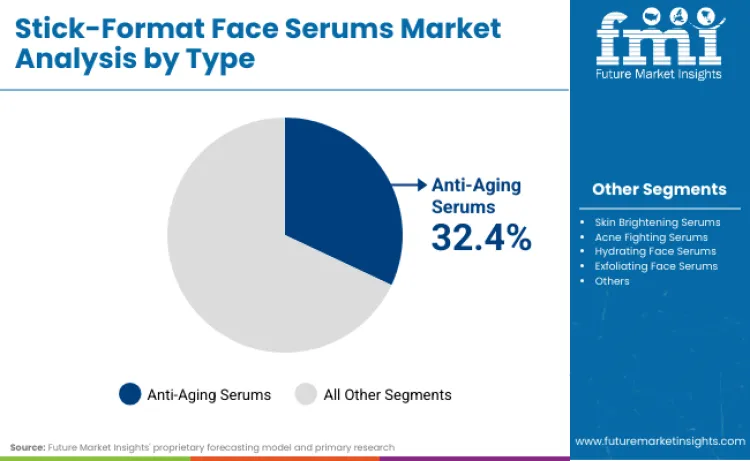
Anti-aging stick serums lead the category with a 32.4% share. Demand centers on targeted treatment for wrinkle-prone facial zones. Common application areas include crow’s feet, forehead lines, and nasolabial folds. These products deliver high concentrations of retinol, peptides, and fermented actives that support firmness and visible skin renewal. Adoption is strongest in the United States, South Korea, and Japan. Consumers value precision and dosage control. Nighttime routines drive core usage. Daytime reapplication over makeup supports incremental demand. Growth is also visible in brightening and acne-focused sticks.
L’Oréal is securing the dominant share of the anti-aging stick market by adapting its high-efficacy "Revitalift" chassis into anhydrous (waterless) formats, focusing on localized "Micro-Lifting" for crow’s feet and nasolabial folds. Amorepacific leads the K-Beauty stick serum movement by leveraging "Ginsenomics" and "White Biotechnology" to provide 6,000x concentrated actives. Shiseido is revolutionizing the "targeted treatment" sub-category through MolecuShift Technology. Estée Lauder is driving the "Nighttime Stick" segment via its patented Night Peptide, reinforcing usage in the skin’s nocturnal recovery phase.
How Do Formulation Types Influence Stick Serum Preferences?
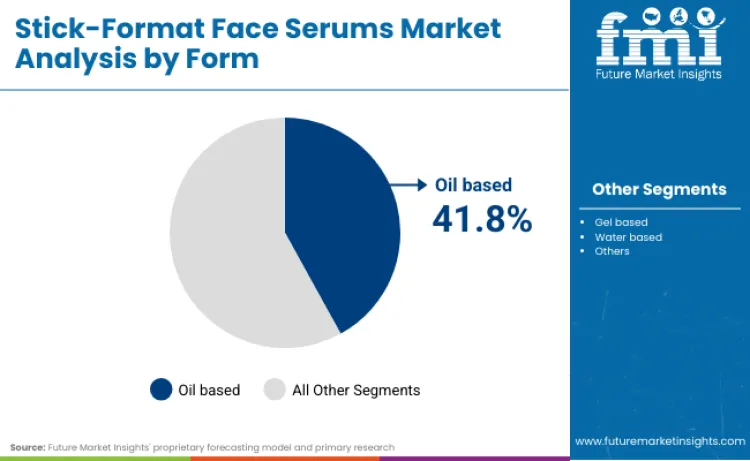
Formulation types exert significant influence on stick serum preferences across climate zones and skin concerns. Oil-based stick serums dominate formulation demand with a 41.8% share. These systems provide strong active stability and consistent glide. Lipophilic ingredients perform reliably in occlusive matrices. Common actives include retinol, vitamin E, bakuchiol, and botanical seed oils. Retention remains high in colder climates and aging-focused routines. Tatcha’s The Serum Stick records strong repeat usage. Tatcha (under Unilever Prestige) dominates the oil-based segment by using 80% squalane-based matrices that mimic the skin's natural lipids, providing a "non-waxy" glide that specifically targets dryness-induced fine lines. Gel-based and water-based sticks gain preference in warm and humid regions. These textures suit oily and acne-prone skin. Unilever is capturing the humid-region market by engineering "Water-Burst" technology, designed to address the specific skincare needs of consumers living in hot and humid climates. Beiersdorf utilizes its 140-year expertise and setting industry-wide global standards on measuring and evaluating the effectiveness of skin care products. Texture compatibility influences repeat purchase. Products must layer cleanly with SPF, toner, and makeup.
Which Distribution Channel Is Most Preferred for Stick Serums?
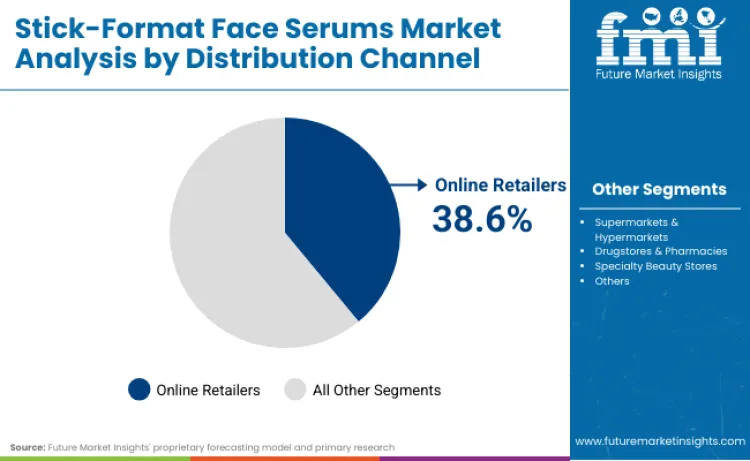
Online channels account for 38.6% of global stick serum revenue. Digital discovery drives category adoption. KOSÉ is driving stick serum adoption by integrating "Maison KOSÉ" digital diagnostics with high-growth marketplaces in Greater China and Southeast Asia, aiming for a 25% e-commerce/travel retail sales ratio by 2026. "On the Maison KOSÉ website, we have already posted makeup pictorials and recommended skin care items, to speed up digital transformation and establish KOSÉ's original beauty platform while stepping up sales on Tmall." Clarins is dominating the prestige stick serum category by migrating its 70-year "Institute" consultation model into a mobile-first DTC strategy, utilizing AI-powered "Skin Observers" to convert mobile users into recurring subscribers. "The app introduces a seamless and intuitive shopping experience that supports Clarins' growing subscription business and enhances our direct-to-consumer strategy, a first in the prestige beauty industry, featuring access to the AI Skin Observer." Revlon is scaling stick format accessibility by utilizing "Amazon Marketing Cloud" to link social discovery with "Buy with Prime" fulfillment. "The campaign demonstrated that when retail media is properly orchestrated with insights, it can deliver true omnichannel impact."
What Structural Drivers Make Stick-Format Face Serums Win Share?
Stick-format serums gain traction when the adoption barrier shifts from novelty to regulatory and logistical efficiency. The strongest driver is packaging economics under Extended Producer Responsibility (EPR) and the EU’s Packaging and Packaging Waste Regulation (PPWR). These frameworks assign financial liability to brands based on packaging weight and recyclability. Stick formats, which avoid glass droppers and complex pump assemblies, fall into “packaging-light” categories, reducing modulated EPR fees and simplifying compliance documentation.
A second driver is retail logistics. US and EU mass retailers now list sticks in the core serum aisle, not alternative formats. Operationally, sticks offer higher shelf density, better breakage resistance, and streamlined replenishment economics. A third driver is institutional demand from travel and hospitality sectors. As legislation like California’s AB 1162 phases out single-use liquids, procurement heads adopt stick serums as zero-liquid, TSA-compliant skincare alternatives. These drivers reflect system-level shifts: policy incentives reward lighter packaging; shelf logic prioritizes operational performance; and institutional mandates pull in low-waste, solid delivery systems.
Which Constraints Slow Adoption Even When Interest Exists?
Constraints emerge when compliance or formulation requirements increase the switching cost. A primary brake is administrative: under the USA FDA’s MoCRA law, brands must generate formal safety substantiation for solid formats by 2026. This includes microbial stability testing of the anhydrous matrix-often a more complex exercise than for emulsions. Smaller brands face added documentation and regulatory workload.
A second brake is manufacturing performance. Stick formats require hot-pour filling, which can degrade actives like vitamin C or retinol if not properly stabilized. This raises product failure risk and weakens repeat purchase behavior. A third constraint involves EU microplastic enforcement. Recent bans on synthetic polymer microparticles force brands to verify that structuring agents like waxes and thickeners do not fall under microplastic definitions. This creates a cross-border compliance burden, especially for brands scaling internationally. These frictions operate upstream and downstream: safety substantiation slows development; stability issues undermine end-user trust; and fragmented enforcement clouds commercial planning.
What Recent Shifts Explain Why Momentum Has Increased Lately?
Recent momentum is best explained by a structural shift in packaging governance and channel architecture, not simply consumer interest. Policy changes like California SB 54 transfer financial responsibility for plastic waste from consumers to producers, raising USD 5 billion over 10 years. This incentivizes producers to “de-bulk” packaging. Stick formats, typically mono-material and small-footprint, align with this compliance economy and simplify reporting to state-level Producer Responsibility Organizations (PROs).
The CPCB’s centralized EPR portal compels domestic brands to account for packaging weight in logistics and regulatory filing. Sticks reduce shipment costs and packaging disclosures, supporting their rise as “waterless efficiency” formats in D2C commerce. Simultaneously, technical advancements enable higher active loading and improved ingredient encapsulation, eliminating the water phase without sacrificing efficacy. These shifts are structural: EPR tightening, retailer normalization, and high-performance solid delivery architectures converge to make stick serums commercially rational, beyond sustainability rhetoric.
How Is the Stick-Format Face Serums Market Evolving Globally?
Global demand for stick-format face serums is increasing as personal care brands scale waterless manufacturing capacity while addressing actives delivery, portability, and high-frequency application requirements. Growth reflects rising adoption of anhydrous formulation platforms, bioengineered ingredients, and packaging systems across skincare production hubs, cosmetic innovation pipelines, and dermocosmetic retail operations. Product selection centers on texture preservation, active concentration, and performance durability under daily-use conditions. South Korea records 8.1% CAGR, India 7.6%, USA 6.8%, Japan 6.3%, and the UK 5.9%. Uptake remains driven by format compatibility, climate-specific user needs, and formulation optimization rather than volume expansion alone.
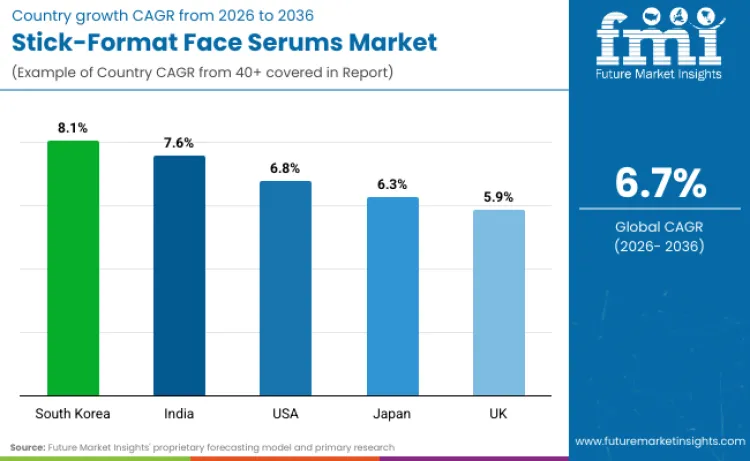
| Country | CAGR (2026 to 2036) |
|---|---|
| South Korea | 8.1% |
| India | 7.6% |
| USA | 6.8% |
| Japan | 6.3% |
| UK | 5.9% |
Source: Future Market Insights (FMI) analysis, based on proprietary forecasting model and primary research
United Kingdom Stick Serum Market Gaining Ground
The United Kingdom stick serum market is projected to grow at a 5.9% CAGR from 2026 to 2036 as claim substantiation becomes a compliance-first requirement rather than brand marketing. The UK’s Digital Markets, Competition and Consumers Act gives the CMA direct power to fine beauty companies for misleading environmental claims. "From 6 April 2025, the UK Competition and Markets Authority can directly enforce consumer protection law and issue fines of up to 10% of global turnover, including for misleading environmental claims (so-called 'greenwashing')." This framework makes mono-material, waterless stick formats structurally easier to defend under the Green Claims Code.
Distribution dynamics reinforce this compliance logic. Boots and Superdrug increasingly list sticks under sustainability-led merchandising blocks. Retail buyers view packaging-light formats as safer from a legal and operational standpoint, especially under emerging EPR frameworks. As regulatory risk is priced into shelf decisions, stick serums become not just format alternatives but preferred choices for brands seeking to lower exposure while meeting UK enforcement thresholds.
South Korea: Are Safety Documentation Mandates Turning Stick Serums into High-Trust Delivery Formats?
The South Korean stick serum market is projected to grow at an 8.1% CAGR from 2026 to 2036, driven by strict safety substantiation policies that mirror EU dossier models. In July 2025, the amended Cosmetic Act mandated product-specific safety assessments. "On July 3rd, 2025, South Korea announced a partial amendment of Cosmetic Act. Cosmetic manufacturers (responsible sellers) must prepare and retain safety assessment documentation for each product before distribution or sale." This requires stick-format serums to provide microbial and toxicological evidence, making general balm data obsolete.
This directly affects launch cycles and retail listing windows. Large Korean retailers increasingly prioritize products with documentation readiness for faster onboarding. As occlusive wax systems and high-active formulations are reclassified as high scrutiny formats, brands with internal safety teams can use sticks to showcase validated performance. The format is being redefined. Where once it offered novelty, it now offers dossier completeness and compliance leadership in a regulatory environment prioritizing traceability, technical performance, and documentation maturity.
India Stick Serum Market Strengthened by EPR Logistics and D2C Economics
India’s stick serum market is projected to grow at a 7.6% CAGR from 2026 to 2036 as EPR alignment and lightweight logistics drive packaging decisions. Under new CPCB guidance, brands must register and report packaging footprint through a centralized Extended Producer Responsibility portal. "CPCB has developed the Centralized EPR Portal for plastic packaging providing provision for registration of PIBOs [Producers, Importers, and Brand Owners] in accordance with the notified EPR Guidelines." Multi-component droppers face declaration burdens and reporting friction, while stick formats simplify both accounting and disposal.
D2C and marketplace logistics reinforce the same logic. Amazon India and Nykaa favor stick formats for their lower breakage, leak-proof delivery, and high packaging-to-formula ratio. Domestic brands report that packaging accounts for up to 67% of unit costs, making sticks operationally superior. The format is no longer a novelty in India. It is becoming the default in high-growth, price-sensitive, compliance-bound skincare categories, especially among digitally native brands balancing cost, regulation, and speed to market.
United States Stick Serum Sales Accelerate Through MoCRA and Clean Retail Infrastructure
The United States stick serum market is projected to grow at a 6.8% CAGR from 2026 to 2036, reflecting regulatory alignment under MoCRA and shelf normalization under clean beauty protocols. "A responsible person is required to ensure and maintain records supporting adequate safety substantiation of their cosmetic products... FDA will also have access to adverse event reports during an inspection." Stick formats now require validated toxicological profiles, dermal exposure risk analysis, and contamination resistance documentation to pass FDA review.
Retailers such as Ulta and Target are actively merchandising solid serums under waterless, fragrance-free, and low-allergen claims. These features pre-align with clean beauty shelves while supporting back-end compliance. PFAS screening and fragrance allergen transparency rules add additional visibility risk for liquid formats. Stick serums avoid many of these concerns through structural simplicity. As the USA moves from “natural claims” to regulated ingredient declarations, the stick format becomes a dual solution, offering retailers merchandising reliability and giving manufacturers a platform to reduce regulatory drag.
Japan Stick Serum Format Gains Momentum as METI Certification Becomes Market Standard
Japan’s stick-format serum market is projected to grow at a 6.3% CAGR from 2026 to 2036, as manufacturers align packaging with recyclability standards introduced by the Ministry of Economy, Trade and Industry (METI). "Japan’s Ministry of Economy, Trade and Industry has published certification criteria for cosmetics packaging - intended to increase recycled content, reduce material consumption, and streamline recyclability." Stick serums, typically composed of mono-material PP or PE, simplify certification under Japan’s Green Purchasing Law and offer eligibility for public procurement channels.
Beauty stores and pharmacies have begun labeling products with recyclability scores and METI-compliant packaging metrics. Sticks offer streamlined material declarations, favorable bulk-to-packaging ratios, and low-contamination packaging footprints. As METI pushes manufacturers to meet 60% recycled or biomass content thresholds, brands are re-engineering their delivery systems. The result is a format shift rooted in compliance logic. Sticks now provide packaging efficiency and procurement readiness in Japan’s increasingly circular and certification-driven cosmetics retail environment.
Which Companies Are Shaping the Competitive Landscape in Stick Format Face Serums?
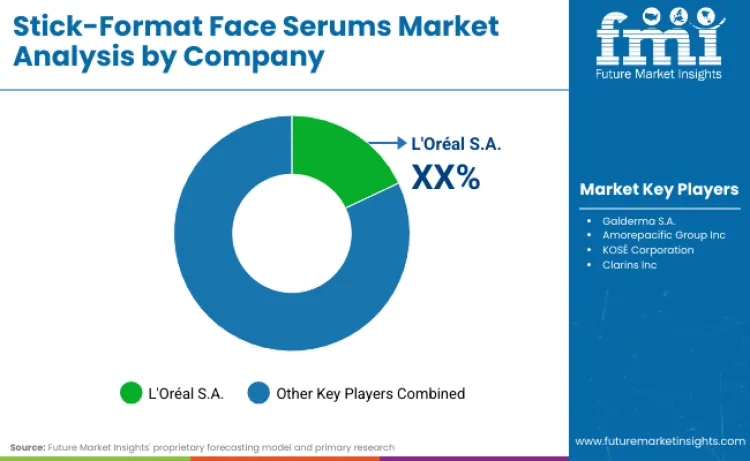
The stick-format face serums landscape is shaped by companies that already command credibility in high-performance skincare and can translate clinical efficacy into solid-state delivery without relying on format novelty. Stick serums represent a shift in formulation and usage logic rather than a line extension, and leading players focus on ingredient stability, precision targeting, and compatibility with daily routines that include SPF, makeup, and barrier-support products.
Large multinational beauty groups anchor the category through science-led portfolios. L’Oréal maintains a strong position by integrating stick serums into its dermatological and premium skincare lines, emphasizing glide quality, layering compatibility, and treatment parity with liquids. Shiseido advances the segment through quasi-drug compliant wrinkle-zone sticks engineered for frictionless application and long wear. Beiersdorf applies epigenetic skincare research to develop solid formats that deliver high-science actives in portable systems, while Amorepacific and KOSÉ lead brightening and regenerative stick innovation across Asian markets.
Asia, particularly South Korea and Japan, plays a central structural role through its OEM and ODM ecosystem. Global brands depend on regional partners for encapsulation technologies, heat-stable bases, and refill-compatible stick mechanisms. At the mass-premium tier, Unilever is expanding stick-format serums under brands such as Pond’s, tailoring formulations for humid climates and younger demographics.
Overall, the competitive field divides into two strategic positions. One is held by innovation-led companies that control formulation science, clinical validation, and routine ownership. The other consists of scale-driven brands capable of rapidly distributing stick formats once consumer familiarity is established. Until mass players position stick serums as core treatment products rather than adjacent extensions, leadership remains concentrated with companies that combine scientific authority with routine integration.
Key Players in the Stick Format Face Serums Market
- L'Oréal S.A.
- Galderma S.A.
- Amorepacific Group Inc
- KOSÉ Corporation
- Clarins Inc
- Unilever Plc
- Shiseido Company Limited
- Beiersdorf AG
- Estée Lauder Companies Inc
- Revlon
Market Definition
The stick format face serums market refers to revenues generated from solid-state, waterless facial skincare products formulated in twist-up or pressed stick form and intended for targeted or full-face application of active ingredients. These products are designed to deliver functional skincare benefits, including anti-aging, brightening, hydration, exfoliation, and acne control, through concentrated anhydrous bases that support ingredient stability, precise application, and portable use. Market size is measured in USD billion and analyzed over the 2026 to 2036 forecast period.
Stick-format face serums are treated as a standalone skincare category, distinct from liquid serums, creams, roll-ons, and balm sticks. The scope includes cosmetic, dermocosmetic, and hybrid therapeutic products where the primary positioning is performance-led skincare delivered through solid topical formats. Revenues are attributed only to standalone stick serums sold for direct consumer or professional use and not embedded within unrelated kits or sample assortments.
Market Inclusion
The market includes solid, twist-up, or pressed stick products explicitly positioned and marketed as face serums, incorporating active skincare ingredients such as retinol, niacinamide, hyaluronic acid, salicylic acid, peptides, antioxidants, and botanical extracts. Included formats span oil-based, gel-based, wax-based, and hybrid systems designed for application to defined treatment zones (e.g., eye area, T-zone) or full-face use.
Both monofunctional products (e.g., anti-aging or acne-targeting sticks) and multifunctional products (e.g., anti-aging combined with brightening or barrier support) are within scope, provided serum functionality is the primary use case. Packaging formats include retractable sticks, push-up paper sticks, and refillable cartridge systems. Distribution channels covered include e-commerce platforms, specialty beauty retailers, pharmacies, direct-to-consumer platforms, and travel beauty channels.
The analysis includes consumer use across household settings, dermatology clinics, professional beauty salons, and wellness centers. Country-level coverage is provided where retail penetration, climate-adaptive usage patterns, regulatory frameworks, or OEM formulation activity materially influence adoption.
Market Exclusion
Excluded from the stick format face serums market are liquid serums packaged in droppers, pump bottles, ampoules, or sachets, regardless of portability or concentration claims. Cream sticks, tinted moisturizers, face balms, lip balms, and sunscreen sticks are excluded unless explicitly positioned and marketed primarily as serum products delivering active skincare treatment.
Also excluded are color cosmetics with secondary skincare claims (e.g., foundation or concealer sticks containing vitamins), unless serum functionality is clearly defined as the primary purpose. Hybrid wellness products such as aromatherapy sticks, DIY serum kits, single-use wipes, and experimental or pilot products without established commercial retail presence are outside the scope.
The market definition excludes ancillary accessories, including applicators, storage tools, or refill components sold without active formulation. Institutional bulk formats not packaged for retail sale, as well as product lines where the stick format is secondary to another delivery mechanism in marketing or usage emphasis, are not considered part of the stick format face serums market.
Scope of the Report
| Items | Values |
|---|---|
| Quantitative Units | USD billion |
| Product Type | Anti-Aging Serum Sticks; Skin Brightening Serum Sticks; Acne-Fighting Serum Sticks; Hydrating Serum Sticks; Exfoliating Serum Sticks; Others |
| Formulation Type | Oil-Based Sticks; Gel-Based Sticks; Water-Based Sticks; Hybrid Balm-to-Serum Sticks; Others |
| Distribution Channel | Online Retailers (DTC & Marketplaces); Supermarkets & Hypermarkets; Drugstores & Pharmacies; Specialty Beauty Stores; Others |
| Price Tier | Premium; Mass-Market (Masstige); Luxury/Clinical |
| Regions Covered | North America, Europe, Asia Pacific, Latin America, Middle East & Africa |
| Countries Covered | South Korea, India, United States, Japan, United Kingdom, France, Germany, China, Australia, and 40+ countries |
| Key Companies Profiled | L'Oréal S.A.; Shiseido Company Limited; Beiersdorf AG; Amorepacific Group; KOSÉ Corporation; Unilever Plc; Estée Lauder Companies; Clarins; Galderma; Others |
| Additional Attributes | Dollar sales by product type, formulation, price tier, and distribution channel; performance benchmarking across active concentration, ingredient preservation, glide efficiency, and skin penetration efficacy; consumer adoption trends tied to waterless beauty, portability, and hybrid skincare-makeup usage; impact on routine simplification, reapplication frequency, and compliance; regulatory alignment across dermocosmetic and personal care standards; OEM manufacturing scale, packaging innovation, and supply chain efficiency within solid-state skincare ecosystems |
Stick-Format Face Serums Market by Segment
Type:
- Anti-Aging Serums
- Skin Brightening Serums
- Acne Fighting Serums
- Hydrating Face Serums
- Exfoliating Face Serums
- Others
Form:
- Oil-Based Sticks
- Gel-Based Sticks
- Water-Based Sticks
- Hybrid Balm-to-Serum Sticks
- Others
Distribution Channel:
- Online Retailers
- Supermarkets & Hypermarkets
- Drugstores & Pharmacies
- Specialty Beauty Stores
- Others
Price Point:
- Premium
- Mass-Market
- Luxury
Region:
- Asia Pacific
- China
- Japan
- South Korea
- India
- Australia & New Zealand
- ASEAN
- Rest of Asia Pacific
- Europe
- Germany
- United Kingdom
- France
- Italy
- Spain
- Nordic
- BENELUX
- Rest of Europe
- North America
- USA
- Canada
- Mexico
- Latin America
- Brazil
- Chile
- Rest of Latin America
- Middle East & Africa
- Kingdom of Saudi Arabia
- Other GCC Countries
- Turkey
- South Africa
- Other African Union
- Rest of Middle East & Africa
Bibliography
- European Parliament & Council of the European Union. (2009/Consolidated 2023). Regulation (EC) No 1223/2009 on cosmetic products. Official Journal of the European Union.
- USA Food and Drug Administration. (2024). Cosmetics - Laws and regulations. USA Department of Health and Human Services, FDA.
- Organisation for Economic Co‑operation and Development. (2024). Policy guidance for sustainable chemistry and consumer product formulation. OECD Publishing.
Frequently Asked Questions
How big is the global stick-format face serums market?
The global stick-format face serums market is valued at USD 6.2 billion in 2026 and is forecast to reach USD 11.9 billion by 2036.
What is the growth outlook for the stick-format face serums market over the next 10 years?
The category is projected to expand at a 6.7% CAGR from 2026 to 2036, supported by the shift toward portable, high-active, solid-state skincare delivery.
Which product segments or formats drive demand in this market?
Demand is led by anti-aging serum sticks (32.4% share) and reinforced by oil-based stick formulations (41.8% share) due to glide and preservation advantages for lipophilic actives.
What are the main risks and constraints affecting this market?
The main constraints are higher costs for stable waterless bases and packaging, plus performance risk if texture or glide fails under heat, humidity, or frequent reapplication.
Who are the leading brands or manufacturers, and how is leadership defined?
Leadership is defined by clinically credible formulation performance, strong OEM/ODM innovation access, and scaled distribution, led by L'Oréal S.A., Shiseido, Beiersdorf, Amorepacific, and KOSÉ.
Preview the report firsthand - request a free sample
Get SampleGet the brochure for pricing and purchase details.
Get PDFTable of Content
- Executive Summary
- Global Market Outlook
- Demand Side Trends
- Supply Side Trends
- Technology Roadmap Analysis
- Analysis and Recommendations
- Market Overview
- Market Coverage / Taxonomy
- Market Definition / Scope / Limitations
- Research Methodology
- Chapter Orientation
- Analytical Lens and Working Hypotheses
- Market Structure, Signals, and Trend Drivers
- Benchmarking and Cross-market Comparability
- Market Sizing, Forecasting, and Opportunity Mapping
- Research Design and Evidence Framework
- Desk Research Programme (Secondary Evidence)
- Company Annual and Sustainability Reports
- Peer-reviewed Journals and Academic Literature
- Corporate Websites, Product Literature, and Technical Notes
- Earnings Decks and Investor Briefings
- Statutory Filings and Regulatory Disclosures
- Technical White Papers and Standards Notes
- Trade Journals, Industry Magazines, and Analyst Briefs
- Conference Proceedings, Webinars, and Seminar Materials
- Government Statistics Portals and Public Data Releases
- Press Releases and Reputable Media Coverage
- Specialist Newsletters and Curated Briefings
- Sector Databases and Reference Repositories
- FMI Internal Knowledge Base and Historical Datasets
- Subscription Datasets and Paid Sources
- Social Channels, Communities, and Digital Listening Inputs
- Additional Desk Sources
- Expert Input and Fieldwork (Primary Evidence)
- Primary Modes
- Qualitative Interviews and Expert Elicitation
- Quantitative Surveys and Structured Data Capture
- Blended Approach
- Why Primary Evidence is Used
- Field Techniques
- Interviews
- Surveys
- Focus Groups
- Observational and In-context Research
- Social and Community Interactions
- Stakeholder Universe Engaged
- C-suite Leaders
- Board Members
- Presidents and Vice Presidents
- R&D and Innovation Heads
- Technical Specialists
- Domain Subject-matter Experts
- Scientists
- Physicians and Other Healthcare Professionals
- Governance, Ethics, and Data Stewardship
- Research Ethics
- Data Integrity and Handling
- Primary Modes
- Tooling, Models, and Reference Databases
- Desk Research Programme (Secondary Evidence)
- Data Engineering and Model Build
- Data Acquisition and Ingestion
- Cleaning, Normalisation, and Verification
- Synthesis, Triangulation, and Analysis
- Quality Assurance and Audit Trail
- Market Background
- Market Dynamics
- Drivers
- Restraints
- Opportunity
- Trends
- Scenario Forecast
- Demand in Optimistic Scenario
- Demand in Likely Scenario
- Demand in Conservative Scenario
- Opportunity Map Analysis
- Product Life Cycle Analysis
- Supply Chain Analysis
- Investment Feasibility Matrix
- Value Chain Analysis
- PESTLE and Porter's Analysis
- Regulatory Landscape
- Regional Parent Market Outlook
- Production and Consumption Statistics
- Import and Export Statistics
- Market Dynamics
- Global Market Analysis 2021 to 2025 and Forecast, 2026 to 2036
- Historical Market Size Value (USD Billion) Analysis, 2021 to 2025
- Current and Future Market Size Value (USD Billion) Projections, 2026 to 2036
- Y-o-Y Growth Trend Analysis
- Absolute $ Opportunity Analysis
- Global Market Pricing Analysis 2021 to 2025 and Forecast 2026 to 2036
- Y-o-Y Growth Trend Analysis 2021 to 2025
- Absolute $ Opportunity Analysis 2026 to 2036
- Global Market Analysis 2021 to 2025 and Forecast 2026 to 2036, By Product Type
- Introduction / Key Findings
- Historical Market Size Value (USD Billion) Analysis By Product Type, 2021 to 2025
- Current and Future Market Size Value (USD Billion) Analysis and Forecast By Product Type, 2026 to 2036
- Anti-Aging Serums
- Skin Brightening Serums
- Acne Fighting Serums
- Hydrating Face Serums
- Exfoliating Face Serums
- Others
- Y-o-Y Growth Trend Analysis By Product Type, 2021 to 2025
- Absolute $ Opportunity Analysis By Product Type, 2026 to 2036
- Global Market Analysis 2021 to 2025 and Forecast 2026 to 2036, By Formulation Type
- Introduction / Key Findings
- Historical Market Size Value (USD Billion) Analysis By Formulation Type, 2021 to 2025
- Current and Future Market Size Value (USD Billion) Analysis and Forecast By Formulation Type, 2026 to 2036
- Oil-Based Sticks
- Gel-Based Sticks
- Water-Based Sticks
- Hybrid Balm-to-Serum Sticks
- Others
- Y-o-Y Growth Trend Analysis By Formulation Type, 2021 to 2025
- Absolute $ Opportunity Analysis By Formulation Type, 2026 to 2036
- Global Market Analysis 2021 to 2025 and Forecast 2026 to 2036, By Distribution Channel
- Introduction / Key Findings
- Historical Market Size Value (USD Billion) Analysis By Distribution Channel, 2021 to 2025
- Current and Future Market Size Value (USD Billion) Analysis and Forecast By Distribution Channel, 2026 to 2036
- Online Retailers
- Supermarkets & Hypermarkets
- Drugstores & Pharmacies
- Specialty Beauty Stores
- Others
- Y-o-Y Growth Trend Analysis By Distribution Channel, 2021 to 2025
- Absolute $ Opportunity Analysis By Distribution Channel, 2026 to 2036
- Global Market Analysis 2021 to 2025 and Forecast 2026 to 2036, By Region
- Introduction
- Historical Market Size Value (USD Billion) Analysis By Region, 2021 to 2025
- Current Market Size Value (USD Billion) Analysis and Forecast By Region, 2026 to 2036
- North America
- Latin America
- Western Europe
- Eastern Europe
- East Asia
- South Asia and Pacific
- Middle East & Africa
- Market Attractiveness Analysis By Region
- North America Market Analysis 2021 to 2025 and Forecast 2026 to 2036, By Country
- Historical Market Size Value (USD Billion) Trend Analysis By Market Taxonomy, 2021 to 2025
- Market Size Value (USD Billion) Forecast By Market Taxonomy, 2026 to 2036
- By Country
- USA
- Canada
- Mexico
- By Product Type
- By Formulation Type
- By Distribution Channel
- By Country
- Market Attractiveness Analysis
- By Country
- By Product Type
- By Formulation Type
- By Distribution Channel
- Key Takeaways
- Latin America Market Analysis 2021 to 2025 and Forecast 2026 to 2036, By Country
- Historical Market Size Value (USD Billion) Trend Analysis By Market Taxonomy, 2021 to 2025
- Market Size Value (USD Billion) Forecast By Market Taxonomy, 2026 to 2036
- By Country
- Brazil
- Chile
- Rest of Latin America
- By Product Type
- By Formulation Type
- By Distribution Channel
- By Country
- Market Attractiveness Analysis
- By Country
- By Product Type
- By Formulation Type
- By Distribution Channel
- Key Takeaways
- Western Europe Market Analysis 2021 to 2025 and Forecast 2026 to 2036, By Country
- Historical Market Size Value (USD Billion) Trend Analysis By Market Taxonomy, 2021 to 2025
- Market Size Value (USD Billion) Forecast By Market Taxonomy, 2026 to 2036
- By Country
- Germany
- UK
- Italy
- Spain
- France
- Nordic
- BENELUX
- Rest of Western Europe
- By Product Type
- By Formulation Type
- By Distribution Channel
- By Country
- Market Attractiveness Analysis
- By Country
- By Product Type
- By Formulation Type
- By Distribution Channel
- Key Takeaways
- Eastern Europe Market Analysis 2021 to 2025 and Forecast 2026 to 2036, By Country
- Historical Market Size Value (USD Billion) Trend Analysis By Market Taxonomy, 2021 to 2025
- Market Size Value (USD Billion) Forecast By Market Taxonomy, 2026 to 2036
- By Country
- Russia
- Poland
- Hungary
- Balkan & Baltic
- Rest of Eastern Europe
- By Product Type
- By Formulation Type
- By Distribution Channel
- By Country
- Market Attractiveness Analysis
- By Country
- By Product Type
- By Formulation Type
- By Distribution Channel
- Key Takeaways
- East Asia Market Analysis 2021 to 2025 and Forecast 2026 to 2036, By Country
- Historical Market Size Value (USD Billion) Trend Analysis By Market Taxonomy, 2021 to 2025
- Market Size Value (USD Billion) Forecast By Market Taxonomy, 2026 to 2036
- By Country
- China
- Japan
- South Korea
- By Product Type
- By Formulation Type
- By Distribution Channel
- By Country
- Market Attractiveness Analysis
- By Country
- By Product Type
- By Formulation Type
- By Distribution Channel
- Key Takeaways
- South Asia and Pacific Market Analysis 2021 to 2025 and Forecast 2026 to 2036, By Country
- Historical Market Size Value (USD Billion) Trend Analysis By Market Taxonomy, 2021 to 2025
- Market Size Value (USD Billion) Forecast By Market Taxonomy, 2026 to 2036
- By Country
- India
- ASEAN
- Australia & New Zealand
- Rest of South Asia and Pacific
- By Product Type
- By Formulation Type
- By Distribution Channel
- By Country
- Market Attractiveness Analysis
- By Country
- By Product Type
- By Formulation Type
- By Distribution Channel
- Key Takeaways
- Middle East & Africa Market Analysis 2021 to 2025 and Forecast 2026 to 2036, By Country
- Historical Market Size Value (USD Billion) Trend Analysis By Market Taxonomy, 2021 to 2025
- Market Size Value (USD Billion) Forecast By Market Taxonomy, 2026 to 2036
- By Country
- Kingdom of Saudi Arabia
- Other GCC Countries
- Turkiye
- South Africa
- Other African Union
- Rest of Middle East & Africa
- By Product Type
- By Formulation Type
- By Distribution Channel
- By Country
- Market Attractiveness Analysis
- By Country
- By Product Type
- By Formulation Type
- By Distribution Channel
- Key Takeaways
- Key Countries Market Analysis
- USA
- Pricing Analysis
- Market Share Analysis, 2025
- By Product Type
- By Formulation Type
- By Distribution Channel
- Canada
- Pricing Analysis
- Market Share Analysis, 2025
- By Product Type
- By Formulation Type
- By Distribution Channel
- Mexico
- Pricing Analysis
- Market Share Analysis, 2025
- By Product Type
- By Formulation Type
- By Distribution Channel
- Brazil
- Pricing Analysis
- Market Share Analysis, 2025
- By Product Type
- By Formulation Type
- By Distribution Channel
- Chile
- Pricing Analysis
- Market Share Analysis, 2025
- By Product Type
- By Formulation Type
- By Distribution Channel
- Germany
- Pricing Analysis
- Market Share Analysis, 2025
- By Product Type
- By Formulation Type
- By Distribution Channel
- UK
- Pricing Analysis
- Market Share Analysis, 2025
- By Product Type
- By Formulation Type
- By Distribution Channel
- Italy
- Pricing Analysis
- Market Share Analysis, 2025
- By Product Type
- By Formulation Type
- By Distribution Channel
- Spain
- Pricing Analysis
- Market Share Analysis, 2025
- By Product Type
- By Formulation Type
- By Distribution Channel
- France
- Pricing Analysis
- Market Share Analysis, 2025
- By Product Type
- By Formulation Type
- By Distribution Channel
- India
- Pricing Analysis
- Market Share Analysis, 2025
- By Product Type
- By Formulation Type
- By Distribution Channel
- ASEAN
- Pricing Analysis
- Market Share Analysis, 2025
- By Product Type
- By Formulation Type
- By Distribution Channel
- Australia & New Zealand
- Pricing Analysis
- Market Share Analysis, 2025
- By Product Type
- By Formulation Type
- By Distribution Channel
- China
- Pricing Analysis
- Market Share Analysis, 2025
- By Product Type
- By Formulation Type
- By Distribution Channel
- Japan
- Pricing Analysis
- Market Share Analysis, 2025
- By Product Type
- By Formulation Type
- By Distribution Channel
- South Korea
- Pricing Analysis
- Market Share Analysis, 2025
- By Product Type
- By Formulation Type
- By Distribution Channel
- Russia
- Pricing Analysis
- Market Share Analysis, 2025
- By Product Type
- By Formulation Type
- By Distribution Channel
- Poland
- Pricing Analysis
- Market Share Analysis, 2025
- By Product Type
- By Formulation Type
- By Distribution Channel
- Hungary
- Pricing Analysis
- Market Share Analysis, 2025
- By Product Type
- By Formulation Type
- By Distribution Channel
- Kingdom of Saudi Arabia
- Pricing Analysis
- Market Share Analysis, 2025
- By Product Type
- By Formulation Type
- By Distribution Channel
- Turkiye
- Pricing Analysis
- Market Share Analysis, 2025
- By Product Type
- By Formulation Type
- By Distribution Channel
- South Africa
- Pricing Analysis
- Market Share Analysis, 2025
- By Product Type
- By Formulation Type
- By Distribution Channel
- USA
- Market Structure Analysis
- Competition Dashboard
- Competition Benchmarking
- Market Share Analysis of Top Players
- By Regional
- By Product Type
- By Formulation Type
- By Distribution Channel
- Competition Analysis
- Competition Deep Dive
- L'Oréal S.A.
- Galderma S.A.
- Amorepacific Group Inc
- KOSÉ Corporation
- Clarins Inc
- Unilever Plc
- Shiseido Company Limited
- Beiersdorf AG
- Estée Lauder Companies Inc
- Revlon
- Competition Deep Dive
- Assumptions & Acronyms Used


