

- Industry Size (2026)
- U
- Forecast (2036)
- U
- CAGR
- 4 (2026 to 2036)
Facet Fixation System Market Forecast and Outlook By FMI
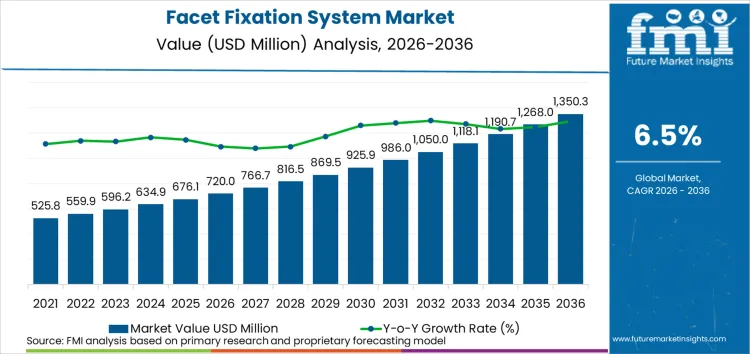
Future Market Insights anticipates the global facet fixation system market to expand from USD 720.0 million in 2026 to USD 1,350.0 million by 2036, registering a CAGR of 6.5% over the forecast period. With spinal procedures providing continued volume growth, increasing adoption of minimally invasive stabilization techniques, and sustained lumber level stabilization mechanisms where biomechanical stability is a consideration as well as procedural efficiency, it’s noted that minimally invasive and percutaneous methods will continue to outpace open approaches as more hospitals and ASCs seek to streamline operations to promote better recovery times.
FMI points out the importance of procedural migration, along with the rise of material standardizations, as the two key developments in the market from 2036. The demand is likely to remain focused across the lumbar segment (L1-L4) and L5-S1 levels, corresponding to the degree of facet fixation in both procedures. Titanium is likely dominating the market due to the degree of clinical comfort and understanding, whereas PEEK is still an important option for the market due to the presence of imaging and surgeon factors for
utilization. Hospitals are likely dominating the market space due to the complexity of the procedures required, whereas ASCs are likely to play an impact on the market due to the rise of minimally invasive procedures. “ION-C™ demonstrates our commitment to delivering cutting-edge solutions that empower physicians with advanced options to treat their patients, maintaining native alignment and curvature is critical in spine surgery. ION-C™ has demonstrated long-term fusion success while preserving the facet joints in a neutral position and minimizing the risk of joint expansion that can lead to postoperative kyphosis.” said Travis Greenhalgh, CEO of SurGenTec.
As per FMI, the mode by which manufacturers acquire competitive advantage lies in how well facet fixation systems can cater to minimally invasive workflow needs, portfolio adjacency, and hospital ASC channel execution. As procedural models transition towards ever-percutaneous methods, suppliers who can successfully integrate implant reliability with simplified instrumentation and scalable adoption will continue to gain share up to 2036, especially in lumbar-dominant models of care.
Summary of Facet Fixation System Market
What Is Growth Outlook for Facet Fixation System Market as per Future Market Insights Projection?
Future Market Insights projects the facet fixation system market to expand at a CAGR of 6.5% from 2026 to 2036, increasing from USD 720.0 Mn in 2026 to USD 1,350.0 Mn by 2036. Growth is being supported by sustained spine procedure volumes and broader preference for posterior stabilization options that can be integrated into decompression and fusion workflows, particularly as minimally invasive approaches are being adopted across routine degenerative indications.
FMI Research Approach: Historical market size, procedure approach adoption curves, product-type utilization patterns, spinal level mix, and hospital versus ASC case distribution were used to model demand scenarios through 2036.
How Do FMI Analysts Perceive Facet Fixation System Market to Evolve?
The demand is now being influenced by the trend towards minimally invasive and percutaneous techniques, with less tissue disturbance and an emphasis on reduced recovery periods. The product selection is being driven by systems that offer consistent screw placement and compatibility with common pathways in lumbar stabilization, and the materials used continue to show an increase in titanium due to strengths and platform familiarity.
FMI Research Approach: Evaluation focused on MIS adoption, instrumentation simplification trends, surgeon workflow preferences, implant material selection patterns, and procedural mix across lumbar and cervical segments.
Which Country Holds Largest Share in Global Facet Fixation System Market?
United States represents the biggest market share in the global facet fixation system market due to a combination of high degenerative spine procedure volumes, robust outpatient spine center development, and existing mechanisms to obtain reimbursements for stabilization procedures. This is additionally fueled by hospital system purchasing concentration.
FMI Research Approach: Country-level inputs included spine procedure volumes, outpatient migration pace, reimbursement-linked adoption dynamics, and purchasing behavior across hospitals and ASCs.
How Large Will Facet Fixation System Market Be by 2036?
The global facet fixation system market is projected to reach USD 1,350.0 Mn by 2036.
FMI Research Approach: Market size was calculated by modeling demand across leading procedure approaches and dominant product types using weighted utilization factors by spinal level and end user.
How are Minimally Invasive Spine Pathways Fueling Facet Fixation Adoption?
The growing trend toward minimally invasive spine pathways has seen demand for fixation systems grow as this approach provides support for smaller incisions, faster operative times, and standardized outcomes for stabilization. This utilization pattern is being supported in terms of increasing use of percutaneous approaches in outpatients as well as in hospitals where there is a priority on reproducibility of instrumentation patterns for high-volume lumbar cases.
FMI Research Approach: Incorporated MIS spine growth, outpatient procedure migration, instrumentation standardization, and material selection trends into forecasting models to refine demand estimates.
Facet Fixation System Market Key Takeaways
| Metric | Details |
|---|---|
| Industry Size (2026) | USD 720.0 Million |
| Industry Value (2036) | USD 1,350.0 Million |
| CAGR (2026-2036) | 6.5% |
Source: Future Market Insights (FMI) analysis, based on proprietary forecasting model and primary research.
Why is the Demand for Facet Fixation System Market Growing?
The demand for facet fixation systems growing as degenerative spine care increasingly shifts toward stabilization solutions that can be delivered with less tissue disruption and predictable procedural reproducibility. Adoption is being led by minimally invasive/percutaneous approaches, reflecting the outpatient migration of spine procedures and the preference for shorter recovery pathways. Product demand is being anchored in facet screw systems and facet fusion cages/spacers, where instrumentation familiarity and workflow compatibility remain decisive in lumbar fusion-adjunct use. Utilization is being concentrated at the lumbar level, supported by the high prevalence of degenerative pathology in this segment. Material selection is being dominated by titanium, consistent with strength expectations and established implant performance, while end-user demand is being led by hospitals with meaningful contribution from ASCs as minimally invasive spine care expands outside traditional inpatient settings.
How is the Facet Fixation System Market Segmented?
The facet fixation system market is segmented by procedure approach, product type, spinal level, material, and end user. By procedure approach, the market includes open and minimally invasive / percutaneous techniques. Based on product type, the market comprises facet screw systems, facet fusion cages / spacers, facet plates / clamps, and interlaminar devices. By spinal level, demand is categorized into lumbar (L1-L4), L5-S1, cervical, and thoracic applications. By material, systems are segmented into titanium, PEEK, stainless steel, and bioresorbable / other materials. By end user, adoption spans hospitals, ASCs, and specialty spine centers.
How Do Minimally Invasive / Percutaneous Approaches Secure Market Leadership?
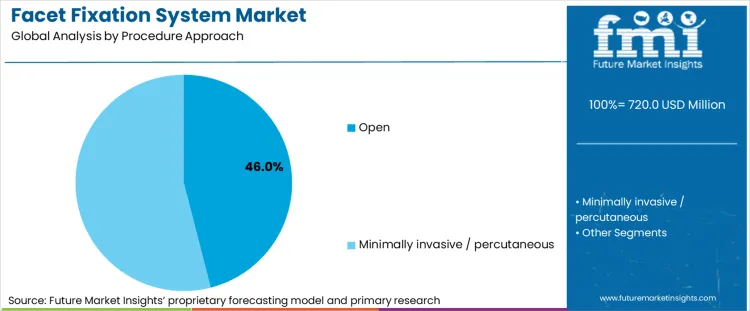
The minimally invasive/percutaneous techniques dominate the global facet fixation system market with the highest share, due to their adoption and focus on the current trends in spine surgery, which include an emphasis on reduced tissue compromise and expedited recovery. These techniques account for an estimated 54.0% share of the overall procedural demand.
The use of minimally invasive surgery is linked with reduced intraoperative timings, less blood loss, and early mobilization compared with open surgery. In routine lumbar stabilization practices, hospitals and spinal centers are increasingly adopting percutaneous systems, particularly those with patients presenting with the need for motion-preserving and adjunct fixation options. As hospitals and the healthcare landscape continue to evolve and focus on early discharge and improving surgical efficiency, the use of minimally invasive/perpendicular surgery continues to be the cornerstone for this market.
How Does Lumbar (L1-L4) Drive Facet Fixation Demand?
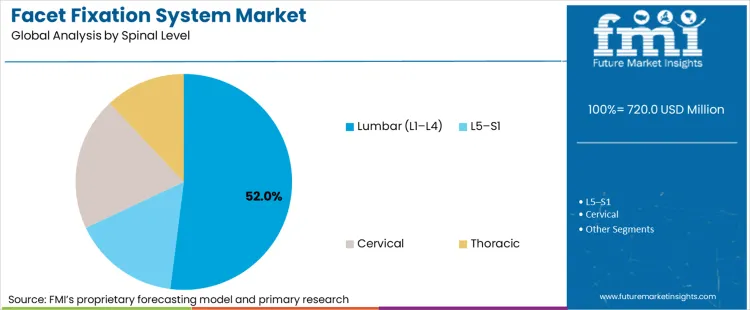
According to Future Market Insights, the lumbar segments of the spine, comprising the L1-L4 segments, account for the largest proportion of the facet fixation system market, about 52.0%. The lumbar segments of the spine are the most common site of diagnosis of degenerative disc disease, spinal stenosis, and spondylolisthesis, the lumbar segments in the lower lumbar region receiving the highest stress; facet fixation systems are used during stabilizations in the lumbar segment. The lumbar region has to deal with an axial load and, therefore, has the highest amount of surgeries requiring posterior stabilization. High volume of cases and established protocols support the dominance of the lumber region of this market. With high volumes of surgeries for degenerative conditions continuing to dominate the spinal surgery market, L1/L4 applications remain the key driver.
How Are Regulatory and Clinical Standards Influencing Implant Selection?
Future Market Insights estimates that the lumbar segment (L1-L4) is the most dominating spinal level segment, accounting for about 52.0% share of the overall usage of facet fixation systems. Degenerative disc disease, spinal stenosis, and spondylolisthesis are commonly observed in the lumbar region, especially lower lumbar segments that bear higher biomechanical stress. These procedures are often performed using facet fixation systems as an adjunct stabilization device.
The lumbar spine receives the largest amount of axial load, making it the most frequent site of surgical intervention requiring posterior stabilization. High case volume and established clinical protocols are two other factors that reinforce market dominance of the lumbar modality. Consequently, since lumbar degenerative conditions continue to represent the largest surgical burden in spine care, L1-L4 applications remain the central demand driver.
Why Is the Shift Toward Outpatient Spine Surgery Reshaping Demand Patterns?
The trend towards more outpatient procedures like spinal surgery is reconfiguring the demand environment for facet fixation systems that facilitate the practice of minimally invasive spinal surgery. ASCs are expanding the range of procedures that can be performed in lumbar stabilization surgeries, favoring systems that support the practice with benefits like reduced operative complexity. This mirrors the influence of payers seeking to reduce the costs of inpatient procedures without compromising the quality of surgery.
With growing volumes of outpatient spine surgeries, the emphasis is now on systems designed for efficient instrumentation, and this structure will continue to impact the purchasing habits of hospitals and ASCs.
How Are Material and Design Innovations Driving Market Evolution?
Innovation in the facet fixation system market is showing a trend toward material optimization and optimization in device design. Titanium is most commonly used due to its strength-to-weight ratio and ability to achieve osseointegration, as well as PEEK systems due to its radiolucency in image guidance during postoperative evaluation. Device geometry optimization aims to improve load distribution and minimize hardware conspicuousness.
The incremental refinement in ergonomics as well as instrumental adaptability is aiding the procedural advancement. With spine surgery shifting to precision-based approaches, incremental refinement in materials is core to ensuring long-term advancement in spine surgery devices.
How Will Facet Fixation System Market Expansion Unfold Across Key Global Regions?
Future Market Insights identifies the United States (CAGR ~6.8%), Germany (~5.6%), the United Kingdom (~5.3%), France (~5.0%), Japan (~4.7%), China (~7.4%), and Türkiye (~6.1%) as the core demand drivers shaping facet fixation system adoption globally. The USA drives through the leadership in spinal procedure volume, minimally invasive techniques, and accelerated innovation uptake in posterior fixation adjunction into degenerative lumbar surgery. Germany remains the foundation of premium-level degenerative lumbar surgery service through spinal surgery approaches, disciplined implant usage, and steady innovation uptake in hospital-centric orthopedic and spinal surgery departments.
The UK and French markets continue their steady growth trajectory through fixation utilization expansion into indications where procedural indications of stability enhancement and pain reduction are prioritized. In the Japanese market, the degenerative lumbar surgery service requirement remains robust on the back of the demographic profile and the steady rate of degenerative spinal disease. Careful utilization remains guided by validation trends through clinical results.
FMI remains firm on their belief that the steady utilization rates are here to stay through 2036. The Chinese market is booming through steady capacity additions in hospital infrastructure, increasing utilization levels in lumbar surgery intervention, and minimally invasive spinal surgery approaches. The Turkish market remains robust on the back of steady capacity additions in spinal surgery service delivery capabilities in private hospital infrastructure and increasing access to advanced orthopedic procedures through metropolitan areas.
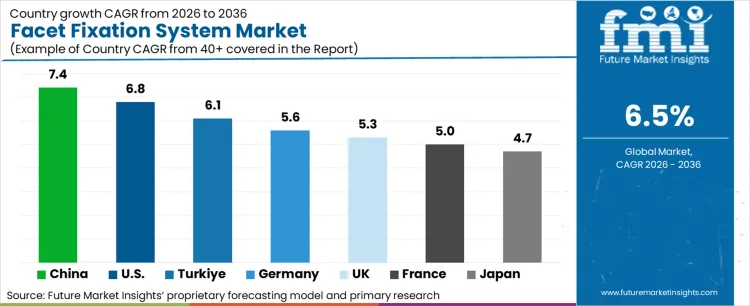
| Country | CAGR (2026-2036) |
|---|---|
| United States | 6.8% |
| Germany | 5.6% |
| United Kingdom | 5.3% |
| France | 5.0% |
| Japan | 4.7% |
| China | 7.4% |
| Türkiye | 6.1% |
Source: Future Market Insights (FMI) analysis, based on proprietary forecasting model and primary research.
Is Minimally Invasive Spine Surgery Scaling Redefining Demand in the United States?
The market for facet fixation systems in the US is presently projected to expand at a CAGR of 6.8%. This trend is mainly attributed to the increasing demand for minimally invasive spine procedures. This trend is further influenced by the current need for targeted stability solutions for the effective management of degenerative lumbar disease. The trend is also reinforced by the increasing scope of outpatient capable spine programs. It is anticipated that this surge will continue to remain structurally underpinned by the trend towards the continued integration of minimally invasive fixation adjuncts. However, the trend is being driven by the growing need among surgeons for the development of stability options that require reduced tissue disruption compared with larger construct options for specific applications.
Does Germany’s Evidence-Led Implant Selection Sustain High-Value Adoption?
According to Future Market Insights, Germany’s facet fixation system market is projected to expand at a 5.6% CAGR, shaped by evidence-led surgical decision-making and disciplined implant selection within structured hospital pathways. Demand is being supported where facet fixation is being used to enhance stability in degenerative lumbar conditions, particularly in settings emphasizing reproducible outcomes and controlled complication risk. FMI analysts observe that product preference is being guided by biomechanical reliability, material quality expectations, and compatibility with established spine workflows. Growth is expected to remain steady, driven by measured adoption and protocol-led utilization rather than rapid diffusion.
Is the United Kingdom’s Conservative Adoption Pattern Supporting Measured Growth?
UK facet fixation system market to grow at a 5.3% CAGR, supported by gradual integration of facet-based stabilization within defined clinical pathways where minimally invasive approaches are being prioritized. Demand is being shaped by procurement discipline and careful case selection, with adoption being focused on scenarios where stabilization benefits can be delivered without extensive instrumentation. FMI analysts note that growth is being reinforced through expansion of specialist spine centers and increasing comfort with minimally invasive posterior approaches. Market progression is expected to remain steady, anchored in pathway-led adoption rather than aggressive expansion.
How Is France’s Center-of-Excellence Use Case Driving Incremental Expansion?
France’s facet fixation system market is expected to expand at a 5.0% CAGR, shaped by adoption concentrated in specialist orthopedic and neurosurgical centers where procedural standardization and outcome consistency are being emphasized. Demand is being reinforced where facet fixation is being positioned as a stability-enhancing option in degenerative lumbar care pathways, particularly when minimally invasive approaches are being pursued. FMI analysts observe that uptake is being guided by clinical validation and workflow fit, resulting in controlled expansion rather than broad deployment. Growth is expected to remain supported as specialist capacity expands and technique familiarity improves.
Does Japan’s Aging Demographic Base Sustain Stable Long-Term Demand?
Future Market Insights states that the Japan facet fixation system market will experience growth at a 4.7% CAGR, as the continuous pressure of age demographics upon the population continues to raise demand for stabilization procedures with a sustained burden of degenerative spine diseases. Adoption is being reinforced in those places where facet fixation is being used in carefully selected cases to support pain reduction and functional improvement while maintaining procedural control. According to FMI analysts, technology adoption is being pursued with caution, placing powerful emphasis on long-term safety, implant reliability, and surgeon training discipline. Growth is expected to remain stable as modernization in spine care proceeds at a measured pace.
How Is China’s Procedural Scale-Up Accelerating Facet Fixation Adoption?
According to Future Market Insights, China’s facet fixation system market is projected to expand at a 7.4% CAGR, underpinned by expanding tertiary hospital capacity and rising volumes of lumbar interventions in degenerative spine disease. Demand is being reinforced as minimally invasive spine surgery techniques scale and as hospitals seek stabilization options that support consistent outcomes and faster recovery pathways. FMI analysts observe that growth is being supported by increased specialist training exposure and stronger investment in modern spine surgery infrastructure. Expansion is expected to remain structurally supported through continued procedural growth and deeper integration of minimally invasive stabilization approaches.
Is Türkiye’s Private Hospital Spine Expansion Supporting Market Momentum?
According to Future Market Insights, the facet fixation system market in Türkiye is likely to expand at a CAGR of 6.1%. This growth is influenced by enhanced private spinal programs and access to cutting-edge orthopedic and neurosurgical treatments. Additionally, the growth of this market is being fueled by investment in modern surgical facilities in metropolitan cities and the popularization of minimally invasive treatments in degenerative lumbar cases. Market analysts at FMI explain that this growth trend is being sustained by an increased willingness for patients to undertake interventional spinal treatments and an increased level of comfort for spinal surgeons in utilizing facet stabilization treatments.
What Strategic Moves Are Defining Competitive Landscape?
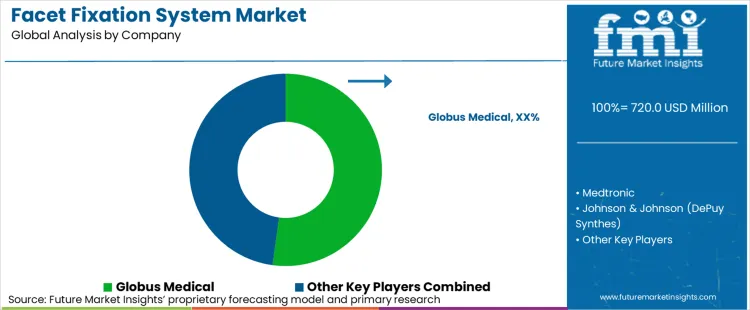
The base of competition in the facet fixation system market is now shifting towards procedural versatility, minimally invasive procedure alignment, and implant material optimization, as opposed to hardware differentiation. There is a need for systems that offer support for both the open and the minimally invasive/ percutaneous procedure routes, driven by surgeon need for less tissue disruption, accelerated recovery, and greater efficiency in the operating room.
Another prominent strategic step is the product-type specialization in facet screw systems, facet fusion cages/spacers, facet plates/clamps, as well as interlaminar solutions. Company news discusses the extension of procedural opportunities to degenerative and stabilization procedures across the Lumbar spine segment (from L1 to L4, L5 to S1), across the Cervical spine segment, as well as across the Thoracic spine segment. This way, companies like Globus Medical and Medtronic can promote facet fixation systems as motion-preserving or as adjunctive stabilizing solutions in spinal fusion procedures.
FMI also points out differentiation and growth due to innovation in materials with the increasing use of Titanium and PEEK systems that offer solutions with optimal mechanical properties, imaging characteristics, and biocompatibility. Strategic focus on the segment of Hospitals, coupled with penetration of the ASC segment as well as Specialty Spine centers, creates a differentiation of the market position of companies like theirs. These points indicate the evolution of competition towards minimally invasive fixation solutions with optimal level and evolving materials solutions as we move towards the year 2036.
Recent Developments:
- On January, 2026, SurGenTec, a medical device innovation company announced FDA clearance of its ION-C Facet Fixation System. ION-C, part of SurGenTec’s posterior cervical platform, has received expanded indications allowing for the treatment of cervical pseudoarthrosis when implanted bilaterally within the facet joints.
- In October 2025, SC Medica has received USA FDA clearance for standalone use of its FFX® Facet FiXation System, making it the first facet fusion cage approved for lumbar spine surgery without supplemental fixation. The milestone allows surgeons to perform facet arthrodesis without pedicle screws or interbody cages, expanding minimally invasive fusion options for selected patients in the USA
- In May 2024, ZygoFix announced it received FDA 510(k) clearance for its zLock Lumbar Facet Fixation system.
- In January 2024, Providence Medical Technology, Inc., a medical device innovator company announced that the USA Food and Drug Administration (FDA) has cleared its CAVUX FFS-LX, a lumbar facet fixation system for use in lumbar spinal fusion surgery.
Key Players in Facet Fixation System Market
- Globus Medical
- Medtronic
- Johnson & Johnson (DePuy Synthes)
- Stryker
- Zimmer Biomet
- Orthofix
- Alphatec Spine
- SeaSpine
- Aurora Spine
- RTI Surgical
- SC Medica
- SurGenTec®
Market Definition
The facet fixation system market refers to the global industry involved in the development, manufacture, and clinical use of spinal implant systems designed to stabilize facet joints and support spinal fusion or motion-preserving procedures. These systems are utilized to address degenerative disc disease, spinal instability, and related structural disorders by providing posterior column stabilization across specific spinal levels. The market size is measured in USD million and analyzed over the 2026 to 2036 forecast period.
The market includes systems segmented by procedure approach, product type, spinal level, material, and end user. Products encompassed within the market include open and minimally invasive / percutaneous approaches and implant systems such as facet screw systems, facet fusion cages / spacers, facet plates / clamps, and interlaminar devices. These systems are deployed across lumbar (L1-L4), L5-S1, cervical, and thoracic spinal levels and are manufactured using titanium, peek, stainless steel, and bioresorbable / other materials. Facet fixation systems are primarily utilized within Hospitals, ASCs, and Specialty spine centers.
The market excludes anterior spinal fixation devices, standalone interbody fusion cages without facet stabilization functionality, spinal rods and pedicle screw systems not intended for facet fixation, non-implantable spinal instrumentation tools, and non-surgical pain management therapies. Also excluded are experimental spinal stabilization devices not approved for clinical use.
Scope of Report
| Items | Values |
|---|---|
| Quantitative Units (2026) | USD 720.0 Million |
| Procedure Approach | Open, Minimally invasive / percutaneous |
| Product Type | Facet screw systems, Facet fusion cages / spacers, Facet plates / clamps, Interlaminar |
| Spinal Level | Lumbar (L1-L4), L5-S1, Cervical, Thoracic |
| Material | Titanium, PEEK, Stainless steel, Bioresorbable / other |
| End User | Hospitals, ASCs, Specialty spine centers |
| Regions Covered | North America, Europe, Asia Pacific, Latin America, Middle East & Africa |
| Countries Covered | USA, Germany, UK, France, Japan, China, Turkiye, and 40+ countries |
| Key Companies Profiled | Globus Medical, Medtronic, Johnson & Johnson (DePuy Synthes), Stryker, Zimmer Biomet, SurGenTec® |
| Additional Attributes | Revenue analysis by product type and spinal level, assessment of minimally invasive adoption trends, evaluation of material preference dynamics, competitive positioning based on procedural versatility and clinical integration |
Facet Fixation System Market by Segments
By Procedure Approach:
- Open
- Minimally invasive / percutaneous
By Product Type:
- Facet Screw Systems
- Facet fusion Cages / Spacers
- Facet Plates / Clamps
- Interlaminar Adjuncts
By Spinal Level:
- Lumbar (L1-L4)
- L5-S1
- Cervical
- Thoracic
By Material:
- Titanium
- PEEK
- Stainless steel
- Bioresorbable / other
By End User:
- Hospitals
- Ambulatory Surgical Centers (ASC)
- Specialty Spine Centers
By Region:
- North America
- Europe
- East Asia
- South Asia
- Latin America
- Middle East & Africa
Bibliography
- USA Food and Drug Administration. (2024). Spinal System Premarket Notification (510(k)) and Performance Testing Guidance. FDA.
- International Organization for Standardization. (2024). ISO 13485: Medical Devices - Quality Management Systems for Implantable Orthopedic Systems. ISO.
- North American Spine Society. (2023). Coverage Policy and Clinical Guidelines for Posterior Lumbar Fusion and Facet Fixation Systems. NASS.
- European Spine Society. (2023). Best Practice Recommendations for Minimally Invasive Posterior Spinal Stabilization. EUROSPINE.
- Association for the Advancement of Medical Instrumentation. (2023). Performance and Biomechanical Testing Standards for Spinal Fixation Devices. AAMI.
- Mobbs, R. J., et al. (2023). Clinical outcomes and biomechanical considerations of facet fixation systems in lumbar stabilization. Spine Journal, 23, 1425-1436.
Frequently Asked Questions
What is the current global market size for facet fixation systems?
The global facet fixation system market is valued at USD 720.0 million in 2026, reflecting steady adoption in posterior lumbar stabilization and minimally invasive spinal procedures.
What is the projected CAGR for the market over the next 10 years?
The market is projected to grow at a 6.5% CAGR from 2026 to 2036, supported by rising degenerative spine conditions and increasing preference for motion-preserving and minimally invasive fixation techniques.
Which regions are experiencing the fastest expansion?
China and the United States are experiencing comparatively faster expansion, driven by increasing spinal surgery volumes, technological advancements in titanium-based systems, and expanded hospital procedural capacity.
What are the primary market drivers?
Growth is being driven by increasing lumbar degenerative disease incidence, higher utilization of minimally invasive stabilization procedures, preference for titanium implants, and expansion of spine-specialty surgical centers.
Who are the leading manufacturers in the market?
Globus Medical, Medtronic, Johnson & Johnson (DePuy Synthes), Stryker, and Zimmer Biomet are among the leading manufacturers, differentiated by comprehensive spinal fixation portfolios and established global distribution networks.
Preview the report firsthand - request a free sample
Get SampleGet the brochure for pricing and purchase details.
Get PDFTable of Content
- Executive Summary
- Global Market Outlook
- Demand-side Trends
- Supply-side Trends
- Technology Roadmap Analysis
- Analysis and Recommendations
- Market Overview
- Market Coverage / Taxonomy
- Market Definition / Scope / Limitations
- Research Methodology
- Chapter Orientation
- Analytical Lens and Working Hypotheses
- Market Structure, Signals, and Trend Drivers
- Benchmarking and Cross-market Comparability
- Market Sizing, Forecasting, and Opportunity Mapping
- Research Design and Evidence Framework
- Desk Research Programme (Secondary Evidence)
- Company Annual and Sustainability Reports
- Peer-reviewed Journals and Academic Literature
- Corporate Websites, Product Literature, and Technical Notes
- Earnings Decks and Investor Briefings
- Statutory Filings and Regulatory Disclosures
- Technical White Papers and Standards Notes
- Trade Journals, Industry Magazines, and Analyst Briefs
- Conference Proceedings, Webinars, and Seminar Materials
- Government Statistics Portals and Public Data Releases
- Press Releases and Reputable Media Coverage
- Specialist Newsletters and Curated Briefings
- Sector Databases and Reference Repositories
- FMI Internal Proprietary Databases and Historical Market Datasets
- Subscription Datasets and Paid Sources
- Social Channels, Communities, and Digital Listening Inputs
- Additional Desk Sources
- Expert Input and Fieldwork (Primary Evidence)
- Primary Modes
- Qualitative Interviews and Expert Elicitation
- Quantitative Surveys and Structured Data Capture
- Blended Approach
- Why Primary Evidence is Used
- Field Techniques
- Interviews
- Surveys
- Focus Groups
- Observational and In-context Research
- Social and Community Interactions
- Stakeholder Universe Engaged
- C-suite Leaders
- Board Members
- Presidents and Vice Presidents
- R&D and Innovation Heads
- Technical Specialists
- Domain Subject-matter Experts
- Scientists
- Physicians and Other Healthcare Professionals
- Governance, Ethics, and Data Stewardship
- Research Ethics
- Data Integrity and Handling
- Primary Modes
- Tooling, Models, and Reference Databases
- Desk Research Programme (Secondary Evidence)
- Data Engineering and Model Build
- Data Acquisition and Ingestion
- Cleaning, Normalisation, and Verification
- Synthesis, Triangulation, and Analysis
- Quality Assurance and Audit Trail
- Market Background
- Market Dynamics
- Drivers
- Restraints
- Opportunity
- Trends
- Scenario Forecast
- Demand in Optimistic Scenario
- Demand in Likely Scenario
- Demand in Conservative Scenario
- Opportunity Map Analysis
- Product Life Cycle Analysis
- Supply Chain Analysis
- Investment Feasibility Matrix
- Value Chain Analysis
- PESTLE and Porter’s Analysis
- Regulatory Landscape
- Regional Parent Market Outlook
- Production and Consumption Statistics
- Import and Export Statistics
- Market Dynamics
- Global Market Analysis 2021 to 2025 and Forecast, 2026 to 2036
- Historical Market Size Value (USD Million) Analysis, 2021 to 2025
- Current and Future Market Size Value (USD Million) Projections, 2026 to 2036
- Y-o-Y Growth Trend Analysis
- Absolute $ Opportunity Analysis
- Global Market Pricing Analysis 2021 to 2025 and Forecast 2026 to 2036
- Global Market Analysis 2021 to 2025 and Forecast 2026 to 2036, By Procedure Approach
- Introduction / Key Findings
- Historical Market Size Value (USD Million) Analysis By Procedure Approach , 2021 to 2025
- Current and Future Market Size Value (USD Million) Analysis and Forecast By Procedure Approach , 2026 to 2036
- Open
- Minimally invasive / percutaneous
- Open
- Y-o-Y Growth Trend Analysis By Procedure Approach , 2021 to 2025
- Absolute $ Opportunity Analysis By Procedure Approach , 2026 to 2036
- Global Market Analysis 2021 to 2025 and Forecast 2026 to 2036, By Product Type
- Introduction / Key Findings
- Historical Market Size Value (USD Million) Analysis By Product Type, 2021 to 2025
- Current and Future Market Size Value (USD Million) Analysis and Forecast By Product Type, 2026 to 2036
- Facet screw systems
- Facet fusion cages / spacers
- Facet plates / clamps
- Interlaminar adjuncts
- Facet screw systems
- Y-o-Y Growth Trend Analysis By Product Type, 2021 to 2025
- Absolute $ Opportunity Analysis By Product Type, 2026 to 2036
- Global Market Analysis 2021 to 2025 and Forecast 2026 to 2036, By Spinal Level
- Introduction / Key Findings
- Historical Market Size Value (USD Million) Analysis By Spinal Level, 2021 to 2025
- Current and Future Market Size Value (USD Million) Analysis and Forecast By Spinal Level, 2026 to 2036
- Lumbar (L1–L4)
- L5–S1
- Cervical
- Thoracic
- Lumbar (L1–L4)
- Y-o-Y Growth Trend Analysis By Spinal Level, 2021 to 2025
- Absolute $ Opportunity Analysis By Spinal Level, 2026 to 2036
- Global Market Analysis 2021 to 2025 and Forecast 2026 to 2036, By Material
- Introduction / Key Findings
- Historical Market Size Value (USD Million) Analysis By Material, 2021 to 2025
- Current and Future Market Size Value (USD Million) Analysis and Forecast By Material, 2026 to 2036
- Titanium
- PEEK
- Stainless steel
- Bioresorbable / other
- Titanium
- Y-o-Y Growth Trend Analysis By Material, 2021 to 2025
- Absolute $ Opportunity Analysis By Material, 2026 to 2036
- Global Market Analysis 2021 to 2025 and Forecast 2026 to 2036, By End User
- Introduction / Key Findings
- Historical Market Size Value (USD Million) Analysis By End User, 2021 to 2025
- Current and Future Market Size Value (USD Million) Analysis and Forecast By End User, 2026 to 2036
- Hospitals
- ASCs
- Specialty spine centers
- Hospitals
- Y-o-Y Growth Trend Analysis By End User, 2021 to 2025
- Absolute $ Opportunity Analysis By End User, 2026 to 2036
- Global Market Analysis 2021 to 2025 and Forecast 2026 to 2036, By Region
- Introduction
- Historical Market Size Value (USD Million) Analysis By Region, 2021 to 2025
- Current Market Size Value (USD Million) Analysis and Forecast By Region, 2026 to 2036
- North America
- Latin America
- Western Europe
- Eastern Europe
- East Asia
- South Asia and Pacific
- Middle East & Africa
- Market Attractiveness Analysis By Region
- North America Market Analysis 2021 to 2025 and Forecast 2026 to 2036, By Country
- Historical Market Size Value (USD Million) Trend Analysis By Market Taxonomy, 2021 to 2025
- Market Size Value (USD Million) Forecast By Market Taxonomy, 2026 to 2036
- By Country
- USA
- Canada
- Mexico
- By Procedure Approach
- By Product Type
- By Spinal Level
- By Material
- By End User
- By Country
- Market Attractiveness Analysis
- By Country
- By Procedure Approach
- By Product Type
- By Spinal Level
- By Material
- By End User
- Key Takeaways
- Latin America Market Analysis 2021 to 2025 and Forecast 2026 to 2036, By Country
- Historical Market Size Value (USD Million) Trend Analysis By Market Taxonomy, 2021 to 2025
- Market Size Value (USD Million) Forecast By Market Taxonomy, 2026 to 2036
- By Country
- Brazil
- Chile
- Rest of Latin America
- By Procedure Approach
- By Product Type
- By Spinal Level
- By Material
- By End User
- By Country
- Market Attractiveness Analysis
- By Country
- By Procedure Approach
- By Product Type
- By Spinal Level
- By Material
- By End User
- Key Takeaways
- Western Europe Market Analysis 2021 to 2025 and Forecast 2026 to 2036, By Country
- Historical Market Size Value (USD Million) Trend Analysis By Market Taxonomy, 2021 to 2025
- Market Size Value (USD Million) Forecast By Market Taxonomy, 2026 to 2036
- By Country
- Germany
- UK
- Italy
- Spain
- France
- Nordic
- BENELUX
- Rest of Western Europe
- By Procedure Approach
- By Product Type
- By Spinal Level
- By Material
- By End User
- By Country
- Market Attractiveness Analysis
- By Country
- By Procedure Approach
- By Product Type
- By Spinal Level
- By Material
- By End User
- Key Takeaways
- Eastern Europe Market Analysis 2021 to 2025 and Forecast 2026 to 2036, By Country
- Historical Market Size Value (USD Million) Trend Analysis By Market Taxonomy, 2021 to 2025
- Market Size Value (USD Million) Forecast By Market Taxonomy, 2026 to 2036
- By Country
- Russia
- Poland
- Hungary
- Balkan & Baltic
- Rest of Eastern Europe
- By Procedure Approach
- By Product Type
- By Spinal Level
- By Material
- By End User
- By Country
- Market Attractiveness Analysis
- By Country
- By Procedure Approach
- By Product Type
- By Spinal Level
- By Material
- By End User
- Key Takeaways
- East Asia Market Analysis 2021 to 2025 and Forecast 2026 to 2036, By Country
- Historical Market Size Value (USD Million) Trend Analysis By Market Taxonomy, 2021 to 2025
- Market Size Value (USD Million) Forecast By Market Taxonomy, 2026 to 2036
- By Country
- China
- Japan
- South Korea
- By Procedure Approach
- By Product Type
- By Spinal Level
- By Material
- By End User
- By Country
- Market Attractiveness Analysis
- By Country
- By Procedure Approach
- By Product Type
- By Spinal Level
- By Material
- By End User
- Key Takeaways
- South Asia and Pacific Market Analysis 2021 to 2025 and Forecast 2026 to 2036, By Country
- Historical Market Size Value (USD Million) Trend Analysis By Market Taxonomy, 2021 to 2025
- Market Size Value (USD Million) Forecast By Market Taxonomy, 2026 to 2036
- By Country
- India
- ASEAN
- Australia & New Zealand
- Rest of South Asia and Pacific
- By Procedure Approach
- By Product Type
- By Spinal Level
- By Material
- By End User
- By Country
- Market Attractiveness Analysis
- By Country
- By Procedure Approach
- By Product Type
- By Spinal Level
- By Material
- By End User
- Key Takeaways
- Middle East & Africa Market Analysis 2021 to 2025 and Forecast 2026 to 2036, By Country
- Historical Market Size Value (USD Million) Trend Analysis By Market Taxonomy, 2021 to 2025
- Market Size Value (USD Million) Forecast By Market Taxonomy, 2026 to 2036
- By Country
- Kingdom of Saudi Arabia
- Other GCC Countries
- Turkiye
- South Africa
- Other African Union
- Rest of Middle East & Africa
- By Procedure Approach
- By Product Type
- By Spinal Level
- By Material
- By End User
- By Country
- Market Attractiveness Analysis
- By Country
- By Procedure Approach
- By Product Type
- By Spinal Level
- By Material
- By End User
- Key Takeaways
- Key Countries Market Analysis
- USA
- Pricing Analysis
- Market Share Analysis, 2025
- By Procedure Approach
- By Product Type
- By Spinal Level
- By Material
- By End User
- Canada
- Pricing Analysis
- Market Share Analysis, 2025
- By Procedure Approach
- By Product Type
- By Spinal Level
- By Material
- By End User
- Mexico
- Pricing Analysis
- Market Share Analysis, 2025
- By Procedure Approach
- By Product Type
- By Spinal Level
- By Material
- By End User
- Brazil
- Pricing Analysis
- Market Share Analysis, 2025
- By Procedure Approach
- By Product Type
- By Spinal Level
- By Material
- By End User
- Chile
- Pricing Analysis
- Market Share Analysis, 2025
- By Procedure Approach
- By Product Type
- By Spinal Level
- By Material
- By End User
- Germany
- Pricing Analysis
- Market Share Analysis, 2025
- By Procedure Approach
- By Product Type
- By Spinal Level
- By Material
- By End User
- UK
- Pricing Analysis
- Market Share Analysis, 2025
- By Procedure Approach
- By Product Type
- By Spinal Level
- By Material
- By End User
- Italy
- Pricing Analysis
- Market Share Analysis, 2025
- By Procedure Approach
- By Product Type
- By Spinal Level
- By Material
- By End User
- Spain
- Pricing Analysis
- Market Share Analysis, 2025
- By Procedure Approach
- By Product Type
- By Spinal Level
- By Material
- By End User
- France
- Pricing Analysis
- Market Share Analysis, 2025
- By Procedure Approach
- By Product Type
- By Spinal Level
- By Material
- By End User
- India
- Pricing Analysis
- Market Share Analysis, 2025
- By Procedure Approach
- By Product Type
- By Spinal Level
- By Material
- By End User
- ASEAN
- Pricing Analysis
- Market Share Analysis, 2025
- By Procedure Approach
- By Product Type
- By Spinal Level
- By Material
- By End User
- Australia & New Zealand
- Pricing Analysis
- Market Share Analysis, 2025
- By Procedure Approach
- By Product Type
- By Spinal Level
- By Material
- By End User
- China
- Pricing Analysis
- Market Share Analysis, 2025
- By Procedure Approach
- By Product Type
- By Spinal Level
- By Material
- By End User
- Japan
- Pricing Analysis
- Market Share Analysis, 2025
- By Procedure Approach
- By Product Type
- By Spinal Level
- By Material
- By End User
- South Korea
- Pricing Analysis
- Market Share Analysis, 2025
- By Procedure Approach
- By Product Type
- By Spinal Level
- By Material
- By End User
- Russia
- Pricing Analysis
- Market Share Analysis, 2025
- By Procedure Approach
- By Product Type
- By Spinal Level
- By Material
- By End User
- Poland
- Pricing Analysis
- Market Share Analysis, 2025
- By Procedure Approach
- By Product Type
- By Spinal Level
- By Material
- By End User
- Hungary
- Pricing Analysis
- Market Share Analysis, 2025
- By Procedure Approach
- By Product Type
- By Spinal Level
- By Material
- By End User
- Kingdom of Saudi Arabia
- Pricing Analysis
- Market Share Analysis, 2025
- By Procedure Approach
- By Product Type
- By Spinal Level
- By Material
- By End User
- Turkiye
- Pricing Analysis
- Market Share Analysis, 2025
- By Procedure Approach
- By Product Type
- By Spinal Level
- By Material
- By End User
- South Africa
- Pricing Analysis
- Market Share Analysis, 2025
- By Procedure Approach
- By Product Type
- By Spinal Level
- By Material
- By End User
- USA
- Market Structure Analysis
- Competition Dashboard
- Competition Benchmarking
- Market Share Analysis of Top Players
- By Regional
- By Procedure Approach
- By Product Type
- By Spinal Level
- By Material
- By End User
- Competition Analysis
- Competition Deep Dive
- Globus Medical
- Overview
- Product Portfolio
- Profitability by Market Segments (Product/Age /Sales Channel/Region)
- Sales Footprint
- Strategy Overview
- Marketing Strategy
- Product Strategy
- Channel Strategy
- Medtronic
- Johnson & Johnson (DePuy Synthes)
- Stryker
- Zimmer Biomet
- Orthofix
- Alphatec Spine
- SeaSpine
- Globus Medical
- Competition Deep Dive
- Assumptions & Acronyms Used


