

- Industry Size (2026)
- USD 1.3 Bn
- Forecast (2036)
- USD 3.1 Bn
- CAGR (2026 to 2036)
- 9.00%
Clean Beauty Packaging Prototypes Market Forecast and Outlook 2026 to 2036
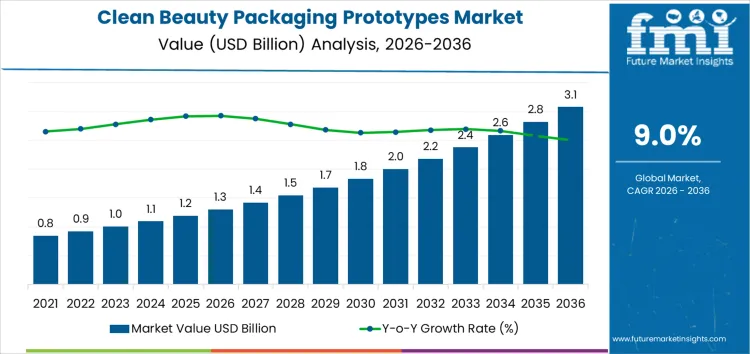
The clean beauty packaging prototypes market is valued at USD 1.3 billion in 2026 and is projected to reach USD 3.1 billion by 2036, reflecting a CAGR of 9.0%. Expansion is influenced by the high capital intensity required for prototyping, including precision manufacturing, sustainable material sourcing, and design validation. Return timelines are extended due to iterative development cycles, regulatory approval, and alignment with brand launch schedules. Investment selectivity determines which innovations are pursued, with preference given to materials and designs demonstrating scalability, environmental compliance, and compatibility with multiple product lines.
Revenue capture is concentrated among suppliers capable of combining prototyping expertise, rapid iteration, and integration with client production planning. Adoption rates vary according to brand sustainability goals, market positioning, and consumer demand for environmentally responsible packaging. Margin concentration favors operators delivering validated, multi-platform prototypes with consistent quality, while smaller or less-capitalized providers encounter constraints in scaling and securing high-value contracts. Performance outcomes rely on a combination of technical precision, material validation, and alignment with client product strategies rather than prototype volume alone.
Quick Stats of the Clean Beauty Packaging Prototypes Market
- Clean Beauty Packaging Prototypes Market Value (2026): USD 1.3 billion
- Clean Beauty Packaging Prototypes Forecast Value (2036): USD 3.1 billion
- Clean Beauty Packaging Prototypes Forecast CAGR 2026 to 2036: 9.0%
- Leading Prototype Type in Clean Beauty Packaging Prototypes Market: Refillable and Reusable Concepts (34.1% share)
- Leading Material Type in Clean Beauty Packaging Prototypes Market: Glass (Recycled and Lightweight) (29.7% share)
- Key Growth Regions in Clean Beauty Packaging Prototypes Market: USA, China, India, Germany, Japan
- Top Players in Clean Beauty Packaging Prototypes Market: AptarGroup, Inc., Berry Global, Inc., Albéa (Groupe Pochet), HCT Group, Silgan Holdings
What is the Growth Forecast for Clean Beauty Packaging Prototypes Market through 2036?
Between 2026 and 2031, the clean beauty packaging prototypes market is projected to grow from USD 1.3 billion to USD 2.1 billion, generating an absolute increase of USD 0.8 billion and reflecting a CAGR of 9.0%. Growth during this period is supported by rising adoption of sustainable materials, innovative design concepts, and development of recyclable and biodegradable packaging solutions. Price growth drives expansion, influenced by premium prototype offerings, enhanced functionality, and differentiation for high-end clean beauty products. Suppliers benefit from providing customizable, high-quality prototypes that meet regulatory and sustainability requirements across personal care and cosmetics segments.
From 2031 to 2036, the market is expected to expand from USD 2.1 billion to USD 3.1 billion, adding USD 1.1 billion. Growth is driven by increased emphasis on sustainable and innovative packaging concepts, adoption by major brands, and demand for differentiated product experiences. Price growth remains the key driver, supported by advanced materials, high-performance finishes, and specialized prototype designs. Competitive advantage favors companies offering validated, high-quality prototypes, rapid iteration capabilities, and alignment with sustainability and brand innovation goals.
Clean Beauty Packaging Prototypes Market Key Takeaways
| Metric | Value |
|---|---|
| Market Value (2026) | USD 1.3 billion |
| Forecast Value (2036) | USD 3.1 billion |
| Forecast CAGR 2026 to 2036 | 9.00% |
How Is the Clean Beauty Packaging Prototypes Market Growing with Sustainability Trends?
Clean beauty packaging prototypes are increasingly developed to support recyclable, refillable, and environmentally responsible cosmetic products. Historically, packaging focused on visual appeal and functionality, often using mixed materials that limited recycling and sustainability. Modern prototypes integrate mono-materials, biodegradable plastics, and refillable systems while maintaining structural integrity and aesthetic quality. Cosmetic brands, packaging designers, and R&D teams prioritize manufacturability, material performance, and regulatory compliance. Early adoption focused on niche clean beauty brands, while current demand extends to mainstream skincare, haircare, and personal care products driven by consumer preference for eco-friendly packaging, corporate ESG goals, and regulatory pressure. Prototype durability, design flexibility, and material compatibility influence supplier selection.
Rising consumer awareness, environmental regulations, and corporate sustainability initiatives are shaping market growth. Compared with traditional prototypes, contemporary designs emphasize recyclability, lightweight construction, and integration with refillable or reusable systems. Cost structures depend on material sourcing, prototyping technology, and iterative design processes, concentrating margins among suppliers able to deliver innovative, scalable solutions. Brands adopt clean beauty prototypes to validate functionality, test consumer appeal, and ensure sustainability performance before mass production. By 2036, clean beauty packaging prototypes are expected to be standard in product development, supporting the adoption of environmentally responsible and consumer-preferred packaging solutions in the cosmetics industry.
What Factors Are Shaping the Demand for Clean Beauty Packaging Prototypes in Terms of Prototype Type and Material Type?
The demand for clean beauty packaging prototypes is segmented by prototype type and material type. Prototype types include refillable or reusable concepts, minimalist sustainable designs, biodegradable or compostable materials, recycled/PCR material prototypes, and other innovations. Material types include glass (recycled or lightweight), sustainable plastics such as PCR or bio-based, metal and aluminum, paperboard and fiber, and additional materials. Adoption is influenced by sustainability goals, regulatory compliance, and functional performance. Uptake is driven by consumer demand for environmentally responsible packaging, operational feasibility, and lifecycle efficiency. Prototype and material selection depend on product compatibility, aesthetic appeal, and manufacturing capabilities.
Why Are Refillable and Reusable Concepts Leading the Prototype Type Segment in Clean Beauty Packaging?
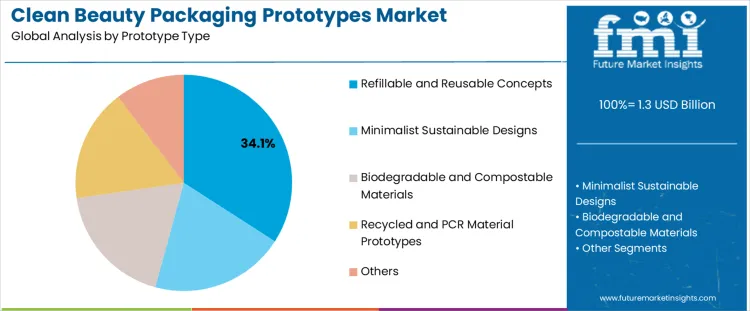
Refillable and reusable concepts account for approximately 34% of total prototype type demand, making them the leading category. These designs reduce single-use packaging waste and extend product life cycles, appealing to environmentally conscious consumers. Adoption is reinforced by the push for circular packaging solutions and regulatory incentives promoting sustainable practices. Beauty brands implement refillable packaging for creams, serums, and cosmetics to enhance consumer engagement while minimizing environmental impact. Maintenance and operational considerations include refill system durability, ease of cleaning, and compatibility with product formulations. The segment leads because refillable and reusable concepts combine sustainability, functionality, and consumer appeal in clean beauty packaging.
Operational factors further shape adoption. Packaging prototypes must withstand repeated use, maintain product integrity, and resist chemical interactions with cosmetic formulations. Material selection, closure systems, and refill mechanisms are calibrated for safety and usability. The segment leads because refillable and reusable prototypes provide measurable sustainability benefits, reduce waste, and support brand commitment to eco-friendly operations while maintaining functional performance.
Why Is Glass (Recycled or Lightweight) Representing the Largest Material Type Segment in Clean Beauty Packaging Prototypes?
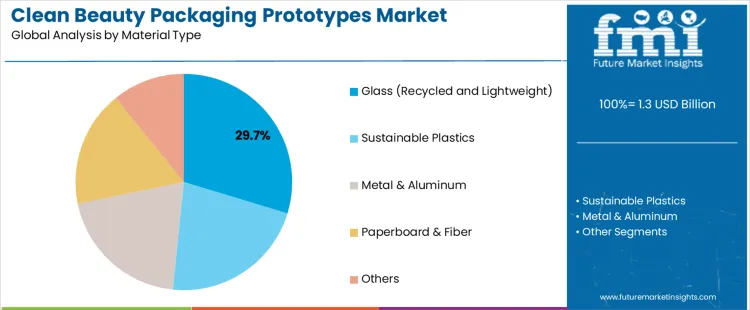
Glass, including recycled or lightweight variants, accounts for approximately 30% of total material type demand, making it the largest segment. Adoption is driven by chemical inertness, recyclability, and premium aesthetic appeal. Beauty brands use glass for jars, bottles, and containers to protect formulations, maintain shelf stability, and convey quality. Recycled or lightweight glass reduces environmental impact while preserving durability. Operational practices include monitoring breakage rates, material sourcing, and refill compatibility to ensure consistent performance.
Functional and design factors further influence adoption. Glass must withstand thermal stress, transportation handling, and repeated reuse in refill systems. Lightweight and recycled variants optimize material efficiency and reduce carbon footprint. The segment leads because glass delivers operational reliability, sustainable benefits, and premium aesthetic value, making it the preferred material for clean beauty packaging prototypes.
How Are Clean Beauty Packaging Prototypes Shaping Sustainable Product Design?
Clean beauty packaging prototypes are increasingly adopted by cosmetic brands to test sustainable, recyclable, or refillable containers before full-scale production. Adoption is strongest in regions with strong consumer demand for eco-friendly products, stringent packaging regulations, and high cosmetic industry activity. Prototypes are selected for material sustainability, durability, and design adaptability. Growth is driven by regulatory compliance, consumer preference for clean packaging, and brand sustainability goals. Investment focuses on material innovation, functional testing, and manufacturability assessment. Brands prioritize prototypes that maintain product integrity, reduce environmental impact, and align with regional regulatory standards and consumer expectations.
Why Are Regional Sustainability Policies and Consumer Preferences Driving Adoption?
Demand is influenced by local regulations on recyclable, biodegradable, and low-impact packaging materials, as well as consumer awareness of environmental issues. Companies adopt clean beauty packaging prototypes to evaluate feasibility, performance, and aesthetic appeal while meeting compliance requirements. Materials with high recyclability, durability, and compatibility with cosmetic formulations gain preference. Adoption is concentrated in regions with active green consumer markets and stringent packaging regulations. Regulatory adherence and market responsiveness drive adoption rather than cost. Suppliers offering validated, innovative prototypes gain advantage among clean beauty brands and manufacturers.
What Factors Limit Broader Implementation of Clean Beauty Packaging Prototypes?
High prototyping costs, limited availability of sustainable materials, and design complexity restrict widespread adoption. Material performance, compatibility with formulations, and manufacturability may vary across prototypes. Regulatory approvals and regional testing requirements can extend development timelines. Smaller brands or regions with limited access to sustainable packaging suppliers may face adoption challenges. These factors concentrate early use among well-funded cosmetic brands, multinational companies, and regions with strong sustainability initiatives, slowing broader deployment despite growing demand.
How Are Technological Advancements and Collaboration Shaping Market Growth?
Developments include biodegradable plastics, refillable systems, and innovative eco-friendly closures and dispensers. Collaboration between packaging manufacturers, cosmetic brands, and research institutions enables performance validation, material testing, and regulatory compliance. Pilot testing evaluates durability, product compatibility, and consumer usability before mass production. Quality monitoring, traceability, and material certification ensure consistency and reliability. Focus is on sustainability, functionality, and regulatory alignment rather than cost or volume. Collaborative efforts enable broader adoption of clean beauty packaging prototypes, supporting sustainable product development and consumer demand in regional and global cosmetic markets.
What is the Demand for Clean Beauty Packaging Prototypes by Country?
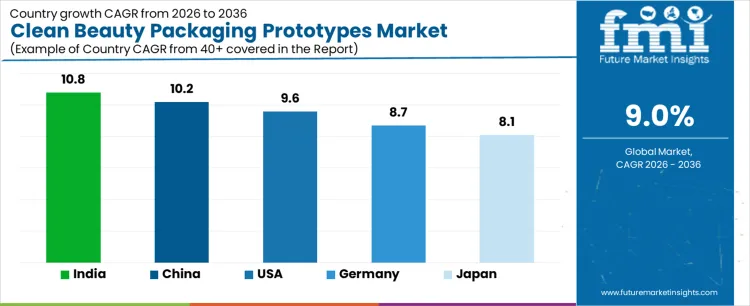
| Country | CAGR (%) |
|---|---|
| USA | 9.6% |
| China | 10.2% |
| India | 10.8% |
| Germany | 8.7% |
| Japan | 8.1% |
Demand for clean beauty packaging prototypes is rising as cosmetic brands prioritize sustainable, recyclable, and innovative packaging to meet consumer expectations and regulatory standards. India leads with a 10.8% CAGR, driven by rapid growth in the personal care sector, adoption of eco-friendly packaging practices, and increasing consumer demand for clean beauty products. China follows at 10.2%, supported by rising domestic cosmetics production, brand initiatives for sustainable packaging, and prototyping of recyclable formats. The USA grows at 9.6%, shaped by innovation in eco-conscious packaging and clean beauty product launches. Germany records 8.7% growth, reflecting steady adoption of sustainable design practices. Japan shows 8.1% CAGR, driven by moderate adoption of eco-friendly prototypes and consumer awareness of clean beauty packaging.
How Is the United States Experiencing Growth in the Clean Beauty Packaging Prototypes Market?
United States is experiencing growth at a CAGR of 9.6%, supported by adoption of clean beauty packaging prototypes to meet consumer demand for sustainable, recyclable, and environmentally friendly packaging solutions. Cosmetic manufacturers and packaging suppliers are developing prototypes optimized for material efficiency, recyclability, and aesthetic appeal. Demand is concentrated in major cosmetic production hubs, R&D centers, and urban retail markets. Investments focus on material innovation, prototype testing, and regulatory compliance rather than large-scale deployment. Growth reflects rising consumer awareness of sustainable beauty products, brand emphasis on eco-friendly packaging, and adoption of advanced prototyping technologies in product development.
- Sustainable packaging drives adoption.
- Prototypes are optimized for recyclability and aesthetics.
- Cosmetic hubs and R&D centers concentrate demand.
- Material innovation and regulatory compliance guide investment.
How Is China Witnessing Rapid Growth With Eco-Friendly Packaging Initiatives?
China is witnessing growth at a CAGR of 10.2%, fueled by adoption of clean beauty packaging prototypes to reduce environmental impact and meet consumer demand for sustainable cosmetics. Manufacturers and suppliers are producing prototypes designed for recyclability, material efficiency, and visual appeal. Demand is concentrated in urban cosmetic manufacturing hubs, R&D centers, and retail markets. Investments prioritize material innovation, prototype performance, and regulatory adherence rather than mass production. Growth reflects government support for sustainable packaging, increasing consumer preference for eco-friendly products, and adoption of advanced packaging technologies in the cosmetic industry.
- Eco-friendly initiatives drive adoption.
- Prototypes focus on recyclability and material efficiency.
- Urban manufacturing hubs and R&D centers concentrate demand.
- Material innovation and regulatory adherence guide investment.
How Is India Experiencing Rapid Growth With Sustainable Beauty Practices?
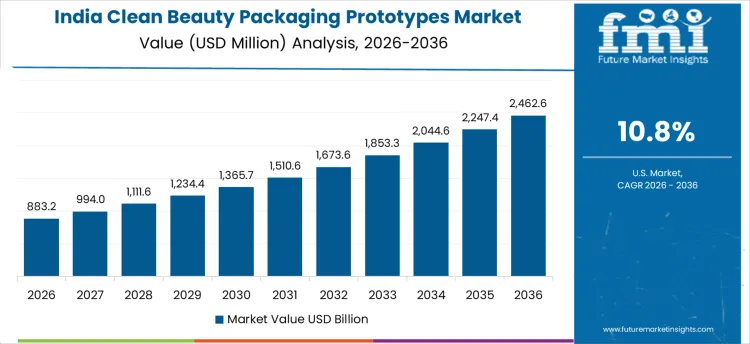
India is experiencing growth at a CAGR of 10.8%, supported by adoption of clean beauty packaging prototypes in domestic and export-oriented cosmetic production to meet rising sustainability standards. Manufacturers and suppliers are deploying prototypes optimized for material efficiency, recyclability, and product presentation. Demand is concentrated in major cosmetic hubs, R&D facilities, and urban retail markets. Investments focus on material innovation, prototype testing, and compliance with environmental regulations rather than large-scale deployment. Growth reflects increasing consumer awareness of sustainable beauty products, government incentives for eco-friendly packaging, and adoption of modern prototyping technologies.
- Sustainable beauty practices drive adoption.
- Prototypes are optimized for recyclability and aesthetics.
- Cosmetic hubs and R&D centers concentrate demand.
- Material innovation and environmental compliance guide investment.
How Is Germany Witnessing Growth With Eco-Conscious Packaging Initiatives?
Germany is witnessing growth at a CAGR of 8.7%, supported by adoption of clean beauty packaging prototypes to reduce environmental impact and align with sustainability standards in cosmetic manufacturing. Manufacturers and suppliers are implementing prototypes designed for material efficiency, recyclability, and visual appeal. Demand is concentrated in urban cosmetic production hubs, R&D centers, and retail-focused facilities. Investments prioritize material quality, prototype performance, and regulatory compliance rather than large-scale commercialization. Growth reflects increasing consumer preference for eco-friendly packaging, brand adoption of sustainable practices, and industrial focus on advanced prototyping technologies.
- Eco-conscious packaging drives adoption.
- Prototypes focus on recyclability and material efficiency.
- Urban production hubs and R&D centers concentrate demand.
- Material quality and regulatory compliance guide investment.
How Is Japan Experiencing Moderate Growth With Sustainable Cosmetic Packaging?
Japan is experiencing growth at a CAGR of 8.1%, fueled by adoption of clean beauty packaging prototypes in cosmetic production to improve sustainability and meet consumer demand for eco-friendly solutions. Manufacturers and suppliers are deploying prototypes optimized for recyclability, material efficiency, and aesthetic presentation. Demand is concentrated in urban manufacturing hubs, R&D centers, and retail markets. Investments focus on material performance, prototype precision, and compliance with environmental regulations rather than large-scale rollout. Growth reflects rising awareness of sustainable packaging, industrial adoption of eco-friendly materials, and use of modern prototyping technologies in the cosmetic sector.
- Sustainable cosmetic packaging drives adoption.
- Prototypes are optimized for recyclability and efficiency.
- Urban hubs and R&D centers concentrate demand.
- Material performance and regulatory compliance guide investment.
Who Competes in the Clean Beauty Packaging Prototypes Market and What Defines Their Roles?
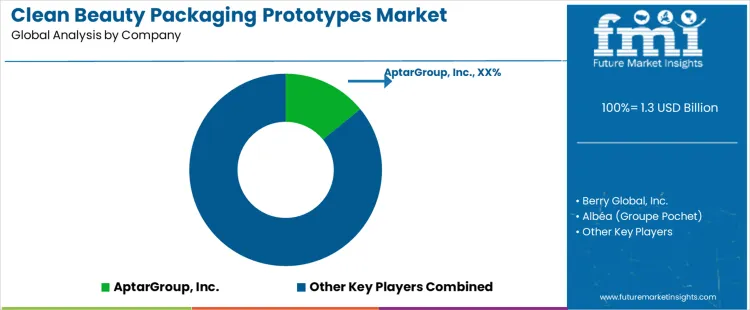
Competition in the clean beauty packaging prototypes market is defined by design innovation, materials expertise, and alignment with sustainability criteria relevant to brand and consumer expectations. AptarGroup, Inc. provides prototype closures and dispensing systems engineered for precision, sensory experience, and low environmental impact. Berry Global, Inc. offers prototype packaging platforms that integrate renewable and recycled resins suited to clean beauty brand narratives. Albéa (Groupe Pochet) focuses on modular designs and refillable systems that align with clean ingredient positioning. HCT Group develops customizable prototypes that address aesthetic and functional requirements in small batch runs. Silgan Holdings supplies prototype closures and containers emphasizing structural integrity and surface quality. Other market participants include specialty designers and regional converters that contribute unique form factors and material blends tailored to brand identity.
Differentiation in the clean beauty packaging prototypes market arises from materials selection, fabrication methods, and ability to respond to packaging performance validation. AptarGroup, Inc. advances prototype designs that integrate innovative pump technologies with sustainable materials that satisfy regulatory and consumer scrutiny. Berry Global, Inc. provides prototype options that balance mechanical resilience with compatibility with post-consumer recycled content targets. Albéa (Groupe Pochet) delivers prototype tubes and jars with surface finishes that appeal to premium clean beauty positioning while meeting performance criteria. HCT Group emphasizes rapid prototyping processes that shorten development cycles for emerging brands. Silgan Holdings offers prototype containers designed to align with fill line and supply chain requirements. Other competitors supply unique closures, barrier systems, and material blends that support diverse formulation needs. Design responsiveness, material innovation, and prototype testing support shape supplier differentiation.
Key Players in the Clean Beauty Packaging Prototypes Market
- AptarGroup, Inc.
- Berry Global, Inc.
- Albéa (Groupe Pochet)
- HCT Group
- Silgan Holdings
- Others
Scope of the Report
| Items | Values |
|---|---|
| Quantitative Units (2026) | USD billion |
| Prototype Type | Refillable and Reusable Concepts, Minimalist Sustainable Designs, Biodegradable and Compostable Materials, Recycled and PCR Material Prototypes, Others |
| Material Type | Glass (Recycled and Lightweight), Sustainable Plastics (PCR and Bio-based), Metal & Aluminum, Paperboard & Fiber, Others |
| End Use Product | Skincare Packaging, Makeup and Color Cosmetics, Hair Care Packaging, Fragrance Packaging, Others |
| Region | Asia Pacific, Europe, North America, Latin America, Middle East & Africa |
| Key Countries Covered | China, Japan, South Korea, India, Australia & New Zealand, Germany, United Kingdom, France, Italy, Spain, Nordic, BENELUX, United States, Canada, Mexico, Brazil, Chile, Kingdom of Saudi Arabia, Other GCC Countries, Turkey, South Africa, Other African Union |
| Key Companies Profiled | AptarGroup, Inc., Berry Global, Inc., Albéa (Groupe Pochet), HCT Group, Silgan Holdings, Others |
| Additional Attributes | Dollar sales by prototype type, material type, and end-use product; regional CAGR, volume and value growth projections; adoption in skincare, haircare, makeup, and fragrance packaging; material innovation, regulatory compliance, and prototype validation for brand sustainability |
Clean Beauty Packaging Prototypes Market Segmentation
Prototype Type:
- Refillable and Reusable Concepts
- Minimalist Sustainable Designs
- Biodegradable and Compostable Materials
- Recycled and PCR Material Prototypes
- Others
Material Type:
- Glass (Recycled and Lightweight)
- Sustainable Plastics (PCR and Bio based)
- Metal & Aluminum
- Paperboard & Fiber
- Others
End-Use Product:
- Skincare Packaging
- Makeup and Color Cosmetics
- Hair Care Packaging
- Fragrance Packaging
- Others
Region
- Asia Pacific
- China
- Japan
- South Korea
- India
- Australia & New Zealand
- ASEAN
- Rest of Asia Pacific
- Europe
- Germany
- United Kingdom
- France
- Italy
- Spain
- Nordic
- BENELUX
- Rest of Europe
- North America
- United States
- Canada
- Mexico
- Latin America
- Brazil
- Chile
- Rest of Latin America
- Middle East & Africa
- Kingdom of Saudi Arabia
- Other GCC Countries
- Turkey
- South Africa
- Other African Union
- Rest of Middle East & Africa
Bibliography
- European Commission – Joint Research Centre (JRC). (2024). Environmental sustainability of cosmetic packaging: Materials, reuse systems, and lifecycle impacts. Publications Office of the European Union.
- OECD. (2024). Reducing the environmental impact of plastics in cosmetics and personal care packaging. Organisation for Economic Co‑operation and Development.
- Ellen MacArthur Foundation. (2024). Global reusable packaging systems for cosmetics: Design principles and performance outcomes.
- ISO 18601:2024. Packaging and the environment — General requirements for packaging optimization. International Organization for Standardization (ISO).
Frequently Asked Questions
How big is the clean beauty packaging prototypes market in 2026?
The global clean beauty packaging prototypes market is estimated to be valued at USD 1.3 billion in 2026.
What will be the size of clean beauty packaging prototypes market in 2036?
The market size for the clean beauty packaging prototypes market is projected to reach USD 3.1 billion by 2036.
How much will be the clean beauty packaging prototypes market growth between 2026 and 2036?
The clean beauty packaging prototypes market is expected to grow at a 9.0% CAGR between 2026 and 2036.
What are the key product types in the clean beauty packaging prototypes market?
The key product types in clean beauty packaging prototypes market are refillable and reusable concepts, minimalist sustainable designs, biodegradable and compostable materials, recycled and pcr material prototypes and others.
Which material type segment to contribute significant share in the clean beauty packaging prototypes market in 2026?
In terms of material type, glass (recycled and lightweight) segment to command 29.7% share in the clean beauty packaging prototypes market in 2026.
Preview the report firsthand - request a free sample
Get SampleGet the brochure for pricing and purchase details.
Get PDFTable of Content
- Executive Summary
- Global Market Outlook
- Demand-side Trends
- Supply-side Trends
- Technology Roadmap Analysis
- Analysis and Recommendations
- Market Overview
- Market Coverage / Taxonomy
- Market Definition / Scope / Limitations
- Market Background
- Market Dynamics
- Drivers
- Restraints
- Opportunity
- Trends
- Scenario Forecast
- Demand in Optimistic Scenario
- Demand in Likely Scenario
- Demand in Conservative Scenario
- Opportunity Map Analysis
- Product Life Cycle Analysis
- Supply Chain Analysis
- Investment Feasibility Matrix
- Value Chain Analysis
- PESTLE and Porter’s Analysis
- Regulatory Landscape
- Regional Parent Market Outlook
- Production and Consumption Statistics
- Import and Export Statistics
- Market Dynamics
- Global Market Analysis 2021 to 2025 and Forecast, 2026 to 2036
- Historical Market Size Value (USD Million) Analysis, 2021 to 2025
- Current and Future Market Size Value (USD Million) Projections, 2026 to 2036
- Y-o-Y Growth Trend Analysis
- Absolute $ Opportunity Analysis
- Global Market Pricing Analysis 2021 to 2025 and Forecast 2026 to 2036
- Global Market Analysis 2021 to 2025 and Forecast 2026 to 2036, By Prototype Type
- Introduction / Key Findings
- Historical Market Size Value (USD Million) Analysis By Prototype Type , 2021 to 2025
- Current and Future Market Size Value (USD Million) Analysis and Forecast By Prototype Type , 2026 to 2036
- Refillable and Reusable Concepts
- Minimalist Sustainable Designs
- Biodegradable and Compostable Materials
- Recycled and PCR Material Prototypes
- Others
- Refillable and Reusable Concepts
- Y-o-Y Growth Trend Analysis By Prototype Type , 2021 to 2025
- Absolute $ Opportunity Analysis By Prototype Type , 2026 to 2036
- Global Market Analysis 2021 to 2025 and Forecast 2026 to 2036, By Material Type
- Introduction / Key Findings
- Historical Market Size Value (USD Million) Analysis By Material Type, 2021 to 2025
- Current and Future Market Size Value (USD Million) Analysis and Forecast By Material Type, 2026 to 2036
- Glass (Recycled and Lightweight)
- Sustainable Plastics
- Metal & Aluminum
- Paperboard & Fiber
- Others
- Glass (Recycled and Lightweight)
- Y-o-Y Growth Trend Analysis By Material Type, 2021 to 2025
- Absolute $ Opportunity Analysis By Material Type, 2026 to 2036
- Global Market Analysis 2021 to 2025 and Forecast 2026 to 2036, By End‑Use Product
- Introduction / Key Findings
- Historical Market Size Value (USD Million) Analysis By End‑Use Product, 2021 to 2025
- Current and Future Market Size Value (USD Million) Analysis and Forecast By End‑Use Product, 2026 to 2036
- Skincare Packaging
- Makeup and Color Cosmetics
- Hair Care Packaging
- Fragrance Packaging
- Others
- Skincare Packaging
- Y-o-Y Growth Trend Analysis By End‑Use Product, 2021 to 2025
- Absolute $ Opportunity Analysis By End‑Use Product, 2026 to 2036
- Global Market Analysis 2021 to 2025 and Forecast 2026 to 2036, By Region
- Introduction
- Historical Market Size Value (USD Million) Analysis By Region, 2021 to 2025
- Current Market Size Value (USD Million) Analysis and Forecast By Region, 2026 to 2036
- North America
- Latin America
- Western Europe
- Eastern Europe
- East Asia
- South Asia and Pacific
- Middle East & Africa
- Market Attractiveness Analysis By Region
- North America Market Analysis 2021 to 2025 and Forecast 2026 to 2036, By Country
- Historical Market Size Value (USD Million) Trend Analysis By Market Taxonomy, 2021 to 2025
- Market Size Value (USD Million) Forecast By Market Taxonomy, 2026 to 2036
- By Country
- USA
- Canada
- Mexico
- By Prototype Type
- By Material Type
- By End‑Use Product
- By Country
- Market Attractiveness Analysis
- By Country
- By Prototype Type
- By Material Type
- By End‑Use Product
- Key Takeaways
- Latin America Market Analysis 2021 to 2025 and Forecast 2026 to 2036, By Country
- Historical Market Size Value (USD Million) Trend Analysis By Market Taxonomy, 2021 to 2025
- Market Size Value (USD Million) Forecast By Market Taxonomy, 2026 to 2036
- By Country
- Brazil
- Chile
- Rest of Latin America
- By Prototype Type
- By Material Type
- By End‑Use Product
- By Country
- Market Attractiveness Analysis
- By Country
- By Prototype Type
- By Material Type
- By End‑Use Product
- Key Takeaways
- Western Europe Market Analysis 2021 to 2025 and Forecast 2026 to 2036, By Country
- Historical Market Size Value (USD Million) Trend Analysis By Market Taxonomy, 2021 to 2025
- Market Size Value (USD Million) Forecast By Market Taxonomy, 2026 to 2036
- By Country
- Germany
- UK
- Italy
- Spain
- France
- Nordic
- BENELUX
- Rest of Western Europe
- By Prototype Type
- By Material Type
- By End‑Use Product
- By Country
- Market Attractiveness Analysis
- By Country
- By Prototype Type
- By Material Type
- By End‑Use Product
- Key Takeaways
- Eastern Europe Market Analysis 2021 to 2025 and Forecast 2026 to 2036, By Country
- Historical Market Size Value (USD Million) Trend Analysis By Market Taxonomy, 2021 to 2025
- Market Size Value (USD Million) Forecast By Market Taxonomy, 2026 to 2036
- By Country
- Russia
- Poland
- Hungary
- Balkan & Baltic
- Rest of Eastern Europe
- By Prototype Type
- By Material Type
- By End‑Use Product
- By Country
- Market Attractiveness Analysis
- By Country
- By Prototype Type
- By Material Type
- By End‑Use Product
- Key Takeaways
- East Asia Market Analysis 2021 to 2025 and Forecast 2026 to 2036, By Country
- Historical Market Size Value (USD Million) Trend Analysis By Market Taxonomy, 2021 to 2025
- Market Size Value (USD Million) Forecast By Market Taxonomy, 2026 to 2036
- By Country
- China
- Japan
- South Korea
- By Prototype Type
- By Material Type
- By End‑Use Product
- By Country
- Market Attractiveness Analysis
- By Country
- By Prototype Type
- By Material Type
- By End‑Use Product
- Key Takeaways
- South Asia and Pacific Market Analysis 2021 to 2025 and Forecast 2026 to 2036, By Country
- Historical Market Size Value (USD Million) Trend Analysis By Market Taxonomy, 2021 to 2025
- Market Size Value (USD Million) Forecast By Market Taxonomy, 2026 to 2036
- By Country
- India
- ASEAN
- Australia & New Zealand
- Rest of South Asia and Pacific
- By Prototype Type
- By Material Type
- By End‑Use Product
- By Country
- Market Attractiveness Analysis
- By Country
- By Prototype Type
- By Material Type
- By End‑Use Product
- Key Takeaways
- Middle East & Africa Market Analysis 2021 to 2025 and Forecast 2026 to 2036, By Country
- Historical Market Size Value (USD Million) Trend Analysis By Market Taxonomy, 2021 to 2025
- Market Size Value (USD Million) Forecast By Market Taxonomy, 2026 to 2036
- By Country
- Kingdom of Saudi Arabia
- Other GCC Countries
- Turkiye
- South Africa
- Other African Union
- Rest of Middle East & Africa
- By Prototype Type
- By Material Type
- By End‑Use Product
- By Country
- Market Attractiveness Analysis
- By Country
- By Prototype Type
- By Material Type
- By End‑Use Product
- Key Takeaways
- Key Countries Market Analysis
- USA
- Pricing Analysis
- Market Share Analysis, 2025
- By Prototype Type
- By Material Type
- By End‑Use Product
- Canada
- Pricing Analysis
- Market Share Analysis, 2025
- By Prototype Type
- By Material Type
- By End‑Use Product
- Mexico
- Pricing Analysis
- Market Share Analysis, 2025
- By Prototype Type
- By Material Type
- By End‑Use Product
- Brazil
- Pricing Analysis
- Market Share Analysis, 2025
- By Prototype Type
- By Material Type
- By End‑Use Product
- Chile
- Pricing Analysis
- Market Share Analysis, 2025
- By Prototype Type
- By Material Type
- By End‑Use Product
- Germany
- Pricing Analysis
- Market Share Analysis, 2025
- By Prototype Type
- By Material Type
- By End‑Use Product
- UK
- Pricing Analysis
- Market Share Analysis, 2025
- By Prototype Type
- By Material Type
- By End‑Use Product
- Italy
- Pricing Analysis
- Market Share Analysis, 2025
- By Prototype Type
- By Material Type
- By End‑Use Product
- Spain
- Pricing Analysis
- Market Share Analysis, 2025
- By Prototype Type
- By Material Type
- By End‑Use Product
- France
- Pricing Analysis
- Market Share Analysis, 2025
- By Prototype Type
- By Material Type
- By End‑Use Product
- India
- Pricing Analysis
- Market Share Analysis, 2025
- By Prototype Type
- By Material Type
- By End‑Use Product
- ASEAN
- Pricing Analysis
- Market Share Analysis, 2025
- By Prototype Type
- By Material Type
- By End‑Use Product
- Australia & New Zealand
- Pricing Analysis
- Market Share Analysis, 2025
- By Prototype Type
- By Material Type
- By End‑Use Product
- China
- Pricing Analysis
- Market Share Analysis, 2025
- By Prototype Type
- By Material Type
- By End‑Use Product
- Japan
- Pricing Analysis
- Market Share Analysis, 2025
- By Prototype Type
- By Material Type
- By End‑Use Product
- South Korea
- Pricing Analysis
- Market Share Analysis, 2025
- By Prototype Type
- By Material Type
- By End‑Use Product
- Russia
- Pricing Analysis
- Market Share Analysis, 2025
- By Prototype Type
- By Material Type
- By End‑Use Product
- Poland
- Pricing Analysis
- Market Share Analysis, 2025
- By Prototype Type
- By Material Type
- By End‑Use Product
- Hungary
- Pricing Analysis
- Market Share Analysis, 2025
- By Prototype Type
- By Material Type
- By End‑Use Product
- Kingdom of Saudi Arabia
- Pricing Analysis
- Market Share Analysis, 2025
- By Prototype Type
- By Material Type
- By End‑Use Product
- Turkiye
- Pricing Analysis
- Market Share Analysis, 2025
- By Prototype Type
- By Material Type
- By End‑Use Product
- South Africa
- Pricing Analysis
- Market Share Analysis, 2025
- By Prototype Type
- By Material Type
- By End‑Use Product
- USA
- Market Structure Analysis
- Competition Dashboard
- Competition Benchmarking
- Market Share Analysis of Top Players
- By Regional
- By Prototype Type
- By Material Type
- By End‑Use Product
- Competition Analysis
- Competition Deep Dive
- AptarGroup, Inc.
- Overview
- Product Portfolio
- Profitability by Market Segments (Product/Age /Sales Channel/Region)
- Sales Footprint
- Strategy Overview
- Marketing Strategy
- Product Strategy
- Channel Strategy
- Berry Global, Inc.
- Albéa (Groupe Pochet)
- HCT Group
- Silgan Holdings
- Others
- AptarGroup, Inc.
- Competition Deep Dive
- Assumptions & Acronyms Used
- Research Methodology


