

- Industry Size (2026)
- USD 458.3 Mn
- Forecast (2036)
- USD 1115.2 Mn
- CAGR (2026 to 2036)
- 9.3%
Waterless Rheology Modifiers Market Forecast and Outlook (2026–2036)
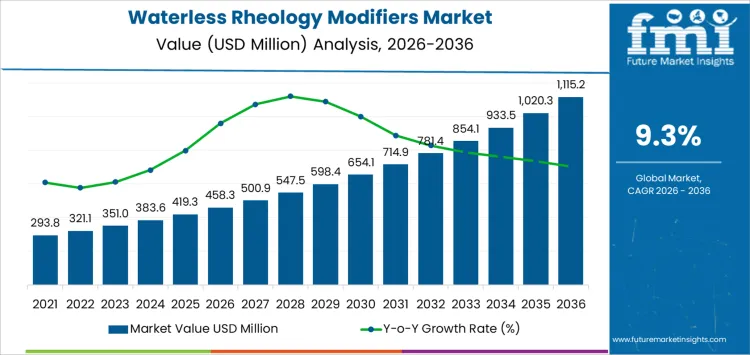
The waterless rheology modifiers market is expected to grow from USD 458.3 million in 2026 to USD 1,115.2 million by 2036, reflecting a compound annual growth rate (CAGR) of 9.3%. Waterless rheology modifiers are used in a variety of industries, including cosmetics, paints, and coatings, to adjust the flow properties of liquids without the use of water. These modifiers are increasingly popular due to their environmental benefits, as they contribute to more sustainable products by reducing water usage and improving product performance. With growing demand for eco-friendly and cost-effective formulations, industries are adopting waterless rheology modifiers to meet both regulatory requirements and consumer expectations for green products.
The market growth is also supported by the increasing use of waterless products in the personal care and home care sectors, where consumers are seeking formulations that offer high performance while minimizing water usage. The rising trend of sustainable and clean-label products across various consumer goods markets is expected to drive the adoption of waterless rheology modifiers, which provide a more efficient, environmentally friendly alternative to traditional ingredients. As the demand for sustainable solutions grows, the market for waterless rheology modifiers is projected to continue its expansion over the next decade.
Quick Stats of the Waterless Rheology Modifiers Market
- Waterless Rheology Modifiers Market Value (2026): USD 458.3 million
- Waterless Rheology Modifiers Market Forecast Value (2036): USD 1,115.2 million
- Waterless Rheology Modifiers Market Global Forecast CAGR (2026-2036): 9.3%
- Waterless Rheology Modifiers Market Leading Segment: Form Factor (Powders) 52%
- Key Growth Regions in Waterless Rheology Modifiers Market: China
- Top Players in Waterless Rheology Modifiers Market: Evonik, Cabot, BYK (ALTANA), BASF, Clariant, Elementis, Wacker Chemie, Ashland, Croda, Nouryon
What is the Growth Forecast for the Waterless Rheology Modifiers Market through 2036?
The compound annual growth rate (CAGR) analysis for the waterless rheology modifiers market shows consistent growth throughout the forecast period. Starting at USD 458.3 million in 2026, the market grows to USD 499.7 million in 2027 and USD 544.5 million in 2028. This initial phase reflects gradual adoption as industries increasingly prioritize waterless formulations to align with sustainability goals and enhance product performance. The market growth is supported by technological advancements that improve the efficacy and stability of waterless rheology modifiers in various applications.
Between 2028 and 2030, the market continues to expand, reaching USD 593.1 million in 2029 and USD 645.7 million in 2030. During this period, adoption accelerates as the benefits of these modifiers become more apparent in reducing environmental impact while improving product quality. From 2030 to 2035, the market experiences significant expansion, reaching USD 702.6 million in 2031, USD 764.2 million in 2032, and USD 830.7 million in 2033. By 2035, the market is projected to reach USD 902.7 million, with a final value of USD 1,115.2 million expected in 2036. This growth trajectory reflects the increasing demand for waterless products and the continued focus on sustainability and high-performance formulations across multiple industries.
Waterless Rheology Modifiers Market Key Takeaways
| Metric | Value |
|---|---|
| Industry Sales Value (2026) | USD 458.3 million |
| Industry Forecast Value (2036) | USD 1,115.2 million |
| Industry Forecast CAGR (2026-2036) | 9.3% |
What Is Driving the Demand for the Waterless Rheology Modifiers Market Globally?
The global demand for waterless rheology modifiers is being driven by growing interest in water free and low water formulations across personal care, cosmetics, coatings, adhesives, and industrial fluids. Rheology modifiers control flow, texture, and stability, and are essential for creating products with the desired viscosity, suspendability, and performance. Traditional modifiers often depend on water as a carrier or activation medium, but formulators face increasing pressure to reduce water content for sustainability, regulatory, and performance reasons. Water is a heavy, energy intensive component in many formulations, and reducing its use lowers transportation costs, shrinkage in packaging, and risk of microbial contamination. In cosmetics and personal care, waterless formats such as bars, balms, and concentrated serums are gaining popularity for their sensory quality, perceived efficacy, and convenience. In coatings and adhesives, waterless systems support fast curing, lower volatile organic compound (VOC) profiles, and improved stability in extreme conditions. The combined effect of consumer demand for eco friendly products, brand commitments to reduced water footprint, and cost pressures in supply chains has intensified interest in rheology modifiers that function effectively without water.
Future demand for waterless rheology modifiers is expected to grow as manufacturers continue to shift toward water reduction and high performance product portfolios. Advances in polymer chemistry, organoclay technologies, and novel thickeners will expand options that deliver precise control of flow and texture in water free matrices. As sustainability standards and regulatory frameworks increasingly encourage minimisation of water use, formulators will seek modifiers that support concentrated and anhydrous formulations while maintaining compatibility with diverse ingredients and production processes. Growth in premium personal care and specialty coatings segments will further boost uptake because waterless products often command higher margins and are positioned as innovative in performance and sustainability. Adoption will also be influenced by improvements in manufacturing techniques that integrate waterless platforms with existing lines without major capital changes. As global markets prioritise resource efficiency and product differentiation, demand for waterless rheology modifiers is expected to expand steadily across formulation categories where controlled rheology is a priority.
What are the Leading Segments in the Global Waterless Rheology Modifiers Market?
The global waterless rheology modifiers market is primarily segmented based on modifier type and form factor. Among the modifier types, fumed silica/silica aerogel powders hold the largest share, contributing to the overall market growth. Other modifier types such as organoclays/smectite-based thickeners, polyamide/hydrocarbon waxes, and cellulosic & bio-based powders also play important roles in market development but occupy smaller shares. On the form factor side, powders lead the market with a significant share, while other form factors such as granules/prills, pre-dispersions/pastes, and masterbatches also contribute to market diversity. The increasing demand for waterless formulations in industries like personal care, paints, coatings, and adhesives is driving growth across both modifier types and form factors.
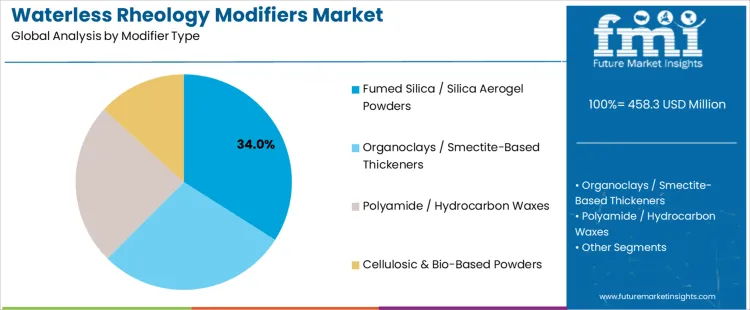
Fumed silica and silica aerogel powders are the leading modifier types in the waterless rheology modifiers market, owing to their ability to effectively control viscosity and improve the stability of waterless formulations. These modifiers are highly favored in industries such as personal care, paints, coatings, and adhesives for their excellent thickening and stabilizing properties. Fumed silica, in particular, is widely used for its efficiency in controlling flow and improving the texture of products without the need for water.
As the demand for waterless formulations continues to rise, driven by sustainability concerns and consumer preference for anhydrous products, fumed silica and silica aerogels are increasingly being incorporated into formulations across various industries. The growing preference for products with reduced water content, especially in personal care items like deodorants, moisturizers, and cleansers, contributes to the dominance of these modifiers. Furthermore, the unique characteristics of fumed silica, such as its high surface area and ability to provide structure to a wide range of product types, make it essential in creating stable and effective waterless products. The continued focus on environmentally friendly solutions and the shift towards sustainable product development will support the growth of fumed silica and silica aerogel powders in the global market.
What is Driving the Demand for Powders in the Waterless Rheology Modifiers Market?
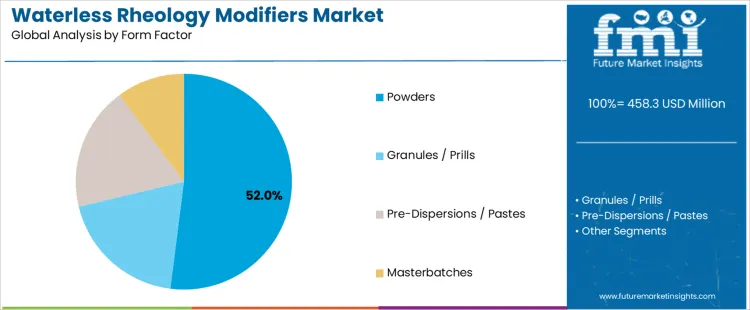
Powders, particularly fumed silica and silica aerogel powders, dominate the form factor segment of the waterless rheology modifiers market. Their large share is attributed to their versatility and effectiveness in waterless formulations. Powders offer several advantages, such as ease of handling, longer shelf life, and the ability to create stable, thickened formulations without requiring water. These qualities are particularly important in the personal care, cosmetics, and paints and coatings industries, where waterless formulations are gaining popularity for their convenience and long-term performance.
In the personal care industry, products like anhydrous deodorants, solid shampoos, and waterless cleansers are increasingly relying on powders for their ability to provide structure and maintain product efficacy without compromising performance. The powder form also allows for easy incorporation into various product types, ensuring a smooth and consistent application. Additionally, powders have been found to enhance the stability and texture of products, making them essential in industries that require precise control over viscosity and texture. The growing consumer preference for minimal water-based formulations and the trend towards sustainable, concentrated products are expected to continue driving the demand for powders in the global waterless rheology modifiers market. This trend will likely persist, reinforcing powders as a dominant form factor in the market.
What are the Key Dynamics of the Global Waterless Rheology Modifiers Market?
The global waterless rheology modifiers market is expanding as formulators in personal care, coatings, adhesives and specialty chemicals shift toward low moisture and solvent free systems. These modifiers control flow, texture and stability in formulations where water is limited or excluded, supporting product performance, application ease and shelf life. Growth reflects innovation in dry and high solids products that meet sustainability, VOC reduction and processing efficiency goals. Demand spans cosmetics, industrial coatings, printing inks and construction materials where precise rheological control enhances functionality and user experience worldwide.
What are the Key Drivers for the Global Waterless Rheology Modifiers Market?
Rising interest in solvent free, high efficiency formulations drives adoption of waterless rheology modifiers that improve suspension, thickening and leveling in low moisture systems. Regulatory pressure to reduce volatile organic compounds (VOCs) and environmental impact motivates use of dry additives that support cleaner manufacturing and end use profiles. Growth in personal care segments such as anhydrous skincare and stick products, where water can compromise stability, encourages formulators to integrate specialized modifiers. Industrial applications including powder coatings, solvent borne paints and high solids adhesives also benefit from modifiers that enable consistent viscosity and performance under diverse processing conditions.
What are the Restraints for the Global Waterless Rheology Modifiers Market?
One restraint is the technical complexity of designing rheology modifiers that deliver consistent performance in the absence of water, where dispersion and interaction with other ingredients require careful formulation. Some applications may need additional processing or equipment to integrate powders or solid modifiers uniformly, adding operational considerations. Higher cost of specialized waterless modifiers relative to conventional wet system additives can slow uptake in price sensitive markets. Formulators may require additional expertise and testing to optimize systems that rely on alternative thickening mechanisms. Limited awareness of waterless rheology options in certain industry segments also affects adoption pace.
What is the Key Trends in the Global Waterless Rheology Modifiers Market?
A key trend is development of tailored modifier chemistries that meet exact performance needs in specific anhydrous or low moisture applications, such as powders, solvent based coatings and solid personal care formats. Ingredient suppliers are focusing on multifunctional modifiers that offer thixotropy, shear thinning and enhanced suspension at lower loading levels. Collaboration between modifier manufacturers and end use formulators accelerates product development and helps establish best practice integration methods. Emphasis on sustainability and reduced processing waste supports innovation in dry and low VOC additive systems. Expansion of formulation toolkits and digital prediction models assists companies in selecting optimal rheology solutions for waterless products.
What is the Country-Wise Analysis of the Waterless Rheology Modifiers Market?
The waterless rheology modifiers market is projected to grow steadily across key regions, driven by increasing demand for sustainable, water-efficient formulations in industries such as personal care, cosmetics, coatings, and pharmaceuticals. Waterless rheology modifiers offer several benefits, including improved product performance and reduced environmental impact by eliminating the need for water in formulation processes. This market is seeing significant growth as industries move toward more eco-friendly solutions and better resource management. High-growth regions like China and the USA are driving the market due to their large manufacturing sectors and focus on sustainability, while Europe, including the UK and Germany, is also seeing steady adoption of waterless formulations due to regulatory pressures and growing consumer demand for green products.
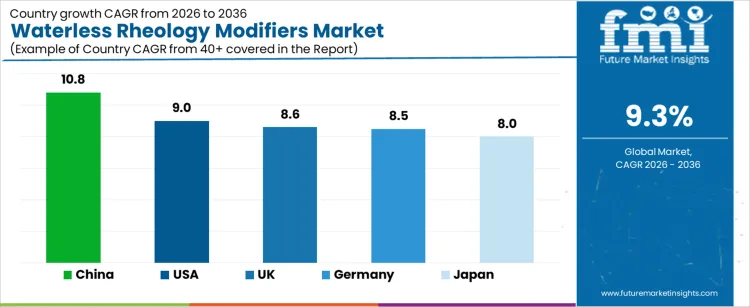
| Country | CAGR (2026-2036) |
|---|---|
| China | 10.8% |
| United States | 9% |
| United Kingdom | 8.6% |
| Germany | 8.5% |
| Japan | 8% |
What is the Growth Outlook for the Waterless Rheology Modifiers Market in China?
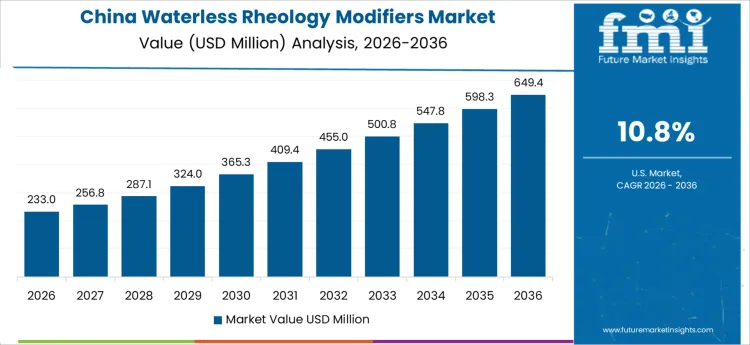
The waterless rheology modifiers market in China is expected to grow at the highest rate, with a projected CAGR of 10.8%. China’s rapidly expanding manufacturing sector, particularly in personal care, cosmetics, and coatings, is driving the demand for waterless formulations. As the country increasingly focuses on sustainable and eco-friendly solutions, waterless rheology modifiers are becoming a preferred choice for companies looking to improve product performance while reducing water usage and environmental impact. Additionally, China’s regulatory push toward sustainability in manufacturing and product formulations supports the rapid adoption of waterless products. As the market continues to grow, China is expected to lead the global demand for waterless rheology modifiers.
What is the Market Outlook for the Waterless Rheology Modifiers Market in the United States?
The waterless rheology modifiers market in the United States is expected to grow steadily, with a projected CAGR of 9%. As industries like personal care, cosmetics, and coatings in the U.S. increasingly prioritize sustainability and eco-friendly formulations, the demand for waterless rheology modifiers is rising. U.S. manufacturers are adopting waterless solutions to meet both regulatory requirements and consumer demand for greener products. Additionally, the growing emphasis on resource conservation, particularly water usage in production processes, is driving market adoption. With increased investment in research and development for waterless formulations, the U.S. market is set to continue growing at a strong pace in the coming years.
What is the Growth Forecast for the Waterless Rheology Modifiers Market in the United Kingdom?
The waterless rheology modifiers market in the United Kingdom is projected to grow at a moderate rate, with a projected CAGR of 8.6%. The UK’s focus on sustainability and eco-friendly products, combined with stringent environmental regulations, is encouraging the adoption of waterless formulations across various industries. The cosmetics and personal care sectors in particular are driving demand, as consumers seek high-performance, environmentally responsible products. The growing awareness of water conservation and environmental impact, combined with an increase in green product certifications and regulatory standards, is expected to continue driving the adoption of waterless rheology modifiers in the UK market.
What is the Market Outlook for the Waterless Rheology Modifiers Market in Germany?
The waterless rheology modifiers market in Germany is expected to grow at a steady pace, with a projected CAGR of 8.5%. Germany’s strong commitment to sustainability, combined with its advanced manufacturing and industrial sectors, is driving the demand for waterless formulations in the personal care, coatings, and pharmaceutical industries. The increasing regulatory focus on reducing water usage and environmental impact in the production of consumer products is also contributing to market growth. As the demand for green and sustainable products continues to rise, Germany is expected to see steady adoption of waterless rheology modifiers in various applications, particularly in industries with high regulatory standards.
What are the Growth Prospects for the Waterless Rheology Modifiers Market in Japan?
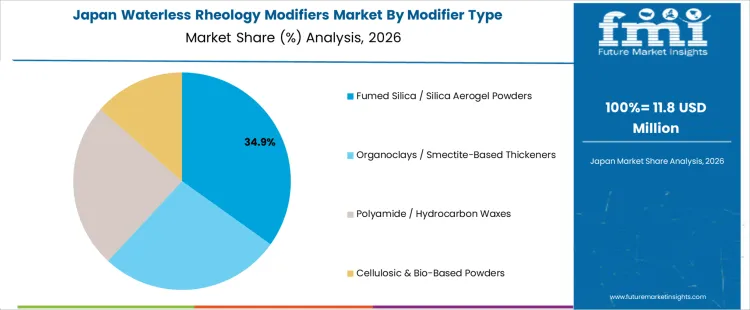
The waterless rheology modifiers market in Japan is expected to grow at a steady pace, with a projected CAGR of 8%. Japan’s well-established consumer goods and industrial sectors are increasingly focusing on sustainability, which is driving the demand for waterless formulations. The personal care and cosmetics industries, in particular, are adopting waterless rheology modifiers to meet both environmental goals and consumer demand for high-performance products. Additionally, Japan’s commitment to reducing resource consumption, especially water, in manufacturing processes supports the adoption of waterless technologies. As the market for sustainable products continues to expand, Japan’s demand for waterless rheology modifiers is expected to grow steadily.
What is the Competitive Landscape for the Waterless Rheology Modifiers Market?
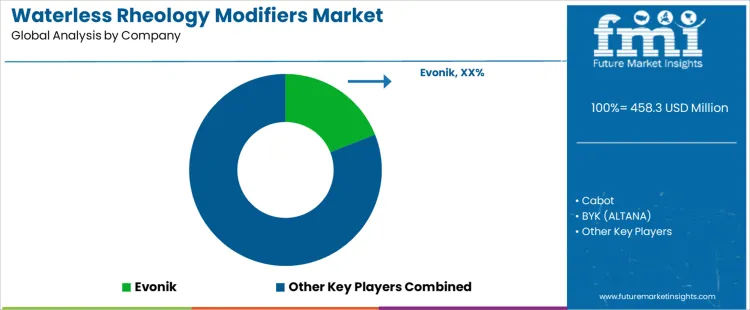
The waterless rheology modifiers market is experiencing growth as industries look for sustainable and efficient solutions to improve product texture and stability without relying on water-based systems. Evonik leads the market with its innovative waterless rheology modifiers, offering high-performance solutions that enhance the viscosity and flow properties of formulations, particularly in personal care and coatings. Their focus on sustainability and efficiency positions them as a market leader. Cabot, BYK (ALTANA), and BASF are significant competitors, each offering advanced rheology modifiers designed for waterless formulations. Cabot and BYK provide tailored solutions that cater to industries such as coatings and cosmetics, while BASF focuses on delivering reliable, high-performance modifiers that enhance product stability.
Clariant, Elementis, Wacker Chemie, Ashland, Croda, and Nouryon further contribute to the competitive landscape by offering a range of waterless rheology modifiers. Clariant and Elementis focus on providing sustainable and innovative rheology solutions for various industries, including personal care and industrial applications. Wacker Chemie and Ashland offer specialty products that improve product texture and stability in waterless systems. Croda focuses on developing eco-friendly rheology modifiers, while Nouryon offers solutions that improve the performance of waterless formulations, particularly in coatings and personal care. These companies compete through technological innovation, product sustainability, and the ability to meet the growing demand for waterless formulations that improve performance while reducing environmental impact.
Key Players of the Waterless Rheology Modifiers Market
- Evonik
- Cabot
- BYK (ALTANA)
- BASF
- Clariant
- Elementis
- Wacker Chemie
- Ashland
- Croda
- Nouryon
Scope of the Report
| Items | Values |
|---|---|
| Quantitative Units (2026) | USD Million |
| Modifier Type | Fumed Silica / Silica Aerogel Powders, Organoclays / Smectite-Based Thickeners, Polyamide / Hydrocarbon Waxes, Cellulosic & Bio-Based Powders |
| Form Factor | Powders, Granules / Prills, Pre-Dispersions / Pastes, Masterbatches |
| End Use | Waterless Skin Care (Balms, Sticks), Color Cosmetics (Anhydrous), Solid Deodorants, Hair Styling Waxes & Pomades |
| Primary Function | Viscosity Build & Structuring, Suspension / Anti-Settling, Texture / Sensory Tuning, Heat & Shear Stability |
| Companies | Evonik, Cabot, BYK (ALTANA), BASF, Clariant, Elementis, Wacker Chemie, Ashland, Croda, Nouryon |
| Regions Covered | North America, Latin America, Western Europe, Eastern Europe, South Asia and Pacific, East Asia, Middle East & Africa |
| Countries Covered | United States, Canada, Mexico, Brazil, Argentina, Germany, France, United Kingdom, Italy, Spain, Netherlands, China, India, Japan, South Korea, ANZ, GCC Countries, South Africa |
| Additional Attributes | Dollar by sales by modifier type, form factor, end-use, primary function, and region. Includes market trends in waterless rheology modifiers, focusing on fumed silica, organoclays, polyamide waxes, and cellulosic powders. Highlights the role of viscosity build, suspension, texture, and stability in personal care products like skin care, cosmetics, deodorants, and hair styling products. Focus on sustainability, cost-effectiveness, regulatory compliance, market share, and competitive positioning of key companies in the market. |
Waterless Rheology Modifiers Market Segmentation
Modifier Type:
- Fumed Silica / Silica Aerogel Powders
- Organoclays / Smectite-Based Thickeners
- Polyamide / Hydrocarbon Waxes
- Cellulosic & Bio-Based Powders
Form Factor:
- Powders
- Granules / Prills
- Pre-Dispersions / Pastes
- Masterbatches
End Use:
- Waterless Skin Care (balms, sticks)
- Color Cosmetics (anhydrous)
- Solid Deodorants
- Hair Styling Waxes & Pomades
Primary Function:
- Viscosity Build & Structuring
- Suspension / Anti-Settling
- Texture / Sensory Tuning
- Heat & Shear Stability
Region:
- Asia Pacific
- China
- Japan
- South Korea
- India
- Australia & New Zealand
- ASEAN
- Rest of Asia Pacific
- Europe
- Germany
- United Kingdom
- France
- Italy
- Spain
- Nordic
- BENELUX
- Rest of Europe
- North America
- United States
- Canada
- Mexico
- Latin America
- Brazil
- Chile
- Rest of Latin America
- Middle East & Africa
- Kingdom of Saudi Arabia
- Other GCC Countries
- Turkey
- South Africa
- Other African Union
- Rest of Middle East & Africa
Frequently Asked Questions
How big is the waterless rheology modifiers market in 2026?
The global waterless rheology modifiers market is estimated to be valued at USD 458.3 million in 2026.
What will be the size of waterless rheology modifiers market in 2036?
The market size for the waterless rheology modifiers market is projected to reach USD 1,115.2 million by 2036.
How much will be the waterless rheology modifiers market growth between 2026 and 2036?
The waterless rheology modifiers market is expected to grow at a 9.3% CAGR between 2026 and 2036.
What are the key product types in the waterless rheology modifiers market?
The key product types in waterless rheology modifiers market are fumed silica / silica aerogel powders, organoclays / smectite-based thickeners, polyamide / hydrocarbon waxes and cellulosic & bio-based powders.
Which form factor segment to contribute significant share in the waterless rheology modifiers market in 2026?
In terms of form factor, powders segment to command 52.0% share in the waterless rheology modifiers market in 2026.
Preview the report firsthand - request a free sample
Get SampleGet the brochure for pricing and purchase details.
Get PDFTable of Content
- Executive Summary
- Global Market Outlook
- Demand-side Trends
- Supply-side Trends
- Technology Roadmap Analysis
- Analysis and Recommendations
- Market Overview
- Market Coverage / Taxonomy
- Market Definition / Scope / Limitations
- Market Background
- Market Dynamics
- Drivers
- Restraints
- Opportunity
- Trends
- Scenario Forecast
- Demand in Optimistic Scenario
- Demand in Likely Scenario
- Demand in Conservative Scenario
- Opportunity Map Analysis
- Product Life Cycle Analysis
- Supply Chain Analysis
- Investment Feasibility Matrix
- Value Chain Analysis
- PESTLE and Porter’s Analysis
- Regulatory Landscape
- Regional Parent Market Outlook
- Production and Consumption Statistics
- Import and Export Statistics
- Market Dynamics
- Global Market Analysis 2021 to 2025 and Forecast, 2026 to 2036
- Historical Market Size Value (USD Million) Analysis, 2021 to 2025
- Current and Future Market Size Value (USD Million) Projections, 2026 to 2036
- Y-o-Y Growth Trend Analysis
- Absolute $ Opportunity Analysis
- Global Market Pricing Analysis 2021 to 2025 and Forecast 2026 to 2036
- Global Market Analysis 2021 to 2025 and Forecast 2026 to 2036, By Modifier Type
- Introduction / Key Findings
- Historical Market Size Value (USD Million) Analysis By Modifier Type , 2021 to 2025
- Current and Future Market Size Value (USD Million) Analysis and Forecast By Modifier Type , 2026 to 2036
- Fumed Silica / Silica Aerogel Powders
- Organoclays / Smectite-Based Thickeners
- Polyamide / Hydrocarbon Waxes
- Cellulosic & Bio-Based Powders
- Y-o-Y Growth Trend Analysis By Modifier Type , 2021 to 2025
- Absolute $ Opportunity Analysis By Modifier Type , 2026 to 2036
- Global Market Analysis 2021 to 2025 and Forecast 2026 to 2036, By Form Factor
- Introduction / Key Findings
- Historical Market Size Value (USD Million) Analysis By Form Factor, 2021 to 2025
- Current and Future Market Size Value (USD Million) Analysis and Forecast By Form Factor, 2026 to 2036
- Powders
- Granules / Prills
- Pre-Dispersions / Pastes
- Masterbatches
- Y-o-Y Growth Trend Analysis By Form Factor, 2021 to 2025
- Absolute $ Opportunity Analysis By Form Factor, 2026 to 2036
- Global Market Analysis 2021 to 2025 and Forecast 2026 to 2036, By End Use
- Introduction / Key Findings
- Historical Market Size Value (USD Million) Analysis By End Use, 2021 to 2025
- Current and Future Market Size Value (USD Million) Analysis and Forecast By End Use, 2026 to 2036
- Waterless Skin Care (balms, sticks)
- Color Cosmetics (anhydrous)
- Solid Deodorants
- Hair Styling Waxes & Pomades
- Y-o-Y Growth Trend Analysis By End Use, 2021 to 2025
- Absolute $ Opportunity Analysis By End Use, 2026 to 2036
- Global Market Analysis 2021 to 2025 and Forecast 2026 to 2036, By Primary Function
- Introduction / Key Findings
- Historical Market Size Value (USD Million) Analysis By Primary Function, 2021 to 2025
- Current and Future Market Size Value (USD Million) Analysis and Forecast By Primary Function, 2026 to 2036
- Viscosity Build & Structuring
- Suspension / Anti-Settling
- Texture / Sensory Tuning
- Heat & Shear Stability
- Y-o-Y Growth Trend Analysis By Primary Function, 2021 to 2025
- Absolute $ Opportunity Analysis By Primary Function, 2026 to 2036
- Global Market Analysis 2021 to 2025 and Forecast 2026 to 2036, By Region
- Introduction
- Historical Market Size Value (USD Million) Analysis By Region, 2021 to 2025
- Current Market Size Value (USD Million) Analysis and Forecast By Region, 2026 to 2036
- North America
- Latin America
- Western Europe
- Eastern Europe
- East Asia
- South Asia and Pacific
- Middle East & Africa
- Market Attractiveness Analysis By Region
- North America Market Analysis 2021 to 2025 and Forecast 2026 to 2036, By Country
- Historical Market Size Value (USD Million) Trend Analysis By Market Taxonomy, 2021 to 2025
- Market Size Value (USD Million) Forecast By Market Taxonomy, 2026 to 2036
- By Country
- USA
- Canada
- Mexico
- By Modifier Type
- By Form Factor
- By End Use
- By Primary Function
- By Country
- Market Attractiveness Analysis
- By Country
- By Modifier Type
- By Form Factor
- By End Use
- By Primary Function
- Key Takeaways
- Latin America Market Analysis 2021 to 2025 and Forecast 2026 to 2036, By Country
- Historical Market Size Value (USD Million) Trend Analysis By Market Taxonomy, 2021 to 2025
- Market Size Value (USD Million) Forecast By Market Taxonomy, 2026 to 2036
- By Country
- Brazil
- Chile
- Rest of Latin America
- By Modifier Type
- By Form Factor
- By End Use
- By Primary Function
- By Country
- Market Attractiveness Analysis
- By Country
- By Modifier Type
- By Form Factor
- By End Use
- By Primary Function
- Key Takeaways
- Western Europe Market Analysis 2021 to 2025 and Forecast 2026 to 2036, By Country
- Historical Market Size Value (USD Million) Trend Analysis By Market Taxonomy, 2021 to 2025
- Market Size Value (USD Million) Forecast By Market Taxonomy, 2026 to 2036
- By Country
- Germany
- UK
- Italy
- Spain
- France
- Nordic
- BENELUX
- Rest of Western Europe
- By Modifier Type
- By Form Factor
- By End Use
- By Primary Function
- By Country
- Market Attractiveness Analysis
- By Country
- By Modifier Type
- By Form Factor
- By End Use
- By Primary Function
- Key Takeaways
- Eastern Europe Market Analysis 2021 to 2025 and Forecast 2026 to 2036, By Country
- Historical Market Size Value (USD Million) Trend Analysis By Market Taxonomy, 2021 to 2025
- Market Size Value (USD Million) Forecast By Market Taxonomy, 2026 to 2036
- By Country
- Russia
- Poland
- Hungary
- Balkan & Baltic
- Rest of Eastern Europe
- By Modifier Type
- By Form Factor
- By End Use
- By Primary Function
- By Country
- Market Attractiveness Analysis
- By Country
- By Modifier Type
- By Form Factor
- By End Use
- By Primary Function
- Key Takeaways
- East Asia Market Analysis 2021 to 2025 and Forecast 2026 to 2036, By Country
- Historical Market Size Value (USD Million) Trend Analysis By Market Taxonomy, 2021 to 2025
- Market Size Value (USD Million) Forecast By Market Taxonomy, 2026 to 2036
- By Country
- China
- Japan
- South Korea
- By Modifier Type
- By Form Factor
- By End Use
- By Primary Function
- By Country
- Market Attractiveness Analysis
- By Country
- By Modifier Type
- By Form Factor
- By End Use
- By Primary Function
- Key Takeaways
- South Asia and Pacific Market Analysis 2021 to 2025 and Forecast 2026 to 2036, By Country
- Historical Market Size Value (USD Million) Trend Analysis By Market Taxonomy, 2021 to 2025
- Market Size Value (USD Million) Forecast By Market Taxonomy, 2026 to 2036
- By Country
- India
- ASEAN
- Australia & New Zealand
- Rest of South Asia and Pacific
- By Modifier Type
- By Form Factor
- By End Use
- By Primary Function
- By Country
- Market Attractiveness Analysis
- By Country
- By Modifier Type
- By Form Factor
- By End Use
- By Primary Function
- Key Takeaways
- Middle East & Africa Market Analysis 2021 to 2025 and Forecast 2026 to 2036, By Country
- Historical Market Size Value (USD Million) Trend Analysis By Market Taxonomy, 2021 to 2025
- Market Size Value (USD Million) Forecast By Market Taxonomy, 2026 to 2036
- By Country
- Kingdom of Saudi Arabia
- Other GCC Countries
- Turkiye
- South Africa
- Other African Union
- Rest of Middle East & Africa
- By Modifier Type
- By Form Factor
- By End Use
- By Primary Function
- By Country
- Market Attractiveness Analysis
- By Country
- By Modifier Type
- By Form Factor
- By End Use
- By Primary Function
- Key Takeaways
- Key Countries Market Analysis
- USA
- Pricing Analysis
- Market Share Analysis, 2025
- By Modifier Type
- By Form Factor
- By End Use
- By Primary Function
- Canada
- Pricing Analysis
- Market Share Analysis, 2025
- By Modifier Type
- By Form Factor
- By End Use
- By Primary Function
- Mexico
- Pricing Analysis
- Market Share Analysis, 2025
- By Modifier Type
- By Form Factor
- By End Use
- By Primary Function
- Brazil
- Pricing Analysis
- Market Share Analysis, 2025
- By Modifier Type
- By Form Factor
- By End Use
- By Primary Function
- Chile
- Pricing Analysis
- Market Share Analysis, 2025
- By Modifier Type
- By Form Factor
- By End Use
- By Primary Function
- Germany
- Pricing Analysis
- Market Share Analysis, 2025
- By Modifier Type
- By Form Factor
- By End Use
- By Primary Function
- UK
- Pricing Analysis
- Market Share Analysis, 2025
- By Modifier Type
- By Form Factor
- By End Use
- By Primary Function
- Italy
- Pricing Analysis
- Market Share Analysis, 2025
- By Modifier Type
- By Form Factor
- By End Use
- By Primary Function
- Spain
- Pricing Analysis
- Market Share Analysis, 2025
- By Modifier Type
- By Form Factor
- By End Use
- By Primary Function
- France
- Pricing Analysis
- Market Share Analysis, 2025
- By Modifier Type
- By Form Factor
- By End Use
- By Primary Function
- India
- Pricing Analysis
- Market Share Analysis, 2025
- By Modifier Type
- By Form Factor
- By End Use
- By Primary Function
- ASEAN
- Pricing Analysis
- Market Share Analysis, 2025
- By Modifier Type
- By Form Factor
- By End Use
- By Primary Function
- Australia & New Zealand
- Pricing Analysis
- Market Share Analysis, 2025
- By Modifier Type
- By Form Factor
- By End Use
- By Primary Function
- China
- Pricing Analysis
- Market Share Analysis, 2025
- By Modifier Type
- By Form Factor
- By End Use
- By Primary Function
- Japan
- Pricing Analysis
- Market Share Analysis, 2025
- By Modifier Type
- By Form Factor
- By End Use
- By Primary Function
- South Korea
- Pricing Analysis
- Market Share Analysis, 2025
- By Modifier Type
- By Form Factor
- By End Use
- By Primary Function
- Russia
- Pricing Analysis
- Market Share Analysis, 2025
- By Modifier Type
- By Form Factor
- By End Use
- By Primary Function
- Poland
- Pricing Analysis
- Market Share Analysis, 2025
- By Modifier Type
- By Form Factor
- By End Use
- By Primary Function
- Hungary
- Pricing Analysis
- Market Share Analysis, 2025
- By Modifier Type
- By Form Factor
- By End Use
- By Primary Function
- Kingdom of Saudi Arabia
- Pricing Analysis
- Market Share Analysis, 2025
- By Modifier Type
- By Form Factor
- By End Use
- By Primary Function
- Turkiye
- Pricing Analysis
- Market Share Analysis, 2025
- By Modifier Type
- By Form Factor
- By End Use
- By Primary Function
- South Africa
- Pricing Analysis
- Market Share Analysis, 2025
- By Modifier Type
- By Form Factor
- By End Use
- By Primary Function
- USA
- Market Structure Analysis
- Competition Dashboard
- Competition Benchmarking
- Market Share Analysis of Top Players
- By Regional
- By Modifier Type
- By Form Factor
- By End Use
- By Primary Function
- Competition Analysis
- Competition Deep Dive
- Evonik
- Overview
- Product Portfolio
- Profitability by Market Segments (Product/Age /Sales Channel/Region)
- Sales Footprint
- Strategy Overview
- Marketing Strategy
- Product Strategy
- Channel Strategy
- Cabot
- BYK (ALTANA)
- BASF
- Clariant
- Elementis
- Wacker Chemie
- Ashland
- Croda
- Nouryon
- Evonik
- Competition Deep Dive
- Assumptions & Acronyms Used
- Research Methodology


