

- Market Size (2026)
- USD 720.7 Mn
- Forecast (2036)
- USD 1290.7 Mn
- CAGR (2026 to 2036)
- 6.0%
How big is Melt Flow Index (MFI) Modifiers Market in 2026?
USD 720.7 million in 2026 and USD 1290.7 million by 2036 at a 6.0% CAGR.
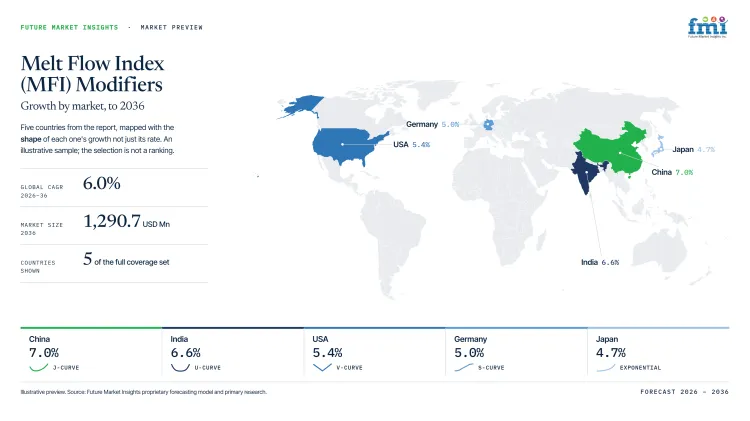
Sales of melt flow index (MFI) modifiers are estimated to rise at 6.0% CAGR through 2036, increasing valuation from USD 720.7 million in 2026 to USD 1290.7 million by 2036. More recycled resin enters plastic packaging formats that require stable flow during established molding and extrusion cycles. Regulation (EU) 2025/40 sets a 35% recycled-content minimum from 2030 for other plastic packaging outside its listed lower-threshold categories. Rheology modifiers earn repeat use once processors return variable resin to a validated processing window without unacceptable property loss.
Country paths differ as recycled-plastic obligations meet collection systems and qualification routines that change how quickly compounders approve packaging formulations. Germany's Environment Agency reported in January 2025 that material recycling of plastic packaging reached 68.9% in 2023, so processors face formulation-control work even in a mature recovery system. South Korea's 5.8% forecast follows a newer recycled-PET mandate, whereas Germany's 5.0% outlook reflects an established system with tighter qualification evidence.
-modifiers-market-value-analysis.webp "Melt Flow Index (mfi) Modifiers Market Value Analysis")
Key Takeaways of Melt Flow Index (MFI) Modifiers Market
- Demand increases as compounders use modifiers to return variable recycled resin to a qualified melt-flow or melt-strength window.
- Based on modifier type, peroxide-based modifiers are projected to account for 29.0% in 2026 due to dose-responsive control of polypropylene chain scission.
- In 2026, polypropylene is expected to lead the polymer category with 34.0% share because controlled degradation lets compounders tune melt flow across grades.
- MFI increase is likely to capture 27.0% share in 2026 attributable to direct correction of filling pressure and extrusion resistance.
- Feedstock contamination and polymer incompatibility can cap modifier effectiveness when sorting quality leaves a formulation outside a stable property window.
- Active companies include Arkema S.A., BASF SE, BYK-Chemie GmbH, L. Brüggemann GmbH & Co. KG, Clariant AG, SI Group, Inc., Gabriel-Chemie Gesellschaft m.b.H. and Avient Corporation.
Analyst Perspective
"Processors should compare modifiers by the dose needed to reach the target MFI and the property loss measured after adjustment. Commercial value comes from repeatable rheology control across changing recyclate lots, especially when local testing shortens requalification without forcing a new base-resin grade."
- Nikhil Kaitwade, Principal Consultant, Future Market Insights
How is the Melt Flow Index (MFI) Modifiers Market segmented?
The market is assessed by modifier type, polymer, function, application and sales channel.
Modifier types include peroxide-based modifiers, chain extenders, reactive compatibilizers, viscosity reducers and flow promoter masterbatches. Polymers include polypropylene, polyethylene, polyesters, polyamides and recycled polyolefins. Functions include MFI increase, MFI reduction or rebuilding, molecular weight control, recycled resin stabilization and processability improvement. Applications include injection molding compounds, film extrusion, fiber or nonwoven, cable compounds and recycled plastics. Sales channels include compounders, recyclers, direct resin producers and additive distributors.
What makes peroxide-based modifiers central to the modifier type category?
-modifiers-market-analysis-by-product-type.webp "Melt Flow Index (mfi) Modifiers Market Analysis By Product Type")
Peroxide-based modifiers suit polypropylene processing that needs higher melt flow without replacing the base resin. Excessive dosage can raise flow and weaken the finished compound, so processors validate radical-driven chain scission against impact strength and color.
- By modifier type, peroxide-based modifiers are estimated to hold 29.0% in 2026 owing to dose-responsive control of polypropylene rheology.
- Regional supply matters during qualification as plants need the same reactive chemistry across repeated trials. Arkema reported in March 2025 that its Changshu organic-peroxide capacity had been expanded 2.5-fold, marking the site's 20th anniversary. Repeat purchases therefore depend on a dose curve that remains reproducible across commercial production lots.
Why does polypropylene lead the polymer category?
Chain scission can increase polypropylene melt flow during extrusion, giving compounders a direct controlled-rheology route. Recycled polypropylene also brings variable thermal history that makes repeatable rheology correction more valuable across qualified plastic compounding formulations. Plastics Recyclers Europe reported in April 2025 that EU27+3 installed polypropylene recycling capacity reached 1.8 million tonnes in 2023.
- Polypropylene is set to lead the polymer category with 34.0% share in 2026 due to use across compounding and conversion.
- Compounders purchase a modifier once fillers or recyclate push the base grade outside its validated flow window. Application testing determines whether the adjusted resin preserves impact strength and dimensional performance.
How does MFI increase define the leading function category?
MFI increase corrects processing resistance for compounders that compare the starting flow rate against the filling or extrusion window required by equipment and finished-part specifications.
- The function category is forecast to be led by MFI increase at 27.0% share in 2026 due to direct control of processing resistance.
- Automotive recycled-content rules add more recycled compounds to validation workloads across high-volume automotive component molding programs. The Council of the EU adopted rules in June 2026 requiring at least 15% recycled plastic in new vehicles after six years without prescribing MFI modifiers across automotive supply chains.
What supports injection molding compounds in the application category?
Injection molding exposes melt-flow variation quickly as a compound must fill the tool within a narrow pressure and cooling window. BASF reported in October 2025 that recycled PA6 from two recycling routes passed component validation in Mercedes-Benz applications, showing why recycled engineering compounds need process properties verified on production parts.
- By application, injection molding compounds are forecast to represent 28.0% in 2026 driven by direct dependence on stable cavity filling.
- Modifier use begins once recyclate or filler changes viscosity enough to disrupt the grade selected for a tool. Adoption depends on restoring fill behavior without sacrificing impact strength or dimensional stability during repeat production.
What are the drivers, restraints and opportunities in the Melt Flow Index (MFI) Modifiers Market?
Recycled-resin variability increases demand for flow correction while feedstock quality limits modifier effectiveness and application testing shortens the route to qualification.
- Driver: Higher recycled-resin use increases the frequency of viscosity correction across extrusion and molding formulations.
- Restraint: Poor sorting can leave contamination or incompatible polymers that a rheology modifier cannot correct without broader formulation changes.
- Opportunity: Application laboratories can reduce qualification work by connecting dosage response with feedstock variation and finished-part requirements.
Recovered Resin Raises Flow-Correction Work
Recycled PET remains a substantial recovery stream, with NAPCOR reporting in June 2026 that 264 million pounds of PET thermoforms were collected during 2024 across the United States and Canada. Prior heat exposure can reduce intrinsic viscosity across those recovered lots, making flow correction a recurring formulation task for compounders. Chain extenders or flow modifiers earn repeat orders once they restore a consistent processing window without forcing a change in the base resin.
Feedstock Quality Limits Modifier Effectiveness
A rheology modifier cannot repair contamination or polymer incompatibility outside its chemical response window, so unstable feedstock can erase an otherwise measurable melt-flow improvement during commercial qualification at production scale. Plastics Recyclers Europe reported in April 2025 that only 42% of collected rigid polyolefin waste was sorted into recyclable material, forcing compounders to qualify feedstock quality before modifier dosage selection.
Application Testing Can Shorten Qualification
Application support reduces trial cost for compounders comparing dosage against feedstock variation and finished-part limits ahead of formulation release. Regional laboratories can document the response on representative material before a plant allocates valuable production time to a line trial. SI Group opened its European Innovation Centre in October 2025 with plastics application-development and analytical-characterization equipment for this type of formulation work.
Which country CAGRs are profiled in the Melt Flow Index (MFI) Modifiers Market?
| Country | CAGR |
|---|---|
| South Korea | 5.8% |
| Mexico | 5.7% |
| USA | 5.4% |
| Germany | 5.0% |
| Japan | 4.7% |
How do country-level CAGRs compare in the Melt Flow Index (MFI) Modifiers Market?
The 1.1 percentage-point spread forms a close upper pair in South Korea and Mexico above three qualification-led markets. The narrow distribution reflects different routes to recycled-resin use rather than current revenue scale. Collection quality changes trial stability across countries, while technical support determines how quickly a validated dosage becomes a recurring order.
- South Korea ties recycled-PET mandates to bottle-grade viscosity control for major beverage producers.
- Mexico combines recycled-content targets with uneven packaging feedstock quality across collection routes.
- USA compounders navigate state rules and customer-specific qualification across multiple packaging applications.
- Germany demands detailed recyclability records and property-retention evidence during formulation changes.
- Japan rewards reproducible dosage data before plants replace already qualified resin grades.
Comparable CAGRs therefore require different chemistry portfolios and technical-service models across these countries. The full report provides country-level CAGR analysis across North America, Latin America, Europe, East Asia, South Asia, Oceania and the Middle East and Africa.
Country-wise Analysis
- South Korea's Ministry of Environment set a 10% recycled-content requirement from January 2026 for beverage producers using at least five thousand tonnes of clear PET bottles annually. Melt flow index modifier demand in South Korea is forecast to rise at 5.8% CAGR over the forecast period, supported by repeated viscosity rebuilding in bottle-grade recycled PET. Domestic PET expertise and high-volume preform production give additive companies local laboratories and commercial lines for repeat qualification across bottle compounds. Food-contact certification and intrinsic-viscosity retention remain the main frictions, so repeat orders depend on documented dosage windows and local testing across changing recycled feedstock.
- Mexican packaging converters use recycled resin from collection routes with uneven contamination, making one standard modifier dosage unreliable across domestic and export-oriented packaging programs. Mexico is estimated to post 5.7% CAGR over the forecast period, aided by established masterbatch distribution and compounding support near major packaging corridors linked to North American customers. Semarnat reported in September 2025 that participants in the national plastics agreement averaged 24% post-consumer recycled content in new packaging. Established masterbatch distributors and compounders near major packaging corridors can run local trials for North American customer specifications. Variable feedstock quality keeps compatibilization guidance central to repeat orders because flow correction alone cannot stabilize incompatible recycled-polymer blends.
- US PET bottle compounders work across state-specific recycled-content rules and brand specifications, so one formulation can require separate approval across packaging programs at separate plant locations. NAPCOR reported in December 2025 that average recycled PET content in US bottles reached 15.9% during 2024 across the national bottle stream. Independent compounders and technical laboratories make line trials accessible for food-contact packaging and durable-goods formulations that need measured flow correction in major converting regions. Melt flow index modifier sales in the USA are forecast to expand at 5.4% CAGR by 2036, supported by broad distributor coverage despite customer-specific mechanical and regulatory checks.
- German compounders work inside a mature recovery system where Umweltbundesamt reported in March 2026 that 52.2% of plastic packaging was recycled during 2023. The recovered-material base gives processors steady access to recyclate for qualification across packaging and technical compounds with established laboratory controls in major processing regions nationwide. The German melt flow index modifiers sector is projected to record 5.0% CAGR during the assessment period, shaped by experienced polymer processors and recycling infrastructure. Detailed recyclability records and property-retention evidence remain necessary before plants approve chain extenders or flow modifiers for repeated production across changing recyclate lots and customer specifications.
- Japanese processors favor controlled formulation changes because appearance or mechanical-property drift can delay replacement of an already qualified resin grade. Adoption of melt flow index modifiers in Japan is estimated to expand at 4.7% CAGR through 2036, reinforced by capable resin and converter laboratories. Local qualification teams compare dose-response data with existing production standards before approving repeated commercial use at each plant. The Ministry of the Environment selected eight advanced plastic-circulation demonstration projects in August 2025 across collection and recycling routes. Conservative change control still requires consistent additive quality, so modifier companies need reproducible rheology data across repeated packaging and engineering-plastics campaigns.
Who are the notable companies in the Melt Flow Index (MFI) Modifiers Market?
Arkema S.A., BASF SE, BYK-Chemie GmbH, L. Brüggemann GmbH & Co. KG, Clariant AG, SI Group, Inc., Gabriel-Chemie Gesellschaft m.b.H. and Avient Corporation are the notable companies profiled in this market.
-modifiers-market-analysis-by-company.webp "Melt Flow Index (mfi) Modifiers Market Analysis By Company")
The competitive field spans reactive chemistry plus specialized processing routes and additive platforms that address different parts of melt-flow control. Masterbatch producers compete on dosing simplicity while chemistry specialists compete on polymer-specific response and property retention. Entry depends on safe dosage data and application trials that preserve finished-part requirements during commercial qualification.
- Reactive modifier specialists include Arkema S.A., BASF SE, BYK-Chemie GmbH and L. Brüggemann GmbH & Co. KG.
- Converter-ready processing suppliers include Clariant AG, Gabriel-Chemie Gesellschaft m.b.H. and Avient Corporation.
- SI Group, Inc. competes through broader plastics-additive development and regional distribution support.
Competitive Benchmarking: Melt Flow Index (MFI) Modifiers Market
| Company | Reactive Flow Control | Recycled-Resin Fit | Converter-Ready Delivery | Geographic Reach |
|---|---|---|---|---|
| Arkema S.A. | High | Unscored | Unscored | Global |
| BASF SE | Unscored | Medium | Unscored | Global |
| BYK-Chemie GmbH | High | High | Medium | Europe, North America and Asia |
| L. Brüggemann GmbH & Co. KG | Medium | High | Unscored | Global |
| Clariant AG | Medium | Unscored | High | Global |
| SI Group, Inc. | Unscored | Unscored | Medium | Americas, Europe and Asia |
| Gabriel-Chemie Gesellschaft m.b.H. | Medium | Unscored | High | Europe, Africa and international sales |
| Avient Corporation | Medium | Medium | Medium | Global |
Key Developments in the Melt Flow Index (MFI) Modifiers Market
- In May 2026, Gabriel-Chemie introduced PFAS- and silicone-free PPA masterbatches for extrusion with polyethylene and polypropylene carrier options.
- In January 2026, SI Group's Azelis plastics-additive distribution partnership took effect across specified EMEA countries and expanded local technical coverage.
- In June 2025, Clariant launched PFAS-free AddWorks PPA grades for polyolefin extrusion with resin-concentrate and masterbatch dosing routes.
Key Players in the Melt Flow Index (MFI) Modifiers Market
Reactive Chemistry and Modifier Specialists
- Arkema S.A.
- BASF SE
- BYK-Chemie GmbH
- L. Brüggemann GmbH & Co. KG
Processing-Aid and Masterbatch Suppliers
- Clariant AG
- Gabriel-Chemie Gesellschaft m.b.H.
- Avient Corporation
Broad Plastics-Additive Platform
- SI Group, Inc.
Melt Flow Index (MFI) Modifiers Market - Report Scope
| Coverage field | Report scope |
|---|---|
| Market breakdown | By modifier type, polymer, function, application, sales channel and region. |
| Quantitative Units | Revenue in USD million and CAGR in %. |
| Market Definition | Commercial additives used to raise, reduce or stabilize polymer melt flow or molecular weight across virgin and recycled resin processing. |
| Regions Covered | North America, Latin America, Europe, East Asia, South Asia and Pacific, and Middle East and Africa. |
| Countries Covered | South Korea, Mexico, USA, Germany, Japan, and 20+ countries included in the full report. |
| Key Companies Profiled | Arkema S.A., BASF SE, BYK-Chemie GmbH, L. Brüggemann GmbH & Co. KG, Clariant AG, SI Group, Inc., Gabriel-Chemie Gesellschaft m.b.H. and Avient Corporation. |
| Forecast Period | 2026 to 2036. |
| Approach | Primary and secondary research with market triangulation. |
Melt Flow Index (MFI) Modifiers Market - Research Methodology
| Method | Approach |
|---|---|
| Primary Research | FMI analysts gathered input from manufacturers, service providers, technology developers, distributors, end users, procurement teams, and subject-matter experts. Interviews examined purchasing decisions, product or service evaluation, adoption barriers, approval requirements, pricing considerations, and expectations for technical or commercial support. Respondents were also asked what evidence is required before a trial, pilot, or initial order develops into regular purchasing. |
| Desk Research | Desk research covered government statistics, regulatory publications, trade data, industry associations, technical literature, standards, company filings, product information, and official corporate announcements. Sources were reviewed for relevance, publication date, geographic coverage, and consistency with the defined market scope. Claims relating to performance, applications, approvals, capacity, investment, and commercial activity were retained only when supported by credible public evidence. |
| Market Sizing and Forecasting | The market model combined the baseline value with historical performance, segment structure, pricing and volume indicators, adoption levels, company participation, and country-level demand conditions. Forecast assumptions considered economic activity, investment trends, regulatory developments, technology adoption, purchasing cycles, supply availability, and barriers to wider market use. Segment and regional estimates were reconciled before the final market total was calculated. |
| Data Validation | Estimates were checked against multiple independent indicators, including public data, company activity, trade patterns, industry developments, and findings from primary interviews. Validation also tested whether products, services, applications, and company revenues fell within the defined market boundaries. Adjacent categories, unsupported claims, overlapping revenues, and activities without direct market relevance were excluded to reduce double counting and maintain consistency across segments and countries. |
Research Sources and Bibliography
- European Parliament and Council of the European Union. (2025, January 22). Regulation (EU) 2025/40 of the European Parliament and of the Council of 19 December 2024 on packaging and packaging waste, amending Regulation (EU) 2019/1020 and Directive (EU) 2019/904, and repealing Directive 94/62/EC.
- Umweltbundesamt. (2025, January 21). Verpackungsrecycling gelingt nur mit richtiger Mülltrennung.
- Arkema China. (2025, March 28). Arkema's Changshu Organic Peroxide Site Celebrates 20 Years.
- Plastics Recyclers Europe. (2025, April 30). Rigid Polyolefins Recycling Market Hits Standstill.
- Council of the European Union. (2026, June 29). Council greenlights rules for a more circular automotive sector.
- BASF SE. (2025, October 2). Turning scrap into new - BASF presents two new recycling processes for polyamides from end-of-life vehicle.
- National Association for PET Container Resources. (2026, June 9). PET Thermoform Recovery Reaches Record 264 Million Pounds, According to New NAPCOR Analysis.
- SI Group. (2025, October 28). SI Group Opens New Innovation Center.
- Ministry of Environment, Republic of Korea. (2025, September 16). 2026년 1월부터 무색페트병에 재생원료 의무적으로 사용.
- Secretaría de Medio Ambiente y Recursos Naturales. (2025, September 4). Organismos empresariales e industriales reportan importantes avances en la gestión y aprovechamiento de plásticos.
- National Association for PET Container Resources. (2025, December 10). NAPCOR Releases 2024 PET Recycling Report Highlighting System Efficiency Gains and Continued Strength of PET Circularity.
- Umweltbundesamt. (2026, March 5). Verpackungsabfälle.
- Ministry of the Environment, Japan. (2025, August 19). 令和7年度プラスチック資源循環に関する先進的社会実装モデル形成支援事業の公募採択事業について.
- BYK-Chemie GmbH. (2026, March 3). BYK WEBseminar: Recycle better - SCONA additives for improved recyclate compatibility.
- L. Brüggemann GmbH & Co. KG. (n.d.). New High Performance Additives for Polyolefin Recyling. Retrieved August 11, 2026.
- Clariant AG. (2025, June 5). Clariant launches innovative PFAS-free polymer processing aids for more sustainable polyolefin extrusion.
- SI Group. (2025, October 2). SI Group Builds EMEA Distribution Network Through New Partnership With Azelis.
- Gabriel-Chemie Gesellschaft m.b.H. (2026, May 28). Gabriel-Chemie introduces new PFAS- and silicone-free PPA masterbatches for modern extrusion applications.
- Avient Corporation. (2026, January 30). Avient Expands Hiformer™ Non-PFAS Process Aid Portfolio to Asia with New Liquid Grades for Polyolefin Film Applications.
This bibliography is provided for reader reference and is not exhaustive. The full report contains the complete reference list and detailed citations
This Report Answers
- How large is the melt flow index (MFI) modifiers market in 2026 and 2036?
- Which operating conditions convert recycled-resin variability into recurring modifier demand?
- Why do peroxide-based modifiers lead modifier type and polypropylene lead polymer demand?
- What qualification failures prevent a successful melt-flow change from becoming a repeat order?
- How do profiled country CAGRs change technical-service needs?
- Which local frictions shape adoption across the five profiled countries?
- How do profiled companies differ in chemistry and delivery format?
- Which developments are changing process-aid availability and application support?
Frequently Asked Questions
How big is the Melt Flow Index (MFI) Modifiers Market in 2026?
The Melt Flow Index (MFI) Modifiers Market is valued at USD 720.7 million in 2026 and is projected to reach USD 1,290.7 million by 2036. Demand rises as compounders correct recycled-resin flow variation before releasing converter specifications.
What is the CAGR of the Melt Flow Index (MFI) Modifiers Market from 2026 to 2036?
The Melt Flow Index (MFI) Modifiers Market is projected to expand at a 6.0% CAGR between 2026 and 2036. Recycled-content requirements increase demand for polymers that maintain stable processing performance.
Which modifier type leads the Melt Flow Index (MFI) Modifiers Market?
Peroxide-based modifiers are projected to account for 29.0% of the Melt Flow Index (MFI) Modifiers Market in 2026. Their leading share reflects dose-responsive control of polypropylene melt flow during compounding.
How much value will the Melt Flow Index (MFI) Modifiers Market add between 2026 and 2036?
The Melt Flow Index (MFI) Modifiers Market is projected to add USD 570.0 million between 2026 and 2036. Growth depends on repeatable viscosity correction without unacceptable mechanical-property or compliance trade-offs.
Which companies are active in the Melt Flow Index (MFI) Modifiers Market?
Active companies include Arkema S.A. and BASF SE plus BYK-Chemie GmbH. L. Brüggemann GmbH & Co. KG works alongside Clariant AG and SI Group, Inc. plus Gabriel-Chemie Gesellschaft m.b.H. and Avient Corporation.
Preview the report firsthand - request a free sample
Get SampleGet the brochure for pricing and purchase details.
Get PDFTable of Content
- Key Takeaways
- Market Size and CAGR
- Top Growth Driver
- Fastest Growing Segment
- Leading Region
- Key Companies
- Emerging Opportunities
- Executive Summary
- Global Market Outlook
- Demand-side Trends
- Supply-side Trends
- Technology Roadmap Analysis
- Analysis and Recommendations
- Analyst Perspective (What is happening? Why now? What should investors know?)
- Key Questions Answered
- How large is the market?
- What is the CAGR?
- What are key trends?
- Which region dominates?
- Who are the leaders?
- Market Overview
- Market Coverage / Taxonomy
- Market Definition / Scope / Limitations
- Research Methodology
- Chapter Orientation
- Analytical Lens and Working Hypotheses
- Market Structure, Signals, and Trend Drivers
- Benchmarking and Cross-market Comparability
- Market Sizing, Forecasting, and Opportunity Mapping
- Research Design and Evidence Framework
- Desk Research Programme (Secondary Evidence)
- Expert Input and Fieldwork (Primary Evidence)
- Tooling, Models, and Reference Databases
- Data Engineering and Model Build
- Quality Assurance and Audit Trail
- Market Background
- Market Dynamics (Drivers, Restraints, Opportunity, Trends)
- Scenario Forecast (Optimistic, Likely, Conservative)
- Impact Analysis
- AI Impact
- Sustainability Impact
- Regulatory Impact
- Technology Impact
- Consumer / Buyer Analysis
- Purchase Drivers
- Adoption Barriers
- Buyer Journey
- Opportunity Map Analysis
- Product Life Cycle Analysis
- Supply Chain Analysis
- Investment Feasibility Matrix
- Value Chain Analysis
- PESTLE and Porter's Analysis
- Regulatory Landscape
- Regional Parent Market Outlook
- Production and Consumption Statistics
- Import and Export Statistics
- Global Market Analysis and Forecast, 2021 to 2036
- Historical Market Size Value (USD Million) Analysis, 2021 to 2025
- Current and Future Market Size Value (USD Million) Projections, 2026 to 2036
- Y-o-Y Growth Trend Analysis
- Absolute $ Opportunity Analysis
- Global Market Pricing Analysis, 2021 to 2036
- Global Market Analysis and Forecast, By Product Type, 2021 to 2036
- Introduction / Key Findings
- Historical Market Size Value (USD Million) Analysis By Product Type, 2021 to 2025
- Current and Future Market Size Value (USD Million) Analysis and Forecast By Product Type, 2026 to 2036
- Peroxide-based modifiers
- Chain extenders
- Reactive compatibilizers
- Viscosity reducers
- Flow promoter masterbatches
- Peroxide-based modifiers
- Y-o-Y Growth Trend Analysis By Product Type, 2021 to 2025
- Absolute $ Opportunity Analysis By Product Type, 2026 to 2036
- Global Market Analysis and Forecast, By Polymer Type, 2021 to 2036
- Introduction / Key Findings
- Historical Market Size Value (USD Million) Analysis By Polymer Type, 2021 to 2025
- Current and Future Market Size Value (USD Million) Analysis and Forecast By Polymer Type, 2026 to 2036
- Polypropylene
- Polyethylene
- Polyesters
- Polyamides
- Recycled polyolefins
- Polypropylene
- Y-o-Y Growth Trend Analysis By Polymer Type, 2021 to 2025
- Absolute $ Opportunity Analysis By Polymer Type, 2026 to 2036
- Global Market Analysis and Forecast, By Function, 2021 to 2036
- Introduction / Key Findings
- Historical Market Size Value (USD Million) Analysis By Function, 2021 to 2025
- Current and Future Market Size Value (USD Million) Analysis and Forecast By Function, 2026 to 2036
- MFI increase
- MFI reduction or rebuilding
- Molecular weight control
- Recycled resin stabilization
- Processability improvement
- MFI increase
- Y-o-Y Growth Trend Analysis By Function, 2021 to 2025
- Absolute $ Opportunity Analysis By Function, 2026 to 2036
- Global Market Analysis and Forecast, By Application, 2021 to 2036
- Introduction / Key Findings
- Historical Market Size Value (USD Million) Analysis By Application, 2021 to 2025
- Current and Future Market Size Value (USD Million) Analysis and Forecast By Application, 2026 to 2036
- Injection molding compounds
- Film extrusion
- Fiber or nonwoven
- Cable compounds
- Recycled plastics
- Injection molding compounds
- Y-o-Y Growth Trend Analysis By Application, 2021 to 2025
- Absolute $ Opportunity Analysis By Application, 2026 to 2036
- Global Market Analysis and Forecast, By Sales Channel, 2021 to 2036
- Introduction / Key Findings
- Historical Market Size Value (USD Million) Analysis By Sales Channel, 2021 to 2025
- Current and Future Market Size Value (USD Million) Analysis and Forecast By Sales Channel, 2026 to 2036
- Compounders
- Recyclers
- Direct resin producers
- Additive distributors
- Compounders
- Y-o-Y Growth Trend Analysis By Sales Channel, 2021 to 2025
- Absolute $ Opportunity Analysis By Sales Channel, 2026 to 2036
- Global Market Analysis and Forecast, By Region, 2021 to 2036
- Introduction
- Historical Market Size Value (USD Million) Analysis By Region, 2021 to 2025
- Current Market Size Value (USD Million) Analysis and Forecast By Region, 2026 to 2036
- North America
- Latin America
- Western Europe
- Eastern Europe
- East Asia
- South Asia and Pacific
- Middle East & Africa
- Market Attractiveness Analysis By Region
- North America Market Analysis and Forecast, By Country, 2021 to 2036
- Historical Market Size Value (USD Million) Trend Analysis By Market Taxonomy, 2021 to 2025
- Market Size Value (USD Million) Forecast By Market Taxonomy, 2026 to 2036
- By Country
- USA
- Canada
- By Product Type
- By Polymer Type
- By Function
- By Application
- By Sales Channel
- By Country
- Market Attractiveness Analysis
- By Country
- By Product Type
- By Polymer Type
- By Function
- By Application
- By Sales Channel
- Key Takeaways
- Latin America Market Analysis and Forecast, By Country
- Historical Market Size Value (USD Million) Trend Analysis By Market Taxonomy, 2021 to 2025
- Market Size Value (USD Million) Forecast By Market Taxonomy, 2026 to 2036
- By Country
- Brazil
- Mexico
- Chile
- Rest of Latin America
- By Product Type
- By Polymer Type
- By Function
- By Application
- By Sales Channel
- By Country
- Market Attractiveness Analysis
- By Country
- By Product Type
- By Polymer Type
- By Function
- By Application
- By Sales Channel
- Key Takeaways
- Western Europe Market Analysis and Forecast, By Country
- Historical Market Size Value (USD Million) Trend Analysis By Market Taxonomy, 2021 to 2025
- Market Size Value (USD Million) Forecast By Market Taxonomy, 2026 to 2036
- By Country
- Germany
- UK
- Italy
- Spain
- France
- Nordic
- BENELUX
- Rest of Western Europe
- By Product Type
- By Polymer Type
- By Function
- By Application
- By Sales Channel
- By Country
- Market Attractiveness Analysis
- By Country
- By Product Type
- By Polymer Type
- By Function
- By Application
- By Sales Channel
- Key Takeaways
- Eastern Europe Market Analysis and Forecast, By Country
- Historical Market Size Value (USD Million) Trend Analysis By Market Taxonomy, 2021 to 2025
- Market Size Value (USD Million) Forecast By Market Taxonomy, 2026 to 2036
- By Country
- Russia
- Poland
- Hungary
- Balkan & Baltic
- Rest of Eastern Europe
- By Product Type
- By Polymer Type
- By Function
- By Application
- By Sales Channel
- By Country
- Market Attractiveness Analysis
- By Country
- By Product Type
- By Polymer Type
- By Function
- By Application
- By Sales Channel
- Key Takeaways
- East Asia Market Analysis and Forecast, By Country
- Historical Market Size Value (USD Million) Trend Analysis By Market Taxonomy, 2021 to 2025
- Market Size Value (USD Million) Forecast By Market Taxonomy, 2026 to 2036
- By Country
- China
- Japan
- South Korea
- By Product Type
- By Polymer Type
- By Function
- By Application
- By Sales Channel
- By Country
- Market Attractiveness Analysis
- By Country
- By Product Type
- By Polymer Type
- By Function
- By Application
- By Sales Channel
- Key Takeaways
- South Asia and Pacific Market Analysis and Forecast, By Country
- Historical Market Size Value (USD Million) Trend Analysis By Market Taxonomy, 2021 to 2025
- Market Size Value (USD Million) Forecast By Market Taxonomy, 2026 to 2036
- By Country
- India
- ASEAN
- Australia & New Zealand
- Rest of South Asia and Pacific
- By Product Type
- By Polymer Type
- By Function
- By Application
- By Sales Channel
- By Country
- Market Attractiveness Analysis
- By Country
- By Product Type
- By Polymer Type
- By Function
- By Application
- By Sales Channel
- Key Takeaways
- Middle East & Africa Market Analysis and Forecast, By Country
- Historical Market Size Value (USD Million) Trend Analysis By Market Taxonomy, 2021 to 2025
- Market Size Value (USD Million) Forecast By Market Taxonomy, 2026 to 2036
- By Country
- Kingdom of Saudi Arabia
- Other GCC Countries
- Türkiye
- South Africa
- Other African Union
- Rest of Middle East & Africa
- By Product Type
- By Polymer Type
- By Function
- By Application
- By Sales Channel
- By Country
- Market Attractiveness Analysis
- By Country
- By Product Type
- By Polymer Type
- By Function
- By Application
- By Sales Channel
- Key Takeaways
- Key Countries Market Analysis
- USA
- Pricing Analysis
- Market Share Analysis, 2025
- By Product Type
- By Polymer Type
- By Function
- By Application
- By Sales Channel
- Canada
- Pricing Analysis
- Market Share Analysis, 2025
- By Product Type
- By Polymer Type
- By Function
- By Application
- By Sales Channel
- Mexico
- Pricing Analysis
- Market Share Analysis, 2025
- By Product Type
- By Polymer Type
- By Function
- By Application
- By Sales Channel
- Brazil
- Pricing Analysis
- Market Share Analysis, 2025
- By Product Type
- By Polymer Type
- By Function
- By Application
- By Sales Channel
- Chile
- Pricing Analysis
- Market Share Analysis, 2025
- By Product Type
- By Polymer Type
- By Function
- By Application
- By Sales Channel
- Germany
- Pricing Analysis
- Market Share Analysis, 2025
- By Product Type
- By Polymer Type
- By Function
- By Application
- By Sales Channel
- UK
- Pricing Analysis
- Market Share Analysis, 2025
- By Product Type
- By Polymer Type
- By Function
- By Application
- By Sales Channel
- Italy
- Pricing Analysis
- Market Share Analysis, 2025
- By Product Type
- By Polymer Type
- By Function
- By Application
- By Sales Channel
- Spain
- Pricing Analysis
- Market Share Analysis, 2025
- By Product Type
- By Polymer Type
- By Function
- By Application
- By Sales Channel
- France
- Pricing Analysis
- Market Share Analysis, 2025
- By Product Type
- By Polymer Type
- By Function
- By Application
- By Sales Channel
- India
- Pricing Analysis
- Market Share Analysis, 2025
- By Product Type
- By Polymer Type
- By Function
- By Application
- By Sales Channel
- ASEAN
- Pricing Analysis
- Market Share Analysis, 2025
- By Product Type
- By Polymer Type
- By Function
- By Application
- By Sales Channel
- Australia & New Zealand
- Pricing Analysis
- Market Share Analysis, 2025
- By Product Type
- By Polymer Type
- By Function
- By Application
- By Sales Channel
- China
- Pricing Analysis
- Market Share Analysis, 2025
- By Product Type
- By Polymer Type
- By Function
- By Application
- By Sales Channel
- Japan
- Pricing Analysis
- Market Share Analysis, 2025
- By Product Type
- By Polymer Type
- By Function
- By Application
- By Sales Channel
- South Korea
- Pricing Analysis
- Market Share Analysis, 2025
- By Product Type
- By Polymer Type
- By Function
- By Application
- By Sales Channel
- Russia
- Pricing Analysis
- Market Share Analysis, 2025
- By Product Type
- By Polymer Type
- By Function
- By Application
- By Sales Channel
- Poland
- Pricing Analysis
- Market Share Analysis, 2025
- By Product Type
- By Polymer Type
- By Function
- By Application
- By Sales Channel
- Hungary
- Pricing Analysis
- Market Share Analysis, 2025
- By Product Type
- By Polymer Type
- By Function
- By Application
- By Sales Channel
- Kingdom of Saudi Arabia
- Pricing Analysis
- Market Share Analysis, 2025
- By Product Type
- By Polymer Type
- By Function
- By Application
- By Sales Channel
- Türkiye
- Pricing Analysis
- Market Share Analysis, 2025
- By Product Type
- By Polymer Type
- By Function
- By Application
- By Sales Channel
- South Africa
- Pricing Analysis
- Market Share Analysis, 2025
- By Product Type
- By Polymer Type
- By Function
- By Application
- By Sales Channel
- USA
- Market Structure Analysis
- Competition Dashboard
- Competition Benchmarking
- Market Share Analysis of Top Players
- By Regional
- By Product Type
- By Polymer Type
- By Function
- By Application
- By Sales Channel
- Emerging Startups
- Innovation Benchmarking
- Competition Analysis
- Competition Deep Dive
- Avient
- Overview
- Product Portfolio
- Profitability by Market Segments
- Sales Footprint
- Strategy Overview
- Marketing Strategy
- Product Strategy
- Channel Strategy
- BASF
- Clariant
- SI Group
- Arkema
- BYK
- Brüggemann
- Gabriel-Chemie
- Polyvel
- Ampacet
- Avient
- Case Studies
- Success Stories
- Recent Developments
- Competition Deep Dive
- Assumptions & Acronyms Used


