

- Industry Size (2026)
- USD 13.39 Bn
- Forecast (2036)
- USD 24.67 Bn
- CAGR (2026 to 2036)
- 6.3%
Masterbatch Market Size, Market Forecast and Outlook By FMI
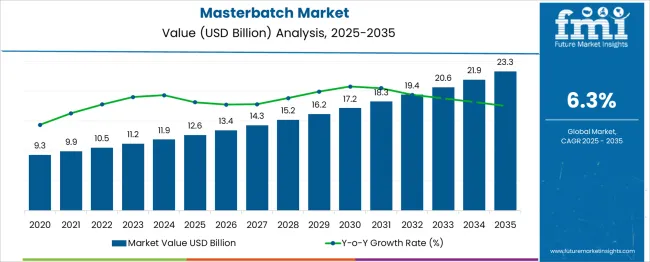
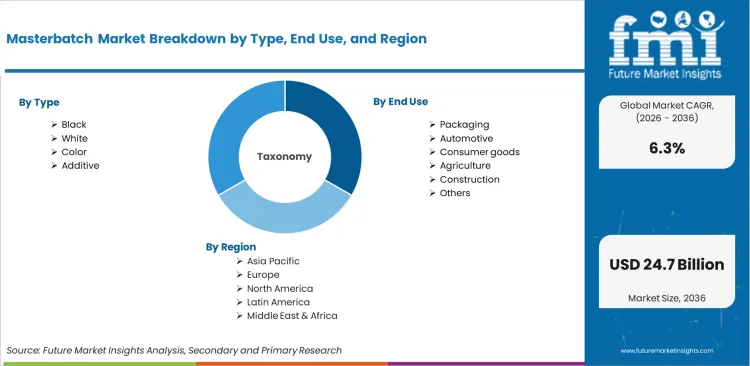
The masterbatch market was valued at USD 12.60 billion in 2025, projected to reach USD 13.39 billion in 2026, and is forecast to expand to USD 24.67 billion by 2036 at a 6.3% CAGR. Accelerating demand for colored, UV-stabilized, and antimicrobial plastic components across packaging, automotive, and consumer goods manufacturing is sustaining masterbatch procurement volumes. Plastics converters operating under brand-specific color matching requirements and regulatory additive compliance treat masterbatch as a specification-critical input rather than a commodity colorant.
Summary of Masterbatch Market
- Market Overview
- The masterbatch market is valued at USD 12.60 billion in 2025 and is projected to reach USD 24.67 billion by 2036.
- The industry is expected to grow at a 6.3% CAGR from 2026 to 2036, creating an incremental opportunity of USD 11.28 billion.
- The market is a specialty polymer additives category where color consistency, additive dispersion quality, and regulatory compliance certification define competitive positioning.
- Demand and Growth Drivers
- Demand is sustained by high-speed plastics conversion lines requiring pre-dispersed color and additive concentrates that minimize cycle time and eliminate on-site pigment handling.
- Automotive lightweighting programs are increasing consumption of specialty masterbatches with UV stability, scratch resistance, and conductivity properties for exterior and interior components.
- Sustainability mandates are accelerating the transition toward bio-based carrier resins and halogen-free flame retardant masterbatch formulations.
- Among key countries, China leads at 8.5% CAGR, followed by India at 7.9%, Germany at 7.2%, and France at 6.6%.
- Product and Segment View
- The market includes black, white, color, and additive masterbatch concentrates designed for extrusion, injection molding, blow molding, and film processing applications.
- Applications span flexible and rigid packaging production, automotive component molding, consumer goods manufacturing, agricultural film production, and construction material extrusion.
- Black masterbatch leads by Type with 36.0% share in 2026, driven by universal demand for UV protection, conductivity, and opacity across packaging and automotive applications.
- Packaging leads by End Use with 29.0% share in 2026, reflecting the concentration of color-critical and additive-dependent conversion volumes in food, beverage, and personal care packaging.
- The scope includes color, white, black, and additive masterbatch concentrates across all carrier resin systems, while excluding dry pigment powders, liquid colorants, and compounded resins sold as finished grades.
- Geography and Competitive Outlook
- China and India are the fastest-growing markets driven by expanding plastics conversion capacity and packaging production scale-up, while Europe and North America maintain specification-grade demand.
- Latin America sustains growth through expanding consumer goods packaging and agricultural film production.
- Competition is shaped by product performance, technical capability, and distribution reach, with key players including Ampacet Corporation, Alok Masterbatches Pvt.Ltd., Avient Corporation, Cabot Corporation, Colloids Ltd., Hubron International, LyondellBasell, Penn Color Inc., Plastiblends, Plastika Kritis S.A., Polyblends, RTP Company, Tosaf Compounds Ltd., Americhem.
- Analyst Opinion at FMI
- FMI is of the opinion that the masterbatch market is structurally linked to plastics conversion throughput and brand-owner color specification cycles, where supplier qualification depends on batch-to-batch consistency and regulatory additive compliance. Masterbatch producers that fail to develop bio-based carrier resin options and halogen-free flame retardant grades risk exclusion from procurement shortlists as FMCG and automotive OEM sustainability mandates tighten.
- Strategic Implications / Executive Takeaways
- Masterbatch producers must invest in bio-based carrier resin development and halogen-free flame retardant formulations to retain specification positions with sustainability-focused brand owners.
- Converters should negotiate color matching service agreements that guarantee batch-to-batch Delta E consistency within 1.0 across production campaigns.
- Procurement managers must validate regulatory compliance certifications for food-contact and automotive-grade masterbatches against evolving REACH and FDA migration testing requirements.
Black masterbatch retains the lead position at 36.0% share in 2026, driven by its universal application in UV protection, conductivity enhancement, and cost-effective opacity for packaging and automotive components. Packaging accounts for 29.0% of end-use demand as flexible and rigid plastic packaging producers require consistent color matching and additive dispersion across high-speed extrusion and injection molding lines. FMI analysts observe that the transition toward bio-based carrier resins and halogen-free flame retardant masterbatches is reshaping supplier qualification criteria as brand owners enforce sustainability targets through procurement specifications. Converters delaying reformulation risk losing positions on approved vendor lists as major FMCG and automotive OEMs tighten chemical compliance requirements under REACH and California Prop 65 frameworks.
All key markets reflect differentiated growth trajectories. China advances at 8.5% driven by expanding packaging and automotive plastics conversion capacity. India advances at 7.9% fueled by consumer goods packaging growth and agricultural film production expansion. Germany advances at 7.2% supported by automotive OEM color specification requirements and REACH compliance demand. France advances at 6.6% sustained by packaging and cosmetics industry color matching requirements. UK advances at 6.0% anchored by food packaging compliance and consumer goods manufacturing. USA advances at 5.4% maintained by steady packaging conversion and automotive component production volumes. Brazil advances at 4.7% supported by expanding agricultural film and consumer packaging production.
Masterbatch Market Key Takeaways
| Metric | Details |
|---|---|
| Industry Size (2026) | USD 13.39 billion |
| Industry Value (2036) | USD 24.67 billion |
| CAGR (2026-2036) | 6.3% |
Source: Future Market Insights, 2026
Masterbatch Market Definition
Masterbatch represents concentrated mixtures of pigments, additives, or functional agents encapsulated in a carrier resin, designed for dispersion into base polymers during plastics conversion processes. The market encompasses black, white, color, and additive masterbatch types used in extrusion, injection molding, blow molding, and film processing across packaging, automotive, consumer goods, agriculture, and construction sectors.
Masterbatch Market Inclusions
Market scope includes black, white, color, and additive masterbatch concentrates across all carrier resin systems for plastics conversion applications. Global and regional market sizes, forecast period 2026 to 2036, and segment breakdowns by Type and End Use are fully covered.
Masterbatch Market Exclusions
The scope excludes dry pigment powders sold for non-plastics applications, liquid colorant systems, and fully compounded polymer grades. Masterbatch used exclusively in rubber compounding is omitted from the valuation.
Masterbatch Market Research Methodology
- Primary Research: Analysts engaged with procurement managers, technical specification leads, and operations directors across key end-use segments to map the decision gates triggering equipment and service upgrades.
- Desk Research: Data collection phases aggregated regulatory compliance timelines, standards body publication schedules, industry association technical reports, and publicly filed corporate disclosures.
- Market-Sizing and Forecasting: Baseline values derive from a bottom-up aggregation of product shipment volumes, service contract values, and consumption data, applying region-specific adoption curves to project future demand velocity.
- Data Validation and Update Cycle: Projections are tested against publicly reported expenditure guidance from leading industry participants and validated through cross-referencing with regulatory filing data and trade association statistics.
Why is the Masterbatch Market Growing?
The masterbatch market is witnessing robust expansion, supported by rising plastic consumption across the packaging, automotive, and consumer goods industries. Black masterbatch continues to experience high demand due to its cost-effectiveness in imparting opacity, UV resistance, and superior aesthetic value in various plastic applications.
Environmental regulations and increased recyclability requirements have prompted manufacturers to explore advanced pigment formulations and sustainable carriers, further boosting demand. The packaging sector, in particular, is driving volume consumption, aided by rapid growth in e-commerce, FMCG demand, and flexible packaging innovation.
Global manufacturing shifts toward lightweight materials and enhanced polymer properties are shaping future opportunities in the market, especially for high-performance and specialty masterbatches.
Segmental Analysis
The masterbatch market is segmented by type, end use, and geographic regions. By type of the masterbatch market is divided into Black, White, Color, and Additive. The end use of the masterbatch market is classified into Packaging, Automotive, Consumer goods, Agriculture, Construction, and Others. Regionally, the masterbatch industry is classified into North America, Latin America, Western Europe, Eastern Europe, Balkan & Baltic Countries, Russia & Belarus, Central Asia, East Asia, South Asia & Pacific, and the Middle East & Africa.
Insights into the Black Type Segment
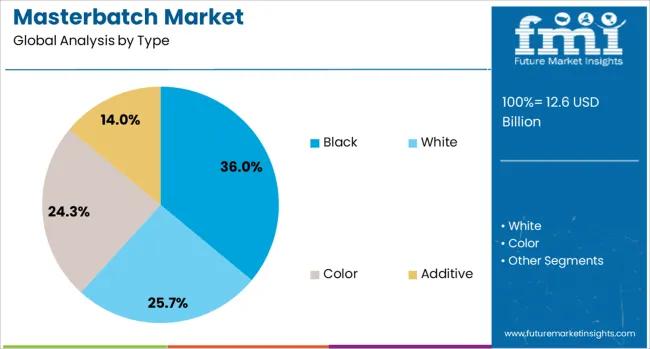
Black masterbatch is anticipated to dominate the masterbatch market with a 36.0% share in 2026. This leadership is attributed to its wide-ranging utility in imparting color, opacity, and UV protection across diverse plastic applications.
Demand has been strengthened by its compatibility with recycled resins and its ability to mask defects or inconsistencies in recycled polymer streams. The automotive and electrical sectors have also relied heavily on black masterbatch for under-the-hood components and cable insulation, where heat stability and color retention are crucial.
Additionally, high pigment loading capacity and lower processing costs have driven widespread adoption in high-volume production environments.
Insights into the Packaging End Use Segment
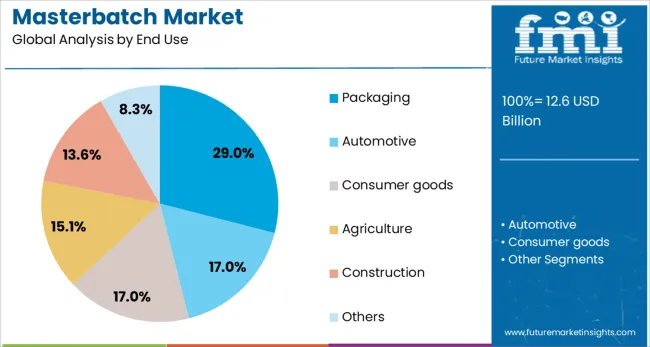
Packaging is expected to hold a 29.0% revenue share in 2026, making it the leading end-use segment within the masterbatch market. Growth is being propelled by surging demand for colored and functional plastics in consumer packaging, industrial films, and rigid containers.
The sector has benefitted from the increasing need for enhanced shelf appeal, brand differentiation, and barrier properties in packaged goods. Moreover, sustainability pressures have encouraged packaging companies to incorporate recyclable materials colored using non-toxic, biodegradable masterbatches.
The rapid growth of food delivery, personal care, and retail logistics has further amplified demand for functional masterbatch additives, positioning packaging as a central driver in the market’s expansion.
What are the Drivers, Restraints, and Key Trends of the Masterbatch Market?
Demand for masterbatches, used as colorants, additives, and fillers in polymer processing, has been stimulated by the need for enhanced material properties and aesthetic appeal. Technological advancements in formulation and customization have broadened product versatility. Sustainability considerations, including the incorporation of bio-based and recycled polymers, have gained traction. The increasing shift toward lightweight and durable plastic components in various industries has further propelled market expansion.
Technological Innovations Enhancing Product Performance
Continuous innovation in masterbatch formulations has been observed to improve the functionality and compatibility of these additives with diverse polymer matrices. Advanced dispersing techniques have enabled uniform color distribution and improved additive efficiency, contributing to superior end-product quality. The integration of functional additives such as UV stabilizers, flame retardants, and anti-microbial agents has expanded the application scope of masterbatches. Sustainable masterbatches incorporating biodegradable and recycled materials have been developed to meet regulatory demands and consumer preferences for environmentally friendly products. These technological improvements have allowed manufacturers to tailor solutions for specific processing conditions and performance requirements, increasing adoption across industries.
Application Expansion Across Key Industries
The demand for masterbatches has been significantly driven by their use in the packaging industry, where color customization and functional additives enhance product appeal and shelf life. Automotive manufacturers have utilized masterbatches to achieve lightweight, durable plastic components with improved UV resistance and aesthetic finishes. In construction, masterbatches contribute to weather resistance and color stability in piping and fittings. Consumer goods have seen increased incorporation of masterbatches for vibrant colors and enhanced mechanical properties in household products and electronics. The rising adoption of plastic components in these sectors has created a consistent demand for specialized masterbatch solutions tailored to industry-specific needs.
Regional Market Development and Expansion Strategies
Regional markets exhibit varied growth patterns, with Asia-Pacific leading due to rapid industrialization and rising plastics consumption in countries such as China and India. Europe and North America maintain steady demand supported by stringent quality standards and the focus on sustainable products. Manufacturers have localized production facilities to cater to regional preferences and regulatory requirements. Emerging markets in Latin America and the Middle East are witnessing gradual uptake supported by infrastructure development and increasing consumer awareness. Strategic partnerships, mergers, and acquisitions have been pursued to strengthen market presence and expand product portfolios, ensuring responsiveness to evolving customer demands across geographies.
Challenges in Raw Material Sourcing and Regulatory Compliance
The masterbatch market faces challenges stemming from fluctuating raw material prices, supply chain disruptions, and complex regulatory landscapes. Dependence on petrochemical-derived polymers exposes manufacturers to price volatility and availability risks. Compliance with environmental regulations regarding chemical composition and emissions has necessitated reformulation efforts and investment in sustainable alternatives. The introduction of biodegradable plastics has required adaptation in masterbatch compatibility and performance. Additionally, stringent quality control and certification requirements increase production costs and time-to-market. Overcoming these challenges demands strategic sourcing, innovation in green materials, and collaboration with regulatory bodies to ensure product safety and market acceptance.
Analysis of Masterbatch Market By Key Countries
.webp "Top Country Growth Comparison Masterbatch Market Cagr (2026 2036)")
| Country | CAGR |
|---|---|
| China | 8.5% |
| India | 7.9% |
| Germany | 7.2% |
| France | 6.6% |
| UK | 6.0% |
| USA | 5.4% |
| Brazil | 4.7% |
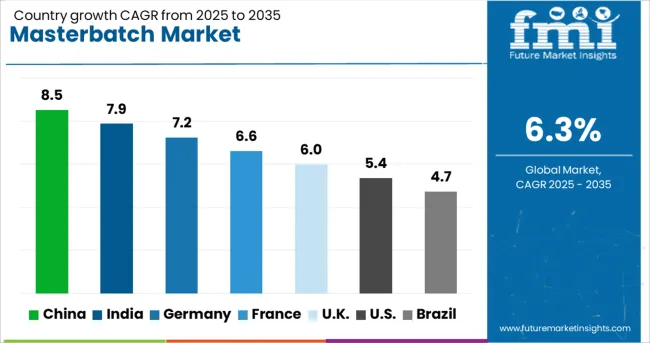
The masterbatch market is expected to grow at a global CAGR of 6.3% between 2026 and 2036, driven by increasing demand for color and additive concentrates in packaging, automotive, and consumer goods industries. China leads with an 8.5% CAGR, supported by large-scale plastic processing and manufacturing growth. India follows at 7.9%, fueled by expanding packaging sectors and automotive production. Germany, at 7.2%, benefits from advanced polymer technologies and high-quality masterbatch formulations. The UK, projected at 6.0%, sees steady growth from packaging and construction applications. The USA, at 5.4%, reflects stable demand across diverse manufacturing segments. This report includes insights on 40+ countries; the top markets are shown here for reference.
Demand Forecast for Masterbatch Market in China
China is projected to grow at a CAGR of 8.5% from 2026 to 2036, driven by expanding plastic processing industries and increasing use in packaging, automotive, and consumer goods sectors. Major producers such as Rongsheng Petrochemical and Jiangsu Sanfangxiang are investing in color and additive masterbatches with enhanced UV resistance and anti-microbial properties. Growth in flexible packaging and automotive lightweighting applications has increased demand for specialized formulations. Collaborations with global raw material suppliers have improved product quality and diversification. Industrial upgrades in Tier 1 and Tier 2 cities have further supported market expansion.
- UV-resistant masterbatch demand grew by 9% in 2025.
- Anti-microbial masterbatch sales increased by 8% year on year.
- Automotive application share rose by 7% in 2025.
Analysis of Masterbatch Market in India
India is expected to register a CAGR of 7.9% from 2026 to 2036, supported by rising plastic consumption and growing demand from packaging and construction sectors. Companies like Clariant India and Aarti Industries are focusing on cost-effective color masterbatches and functional additives. Increasing adoption of masterbatches in flexible films and pipes has contributed to volume growth. Expansion of local compounding facilities has improved supply chain efficiency. Government initiatives promoting plastic recycling are encouraging masterbatch manufacturers to develop recycled-content compatible products.
- Flexible film application demand grew by 8% in 2025.
- Functional additive masterbatch sales increased by 7% year on year.
- Recycled-content masterbatch production rose by 6% in 2025.
Growth Analysis of Masterbatch Market in Germany
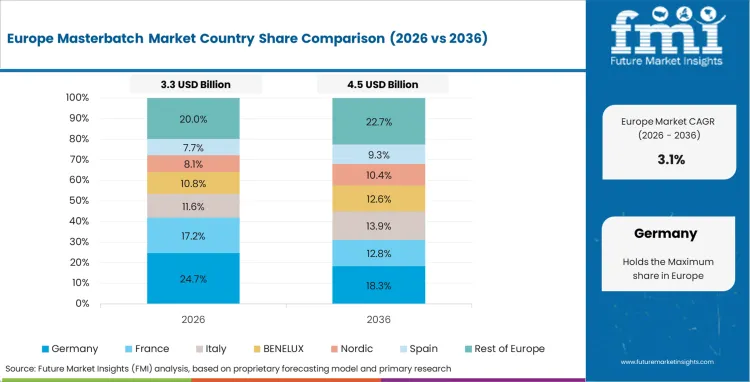
Germany is forecasted to achieve a CAGR of 7.2% from 2026 to 2036, with strong demand from automotive, packaging, and electrical industries. Producers such as BASF and Clariant Germany are developing high-performance masterbatches with improved thermal stability and color fastness. Increasing use of masterbatches in electric vehicle components and sustainable packaging is supporting market growth. The country’s well-established recycling systems have led to greater adoption of recycled-content masterbatches. Export demand for specialty masterbatch products remains robust across Europe.
- Thermal stable masterbatch demand rose by 7% in 2025.
- Recycled-content masterbatch adoption increased by 6% year on year.
- Electric vehicle component masterbatch sales grew by 5% in 2025.
Future Outlook for Masterbatch Market in the United Kingdom
The United Kingdom is expected to expand at a CAGR of 6.0% from 2026 to 2036, driven by growth in packaging and construction sectors. Companies such as Ampacet UK and PolyOne Corporation are investing in biodegradable and additive masterbatches to meet evolving regulatory requirements. The rising demand for sustainable packaging solutions is encouraging the development of eco-friendly masterbatches compatible with recycled plastics. Infrastructure development projects also provide opportunities for masterbatch use in durable pipes and fittings.
- Biodegradable masterbatch demand increased by 6% in 2025.
- Additive masterbatch sales grew by 5% year on year.
- Infrastructure-related application share rose by 4% in 2025.
Masterbatch Market Growth Outlook in the United States
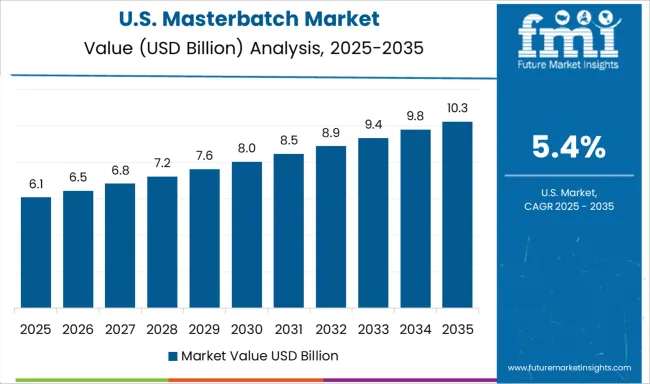
The United States is forecasted to grow at a CAGR of 5.4% from 2026 to 2036, supported by demand in packaging, automotive, and consumer goods industries. Key players like Ampacet Corporation and PolyOne Corporation are focusing on high-performance color and additive masterbatches with improved durability and UV protection. Increasing use of masterbatches in sustainable packaging and medical device applications has boosted market growth. Regulatory focus on recycled content and safety standards continues to shape product innovation.
- Sustainable packaging masterbatch sales rose by 6% in 2025.
- Medical device application demand grew by 5% year on year.
- UV protection masterbatch adoption increased by 4% in 2025.
Competitive Landscape of Masterbatch Market
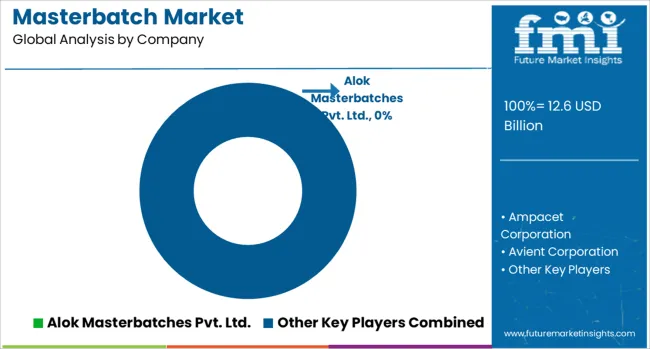
The masterbatch market is led by global chemical and compound producers supplying concentrated pigment and additive formulations for the plastics industry. Ampacet Corporation and Avient Corporation are key players offering a broad range of color, additive, and functional masterbatches tailored to packaging, automotive, consumer goods, and healthcare sectors.
Cabot Corporation specializes in carbon black masterbatches and conductive compounds, serving high-performance applications. LyondellBasell provides integrated polymer and masterbatch solutions, leveraging scale and technology to deliver cost-efficient color and additive concentrates. Penn Color Inc. and RTP Company focus on custom color and engineering compounds with enhanced performance features for specialty plastics.
Alok Masterbatches Pvt. Ltd. and Colloids Ltd. cater primarily to the Indian market, offering competitive pricing and a wide product portfolio. Plastiblends, Polyblends, and Hubron International supply masterbatches for packaging, agricultural films, and injection molding applications. Plastika Kritis S.A. and Tosaf Compounds Ltd. provide specialty and sustainable masterbatches targeting European and global markets.
Americhem emphasizes innovation in additive technologies and sustainable product lines. Key strategies include expanding product portfolios to include biodegradable and performance-enhancing additives, investing in regional manufacturing facilities to reduce lead times, and forming partnerships with polymer producers and converters. Entry into the masterbatch market is limited by capital-intensive production equipment, technical expertise in formulation, and established customer relationships within the plastics processing industry.
Key Developments in Masterbatch Market
- In April 2025, Clariant introduced its new line of CESA Additive Masterbatches, designed to enhance the performance and sustainability of plastic products. These masterbatches incorporate advanced additives that improve properties such as UV resistance, flame retardancy, and antimicrobial activity, catering to industries like automotive, packaging, and consumer goods.
- In March 2025, Ampacet Corporation launched UVBLOCK 1496, a UV-barrier color masterbatch tailored for food and industrial packaging. This innovation addresses the growing demand for packaging solutions that offer enhanced protection against ultraviolet degradation, thereby extending the shelf life and maintaining the quality of packaged goods.
Scope of the Report
| Metric | Value |
|---|---|
| Quantitative Units | USD 13.39 billion to USD 24.67 billion, at a CAGR of 6.3% |
| Market Definition | Masterbatch represents concentrated mixtures of pigments, additives, or functional agents encapsulated in a carrier resin, designed for dispersion into base polymers during plastics conversion processes. The market encompasses black, white, color, and additive masterbatch types used in extrusion, injection molding, blow molding, and film processing across packaging, automotive, consumer goods, agriculture, and construction sectors. |
| Segmentation | Type: Black, White, Color, Additive; End Use: Packaging, Automotive, Consumer goods, Agriculture, Construction, Others |
| Regions Covered | North America, Latin America, Europe, East Asia, South Asia, Oceania, Middle East & Africa |
| Countries Covered | China, India, Germany, France, UK, USA, Brazil, and 40 plus countries |
| Key Companies Profiled | Ampacet Corporation, Alok Masterbatches Pvt.Ltd., Avient Corporation, Cabot Corporation, Colloids Ltd., Hubron International, LyondellBasell, Penn Color Inc., Plastiblends, Plastika Kritis S.A., Polyblends, RTP Company, Tosaf Compounds Ltd., Americhem |
| Forecast Period | 2026 to 2036 |
| Approach | Forecasting models apply a hybrid bottom-up and top-down methodology starting with installed base metrics and cross-validating projections against primary research and public disclosure data. |
Masterbatch Market by Segments
Type:
- Black
- White
- Color
- Additive
End Use:
- Packaging
- Automotive
- Consumer goods
- Agriculture
- Construction
- Others
Region:
- North America
- USA
- Canada
- Mexico
- Latin America
- Brazil
- Chile
- Rest of Latin America
- Western Europe
- Germany
- UK
- Italy
- Spain
- France
- Nordic
- BENELUX
- Rest of Western Europe
- Eastern Europe
- Russia
- Poland
- Hungary
- Balkan & Baltic
- Rest of Eastern Europe
- East Asia
- China
- Japan
- South Korea
- South Asia and Pacific
- India
- ASEAN
- Australia & New Zealand
- Rest of South Asia and Pacific
- Middle East & Africa
- Kingdom of Saudi Arabia
- Other GCC Countries
- Turkiye
- South Africa
- Other African Union
- Rest of Middle East & Africa
Bibliography
- 1. European Plastics Converters Association. (2025). Plastics Conversion in Europe: Annual Statistics 2025. EuPC.
- 2. PlasticsEurope. (2025). Plastics: The Fast Facts 2025. PlasticsEurope.
- 3. European Chemicals Agency. (2025). REACH Regulation: Restrictions on Substances in Articles. ECHA.
- 4. Bureau of Indian Standards. (2025). IS 9833: Masterbatch for Plastics. BIS.
- 5. International Organization for Standardization. (2025). ISO 18553: Method for the Assessment of the Degree of Pigment Dispersion in Polyolefin Pipes, Fittings and Compounds. ISO.
- 6. USA Food and Drug Administration. (2025). Code of Federal Regulations Title 21: Colorants for Polymers. FDA.
This bibliography is provided for reader reference. The full Future Market Insights report contains the complete reference list with primary research documentation.
Frequently Asked Questions
How large is the demand for Masterbatch in the global market in 2026?
Demand for Masterbatch in the global market is estimated to be valued at USD 13.39 billion in 2026.
What will be the market size of Masterbatch in the global market by 2036?
Market size for Masterbatch is projected to reach USD 24.67 billion by 2036.
What is the expected demand growth for Masterbatch in the global market between 2026 and 2036?
Demand for Masterbatch is expected to grow at a CAGR of 6.3% between 2026 and 2036.
Which Type is poised to lead global sales by 2026?
Black accounts for 36.0% share in 2026.
How significant is Packaging in driving Masterbatch adoption in 2026?
Packaging represents 29.0% of segment share in 2026.
What is China's growth outlook in this report?
China is projected to grow at a CAGR of 8.5% during 2026 to 2036.
What is Masterbatch and what is it mainly used for?
Masterbatch represents concentrated mixtures of pigments, additives, or functional agents encapsulated in a carrier resin, designed for dispersion into base polymers during plastics conversion processes. The market encompasses black, white, color, and additive masterbatch types used in extrusion, injection molding, blow molding, and film processing across packaging, automotive, consumer goods, agriculture, and construction sectors.
What is included in the scope of this Masterbatch report?
Market scope includes black, white, color, and additive masterbatch concentrates across all carrier resin systems for plastics conversion applications. Global and regional market sizes, forecast period 2026 to 2036, and segment breakdowns by Type and End Use are fully covered.
Preview the report firsthand - request a free sample
Get SampleGet the brochure for pricing and purchase details.
Get PDFTable of Content
- Executive Summary
- Global Market Outlook
- Demand-side Trends
- Supply-side Trends
- Technology Roadmap Analysis
- Analysis and Recommendations
- Market Overview
- Market Coverage / Taxonomy
- Market Definition / Scope / Limitations
- Research Methodology
- Chapter Orientation
- Analytical Lens and Working Hypotheses
- Market Structure, Signals, and Trend Drivers
- Company Annual and Sustainability Reports
- Peer-reviewed Journals and Academic Literature
- Corporate Websites, Product Literature, and Technical Notes
- Earnings Decks and Investor Briefings
- Statutory Filings and Regulatory Disclosures
- Technical White Papers and Standards Notes
- Trade Journals, Industry Magazines, and Analyst Briefs
- Conference Proceedings, Webinars, and Seminar Materials
- Government Statistics Portals and Public Data Releases
- Press Releases and Reputable Media Coverage
- Specialist Newsletters and Curated Briefings
- Sector Databases and Reference Repositories
- FMI Internal Proprietary Databases and Historical Market Datasets
- Subscription Datasets and Paid Sources
- Social Channels, Communities, and Digital Listening Inputs
- Additional Desk Sources
- Expert Input and Fieldwork (Primary Evidence)
- Primary Modes
- Qualitative Interviews and Expert Elicitation
- Quantitative Surveys and Structured Data Capture
- Blended Approach
- Why Primary Evidence is Used
- Field Techniques
- Interviews
- Surveys
- Focus Groups
- Observational and In-context Research
- Social and Community Interactions
- Stakeholder Universe Engaged
- C-suite Leaders
- Board Members
- Presidents and Vice Presidents
- R&D and Innovation Heads
- Technical Specialists
- Domain Subject-matter Experts
- Scientists
- Physicians and Other Healthcare Professionals
- Governance, Ethics, and Data Stewardship
- Research Ethics
- Data Integrity and Handling
- Primary Modes
- Tooling, Models, and Reference Databases
- Data Engineering and Model Build
- Data Acquisition and Ingestion
- Cleaning, Normalisation, and Verification
- Synthesis, Triangulation, and Analysis
- Quality Assurance and Audit Trail
- Market Background
- Market Dynamics
- Drivers
- Restraints
- Opportunity
- Trends
- Scenario Forecast
- Demand in Optimistic Scenario
- Demand in Likely Scenario
- Demand in Conservative Scenario
- Opportunity Map Analysis
- Product Life Cycle Analysis
- Supply Chain Analysis
- Investment Feasibility Matrix
- Value Chain Analysis
- PESTLE and Porter’s Analysis
- Regulatory Landscape
- Regional Parent Market Outlook
- Production and Consumption Statistics
- Import and Export Statistics
- Market Dynamics
- Global Market Analysis 2021 to 2025 and Forecast, 2026 to 2036
- Historical Market Size Value (USD Million) Analysis, 2021 to 2025
- Current and Future Market Size Value (USD Million) Projections, 2026 to 2036
- Y-o-Y Growth Trend Analysis
- Absolute $ Opportunity Analysis
- Global Market Pricing Analysis 2021 to 2025 and Forecast 2026 to 2036
- Global Market Analysis 2021 to 2025 and Forecast 2026 to 2036, By Type
- Introduction / Key Findings
- Historical Market Size Value (USD Million) Analysis By Type , 2021 to 2025
- Current and Future Market Size Value (USD Million) Analysis and Forecast By Type , 2026 to 2036
- Black
- White
- Color
- Additive
- Black
- Y-o-Y Growth Trend Analysis By Type , 2021 to 2025
- Absolute $ Opportunity Analysis By Type , 2026 to 2036
- Global Market Analysis 2021 to 2025 and Forecast 2026 to 2036, By End Use
- Introduction / Key Findings
- Historical Market Size Value (USD Million) Analysis By End Use, 2021 to 2025
- Current and Future Market Size Value (USD Million) Analysis and Forecast By End Use, 2026 to 2036
- Packaging
- Automotive
- Consumer goods
- Agriculture
- Construction
- Others
- Packaging
- Y-o-Y Growth Trend Analysis By End Use, 2021 to 2025
- Absolute $ Opportunity Analysis By End Use, 2026 to 2036
- Global Market Analysis 2021 to 2025 and Forecast 2026 to 2036, By Region
- Introduction
- Historical Market Size Value (USD Million) Analysis By Region, 2021 to 2025
- Current Market Size Value (USD Million) Analysis and Forecast By Region, 2026 to 2036
- North America
- Latin America
- Western Europe
- Eastern Europe
- East Asia
- South Asia and Pacific
- Middle East & Africa
- Market Attractiveness Analysis By Region
- North America Market Analysis 2021 to 2025 and Forecast 2026 to 2036, By Country
- Historical Market Size Value (USD Million) Trend Analysis By Market Taxonomy, 2021 to 2025
- Market Size Value (USD Million) Forecast By Market Taxonomy, 2026 to 2036
- By Country
- USA
- Canada
- Mexico
- By Type
- By End Use
- By Country
- Market Attractiveness Analysis
- By Country
- By Type
- By End Use
- Key Takeaways
- Latin America Market Analysis 2021 to 2025 and Forecast 2026 to 2036, By Country
- Historical Market Size Value (USD Million) Trend Analysis By Market Taxonomy, 2021 to 2025
- Market Size Value (USD Million) Forecast By Market Taxonomy, 2026 to 2036
- By Country
- Brazil
- Chile
- Rest of Latin America
- By Type
- By End Use
- By Country
- Market Attractiveness Analysis
- By Country
- By Type
- By End Use
- Key Takeaways
- Western Europe Market Analysis 2021 to 2025 and Forecast 2026 to 2036, By Country
- Historical Market Size Value (USD Million) Trend Analysis By Market Taxonomy, 2021 to 2025
- Market Size Value (USD Million) Forecast By Market Taxonomy, 2026 to 2036
- By Country
- Germany
- UK
- Italy
- Spain
- France
- Nordic
- BENELUX
- Rest of Western Europe
- By Type
- By End Use
- By Country
- Market Attractiveness Analysis
- By Country
- By Type
- By End Use
- Key Takeaways
- Eastern Europe Market Analysis 2021 to 2025 and Forecast 2026 to 2036, By Country
- Historical Market Size Value (USD Million) Trend Analysis By Market Taxonomy, 2021 to 2025
- Market Size Value (USD Million) Forecast By Market Taxonomy, 2026 to 2036
- By Country
- Russia
- Poland
- Hungary
- Balkan & Baltic
- Rest of Eastern Europe
- By Type
- By End Use
- By Country
- Market Attractiveness Analysis
- By Country
- By Type
- By End Use
- Key Takeaways
- East Asia Market Analysis 2021 to 2025 and Forecast 2026 to 2036, By Country
- Historical Market Size Value (USD Million) Trend Analysis By Market Taxonomy, 2021 to 2025
- Market Size Value (USD Million) Forecast By Market Taxonomy, 2026 to 2036
- By Country
- China
- Japan
- South Korea
- By Type
- By End Use
- By Country
- Market Attractiveness Analysis
- By Country
- By Type
- By End Use
- Key Takeaways
- South Asia and Pacific Market Analysis 2021 to 2025 and Forecast 2026 to 2036, By Country
- Historical Market Size Value (USD Million) Trend Analysis By Market Taxonomy, 2021 to 2025
- Market Size Value (USD Million) Forecast By Market Taxonomy, 2026 to 2036
- By Country
- India
- ASEAN
- Australia & New Zealand
- Rest of South Asia and Pacific
- By Type
- By End Use
- By Country
- Market Attractiveness Analysis
- By Country
- By Type
- By End Use
- Key Takeaways
- Middle East & Africa Market Analysis 2021 to 2025 and Forecast 2026 to 2036, By Country
- Historical Market Size Value (USD Million) Trend Analysis By Market Taxonomy, 2021 to 2025
- Market Size Value (USD Million) Forecast By Market Taxonomy, 2026 to 2036
- By Country
- Kingdom of Saudi Arabia
- Other GCC Countries
- Turkiye
- South Africa
- Other African Union
- Rest of Middle East & Africa
- By Type
- By End Use
- By Country
- Market Attractiveness Analysis
- By Country
- By Type
- By End Use
- Key Takeaways
- Key Countries Market Analysis
- USA
- Pricing Analysis
- Market Share Analysis, 2025
- By Type
- By End Use
- Canada
- Pricing Analysis
- Market Share Analysis, 2025
- By Type
- By End Use
- Mexico
- Pricing Analysis
- Market Share Analysis, 2025
- By Type
- By End Use
- Brazil
- Pricing Analysis
- Market Share Analysis, 2025
- By Type
- By End Use
- Chile
- Pricing Analysis
- Market Share Analysis, 2025
- By Type
- By End Use
- Germany
- Pricing Analysis
- Market Share Analysis, 2025
- By Type
- By End Use
- UK
- Pricing Analysis
- Market Share Analysis, 2025
- By Type
- By End Use
- Italy
- Pricing Analysis
- Market Share Analysis, 2025
- By Type
- By End Use
- Spain
- Pricing Analysis
- Market Share Analysis, 2025
- By Type
- By End Use
- France
- Pricing Analysis
- Market Share Analysis, 2025
- By Type
- By End Use
- India
- Pricing Analysis
- Market Share Analysis, 2025
- By Type
- By End Use
- ASEAN
- Pricing Analysis
- Market Share Analysis, 2025
- By Type
- By End Use
- Australia & New Zealand
- Pricing Analysis
- Market Share Analysis, 2025
- By Type
- By End Use
- China
- Pricing Analysis
- Market Share Analysis, 2025
- By Type
- By End Use
- Japan
- Pricing Analysis
- Market Share Analysis, 2025
- By Type
- By End Use
- South Korea
- Pricing Analysis
- Market Share Analysis, 2025
- By Type
- By End Use
- Russia
- Pricing Analysis
- Market Share Analysis, 2025
- By Type
- By End Use
- Poland
- Pricing Analysis
- Market Share Analysis, 2025
- By Type
- By End Use
- Hungary
- Pricing Analysis
- Market Share Analysis, 2025
- By Type
- By End Use
- Kingdom of Saudi Arabia
- Pricing Analysis
- Market Share Analysis, 2025
- By Type
- By End Use
- Turkiye
- Pricing Analysis
- Market Share Analysis, 2025
- By Type
- By End Use
- South Africa
- Pricing Analysis
- Market Share Analysis, 2025
- By Type
- By End Use
- USA
- Market Structure Analysis
- Competition Dashboard
- Competition Benchmarking
- Market Share Analysis of Top Players
- By Regional
- By Type
- By End Use
- Competition Analysis
- Competition Deep Dive
- Ampacet Corporation
- Overview
- Product Portfolio
- Profitability by Market Segments (Product/Age /Sales Channel/Region)
- Sales Footprint
- Strategy Overview
- Marketing Strategy
- Product Strategy
- Channel Strategy
- Alok Masterbatches Pvt.Ltd.
- Avient Corporation
- Cabot Corporation
- Colloids Ltd.
- Hubron International
- LyondellBasell
- Penn Color Inc.
- Plastiblends
- Plastika Kritis S.A.
- Polyblends
- RTP Company
- Tosaf Compounds Ltd.
- Americhem
- Ampacet Corporation
- Competition Deep Dive
- Assumptions & Acronyms Used


