

- Industry Size (2026)
- USD 1.1 Bn
- Forecast (2036)
- USD 3.6 Bn
- CAGR (2026 to 2036)
- 12.7%
Proteome Balms Market Forecast and Outlook 2026 to 2036
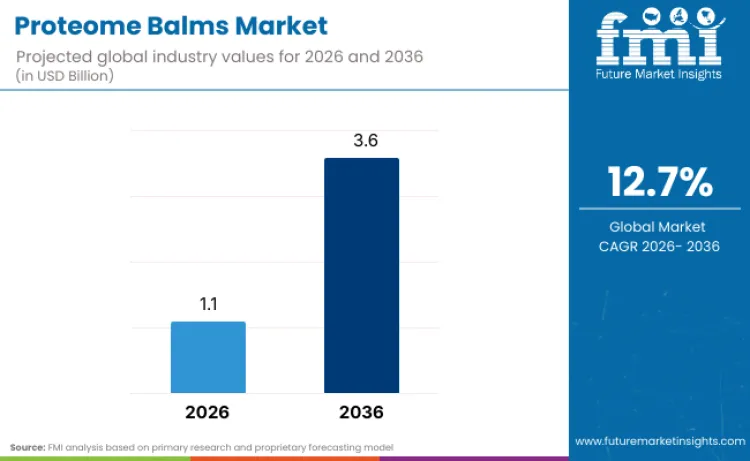
The proteome balms market is positioned to expand from USD 1.1 billion in 2026 toward USD 3.6 billion by 2036, advancing at a 12.7% CAGR. Demand for proteome balms, as per Future Market Insights, is being driven by a clear shift toward scientifically validated active ingredients and dermatologist-backed formulations that target protein-level skin repair. Growth is anchored in rising consumer focus on barrier restoration and functional efficacy, as advances in peptide synthesis and protein bioengineering now allow stable incorporation of complex proteins into topical formats. These developments are accelerating the transition of balms from cosmetic moisturizers toward treatment-oriented skincare positioned within the cosmecutical market.
Brand philosophy and long-term biological positioning are shaping competitive differentiation within this category. Jean-Noël Thorel, President-founder of NAOS, articulated this ethos by stating: “In everything we do, we cultivate our difference: love, understand and care for the living.” This philosophy reflects a broader industry shift toward respecting skin biology rather than masking symptoms, reinforcing why protein-based and proteome-aligned formulations are gaining credibility among both consumers and professionals. Market leaders such as L’Oréal Group continue to invest heavily in skin biology research, underscoring the strategic importance of molecular and cellular understanding in next-generation balm development.
Product and application dynamics further support expansion. Lip balms account for 37.8% of product value in 2026, supported by high usage frequency and premiumization within the lip care market, while skin repair balms are gaining traction alongside the growth of the dermatology devices market as adjunct topical solutions. Plant-based actives hold 42.1% of ingredient share, influenced by the organic personal care market, even as proteomic peptides and bioengineered proteins gain traction in professional settings. Face care applications lead with a 39.4% share, and the anti-aging market continues to stimulate demand for balms featuring collagen-supporting peptides and cellular repair proteins.
Summary of the Proteome Balms Market
What is Growth Outlook for Proteome Balms Market as per Future Market Insights Projection?
Future Market Insights projects the proteome balms market to grow at a CAGR of 12.7% from 2026 to 2036, expanding from USD 1.1 billion to USD 3.6 billion.
FMI research approach: Bottom-up revenue modeling by product type and distribution channel, primary interviews with dermatology formulation chemists and cosmeceutical brand managers, and peptide synthesis cost trajectory analysis.
How do FMI Analysts Perceive Proteome Balms Market to Evolve?
FMI analysts perceive the market transitioning from commodity emollients toward precision protein-based formulations targeting specific skin barrier dysfunctions, where clinical validation and dermatologist recommendations drive professional and consumer adoption.
FMI research approach: Comparative analysis of protein-based versus conventional formulations, adoption patterns across dermatology and retail channels, and regulatory guidance tracking for cosmeceutical protein ingredient approvals.
Which Country Holds Largest Share in the Global Proteome Balms Market?
China holds the largest share of the global proteome balms market by value, driven by rapid adoption of premium skincare technologies and strong consumer preference for products with visible efficacy claims.
FMI research approach: Country-level revenue modeling by end-user channel and ingredient positioning, analysis of beauty retail penetration rates for protein-based products, and regulatory framework assessment for cosmeceutical ingredients.
How Large Will the Proteome Balms Market be by 2036?
The global proteome balms market is estimated to reach USD 3.6 billion by 2036.
FMI research approach: Long-term revenue forecast based on peptide ingredient cost reduction curves, dermatology adoption timelines for protein-based topicals, and consumer acceptance rates for premium-priced functional balms.
What is Definition of Proteome Balms Market?
The proteome balms market comprises topical skincare products formulated with protein-based active ingredients including peptides, bioengineered proteins, and plant protein extracts, delivered in balm formats for skin barrier repair and therapeutic applications.
FMI research approach: Market taxonomy validation across ingredient types and therapeutic claims, alignment with cosmeceutical classification principles, and exclusion mapping for basic emollient products without functional protein content.
What are Globally Unique Trends Shaping Proteome Balms Market?
Globally unique trends include bioengineering of functional proteins through microbial fermentation, clinical validation studies for dermatology channel credibility, and consumer demand for ingredient transparency with specific peptide sequence disclosure.
FMI research approach: Analysis of bioengineering patent filings for cosmetic proteins, dermatology partnership tracking between beauty brands and research institutions, and consumer ingredient literacy trends for protein-based actives.
Proteome Balms Market Key Takeaways
| Metric | Details |
|---|---|
| Industry Size (2026) | USD 1.1 Billion |
| Industry Value (2036) | USD 3.6 Billion |
| CAGR (2026-2036) | 12.7% |
Source: Future Market Insights (FMI) analysis, based on proprietary forecasting model and primary research
What is Driving Demand for Proteome Balms?
Rising awareness of skin barrier science is fundamentally reshaping consumer expectations for topical skincare, shifting demand toward formulations that address skin dysfunction at the molecular level rather than offering short-term occlusion. Consumers are increasingly seeking products that support collagen synthesis, barrier lipid production, and long-term skin resilience, accelerating the transition of protein-based balms from niche offerings into mainstream, performance-led skincare solutions. Professional endorsement plays a central role in this shift, as dermatologists and aestheticians recommend targeted protein formulations for specific concerns such as barrier compromise, sensitivity, and post-treatment recovery.
This demand is reinforced by the industry’s growing focus on skin biology as a foundation for product development. L'Oréal has emphasized this direction, noting that “L'Oréal's Research and Innovation division focuses on understanding skin biology at molecular and cellular levels to develop targeted skincare solutions.” Such positioning validates proteome balms as biologically grounded products rather than cosmetic enhancements, strengthening consumer trust and willingness to pay premium prices.
At the same time, clean beauty and sustainability priorities are amplifying interest in bioengineered proteins produced through fermentation, which address ethical and environmental concerns tied to animal-derived ingredients. Medical-grade skincare channels are further expanding demand, as dermatology practices increasingly retail protein-rich balms used in post-procedure care. This convergence of scientific credibility, professional recommendation, and sustainable sourcing is positioning proteome balms as therapeutic-grade skincare within everyday routines.
How is the Proteome Balms Market Segmented?
The proteome balms market is segmented by product type, ingredient type, form, application, end user, and region to reflect the category’s transition from basic moisturization toward precision, protein-led skin repair. By product type, the market comprises lip balms, skin repair balms, anti-aging balms, therapeutic balms, and multi-functional balms, with each serving distinct use cases ranging from daily maintenance to clinically guided recovery. By ingredient type, formulations span plant-based actives, proteomic peptides, bioengineered proteins, natural oils and butters, and synthetic functional ingredients, highlighting the coexistence of clean beauty preferences and advanced biotechnology inputs.
By form, demand is distributed across stick, solid, cream, and gel formats, aligning convenience with targeted application needs. By application, the market covers face care, lip care, body care, hand and foot care, and medical skin repair, reflecting both consumer routines and professional use. By end user, adoption is led by individual consumers, while professional dermatology clinics and medical and therapeutic users represent high-value, credibility-driven channels. FMI analysis indicates that while mass-market lip care anchors volume, market structure increasingly favors clinically positioned, protein-rich formulations that deliver depth of efficacy alongside broad consumer reach.
Why Do Lip Balms Dominate the Proteome Balms Market?
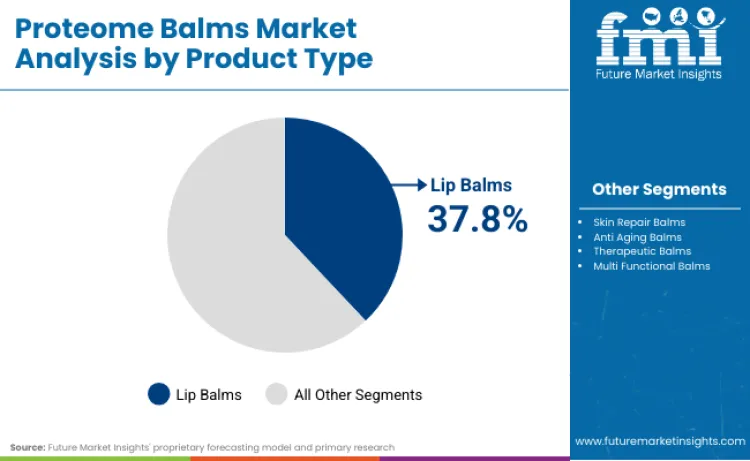
Lip balms command a dominant 37.8% market share in 2026 because they represent the most frequent and behaviorally ingrained use case for protein-based barrier repair. The lip area is continuously exposed to dehydration, UV stress, and environmental aggression, creating persistent demand for formulations that go beyond surface occlusion to protect functional skin proteins. Premium proteome balms differentiate from commodity lip care by addressing the biological root cause of aging, specifically protein carbonylation, which irreversibly damages collagen and elastin and accelerates visible deterioration. This positioning allows brands to justify higher price points while reframing lip balms as long-term skin health interventions rather than temporary moisturizers.
This biological rationale is strongly reinforced by skin science narratives adopted by leading dermocosmetic groups. NAOS articulates this foundation clearly, stating: “The proteome is a dynamic network of complementary proteins designed by centuries of evolution to allow the skin to self-repair, self-renew and maintain health and functionality throughout time and aggressive environments.” By emphasizing protection of the skin’s functional proteins and positioning the skin as the “actor of its health,” proteome lip balms resonate with dermatologists and consumers seeking durable biological outcomes over short-term cosmetic fixes. Compact stick formats further reinforce dominance through portability and habitual reapplication, maintaining relevance across all age groups and retail channels.
How Do Ingredient Types Influence Market Positioning?
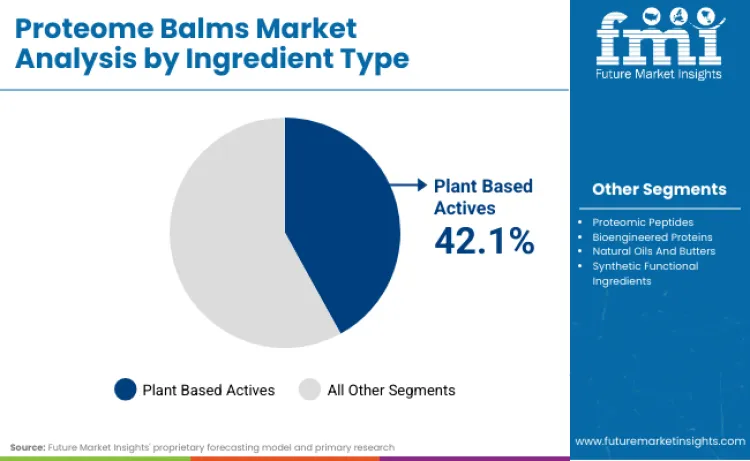
Ingredient type plays a decisive role in how proteome balms are positioned, determining whether products compete on natural affinity, professional authority, or long-term biological performance. Plant-based actives lead with a 42.1% share, driven by consumer preference for natural ingredients and the perception of gentleness in sensitive skin applications. Botanical protein extracts sourced from quinoa, pea, and rice deliver functional support while aligning with clean beauty expectations around sustainability, vegan formulation, and ethical sourcing. These narratives resonate strongly with environmentally conscious consumers and underpin broad retail adoption.
At the premium and professional end of the market, proteomic peptides and bioengineered proteins are redefining differentiation by addressing the full biological spectrum of skin aging rather than isolated surface concerns. This positioning is exemplified by Institut Esthederm, whose Age Proteom innovation has been described as exerting “enduring influence over all aspects of skin aging, from fine lines and loss of firmness to uneven complexion, lackluster appearance, and reduced skin density,” achieved through patented biotechnology derived from an almost “immortal” microorganism that forms a protective shield preserving the proteome. Bioengineered proteins produced via fermentation further reinforce this positioning by combining high efficacy with ethical sourcing, eliminating animal extraction while protecting collagen, elastin, and other functional skin proteins.
Why Is Precision Peptide Engineering Reshaping Proteome Balm Formulation?
Technological evolution in proteome balms is being driven by a decisive shift from generic protein extracts toward precisely engineered peptide sequences designed for defined biological functions. Advances in computational biology now enable the rational selection of peptides that interact with collagen receptors, stimulate fibroblast activity, and modulate inflammatory signaling. This precision-led approach is fundamentally changing balms from passive moisturizers into functional, mechanism-based skin treatments with clearly articulated modes of action. As a result, formulation strategies are increasingly centered on biological specificity rather than ingredient abundance.
How Are Advanced Delivery and Stability Systems Converting Innovation into Scalable Products?
Formulation progress is equally shaped by advances in protein stabilization and delivery technologies. Encapsulation systems such as liposomes and nanocarriers are being deployed to protect peptides from enzymatic degradation while enabling controlled, sustained release into targeted skin layers. These systems ensure protein integrity throughout manufacturing, storage, and consumer use, resolving one of the historical constraints on protein-based topicals. By preserving activity across the product lifecycle, delivery innovation is allowing proteome balms to scale beyond niche applications into reliable, repeat-use skincare formats.
What Role Do Standardized Measurement Tools Play in Category Maturation?
The maturation of proteome balms is further supported by the standardization of analytical methods used to quantify protein bioavailability and skin penetration. Advanced measurement frameworks now allow brands to demonstrate that peptides reach viable skin layers and interact with target structures, strengthening claim substantiation and commercial credibility. This technical infrastructure is elevating proteome balms from conceptual formulations into evidence-aligned cosmeceuticals, reinforcing trust among professionals and consumers without reliance on short-term cosmetic effects.
What is Proteome Balms Market Regional Outlook?
Sales of proteome balms in emerging markets are expanding well above the global average, driven by rapid premium skincare adoption, rising awareness of skin barrier science, and strong acceptance of protein-based actives. While the global proteome balms market advances at a 12.7% CAGR, high-growth economies are accelerating demand by combining increasing disposable incomes with greater exposure to science-led beauty narratives. China leads this expansion with a 17.1% CAGR, followed by India at 15.9% and Brazil at 13.3%, establishing Asia and Latin America as the primary growth engines for the category. In contrast, mature markets such as the United States (12.1%) and Germany (14.6%) are growing through premiumization, professional endorsement, and ingredient credibility rather than sheer volume expansion, while the United Kingdom (10.8%) reflects a more measured, value-led adoption pattern.
FMI analysis indicates that future growth will be anchored in the convergence of professional dermatology influence and consumer willingness to pay for biologically differentiated skincare in high-population regions, while developed markets will continue to shape quality standards and long-term brand credibility.
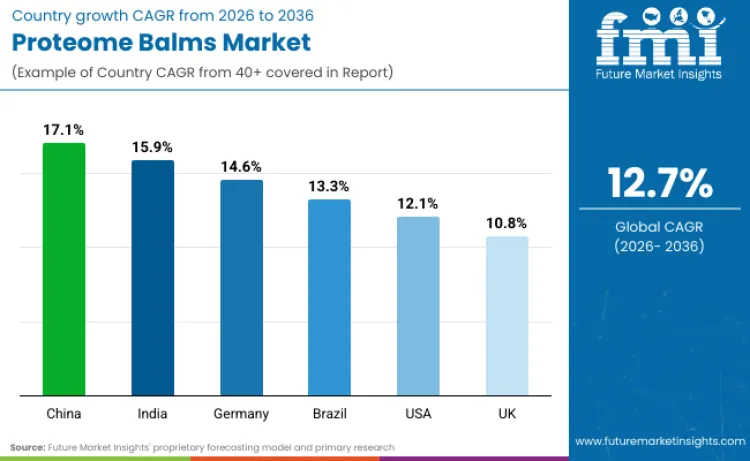
| Country | CAGR (2026 to 2036) |
|---|---|
| China | 17.1% |
| India | 15.9% |
| Germany | 14.6% |
| Brazil | 13.3% |
| United States | 12.1% |
| United Kingdom | 10.8% |
Source: FMI historical analysis and forecast data.
Why is China embedding proteome science into national economic strategy?
China is expanding at a rapid 17.1% CAGR, driven primarily by the formal integration of proteome-scale research into central economic planning. The 14th Five-Year Plan for Bioeconomy Development explicitly positions the bioeconomy as a growth engine built on the protection, development, and utilization of bioresources to advance life science and biotechnology. This policy direction is reinforcing large-scale investment in proteomics, biomarker science, and applied biotechnology across both medical and adjacent consumer health sectors.
The mandate to integrate biotechnology with informatics and to establish national laboratories focused on biomedicine is accelerating the translation of high-throughput proteomic capabilities into real-world applications. Regulatory acceleration for innovative drugs and clinical approvals further strengthens this ecosystem by shortening development cycles and encouraging private participation. FMI analysis indicates that this state-led alignment between policy, infrastructure, and regulatory speed is positioning China as the most structurally advantaged market for proteome-driven innovation through 2036.
Why is India scaling a national proteomics ecosystem through Biopharma SHAKTI?
India is growing at a strong 15.9% CAGR, driven by a decisive shift from volume-led manufacturing toward high-value biologics and proteomics. The government’s proposed Biopharma SHAKTI initiative, backed by a multi-year public investment outlay, is designed to strengthen the country’s end-to-end ecosystem for biologics and biosimilars. This framework prioritizes infrastructure creation, translational capability, and domestic capacity for advanced protein science. Complementing this effort, the BioE3 Policy places emphasis on precision biotherapeutics and smart proteins, aligning industrial policy with next-generation molecular platforms.
The explicit national objective of capturing a meaningful share of the global biopharmaceutical market is incentivizing private investment, talent migration, and academic-industry collaboration. FMI analysis suggests that India’s growth trajectory is anchored less in consumer demand alone and more in policy-driven ecosystem building that will steadily expand proteome applications across healthcare, diagnostics, and adjacent therapeutic skincare categories.
Why is Germany advancing through systems biology and translational networks?
Germany is expanding at a 14.6% CAGR, supported by its long-standing emphasis on systems biology and structured translational research. Growth is anchored in federal initiatives that connect interdisciplinary research networks with applied medical outcomes, ensuring that complex biological insights move efficiently toward patient-facing solutions. National innovation frameworks are designed to shorten the distance between discovery and deployment, reinforcing Germany’s reputation for scientific rigor and regulatory discipline.
This environment favors proteome-driven platforms that require high standards of validation, reproducibility, and clinical relevance. Rather than prioritizing rapid scale, Germany’s market evolution emphasizes quality thresholds, institutional trust, and methodical adoption. FMI analysis indicates that Germany’s role in the global proteome balms landscape will be defined by standard-setting and credibility, influencing formulation science, ingredient acceptance, and professional endorsement patterns across Europe rather than sheer volume expansion.
Why is Brazil leveraging epidemiological intelligence to drive adoption?
Brazil is growing at a 13.3% CAGR, supported by improved national capability in epidemiological monitoring and predictive health modeling. Government-led use of protein-based biomarker data to forecast disease patterns is strengthening institutional familiarity with proteomic tools and their practical value in decision-making. This normalization of protein-level analytics within public health infrastructure is indirectly accelerating acceptance of proteome-based approaches in adjacent applications.
As data visibility improves, Brazil is becoming more attractive for international collaboration and regional innovation hubs. FMI analysis suggests that Brazil’s growth is less about premiumization alone and more about systemic adoption of biological intelligence frameworks. This positions the country as a key Latin American market where proteome-driven solutions gain traction through public-sector validation, expanding downstream acceptance across professional and consumer-facing health categories.
Why is the United States maturing around large-scale multi-omic data access?
The United States is expanding at a steady 12.1% CAGR, characterized by market maturation rather than rapid acceleration. Growth is driven by unprecedented access to large-scale, diverse multi-omic datasets that are reshaping how biological systems are understood and applied. National initiatives have dramatically expanded the availability of integrated genomic, proteomic, and phenotypic data, enabling more precise modeling of health and aging processes.
This data depth is supporting a shift toward tailored, evidence-aligned applications across healthcare and wellness ecosystems. FMI analysis indicates that the USA market is moving from exploration to optimization, where the focus is on translating biological insight into scalable, regulated, and reimbursable solutions. The country’s influence lies in defining data standards, ethical frameworks, and long-term commercialization pathways for proteome-based innovations.
Why is the United Kingdom advancing through population-scale proteomics?
The United Kingdom is growing at a 10.8% CAGR, supported by leadership in population-scale proteomics infrastructure. National initiatives are measuring thousands of proteins across hundreds of thousands of participants, creating one of the most comprehensive biological datasets globally. This approach enables longitudinal insight into how protein networks influence aging, disease progression, and resilience over time. The scale and openness of this resource are positioning the UK as a global reference point for proteome-informed discovery and downstream application. FMI analysis suggests that while growth is more measured than in emerging markets, the UK’s strategic value lies in its ability to fuel innovation pipelines worldwide. Population-level proteomic intelligence is expected to influence formulation science, validation frameworks, and biological positioning across multiple international markets through 2036.
How is the Competition in the Proteome Balms Market?
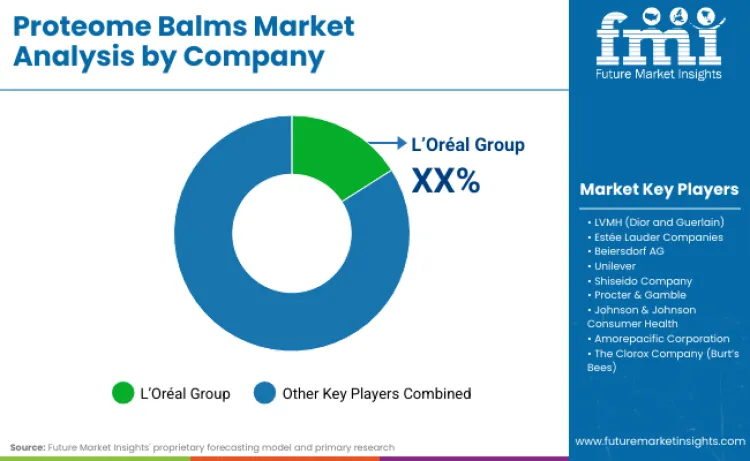
Competition in the proteome balms market is being reshaped as established beauty leaders transition decisively from traditional cosmetic chemistry toward longevity science and advanced proteomics. Market leaders are defending their positions by embedding protein-level biology into both product development and consumer engagement models. L’Oréal Groupe continues to lead this shift, positioning itself as a Beauty Tech powerhouse focused on inventing the future of beauty through molecular and cellular skin science. This strategic pivot moves competition beyond formulation alone and into ownership of biological insight and long-term skin health narratives.
A new competitive front has emerged through the integration of high-tech diagnostic hardware that acts as a gatekeeper for protein-based treatments. L’Oréal’s introduction of Cell BioPrint, a tabletop device delivering personalized skin analysis in minutes using advanced proteomics, exemplifies how diagnostics are becoming embedded within the skincare value chain. This convergence of diagnostics and treatment is redefining how proteome balms are prescribed, personalized, and justified. As a result, competition is shifting away from shelf-based differentiation toward ecosystem control, where brands that combine diagnostics, proteomic intelligence, and targeted therapeutics are setting a higher barrier to entry for both emerging brands and traditional skincare players.
Recent Developments:
- In January 2026, Beiersdorf and the Helmholtz Institute for Pharmaceutical Research Saarland launched a long-term exclusive partnership to study the skin microbiome, leveraging large genomic datasets to identify microbial natural products and translate microbiome science into next-generation skincare innovations supporting healthy skin balance.
- In June 2025: Shiseido introduced its “Reservoir in Skin” technology, designed to help moisturizing ingredients penetrate deeper and stay longer in the skin, improving hydration, texture, and overall skin condition through a more science-driven approach to ingredient retention.
Key Players in the Proteome Balms Market
- L'Oréal Group
- LVMH (Dior And Guerlain)
- Estée Lauder Companies
- Beiersdorf AG
- Unilever
- Shiseido Company
- Procter And Gamble
- Johnson And Johnson Consumer Health
- Amorepacific Corporation
- The Clorox Company (Burt's Bees)
Market Definition
The proteome balms market represents revenue generated from topical skincare products formulated with protein-based active ingredients including peptides, bioengineered proteins, and plant protein extracts, delivered in balm formats for skin barrier repair, anti-aging, and therapeutic applications. As operationally defined in the analysis, the market measures commercially deployed proteome-containing balms sold through retail and professional channels, analyzed by product type, ingredient type, form, application, end user, and region, and expressed in USD billion.
Market Inclusion
Included in the proteome balms market are products explicitly segmented by therapeutic positioning: lip balms, skin repair balms, anti-aging balms, therapeutic balms, and multi-functional balms containing protein actives. Ingredient coverage spans plant-based protein actives, proteomic peptides (short-chain functional sequences), bioengineered proteins from microbial fermentation, natural oils and butters combined with protein actives, and synthetic functional protein ingredients. Form types include stick, solid, cream, and gel delivery systems. Applications encompass face care, lip care, body care, hand and foot care, and medical skin repair. End users include individual consumers purchasing through retail, professional dermatology clinics prescribing medical-grade formulations, and medical and therapeutic users requiring clinical-specification products. Geographic scope covers North America, Europe, East Asia, South Asia, Latin America, and Middle East and Africa.
Market Exclusion
Excluded from the market scope are basic emollient balms without functional protein content, including petroleum jelly products and simple oil-based formulations. Facial moisturizers and body lotions in non-balm formats are not included even when containing protein ingredients. Prescription pharmaceutical products for dermatological conditions are outside market scope. Professional dermatology procedure fees and clinical consultation charges are excluded. Soap and cleansing balms are not counted even when formulated with protein ingredients. Research-grade peptide ingredients sold to formulators rather than finished consumer products are excluded. Revenue from beauty device sales and professional treatment equipment is outside market definition.
Scope of Report
| Items | Values |
|---|---|
| Quantitative Units | USD billion |
| Product Type | Lip Balms; Skin Repair Balms; Anti-Aging Balms; Therapeutic Balms; Multi-Functional Balms |
| Ingredient Type | Plant-Based Protein Actives; Proteomic Peptides; Bioengineered Proteins; Natural Oils & Butters; Synthetic Functional Ingredients |
| Form | Stick; Solid; Cream; Gel |
| Application | Face Care; Lip Care; Body Care; Hand & Foot Care; Medical Skin Repair |
| End User | Individual Consumers; Professional Dermatology Clinics; Medical & Therapeutic Users |
| Formulation & Technology Focus | Precision Peptide Engineering Platforms; Bioengineered Protein Fermentation Systems; Controlled-Release Protein Delivery Technologies; Proteome Preservation Actives; Clinically Validated Barrier Repair Formulations |
| Regions Covered | North America, Europe, East Asia, South Asia, Latin America, Middle East & Africa |
| Countries Covered | China, India, Germany, Brazil, United States, United Kingdom, Japan, South Korea, France, and 40+ countries |
| Key Companies Profiled | L’Oréal Group; LVMH (Dior & Guerlain); Estée Lauder Companies; Beiersdorf AG; Unilever; Shiseido Company; Procter & Gamble; Johnson & Johnson Consumer Health; Amorepacific Corporation; The Clorox Company (Burt’s Bees) |
| Additional Attributes | Dollar sales by product type, ingredient class, form, application, and end user; performance benchmarking across protein stability, barrier repair efficacy, collagen preservation, and long-term skin resilience; adoption trends for peptide-engineered formulations and bioengineered protein actives; impact on dermatologist recommendation rates, premiumization, and repeat usage; regulatory influence on cosmeceutical protein ingredient approval and claim substantiation; supply chain dynamics across fermentation-based protein sourcing, stabilization technologies, and omnichannel skincare retail |
Proteome Balms Market by Segments
Product Type:
- Lip Balms
- Skin Repair Balms
- Anti-Aging Balms
- Therapeutic Balms
- Multi-Functional Balms
Ingredient Type:
- Plant-Based Actives
- Proteomic Peptides
- Bioengineered Proteins
- Natural Oils And Butters
- Synthetic Functional Ingredients
Form:
- Stick
- Solid
- Cream
- Gel
Application:
- Face Care
- Lip Care
- Body Care
- Hand And Foot Care
- Medical Skin Repair
End User:
- Individual Consumers
- Professional Dermatology Clinics
- Medical And Therapeutic Users
Region:
- North America
- Europe
- East Asia
- South Asia
- Latin America
- Middle East & Africa
Bibliography
- National Center for Biotechnology Information. (2024). Proteomics and skin biology: Protein networks in barrier function and aging. NCBI Bookshelf.
- International Federation of Societies of Cosmetic Chemists. (2024). Technical monograph on peptides and proteins in cosmetic science. IFSCC Publications.
- European Medicines Agency. (2024). Scientific advice on nanomaterials and advanced delivery systems in topical products. EMA Scientific Guidance.
Frequently Asked Questions
What is the current global market size for Proteome Balms?
The global Proteome Balms market is valued at USD 1.1 billion in 2026.
What is the projected CAGR for the Proteome Balms market?
The market is projected to grow at a 12.7% CAGR from 2026 to 2036.
Which segment currently dominates the industry?
Lip balms lead with a 37.8% share while plant-based protein actives dominate ingredients with 42.1%.
What are the primary drivers for adoption in emerging markets?
Adoption is driven by government-supported biotechnology ecosystems, rising premium skincare consumption, and growing acceptance of protein-based cosmeceuticals in China and India.
Who are the leading players in the Proteome Balms space?
Key players include L’Oréal Group, LVMH (Dior and Guerlain), Estée Lauder Companies, Beiersdorf AG, Unilever, Shiseido Company, and Procter & Gamble.
Preview the report firsthand - request a free sample
Get SampleGet the brochure for pricing and purchase details.
Get PDFTable of Content
- Executive Summary
- Global Market Outlook
- Demand Side Trends
- Supply Side Trends
- Technology Roadmap Analysis
- Analysis and Recommendations
- Market Overview
- Market Coverage / Taxonomy
- Market Definition / Scope / Limitations
- Research Methodology
- Chapter Orientation
- Analytical Lens and Working Hypotheses
- Market Structure, Signals, and Trend Drivers
- Benchmarking and Cross-market Comparability
- Market Sizing, Forecasting, and Opportunity Mapping
- Research Design and Evidence Framework
- Desk Research Programme (Secondary Evidence)
- Company Annual and Sustainability Reports
- Peer-reviewed Journals and Academic Literature
- Corporate Websites, Product Literature, and Technical Notes
- Earnings Decks and Investor Briefings
- Statutory Filings and Regulatory Disclosures
- Technical White Papers and Standards Notes
- Trade Journals, Industry Magazines, and Analyst Briefs
- Conference Proceedings, Webinars, and Seminar Materials
- Government Statistics Portals and Public Data Releases
- Press Releases and Reputable Media Coverage
- Specialist Newsletters and Curated Briefings
- Sector Databases and Reference Repositories
- FMI Internal Knowledge Base and Historical Datasets
- Subscription Datasets and Paid Sources
- Social Channels, Communities, and Digital Listening Inputs
- Additional Desk Sources
- Expert Input and Fieldwork (Primary Evidence)
- Primary Modes
- Qualitative Interviews and Expert Elicitation
- Quantitative Surveys and Structured Data Capture
- Blended Approach
- Why Primary Evidence is Used
- Field Techniques
- Interviews
- Surveys
- Focus Groups
- Observational and In-context Research
- Social and Community Interactions
- Stakeholder Universe Engaged
- C-suite Leaders
- Board Members
- Presidents and Vice Presidents
- R&D and Innovation Heads
- Technical Specialists
- Domain Subject-matter Experts
- Scientists
- Physicians and Other Healthcare Professionals
- Governance, Ethics, and Data Stewardship
- Research Ethics
- Data Integrity and Handling
- Primary Modes
- Tooling, Models, and Reference Databases
- Desk Research Programme (Secondary Evidence)
- Data Engineering and Model Build
- Data Acquisition and Ingestion
- Cleaning, Normalisation, and Verification
- Synthesis, Triangulation, and Analysis
- Quality Assurance and Audit Trail
- Market Background
- Market Dynamics
- Drivers
- Restraints
- Opportunity
- Trends
- Scenario Forecast
- Demand in Optimistic Scenario
- Demand in Likely Scenario
- Demand in Conservative Scenario
- Opportunity Map Analysis
- Product Life Cycle Analysis
- Supply Chain Analysis
- Investment Feasibility Matrix
- Value Chain Analysis
- PESTLE and Porter's Analysis
- Regulatory Landscape
- Regional Parent Market Outlook
- Production and Consumption Statistics
- Import and Export Statistics
- Market Dynamics
- Global Market Analysis 2021 to 2025 and Forecast, 2026 to 2036
- Historical Market Size Value (USD Million) Analysis, 2021 to 2025
- Current and Future Market Size Value (USD Million) Projections, 2026 to 2036
- Y-o-Y Growth Trend Analysis
- Absolute $ Opportunity Analysis
- Global Market Pricing Analysis 2021 to 2025 and Forecast 2026 to 2036
- Y-o-Y Growth Trend Analysis 2021 to 2025
- Absolute $ Opportunity Analysis 2026 to 2036
- Global Market Analysis 2021 to 2025 and Forecast 2026 to 2036, By Product Type
- Introduction / Key Findings
- Historical Market Size Value (USD Million) Analysis By Product Type, 2021 to 2025
- Current and Future Market Size Value (USD Million) Analysis and Forecast By Product Type, 2026 to 2036
- Lip Balms
- Skin Repair Balms
- Anti-Aging Balms
- Therapeutic Balms
- Multi-Functional Balms
- Y-o-Y Growth Trend Analysis By Product Type, 2021 to 2025
- Absolute $ Opportunity Analysis By Product Type, 2026 to 2036
- Global Market Analysis 2021 to 2025 and Forecast 2026 to 2036, By Ingredient Type
- Introduction / Key Findings
- Historical Market Size Value (USD Million) Analysis By Ingredient Type, 2021 to 2025
- Current and Future Market Size Value (USD Million) Analysis and Forecast By Ingredient Type, 2026 to 2036
- Plant-Based Actives
- Proteomic Peptides
- Bioengineered Proteins
- Natural Oils and Butters
- Synthetic Functional Ingredients
- Y-o-Y Growth Trend Analysis By Ingredient Type, 2021 to 2025
- Absolute $ Opportunity Analysis By Ingredient Type, 2026 to 2036
- Global Market Analysis 2021 to 2025 and Forecast 2026 to 2036, By Form
- Introduction / Key Findings
- Historical Market Size Value (USD Million) Analysis By Form, 2021 to 2025
- Current and Future Market Size Value (USD Million) Analysis and Forecast By Form, 2026 to 2036
- Stick
- Solid
- Cream
- Gel
- Y-o-Y Growth Trend Analysis By Form, 2021 to 2025
- Absolute $ Opportunity Analysis By Form, 2026 to 2036
- Global Market Analysis 2021 to 2025 and Forecast 2026 to 2036, By Application
- Introduction / Key Findings
- Historical Market Size Value (USD Million) Analysis By Application, 2021 to 2025
- Current and Future Market Size Value (USD Million) Analysis and Forecast By Application, 2026 to 2036
- Face Care
- Lip Care
- Body Care
- Hand and Foot Care
- Medical Skin Repair
- Y-o-Y Growth Trend Analysis By Application, 2021 to 2025
- Absolute $ Opportunity Analysis By Application, 2026 to 2036
- Global Market Analysis 2021 to 2025 and Forecast 2026 to 2036, By End User
- Introduction / Key Findings
- Historical Market Size Value (USD Million) Analysis By End User, 2021 to 2025
- Current and Future Market Size Value (USD Million) Analysis and Forecast By End User, 2026 to 2036
- Individual Consumers
- Professional Dermatology Clinics
- Medical and Therapeutic Users
- Y-o-Y Growth Trend Analysis By End User, 2021 to 2025
- Absolute $ Opportunity Analysis By End User, 2026 to 2036
- Global Market Analysis 2021 to 2025 and Forecast 2026 to 2036, By Region
- Introduction
- Historical Market Size Value (USD Million) Analysis By Region, 2021 to 2025
- Current Market Size Value (USD Million) Analysis and Forecast By Region, 2026 to 2036
- North America
- Latin America
- Western Europe
- Eastern Europe
- East Asia
- South Asia and Pacific
- Middle East & Africa
- Market Attractiveness Analysis By Region
- North America Market Analysis 2021 to 2025 and Forecast 2026 to 2036, By Country
- Historical Market Size Value (USD Million) Trend Analysis By Market Taxonomy, 2021 to 2025
- Market Size Value (USD Million) Forecast By Market Taxonomy, 2026 to 2036
- By Country
- USA
- Canada
- Mexico
- By Product Type
- By Ingredient Type
- By Form
- By Application
- By End User
- By Country
- Market Attractiveness Analysis
- By Country
- By Product Type
- By Ingredient Type
- By Form
- By Application
- By End User
- Key Takeaways
- Latin America Market Analysis 2021 to 2025 and Forecast 2026 to 2036, By Country
- Historical Market Size Value (USD Million) Trend Analysis By Market Taxonomy, 2021 to 2025
- Market Size Value (USD Million) Forecast By Market Taxonomy, 2026 to 2036
- By Country
- Brazil
- Chile
- Colombia
- Argentina
- Rest of Latin America
- By Product Type
- By Ingredient Type
- By Form
- By Application
- By End User
- By Country
- Market Attractiveness Analysis
- By Country
- By Product Type
- By Ingredient Type
- By Form
- By Application
- By End User
- Key Takeaways
- Western Europe Market Analysis 2021 to 2025 and Forecast 2026 to 2036, By Country
- Historical Market Size Value (USD Million) Trend Analysis By Market Taxonomy, 2021 to 2025
- Market Size Value (USD Million) Forecast By Market Taxonomy, 2026 to 2036
- By Country
- Germany
- France
- UK
- Italy
- Spain
- BENELUX
- Nordics
- Rest of Western Europe
- By Product Type
- By Ingredient Type
- By Form
- By Application
- By End User
- By Country
- Market Attractiveness Analysis
- By Country
- By Product Type
- By Ingredient Type
- By Form
- By Application
- By End User
- Key Takeaways
- Eastern Europe Market Analysis 2021 to 2025 and Forecast 2026 to 2036, By Country
- Historical Market Size Value (USD Million) Trend Analysis By Market Taxonomy, 2021 to 2025
- Market Size Value (USD Million) Forecast By Market Taxonomy, 2026 to 2036
- By Country
- Russia
- Poland
- Hungary
- Balkan & Baltic
- Rest of Eastern Europe
- By Product Type
- By Ingredient Type
- By Form
- By Application
- By End User
- By Country
- Market Attractiveness Analysis
- By Country
- By Product Type
- By Ingredient Type
- By Form
- By Application
- By End User
- Key Takeaways
- East Asia Market Analysis 2021 to 2025 and Forecast 2026 to 2036, By Country
- Historical Market Size Value (USD Million) Trend Analysis By Market Taxonomy, 2021 to 2025
- Market Size Value (USD Million) Forecast By Market Taxonomy, 2026 to 2036
- By Country
- China
- Japan
- South Korea
- By Product Type
- By Ingredient Type
- By Form
- By Application
- By End User
- By Country
- Market Attractiveness Analysis
- By Country
- By Product Type
- By Ingredient Type
- By Form
- By Application
- By End User
- Key Takeaways
- South Asia and Pacific Market Analysis 2021 to 2025 and Forecast 2026 to 2036, By Country
- Historical Market Size Value (USD Million) Trend Analysis By Market Taxonomy, 2021 to 2025
- Market Size Value (USD Million) Forecast By Market Taxonomy, 2026 to 2036
- By Country
- India
- Australia & New Zealand
- Southeast Asia
- Rest of South Asia and Pacific
- By Product Type
- By Ingredient Type
- By Form
- By Application
- By End User
- By Country
- Market Attractiveness Analysis
- By Country
- By Product Type
- By Ingredient Type
- By Form
- By Application
- By End User
- Key Takeaways
- Middle East & Africa Market Analysis 2021 to 2025 and Forecast 2026 to 2036, By Country
- Historical Market Size Value (USD Million) Trend Analysis By Market Taxonomy, 2021 to 2025
- Market Size Value (USD Million) Forecast By Market Taxonomy, 2026 to 2036
- By Country
- Kingdom of Saudi Arabia
- Other GCC Countries
- South Africa
- Other African Union
- Rest of Middle East & Africa
- By Product Type
- By Ingredient Type
- By Form
- By Application
- By End User
- By Country
- Market Attractiveness Analysis
- By Country
- By Product Type
- By Ingredient Type
- By Form
- By Application
- By End User
- Key Takeaways
- Key Countries Market Analysis
- USA
- Pricing Analysis
- Market Share Analysis, 2025
- By Product Type
- By Ingredient Type
- By Form
- By Application
- By End User
- Canada
- Pricing Analysis
- Market Share Analysis, 2025
- By Product Type
- By Ingredient Type
- By Form
- By Application
- By End User
- Mexico
- Pricing Analysis
- Market Share Analysis, 2025
- By Product Type
- By Ingredient Type
- By Form
- By Application
- By End User
- Brazil
- Pricing Analysis
- Market Share Analysis, 2025
- By Product Type
- By Ingredient Type
- By Form
- By Application
- By End User
- Chile
- Pricing Analysis
- Market Share Analysis, 2025
- By Product Type
- By Ingredient Type
- By Form
- By Application
- By End User
- Germany
- Pricing Analysis
- Market Share Analysis, 2025
- By Product Type
- By Ingredient Type
- By Form
- By Application
- By End User
- France
- Pricing Analysis
- Market Share Analysis, 2025
- By Product Type
- By Ingredient Type
- By Form
- By Application
- By End User
- UK
- Pricing Analysis
- Market Share Analysis, 2025
- By Product Type
- By Ingredient Type
- By Form
- By Application
- By End User
- Italy
- Pricing Analysis
- Market Share Analysis, 2025
- By Product Type
- By Ingredient Type
- By Form
- By Application
- By End User
- Spain
- Pricing Analysis
- Market Share Analysis, 2025
- By Product Type
- By Ingredient Type
- By Form
- By Application
- By End User
- China
- Pricing Analysis
- Market Share Analysis, 2025
- By Product Type
- By Ingredient Type
- By Form
- By Application
- By End User
- Japan
- Pricing Analysis
- Market Share Analysis, 2025
- By Product Type
- By Ingredient Type
- By Form
- By Application
- By End User
- South Korea
- Pricing Analysis
- Market Share Analysis, 2025
- By Product Type
- By Ingredient Type
- By Form
- By Application
- By End User
- India
- Pricing Analysis
- Market Share Analysis, 2025
- By Product Type
- By Ingredient Type
- By Form
- By Application
- By End User
- Australia & New Zealand
- Pricing Analysis
- Market Share Analysis, 2025
- By Product Type
- By Ingredient Type
- By Form
- By Application
- By End User
- Russia
- Pricing Analysis
- Market Share Analysis, 2025
- By Product Type
- By Ingredient Type
- By Form
- By Application
- By End User
- Poland
- Pricing Analysis
- Market Share Analysis, 2025
- By Product Type
- By Ingredient Type
- By Form
- By Application
- By End User
- Kingdom of Saudi Arabia
- Pricing Analysis
- Market Share Analysis, 2025
- By Product Type
- By Ingredient Type
- By Form
- By Application
- By End User
- South Africa
- Pricing Analysis
- Market Share Analysis, 2025
- By Product Type
- By Ingredient Type
- By Form
- By Application
- By End User
- USA
- Market Structure Analysis
- Competition Dashboard
- Competition Benchmarking
- Market Share Analysis of Top Players
- By Regional
- By Product Type
- By Ingredient Type
- By Form
- By Application
- By End User
- Competition Analysis
- Competition Deep Dive
- L'Oréal Group
- LVMH (Dior and Guerlain)
- Estée Lauder Companies
- Beiersdorf AG
- Unilever
- Shiseido Company
- Procter & Gamble
- Johnson & Johnson Consumer Health
- Amorepacific Corporation
- The Clorox Company (Burt's Bees)
- Competition Deep Dive
- Assumptions & Acronyms Used


