

- Industry Size (2026)
- USD 1.3 Bn
- Forecast (2036)
- USD 4.2 Bn
- CAGR (2026 to 2036)
- 12.0%
Waterless Cream Blush Sticks Market Forecast and Outlook 2026 to 2036
The waterless cream blush sticks market is valued at USD 1.3 billion in 2026 and is projected to reach USD 4.2 billion by 2036, expanding at a 12.0% CAGR. As per Future Market Insights, market growth is being shaped by the accelerating shift toward water-efficient beauty formats and rising consumer preference for solid, portable color cosmetics that enable precise, mess-free application. Stick-based blush formats address several structural limitations associated with liquid and cream compacts, including leakage risk, shorter shelf life linked to water content, and limited convenience for on-the-go usage.
Product activity between 2025 and 2026 reflects a strong move toward multi-functional blush sticks formulated with skincare-grade ingredients such as hyaluronic acid, barrier-supporting lipids, and soothing botanical extracts to meet rising demand for hybrid makeup products that deliver color with skin conditioning benefits. This aligns with the growing “skin-first makeup” narrative shaping the category. As noted by celebrity makeup artist Kasey Spickard, “Blush sticks are generally skin-forward and super glowy, giving you the perfect fresh flush and the ease of application with the stick format,” reinforcing how glow-enhancing finishes and effortless application are becoming central to product positioning.
Established cosmetics brands are extending complexion and color portfolios into waterless stick formats to strengthen sustainability positioning and improve travel-friendly product offerings. In parallel, emerging indie brands are using minimalist, solid-format blush sticks to connect with younger consumers seeking compact, refillable, and low-waste beauty solutions. The transition toward concentrated, water-free formulations and targeted application is supporting wider adoption of blush sticks across daily makeup routines, travel kits, and gym or touch-up use cases. Future Market Insights notes that e-commerce and social commerce are playing a decisive role in category expansion, as blush sticks are highly demonstrable and perform well in short-form video and creator-led tutorials. Growing acceptance of waterless, multifunctional color cosmetics formats is expected to sustain robust value growth and broader brand participation through 2036.
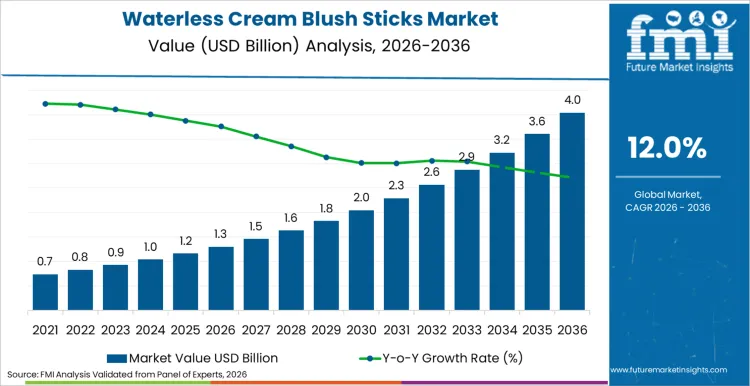
Summary of the Waterless Cream Blush Sticks Market
What Is Growth Outlook for the Waterless Cream Blush Sticks Market as per Future Market Insights Projection?
Future Market Insights projects the waterless cream blush sticks market to grow at a 12.0% CAGR from 2026 to 2036, expanding from USD 1.3 billion in 2026 to USD 4.2 billion by 2036.
FMI Research Approach: FMI proprietary forecasting model based on bottom-up revenue estimation, tracking penetration of waterless and solid-format color cosmetics across makeup portfolios, and demand modeling linked to daily makeup routines, hybrid makeup skincare usage, and portability-driven cosmetics adoption.
How Do FMI Analysts Perceive Waterless Cream Blush Sticks Market to Evolve?
FMI analysts perceive the market evolving from niche eco-conscious and travel-friendly makeup formats toward routine daily complexion use, supported by demand for skin-forward, glow-enhancing, and buildable color formats. Waterless cream blush sticks are increasingly adopted for quick touch-ups, multi-use face applications, and minimal-makeup routines without disrupting existing beauty habits.
FMI Research Approach: Assessment of product positioning centered on skin-forward makeup, expansion of blush sticks within mainstream color cosmetics assortments, and evaluation of consumer acceptance of waterless and solid cosmetic formats across daily beauty routines.
Which Country Holds Largest Share in the Global Waterless Cream Blush Sticks Market?
China holds the largest share of the global waterless cream blush sticks market by value, supported by strong uptake of compact makeup formats, rapid growth of social commerce beauty discovery, and rising demand for portable, waterless cosmetics among urban consumers.
FMI Research Approach: FMI country-level demand assessment across urban beauty consumers, evaluation of frequency of daily makeup usage, and tracking of domestic and international brand expansion across Chinese online beauty platforms and specialty retail.
How Large Will the Waterless Cream Blush Sticks Market Be by 2036?
The global waterless cream blush sticks market is projected to reach USD 4.2 billion by 2036.
FMI Research Approach: FMI long-term forecast by country, product type, formulation, and distribution channel, incorporating scaling assumptions for daily adoption of waterless blush sticks and cross-checking against broader solid color cosmetics growth trends.
What Is Definition of Waterless Cream Blush Sticks Market?
The waterless cream blush sticks market comprises solid, balm, or concentrated cream blush products formulated without added water and delivered in stick formats for direct facial application, targeting complexion enhancement, glow effects, and daily makeup use.
FMI Research Approach: FMI market taxonomy and inclusion-exclusion framework covering blush sticks and multi-use face color sticks, while excluding liquid blushes, compact creams, powder blushes, and conventional water-based face color products.
What Are Globally Unique Trends Shaping Waterless Cream Blush Sticks Market?
Globally unique trends include rising demand for waterless beauty formulations, growth of online retail as the primary discovery channel, and Asia-led adoption driven by China and India. Hybrid makeup skincare positioning and multi-use stick formats are shaping new product development strategies.
FMI Research Approach: Analysis of product-type-level demand shares, formulation preferences across solid and balm formats, distribution channel contribution trends, country-wise growth differentials, and expansion of waterless blush sticks across routine daily makeup usage.
Waterless Cream Blush Sticks Market Key Takeaways
| Metric | Details |
|---|---|
| Industry Size (2026) | USD 1.3 Billion |
| Industry Value (2036) | USD 4.2 Billion |
| CAGR (2026-2036) | 12.0% |
Source: Future Market Insights (FMI) analysis, based on proprietary forecasting model and primary research.
What Is Driving Higher Adoption of Waterless Cream Blush Stick Formats?
Waterless cream blush sticks are moving closer to mainstream adoption as face makeup usage patterns prioritize convenience and controlled application. These products provide consistent color payoff and blend easily, which supports repeated daily use across varied skin types and makeup styles. Historically, stick blush formats were often associated with portability and limited-use scenarios. Their role is broadening as they gain shelf space within conventional blush categories.
Brand portfolio development illustrates this trend. Fenty Beauty treats blush sticks as part of its standard color cosmetics lineup, placing them alongside traditional blush formats rather than as niche accessories. The waterless formulation approach supports compact packaging and stable texture performance. FMI highlights that when blush sticks are positioned as routine makeup options, they benefit from higher visibility and stronger repeat demand within the broader face makeup market.
How Is the Waterless Cream Blush Sticks Market Segmented?
The waterless cream blush sticks market is segmented by product type, formulation, distribution channel, and consumer orientation, reflecting how solid color cosmetics are adopted across everyday makeup routines. By product type, the market spans makeup, skincare-linked color cosmetics, hair care adjacencies, and other solid beauty formats, with makeup-led products including blush sticks, lipsticks, and multi-use face sticks accounting for the largest share due to their routine use in daily complexion enhancement. By formulation, the market includes solid, balm or stick formats, powder-based waterless color products, and oil-based concentrated products, with solid and balm formulations dominating due to ease of application, portability, and skin-friendly textures. By distribution channel, online retail leads category sales, followed by specialty beauty stores, hypermarkets and supermarkets, and department stores, each supporting different discovery and replenishment behaviors. By consumer orientation, women represent the largest share of demand, while men and unisex segments reflect rising participation in minimalist grooming and complexion enhancement routines.
Why Does Makeup Hold a Dominant Share by Product Type?
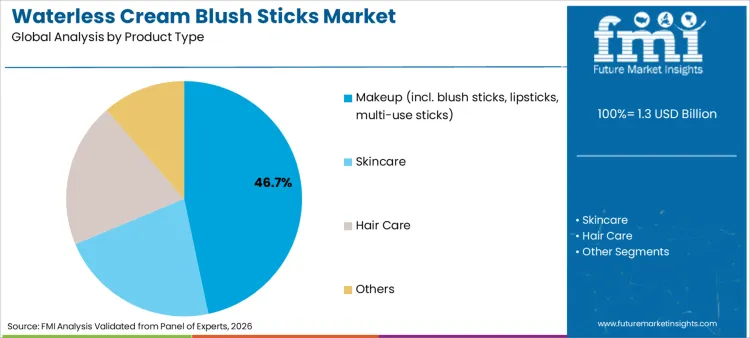
Makeup products, including blush sticks, lipsticks, and multi-use face sticks, account for 46.7% of the waterless cream blush sticks market, reflecting their central role in everyday beauty routines. These formats combine color payoff with skin-conditioning benefits, which supports frequent use across daily makeup, travel, and touch-up occasions. Consumers value stick-based makeup for precision application, reduced mess, and compact packaging that fits mobile lifestyles. Multi-use positioning further increases product utility, as single sticks can serve cheeks, lips, and eyelids, strengthening value perception and encouraging repeat purchase. FMI observes that makeup-led stick formats anchor category demand due to higher usage frequency and stronger emotional attachment to color cosmetics compared with adjacent solid beauty categories.
Why Do Solid, Balm, and Stick Formulations Lead the Market?
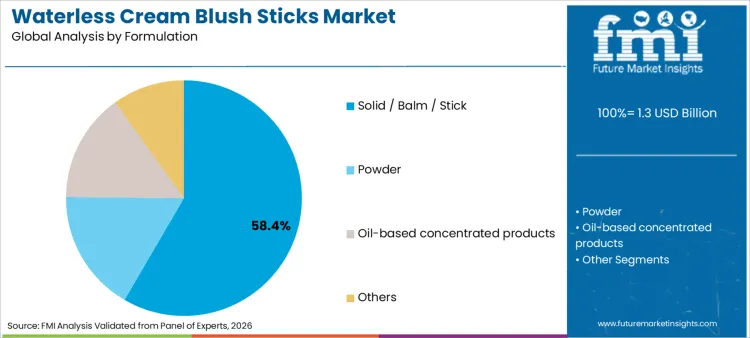
Solid, balm, and stick formulations represent 58.4% of total market share, driven by their compatibility with waterless beauty preferences and convenience-led consumption. These formulations offer smooth glide, buildable color, and skin-forward finishes without the instability associated with water-based emulsions. Balm textures support glow-enhancing effects and are perceived as more nourishing than powders, which appeals to consumers seeking makeup that aligns with skincare benefits. The solid format also improves portability, reduces leakage risk, and extends shelf stability, supporting travel use and on-the-go touch-ups. FMI notes that balm and stick formulations are favored as daily-use complexion products due to their comfort on skin and ease of reapplication across varying environments.
Why Does Online Retail Lead the Distribution Channel?
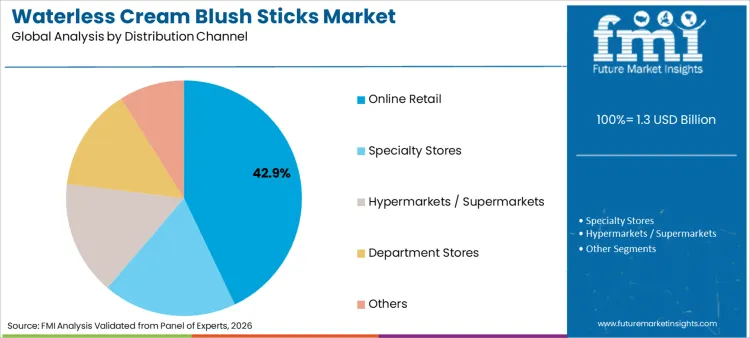
Online retail accounts for 42.9% of waterless cream blush stick sales, reflecting the category’s strong alignment with digital beauty discovery and replenishment behaviors. Stick-based makeup products are compact, durable, and low-risk to ship, which lowers logistics constraints compared with liquid cosmetics. Digital platforms enable visual demonstration through tutorials, influencer content, and shade-matching tools, which accelerates consumer confidence in purchase decisions. Online retail also supports rapid trial of new launches and convenient replenishment of frequently used shades. Specialty beauty stores remain important for shade testing and experiential discovery, while hypermarkets, supermarkets, and department stores support impulse purchases and routine restocking. FMI notes that online channels continue to dominate as consumers prioritize convenience, product comparison, and access to niche waterless beauty formats.
Why Do Women Represent the Largest Consumer Orientation Segment?
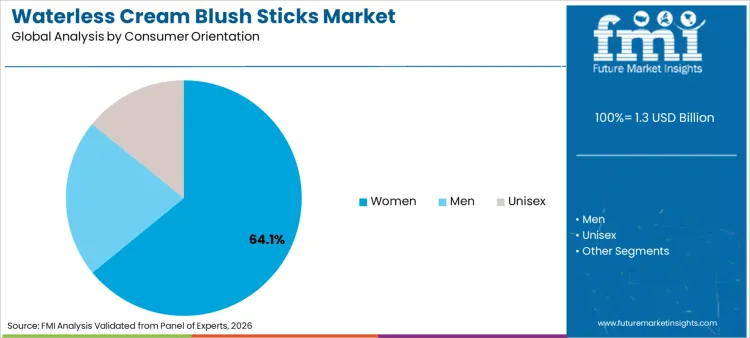
Women account for 64.1% of total demand, reflecting higher frequency of blush and complexion product usage within daily beauty routines. Stick-based blush formats appeal to women seeking quick, natural-looking flush, skin-forward finishes, and minimal-effort application. These products integrate easily into multi-step or minimalist routines, supporting repeat use across work, travel, and social settings. At the same time, men and unisex segments are expanding as grooming norms evolve and multifunctional makeup gains acceptance. FMI observes that while women anchor category volume, unisex positioning is gaining relevance as brands promote subtle complexion enhancement and skin-health-aligned makeup narratives.
Which Market Shifts Are Advancing Waterless Blush Stick Formats?
Waterless cream blush sticks are gaining wider acceptance as makeup routines increasingly favor compact formats that support precise application and cleaner handling than liquid blushes. Stick formats enable controlled color placement on cheeks and facial contours while reducing mess during use. Earlier, blush sticks were positioned mainly for travel convenience, which constrained their role in daily routines. That positioning is changing as these products gain shelf presence within mainstream face makeup assortments. Beauty brands are increasingly positioning waterless blush sticks for routine complexion use rather than limited touch-ups. Market data from FMI indicates that compact packaging and tool-free application are supporting higher trial and repeat usage, enabling these formats to function as everyday alternatives to liquid and powder blushes.
How Is Range Expansion Strengthening Color Cosmetics Portfolios?
Range expansion is strengthening competitive positioning as brands embed waterless blush sticks within broader face makeup assortments. These formats are being added alongside liquid blushes and pressed powders to expand application choices without shifting shade architectures. This integration improves consistency across product families and strengthens distribution coverage across retail channels. FMI notes that when blush sticks are positioned as part of core makeup ranges, trial barriers decline as consumers recognize familiar shades and performance claims. Portfolio alignment also improves merchandising coherence in physical stores and digital platforms, supporting stronger visibility for stick formats. As a result, blush sticks are benefiting from the same promotional and placement strategies used for established blush products, which is improving adoption rates across mass and prestige beauty segments.
What Role Does Texture Optimization Play in Product Differentiation?
Texture optimization is becoming a key differentiator as manufacturers refine waterless blush stick formulations to deliver smooth glide and stable color adherence. Stick formats require careful balancing of waxes, oils, and pigment dispersion systems to ensure even blending and consistent finish. Minor formulation changes can influence wear behavior, skin feel, and performance across humid or dry climates. FMI highlights that rising competition is encouraging tighter formulation control to support predictable application across diverse skin types. This focus on formulation discipline is improving performance reliability, which supports consumer confidence in repeat use. As formulation quality improves, waterless blush sticks are being positioned as dependable daily-use makeup options rather than novelty products tied to convenience-led purchasing.
What Is the Country-wise Outlook for the Waterless Cream Blush Sticks Market?
Country-level growth in waterless cream blush sticks varies by makeup culture, climate, and adoption of compact beauty formats. China leads with 16.2% CAGR, driven by strong demand for portable, targeted makeup solutions aligned with fast-paced urban lifestyles. India follows at 15.0%, supported by expanding beauty consumption and rising preference for lightweight, travel-friendly formats. Germany records 13.8%, reflecting structured makeup routines and openness to hybrid textures. Brazil grows at 12.6%, supported by frequent makeup use in warm climates. The United States posts 11.4%, showing steady expansion in a mature cosmetics market. The United Kingdom reaches 10.2%, while Japan trails at 9.0%, shaped by conservative format adoption.
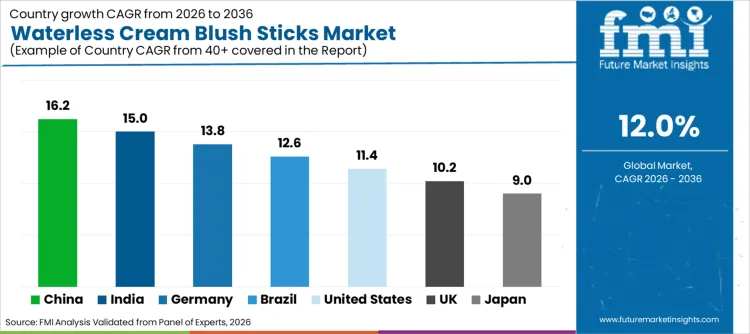
| Country | CAGR (2026 to 2036) |
|---|---|
| China | 16.2% |
| India | 15.0% |
| Germany | 13.8% |
| Brazil | 12.6% |
| United States | 11.4% |
| UK | 10.2% |
| Japan | 9.0% |
Source: FMI historical analysis and forecast data.
Why Is China Leading Growth in Waterless Cream Blush Sticks?
China’s 16.2% CAGR is supported by high engagement with compact, multifunctional beauty formats among urban consumers. Waterless blush sticks fit well with routines that prioritize portability, quick application, and minimal product waste. Strong e-commerce penetration accelerates discovery and repeat purchasing, while social media-driven beauty trends encourage experimentation with new textures and formats. Usage is centered on targeted application for daily wear rather than full-face makeup. Growth is shaped by rising frequency of use and substitution from liquid blushes for convenience-focused routines. As consumers favor efficient, easy-to-carry makeup products, waterless blush sticks are becoming integrated into everyday complexion routines.
What Is Supporting Growth in India’s Waterless Cream Blush Stick Market?
India’s 15.0% CAGR reflects expanding urban beauty awareness and growing acceptance of compact makeup formats. Waterless blush sticks appeal due to ease of storage, portability, and suitability for warm climates where liquid products can feel heavy. Younger consumers favor stick formats for quick application during daily routines, supporting repeat usage. Online retail platforms are widening access beyond major cities, encouraging trial across emerging urban centers. Market activity reflects this shift, with Lakmé expanding stick-format face makeup products within its complexion portfolio, positioned for everyday use. Growth is reinforced by rising participation in daily makeup routines and preference for convenient formats that fit established beauty habits, supporting steady adoption across diverse consumer groups.
Why Is Germany Showing Consistent Expansion in Blush Sticks?
Germany’s 13.8% CAGR reflects preference for functional, well-defined makeup formats that support controlled application. Consumers value product reliability, clean handling, and predictable performance, which aligns with waterless blush stick usage. Adoption is steady and deliberate, with consumers integrating stick formats into existing routines rather than replacing powders or liquids entirely. Retail visibility and structured product positioning support gradual uptake across specialty beauty and pharmacy channels. Growth is driven by performance consistency and ease of use rather than trend-led experimentation. This measured adoption pattern supports sustained expansion as blush sticks gain recognition as practical alternatives within routine face makeup use.
What Is Driving Growth in Brazil’s Waterless Cream Blush Sticks Market?
Warm and humid conditions across major Brazilian cities, reflected in a projected 12.6% CAGR, encourage frequent makeup touch-ups during the day and favor compact, stable color cosmetics formats. Waterless blush sticks maintain texture integrity in higher temperatures, making them practical for repeated application without mess. Urban consumers increasingly prefer products that fit easily into handbags for work and social settings. Expanded availability through e-commerce platforms and specialty beauty retailers is improving product discovery and supporting repeat purchasing. Market activity reflects this shift, with major industry players highlighting growing engagement with portable face makeup formats in recent corporate communications. Blush sticks continue to be used alongside powders and liquids for targeted application, supporting steady category expansion without disrupting established makeup preferences.
Why Is Growth More Moderate in the United States?
The United States posts 11.4% CAGR, reflecting measured adoption within a mature cosmetics market where liquid and powder blush formats continue to dominate daily routines. Waterless cream blush sticks are often added for convenience, portability, and quick touch-ups rather than replacing established products used for full-face application. Strong brand loyalty and habitual purchasing patterns slow rapid switching toward newer formats. Digital retail and specialty beauty stores support steady trial and replenishment, though usage remains concentrated among convenience-driven consumers. As familiarity with stick formats increases and product performance continues to improve, adoption progresses at a stable pace without causing major disruption to entrenched blush category preferences.
What Is the Competitive Outlook for the Waterless Cream Blush Sticks Market?
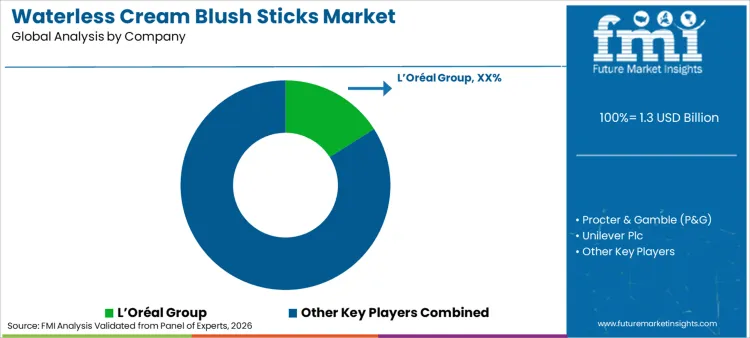
Competition in the waterless cream blush sticks market reflects a mix of multinational beauty groups and smaller clean-beauty specialists seeking relevance through format innovation. Established conglomerates like L’Oréal and Coty leverage scale and channel access to introduce stick-based products as extensions of existing complexion lines. Competitive positioning is less about replacing liquid blushes and more about providing additional format choices within everyday routines.
According to FMI, performance consistency and user experience are emerging as primary differentiators. While mass-market leaders focus on accessibility, brands like Loli Beauty emphasize waterless product design and sustainability-driven positioning. This contrast highlights how both scale-driven and values-led strategies coexist within the segment. Over time, competitive strength is likely to favor brands that integrate waterless blush sticks into regular face makeup usage rather than treating them as experimental product formats.
Recent Developments:
- In June 2024, The Estée Lauder Companies completed its acquisition of DECIEM, buying remaining interests for about USD 860 million in cash, taking total net investment to roughly USD 1.7 billion, and fully integrating the vertically integrated, multi-brand Canadian beauty group.
- In January 2025, Hindustan Unilever Limited announced a definitive agreement to acquire Minimalist, strengthening its Beauty & Wellbeing portfolio and accelerating expansion into premium, actives-led skincare and higher-growth beauty segments.
Key Players in Waterless Cream Blush Sticks Market
- L’Oréal Group
- Procter & Gamble (P&G)
- Unilever Plc
- Beiersdorf AG
- Pinch of Colour LLC
- Ruby’s Organics
- Clensta
- Loli Beauty
- Ethique
Market Definition
The waterless cream blush sticks market captures revenue from solid-format cheek color products formulated without added water and designed for direct, on-skin application. In this assessment, the market covers commercially available blush sticks positioned for everyday cheek tinting, natural flush enhancement, skin-comfort finishes, or multi-use complexion color within routine makeup use. Market sizing reflects the value of finished consumer products sold through physical retail and online platforms, analyzed by finish type, sales channel, and region, and reported in USD billion.
The scope includes waterless cream blush sticks developed for natural, dewy, satin, or soft-matte finishes, skin-conditioning color delivery, and long-wear or blendable textures. Products intended for localized use on areas such as cheeks, cheekbones, temples, and lips are included when marketed specifically as blush sticks. Sales through e-commerce platforms, specialty cosmetic retailers, department stores, mass retail chains, and beauty boutiques are counted. Geographic coverage spans North America, Europe, Asia Pacific, Latin America, and the Middle East & Africa.
The market excludes powder blushes, liquid blushes, water-based cream blushes, tint drops, cheek stains, lip-and-cheek tints not positioned primarily as blush sticks, contour-only sticks, and professional backstage makeup products sold exclusively through non-retail channels. Revenues from bulk pigments, cosmetic raw materials, private-label contract manufacturing, packaging components, and logistics services are excluded. Products sold solely for professional makeup artistry, theatrical use, or salon-exclusive application without mainstream retail availability fall outside the defined market scope.
Scope of Report
| Items | Values |
|---|---|
| Quantitative Units (2026) | USD 1.3 Billion |
| Product Type | Makeup (incl. blush sticks, lipsticks, multi-use sticks); Skincare; Haircare; Others |
| Formulation | Solid / Balm / Stick; Oil-based concentrated products; Powder (limited presence); Others |
| Distribution Channel | Online Retail; Specialty Stores; Hypermarkets / Supermarkets; Department Stores; Others |
| Consumer Orientation | Women; Men; Unisex |
| Regions Covered | North America, Europe, Asia Pacific, Latin America, Middle East & Africa |
| Countries Covered | United States, Germany, United Kingdom, India, China, Brazil, and 40+ countries |
| Key Companies Profiled | L’Oréal Group; Procter & Gamble (P&G); Unilever Plc; Beiersdorf AG; Pinch of Colour LLC; Ruby’s Organics; Clensta; Loli Beauty; Ethique |
| Additional Attributes | Dollar sales by product type, formulation, and distribution channel; country-wise growth analysis; adoption trends for waterless and solid-format blush sticks; usage patterns across everyday makeup and hybrid makeup-skincare routines; competitive brand positioning across mass, masstige, premium, and clean beauty channels |
Source: FMI historical analysis and forecast data
Waterless Cream Blush Sticks Market by Segments
By Product Type:
- Makeup (incl. blush sticks, lipsticks, multi-use sticks)
- Skincare
- Hair Care
- Others
By Formulation:
- Solid / Balm / Stick
- Powder
- Oil-based concentrated products
- Others
By Distribution Channel:
- Online Retail
- Specialty Stores
- Hypermarkets / Supermarkets
- Department Stores
- Others
By Consumer Orientation:
- Women
- Men
- Unisex
By Region:
- North America
- Europe
- Asia Pacific
- Latin America
- Middle East & Africa
Bibliography
- Westman Atelier. (2025). Baby Cheeks Blush Stick: "Garçonne" Product Campaign & Verified Consumer Reviews (March 2025). (Source for the 2025 shade expansion and ingredient claims).
- ATTITUDE Living. (2026). Oceanly™ Plastic-Free Beauty Collection: 2025/2026 Product Portfolio. (Source for the "solid format" and "plastic-free" market positioning verified by 2026 consumer data).
- Women's Health UK. (2025). Best Blush of 2025: Tested & Reviewed. (Source for the category dominance of Haus Labs and the "glassy" finish trend).
Frequently Asked Questions
How big is the waterless cream blush sticks market in 2026?
The global waterless cream blush sticks market is estimated to be valued at USD 1.3 billion in 2026.
What will be the size of waterless cream blush sticks market in 2036?
The market size for the waterless cream blush sticks market is projected to reach USD 4.0 billion by 2036.
How much will be the waterless cream blush sticks market growth between 2026 and 2036?
The waterless cream blush sticks market is expected to grow at a 12.0% CAGR between 2026 and 2036.
What are the key product types in the waterless cream blush sticks market?
The key product types in waterless cream blush sticks market are makeup (incl. blush sticks, lipsticks, multi-use sticks), skincare, hair care and others.
Which formulation segment to contribute significant share in the waterless cream blush sticks market in 2026?
In terms of formulation, solid / balm / stick segment to command 58.4% share in the waterless cream blush sticks market in 2026.
Preview the report firsthand - request a free sample
Get SampleGet the brochure for pricing and purchase details.
Get PDFTable of Content
- Executive Summary
- Global Market Outlook
- Demand-side Trends
- Supply-side Trends
- Technology Roadmap Analysis
- Analysis and Recommendations
- Market Overview
- Market Coverage / Taxonomy
- Market Definition / Scope / Limitations
- Market Background
- Market Dynamics
- Drivers
- Restraints
- Opportunity
- Trends
- Scenario Forecast
- Demand in Optimistic Scenario
- Demand in Likely Scenario
- Demand in Conservative Scenario
- Opportunity Map Analysis
- Product Life Cycle Analysis
- Supply Chain Analysis
- Investment Feasibility Matrix
- Value Chain Analysis
- PESTLE and Porter’s Analysis
- Regulatory Landscape
- Regional Parent Market Outlook
- Production and Consumption Statistics
- Import and Export Statistics
- Market Dynamics
- Global Market Analysis 2021 to 2025 and Forecast, 2026 to 2036
- Historical Market Size Value (USD Million) Analysis, 2021 to 2025
- Current and Future Market Size Value (USD Million) Projections, 2026 to 2036
- Y-o-Y Growth Trend Analysis
- Absolute $ Opportunity Analysis
- Global Market Pricing Analysis 2021 to 2025 and Forecast 2026 to 2036
- Global Market Analysis 2021 to 2025 and Forecast 2026 to 2036, By Product Type
- Introduction / Key Findings
- Historical Market Size Value (USD Million) Analysis By Product Type , 2021 to 2025
- Current and Future Market Size Value (USD Million) Analysis and Forecast By Product Type , 2026 to 2036
- Makeup (incl. blush sticks, lipsticks, multi-use sticks)
- Skincare
- Hair Care
- Others
- Makeup (incl. blush sticks, lipsticks, multi-use sticks)
- Y-o-Y Growth Trend Analysis By Product Type , 2021 to 2025
- Absolute $ Opportunity Analysis By Product Type , 2026 to 2036
- Global Market Analysis 2021 to 2025 and Forecast 2026 to 2036, By Formulation
- Introduction / Key Findings
- Historical Market Size Value (USD Million) Analysis By Formulation, 2021 to 2025
- Current and Future Market Size Value (USD Million) Analysis and Forecast By Formulation, 2026 to 2036
- Solid / Balm / Stick
- Powder
- Oil-based concentrated products
- Others
- Solid / Balm / Stick
- Y-o-Y Growth Trend Analysis By Formulation, 2021 to 2025
- Absolute $ Opportunity Analysis By Formulation, 2026 to 2036
- Global Market Analysis 2021 to 2025 and Forecast 2026 to 2036, By Distribution Channel
- Introduction / Key Findings
- Historical Market Size Value (USD Million) Analysis By Distribution Channel, 2021 to 2025
- Current and Future Market Size Value (USD Million) Analysis and Forecast By Distribution Channel, 2026 to 2036
- Online Retail
- Specialty Stores
- Hypermarkets / Supermarkets
- Department Stores
- Others
- Online Retail
- Y-o-Y Growth Trend Analysis By Distribution Channel, 2021 to 2025
- Absolute $ Opportunity Analysis By Distribution Channel, 2026 to 2036
- Global Market Analysis 2021 to 2025 and Forecast 2026 to 2036, By Consumer Orientation
- Introduction / Key Findings
- Historical Market Size Value (USD Million) Analysis By Consumer Orientation, 2021 to 2025
- Current and Future Market Size Value (USD Million) Analysis and Forecast By Consumer Orientation, 2026 to 2036
- Women
- Men
- Unisex
- Women
- Y-o-Y Growth Trend Analysis By Consumer Orientation, 2021 to 2025
- Absolute $ Opportunity Analysis By Consumer Orientation, 2026 to 2036
- Global Market Analysis 2021 to 2025 and Forecast 2026 to 2036, By Region
- Introduction
- Historical Market Size Value (USD Million) Analysis By Region, 2021 to 2025
- Current Market Size Value (USD Million) Analysis and Forecast By Region, 2026 to 2036
- North America
- Latin America
- Western Europe
- Eastern Europe
- East Asia
- South Asia and Pacific
- Middle East & Africa
- Market Attractiveness Analysis By Region
- North America Market Analysis 2021 to 2025 and Forecast 2026 to 2036, By Country
- Historical Market Size Value (USD Million) Trend Analysis By Market Taxonomy, 2021 to 2025
- Market Size Value (USD Million) Forecast By Market Taxonomy, 2026 to 2036
- By Country
- USA
- Canada
- Mexico
- By Product Type
- By Formulation
- By Distribution Channel
- By Consumer Orientation
- By Country
- Market Attractiveness Analysis
- By Country
- By Product Type
- By Formulation
- By Distribution Channel
- By Consumer Orientation
- Key Takeaways
- Latin America Market Analysis 2021 to 2025 and Forecast 2026 to 2036, By Country
- Historical Market Size Value (USD Million) Trend Analysis By Market Taxonomy, 2021 to 2025
- Market Size Value (USD Million) Forecast By Market Taxonomy, 2026 to 2036
- By Country
- Brazil
- Chile
- Rest of Latin America
- By Product Type
- By Formulation
- By Distribution Channel
- By Consumer Orientation
- By Country
- Market Attractiveness Analysis
- By Country
- By Product Type
- By Formulation
- By Distribution Channel
- By Consumer Orientation
- Key Takeaways
- Western Europe Market Analysis 2021 to 2025 and Forecast 2026 to 2036, By Country
- Historical Market Size Value (USD Million) Trend Analysis By Market Taxonomy, 2021 to 2025
- Market Size Value (USD Million) Forecast By Market Taxonomy, 2026 to 2036
- By Country
- Germany
- UK
- Italy
- Spain
- France
- Nordic
- BENELUX
- Rest of Western Europe
- By Product Type
- By Formulation
- By Distribution Channel
- By Consumer Orientation
- By Country
- Market Attractiveness Analysis
- By Country
- By Product Type
- By Formulation
- By Distribution Channel
- By Consumer Orientation
- Key Takeaways
- Eastern Europe Market Analysis 2021 to 2025 and Forecast 2026 to 2036, By Country
- Historical Market Size Value (USD Million) Trend Analysis By Market Taxonomy, 2021 to 2025
- Market Size Value (USD Million) Forecast By Market Taxonomy, 2026 to 2036
- By Country
- Russia
- Poland
- Hungary
- Balkan & Baltic
- Rest of Eastern Europe
- By Product Type
- By Formulation
- By Distribution Channel
- By Consumer Orientation
- By Country
- Market Attractiveness Analysis
- By Country
- By Product Type
- By Formulation
- By Distribution Channel
- By Consumer Orientation
- Key Takeaways
- East Asia Market Analysis 2021 to 2025 and Forecast 2026 to 2036, By Country
- Historical Market Size Value (USD Million) Trend Analysis By Market Taxonomy, 2021 to 2025
- Market Size Value (USD Million) Forecast By Market Taxonomy, 2026 to 2036
- By Country
- China
- Japan
- South Korea
- By Product Type
- By Formulation
- By Distribution Channel
- By Consumer Orientation
- By Country
- Market Attractiveness Analysis
- By Country
- By Product Type
- By Formulation
- By Distribution Channel
- By Consumer Orientation
- Key Takeaways
- South Asia and Pacific Market Analysis 2021 to 2025 and Forecast 2026 to 2036, By Country
- Historical Market Size Value (USD Million) Trend Analysis By Market Taxonomy, 2021 to 2025
- Market Size Value (USD Million) Forecast By Market Taxonomy, 2026 to 2036
- By Country
- India
- ASEAN
- Australia & New Zealand
- Rest of South Asia and Pacific
- By Product Type
- By Formulation
- By Distribution Channel
- By Consumer Orientation
- By Country
- Market Attractiveness Analysis
- By Country
- By Product Type
- By Formulation
- By Distribution Channel
- By Consumer Orientation
- Key Takeaways
- Middle East & Africa Market Analysis 2021 to 2025 and Forecast 2026 to 2036, By Country
- Historical Market Size Value (USD Million) Trend Analysis By Market Taxonomy, 2021 to 2025
- Market Size Value (USD Million) Forecast By Market Taxonomy, 2026 to 2036
- By Country
- Kingdom of Saudi Arabia
- Other GCC Countries
- Turkiye
- South Africa
- Other African Union
- Rest of Middle East & Africa
- By Product Type
- By Formulation
- By Distribution Channel
- By Consumer Orientation
- By Country
- Market Attractiveness Analysis
- By Country
- By Product Type
- By Formulation
- By Distribution Channel
- By Consumer Orientation
- Key Takeaways
- Key Countries Market Analysis
- USA
- Pricing Analysis
- Market Share Analysis, 2025
- By Product Type
- By Formulation
- By Distribution Channel
- By Consumer Orientation
- Canada
- Pricing Analysis
- Market Share Analysis, 2025
- By Product Type
- By Formulation
- By Distribution Channel
- By Consumer Orientation
- Mexico
- Pricing Analysis
- Market Share Analysis, 2025
- By Product Type
- By Formulation
- By Distribution Channel
- By Consumer Orientation
- Brazil
- Pricing Analysis
- Market Share Analysis, 2025
- By Product Type
- By Formulation
- By Distribution Channel
- By Consumer Orientation
- Chile
- Pricing Analysis
- Market Share Analysis, 2025
- By Product Type
- By Formulation
- By Distribution Channel
- By Consumer Orientation
- Germany
- Pricing Analysis
- Market Share Analysis, 2025
- By Product Type
- By Formulation
- By Distribution Channel
- By Consumer Orientation
- UK
- Pricing Analysis
- Market Share Analysis, 2025
- By Product Type
- By Formulation
- By Distribution Channel
- By Consumer Orientation
- Italy
- Pricing Analysis
- Market Share Analysis, 2025
- By Product Type
- By Formulation
- By Distribution Channel
- By Consumer Orientation
- Spain
- Pricing Analysis
- Market Share Analysis, 2025
- By Product Type
- By Formulation
- By Distribution Channel
- By Consumer Orientation
- France
- Pricing Analysis
- Market Share Analysis, 2025
- By Product Type
- By Formulation
- By Distribution Channel
- By Consumer Orientation
- India
- Pricing Analysis
- Market Share Analysis, 2025
- By Product Type
- By Formulation
- By Distribution Channel
- By Consumer Orientation
- ASEAN
- Pricing Analysis
- Market Share Analysis, 2025
- By Product Type
- By Formulation
- By Distribution Channel
- By Consumer Orientation
- Australia & New Zealand
- Pricing Analysis
- Market Share Analysis, 2025
- By Product Type
- By Formulation
- By Distribution Channel
- By Consumer Orientation
- China
- Pricing Analysis
- Market Share Analysis, 2025
- By Product Type
- By Formulation
- By Distribution Channel
- By Consumer Orientation
- Japan
- Pricing Analysis
- Market Share Analysis, 2025
- By Product Type
- By Formulation
- By Distribution Channel
- By Consumer Orientation
- South Korea
- Pricing Analysis
- Market Share Analysis, 2025
- By Product Type
- By Formulation
- By Distribution Channel
- By Consumer Orientation
- Russia
- Pricing Analysis
- Market Share Analysis, 2025
- By Product Type
- By Formulation
- By Distribution Channel
- By Consumer Orientation
- Poland
- Pricing Analysis
- Market Share Analysis, 2025
- By Product Type
- By Formulation
- By Distribution Channel
- By Consumer Orientation
- Hungary
- Pricing Analysis
- Market Share Analysis, 2025
- By Product Type
- By Formulation
- By Distribution Channel
- By Consumer Orientation
- Kingdom of Saudi Arabia
- Pricing Analysis
- Market Share Analysis, 2025
- By Product Type
- By Formulation
- By Distribution Channel
- By Consumer Orientation
- Turkiye
- Pricing Analysis
- Market Share Analysis, 2025
- By Product Type
- By Formulation
- By Distribution Channel
- By Consumer Orientation
- South Africa
- Pricing Analysis
- Market Share Analysis, 2025
- By Product Type
- By Formulation
- By Distribution Channel
- By Consumer Orientation
- USA
- Market Structure Analysis
- Competition Dashboard
- Competition Benchmarking
- Market Share Analysis of Top Players
- By Regional
- By Product Type
- By Formulation
- By Distribution Channel
- By Consumer Orientation
- Competition Analysis
- Competition Deep Dive
- L’Oréal Group
- Overview
- Product Portfolio
- Profitability by Market Segments (Product/Age /Sales Channel/Region)
- Sales Footprint
- Strategy Overview
- Marketing Strategy
- Product Strategy
- Channel Strategy
- Procter & Gamble (P&G)
- Unilever Plc
- Beiersdorf AG
- Pinch of Colour LLC
- Ruby’s Organics
- Clensta
- Loli Beauty
- Ethique
- L’Oréal Group
- Competition Deep Dive
- Assumptions & Acronyms Used
- Research Methodology


