

- Industry Size (2026)
- USD 540.0 Mn
- Forecast (2036)
- USD 1102.6 Mn
- CAGR (2026 to 2036)
- 7.4%
Waterless Car Wash Kits Market Forecast and Outlook 2026 to 2036
The waterless car wash kits market is likely to be valued at USD 540.0 million in 2026, and reach USD 1,102.6 million by 2036, at 7.4% CAGR. Expansion reflects structural shifts in vehicle maintenance practices rather than substitution of conventional washing alone. Demand concentrates where water availability, residential washing restrictions, and time constraints limit hose-based cleaning. Urban vehicle density, apartment living, and street parking increase relevance of portable, low-runoff solutions for routine exterior upkeep. Value realization depends on formulation lubrication, surface safety, and consistency of results, since improper use elevates risk of paint marring and erodes user confidence.
Growth remains bounded by functional limitations inherent to waterless cleaning. Products perform best under light to moderate soiling, restricting use after heavy rain, off-road exposure, or seasonal grime buildup. Outcome variability across formulations and microfiber quality affects repeat purchase behavior. Consumable costs rise with frequent cloth replacement, influencing cost sensitivity among high-usage users. Regulatory attention to chemical residues and labeling affects formulation flexibility across regions. Adoption therefore scales with water stress severity, urban practicality, and maintenance convenience priorities rather than replacement of full-service washing or premium detailing workflows.
Quick Stats for Waterless Car Wash Kits Market
- Waterless Car Wash Kits Market Value (2026): USD 540.0 million
- Waterless Car Wash Kits Market Forecast Value (2036): USD 1,102.6 million
- Waterless Car Wash Kits Market Forecast CAGR 2026 to 2036: 7.4%
- Leading Product Type by Demand Share: Waterless Wash Sprays
- Top Countries Driving Growth: India, China, Mexico, Brazil, South Africa
- Top Players in Global Demand: Optimum Polymer Technologies, Aero Cosmetics, 3D Car Care, Meguiar's, Turtle Wax
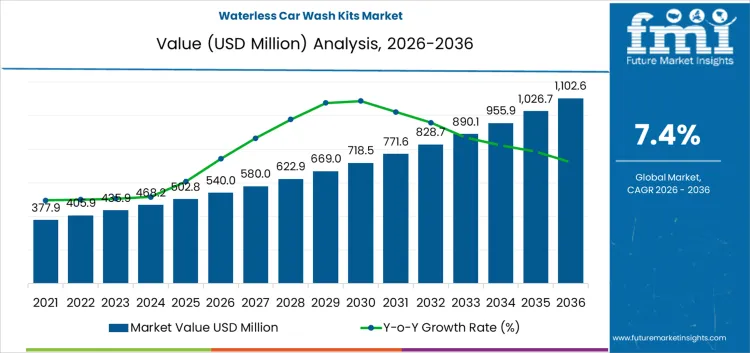
Waterless Car Wash Kits Market Key Takeaways
| Metric | Value |
|---|---|
| Market Value (2026) | USD 540.0 million |
| Market Forecast Value (2036) | USD 1,102.6 million |
| Forecast CAGR (2026-2036) | 7.4% |
Why is the Demand for Waterless Car Wash Kits Growing?
Demand for waterless car wash kits is increasing as vehicle owners and professional detailers seek efficient cleaning solutions that reduce water use while maintaining exterior finish quality. Waterless kits combine high-lubricity spray formulas with microfiber applicators to safely lift dirt, brake dust, and road film from painted surfaces without requiring a traditional wash station or hose connection. Consumers specify products with streak-free drying and protective polymer additives because these features deliver visible surface clarity and residual protective benefits without introducing swirl marks or abrasion. Procurement decisions focus on cleaning efficacy, compatibility with clear coat and ceramic coatings, and ease of use in urban and residential settings where water access may be restricted by supply limitations or municipal regulations.
Growth in urban vehicle ownership and heightened environmental awareness about water conservation supports adoption among drivers who wish to reduce consumption during routine maintenance. Aftermarket detailers and mobile car care services also drive uptake of waterless car wash kits because they enable rapid service delivery without setup of water logistics, minimizing time and operational cost. Product formulations that maintain surface lubrication during contact reduce risk of micro-scratches and support repeated use across varied vehicle colors and finishes. Retailers maintain inventories that align with seasonal demand peaks and promotional cycles to ensure availability for consumer and professional buyers. These performance-driven and sustainability-oriented factors are contributing to sustained demand growth in the waterless car wash kits market.
How Are the Segments Classified in the Waterless Car Wash Kits Market?
Demand for waterless car wash kits is shaped by water conservation priorities, urban washing restrictions, and convenience-focused vehicle maintenance practices. Vehicle owners seek cleaning solutions that minimize water usage while maintaining surface appearance and protection. Adoption aligns with drought awareness, limited access to washing infrastructure, and growth of do-it-yourself vehicle care. Product selection prioritizes cleaning effectiveness, surface safety, and ease of use. Segment classification reflects differentiation by kit formulation, user category, and packaging format influencing usage frequency, consumption volume, and purchasing behavior.
Which Product Type Represents the Largest Share of Demand?
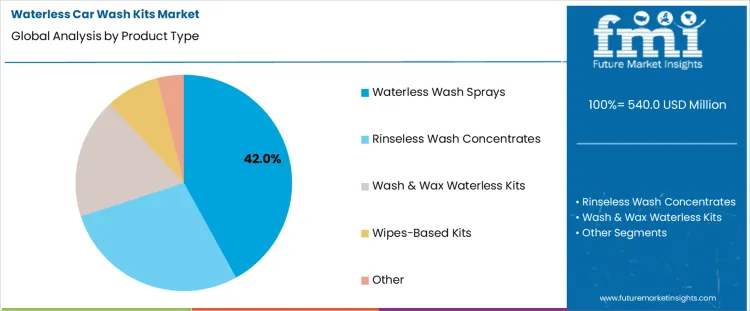
Waterless wash sprays hold 42.0%, representing the largest share among product types due to ready-to-use convenience. Spray formulations allow direct application without dilution or additional equipment. Quick cleaning capability suits routine maintenance between traditional washes. Portability supports use in residential parking areas and urban settings. Rinseless wash concentrates require mixing with water, adding preparation steps. Wash and wax kits combine cleaning and protection with moderate effort. Wipes-based kits address spot cleaning with limited surface coverage. Product type segmentation reflects preference for simple, immediate-use solutions supporting frequent vehicle upkeep.
Key Points
- Spray formats enable quick and simple application.
- Ready-to-use design supports frequent maintenance.
- Other products require preparation or target limited use.
Which End User Accounts for the Highest Share of Demand?
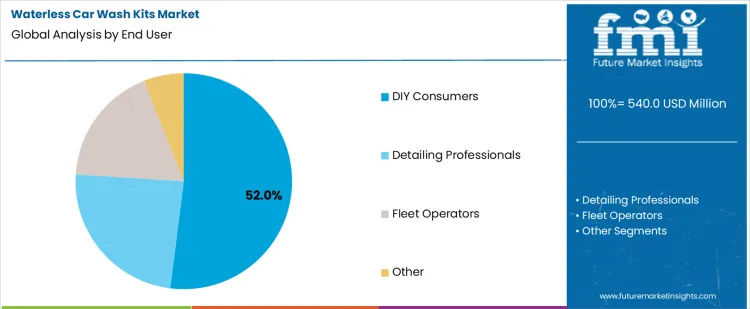
DIY consumers hold 52.0%, representing the largest share among end-user categories due to accessibility. Home users adopt waterless solutions to comply with water restrictions and reduce washing time. Cost savings compared with professional services encourage self-use. Online tutorials and product instructions support confidence in application. Detailing professionals use waterless kits for mobile services with selective deployment. Fleet operators apply solutions for interim cleaning with efficiency focus. End-user segmentation reflects dominance of individual vehicle owners where convenience, compliance, and affordability drive adoption.
Key Points
- DIY users seek convenient and water-saving solutions.
- Cost efficiency supports self-application preference.
- Other users apply kits for professional or fleet needs.
Which Packaging Format Drives the Largest Share of Demand?
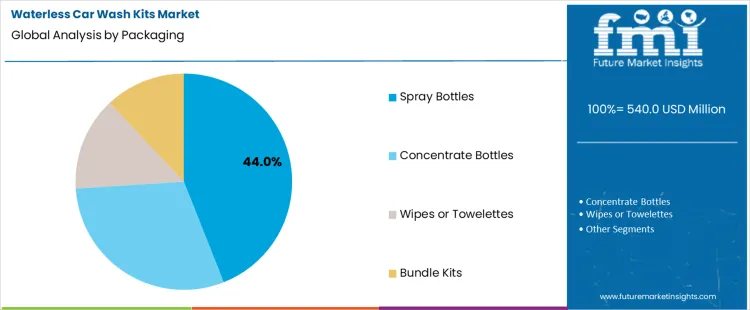
Spray bottles hold 44.0%, representing the largest share among packaging formats due to ease of handling. Integrated spray mechanisms support controlled product application and reduced waste. Lightweight packaging enhances portability and storage convenience. Standard bottle sizes align with retail distribution formats. Concentrate bottles support cost efficiency with added dilution steps. Wipes or towelettes provide portability with limited cleaning capacity. Bundle kits combine multiple products for comprehensive care. Packaging segmentation reflects preference for formats enabling precise application, convenience, and compatibility with common retail channels.
Key Points
- Spray bottles support controlled and efficient application.
- Portability aligns with urban and residential use.
- Other formats emphasize cost savings or bundled solutions.
What are the Key Dynamics in the Waterless Car Wash Kits Market?
Demand for waterless car wash kits reflects vehicle cleaning requirements under water use constraints and urban maintenance conditions. Adoption concentrates in passenger vehicles, urban fleets, detailing services, and regions facing water scarcity or usage regulation. Global scope aligns with environmental compliance and convenience-driven vehicle care practices. Usage centers on spray-and-wipe formulations combining surfactants, lubricants, and polymers to lift and encapsulate surface dirt without rinsing.
How does water conservation need and urban vehicle usage patterns shape adoption?
Urban vehicle owners face restrictions on hose-based washing due to water scarcity regulations and limited access to private washing space. Demand increases where apartment living, street parking, and drought controls limit conventional washing. Waterless kits enable spot cleaning and full exterior maintenance without runoff or drainage infrastructure. Fleet operators adopt kits to maintain appearance across frequent stops without relocating vehicles. Lubricant-rich formulations reduce scratch risk during low-soil cleaning scenarios. Quick application supports frequent light cleaning between conventional washes. Environmental positioning supports adoption in municipalities promoting reduced water consumption. Adoption reflects operational convenience and regulatory alignment rather than replacement of deep cleaning processes.
How do cleaning limitations, surface risk, and cost sensitivity influence market scalability?
Waterless kits remain unsuitable for heavily soiled vehicles due to abrasion risk from particulate load. Demand sensitivity rises where improper use causes swirl marks or paint marring. Performance varies across formulations and wiping materials, affecting outcome consistency. Repeated microfiber replacement increases operating cost. Consumer trust depends on clear usage guidance and surface condition awareness. Pricing pressure remains high due to perceived low formulation complexity. Chemical residue buildup affects long-term surface behavior. Regulatory scrutiny of chemical runoff and labeling affects distribution. Seasonal dirt variation limits year-round reliance, constraining scalable adoption across all vehicle maintenance scenarios.
How Is Demand for Waterless Car Wash Kits Evolving Globally?
Demand for waterless car wash kits is expanding globally due to water conservation priorities, urban living constraints, and convenience-driven vehicle maintenance. Adoption aligns with regions facing water scarcity, limited access to washing infrastructure, and restrictions on residential water use. Fleet operators and individual owners prioritize quick cleaning solutions that reduce downtime and runoff. Environmental awareness and cost control support repeat purchases. Growth rates in India at 8.8%, China at 8.2%, Mexico at 7.5%, Brazil at 7.1%, and South Africa at 6.5% indicate sustained expansion driven by water stress management, urban density, and maintenance efficiency rather than premium detailing trends.
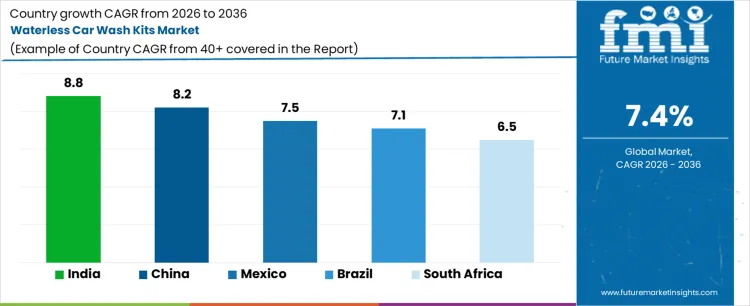
| Country | CAGR (%) |
|---|---|
| India | 8.8% |
| China | 8.2% |
| Mexico | 7.5% |
| Brazil | 7.1% |
| South Africa | 6.5% |
What Is Driving Strong Expansion of Waterless Car Wash Demand in India?
Demand for waterless car wash kits in India is growing at a CAGR of 8.8%, supported by urban water scarcity and high vehicle density. Apartment living restricts access to traditional washing facilities. Municipal water regulations discourage hose-based vehicle cleaning. Owners seek convenient solutions requiring minimal space and time. Commercial fleets adopt waterless kits to reduce operational downtime. Expansion of organized car care retail improves product availability and usage awareness. Growth reflects water conservation needs and urban practicality rather than preference for premium detailing outcomes.
- Urban water scarcity and usage restrictions
- High apartment-based vehicle ownership
- Fleet downtime reduction requirements
- Organized car care retail expansion
Why Is China Seeing Sustained Growth in Waterless Car Wash Kit Adoption?
Waterless car wash kit demand in China is expanding at a CAGR of 8.2%, driven by dense urban environments and environmental compliance efforts. Limited residential washing space increases reliance on portable cleaning solutions. Airborne dust and pollution increase cleaning frequency. Commercial vehicle operators adopt waterless products to meet environmental norms. Domestic manufacturers supply cost-effective formulations at scale. Growth reflects urban density challenges and environmental compliance rather than transition away from automated car wash infrastructure.
- Dense urban housing limiting wash access
- High dust and pollution exposure
- Environmental compliance for commercial vehicles
- Large-scale domestic product availability
How Are Waterless Car Wash Sales Developing in Mexico?
Sales of waterless car wash kits in Mexico are growing at a CAGR of 7.5%, shaped by water availability constraints and urban vehicle usage. Periodic water rationing encourages alternative cleaning methods. Street parking increases need for on-site vehicle cleaning. Independent car care providers promote waterless solutions to reduce service costs. Compatibility with diverse vehicle types supports broad adoption. Growth reflects practical water management and service convenience rather than discretionary eco-conscious purchasing.
- Periodic urban water rationing
- Street parking limiting wash facility access
- Promotion by independent car care providers
- Broad vehicle compatibility
What Factors Are Supporting Waterless Car Wash Demand in Brazil?
Waterless car wash demand in Brazil is expanding at a CAGR of 7.1%, influenced by urban congestion and environmental awareness. Limited access to private washing spaces increases reliance on portable cleaning kits. Water conservation campaigns encourage reduced domestic usage. Fleet operators adopt waterless cleaning to improve turnaround times. Aftermarket distribution networks expand reach across cities. Growth reflects urban practicality and environmental considerations rather than premium vehicle detailing demand.
- Urban congestion restricting washing access
- Water conservation awareness campaigns
- Fleet adoption for faster turnaround
- Expanding aftermarket distribution
Why Is South Africa Experiencing Measured Growth in Waterless Car Wash Kits?
Demand for waterless car wash kits in South Africa is growing at a CAGR of 6.5%, supported by chronic water shortages and regulatory controls. Residential water restrictions limit traditional washing practices. Vehicle owners seek compliant alternatives for routine maintenance. Commercial fleets adopt kits to ensure continuity during drought periods. Local suppliers tailor formulations for dusty environments. Growth remains measured, reflecting necessity-driven adoption and water resilience planning rather than expansion of vehicle ownership.
- Chronic water shortages and restrictions
- Compliance with residential water regulations
- Fleet continuity during drought conditions
- Dust-adapted product formulations
What is the competitive landscape of demand for the waterless car wash kits market globally?
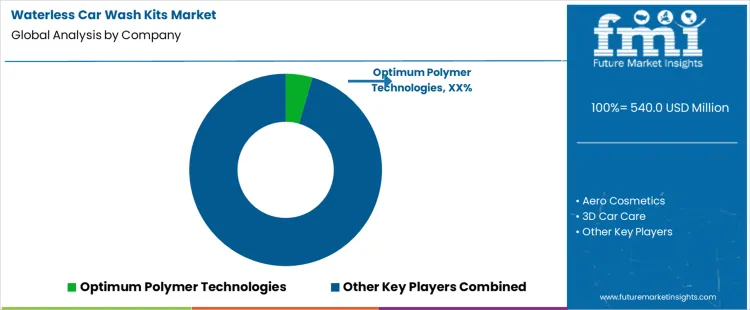
Demand for waterless car wash kits is driven by the growing preference for environmentally friendly cleaning solutions, convenience, and the need for quick, effective vehicle maintenance. Buyers evaluate the cleaning power, streak-free finish, ease of application, and ability to protect vehicle surfaces without water. Procurement behavior emphasizes products that provide superior cleaning results, protect paintwork, and require minimal effort for maximum efficiency. Purchasing decisions prioritize trusted brands known for eco-friendly formulations, high-quality results, and ease of use. Trend in the market reflects increasing consumer interest in sustainable car care products and the rise in on-the-go solutions for busy car owners.
Optimum Polymer Technologies leads competitive positioning with its waterless car wash kits, offering high-quality products that deliver excellent cleaning and protection while minimizing environmental impact. Aero Cosmetics competes by providing waterless cleaning solutions that cater to both car and aviation sectors, with an emphasis on ease of use and effective performance. 3D Car Care supports demand with professional-grade waterless wash kits that provide a smooth, scratch-free finish while maintaining vehicle paint quality. Meguiar’s participates with its trusted product line designed for optimal cleaning performance and durability, appealing to both professional detailers and DIY enthusiasts. Turtle Wax and Griot’s Garage provide waterless wash kits that combine ease of use with long-lasting protection for various vehicle types.
Key Players in the Waterless Car Wash Kits Market
- Optimum Polymer Technologies
- Aero Cosmetics
- 3D Car Care
- Meguiar's
- Turtle Wax
- Griot's Garage
- Adam's Polishes
- Rain-X
Scope of the Report
| Items | Values |
|---|---|
| Quantitative Units | USD million |
| Product Type | Waterless Wash Sprays; Rinseless Wash Concentrates; Wash & Wax Waterless Kits; Wipes-Based Kits; Other |
| End User | DIY Consumers; Detailing Professionals; Fleet Operators; Other |
| Packaging | Spray Bottles; Concentrate Bottles; Wipes or Towelettes; Bundle Kits |
| Sales Channel | Online Retail; Auto Parts Retail; Big-Box Retail; B2B or Wholesale; Other |
| Regions Covered | Asia Pacific, Europe, North America, Latin America, Middle East & Africa |
| Countries Covered | India, China, Mexico, Brazil, South Africa, and 40+ countries |
| Key Companies Profiled | Optimum Polymer Technologies; Aero Cosmetics; 3D Car Care; Meguiar's; Turtle Wax; Griot's Garage; Adam's Polishes; Rain-X |
| Additional Attributes | Dollar sales by product type, end user, packaging, and sales channel; product performance in waterless cleaning, shine, and protection across sprays, concentrates, and wipes-based kits; end user trends driven by DIY consumers, detailing professionals, and fleet operators; packaging preferences influencing spray, concentrate, and wipe-towelette formats; channel dynamics influenced by online retail, auto parts retail, and B2B wholesale distribution. |
Waterless Car Wash Kits Market by Segment
Product Type:
- Waterless Wash Sprays
- Rinseless Wash Concentrates
- Wash & Wax Waterless Kits
- Wipes-Based Kits
- Other
End User:
- DIY Consumers
- Detailing Professionals
- Fleet Operators
- Other
Packaging:
- Spray Bottles
- Concentrate Bottles
- Wipes or Towelettes
- Bundle Kits
Sales Channel:
- Online Retail
- Auto Parts Retail
- Big-Box Retail
- B2B or Wholesale
- Other
Region:
- Asia Pacific
- China
- Japan
- South Korea
- India
- Australia & New Zealand
- ASEAN
- Rest of Asia Pacific
- Europe
- Germany
- United Kingdom
- France
- Italy
- Spain
- Nordic
- BENELUX
- Rest of Europe
- North America
- United States
- Canada
- Mexico
- Latin America
- Brazil
- Chile
- Rest of Latin America
- Middle East & Africa
- Kingdom of Saudi Arabia
- Other GCC Countries
- Turkey
- South Africa
- Other African Union
- Rest of Middle East & Africa
Bibliography
- International Organization for Standardization. (2023). Surface active agents—Wetting agents—Determination of wetting power (ISO 8022:2023). ISO.
- International Organization for Standardization. (2023). Paints and varnishes—Resistance to mechanical abrasion—Part 2: Rotating abrasive rubber wheels method (ISO 7784-2:2023). ISO.
- Organisation for Economic Co-operation and Development. (2023). Water efficiency and conservation in urban household activities. OECD Publishing.
Frequently Asked Questions
How big is the waterless car wash kits market in 2026?
The global waterless car wash kits market is estimated to be valued at USD 540.0 million in 2026.
What will be the size of waterless car wash kits market in 2036?
The market size for the waterless car wash kits market is projected to reach USD 1,102.6 million by 2036.
How much will be the waterless car wash kits market growth between 2026 and 2036?
The waterless car wash kits market is expected to grow at a 7.4% CAGR between 2026 and 2036.
What are the key product types in the waterless car wash kits market?
The key product types in waterless car wash kits market are waterless wash sprays, rinseless wash concentrates, wash & wax waterless kits, wipes-based kits and other.
Which end user segment to contribute significant share in the waterless car wash kits market in 2026?
In terms of end user, diy consumers segment to command 52.0% share in the waterless car wash kits market in 2026.
Preview the report firsthand - request a free sample
Get SampleGet the brochure for pricing and purchase details.
Get PDFTable of Content
- Executive Summary
- Global Market Outlook
- Demand-side Trends
- Supply-side Trends
- Technology Roadmap Analysis
- Analysis and Recommendations
- Market Overview
- Market Coverage / Taxonomy
- Market Definition / Scope / Limitations
- Market Background
- Market Dynamics
- Drivers
- Restraints
- Opportunity
- Trends
- Scenario Forecast
- Demand in Optimistic Scenario
- Demand in Likely Scenario
- Demand in Conservative Scenario
- Opportunity Map Analysis
- Product Life Cycle Analysis
- Supply Chain Analysis
- Investment Feasibility Matrix
- Value Chain Analysis
- PESTLE and Porter’s Analysis
- Regulatory Landscape
- Regional Parent Market Outlook
- Production and Consumption Statistics
- Import and Export Statistics
- Market Dynamics
- Global Market Analysis 2021 to 2025 and Forecast, 2026 to 2036
- Historical Market Size Value (USD Million) Analysis, 2021 to 2025
- Current and Future Market Size Value (USD Million) Projections, 2026 to 2036
- Y-o-Y Growth Trend Analysis
- Absolute $ Opportunity Analysis
- Global Market Pricing Analysis 2021 to 2025 and Forecast 2026 to 2036
- Global Market Analysis 2021 to 2025 and Forecast 2026 to 2036, By Product Type
- Introduction / Key Findings
- Historical Market Size Value (USD Million) Analysis By Product Type , 2021 to 2025
- Current and Future Market Size Value (USD Million) Analysis and Forecast By Product Type , 2026 to 2036
- Waterless Wash Sprays
- Rinseless Wash Concentrates
- Wash & Wax Waterless Kits
- Wipes-Based Kits
- Other
- Waterless Wash Sprays
- Y-o-Y Growth Trend Analysis By Product Type , 2021 to 2025
- Absolute $ Opportunity Analysis By Product Type , 2026 to 2036
- Global Market Analysis 2021 to 2025 and Forecast 2026 to 2036, By End User
- Introduction / Key Findings
- Historical Market Size Value (USD Million) Analysis By End User, 2021 to 2025
- Current and Future Market Size Value (USD Million) Analysis and Forecast By End User, 2026 to 2036
- DIY Consumers
- Detailing Professionals
- Fleet Operators
- Other
- DIY Consumers
- Y-o-Y Growth Trend Analysis By End User, 2021 to 2025
- Absolute $ Opportunity Analysis By End User, 2026 to 2036
- Global Market Analysis 2021 to 2025 and Forecast 2026 to 2036, By Packaging
- Introduction / Key Findings
- Historical Market Size Value (USD Million) Analysis By Packaging, 2021 to 2025
- Current and Future Market Size Value (USD Million) Analysis and Forecast By Packaging, 2026 to 2036
- Spray Bottles
- Concentrate Bottles
- Wipes or Towelettes
- Bundle Kits
- Spray Bottles
- Y-o-Y Growth Trend Analysis By Packaging, 2021 to 2025
- Absolute $ Opportunity Analysis By Packaging, 2026 to 2036
- Global Market Analysis 2021 to 2025 and Forecast 2026 to 2036, By Sales Channel
- Introduction / Key Findings
- Historical Market Size Value (USD Million) Analysis By Sales Channel, 2021 to 2025
- Current and Future Market Size Value (USD Million) Analysis and Forecast By Sales Channel, 2026 to 2036
- Online Retail
- Auto Parts Retail
- Big-Box Retail
- B2B or Wholesale
- Other
- Online Retail
- Y-o-Y Growth Trend Analysis By Sales Channel, 2021 to 2025
- Absolute $ Opportunity Analysis By Sales Channel, 2026 to 2036
- Global Market Analysis 2021 to 2025 and Forecast 2026 to 2036, By Region
- Introduction
- Historical Market Size Value (USD Million) Analysis By Region, 2021 to 2025
- Current Market Size Value (USD Million) Analysis and Forecast By Region, 2026 to 2036
- North America
- Latin America
- Western Europe
- Eastern Europe
- East Asia
- South Asia and Pacific
- Middle East & Africa
- Market Attractiveness Analysis By Region
- North America Market Analysis 2021 to 2025 and Forecast 2026 to 2036, By Country
- Historical Market Size Value (USD Million) Trend Analysis By Market Taxonomy, 2021 to 2025
- Market Size Value (USD Million) Forecast By Market Taxonomy, 2026 to 2036
- By Country
- USA
- Canada
- Mexico
- By Product Type
- By End User
- By Packaging
- By Sales Channel
- By Country
- Market Attractiveness Analysis
- By Country
- By Product Type
- By End User
- By Packaging
- By Sales Channel
- Key Takeaways
- Latin America Market Analysis 2021 to 2025 and Forecast 2026 to 2036, By Country
- Historical Market Size Value (USD Million) Trend Analysis By Market Taxonomy, 2021 to 2025
- Market Size Value (USD Million) Forecast By Market Taxonomy, 2026 to 2036
- By Country
- Brazil
- Chile
- Rest of Latin America
- By Product Type
- By End User
- By Packaging
- By Sales Channel
- By Country
- Market Attractiveness Analysis
- By Country
- By Product Type
- By End User
- By Packaging
- By Sales Channel
- Key Takeaways
- Western Europe Market Analysis 2021 to 2025 and Forecast 2026 to 2036, By Country
- Historical Market Size Value (USD Million) Trend Analysis By Market Taxonomy, 2021 to 2025
- Market Size Value (USD Million) Forecast By Market Taxonomy, 2026 to 2036
- By Country
- Germany
- UK
- Italy
- Spain
- France
- Nordic
- BENELUX
- Rest of Western Europe
- By Product Type
- By End User
- By Packaging
- By Sales Channel
- By Country
- Market Attractiveness Analysis
- By Country
- By Product Type
- By End User
- By Packaging
- By Sales Channel
- Key Takeaways
- Eastern Europe Market Analysis 2021 to 2025 and Forecast 2026 to 2036, By Country
- Historical Market Size Value (USD Million) Trend Analysis By Market Taxonomy, 2021 to 2025
- Market Size Value (USD Million) Forecast By Market Taxonomy, 2026 to 2036
- By Country
- Russia
- Poland
- Hungary
- Balkan & Baltic
- Rest of Eastern Europe
- By Product Type
- By End User
- By Packaging
- By Sales Channel
- By Country
- Market Attractiveness Analysis
- By Country
- By Product Type
- By End User
- By Packaging
- By Sales Channel
- Key Takeaways
- East Asia Market Analysis 2021 to 2025 and Forecast 2026 to 2036, By Country
- Historical Market Size Value (USD Million) Trend Analysis By Market Taxonomy, 2021 to 2025
- Market Size Value (USD Million) Forecast By Market Taxonomy, 2026 to 2036
- By Country
- China
- Japan
- South Korea
- By Product Type
- By End User
- By Packaging
- By Sales Channel
- By Country
- Market Attractiveness Analysis
- By Country
- By Product Type
- By End User
- By Packaging
- By Sales Channel
- Key Takeaways
- South Asia and Pacific Market Analysis 2021 to 2025 and Forecast 2026 to 2036, By Country
- Historical Market Size Value (USD Million) Trend Analysis By Market Taxonomy, 2021 to 2025
- Market Size Value (USD Million) Forecast By Market Taxonomy, 2026 to 2036
- By Country
- India
- ASEAN
- Australia & New Zealand
- Rest of South Asia and Pacific
- By Product Type
- By End User
- By Packaging
- By Sales Channel
- By Country
- Market Attractiveness Analysis
- By Country
- By Product Type
- By End User
- By Packaging
- By Sales Channel
- Key Takeaways
- Middle East & Africa Market Analysis 2021 to 2025 and Forecast 2026 to 2036, By Country
- Historical Market Size Value (USD Million) Trend Analysis By Market Taxonomy, 2021 to 2025
- Market Size Value (USD Million) Forecast By Market Taxonomy, 2026 to 2036
- By Country
- Kingdom of Saudi Arabia
- Other GCC Countries
- Turkiye
- South Africa
- Other African Union
- Rest of Middle East & Africa
- By Product Type
- By End User
- By Packaging
- By Sales Channel
- By Country
- Market Attractiveness Analysis
- By Country
- By Product Type
- By End User
- By Packaging
- By Sales Channel
- Key Takeaways
- Key Countries Market Analysis
- USA
- Pricing Analysis
- Market Share Analysis, 2025
- By Product Type
- By End User
- By Packaging
- By Sales Channel
- Canada
- Pricing Analysis
- Market Share Analysis, 2025
- By Product Type
- By End User
- By Packaging
- By Sales Channel
- Mexico
- Pricing Analysis
- Market Share Analysis, 2025
- By Product Type
- By End User
- By Packaging
- By Sales Channel
- Brazil
- Pricing Analysis
- Market Share Analysis, 2025
- By Product Type
- By End User
- By Packaging
- By Sales Channel
- Chile
- Pricing Analysis
- Market Share Analysis, 2025
- By Product Type
- By End User
- By Packaging
- By Sales Channel
- Germany
- Pricing Analysis
- Market Share Analysis, 2025
- By Product Type
- By End User
- By Packaging
- By Sales Channel
- UK
- Pricing Analysis
- Market Share Analysis, 2025
- By Product Type
- By End User
- By Packaging
- By Sales Channel
- Italy
- Pricing Analysis
- Market Share Analysis, 2025
- By Product Type
- By End User
- By Packaging
- By Sales Channel
- Spain
- Pricing Analysis
- Market Share Analysis, 2025
- By Product Type
- By End User
- By Packaging
- By Sales Channel
- France
- Pricing Analysis
- Market Share Analysis, 2025
- By Product Type
- By End User
- By Packaging
- By Sales Channel
- India
- Pricing Analysis
- Market Share Analysis, 2025
- By Product Type
- By End User
- By Packaging
- By Sales Channel
- ASEAN
- Pricing Analysis
- Market Share Analysis, 2025
- By Product Type
- By End User
- By Packaging
- By Sales Channel
- Australia & New Zealand
- Pricing Analysis
- Market Share Analysis, 2025
- By Product Type
- By End User
- By Packaging
- By Sales Channel
- China
- Pricing Analysis
- Market Share Analysis, 2025
- By Product Type
- By End User
- By Packaging
- By Sales Channel
- Japan
- Pricing Analysis
- Market Share Analysis, 2025
- By Product Type
- By End User
- By Packaging
- By Sales Channel
- South Korea
- Pricing Analysis
- Market Share Analysis, 2025
- By Product Type
- By End User
- By Packaging
- By Sales Channel
- Russia
- Pricing Analysis
- Market Share Analysis, 2025
- By Product Type
- By End User
- By Packaging
- By Sales Channel
- Poland
- Pricing Analysis
- Market Share Analysis, 2025
- By Product Type
- By End User
- By Packaging
- By Sales Channel
- Hungary
- Pricing Analysis
- Market Share Analysis, 2025
- By Product Type
- By End User
- By Packaging
- By Sales Channel
- Kingdom of Saudi Arabia
- Pricing Analysis
- Market Share Analysis, 2025
- By Product Type
- By End User
- By Packaging
- By Sales Channel
- Turkiye
- Pricing Analysis
- Market Share Analysis, 2025
- By Product Type
- By End User
- By Packaging
- By Sales Channel
- South Africa
- Pricing Analysis
- Market Share Analysis, 2025
- By Product Type
- By End User
- By Packaging
- By Sales Channel
- USA
- Market Structure Analysis
- Competition Dashboard
- Competition Benchmarking
- Market Share Analysis of Top Players
- By Regional
- By Product Type
- By End User
- By Packaging
- By Sales Channel
- Competition Analysis
- Competition Deep Dive
- Optimum Polymer Technologies
- Overview
- Product Portfolio
- Profitability by Market Segments (Product/Age /Sales Channel/Region)
- Sales Footprint
- Strategy Overview
- Marketing Strategy
- Product Strategy
- Channel Strategy
- Aero Cosmetics
- 3D Car Care
- Meguiar's
- Turtle Wax
- Griot's Garage
- Adam's Polishes
- Rain-X
- Optimum Polymer Technologies
- Competition Deep Dive
- Assumptions & Acronyms Used
- Research Methodology


