

- Industry Size (2026)
- USD 720.0 Mn
- Forecast (2036)
- USD 1583.5 Mn
- CAGR (2026 to 2036)
- 8.2%
Automotive Ceramic Coating Kits Market Forecast and Outlook (2026-2036)
The automotive ceramic coating kits market is likely to be valued at USD 720.0 million in 2026, and reach USD 1,583.5 million by 2036, at 8.2% CAGR. Value behavior reflects surface protection economics rather than discretionary appearance enhancement alone. Demand concentrates where exterior finish degradation imposes recurring maintenance cost, time, and resale value loss. Adoption aligns with extended vehicle ownership cycles, environmental exposure intensity, and rising acceptance of semi-permanent coatings over short-life waxes. Product value capture depends on coating longevity, hydrophobic stability, and resistance to chemical and ultraviolet damage, since inconsistent performance undermines repeat purchasing. Procurement decisions emphasize formulation reliability and application tolerance, given variability in user skill and environmental conditions during installation.
Quick Stats for Automotive Ceramic Coating Kits Market
- Automotive Ceramic Coating Kits Market Value (2026): USD 720.0 million
- Automotive Ceramic Coating Kits Market Forecast Value (2036): USD 1,583.5 million
- Automotive Ceramic Coating Kits Market Forecast CAGR 2026 to 2036: 8.2%
- Leading Product Type by Demand Share: SiO2 Ceramic Spray Coatings
- Fastest-Growing Countries: India, Vietnam, Indonesia, Mexico, Brazil
- Top Players in Global Demand: Meguiar's, Chemical Guys, Turtle Wax, Gtechniq, CarPro
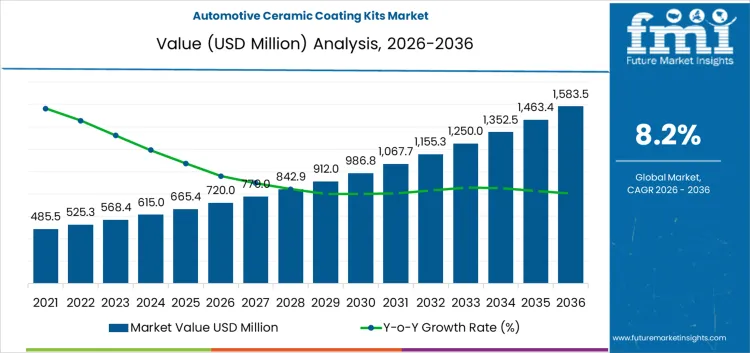
Expansion remains shaped by application sensitivity and outcome variability across user segments. Improper surface preparation or curing conditions reduce coating effectiveness, constraining confidence among first-time users. Performance dispersion across formulations complicates comparability and reinforces brand dependence rather than category standardization. Abrasion from automated washing and road debris limits functional lifespan, sustaining replacement-led demand instead of permanent adoption. Price stratification separates consumer kits from professional-grade systems, moderating penetration in cost-sensitive segments. Regulatory scrutiny on chemical composition and labeling affects formulation flexibility across regions. Volume growth follows climate exposure, vehicle care awareness, and maintenance cost avoidance priorities rather than luxury vehicle penetration or stylistic preference shifts.
Automotive Ceramic Coating Kits Market Key Takeaways
| Metric | Value |
|---|---|
| Market Value (2026) | USD 720.0 million |
| Market Forecast Value (2036) | USD 1,583.5 million |
| Forecast CAGR (2026 to 2036) | 8.2% |
Why is the Demand for Automotive Ceramic Coating Kits Growing?
Demand for automotive ceramic coating kits is increasing as vehicle owners and detailing professionals seek durable surface protection that maintains exterior finish quality while resisting environmental contaminants. Ceramic coatings form a thin, semi-permanent layer on automotive paint that enhances chemical resistance against acid rain, bird droppings, road salts, and ultraviolet exposure. Consumers specify kits with high-silica or nano-ceramic formulations that bond at a molecular level because these coatings deliver greater hardness and hydrophobicity than traditional wax or sealant products. Procurement decisions focus on product longevity, ease of application, and compatibility with diverse paint types because protective performance and ease of use influence adoption among both DIY enthusiasts and professional detailers working in varied climate zones. Growth in premium vehicle segments and heightened awareness of resale value preservation reinforce the appeal of protective coatings that reduce surface degradation over extended ownership periods.
Aftermarket demand remains robust as automotive enthusiasts and fleet maintenance operations incorporate ceramic coatings into routine cosmetic care to extend service intervals between washing and polishing. Professional detail shops require kits that include application accessories, curing instructions, and quality control kits to support consistent results and minimize surface defects. Technical improvements in curing agents and application viscosity enhance flow-out and reduce streaking, which improves aesthetic outcomes. Education on surface prep, proper application protocols, and long-term maintenance further supports product adoption. These performance-and protection-oriented criteria are contributing to sustained demand growth in the automotive ceramic coating kits market.
How Are the Segments Classified in the Automotive Ceramic Coating Kits Market?
Demand for automotive ceramic coating kits is shaped by surface protection expectations, vehicle appearance maintenance, and reduced cleaning frequency requirements. Vehicle owners seek protective layers that enhance gloss retention, hydrophobic behavior, and resistance to environmental contaminants. Adoption aligns with rising vehicle ownership, increased aftermarket care awareness, and accessibility of do-it-yourself detailing solutions. Product selection prioritizes ease of application, coating durability, and surface compatibility. Segment classification reflects differentiation by coating formulation, intended application surface, and buyer profile influencing usage frequency, skill requirements, and replacement cycles.
Which Product Type Represents the Largest Share of Demand?
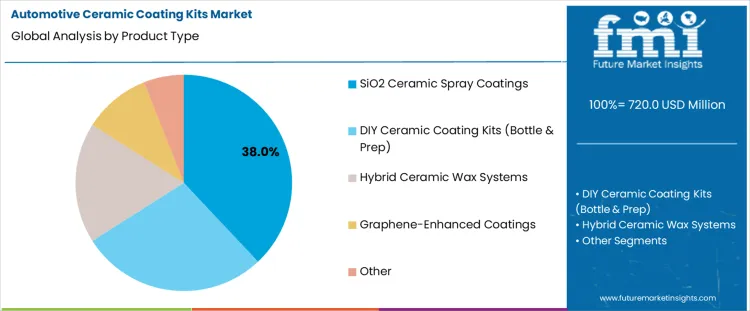
SiO2 ceramic spray coatings hold 38.0%, representing the largest share among product types due to application simplicity. Spray-based formats enable quick application without complex surface preparation or curing processes. These coatings provide short to medium-term protection suitable for routine maintenance cycles. Accessibility supports frequent reapplication by non-professional users. DIY ceramic coating kits deliver longer durability with additional preparation steps and higher effort. Hybrid ceramic wax systems combine protection with traditional waxing familiarity. Graphene-enhanced coatings target advanced users with higher performance expectations. Product type segmentation reflects preference for convenient solutions balancing protection benefits and ease of use.
Key Points
- Spray coatings offer quick and accessible application.
- Ease of use supports frequent maintenance cycles.
- Other products target durability or advanced performance needs.
Which Application Surface Accounts for the Highest Share of Demand?
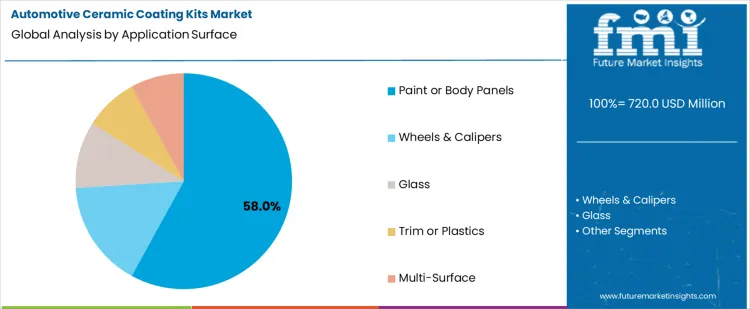
Paint or body panels hold 58.0%, representing the largest share among application surfaces due to visibility importance. Exterior paint surfaces face constant exposure to ultraviolet radiation, pollutants, and weather elements. Owners prioritize protective coatings to preserve gloss and color integrity. Large surface area increases coating consumption volume. Wheels and calipers require coatings for brake dust resistance with lower coverage area. Glass and trim applications address specific functional benefits. Multi-surface products offer versatility with diluted performance focus. Application segmentation reflects concentration where aesthetic preservation and exposure intensity drive consistent coating usage.
Key Points
- Paint surfaces face continuous environmental exposure.
- Gloss retention motivates protective coating use.
- Other surfaces receive targeted or secondary protection.
Which Buyer Type Drives the Largest Share of Demand?
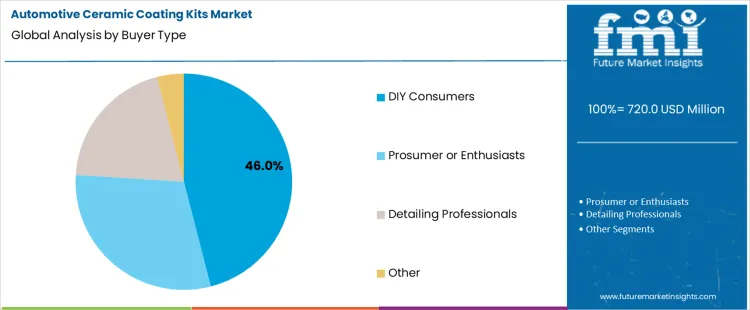
DIY consumers hold 46.0%, representing the largest share among buyer types due to accessibility of modern kits. Simplified instructions and ready-to-use formats lower skill barriers. Cost savings compared with professional services encourage self-application. Online availability supports product discovery and education. Prosumer enthusiasts adopt higher-specification products with greater preparation effort. Detailing professionals select concentrated formulations for service delivery. Buyer type segmentation reflects dominance of self-applied solutions where convenience, affordability, and acceptable performance outcomes align with consumer expectations.
Key Points
- DIY buyers value affordability and ease of application.
- Simplified kits reduce technical skill requirements.
- Other buyers prioritize performance depth or service delivery.
What are the Key Dynamics in the Automotive Ceramic Coating Kits Market?
Demand for automotive ceramic coating kits reflects surface protection requirements for vehicle paint, glass, and trim exposed to environmental and mechanical wear. Adoption concentrates in passenger vehicles, premium vehicles, detailing studios, and informed consumer users. Global scope aligns with vehicle ownership duration extension and exterior finish preservation priorities. Usage centers on silica-based liquid coatings applied manually to create hydrophobic, chemical-resistant surface layers.
How do vehicle appearance preservation and maintenance reduction need shape adoption?
Automotive paint surfaces face degradation from UV radiation, road salts, bird droppings, industrial fallout, and repeated washing. Demand increases as vehicle owners seek longer-lasting protection than waxes or sealants. Ceramic coatings form semi-permanent layers that reduce oxidation, staining, and clear coat erosion. Hydrophobic behavior improves water runoff, lowering dirt adhesion and wash frequency. Detailing professionals adopt kits to offer differentiated protection packages with measurable durability. Consumer-grade kits expand adoption among DIY users seeking cost-effective alternatives to professional application. Compatibility with clear coats, plastics, and glass broadens use cases. Adoption reflects practical intent to reduce surface degradation and maintenance effort over extended ownership cycles.
How do application sensitivity, performance variability, and cost pressure influence market scalability?
Ceramic coatings require controlled surface preparation and application conditions to achieve expected performance. Demand sensitivity rises where improper application leads to streaking, high spots, or reduced durability. Cure time and environmental control limit ease of use for casual users. Performance varies widely across formulations, affecting consistency and consumer trust. Abrasion resistance remains limited under frequent automatic washing. Removal and reapplication increase labor intensity. Price dispersion across professional and consumer kits complicates value comparison. Lack of standardized durability metrics constrains objective evaluation. Regulatory scrutiny of chemical handling and labeling affects formulation and distribution, limiting uniform scalability across markets.
How Is Demand for Automotive Ceramic Coating Kits Evolving Globally?
Demand for automotive ceramic coating kits is expanding globally due to vehicle appearance protection needs, rising ownership duration, and growing awareness of surface durability benefits. Adoption aligns with passenger vehicles where paint protection, gloss retention, and ease of maintenance influence purchasing behavior. Urban driving exposure, environmental contaminants, and resale value considerations reinforce kit usage. Aftermarket detailing services and DIY applications support recurring demand. Growth rates in India at 10.1%, Vietnam at 9.4%, Indonesia at 9.0%, Mexico at 8.3%, and Brazil at 7.8% indicate strong expansion driven by vehicle care prioritization, climate exposure, and service-led accessory penetration rather than luxury vehicle growth alone.
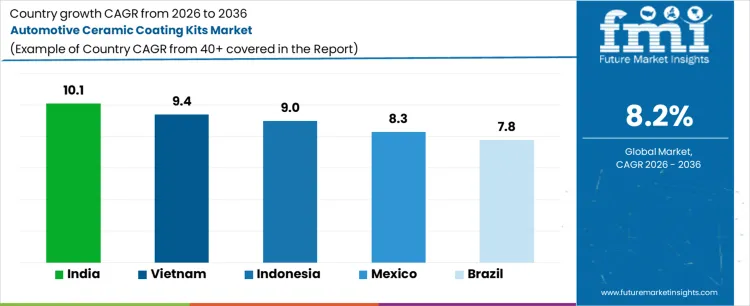
| Country | CAGR (%) |
|---|---|
| India | 10.1% |
| Vietnam | 9.4% |
| Indonesia | 9.0% |
| Mexico | 8.3% |
| Brazil | 7.8% |
What Is Driving Strong Growth of Automotive Ceramic Coating Demand in India?
Demand for automotive ceramic coating kits in India is growing at a CAGR of 10.1%, supported by rising passenger vehicle ownership and longer vehicle retention periods. Urban pollution, dust, and UV exposure accelerate paint degradation, increasing need for protective coatings. Owners seek reduced washing frequency and lower maintenance effort. Professional detailing studios promote ceramic kits as long-term surface protection solutions. Growth of organized car care outlets improves product accessibility. Demand growth reflects practical vehicle upkeep priorities and environmental exposure rather than premium vehicle customization trends.
- High urban pollution and dust exposure
- Longer vehicle ownership cycles
- Expansion of professional detailing services
- Reduced maintenance effort preference
Why Is Vietnam Experiencing Rapid Adoption of Ceramic Coating Kits?
Automotive ceramic coating kit demand in Vietnam is expanding at a CAGR of 9.4%, driven by urbanization and increasing personal vehicle usage. Tropical climate conditions accelerate paint fading and surface oxidation. Owners prioritize protective solutions to maintain exterior appearance. Independent detailing shops actively promote ceramic coatings during vehicle delivery and servicing. Compact car ownership supports DIY kit adoption. Growth reflects climate-driven protection needs and service-channel promotion rather than expansion of luxury vehicle segments.
- Tropical climate accelerating paint degradation
- Growth in personal vehicle ownership
- Promotion by independent detailing workshops
- Rising DIY car care adoption
How Is Indonesia Supporting Growth in Automotive Ceramic Coating Sales?
Sales of automotive ceramic coating kits in Indonesia are growing at a CAGR of 9.0%, shaped by humid climate conditions and urban traffic exposure. Frequent rainfall and airborne contaminants increase paint wear risk. Owners adopt coatings to simplify cleaning and reduce surface damage. Detailing service providers bundle ceramic treatments with routine maintenance. Aftermarket brands expand distribution across metropolitan regions. Growth reflects environmental exposure management and service-led adoption rather than discretionary aesthetic upgrades.
- High humidity and rainfall exposure
- Urban traffic-related surface contamination
- Bundling by detailing service providers
- Expanding metropolitan aftermarket distribution
What Factors Are Driving Ceramic Coating Kit Demand in Mexico?
Automotive ceramic coating kit demand in Mexico is expanding at a CAGR of 8.3%, supported by vehicle care awareness and urban driving conditions. Sun exposure and road debris accelerate paint deterioration. Owners seek protective coatings to preserve resale value. Independent installers promote ceramic kits as cost-effective alternatives to paint protection films. Compatibility with North American vehicle platforms supports product standardization. Growth reflects value retention priorities and installer-driven sales rather than premium car ownership growth.
- High UV exposure affecting vehicle paint
- Focus on resale value preservation
- Installer promotion as cost-effective protection
- Platform compatibility across vehicle models
Why Is Brazil Showing Sustained Growth in Automotive Ceramic Coating Adoption?
Demand for automotive ceramic coating kits in Brazil is growing at a CAGR of 7.8%, driven by urban congestion and environmental exposure. Airborne pollutants and road conditions increase paint damage risk. Owners favor coatings to maintain vehicle appearance and reduce frequent washing. Detailing studios expand ceramic service offerings. Fleet operators apply coatings to maintain exterior presentation. Growth remains steady, reflecting practical maintenance benefits and service availability rather than discretionary styling preferences.
- Urban congestion increasing paint contamination
- Preference for reduced washing frequency
- Expansion of ceramic coating service offerings
- Fleet usage for exterior appearance upkeep
What is the competitive landscape of demand for the automotive ceramic coating kits market globally?
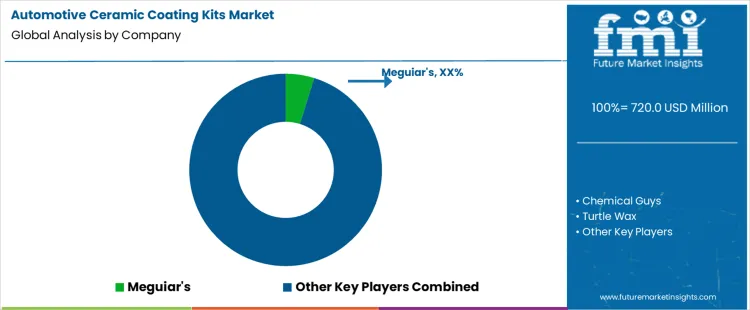
Demand for automotive ceramic coating kits is driven by the growing consumer desire for vehicle protection, ease of maintenance, and long-lasting aesthetics. Buyers evaluate the durability, ease of application, gloss enhancement, hydrophobic properties, and resistance to environmental contaminants. Procurement behavior emphasizes products that offer effective long-term protection, improve vehicle appearance, and minimize the need for frequent maintenance. Purchasing decisions prioritize brands known for high-quality products, ease of use, and strong customer support. Trend in the market reflects a shift towards DIY solutions for vehicle care, as consumers increasingly seek products that deliver professional-grade results at home.
Meguiar’s leads competitive positioning with its extensive range of high-quality, user-friendly ceramic coatings, offering trusted protection and performance for both amateur and professional users. Chemical Guys competes by providing ceramic coating kits that focus on enhancing gloss, water repellency, and overall vehicle appearance, with a focus on ease of use. Turtle Wax supports demand with affordable and effective solutions, catering to a broad customer base while delivering solid protection and ease of application. Gtechniq participates with professional-grade ceramic coatings that offer superior durability and resistance to environmental factors. CarPro excels by offering premium, high-performance coatings designed to deliver exceptional protection and finish for discerning automotive enthusiasts.
Key Players in the Automotive Ceramic Coating Kits Market
- Meguiar's
- Chemical Guys
- Turtle Wax
- Gtechniq
- CarPro
- Mothers
- Sonax
- 3M
- Adam's Polishes
- Griot's Garage
Scope of the Report
| Items | Values |
|---|---|
| Quantitative Units | USD million |
| Product Type | SiO2 Ceramic Spray Coatings; DIY Ceramic Coating Kits (Bottle & Prep); Hybrid Ceramic Wax Systems; Graphene-Enhanced Coatings; Other |
| Application Surface | Paint or Body Panels; Wheels & Calipers; Glass; Trim or Plastics; Multi-Surface |
| Buyer Type | DIY Consumers; Prosumer or Enthusiasts; Detailing Professionals; Other |
| Sales Channel | Online Retail; Auto Parts Retail; Detailing Distributors; Big-Box Retail; Other |
| Regions Covered | Asia Pacific, Europe, North America, Latin America, Middle East & Africa |
| Countries Covered | India, Vietnam, Indonesia, Mexico, Brazil, and 40+ countries |
| Key Companies Profiled | Meguiar's; Chemical Guys; Turtle Wax; Gtechniq; CarPro; Mothers; Sonax; 3M; Adam's Polishes; Griot's Garage |
| Additional Attributes | Dollar sales by product type, application surface, buyer type, and sales channel; coating durability, hydrophobic performance, and scratch resistance across SiO2, hybrid wax, and graphene-enhanced systems; buyer adoption trends driven by DIY consumers, prosumers, and detailing professionals; channel dynamics influenced by online retail growth, auto parts retail, detailing distributors, and big-box retail sales. |
Automotive Ceramic Coating Kits Market by Segment
Product Type:
- SiO2 Ceramic Spray Coatings
- DIY Ceramic Coating Kits (Bottle & Prep)
- Hybrid Ceramic Wax Systems
- Graphene-Enhanced Coatings
- Other
Application Surface:
- Paint or Body Panels
- Wheels & Calipers
- Glass
- Trim or Plastics
- Multi-Surface
Buyer Type:
- DIY Consumers
- Prosumer or Enthusiasts
- Detailing Professionals
- Other
Sales Channel:
- Online Retail
- Auto Parts Retail
- Detailing Distributors
- Big-Box Retail
- Other
Region:
- Asia Pacific
- China
- Japan
- South Korea
- India
- Australia & New Zealand
- ASEAN
- Rest of Asia Pacific
- Europe
- Germany
- United Kingdom
- France
- Italy
- Spain
- Nordic
- BENELUX
- Rest of Europe
- North America
- United States
- Canada
- Mexico
- Latin America
- Brazil
- Chile
- Rest of Latin America
- Middle East & Africa
- Kingdom of Saudi Arabia
- Other GCC Countries
- Turkey
- South Africa
- Other African Union
- Rest of Middle East & Africa
Bibliography
- International Organization for Standardization. (2023). Paints and varnishes-Determination of resistance to liquids (ISO 2812-1:2023). ISO.
- International Organization for Standardization. (2024). Paints and varnishes-Determination of gloss value at 20°, 60° and 85° (ISO 2813:2024). ISO.
- International Organization for Standardization. (2023). Paints and varnishes-Cross-cut test for adhesion (ISO 2409:2023). ISO.
- International Organization for Standardization. (2024). Paints and varnishes-Artificial weathering and exposure to artificial radiation (ISO 16474-2:2024). ISO.
- Organisation for Economic Co-operation and Development. (2023). Non-exhaust emissions from road transport: Sources, measurement, and mitigation strategies. OECD Publishing.
- European Commission Joint Research Centre. (2023). Environmental durability of automotive surface coatings under urban and climatic exposure. Publications Office of the European Union.
Frequently Asked Questions
How big is the automotive ceramic coating kits market in 2026?
The global automotive ceramic coating kits market is estimated to be valued at USD 720.0 million in 2026.
What will be the size of automotive ceramic coating kits market in 2036?
The market size for the automotive ceramic coating kits market is projected to reach USD 1,583.5 million by 2036.
How much will be the automotive ceramic coating kits market growth between 2026 and 2036?
The automotive ceramic coating kits market is expected to grow at a 8.2% CAGR between 2026 and 2036.
What are the key product types in the automotive ceramic coating kits market?
The key product types in automotive ceramic coating kits market are sio2 ceramic spray coatings, diy ceramic coating kits (bottle & prep), hybrid ceramic wax systems, graphene-enhanced coatings and other.
Which application surface segment to contribute significant share in the automotive ceramic coating kits market in 2026?
In terms of application surface, paint or body panels segment to command 58.0% share in the automotive ceramic coating kits market in 2026.
Preview the report firsthand - request a free sample
Get SampleGet the brochure for pricing and purchase details.
Get PDFTable of Content
- Executive Summary
- Global Market Outlook
- Demand-side Trends
- Supply-side Trends
- Technology Roadmap Analysis
- Analysis and Recommendations
- Market Overview
- Market Coverage / Taxonomy
- Market Definition / Scope / Limitations
- Market Background
- Market Dynamics
- Drivers
- Restraints
- Opportunity
- Trends
- Scenario Forecast
- Demand in Optimistic Scenario
- Demand in Likely Scenario
- Demand in Conservative Scenario
- Opportunity Map Analysis
- Product Life Cycle Analysis
- Supply Chain Analysis
- Investment Feasibility Matrix
- Value Chain Analysis
- PESTLE and Porter’s Analysis
- Regulatory Landscape
- Regional Parent Market Outlook
- Production and Consumption Statistics
- Import and Export Statistics
- Market Dynamics
- Global Market Analysis 2021 to 2025 and Forecast, 2026 to 2036
- Historical Market Size Value (USD Million) Analysis, 2021 to 2025
- Current and Future Market Size Value (USD Million) Projections, 2026 to 2036
- Y-o-Y Growth Trend Analysis
- Absolute $ Opportunity Analysis
- Global Market Pricing Analysis 2021 to 2025 and Forecast 2026 to 2036
- Global Market Analysis 2021 to 2025 and Forecast 2026 to 2036, By Product Type
- Introduction / Key Findings
- Historical Market Size Value (USD Million) Analysis By Product Type , 2021 to 2025
- Current and Future Market Size Value (USD Million) Analysis and Forecast By Product Type , 2026 to 2036
- SiO2 Ceramic Spray Coatings
- DIY Ceramic Coating Kits (Bottle & Prep)
- Hybrid Ceramic Wax Systems
- Graphene-Enhanced Coatings
- Other
- SiO2 Ceramic Spray Coatings
- Y-o-Y Growth Trend Analysis By Product Type , 2021 to 2025
- Absolute $ Opportunity Analysis By Product Type , 2026 to 2036
- Global Market Analysis 2021 to 2025 and Forecast 2026 to 2036, By Application Surface
- Introduction / Key Findings
- Historical Market Size Value (USD Million) Analysis By Application Surface, 2021 to 2025
- Current and Future Market Size Value (USD Million) Analysis and Forecast By Application Surface, 2026 to 2036
- Paint or Body Panels
- Wheels & Calipers
- Glass
- Trim or Plastics
- Multi-Surface
- Paint or Body Panels
- Y-o-Y Growth Trend Analysis By Application Surface, 2021 to 2025
- Absolute $ Opportunity Analysis By Application Surface, 2026 to 2036
- Global Market Analysis 2021 to 2025 and Forecast 2026 to 2036, By Buyer Type
- Introduction / Key Findings
- Historical Market Size Value (USD Million) Analysis By Buyer Type, 2021 to 2025
- Current and Future Market Size Value (USD Million) Analysis and Forecast By Buyer Type, 2026 to 2036
- DIY Consumers
- Prosumer or Enthusiasts
- Detailing Professionals
- Other
- DIY Consumers
- Y-o-Y Growth Trend Analysis By Buyer Type, 2021 to 2025
- Absolute $ Opportunity Analysis By Buyer Type, 2026 to 2036
- Global Market Analysis 2021 to 2025 and Forecast 2026 to 2036, By Sales Channel
- Introduction / Key Findings
- Historical Market Size Value (USD Million) Analysis By Sales Channel, 2021 to 2025
- Current and Future Market Size Value (USD Million) Analysis and Forecast By Sales Channel, 2026 to 2036
- Online Retail
- Auto Parts Retail
- Detailing Distributors
- Big-Box Retail
- Other
- Online Retail
- Y-o-Y Growth Trend Analysis By Sales Channel, 2021 to 2025
- Absolute $ Opportunity Analysis By Sales Channel, 2026 to 2036
- Global Market Analysis 2021 to 2025 and Forecast 2026 to 2036, By Region
- Introduction
- Historical Market Size Value (USD Million) Analysis By Region, 2021 to 2025
- Current Market Size Value (USD Million) Analysis and Forecast By Region, 2026 to 2036
- North America
- Latin America
- Western Europe
- Eastern Europe
- East Asia
- South Asia and Pacific
- Middle East & Africa
- Market Attractiveness Analysis By Region
- North America Market Analysis 2021 to 2025 and Forecast 2026 to 2036, By Country
- Historical Market Size Value (USD Million) Trend Analysis By Market Taxonomy, 2021 to 2025
- Market Size Value (USD Million) Forecast By Market Taxonomy, 2026 to 2036
- By Country
- USA
- Canada
- Mexico
- By Product Type
- By Application Surface
- By Buyer Type
- By Sales Channel
- By Country
- Market Attractiveness Analysis
- By Country
- By Product Type
- By Application Surface
- By Buyer Type
- By Sales Channel
- Key Takeaways
- Latin America Market Analysis 2021 to 2025 and Forecast 2026 to 2036, By Country
- Historical Market Size Value (USD Million) Trend Analysis By Market Taxonomy, 2021 to 2025
- Market Size Value (USD Million) Forecast By Market Taxonomy, 2026 to 2036
- By Country
- Brazil
- Chile
- Rest of Latin America
- By Product Type
- By Application Surface
- By Buyer Type
- By Sales Channel
- By Country
- Market Attractiveness Analysis
- By Country
- By Product Type
- By Application Surface
- By Buyer Type
- By Sales Channel
- Key Takeaways
- Western Europe Market Analysis 2021 to 2025 and Forecast 2026 to 2036, By Country
- Historical Market Size Value (USD Million) Trend Analysis By Market Taxonomy, 2021 to 2025
- Market Size Value (USD Million) Forecast By Market Taxonomy, 2026 to 2036
- By Country
- Germany
- UK
- Italy
- Spain
- France
- Nordic
- BENELUX
- Rest of Western Europe
- By Product Type
- By Application Surface
- By Buyer Type
- By Sales Channel
- By Country
- Market Attractiveness Analysis
- By Country
- By Product Type
- By Application Surface
- By Buyer Type
- By Sales Channel
- Key Takeaways
- Eastern Europe Market Analysis 2021 to 2025 and Forecast 2026 to 2036, By Country
- Historical Market Size Value (USD Million) Trend Analysis By Market Taxonomy, 2021 to 2025
- Market Size Value (USD Million) Forecast By Market Taxonomy, 2026 to 2036
- By Country
- Russia
- Poland
- Hungary
- Balkan & Baltic
- Rest of Eastern Europe
- By Product Type
- By Application Surface
- By Buyer Type
- By Sales Channel
- By Country
- Market Attractiveness Analysis
- By Country
- By Product Type
- By Application Surface
- By Buyer Type
- By Sales Channel
- Key Takeaways
- East Asia Market Analysis 2021 to 2025 and Forecast 2026 to 2036, By Country
- Historical Market Size Value (USD Million) Trend Analysis By Market Taxonomy, 2021 to 2025
- Market Size Value (USD Million) Forecast By Market Taxonomy, 2026 to 2036
- By Country
- China
- Japan
- South Korea
- By Product Type
- By Application Surface
- By Buyer Type
- By Sales Channel
- By Country
- Market Attractiveness Analysis
- By Country
- By Product Type
- By Application Surface
- By Buyer Type
- By Sales Channel
- Key Takeaways
- South Asia and Pacific Market Analysis 2021 to 2025 and Forecast 2026 to 2036, By Country
- Historical Market Size Value (USD Million) Trend Analysis By Market Taxonomy, 2021 to 2025
- Market Size Value (USD Million) Forecast By Market Taxonomy, 2026 to 2036
- By Country
- India
- ASEAN
- Australia & New Zealand
- Rest of South Asia and Pacific
- By Product Type
- By Application Surface
- By Buyer Type
- By Sales Channel
- By Country
- Market Attractiveness Analysis
- By Country
- By Product Type
- By Application Surface
- By Buyer Type
- By Sales Channel
- Key Takeaways
- Middle East & Africa Market Analysis 2021 to 2025 and Forecast 2026 to 2036, By Country
- Historical Market Size Value (USD Million) Trend Analysis By Market Taxonomy, 2021 to 2025
- Market Size Value (USD Million) Forecast By Market Taxonomy, 2026 to 2036
- By Country
- Kingdom of Saudi Arabia
- Other GCC Countries
- Turkiye
- South Africa
- Other African Union
- Rest of Middle East & Africa
- By Product Type
- By Application Surface
- By Buyer Type
- By Sales Channel
- By Country
- Market Attractiveness Analysis
- By Country
- By Product Type
- By Application Surface
- By Buyer Type
- By Sales Channel
- Key Takeaways
- Key Countries Market Analysis
- USA
- Pricing Analysis
- Market Share Analysis, 2025
- By Product Type
- By Application Surface
- By Buyer Type
- By Sales Channel
- Canada
- Pricing Analysis
- Market Share Analysis, 2025
- By Product Type
- By Application Surface
- By Buyer Type
- By Sales Channel
- Mexico
- Pricing Analysis
- Market Share Analysis, 2025
- By Product Type
- By Application Surface
- By Buyer Type
- By Sales Channel
- Brazil
- Pricing Analysis
- Market Share Analysis, 2025
- By Product Type
- By Application Surface
- By Buyer Type
- By Sales Channel
- Chile
- Pricing Analysis
- Market Share Analysis, 2025
- By Product Type
- By Application Surface
- By Buyer Type
- By Sales Channel
- Germany
- Pricing Analysis
- Market Share Analysis, 2025
- By Product Type
- By Application Surface
- By Buyer Type
- By Sales Channel
- UK
- Pricing Analysis
- Market Share Analysis, 2025
- By Product Type
- By Application Surface
- By Buyer Type
- By Sales Channel
- Italy
- Pricing Analysis
- Market Share Analysis, 2025
- By Product Type
- By Application Surface
- By Buyer Type
- By Sales Channel
- Spain
- Pricing Analysis
- Market Share Analysis, 2025
- By Product Type
- By Application Surface
- By Buyer Type
- By Sales Channel
- France
- Pricing Analysis
- Market Share Analysis, 2025
- By Product Type
- By Application Surface
- By Buyer Type
- By Sales Channel
- India
- Pricing Analysis
- Market Share Analysis, 2025
- By Product Type
- By Application Surface
- By Buyer Type
- By Sales Channel
- ASEAN
- Pricing Analysis
- Market Share Analysis, 2025
- By Product Type
- By Application Surface
- By Buyer Type
- By Sales Channel
- Australia & New Zealand
- Pricing Analysis
- Market Share Analysis, 2025
- By Product Type
- By Application Surface
- By Buyer Type
- By Sales Channel
- China
- Pricing Analysis
- Market Share Analysis, 2025
- By Product Type
- By Application Surface
- By Buyer Type
- By Sales Channel
- Japan
- Pricing Analysis
- Market Share Analysis, 2025
- By Product Type
- By Application Surface
- By Buyer Type
- By Sales Channel
- South Korea
- Pricing Analysis
- Market Share Analysis, 2025
- By Product Type
- By Application Surface
- By Buyer Type
- By Sales Channel
- Russia
- Pricing Analysis
- Market Share Analysis, 2025
- By Product Type
- By Application Surface
- By Buyer Type
- By Sales Channel
- Poland
- Pricing Analysis
- Market Share Analysis, 2025
- By Product Type
- By Application Surface
- By Buyer Type
- By Sales Channel
- Hungary
- Pricing Analysis
- Market Share Analysis, 2025
- By Product Type
- By Application Surface
- By Buyer Type
- By Sales Channel
- Kingdom of Saudi Arabia
- Pricing Analysis
- Market Share Analysis, 2025
- By Product Type
- By Application Surface
- By Buyer Type
- By Sales Channel
- Turkiye
- Pricing Analysis
- Market Share Analysis, 2025
- By Product Type
- By Application Surface
- By Buyer Type
- By Sales Channel
- South Africa
- Pricing Analysis
- Market Share Analysis, 2025
- By Product Type
- By Application Surface
- By Buyer Type
- By Sales Channel
- USA
- Market Structure Analysis
- Competition Dashboard
- Competition Benchmarking
- Market Share Analysis of Top Players
- By Regional
- By Product Type
- By Application Surface
- By Buyer Type
- By Sales Channel
- Competition Analysis
- Competition Deep Dive
- Meguiar's
- Overview
- Product Portfolio
- Profitability by Market Segments (Product/Age /Sales Channel/Region)
- Sales Footprint
- Strategy Overview
- Marketing Strategy
- Product Strategy
- Channel Strategy
- Chemical Guys
- Turtle Wax
- Gtechniq
- CarPro
- Mothers
- Sonax
- 3M
- Adam's Polishes
- Griot's Garage
- Meguiar's
- Competition Deep Dive
- Assumptions & Acronyms Used
- Research Methodology


