

- Industry Size (2026)
- USD 3.5 Bn
- Forecast (2036)
- USD 6.3 Bn
- CAGR (2026 to 2036)
- 6.1%
Cream-to-Powder Foundation Sticks Market Forecast and Outlook 2026 to 2036
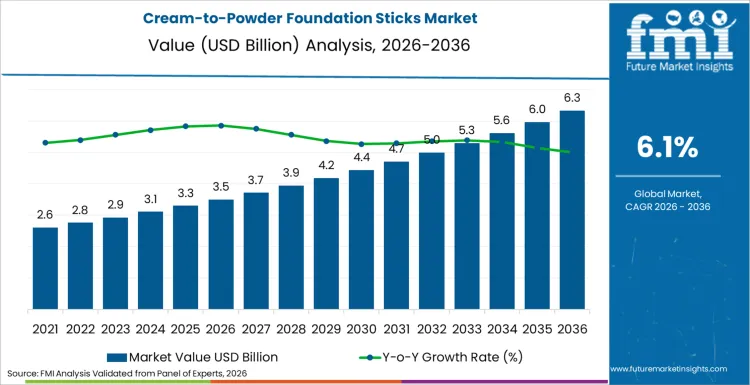
The cream-to-powder foundation sticks market is valued at USD 3.5 billion in 2026 and is projected to reach USD 6.3 billion by 2036, expanding at a 6.1% CAGR. As per Future Market Insights, market expansion is being driven by rising demand for portable, all-in-one complexion products that combine coverage, mattifying effects, and easy on-the-go application compared with traditional liquid foundations and loose powders. Stick formats address several structural drawbacks of bottled foundations, including leakage risk, the need for tools, and limited convenience for quick touch-ups.
Product activity between 2025 and 2026 highlights a clear shift toward skin-adaptive cream-to-powder sticks incorporating lightweight silicones, oil-absorbing powders, and skin-conditioning agents to deliver smooth coverage with a natural, set finish across different skin types. Reflecting this product positioning, Charlotte Tilbury, Founder & Makeup Artist, stated, “My NEW! Unreal Skin Sheer Glow Tint hydrating foundation stick looks so real, it’s UNREAL in the best way.
It smooths, blurs, and gives your complexion a radiant, super-natural glow,” underscoring how brands are framing stick foundations around skin-first performance and effortless application. Established color cosmetics brands are extending base makeup portfolios into stick formats to protect category relevance, while emerging brands are using compact foundation sticks to attract younger consumers seeking convenience and hybrid makeup formats.
The shift toward multi-functional base makeup and localized complexion correction is supporting stronger uptake of cream-to-powder foundation sticks within everyday makeup routines. These products align with mobile lifestyles, fast touch-up needs, and reduced product spillage, strengthening their appeal across travel, gym bags, and daily carry use scenarios. Skin-first positioning and no-tool application narratives are increasingly shaping how brands frame new launches within mass, masstige, and premium foundation segments. Future Market Insights notes that e-commerce and social commerce continue to play a central role in category visibility, as stick foundations are highly demonstrable and well suited for short-form video platforms and creator-led tutorials.
Summary of the Cream-to-Powder Foundation Sticks Market
What Is Growth Outlook for the Cream-to-Powder Foundation Sticks Market as per Future Market Insights Projection?
Future Market Insights projects the cream-to-powder foundation sticks market to grow at a 6.1% CAGR from 2026 to 2036, expanding from USD 3.5 billion in 2026 to USD 6.3 billion by 2036.
FMI Research Approach: FMI proprietary forecasting model based on bottom-up revenue estimation, tracking penetration of stick-based complexion products across base makeup portfolios, and demand modeling linked to convenience-led makeup usage, hybrid cream-powder formats, and on-the-go application trends.
How Do FMI Analysts Perceive the Cream-to-Powder Foundation Sticks Market to Evolve?
FMI analysts perceive the market shifting from niche stick foundations toward routine everyday complexion use, supported by preference for no-tool application, portable formats, and skin-adaptive finishes. Cream-to-powder sticks are increasingly used for quick base makeup, touch-ups, and localized complexion correction without altering existing makeup routines.
FMI Research Approach: Assessment of product positioning centered on multi-finish coverage, expansion of stick foundations within mainstream base makeup assortments, and evaluation of consumer acceptance of hybrid cream-to-powder textures.
Which Country Holds the Largest Share in the Global Cream-to-Powder Foundation Sticks Market?
China holds the largest share of the global cream-to-powder foundation sticks market by value, supported by strong uptake of compact makeup formats, high social commerce influence, and frequent daily touch-up behavior among urban consumers.
FMI Research Approach: FMI country-level demand assessment across urban beauty consumers, evaluation of daily makeup usage frequency, and tracking of domestic and international brand expansion within Chinese color cosmetics retail.
How Large Will the Cream-to-Powder Foundation Sticks Market Be by 2036?
The global cream-to-powder foundation sticks market is projected to reach USD 6.3 billion by 2036.
FMI Research Approach: FMI long-term forecast by product type, coverage level, skin type, distribution channel, and end user, incorporating scaling assumptions for hybrid foundation stick adoption and cross-checking against broader stick-format makeup growth trends.
What Is the Definition of the Cream-to-Powder Foundation Sticks Market?
The cream-to-powder foundation sticks market comprises solid or semi-solid base makeup products formulated in stick formats that apply as creams and set into powder-like finishes, targeting complexion coverage, mattification, and everyday base makeup needs.
FMI Research Approach: FMI market taxonomy and inclusion-exclusion framework covering cream-to-powder, matte, dewy, satin, and multi-finish foundation sticks, while excluding liquid foundations, pressed powders, compacts, and pump-dispensed base makeup.
What Are Globally Unique Trends Shaping the Cream-to-Powder Foundation Sticks Market?
Globally unique trends include rising demand for hybrid makeup-skincare textures, growth of specialty beauty stores and online retail as primary channels, and Asia-led adoption driven by China and India.
FMI Research Approach: Analysis of product-format-level demand shares, distribution channel contribution trends, country-wise growth differentials, and expansion of foundation sticks across routine daily makeup use.
Cream-to-Powder Foundation Sticks Market Key Takeaways
| Metric | Details |
|---|---|
| Industry Size (2026) | USD 3.5 Billion |
| Industry Value (2036) | USD 6.3 Billion |
| CAGR (2026-2036) | 6.1% |
Source: Future Market Insights (FMI) analysis, based on proprietary forecasting model and primary research.
Why Is Demand Rising for Cream-to-Powder Foundation Sticks?
Preferences in base makeup are evolving as cream-to-powder foundation sticks move from being viewed as quick travel fixes to becoming part of regular daily makeup routines. As per Future Market Insights, buyers now look for complexion products that offer fast application, a comfortable skin feel, and a finish that sets without needing extra powder. Earlier stick foundations were often chosen for convenience during short outings or touch-ups, which limited their use as full-coverage base products. That perception is changing as hybrid cream-to-powder textures gain stronger placement within mainstream foundation ranges, supported by growing demand for no-brush application, lower transfer, and finishes that hold up through long days.
Brand strategies highlight this transition. L’Oréal has positioned stick foundations within its broader base makeup portfolios across mass and premium brands, treating them as everyday foundation options rather than secondary formats. For example, Maybelline promotes its Super Stay foundation stick for easy blending and a set finish suited to routine wear, placing it alongside liquid foundations for daily use. FMI notes that brands embedding cream-to-powder sticks into core complexion lines, with dependable shade ranges and consistent wear performance, are more likely to secure repeat purchases as these formats become normalized within everyday makeup habits.
How Is the Cream-to-Powder Foundation Sticks Market Segmented?
The cream-to-powder foundation sticks market is segmented by product type, coverage level, skin type, distribution channel, and end user, reflecting how consumers choose base makeup for daily wear and touch-ups. By product type, the market includes cream-to-powder or multi-finish sticks, matte finish sticks, dewy finish sticks, satin or natural finish sticks, and other innovative textures. Multi-finish formats lead adoption as they balance blendability with a set finish suitable for long wear. By coverage, medium-coverage sticks dominate routine use, while sheer and full coverage cater to specific looks. By skin type, combination skin leads usage due to the need for balanced oil control and comfort. By channel, specialty beauty stores lead due to shade matching and trials, followed by online retail and mass retail. Women represent the primary end-user base.
Why Do Cream-to-Powder / Multi-Finish Sticks Hold the Largest Share?
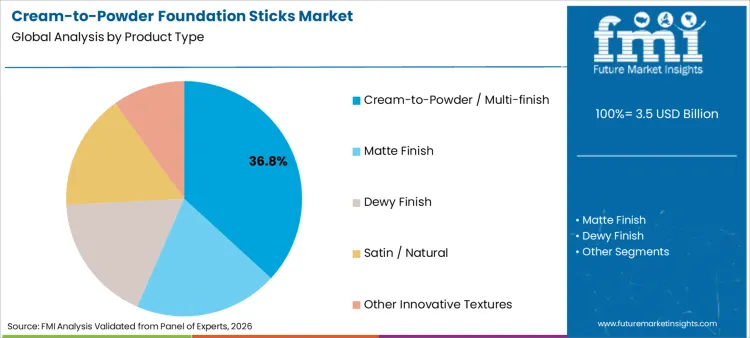
Cream-to-powder or multi-finish formats account for 36.8% share, driven by their versatility across daily makeup routines and broad skin-type compatibility. These sticks apply smoothly like creams, then set to a powder-like finish that reduces shine and improves wear time without extra setting products. Consumers prefer multi-finish textures for office wear, travel, and quick touch-ups because they offer dependable coverage with a natural look. Their ability to perform across different climates and skin conditions lowers the need to carry separate liquid and powder products. FMI notes that brands position multi-finish sticks as practical, all-in-one base solutions rather than niche formats, supporting higher repeat purchase and anchoring demand within everyday complexion routines.
Why Does Medium Coverage Lead Usage Among Foundation Stick Formats?
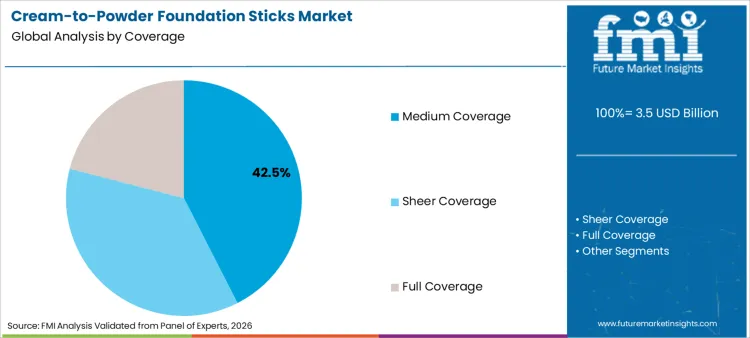
Medium coverage accounts for 42.5% share, reflecting consumer preference for natural-looking complexion correction that evens tone without masking skin texture. Medium-coverage sticks suit daily wear across work, social, and casual settings, offering a balance between coverage and skin-like finish. These formats allow users to build coverage selectively on blemishes or redness while keeping the overall look light. Consumers associate medium coverage with comfort, lower transfer, and reduced cakiness compared with full-coverage bases. FMI observes that medium-coverage sticks align with current “skin-first” makeup trends, where breathable finishes and quick blending matter more than heavy concealment, driving higher frequency of use and repeat buying.
Why Does Combination Skin Represent the Largest Skin-Type Segment?
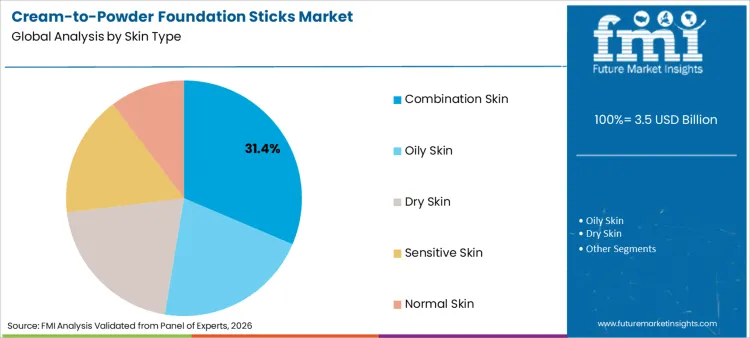
Combination skin holds 31.4% share, supported by the need for base products that manage oil in the T-zone while maintaining comfort on drier areas. Cream-to-powder sticks suit combination skin because they deliver controlled coverage with a set finish that reduces shine without over-drying. Users value products that simplify routines by working across mixed skin zones, limiting the need for multiple foundations. These sticks provide adaptable performance across seasons and humidity levels, which supports regular use. FMI notes that brands emphasize balanced oil control and lightweight feel in stick formulations, making them suitable for combination skin users who seek stable wear across long days and variable conditions.
Why Do Specialty Beauty Stores Lead the Distribution Channel?
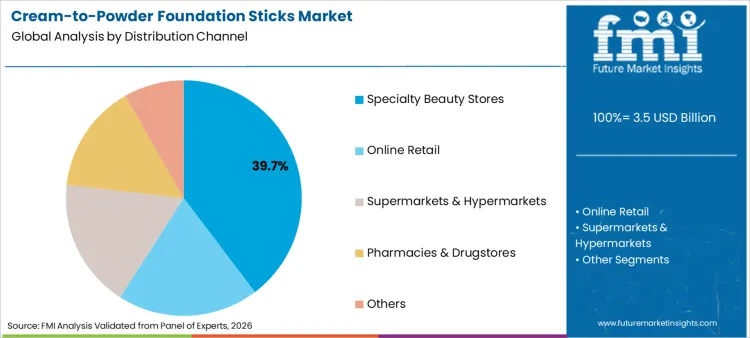
Specialty beauty stores account for 39.7% share, reflecting the importance of in-store shade matching, texture testing, and assisted selling for complexion products. Foundation sticks require precise color selection and finish preference, which benefits from hands-on trials and trained staff guidance. These retailers support discovery of new textures and multi-finish formats through curated assortments and brand-led demonstrations. Consumers often purchase foundation sticks during planned beauty shopping trips rather than impulse buys, reinforcing the role of specialty stores. FMI highlights that while online retail supports replenishment, specialty beauty stores remain central to first-time trials and conversion for complexion products where shade accuracy and finish confidence influence purchase decisions.
Why Do Women Represent the Primary End-User Segment?
Women account for 71.9% share, driven by higher daily makeup usage frequency and greater experimentation with complexion products across work and social settings. Foundation sticks fit well into women’s routines due to quick application, portability, and suitability for touch-ups throughout the day. Adoption is supported by broad shade ranges, finish options, and marketing focused on convenience and skin comfort. While men’s grooming and gender-neutral makeup use are growing, women remain the core demand base for foundation sticks due to established usage habits. FMI notes that women-led demand anchors volume today, while incremental growth from men and unisex users supports gradual broadening of the end-user base.
Which Usage Shifts Are Redefining Cream-to-Powder Foundation Stick Adoption?
Cream-to-powder foundation sticks are gaining stronger visibility as makeup routines move toward compact, multi-functional formats that support quick application. These sticks allow users to apply base makeup directly to targeted areas such as the cheeks, forehead, and under-eye region, while converting to a lightweight powder finish on blending. Compared with liquid foundations, stick formats offer better handling control and reduced product waste. Brands such as Estée Lauder Companies and L’Oréal Group are strengthening their stick-format offerings to address everyday wear needs. FMI indicates that these formats are shifting from travel-focused use toward daily complexion routines, supported by their compact form factor and ease of reapplication.
How Are Multi-Format Portfolios Improving Brand Competitiveness?
Makeup brands are reinforcing competitive positioning by embedding cream-to-powder foundation sticks within broader complexion portfolios. These products are being aligned with liquid foundations, pressed powders, and compacts to provide consumers with format flexibility without altering shade families. This integration strengthens consistency across product families and supports wider retail penetration. FMI highlights that portfolio alignment reduces barriers to trial by leveraging existing shade recognition and brand familiarity, allowing foundation sticks to scale across mass, premium, and specialty beauty channels.
What Is Driving Refinement in Hybrid Texture Performance?
Hybrid foundation sticks require precise formulation control to deliver smooth application followed by a stable powder finish. The balance between emollient content and powder dispersion determines glide, blendability, and wear duration. Small changes in formulation can affect skin feel, finish uniformity, and performance under humidity or heat. FMI observes that growing competition is pushing brands to improve formulation stability and sensory performance, supporting dependable daily wear across diverse skin types and environmental conditions.
What Is the Country-wise Outlook for the Cream-to-Powder Foundation Sticks Market?
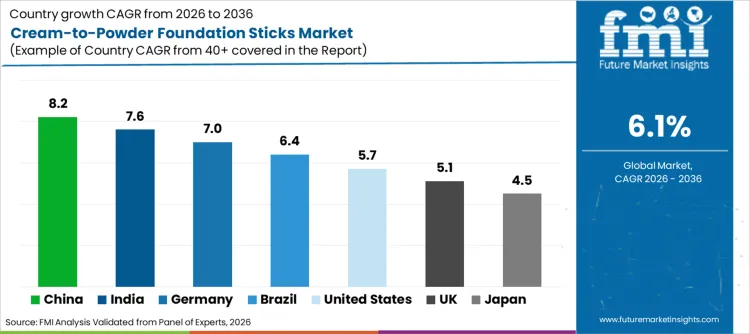
Country-level growth for cream-to-powder foundation sticks varies by makeup habits, social commerce influence, and acceptance of compact base makeup formats. China leads with an 8.2% CAGR, supported by strong short-form beauty content consumption, influencer-led product discovery, and high daily touch-up frequency among urban users. India follows at 7.6%, driven by rising color cosmetics adoption, growing preference for cream and balm textures, and expanding online beauty retail reach beyond metro cities.
Germany records 7.0% growth, reflecting demand for practical, skin-comfort base makeup formats within structured grooming routines. Brazil grows at 6.4%, supported by a strong beauty culture and frequent makeup use for social and professional settings. The United States posts 5.7%, indicating steady uptake in a mature cosmetics market where stick formats complement liquids and compacts. The United Kingdom reaches 5.1%, shaped by selective adoption of natural-finish complexion products. Japan trails at 4.5%, reflecting conservative switching from powders and preference for subtle, lightweight base makeup.
| Country | CAGR (2026 to 2036) |
|---|---|
| China | 8.2% |
| India | 7.6% |
| Germany | 7.0% |
| Brazil | 6.4% |
| United States | 5.7% |
| UK | 5.1% |
| Japan | 4.5% |
Source: FMI historical analysis and forecast data.
Why Is China Leading Growth in Cream-to-Powder Foundation Sticks?
China’s 8.2% CAGR is driven by heavy engagement with short-form beauty content, creator-led tutorials, and frequent on-the-go touch-ups among urban consumers. Stick foundations align with fast-paced lifestyles where portability, quick blending, and mess-free application matter. E-commerce and social commerce accelerate discovery and replenishment, while live commerce formats support shade education and impulse conversion. Adoption is shaped more by higher usage frequency and format substitution from liquids for daily wear than by population growth alone. As consumers prioritize convenience and skin-like finishes, foundation sticks are becoming routine items in everyday makeup kits.
What Is Supporting Growth in India’s Cream-to-Powder Foundation Sticks Market?
India’s 7.6% CAGR reflects expanding beauty participation, rising comfort with cream and balm textures, and growing online access to shade-inclusive products. Foundation sticks appeal for travel, humidity-friendly wear, and quick touch-ups without tools. Younger consumers increasingly favor compact base products that fit mobile lifestyles, while social media content improves shade confidence. Wider availability across price tiers supports trial beyond metros. Growth is reinforced by higher daily makeup usage among urban professionals and students, with sticks positioned as practical complements to liquid foundations rather than replacements.
Why Is Germany Showing Steady Expansion in Foundation Stick Adoption?
Germany’s 7.0% CAGR is supported by preference for functional, reliable makeup formats that offer consistent wear and skin comfort. Consumers value controlled application, clean finishes, and product longevity, which aligns with cream-to-powder sticks designed for precise coverage. Adoption is deliberate, with sticks integrated into existing base routines for convenience rather than trend-driven experimentation. Specialty beauty retail and informed purchasing behavior support steady trial and repeat use. This pragmatic adoption pattern sustains moderate, reliable growth anchored by demand for practical complexion solutions.
What Is Driving Growth in Brazil’s Foundation Stick Market?
Brazil’s 6.4% CAGR is shaped by strong beauty culture, frequent makeup uses for social settings, and climate conditions that favor set finishes. Cream-to-powder sticks suit warm, humid environments by offering quick application and reduced transfer. Urban consumers value portability for work and travel, while expanding digital retail improves access to new textures. Adoption remains steady as users treat sticks as complements to traditional bases for targeted correction and touch-ups, supporting balanced growth across major cities.
Why Is Growth More Moderate in the United States?
The United States posts a 5.7% CAGR, reflecting selective adoption in a mature base makeup market dominated by liquids and compacts. Foundation sticks are commonly layered into existing routines for convenience rather than replacing primary bases. Growth concentrates among users seeking portability and fast application for travel and daily commutes. Digital retail supports discovery, though strong brand loyalty to liquid foundations tempers rapid switching. As familiarity with stick formats grows, adoption continues at a steady pace without disrupting established complexion habits.
What Is the Competitive Outlook for the Cream-to-Powder Foundation Sticks Market?
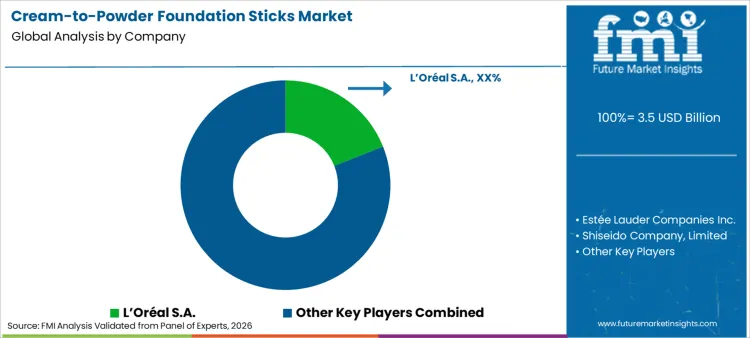
The competitive landscape for cream-to-powder foundation sticks is shaped by large global beauty and color cosmetics companies that are expanding beyond traditional liquid foundations, compacts, and loose powders to protect format relevance and portfolio breadth. Players such as L’Oréal S.A., Estée Lauder Companies Inc., Shiseido Company, Limited, Coty Inc., Revlon, Inc., Unilever PLC, Procter & Gamble Co., Amorepacific, and KOSÉ benefit from strong global distribution, deep shade portfolios, and well-established mass, masstige, and prestige makeup franchises.
These groups leverage their existing foundation and complexion platforms to introduce stick formats positioned for portability, no-tool application, and hybrid makeup performance. Competitive positioning in this market is less about rapid volume capture and more about offering alternative complexion formats that fit into existing base makeup routines across everyday, travel, and professional use scenarios.
Future Market Insights observes that competition is increasingly centered on finish quality, skin feel, blendability, and wear performance rather than aggressive channel expansion. Prestige players such as Chanel, Clarins, Sisley Paris, and Estée Lauder Companies Inc. emphasize refined textures, skin-conditioning claims, and premium complexion aesthetics, while Fenty Beauty (LVMH) and Shiseido Company, Limited focus on shade inclusivity, natural finishes, and skin-comfort positioning. At the same time, brands under L’Oréal S.A. (Maybelline, NYX, Urban Decay) and Coty Inc. support wider adoption through accessible price points and trend-led launches across mass and masstige channels. FMI notes that long-term competitive advantage will depend on how effectively cream-to-powder sticks are embedded within complete complexion systems alongside liquids, powders, primers, and concealers, rather than being positioned as standalone novelty formats.
Recent Developments:
- In October 2024, Dior Beauty entered the stick category with the launch of the Forever Skin Perfect Stick, a multi-use foundation that explicitly markets a "blurring filter" effect. This launch signifies a major shift in the luxury segment toward cream-to-powder textures that offer "24-hour wear" and hydration while maintaining a soft-matte finish, directly challenging established players like Hourglass.
- In March 2024, Ilia Beauty launched the Skin Rewind Complexion Stick, which drove the "skincare-first" trend in the stick market throughout 2025. The formula, containing a Ceramide-Peptide Complex, was positioned not just as makeup but as an anti-aging treatment that firms skin over time, validating the consumer shift toward "functional" solid foundations that deliver a natural-matte finish without drying.
- In 2025, Fenty Beauty continued to expand the retail footprint of its Eaze Drop Blur + Smooth Tint Stick (originally launched late 2023), leveraging its "QuickBlur" technology to dominate the "no-makeup makeup" segment. Market analysis from 2025 highlights this product as a key driver in normalizing "light coverage" sticks over traditional full-coverage heavy sticks.
Key Players in Cream-to-Powder Foundation Sticks Market
- L’Oréal S.A.
- Estée Lauder Companies Inc.
- Shiseido Company, Limited
- Coty Inc.
- Revlon, Inc.
- Unilever PLC
- Procter & Gamble Co.
- Amorepacific
- KOSÉ
- Fenty Beauty (LVMH)
- Mary Kay
- Avon
- Chanel
- Clarins
- Beiersdorf
- Sisley Paris
Market Definition
The cream-to-powder foundation sticks market captures revenue from solid-format complexion base products formulated for direct, on-skin application and designed to deliver cream-based coverage that sets into a powder-like finish. In this assessment, the market covers commercially available foundation sticks positioned for everyday makeup use, quick complexion correction, oil-control routines, or long-wear coverage. Market sizing reflects the value of finished consumer products sold through physical retail and online platforms, analyzed by skin type, coverage preference, sales channel, and region, and reported in USD billion.
Market Inclusion
The scope includes cream-to-powder foundation sticks developed for normal, oily, combination, and sensitive skin types, along with variants positioned for matte, natural, or soft-focus finishes. Products intended for full-face application, targeted coverage on areas such as the T-zone, cheeks, and under-eye regions, or on-the-go touch-ups are included when marketed specifically as foundation sticks. Sales through e-commerce platforms, beauty and specialty retailers, department stores, pharmacies, and mass retail chains are counted. Geographic coverage spans North America, Europe, Asia Pacific, Latin America, and the Middle East & Africa.
Market Exclusion
The market excludes liquid foundations, pressed or loose powders, cushion foundations, tinted moisturizers, BB and CC creams, cream concealers, contour sticks, blush sticks, and multi-use color sticks not positioned primarily as foundation. Revenues from bulk cosmetic ingredients, private-label raw materials, contract manufacturing, packaging supply, and logistics services are excluded. Products sold solely for professional makeup artistry or theatrical use without mainstream retail availability fall outside the defined market scope.
Scope of Report
| Items | Values |
|---|---|
| Quantitative Units (2026) | USD 3.5 Billion |
| Product Type | Cream-to-Powder / Multi-finish; Matte Finish; Dewy Finish; Satin / Natural; Other Innovative Textures |
| Coverage | Medium Coverage; Sheer Coverage; Full Coverage |
| Skin Type | Combination Skin; Oily Skin; Dry Skin; Sensitive Skin; Normal Skin |
| Distribution Channel | Specialty Beauty Stores; Online Retail; Supermarkets & Hypermarkets; Pharmacies & Drugstores; Others |
| End User | Women; Men; Unisex / Gender-neutral |
| Regions Covered | North America, Europe, Asia Pacific, Latin America, Middle East & Africa |
| Countries Covered | United States, Germany, United Kingdom, India, China, Brazil, and 40+ countries |
| Key Companies Profiled | L’Oréal Group; Estée Lauder Companies; Shiseido Company; Coty; Revlon; Unilever; Procter & Gamble; Amorepacific; KOSÉ; Fenty Beauty; Mary Kay; Avon; Chanel |
| Additional Attributes | Dollar sales by product type, coverage, skin type, and distribution channel; country-wise growth analysis; adoption trends for cream-to-powder and multi-finish foundation sticks; usage patterns for medium, sheer, and full coverage routines; competitive brand positioning across mass, premium, and prestige beauty channels |
Source: FMI historical analysis and forecast data
Cream-to-Powder Foundation Sticks Market by Segments
By Product Type:
- Cream-to-Powder / Multi-finish
- Matte Finish
- Dewy Finish
- Satin / Natural
- Other Innovative Textures
By Coverage:
- Medium Coverage
- Sheer Coverage
- Full Coverage
By Skin Type:
- Combination Skin
- Oily Skin
- Dry Skin
- Sensitive Skin
- Normal Skin
By Distribution Channel:
- Specialty Beauty Stores
- Online Retail
- Supermarkets & Hypermarkets
- Pharmacies & Drugstores
- Others
By End User:
- Women
- Men
- Unisex / Gender-neutral
By Region:
- North America
- Europe
- Asia Pacific
- Latin America
- Middle East & Africa
Bibliography
- L’Oréal S.A. (2025, March). 2024 Universal Registration Document. (Source for the Dermatological Beauty and Luxe Division strategies, confirming the "skinification" of makeup and the strong performance of long-wear formats like Lancôme Teint Idole).
- The Estée Lauder Companies Inc. (2025, August). Form 10-K Annual Report 2025. (Source for the "Beauty Reimagined" strategy, highlighting the focus on high-performance, prestige makeup franchises like Tom Ford and Bobbi Brown stick foundations).
- LVMH Moët Hennessy Louis Vuitton. (2025, March). 2024 Universal Registration Document. (Source for the Christian Dior Parfums financial review, specifically noting the successful expansion of the Dior Forever complexion range into new formats).
- Unilever PLC. (2025, February). Unilever Annual Report and Accounts 2024. (Source for the Prestige Beauty division performance, explicitly citing Hourglass Cosmetics [maker of the Vanish Stick] as a double-digit growth driver).
Frequently Asked Questions
What is the current global market size for Cream-to-Powder Foundation Sticks?
The global cream-to-powder foundation sticks market is valued at USD 3.5 billion in 2026, supported by rising demand for portable, no-tool complexion products and hybrid makeup formats suited for everyday use.
What is the projected CAGR for the Cream-to-Powder Foundation Sticks market?
Market revenues are projected to grow at a 6.1% CAGR from 2026 to 2036, reaching USD 6.3 billion by the end of the forecast period.
Which segment currently dominates the industry?
Cream-to-powder and multi-finish sticks lead product type demand, with medium-coverage formats seeing the widest adoption due to suitability for daily wear across combination skin users.
What are the primary risks or barriers to adoption?
Key barriers include strong consumer attachment to liquid foundations and pressed powders, limited shade matching confidence for stick formats online, and learning curves for no-tool application.
Who are the leading players in the Cream-to-Powder Foundation Sticks space?
Leading companies include L’Oréal S.A., Estée Lauder Companies Inc., Shiseido Company, Limited, Coty Inc., Revlon, Inc., and Amorepacific, leveraging established complexion portfolios and multi-channel retail reach.
Preview the report firsthand - request a free sample
Get SampleGet the brochure for pricing and purchase details.
Get PDFTable of Content
- Executive Summary
- Global Market Outlook
- Demand-side Trends
- Supply-side Trends
- Technology Roadmap Analysis
- Analysis and Recommendations
- Market Overview
- Market Coverage / Taxonomy
- Market Definition / Scope / Limitations
- Market Background
- Market Dynamics
- Drivers
- Restraints
- Opportunity
- Trends
- Scenario Forecast
- Demand in Optimistic Scenario
- Demand in Likely Scenario
- Demand in Conservative Scenario
- Opportunity Map Analysis
- Product Life Cycle Analysis
- Supply Chain Analysis
- Investment Feasibility Matrix
- Value Chain Analysis
- PESTLE and Porter’s Analysis
- Regulatory Landscape
- Regional Parent Market Outlook
- Production and Consumption Statistics
- Import and Export Statistics
- Market Dynamics
- Global Market Analysis 2021 to 2025 and Forecast, 2026 to 2036
- Historical Market Size Value (USD Million) Analysis, 2021 to 2025
- Current and Future Market Size Value (USD Million) Projections, 2026 to 2036
- Y-o-Y Growth Trend Analysis
- Absolute $ Opportunity Analysis
- Global Market Pricing Analysis 2021 to 2025 and Forecast 2026 to 2036
- Global Market Analysis 2021 to 2025 and Forecast 2026 to 2036, By Product Type
- Introduction / Key Findings
- Historical Market Size Value (USD Million) Analysis By Product Type , 2021 to 2025
- Current and Future Market Size Value (USD Million) Analysis and Forecast By Product Type , 2026 to 2036
- Cream-to-Powder / Multi-finish
- Matte Finish
- Dewy Finish
- Satin / Natural
- Other Innovative Textures
- Cream-to-Powder / Multi-finish
- Y-o-Y Growth Trend Analysis By Product Type , 2021 to 2025
- Absolute $ Opportunity Analysis By Product Type , 2026 to 2036
- Global Market Analysis 2021 to 2025 and Forecast 2026 to 2036, By Coverage
- Introduction / Key Findings
- Historical Market Size Value (USD Million) Analysis By Coverage, 2021 to 2025
- Current and Future Market Size Value (USD Million) Analysis and Forecast By Coverage, 2026 to 2036
- Medium Coverage
- Sheer Coverage
- Full Coverage
- Medium Coverage
- Y-o-Y Growth Trend Analysis By Coverage, 2021 to 2025
- Absolute $ Opportunity Analysis By Coverage, 2026 to 2036
- Global Market Analysis 2021 to 2025 and Forecast 2026 to 2036, By Skin Type
- Introduction / Key Findings
- Historical Market Size Value (USD Million) Analysis By Skin Type, 2021 to 2025
- Current and Future Market Size Value (USD Million) Analysis and Forecast By Skin Type, 2026 to 2036
- Combination Skin
- Oily Skin
- Dry Skin
- Sensitive Skin
- Normal Skin
- Combination Skin
- Y-o-Y Growth Trend Analysis By Skin Type, 2021 to 2025
- Absolute $ Opportunity Analysis By Skin Type, 2026 to 2036
- Global Market Analysis 2021 to 2025 and Forecast 2026 to 2036, By Distribution Channel
- Introduction / Key Findings
- Historical Market Size Value (USD Million) Analysis By Distribution Channel, 2021 to 2025
- Current and Future Market Size Value (USD Million) Analysis and Forecast By Distribution Channel, 2026 to 2036
- Specialty Beauty Stores
- Online Retail
- Supermarkets & Hypermarkets
- Pharmacies & Drugstores
- Others
- Specialty Beauty Stores
- Y-o-Y Growth Trend Analysis By Distribution Channel, 2021 to 2025
- Absolute $ Opportunity Analysis By Distribution Channel, 2026 to 2036
- Global Market Analysis 2021 to 2025 and Forecast 2026 to 2036, By End User
- Introduction / Key Findings
- Historical Market Size Value (USD Million) Analysis By End User, 2021 to 2025
- Current and Future Market Size Value (USD Million) Analysis and Forecast By End User, 2026 to 2036
- Women
- Men
- Unisex / Gender-neutral
- Women
- Y-o-Y Growth Trend Analysis By End User, 2021 to 2025
- Absolute $ Opportunity Analysis By End User, 2026 to 2036
- Global Market Analysis 2021 to 2025 and Forecast 2026 to 2036, By Region
- Introduction
- Historical Market Size Value (USD Million) Analysis By Region, 2021 to 2025
- Current Market Size Value (USD Million) Analysis and Forecast By Region, 2026 to 2036
- North America
- Latin America
- Western Europe
- Eastern Europe
- East Asia
- South Asia and Pacific
- Middle East & Africa
- Market Attractiveness Analysis By Region
- North America Market Analysis 2021 to 2025 and Forecast 2026 to 2036, By Country
- Historical Market Size Value (USD Million) Trend Analysis By Market Taxonomy, 2021 to 2025
- Market Size Value (USD Million) Forecast By Market Taxonomy, 2026 to 2036
- By Country
- USA
- Canada
- Mexico
- By Product Type
- By Coverage
- By Skin Type
- By Distribution Channel
- By End User
- By Country
- Market Attractiveness Analysis
- By Country
- By Product Type
- By Coverage
- By Skin Type
- By Distribution Channel
- By End User
- Key Takeaways
- Latin America Market Analysis 2021 to 2025 and Forecast 2026 to 2036, By Country
- Historical Market Size Value (USD Million) Trend Analysis By Market Taxonomy, 2021 to 2025
- Market Size Value (USD Million) Forecast By Market Taxonomy, 2026 to 2036
- By Country
- Brazil
- Chile
- Rest of Latin America
- By Product Type
- By Coverage
- By Skin Type
- By Distribution Channel
- By End User
- By Country
- Market Attractiveness Analysis
- By Country
- By Product Type
- By Coverage
- By Skin Type
- By Distribution Channel
- By End User
- Key Takeaways
- Western Europe Market Analysis 2021 to 2025 and Forecast 2026 to 2036, By Country
- Historical Market Size Value (USD Million) Trend Analysis By Market Taxonomy, 2021 to 2025
- Market Size Value (USD Million) Forecast By Market Taxonomy, 2026 to 2036
- By Country
- Germany
- UK
- Italy
- Spain
- France
- Nordic
- BENELUX
- Rest of Western Europe
- By Product Type
- By Coverage
- By Skin Type
- By Distribution Channel
- By End User
- By Country
- Market Attractiveness Analysis
- By Country
- By Product Type
- By Coverage
- By Skin Type
- By Distribution Channel
- By End User
- Key Takeaways
- Eastern Europe Market Analysis 2021 to 2025 and Forecast 2026 to 2036, By Country
- Historical Market Size Value (USD Million) Trend Analysis By Market Taxonomy, 2021 to 2025
- Market Size Value (USD Million) Forecast By Market Taxonomy, 2026 to 2036
- By Country
- Russia
- Poland
- Hungary
- Balkan & Baltic
- Rest of Eastern Europe
- By Product Type
- By Coverage
- By Skin Type
- By Distribution Channel
- By End User
- By Country
- Market Attractiveness Analysis
- By Country
- By Product Type
- By Coverage
- By Skin Type
- By Distribution Channel
- By End User
- Key Takeaways
- East Asia Market Analysis 2021 to 2025 and Forecast 2026 to 2036, By Country
- Historical Market Size Value (USD Million) Trend Analysis By Market Taxonomy, 2021 to 2025
- Market Size Value (USD Million) Forecast By Market Taxonomy, 2026 to 2036
- By Country
- China
- Japan
- South Korea
- By Product Type
- By Coverage
- By Skin Type
- By Distribution Channel
- By End User
- By Country
- Market Attractiveness Analysis
- By Country
- By Product Type
- By Coverage
- By Skin Type
- By Distribution Channel
- By End User
- Key Takeaways
- South Asia and Pacific Market Analysis 2021 to 2025 and Forecast 2026 to 2036, By Country
- Historical Market Size Value (USD Million) Trend Analysis By Market Taxonomy, 2021 to 2025
- Market Size Value (USD Million) Forecast By Market Taxonomy, 2026 to 2036
- By Country
- India
- ASEAN
- Australia & New Zealand
- Rest of South Asia and Pacific
- By Product Type
- By Coverage
- By Skin Type
- By Distribution Channel
- By End User
- By Country
- Market Attractiveness Analysis
- By Country
- By Product Type
- By Coverage
- By Skin Type
- By Distribution Channel
- By End User
- Key Takeaways
- Middle East & Africa Market Analysis 2021 to 2025 and Forecast 2026 to 2036, By Country
- Historical Market Size Value (USD Million) Trend Analysis By Market Taxonomy, 2021 to 2025
- Market Size Value (USD Million) Forecast By Market Taxonomy, 2026 to 2036
- By Country
- Kingdom of Saudi Arabia
- Other GCC Countries
- Turkiye
- South Africa
- Other African Union
- Rest of Middle East & Africa
- By Product Type
- By Coverage
- By Skin Type
- By Distribution Channel
- By End User
- By Country
- Market Attractiveness Analysis
- By Country
- By Product Type
- By Coverage
- By Skin Type
- By Distribution Channel
- By End User
- Key Takeaways
- Key Countries Market Analysis
- USA
- Pricing Analysis
- Market Share Analysis, 2025
- By Product Type
- By Coverage
- By Skin Type
- By Distribution Channel
- By End User
- Canada
- Pricing Analysis
- Market Share Analysis, 2025
- By Product Type
- By Coverage
- By Skin Type
- By Distribution Channel
- By End User
- Mexico
- Pricing Analysis
- Market Share Analysis, 2025
- By Product Type
- By Coverage
- By Skin Type
- By Distribution Channel
- By End User
- Brazil
- Pricing Analysis
- Market Share Analysis, 2025
- By Product Type
- By Coverage
- By Skin Type
- By Distribution Channel
- By End User
- Chile
- Pricing Analysis
- Market Share Analysis, 2025
- By Product Type
- By Coverage
- By Skin Type
- By Distribution Channel
- By End User
- Germany
- Pricing Analysis
- Market Share Analysis, 2025
- By Product Type
- By Coverage
- By Skin Type
- By Distribution Channel
- By End User
- UK
- Pricing Analysis
- Market Share Analysis, 2025
- By Product Type
- By Coverage
- By Skin Type
- By Distribution Channel
- By End User
- Italy
- Pricing Analysis
- Market Share Analysis, 2025
- By Product Type
- By Coverage
- By Skin Type
- By Distribution Channel
- By End User
- Spain
- Pricing Analysis
- Market Share Analysis, 2025
- By Product Type
- By Coverage
- By Skin Type
- By Distribution Channel
- By End User
- France
- Pricing Analysis
- Market Share Analysis, 2025
- By Product Type
- By Coverage
- By Skin Type
- By Distribution Channel
- By End User
- India
- Pricing Analysis
- Market Share Analysis, 2025
- By Product Type
- By Coverage
- By Skin Type
- By Distribution Channel
- By End User
- ASEAN
- Pricing Analysis
- Market Share Analysis, 2025
- By Product Type
- By Coverage
- By Skin Type
- By Distribution Channel
- By End User
- Australia & New Zealand
- Pricing Analysis
- Market Share Analysis, 2025
- By Product Type
- By Coverage
- By Skin Type
- By Distribution Channel
- By End User
- China
- Pricing Analysis
- Market Share Analysis, 2025
- By Product Type
- By Coverage
- By Skin Type
- By Distribution Channel
- By End User
- Japan
- Pricing Analysis
- Market Share Analysis, 2025
- By Product Type
- By Coverage
- By Skin Type
- By Distribution Channel
- By End User
- South Korea
- Pricing Analysis
- Market Share Analysis, 2025
- By Product Type
- By Coverage
- By Skin Type
- By Distribution Channel
- By End User
- Russia
- Pricing Analysis
- Market Share Analysis, 2025
- By Product Type
- By Coverage
- By Skin Type
- By Distribution Channel
- By End User
- Poland
- Pricing Analysis
- Market Share Analysis, 2025
- By Product Type
- By Coverage
- By Skin Type
- By Distribution Channel
- By End User
- Hungary
- Pricing Analysis
- Market Share Analysis, 2025
- By Product Type
- By Coverage
- By Skin Type
- By Distribution Channel
- By End User
- Kingdom of Saudi Arabia
- Pricing Analysis
- Market Share Analysis, 2025
- By Product Type
- By Coverage
- By Skin Type
- By Distribution Channel
- By End User
- Turkiye
- Pricing Analysis
- Market Share Analysis, 2025
- By Product Type
- By Coverage
- By Skin Type
- By Distribution Channel
- By End User
- South Africa
- Pricing Analysis
- Market Share Analysis, 2025
- By Product Type
- By Coverage
- By Skin Type
- By Distribution Channel
- By End User
- USA
- Market Structure Analysis
- Competition Dashboard
- Competition Benchmarking
- Market Share Analysis of Top Players
- By Regional
- By Product Type
- By Coverage
- By Skin Type
- By Distribution Channel
- By End User
- Competition Analysis
- Competition Deep Dive
- L’Oréal S.A.
- Overview
- Product Portfolio
- Profitability by Market Segments (Product/Age /Sales Channel/Region)
- Sales Footprint
- Strategy Overview
- Marketing Strategy
- Product Strategy
- Channel Strategy
- Estée Lauder Companies Inc.
- Shiseido Company, Limited
- Coty Inc.
- Revlon, Inc.
- Unilever PLC
- Procter & Gamble Co.
- Amorepacific
- KOSÉ
- Fenty Beauty (LVMH)
- Mary Kay
- Avon
- Chanel
- Clarins
- Beiersdorf
- Sisley Paris
- L’Oréal S.A.
- Competition Deep Dive
- Assumptions & Acronyms Used
- Research Methodology


